L I B R A R Y B L O G G I N G A T E P P L
A U G U S T 2 0 1 3
Using Wordpress
Let’s Get Started!
 Log into your account.
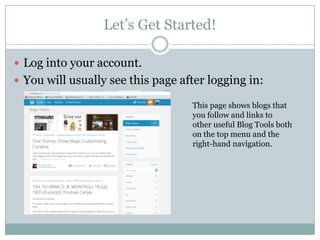
 You will usually see this page after logging in:
This page shows blogs that
you follow and links to
other useful Blog Tools both
on the top menu and the
right-hand navigation.
Let’s Get Started!
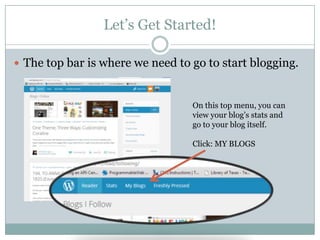
 The top bar is where we need to go to start blogging.
On this top menu, you can
view your blog’s stats and
go to your blog itself.
Click: MY BLOGS
Let’s Get Started!
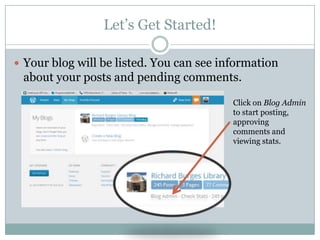
 Your blog will be listed. You can see information
about your posts and pending comments.
Click on Blog Admin
to start posting,
approving
comments and
viewing stats.
The Dashboard
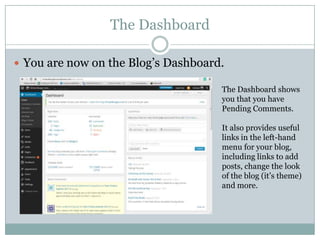
 You are now on the Blog’s Dashboard.
The Dashboard shows
you that you have
Pending Comments.
It also provides useful
links in the left-hand
menu for your blog,
including links to add
posts, change the look
of the blog (it’s theme)
and more.
The Dashboard
 Let’s check out those comments first.
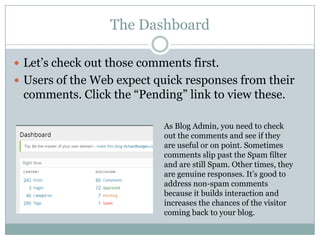
 Users of the Web expect quick responses from their
comments. Click the “Pending” link to view these.
As Blog Admin, you need to check
out the comments and see if they
are useful or on point. Sometimes
comments slip past the Spam filter
and are still Spam. Other times, they
are genuine responses. It’s good to
address non-spam comments
because it builds interaction and
increases the chances of the visitor
coming back to your blog.
Blog Comments
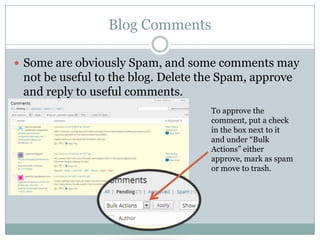
 Some are obviously Spam, and some comments may
not be useful to the blog. Delete the Spam, approve
and reply to useful comments.
To approve the
comment, put a check
in the box next to it
and under “Bulk
Actions” either
approve, mark as spam
or move to trash.
Adding Posts
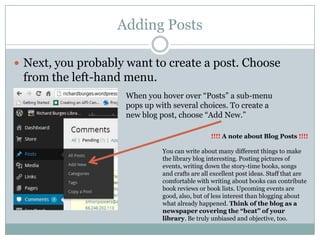
 Next, you probably want to create a post. Choose
from the left-hand menu.
When you hover over “Posts” a sub-menu
pops up with several choices. To create a
new blog post, choose “Add New.”
!!!! A note about Blog Posts !!!!
You can write about many different things to make
the library blog interesting. Posting pictures of
events, writing down the story-time books, songs
and crafts are all excellent post ideas. Staff that are
comfortable with writing about books can contribute
book reviews or book lists. Upcoming events are
good, also, but of less interest than blogging about
what already happened. Think of the blog as a
newspaper covering the “beat” of your
library. Be truly unbiased and objective, too.
Adding Posts
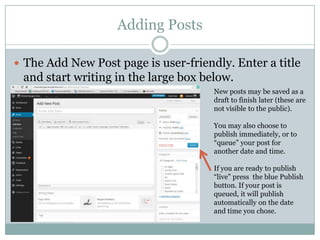
 The Add New Post page is user-friendly. Enter a title
and start writing in the large box below.
New posts may be saved as a
draft to finish later (these are
not visible to the public).
You may also choose to
publish immediately, or to
“queue” your post for
another date and time.
If you are ready to publish
“live” press the blue Publish
button. If your post is
queued, it will publish
automatically on the date
and time you chose.
Adding Posts
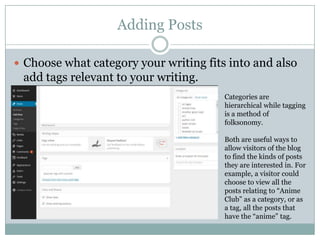
 Choose what category your writing fits into and also
add tags relevant to your writing.
Categories are
hierarchical while tagging
is a method of
folksonomy.
Both are useful ways to
allow visitors of the blog
to find the kinds of posts
they are interested in. For
example, a visitor could
choose to view all the
posts relating to “Anime
Club” as a category, or as
a tag, all the posts that
have the “anime” tag.
Adding Posts
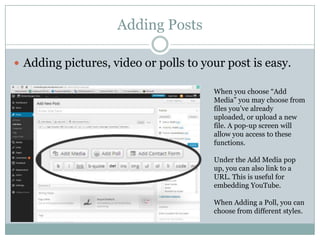
 Adding pictures, video or polls to your post is easy.
When you choose “Add
Media” you may choose from
files you’ve already
uploaded, or upload a new
file. A pop-up screen will
allow you access to these
functions.
Under the Add Media pop
up, you can also link to a
URL. This is useful for
embedding YouTube.
When Adding a Poll, you can
choose from different styles.
Adding Media
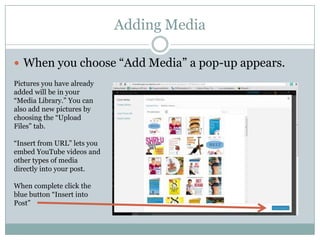
 When you choose “Add Media” a pop-up appears.
Pictures you have already
added will be in your
“Media Library.” You can
also add new pictures by
choosing the “Upload
Files” tab.
“Insert from URL” lets you
embed YouTube videos and
other types of media
directly into your post.
When complete click the
blue button “Insert into
Post”
Editing Posts
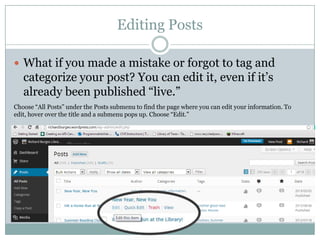
 What if you made a mistake or forgot to tag and
categorize your post? You can edit it, even if it’s
already been published “live.”
Choose “All Posts” under the Posts submenu to find the page where you can edit your information. To
edit, hover over the title and a submenu pops up. Choose “Edit.”
Editing Posts
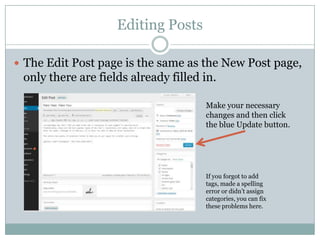
 The Edit Post page is the same as the New Post page,
only there are fields already filled in.
Make your necessary
changes and then click
the blue Update button.
If you forgot to add
tags, made a spelling
error or didn’t assign
categories, you can fix
these problems here.
Now you know the basics!
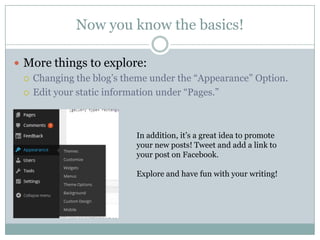
 More things to explore:
 Changing the blog’s theme under the “Appearance” Option.
 Edit your static information under “Pages.”
In addition, it’s a great idea to promote
your new posts! Tweet and add a link to
your post on Facebook.
Explore and have fun with your writing!

Using wordpress

  • 1.
    L I BR A R Y B L O G G I N G A T E P P L A U G U S T 2 0 1 3 Using Wordpress
  • 2.
    Let’s Get Started! Log into your account.  You will usually see this page after logging in: This page shows blogs that you follow and links to other useful Blog Tools both on the top menu and the right-hand navigation.
  • 3.
    Let’s Get Started! The top bar is where we need to go to start blogging. On this top menu, you can view your blog’s stats and go to your blog itself. Click: MY BLOGS
  • 4.
    Let’s Get Started! Your blog will be listed. You can see information about your posts and pending comments. Click on Blog Admin to start posting, approving comments and viewing stats.
  • 5.
    The Dashboard  Youare now on the Blog’s Dashboard. The Dashboard shows you that you have Pending Comments. It also provides useful links in the left-hand menu for your blog, including links to add posts, change the look of the blog (it’s theme) and more.
  • 6.
    The Dashboard  Let’scheck out those comments first.  Users of the Web expect quick responses from their comments. Click the “Pending” link to view these. As Blog Admin, you need to check out the comments and see if they are useful or on point. Sometimes comments slip past the Spam filter and are still Spam. Other times, they are genuine responses. It’s good to address non-spam comments because it builds interaction and increases the chances of the visitor coming back to your blog.
  • 7.
    Blog Comments  Someare obviously Spam, and some comments may not be useful to the blog. Delete the Spam, approve and reply to useful comments. To approve the comment, put a check in the box next to it and under “Bulk Actions” either approve, mark as spam or move to trash.
  • 8.
    Adding Posts  Next,you probably want to create a post. Choose from the left-hand menu. When you hover over “Posts” a sub-menu pops up with several choices. To create a new blog post, choose “Add New.” !!!! A note about Blog Posts !!!! You can write about many different things to make the library blog interesting. Posting pictures of events, writing down the story-time books, songs and crafts are all excellent post ideas. Staff that are comfortable with writing about books can contribute book reviews or book lists. Upcoming events are good, also, but of less interest than blogging about what already happened. Think of the blog as a newspaper covering the “beat” of your library. Be truly unbiased and objective, too.
  • 9.
    Adding Posts  TheAdd New Post page is user-friendly. Enter a title and start writing in the large box below. New posts may be saved as a draft to finish later (these are not visible to the public). You may also choose to publish immediately, or to “queue” your post for another date and time. If you are ready to publish “live” press the blue Publish button. If your post is queued, it will publish automatically on the date and time you chose.
  • 10.
    Adding Posts  Choosewhat category your writing fits into and also add tags relevant to your writing. Categories are hierarchical while tagging is a method of folksonomy. Both are useful ways to allow visitors of the blog to find the kinds of posts they are interested in. For example, a visitor could choose to view all the posts relating to “Anime Club” as a category, or as a tag, all the posts that have the “anime” tag.
  • 11.
    Adding Posts  Addingpictures, video or polls to your post is easy. When you choose “Add Media” you may choose from files you’ve already uploaded, or upload a new file. A pop-up screen will allow you access to these functions. Under the Add Media pop up, you can also link to a URL. This is useful for embedding YouTube. When Adding a Poll, you can choose from different styles.
  • 12.
    Adding Media  Whenyou choose “Add Media” a pop-up appears. Pictures you have already added will be in your “Media Library.” You can also add new pictures by choosing the “Upload Files” tab. “Insert from URL” lets you embed YouTube videos and other types of media directly into your post. When complete click the blue button “Insert into Post”
  • 13.
    Editing Posts  Whatif you made a mistake or forgot to tag and categorize your post? You can edit it, even if it’s already been published “live.” Choose “All Posts” under the Posts submenu to find the page where you can edit your information. To edit, hover over the title and a submenu pops up. Choose “Edit.”
  • 14.
    Editing Posts  TheEdit Post page is the same as the New Post page, only there are fields already filled in. Make your necessary changes and then click the blue Update button. If you forgot to add tags, made a spelling error or didn’t assign categories, you can fix these problems here.
  • 15.
    Now you knowthe basics!  More things to explore:  Changing the blog’s theme under the “Appearance” Option.  Edit your static information under “Pages.” In addition, it’s a great idea to promote your new posts! Tweet and add a link to your post on Facebook. Explore and have fun with your writing!