International Journal of Evaluation and Research in Education (IJERE)
Vol. 13, No. 6, December 2024, pp. 4409~4419
ISSN: 2252-8822, DOI: 10.11591/ijere.v13i6.28148  4409
Journal homepage: http://ijere.iaescore.com
Virtual reality technologies for learning English: an example of
using Immerse
Olga Lobanova1
, Elena Fedorova2
, Alena Vobolevich3
, Polina Minakova4
, Lyudmila Rybakova5
1
Department of Physical Education, I. M. Sechenov First Moscow State Medical University, Moscow, Russian Federation
2
Department of Foreign Languages for the Humanities, North-Eastern Federal University, Yakutsk, Russian Federation
3
Department of Foreign Languages, Peoples Friendship University of Russia (RUDN University), Moscow, Russian Federation
4
English Language Academic Department, Far Eastern Federal University, Vladivostok, Russian Federation
5
Foreign Languages for Technology Specialties, Moscow Aviation Institute (National Research University), Moscow,
Russian Federation
Article Info ABSTRACT
Article history:
Received Jul 25, 2023
Revised Apr 23, 2024
Accepted May 7, 2024
This study aims to examine the effectiveness of using the Immerse virtual
reality technology as an additional tool for learning English. The sample
consisted of 120 students randomly selected from the lists of third-year
students studying English as a foreign language according to their bachelor’s
degree curriculum. The overall sample was divided into two groups. Immerse
was a virtual reality technology used for training in an experimental group for
three months. The results showed that in the experimental group, there was a
significant difference between the pre-test and the post-test (0.35<0.05). In
the control group, there were no relevant changes. In particular, these data
show that the experimental group significantly outperformed the control
group in terms of academic performance in English. However, some of the
tasks that tested writing skills showed unsatisfactory results. In general,
although virtual reality (VR) does not affect students’ writing skills, its use is
crucial for their long-term memorization.
Keywords:
Academic performance
English learning
Immersive technologies
Technology utilization
Virtual objects
This is an open access article under the CC BY-SA license.
Corresponding Author:
Elena Fedorova
Department of Foreign Languages for the Humanities, North-Eastern Federal University
58 Belinsky str., Yakutsk-677000, Russian Federation
Email: elenafedorova666@rambler.ru, ep.fedorova@s-vfu.ru
1. INTRODUCTION
Teaching and learning have moved forward and replaced pen and paper with information
communications and technology [1]. This transition facilitated the process of transferring knowledge and skills
to students [2]. The modern use of immersive technologies in the field of education has proven its effectiveness
in the study of various subjects. Virtual reality and augmented reality are examples of these new technologies
that provide opportunities to advance lifelong learning [3]. Virtual reality (VR) is defined as a real or simulated
environment where the perceiver experiences telepresence. Augmented reality (AR) is often referred to as a
useful educational technology that can be integrated into lessons to overcome the disadvantages of traditional
teaching (such as the lack of visualization of abstract learning content, low involvement and interest of students
in classes, insufficient understanding of complex topics) [4]. Mobile applications with augmented reality mode
can potentially apply to interactive, mixed/hybrid, and face-to-face learning. These forms of learning are
especially important during emergencies.
To reproduce or create a realistic learning environment, virtual reality generates images, sounds, and
other experiences [5]. VR has several distinctive characteristics, including the representation of three-
dimensional images, virtual objects that simulate real-world behavior, and interactive features that allow users
 ISSN: 2252-8822
Int J Eval & Res Educ, Vol. 13, No. 6, December 2024: 4409-4419
4410
to interact with the virtual environment [6]. As an educational and training tool, virtual reality is used to
simulate the interaction of objects and visualize complex concepts. A virtual reality experience spans a variety
of platforms, from smartphones to headset-based options such as Google Cardboard, Samsung Gear VR, and
desktop systems with mounted monitors (HTC Vive, Oculus Rift, and Sony PlayStation VR) [7]. In addition,
three-dimensional virtual environments can be accessed on both desktop and mobile devices, eliminating the
need for a virtual reality headset (Second Life or Unity 3D) [8].
Since virtual reality is considered to be a very promising technology for both computer training and
modeling, it is widely used in numerous applications. Its highly interactive environment allows users to
participate in a computer-generated world where they can interact with various stimuli [9]. Currently, most VR
applications require students to wear devices such as head-mounted displays (HMD), trackers, or sensors.
These devices have several disadvantages. They are usually relatively expensive, heavy, and easily damaged.
In addition, systems that involve additional devices fail to appropriately determine the user settings [10].
However, desktop VR applications imply a lower level of immersion, which can be a problem. User interaction
in this case requires the use of a chromakey (a blue or green screen). Another widely available VR solution is
desktop VR. Desktop VR is an even lower level of immersive VR that can be easily used in most applications
without any special device [11]. Desktop VR is usually considered the most inexpensive of all VR options, and
it is widely used in educational institutions.
The use of high-immersion virtual reality in education is constantly increasing. The growing demand
for advanced VR technology explains a need for a deeper understanding of VR-based learning and the theories
behind its use. In classrooms, this immersive technology is gaining popularity and success. Students are
motivated and interested in learning in VR thanks to an immersive and interactive environment.
2. LITERATURE REVIEW
The idea of VR originated in the mid-1960s. The research on VR as a learning tool is attracting more
and more attention in various fields of education and training, including teacher training [12] and language
learning [13]. VR allows users to experience the virtual environment as if it was real both in sensations and
appearance. The reason for the popularity of VR technology is its capability to interact with both real and
virtual objects, facilitating learning through experience. This feature increases learners’ attention and
motivation. VR applications are used in several education sectors for early learning and primary school when
teaching English in other countries [14], [15]. Studies have proven that the ability to use VR applications
increases students’ motivation and contributes to a more favorable attitude to learning English. If technology
is easy to master and apply, students are more likely to favor it.
Among the various options, VR with video capture provides a higher level of immersion at a low cost.
Due to the low price and the growing popularity of video cameras, researchers use them in combination with
computer vision technology to develop applications [16]. In addition, some computer game developers have
released games that allow users to physically control the interaction (for example, Nintendo’s Wii and Sony’s
EyeToy). However, games of this type focus on entertainment, not learning. Although the use of VR with video
capture is growing, there are still few applications devoted to language learning [17]. None of the above-
mentioned systems offers educational tasks designed with integrated educational content. Therefore, teachers
do not have the opportunity to include relevant educational materials in the systems.
At the same time, most systems require the use of professional video cameras. Depending on the stage
of VR development, it has many definitions and categories. VR has been described as a real or simulated
environment allowing the perceiver to experience telepresence. Another definition indicates that it is a
computer-generated 360° virtual space that can be perceived as spatially realistic due to the high immersion
provided by a head-mounted device [18]. In general, VR technologies can be divided into two categories: VR
with a low level of immersion, which is viewed on a two-dimensional flat screen; and VR with a high level of
immersion, which requires the user to wear a head-mounted VR headset. The degree of immersion and presence
are the features that distinguish the two types of VR. VR headsets help disconnect from the outside world to
fully immerse in virtual reality [19]. In addition, the touch input embedded in the VR headset improves
immersion and presence. Although VR can be a useful tool, it cannot replace real communication and personal
language practice. VR can serve as a complement to traditional teaching methods, providing an exciting and
relevant experience that improves language learning. VR and AR support constructivist learning principles.
Consequently, students who use VR and AR can process and manage various learning-related activities [20].
Thus, students have full control over the time and place of studying; for example, they can change the pace of
their movement in a VR environment. There is also an opportunity to communicate with friends via the network
and perform any necessary action after communication.
On the other hand, several studies based on virtual reality have also presented some opposite
conclusions. The studies provided evidence that virtual reality may negatively affect learning outcomes.
Int J Eval & Res Educ ISSN: 2252-8822 
Virtual reality technologies for learning English: an example of using Immerse (Olga Lobanova)
4411
High levels of immersion and presence shift the focus from the educational aspect of learning. The negative
impact of virtual reality was noticed in various academic subjects, including STEM [21], history [22], and
language learning [23]. In most (7 out of 11) studies, students who used desktop learning environments
demonstrated higher learning outcomes compared to students who used virtual reality with a high level of
immersion [22]. As an example, students learning vocabulary with a VR headset had significantly lower scores
compared to those participants who used a less immersive desktop version of VR [24].
Scholars also identified the factors that significantly affect the success of technology integration.
These factors include the opinions of students and teachers; institutional support; obstacles to integration;
justification for integration; past technological experience. Therefore, it is extremely important to study the
attitude of end users at the early stages of VR technology integration [25]. Virtual reality is able to ‘trick’
consumers into believing that they are inside a virtual experience, allowing them to fully immerse themselves
in virtual reality material. From a pedagogical point of view, VR should serve as a potentially fascinating
platform to complement classroom learning, which is often associated with relatively low engagement [26].
A high level of immersion and presence are variables leading to high engagement.
The advent of virtual reality technology has not only increased the integration and application of
technology but also brought a new model of teaching English, introducing the concept of learning games that
attract students. The technology was presented as a new form of media, consisting of virtual experiments on
learning English, training skills, the interactive use of virtual reality scenes or images, and the full mobilization
of educational initiative and creativity of students [27]. The use of technology can activate cognitive tools and
make conscious learning possible. Thus, VR technologies can improve the ability to perceive information,
especially in the case of learning abstract concepts [28]. In addition, VR reduces cognitive load due to the sense
of reality and immersion, thereby increasing the ability to conceptualize and learn information.
Virtual reality is a visual experience that stands out for its element of ‘reality’ and a sense of
immersion. As a learning tool, it offers excellent opportunities to improve learning efficiency [29]. One of the
advantages related to VR-based training is an expanded spatial knowledge of visual stimuli. This feature
implies the opportunity to interact with images in a way that is impossible when viewing conventional 2D
formats. Second, virtual reality enables users to perform tasks that would be impossible to complete in real-
world conditions [30]. Third, increased motivation and engagement contribute to the high motivation of
students to learn and participate in educational activities. Contextualized learning is another concept that
assumes the introduction of information in a context that is appropriate for students. Finally, VR facilitates
effective collaborative learning and allows students to interact in scenarios that imitate real life [31]. The
language learning aspect of VR requires considerable research and development. Long-term forecasts for the
use of virtual reality in language learning and teaching are sufficiently positive. However, the VR-based
assessment of language learning skills is still imperfect.
This study aims to examine the effectiveness of using VR technologies as an additional tool for
learning English. To this end, it was necessary to accomplish the following tasks: i) Collect data from students
about their awareness and experience with virtual reality technologies in an educational context; ii) Evaluate
and analyze the effectiveness of this tool based on the participants' English language proficiency indicators.
3. METHOD
3.1. Research design
To achieve the objective of the study, the authors conducted two-stage action research [32]. This type
of research uses an interactive methodology, including the definition of the problem, planning of actions,
implementation of the plan, and evaluation of results. In this study, the first stage (cycle) was the design stage,
which included the selection of materials and concepts for the game. After the training system and modules
were planned and developed, the implementation stage was held. At this stage, the authors carried out a pilot
study, which indicated the need to change the training materials. In the second cycle, the researchers performed
experiments and used upgraded materials to evaluate and analyze the students' learning experience based on
virtual reality. Based on the results of the first cycle, the planning of the second cycle implied changing the
action plan and conducting additional research (questionnaires, testing, descriptive statistical analysis of the
average score). These methods served as the basis for obtaining qualitative and quantitative results.
The participants (students) took an educational course that lasted 3 months. The course implied
completing tasks with a virtual reality application. To this end, students were asked to use Immerse in the
classroom. This platform had been insufficiently studied before. The researchers chose Immerse since its VR
learning environment with video capture did not require an avatar to interact with objects on the screen. This
peculiarity distinguished it from traditional VR environments that require wearing heavy and expensive
sensors. In addition, the platform is easy to use. It also provides an immersive language learning experience,
allowing students to practice their English language skills by interacting with the virtual environment and
engaging in conversations with virtual characters or other language learners. Immerse offers a range of
 ISSN: 2252-8822
Int J Eval & Res Educ, Vol. 13, No. 6, December 2024: 4409-4419
4412
materials and exercises for language learning to expand vocabulary, listening, speaking, and understanding of
culture. At the same time, Immerse is the first synchronous platform for teaching and learning languages in
virtual reality, which has always given priority to long-term language interaction, rather than basic vocabulary
and listening comprehension [33]. The focus on this direction makes it possible to practice speaking and
listening skills in a more immersive and social context. Students could physically and naturally interact with
virtual objects on the screen. The learning environment intended for the classroom must allow the teacher to
fulfill the requirements of the curriculum and easily edit educational materials. Immerse also coped with the task.
The methodology used to evaluate the effectiveness of teaching English corresponds to a quasi-
experimental design. After several consultations with an English teacher, it was possible to select the study
tasks that followed the curriculum. Classes with virtual reality technologies took place twice a week for three
months under the supervision of university teachers. Before that, a pre-test on general academic performance
in English was conducted in the classroom. The pre-test consisted of 30 open and closed assignments and
covered all the main areas of English learning. The same test with other tasks was conducted at the end of the
experiment. The tests included sections on listening, speaking, reading, and writing. The purpose of these tests
was to measure language skills based on the standards of language proficiency. The pre-test and post-test were
prepared based on the content of the training modules. A group of three independent experts in the field of
teaching English as a foreign language (TEFL) verified the validity of the tests.
3.2. Participants
The study involved a sample of 120 students aged 18 to 22 years. They studied at Far Eastern Federal
University and Moscow Aviation Institute. The study was conducted within two institutions, so the sample of
120 students is substantial and adequate, especially if it represents a significant proportion of students who are
ready for intervention [34]. Action research often relies more on qualitative data and descriptive statistics than
on sophisticated statistical analysis, so it was appropriate to use a small sample. The selection of participants
was random; the researchers used the lists of students provided by the university administrations. The selected
students voluntarily agreed to participate in the study. According to the inclusion criteria, all participants
studied English as a foreign language in the third year of their bachelor's degree program. The general sample
was randomly divided into two groups. The control group performed the traditional educational activities. The
experimental group studied using virtual reality technologies.
3.3. Survey
It was essential to assess whether students were ready to use the VR learning system. To this end, the
study utilized a questionnaire. The students received a link to this questionnaire and filled it out online. The
number of completed questionnaires was 120. There was a total of 10 questions.
i) Have you had any experience using virtual reality technologies during your university studies?
ii) Do you think VR has the potential to improve learning efficiency?
iii) Have you ever used VR for educational purposes outside of university?
iv) Do you think VR can provide a more engaging and immersive learning environment compared to
traditional methods?
v) Have you studied VR apps specifically designed for language learning?
vi) Are you aware of potential problems or limitations related to the use of VR in education?
vii) Do you think that VR technology is expensive and difficult to implement in an educational environment?
viii)Have you witnessed the use of VR in education?
ix) Do you think VR will become a more common learning tool in the future?
x) Do you believe that VR can effectively improve your English skills?
The survey covered the use of technology in general and in education, in particular, the perception of
VR as a means of learning, and knowledge in the field of VR. The questions were compiled by a group of
teachers and approved by the university administration. After passing the online tests, the experimental group
had to fill out the second questionnaire with five statements. It helped to analyze the participants' involvement
in learning new methods and their effectiveness for students.
3.4. Statistical processing
This study used Cronbach’s alpha (a) to assess the reliability of the data obtained. The SPSS version
25 program served as a computational tool. A scale for interpreting Cronbach’s alpha values was: >0.9
(Excellent); >0.8 (Very good); 0.7 (Satisfactory); 0.6 (Unsatisfactory); >0.5 (Poor). Thus, the validity of the
questionnaire revealed an acceptable value of Cronbach’s alpha (a=0.88). The study also employed the
descriptive statistical analysis of the average score (Mean) and standard deviation (SD) tests of achievements
in English language learning. Nonparametric tests served as tools for the analysis of the data since the sample
size was small. To compare the success of students in learning English between the pre-test and post-test in
two groups, the study utilized the Wilcoxon signed-rank test.
Int J Eval & Res Educ ISSN: 2252-8822 
Virtual reality technologies for learning English: an example of using Immerse (Olga Lobanova)
4413
3.5. Research limitations and ethical issues
The study was limited to a small sample of participants. In addition, the experiment involved only
university students. The experiments with younger students might have had different results. Only one
technology was used to assess students' knowledge. A long-term study may use a bigger number of virtual
reality applications and materials. All the processes of the study that involved the participation of people
corresponded to the ethical standards of research. Informed consent was obtained from all participants in this
study. Ethical standards were not violated.
4. RESULTS AND DISCUSSION
The survey conducted in the first stage of the study showed that only 5% of the total number of
students had experience working with VR tools during their studies at the university. Most students had not
personally used VR technology before. However, they believed in its effectiveness and wanted to try it for
educational purposes. This fact indicates a great interest and openness to the introduction of VR into their
English language learning program. Table 1 presents the results.
Table 1. The results of the survey on the experience of using virtual reality
Question Yes (%) No (%)
1. Have you had any experience using virtual reality technologies during your university studies? 5% 95%
2. Do you think VR has the potential to improve learning efficiency? 95% 5%
3. Have you ever used VR for educational purposes outside of university? 5% 95%
4. Do you think VR can provide a more engaging and immersive learning environment compared to
traditional methods?
94% 6%
5. Have you studied VR apps specifically designed for language learning? 1% 2%
6. Are you aware of potential problems or limitations related to the use of VR in education? 3% 97%
7. Do you think that VR technology is expensive and difficult to implement in an educational environment? 61% 39%
8. Have you witnessed the use of VR in education? 7% 93%
9. Do you think VR will become a more common learning tool in the future? 99% 1%
10. Do you believe that VR can effectively improve your English skills? 91% 9%
According to the results, most students expressed faith in the potential of VR to improve learning
efficiency (95%). However, only a small percentage of students used VR for educational purposes outside the
university (5%). Similarly, a low percentage of students studied VR apps specifically designed for language
learning (1%). Regarding awareness of potential problems or limitations when using VR in education, 97% of
students indicated that they were not fully aware of these issues. The majority of students believed that VR
technology was expensive and difficult to implement in the educational environment (61%). However, a
significant number of students (93%) had witnessed the use of VR in education. Moreover, most students (99%)
believed that VR would become a more widespread learning tool in the future. In addition, 91% of students
claimed that VR could effectively improve their English language skills. These data confirm the need to
modernize teaching technologies for the benefit of students who keep up with new tools. The students also
shared their ideas about the development of different skills (reading, writing, listening, speaking, vocabulary)
with VR. The results showed that the students had a significant interest in testing VR methods. Almost all
participants were deprived of this experience. The above justified the use of the developed course in the
experimental group.
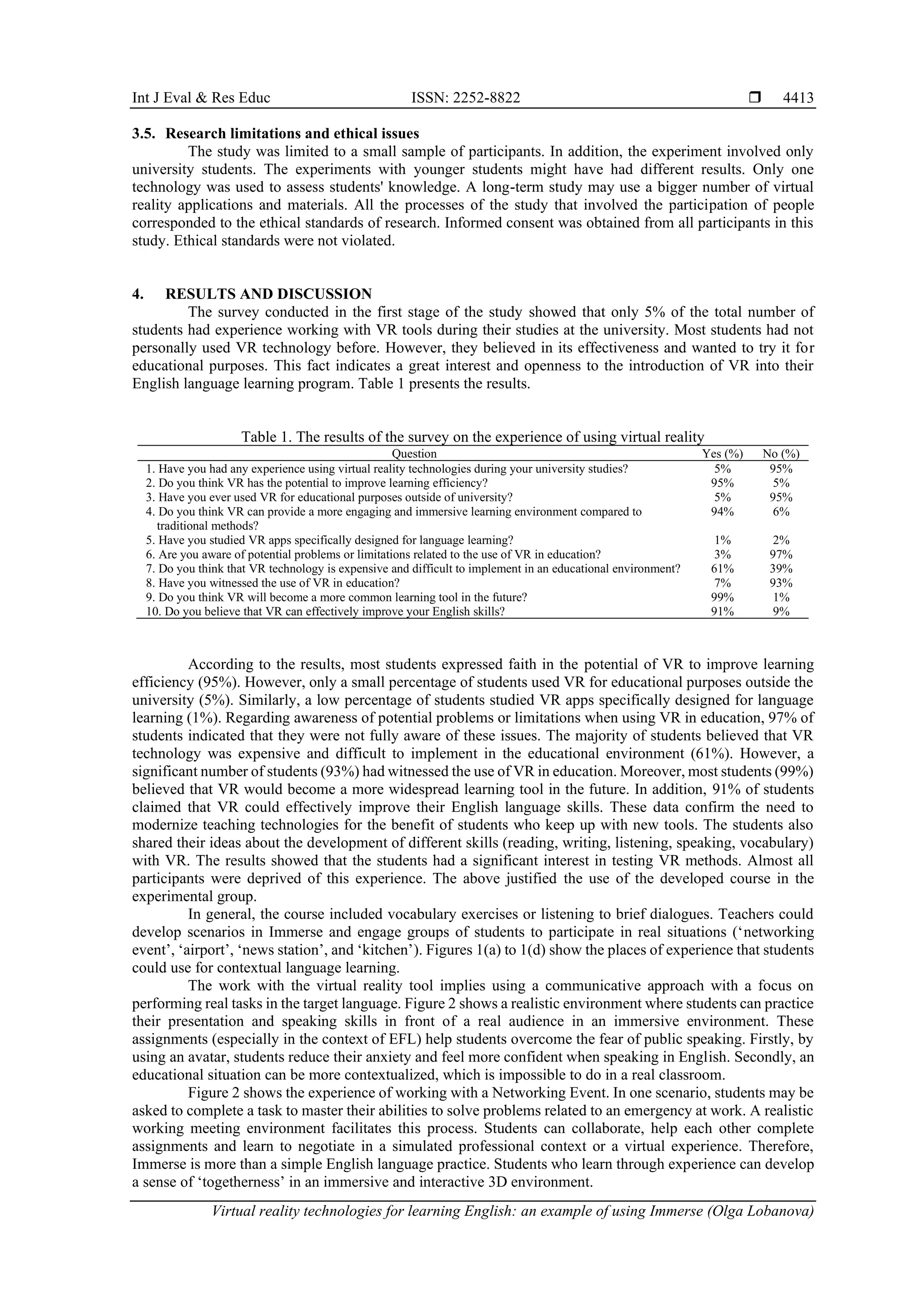
In general, the course included vocabulary exercises or listening to brief dialogues. Teachers could
develop scenarios in Immerse and engage groups of students to participate in real situations (‘networking
event’, ‘airport’, ‘news station’, and ‘kitchen’). Figures 1(a) to 1(d) show the places of experience that students
could use for contextual language learning.
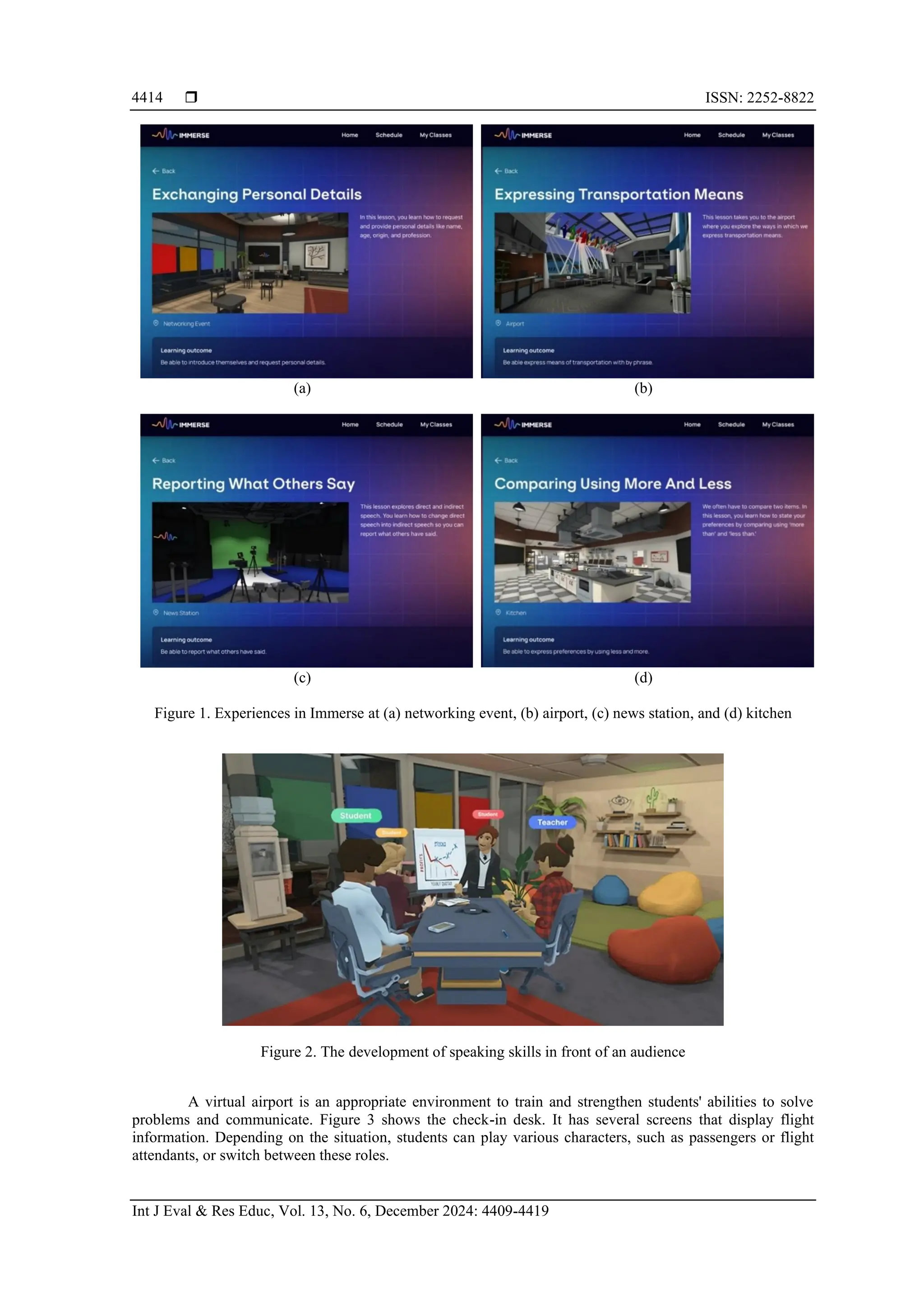
The work with the virtual reality tool implies using a communicative approach with a focus on
performing real tasks in the target language. Figure 2 shows a realistic environment where students can practice
their presentation and speaking skills in front of a real audience in an immersive environment. These
assignments (especially in the context of EFL) help students overcome the fear of public speaking. Firstly, by
using an avatar, students reduce their anxiety and feel more confident when speaking in English. Secondly, an
educational situation can be more contextualized, which is impossible to do in a real classroom.
Figure 2 shows the experience of working with a Networking Event. In one scenario, students may be
asked to complete a task to master their abilities to solve problems related to an emergency at work. A realistic
working meeting environment facilitates this process. Students can collaborate, help each other complete
assignments and learn to negotiate in a simulated professional context or a virtual experience. Therefore,
Immerse is more than a simple English language practice. Students who learn through experience can develop
a sense of ‘togetherness’ in an immersive and interactive 3D environment.
 ISSN: 2252-8822
Int J Eval & Res Educ, Vol. 13, No. 6, December 2024: 4409-4419
4414
(a) (b)
(c) (d)
Figure 1. Experiences in Immerse at (a) networking event, (b) airport, (c) news station, and (d) kitchen
Figure 2. The development of speaking skills in front of an audience
A virtual airport is an appropriate environment to train and strengthen students' abilities to solve
problems and communicate. Figure 3 shows the check-in desk. It has several screens that display flight
information. Depending on the situation, students can play various characters, such as passengers or flight
attendants, or switch between these roles.
Int J Eval & Res Educ ISSN: 2252-8822 
Virtual reality technologies for learning English: an example of using Immerse (Olga Lobanova)
4415
Figure 3. The development of speaking skills in an airport environment
The work with the proposed virtual reality technology allowed us to gain enough experience and
knowledge to improve the learning process, as well as to objectively assess the application in the questionnaire.
Thus, the results of statistical analysis of the pre-test and post-test showed that in the experimental group, there
was a significant difference between the pre-test and the post-test (0.35<0.05). On the contrary, the results of
the control group did not change. To interpret the results, the test statistic value (0.35) was compared with the
critical value that corresponded to the significance level (0.05). The value of the test statistics is lower than the
critical value. Therefore, there is a significant difference between the two related samples. These data show
that the experimental group significantly outperformed the control group in terms of academic performance in
English. However, some results of writing tasks showed unsatisfactory results. VR did not have a significant
impact on the quality of writing in English. Thus, students in the control group showed better results in
traditional writing. Their result was 9.5 in comparison with the indicator 7.1 of the experimental group. In
general, although VR does not affect writing skills, it positively impacts long-term memorization.
After completing the online tests, the experimental group had to fill out questionnaires that helped
scientists analyze the participants' involvement in learning new methods and their effectiveness for students.
This stage aimed to investigate students' opinions about their disappointments and expectations regarding VR.
The following are the questions from the questionnaire and the received answers.
i) The answers of students and the results of tests on the general level of English show that virtual reality
technologies mainly improve pronunciation and speaking skills. ‘Was it useful to study this course and
simultaneously train pronunciation and speaking skills?’. The answers to this question were very useful
(32%); useful (60%); useless (8%).
ii) The second question was as: ‘Was it interesting to learn using innovative methods?’; very interesting
(18%); interesting (69%); not interesting at all (13%).
iii) ‘Is the game environment close to reality?’ the students gave the following answers: very close to reality
(88%); quite real (2%); far from reality (10%).
These answers confirm the conclusion about the perception of the interface and the various types of
‘experience’ presented by VR technology. Users appreciate its high quality and design that mimics real-life
situations and settings. These features considerably simplify language learning.
iv) The questionnaire also contained the following statement ‘VR has made my writing more effective’. Only
20% completely agreed with it, 25% partially agreed and 45% disagreed with the statement.
v) Nevertheless, another statement (‘VR made my speaking skills more effective’) resulted in the opposite
answers. In this case, 80% of students completely agreed with the statement, 11% partially agreed, and
9% did not agree with it at all.
The results of the post-test confirmed these conclusions: there was an improvement in speaking and listening
skills. These data made it possible to determine the level of student engagement. Thus, it was 71.5%, which is
a fairly high indicator of variance. The standard error was 3.1.
According to the action research, the authors compiled a model of an English course based on virtual
reality (the Immerse platform). There is a brief description of the course: i) Lessons in the classroom twice a
week under the guidance of a teacher; ii) Each lesson focuses on immersion (group or individual) in a virtual
environment selected by the teacher in advance. The set of virtual environments includes real situations in
‘A networking event’, ‘An airport’, ‘A news station’, and ‘A kitchen’; iii) The tasks mainly aim to develop
 ISSN: 2252-8822
Int J Eval & Res Educ, Vol. 13, No. 6, December 2024: 4409-4419
4416
skills in speaking, public speech, vocabulary memorization, and listening skills. Writing is involved to a lesser
extent, and the results in this area are not particularly productive; iv) The students’ engagement depends on a
realistic interactive environment. In this case, the teacher is only a curator in this process.
Hence, virtual reality can be a highly effective tool for learning English as a second language. By
immersing students in a virtual environment, VR provides a realistic and engaging platform for practicing and
improving language skills. The following are several VR advantages in terms of improving the learning process
of the experimental group:
i) Immersion in the language environment. VR can simulate real-world scenarios, such as ordering food at a
restaurant or participating in a job interview. In these scenarios, students can interact with virtual characters
or objects. This immersive experience allowed the experimental group to practice their English language
skills contextually.
ii) The practice of pronunciation and colloquial speech. VR technologies offered speech recognition
functions, providing instant feedback on pronunciation and intonation. Students communicated with
virtual characters or participated in language exercises, receiving immediate comments and
recommendations for improving conversational skills.
iii) Language learning that goes beyond grammar and vocabulary. VR transported students to various cultural
environments, allowing them to get acquainted with the customs, traditions, and social norms of English-
speaking countries. The cultural context helped develop a deeper understanding of the language and its
content, Improving the results of the control tests.
iv) Virtual reality has made the language learning process more enjoyable and motivating through
gamification. By integrating such game elements as rewards, challenges, and levels, VR apps engaged
students and kept them interested throughout the experiment. The gamified approach encouraged active
participation and facilitated the memorization of new words.
v) It is crucial to develop students' computational thinking, as well as increase their ability to work in a team,
make accurate decisions, and deploy arguments. This is especially true for English language courses that
encourage the study of culture, original thinking, and oral speech.
The above supports the conclusion about the efficiency of VR apps, which can improve language learning.
Nonetheless, this technology should not replace traditional language learning methods. VR is more effective
as an additional tool for classroom teaching, textbooks, and real language practice.
Immerse as an educational program has also been studied in the context of ESP. Several similar studies
have investigated other technologies, but they present controversial results. In one of these studies, the PILE
interactive learning environment was developed by integrating virtual reality technology with video capture
into the classroom [35]. The system aimed at English lessons in elementary school, where students could
interact with the system through physical movements. To study the effect of using the PILE system, the
researchers conducted an empirical study to compare two different types of methods of teaching English. The
research sample consisted of second-grade students from a Taiwanese school. The results of the pre-test and
the post-test showed a significant a considerable improvement in English language performance in the
experimental group. Another test conducted after the end of the study demonstrated considerable differences
between the two groups. These results indicate that the system has had a significant positive impact on long-
term learning [36]. In comparison with Immerse, PILE is effective only in long-term training. It also requires
the use of expensive sensors, which are a necessary tool for the operation of this system. Immerse is more
beneficial in this case: it is free and effective even in a short period of training. The results of the current study
are comparable to the above-mentioned ones. It is possible to note a significant difference between the pre-test
and post-test results (p-value=0.35<0.05). This fact indicates a significant improvement in the level of English
proficiency in the experimental group compared to the control group. VR has a more gamified form, which is
interesting for both schoolchildren and university students.
A qualitative case study conducted in Malaysia examined the prospects of using AR and VR in
teaching and learning English by secondary school teachers [37]. The study demonstrated both positive and
negative opinions about the use of AR and VR in English language teaching and learning activities. Negative
aspects were time costs and health-related issues. The findings confirm that virtual reality systems may be
harmful to students and their health [38]. Another study suggests an SVVR approach to solve this problem
[39]. To assess the effectiveness of the proposed methodology, the authors performed a quasi-experiment. The
results showed that EFL students who used the ASS-SVVR method demonstrated high reading comprehension,
intrinsic motivation to learn, and metacognitive awareness of the reading strategy. Immerse also improves
reading skills rather than writing. There was no significant difference between the two groups in terms of
cognitive load or sense of presence.
In another study, researchers developed an approach of co-drafting an argument scheme based on
virtual reality [40]. The quasi-experiment involved 45 EFL students. The results showed that in comparison
with the non-VR strategy of joint argument drafting, the method of joint argument drafting based on virtual
Int J Eval & Res Educ ISSN: 2252-8822 
Virtual reality technologies for learning English: an example of using Immerse (Olga Lobanova)
4417
reality (VR-CAM) significantly improved the oral presentations of students in English. Although the VR-CAM
group was superior to the non-VR-CAM group regarding interest in studying culture, there was no noticeable
difference between the two groups. In addition, students who studied with VR-CAM eventually surpassed
those who studied without it in terms of computational and creative thinking. Another study of VR technology
aimed to examine their impact on the development of EFL writing skills [41]. It used a consistent research
mixed methodology: qualitative data were first analyzed and then synchronized with quantitative results.
According to the results, most participants believed that VR provided the greatest benefit in acquiring listening
skills. This conclusion is consistent with the results of the current study. Participants showed a slight
improvement in writing skills only when they received information using VR for writing purposes. The
students were satisfied with the VR experience and found it surreal in terms of the learning environment.
5. CONCLUSION
The results of this study shed light on the effectiveness of integrating Immerse virtual reality
technology as an additional English language learning tool among third-year English as a Foreign Language
students. The results showed that only 5% of students had previously had experience with VR tools while
studying at the university. Given the level of English proficiency in the experimental group, we can note a
significant difference between the pre-test and post-test results (p-value=0.35<0.05). To interpret the results,
the test statistic value (0.35) was compared with the critical value corresponding to the significance level (0.05).
The value of the test statistics is lower than the critical value. It indicates a significant difference between the
two related samples. In particular, these data show that the experimental group significantly outperformed the
control group in terms of academic performance in English. However, it should be noted that VR did not have
a significant impact on the level of writing in English: the control group outperformed the experimental group
in traditional writing tasks. In general, the findings show that virtual reality technology can be very effective
in improving pronunciation and conversational skills when learning a language. It provides an exciting and
engaging platform for working out real-world scenarios and receiving instant feedback. This work
complements the practical and theoretical knowledge bases as it has developed and tested a practical English
language learning course using VR technologies. It offers practical insights into the effectiveness of using VR
technology in improving English language skills, and its design and research findings can inform future
research and educational practice. However, there is a need for further research in this direction. Future studies
may address the limitations and explore additional language learning aspects affected by VR (for instance,
writing skills). This study will be a useful reference base for designing and implementing VR in any
pedagogical program as an additional educational technology. Further research on this topic may focus on
creating courses for different age groups and other language skills, such as speaking, listening, and reading.
REFERENCES
[1] A. Kintonova, I. F. Povkhan, A. Sabitov, A. Tokkuliyeva, and N. Demidchik, “Online learning technologies,” in 2022 IEEE 7th
International Energy Conference (ENERGYCON), May 2022, pp. 1–8. doi: 10.1109/ENERGYCON53164.2022.9830387.
[2] A. M. Alkaabi, A. K. Abdallah, H. R. I. Badwy, H. R. I. Badawy, and S. A. Almammari, “Rethinking school principals leadership
practices for an effective and inclusive education,” in Rethinking Inclusion and Transformation in Special Education, 2022, pp. 53–
70. doi: 10.4018/978-1-6684-4680-5.ch004.
[3] S. Kauppi, H. Muukkonen, T. Suorsa, and M. Takala, “I still miss human contact, but this is more flexible—Paradoxes in virtual
learning interaction and multidisciplinary collaboration,” British Journal of Educational Technology, vol. 51, no. 4, pp. 1101–1116,
Jul. 2020, doi: 10.1111/bjet.12929.
[4] I. Stojšić, N. Ostojić, and J. Stanisavljević, “Students’ acceptance of mobile augmented reality applications in primary and secondary
biology education,” International Journal of Cognitive Research in Science, Engineering and Education (IJCRSEE), vol. 10, no. 3,
pp. 129–138, Dec. 2022, doi: 10.23947/2334-8496-2022-10-3-129-138.
[5] H. Halimah, V. Nurviyani, A. Saepulah, J. Helmie, R. W. Wandawati, and S. Mutiah, “Virtual reality-supported drilling strategy in
teaching English vocabulary to young learners,” Acitya: Journal of Teaching and Education, vol. 4, no. 1, pp. 88–100, Jan. 2022,
doi: 10.30650/ajte.v4i1.3195.
[6] K. C. Li and B. T. M. Wong, “A literature review of augmented reality, virtual reality, and mixed reality in language learning,”
International Journal of Mobile Learning and Organisation, vol. 15, no. 2, pp. 164–178, 2021, doi: 10.1504/IJMLO.2021.114516.
[7] A. van Leeuwen and J. Janssen, “A systematic review of teacher guidance during collaborative learning in primary and secondary
education,” Educational Research Review, vol. 27, pp. 71–89, Jun. 2019, doi: 10.1016/j.edurev.2019.02.001.
[8] M. Mulders, J. Buchner, and M. Kerres, “A framework for the use of immersive virtual reality in learning environments,”
International Journal of Emerging Technologies in Learning (iJET), vol. 15, no. 24, p. 208, 2020, doi: 10.3991/ijet.v15i24.16615.
[9] J. H. Bendeck Soto, D. C. Toro Ocampo, L. D. C. Beltrán Colon, and A. Valencia Oropesa, “Perceptions of ImmerseMe virtual
reality platform to improve English communicative skills in higher education,” International Journal of Interactive Mobile
Technologies (iJIM), vol. 14, no. 07, pp. 4–19, May 2020, doi: 10.3991/ijim.v14i07.12181.
[10] M. Alemi and S. Khatoony, “Virtual reality-assisted pronunciation training (VRAPT) for young EFL learners,” Teaching English
with Technology, vol. 20, no. 4, pp. 59–81, 2020.
[11] G. A. Alwafi, S. Almalki, M. Alrougi, M. Meccawy, and Z. Meccawy, “A social virtual reality mobile application for learning and
practicing English,” International Journal of Interactive Mobile Technologies (iJIM), vol. 16, no. 09, pp. 55–75, May 2022, doi:
10.3991/ijim.v16i09.28289.
 ISSN: 2252-8822
Int J Eval & Res Educ, Vol. 13, No. 6, December 2024: 4409-4419
4418
[12] L. Eutsler and C. S. Long, “Preservice teachers’ acceptance of virtual reality to plan science instruction,” Educational Technology
& Society, vol. 24, no. 2, pp. 28–43, 2021.
[13] I. S. Khukalenko, R. Kaplan-Rakowski, Y. An, and V. D. Iushina, “Teachers’ perceptions of using virtual reality technology in
classrooms: A large-scale survey,” Education and Information Technologies, vol. 27, no. 8, pp. 11591–11613, Sep. 2022, doi:
10.1007/s10639-022-11061-0.
[14] A. S. Azar and N. H. I. Tan, “The application of ICT techs (mobile-assisted language learning, gamification, and virtual reality) in
teaching English for secondary school students in Malaysia during COVID-19 pandemic,” Universal Journal of Educational
Research, vol. 8, no. 11C, pp. 55–63, Nov. 2020, doi: 10.13189/ujer.2020.082307.
[15] M. Kayumova, S. Xembayeva, N. Fominykh, N. Pfeifer, and K. Zumadirova, “The development of research activity with
schoolchildren,” World Journal on Educational Technology: Current Issues, vol. 14, no. 3, pp. 740–756, May 2022, doi:
10.18844/wjet.v14i3.7327.
[16] J. ChengChiang Chen and S. Kent, “Task engagement, learner motivation and avatar identities of struggling English language
learners in the 3D virtual world,” System, vol. 88, Feb. 2020, doi: 10.1016/j.system.2019.102168.
[17] A. Berns and S. Reyes Sánchez, “A Review of Virtual Reality-Based Language Learning Apps,” RIED. Revista Iberoamericana de
Educación a Distancia, vol. 24, no. 1, pp. 159–177, Sep. 2020, doi: 10.5944/ried.24.1.27486.
[18] Y.-J. Lan, “Immersion into virtual reality for language learning,” in Psychology of Learning and Motivation, 2020, pp. 1–26. doi:
10.1016/bs.plm.2020.03.001.
[19] L. Ma, “An immersive context teaching method for college English based on artificial intelligence and machine learning in virtual
reality technology,” Mobile Information Systems, vol. 2021, pp. 1–7, Aug. 2021, doi: 10.1155/2021/2637439.
[20] N. Alalwan, L. Cheng, H. Al-Samarraie, R. Yousef, A. Ibrahim Alzahrani, and S. M. Sarsam, “Challenges and prospects of virtual
reality and augmented reality utilization among primary school teachers: A developing country perspective,” Studies in Educational
Evaluation, vol. 66, Sep. 2020, doi: 10.1016/j.stueduc.2020.100876.
[21] C. Chen, H. Hung, and H. Yeh, “Virtual reality in problem‐based learning contexts: Effects on the problem‐solving performance,
vocabulary acquisition and motivation of English language learners,” Journal of Computer Assisted Learning, vol. 37, no. 3,
pp. 851–860, Jun. 2021, doi: 10.1111/jcal.12528.
[22] J. Parong and R. E. Mayer, “Learning about history in immersive virtual reality: Does immersion facilitate learning?” Educational
Technology Research and Development, vol. 69, no. 3, pp. 1433–1451, Jun. 2021, doi: 10.1007/s11423-021-09999-y.
[23] J. Hartfill et al., “Word saber: An effective and fun VR vocabulary-learning game,” in Proceedings of Mensch und Computer 2020,
Sep. 2020, pp. 145–154. doi: 10.1145/3404983.3405517.
[24] K. Papin and R. Kaplan-Rakowski, “A study of vocabulary learning using annotated 360° pictures,” Computer Assisted Language
Learning, col. 37, no. 5-6, pp. 1108–1135, May 2022, doi: 10.1080/09588221.2022.2068613.
[25] H.-C. Yeh, S.-S. Tseng, and L. Heng, “Enhancing EFL students’ intracultural learning through virtual reality,” Interactive Learning
Environments, vol. 30, no. 9, pp. 1609–1618, Oct. 2022, doi: 10.1080/10494820.2020.1734625.
[26] C. Wang, X. Lian, C. Zhuang, P. K. Kwok, and M. Yan, “A virtual reality-based spoken English learning platform,” in 2021 IEEE
24th International Conference on Computer Supported Cooperative Work in Design (CSCWD), May 2021, pp. 867–872. doi:
10.1109/CSCWD49262.2021.9437696.
[27] A. Y. Chandra, P. T. Prasetyaningrum, O. Suria, P. I. Santosa, and L. E. Nugroho, “Virtual reality mobile application development
with scrum framework as a new media in learning English,” International Journal of Interactive Mobile Technologies (iJIM),
vol. 15, no. 08, pp. 31–49, Apr. 2021, doi: 10.3991/ijim.v15i08.19923.
[28] L. Han, “Students’ daily English situational teaching based on virtual reality technology,” Mobile Information Systems, vol. 2022,
pp. 1–13, Aug. 2022, doi: 10.1155/2022/1222501.
[29] B. Klimova, “Use of virtual reality in non-native language learning and teaching,” Procedia Computer Science, vol. 192, pp. 1385–
1392, 2021, doi: 10.1016/j.procs.2021.08.141.
[30] P. A. Abduvaeitovich, “Latest innovations in teaching English using virtual reality technologies,” Eurasian Journal of Learning
and Academic Teaching, vol. 13, pp. 47–52, 2022.
[31] C. M. Moran and M. F. Rice, Virtual and augmented reality in English language arts education. Lexington Books, 2021.
[32] Y.-L. Chen and C.-C. Hsu, “Self-regulated mobile game-based English learning in a virtual reality environment,” Computers &
Education, vol. 154, Sep. 2020, doi: 10.1016/j.compedu.2020.103910.
[33] M. Christoforou, “Enhancing the ESP lesson with IMMERSE: A pedagogical example of a metaverse language learning platform,”
in Conference: Innovation in Language Learning - 15th Edition, 2022.
[34] I. Etikan and O. Babatope, “A basic approach in sampling methodology and sample size calculation,” MedLife Clinics, vol. 1,
pp. 50–54, 2009.
[35] F.-C. O. Yang, F.-Y. R. Lo, J. C. Hsieh, and W.-C. V. Wu, “Facilitating communicative ability of EFL learners via high-immersion
virtual reality,” Educational Technology & Society, vol. 23, no. 1, pp. 30–49, 2020.
[36] P. Kourtesis, D. Korre, S. Collina, L. A. A. Doumas, and S. E. MacPherson, “Guidelines for the development of immersive virtual
reality software for cognitive neuroscience and neuropsychology: The development of virtual reality everyday assessment lab (VR-
EAL), a neuropsychological test battery in immersive virtual reality,” Frontiers in Computer Science, vol. 1, Jan. 2020, doi:
10.3389/fcomp.2019.00012.
[37] N. Annamalai, A. Uthayakumaran, and S. H. Zyoud, “High school teachers’ perception of AR and VR in English language teaching
and learning activities: A developing country perspective,” Education and Information Technologies, vol. 28, no. 3, pp. 3117–3143,
Mar. 2023, doi: 10.1007/s10639-022-11275-2.
[38] M. Kavaric, A. Kavaric, and R. Djokovic, “Challenges in online teaching during the COVID-19 pandemic: Higher education survey
in Montenegro,” Innovations in Education and Teaching International, vol. 60, no. 2, pp. 163–173, Mar. 2023, doi:
10.1080/14703297.2021.2013287.
[39] C.-C. Liu, Y. Guo, G.-J. Hwang, Y.-F. Tu, and Z. Wang, “Effects of an article-structure strategy-based spherical video-based virtual
reality approach on EFL learners’ English reading comprehension and learning conceptions,” Interactive Learning Environments,
pp. 1–18, Feb. 2023, doi: 10.1080/10494820.2022.2155840.
[40] H. Mubarok, C.-J. Lin, and G.-J. Hwang, “A virtual reality-based collaborative argument mapping approach in the EFL classroom,”
Interactive Learning Environments, pp. 1–19, May 2023, doi: 10.1080/10494820.2023.2207197.
[41] S.-Y. Chien, G.-J. Hwang, and M. S.-Y. Jong, “Effects of peer assessment within the context of spherical video-based virtual reality
on EFL students’ English-Speaking performance and learning perceptions,” Computers & Education, vol. 146, Mar. 2020, doi:
10.1016/j.compedu.2019.103751.
Int J Eval & Res Educ ISSN: 2252-8822 
Virtual reality technologies for learning English: an example of using Immerse (Olga Lobanova)
4419
BIOGRAPHIES OF AUTHORS
Olga Lobanova is a Senior Teacher of the Department of Physical Education,
I. M. Sechenov First Moscow State Medical University, Moscow, Russian Federation. Her
research interests, include: English language learning; speaking practice; spoken English
skills; teaching environment. She can be contacted at: lobanova_o_l@staff.sechenov.ru.
Elena Fedorova is an Associate Professor of the Department of Foreign
Languages for the Humanities, North-Eastern Federal University, Yakutsk, Russian
Federation. Her research interests, include: English language learning; speaking practice;
spoken English skills; and teaching environment. She can be contacted at email:
elenafedorova666@rambler.ru, ep.fedorova@s-vfu.ru.
Alena Vobolevich is a Senior Lecturer of the Department of Foreign Languages,
Peoples Friendship University of Russia (RUDN University), Moscow, Russian Federation.
Her research interests, include: English language learning; speaking practice; spoken English
skills; teaching environment. She can be contacted at email: alenavobolevich6@rambler.ru.
Polina Minakova is PhD in Education, Associate Professor of the English
Language Academic Department, Far Eastern Federal University, Vladivostok, Russian
Federation. Her research interests include: English language learning; speaking practice;
spoken English skills; and teaching environment. She can be contacted at email:
minakova.ps@dvfu.ru.
Lyudmila Rybakova is Candidate Pedagogical Sciences, Docent of the Foreign
Languages for Technology Specialties, Moscow Aviation Institute (National Research
University), Moscow, Russian Federation. Her research interests include: English language
learning; speaking practice; spoken English skills; and teaching environment. She can be
contacted at email: lyudmilarybakova6@rambler.ru.

Virtual reality technologies for learning English: an example of using Immerse

  • 1.
    International Journal ofEvaluation and Research in Education (IJERE) Vol. 13, No. 6, December 2024, pp. 4409~4419 ISSN: 2252-8822, DOI: 10.11591/ijere.v13i6.28148  4409 Journal homepage: http://ijere.iaescore.com Virtual reality technologies for learning English: an example of using Immerse Olga Lobanova1 , Elena Fedorova2 , Alena Vobolevich3 , Polina Minakova4 , Lyudmila Rybakova5 1 Department of Physical Education, I. M. Sechenov First Moscow State Medical University, Moscow, Russian Federation 2 Department of Foreign Languages for the Humanities, North-Eastern Federal University, Yakutsk, Russian Federation 3 Department of Foreign Languages, Peoples Friendship University of Russia (RUDN University), Moscow, Russian Federation 4 English Language Academic Department, Far Eastern Federal University, Vladivostok, Russian Federation 5 Foreign Languages for Technology Specialties, Moscow Aviation Institute (National Research University), Moscow, Russian Federation Article Info ABSTRACT Article history: Received Jul 25, 2023 Revised Apr 23, 2024 Accepted May 7, 2024 This study aims to examine the effectiveness of using the Immerse virtual reality technology as an additional tool for learning English. The sample consisted of 120 students randomly selected from the lists of third-year students studying English as a foreign language according to their bachelor’s degree curriculum. The overall sample was divided into two groups. Immerse was a virtual reality technology used for training in an experimental group for three months. The results showed that in the experimental group, there was a significant difference between the pre-test and the post-test (0.35<0.05). In the control group, there were no relevant changes. In particular, these data show that the experimental group significantly outperformed the control group in terms of academic performance in English. However, some of the tasks that tested writing skills showed unsatisfactory results. In general, although virtual reality (VR) does not affect students’ writing skills, its use is crucial for their long-term memorization. Keywords: Academic performance English learning Immersive technologies Technology utilization Virtual objects This is an open access article under the CC BY-SA license. Corresponding Author: Elena Fedorova Department of Foreign Languages for the Humanities, North-Eastern Federal University 58 Belinsky str., Yakutsk-677000, Russian Federation Email: elenafedorova666@rambler.ru, ep.fedorova@s-vfu.ru 1. INTRODUCTION Teaching and learning have moved forward and replaced pen and paper with information communications and technology [1]. This transition facilitated the process of transferring knowledge and skills to students [2]. The modern use of immersive technologies in the field of education has proven its effectiveness in the study of various subjects. Virtual reality and augmented reality are examples of these new technologies that provide opportunities to advance lifelong learning [3]. Virtual reality (VR) is defined as a real or simulated environment where the perceiver experiences telepresence. Augmented reality (AR) is often referred to as a useful educational technology that can be integrated into lessons to overcome the disadvantages of traditional teaching (such as the lack of visualization of abstract learning content, low involvement and interest of students in classes, insufficient understanding of complex topics) [4]. Mobile applications with augmented reality mode can potentially apply to interactive, mixed/hybrid, and face-to-face learning. These forms of learning are especially important during emergencies. To reproduce or create a realistic learning environment, virtual reality generates images, sounds, and other experiences [5]. VR has several distinctive characteristics, including the representation of three- dimensional images, virtual objects that simulate real-world behavior, and interactive features that allow users
  • 2.
     ISSN: 2252-8822 IntJ Eval & Res Educ, Vol. 13, No. 6, December 2024: 4409-4419 4410 to interact with the virtual environment [6]. As an educational and training tool, virtual reality is used to simulate the interaction of objects and visualize complex concepts. A virtual reality experience spans a variety of platforms, from smartphones to headset-based options such as Google Cardboard, Samsung Gear VR, and desktop systems with mounted monitors (HTC Vive, Oculus Rift, and Sony PlayStation VR) [7]. In addition, three-dimensional virtual environments can be accessed on both desktop and mobile devices, eliminating the need for a virtual reality headset (Second Life or Unity 3D) [8]. Since virtual reality is considered to be a very promising technology for both computer training and modeling, it is widely used in numerous applications. Its highly interactive environment allows users to participate in a computer-generated world where they can interact with various stimuli [9]. Currently, most VR applications require students to wear devices such as head-mounted displays (HMD), trackers, or sensors. These devices have several disadvantages. They are usually relatively expensive, heavy, and easily damaged. In addition, systems that involve additional devices fail to appropriately determine the user settings [10]. However, desktop VR applications imply a lower level of immersion, which can be a problem. User interaction in this case requires the use of a chromakey (a blue or green screen). Another widely available VR solution is desktop VR. Desktop VR is an even lower level of immersive VR that can be easily used in most applications without any special device [11]. Desktop VR is usually considered the most inexpensive of all VR options, and it is widely used in educational institutions. The use of high-immersion virtual reality in education is constantly increasing. The growing demand for advanced VR technology explains a need for a deeper understanding of VR-based learning and the theories behind its use. In classrooms, this immersive technology is gaining popularity and success. Students are motivated and interested in learning in VR thanks to an immersive and interactive environment. 2. LITERATURE REVIEW The idea of VR originated in the mid-1960s. The research on VR as a learning tool is attracting more and more attention in various fields of education and training, including teacher training [12] and language learning [13]. VR allows users to experience the virtual environment as if it was real both in sensations and appearance. The reason for the popularity of VR technology is its capability to interact with both real and virtual objects, facilitating learning through experience. This feature increases learners’ attention and motivation. VR applications are used in several education sectors for early learning and primary school when teaching English in other countries [14], [15]. Studies have proven that the ability to use VR applications increases students’ motivation and contributes to a more favorable attitude to learning English. If technology is easy to master and apply, students are more likely to favor it. Among the various options, VR with video capture provides a higher level of immersion at a low cost. Due to the low price and the growing popularity of video cameras, researchers use them in combination with computer vision technology to develop applications [16]. In addition, some computer game developers have released games that allow users to physically control the interaction (for example, Nintendo’s Wii and Sony’s EyeToy). However, games of this type focus on entertainment, not learning. Although the use of VR with video capture is growing, there are still few applications devoted to language learning [17]. None of the above- mentioned systems offers educational tasks designed with integrated educational content. Therefore, teachers do not have the opportunity to include relevant educational materials in the systems. At the same time, most systems require the use of professional video cameras. Depending on the stage of VR development, it has many definitions and categories. VR has been described as a real or simulated environment allowing the perceiver to experience telepresence. Another definition indicates that it is a computer-generated 360° virtual space that can be perceived as spatially realistic due to the high immersion provided by a head-mounted device [18]. In general, VR technologies can be divided into two categories: VR with a low level of immersion, which is viewed on a two-dimensional flat screen; and VR with a high level of immersion, which requires the user to wear a head-mounted VR headset. The degree of immersion and presence are the features that distinguish the two types of VR. VR headsets help disconnect from the outside world to fully immerse in virtual reality [19]. In addition, the touch input embedded in the VR headset improves immersion and presence. Although VR can be a useful tool, it cannot replace real communication and personal language practice. VR can serve as a complement to traditional teaching methods, providing an exciting and relevant experience that improves language learning. VR and AR support constructivist learning principles. Consequently, students who use VR and AR can process and manage various learning-related activities [20]. Thus, students have full control over the time and place of studying; for example, they can change the pace of their movement in a VR environment. There is also an opportunity to communicate with friends via the network and perform any necessary action after communication. On the other hand, several studies based on virtual reality have also presented some opposite conclusions. The studies provided evidence that virtual reality may negatively affect learning outcomes.
  • 3.
    Int J Eval& Res Educ ISSN: 2252-8822  Virtual reality technologies for learning English: an example of using Immerse (Olga Lobanova) 4411 High levels of immersion and presence shift the focus from the educational aspect of learning. The negative impact of virtual reality was noticed in various academic subjects, including STEM [21], history [22], and language learning [23]. In most (7 out of 11) studies, students who used desktop learning environments demonstrated higher learning outcomes compared to students who used virtual reality with a high level of immersion [22]. As an example, students learning vocabulary with a VR headset had significantly lower scores compared to those participants who used a less immersive desktop version of VR [24]. Scholars also identified the factors that significantly affect the success of technology integration. These factors include the opinions of students and teachers; institutional support; obstacles to integration; justification for integration; past technological experience. Therefore, it is extremely important to study the attitude of end users at the early stages of VR technology integration [25]. Virtual reality is able to ‘trick’ consumers into believing that they are inside a virtual experience, allowing them to fully immerse themselves in virtual reality material. From a pedagogical point of view, VR should serve as a potentially fascinating platform to complement classroom learning, which is often associated with relatively low engagement [26]. A high level of immersion and presence are variables leading to high engagement. The advent of virtual reality technology has not only increased the integration and application of technology but also brought a new model of teaching English, introducing the concept of learning games that attract students. The technology was presented as a new form of media, consisting of virtual experiments on learning English, training skills, the interactive use of virtual reality scenes or images, and the full mobilization of educational initiative and creativity of students [27]. The use of technology can activate cognitive tools and make conscious learning possible. Thus, VR technologies can improve the ability to perceive information, especially in the case of learning abstract concepts [28]. In addition, VR reduces cognitive load due to the sense of reality and immersion, thereby increasing the ability to conceptualize and learn information. Virtual reality is a visual experience that stands out for its element of ‘reality’ and a sense of immersion. As a learning tool, it offers excellent opportunities to improve learning efficiency [29]. One of the advantages related to VR-based training is an expanded spatial knowledge of visual stimuli. This feature implies the opportunity to interact with images in a way that is impossible when viewing conventional 2D formats. Second, virtual reality enables users to perform tasks that would be impossible to complete in real- world conditions [30]. Third, increased motivation and engagement contribute to the high motivation of students to learn and participate in educational activities. Contextualized learning is another concept that assumes the introduction of information in a context that is appropriate for students. Finally, VR facilitates effective collaborative learning and allows students to interact in scenarios that imitate real life [31]. The language learning aspect of VR requires considerable research and development. Long-term forecasts for the use of virtual reality in language learning and teaching are sufficiently positive. However, the VR-based assessment of language learning skills is still imperfect. This study aims to examine the effectiveness of using VR technologies as an additional tool for learning English. To this end, it was necessary to accomplish the following tasks: i) Collect data from students about their awareness and experience with virtual reality technologies in an educational context; ii) Evaluate and analyze the effectiveness of this tool based on the participants' English language proficiency indicators. 3. METHOD 3.1. Research design To achieve the objective of the study, the authors conducted two-stage action research [32]. This type of research uses an interactive methodology, including the definition of the problem, planning of actions, implementation of the plan, and evaluation of results. In this study, the first stage (cycle) was the design stage, which included the selection of materials and concepts for the game. After the training system and modules were planned and developed, the implementation stage was held. At this stage, the authors carried out a pilot study, which indicated the need to change the training materials. In the second cycle, the researchers performed experiments and used upgraded materials to evaluate and analyze the students' learning experience based on virtual reality. Based on the results of the first cycle, the planning of the second cycle implied changing the action plan and conducting additional research (questionnaires, testing, descriptive statistical analysis of the average score). These methods served as the basis for obtaining qualitative and quantitative results. The participants (students) took an educational course that lasted 3 months. The course implied completing tasks with a virtual reality application. To this end, students were asked to use Immerse in the classroom. This platform had been insufficiently studied before. The researchers chose Immerse since its VR learning environment with video capture did not require an avatar to interact with objects on the screen. This peculiarity distinguished it from traditional VR environments that require wearing heavy and expensive sensors. In addition, the platform is easy to use. It also provides an immersive language learning experience, allowing students to practice their English language skills by interacting with the virtual environment and engaging in conversations with virtual characters or other language learners. Immerse offers a range of
  • 4.
     ISSN: 2252-8822 IntJ Eval & Res Educ, Vol. 13, No. 6, December 2024: 4409-4419 4412 materials and exercises for language learning to expand vocabulary, listening, speaking, and understanding of culture. At the same time, Immerse is the first synchronous platform for teaching and learning languages in virtual reality, which has always given priority to long-term language interaction, rather than basic vocabulary and listening comprehension [33]. The focus on this direction makes it possible to practice speaking and listening skills in a more immersive and social context. Students could physically and naturally interact with virtual objects on the screen. The learning environment intended for the classroom must allow the teacher to fulfill the requirements of the curriculum and easily edit educational materials. Immerse also coped with the task. The methodology used to evaluate the effectiveness of teaching English corresponds to a quasi- experimental design. After several consultations with an English teacher, it was possible to select the study tasks that followed the curriculum. Classes with virtual reality technologies took place twice a week for three months under the supervision of university teachers. Before that, a pre-test on general academic performance in English was conducted in the classroom. The pre-test consisted of 30 open and closed assignments and covered all the main areas of English learning. The same test with other tasks was conducted at the end of the experiment. The tests included sections on listening, speaking, reading, and writing. The purpose of these tests was to measure language skills based on the standards of language proficiency. The pre-test and post-test were prepared based on the content of the training modules. A group of three independent experts in the field of teaching English as a foreign language (TEFL) verified the validity of the tests. 3.2. Participants The study involved a sample of 120 students aged 18 to 22 years. They studied at Far Eastern Federal University and Moscow Aviation Institute. The study was conducted within two institutions, so the sample of 120 students is substantial and adequate, especially if it represents a significant proportion of students who are ready for intervention [34]. Action research often relies more on qualitative data and descriptive statistics than on sophisticated statistical analysis, so it was appropriate to use a small sample. The selection of participants was random; the researchers used the lists of students provided by the university administrations. The selected students voluntarily agreed to participate in the study. According to the inclusion criteria, all participants studied English as a foreign language in the third year of their bachelor's degree program. The general sample was randomly divided into two groups. The control group performed the traditional educational activities. The experimental group studied using virtual reality technologies. 3.3. Survey It was essential to assess whether students were ready to use the VR learning system. To this end, the study utilized a questionnaire. The students received a link to this questionnaire and filled it out online. The number of completed questionnaires was 120. There was a total of 10 questions. i) Have you had any experience using virtual reality technologies during your university studies? ii) Do you think VR has the potential to improve learning efficiency? iii) Have you ever used VR for educational purposes outside of university? iv) Do you think VR can provide a more engaging and immersive learning environment compared to traditional methods? v) Have you studied VR apps specifically designed for language learning? vi) Are you aware of potential problems or limitations related to the use of VR in education? vii) Do you think that VR technology is expensive and difficult to implement in an educational environment? viii)Have you witnessed the use of VR in education? ix) Do you think VR will become a more common learning tool in the future? x) Do you believe that VR can effectively improve your English skills? The survey covered the use of technology in general and in education, in particular, the perception of VR as a means of learning, and knowledge in the field of VR. The questions were compiled by a group of teachers and approved by the university administration. After passing the online tests, the experimental group had to fill out the second questionnaire with five statements. It helped to analyze the participants' involvement in learning new methods and their effectiveness for students. 3.4. Statistical processing This study used Cronbach’s alpha (a) to assess the reliability of the data obtained. The SPSS version 25 program served as a computational tool. A scale for interpreting Cronbach’s alpha values was: >0.9 (Excellent); >0.8 (Very good); 0.7 (Satisfactory); 0.6 (Unsatisfactory); >0.5 (Poor). Thus, the validity of the questionnaire revealed an acceptable value of Cronbach’s alpha (a=0.88). The study also employed the descriptive statistical analysis of the average score (Mean) and standard deviation (SD) tests of achievements in English language learning. Nonparametric tests served as tools for the analysis of the data since the sample size was small. To compare the success of students in learning English between the pre-test and post-test in two groups, the study utilized the Wilcoxon signed-rank test.
  • 5.
    Int J Eval& Res Educ ISSN: 2252-8822  Virtual reality technologies for learning English: an example of using Immerse (Olga Lobanova) 4413 3.5. Research limitations and ethical issues The study was limited to a small sample of participants. In addition, the experiment involved only university students. The experiments with younger students might have had different results. Only one technology was used to assess students' knowledge. A long-term study may use a bigger number of virtual reality applications and materials. All the processes of the study that involved the participation of people corresponded to the ethical standards of research. Informed consent was obtained from all participants in this study. Ethical standards were not violated. 4. RESULTS AND DISCUSSION The survey conducted in the first stage of the study showed that only 5% of the total number of students had experience working with VR tools during their studies at the university. Most students had not personally used VR technology before. However, they believed in its effectiveness and wanted to try it for educational purposes. This fact indicates a great interest and openness to the introduction of VR into their English language learning program. Table 1 presents the results. Table 1. The results of the survey on the experience of using virtual reality Question Yes (%) No (%) 1. Have you had any experience using virtual reality technologies during your university studies? 5% 95% 2. Do you think VR has the potential to improve learning efficiency? 95% 5% 3. Have you ever used VR for educational purposes outside of university? 5% 95% 4. Do you think VR can provide a more engaging and immersive learning environment compared to traditional methods? 94% 6% 5. Have you studied VR apps specifically designed for language learning? 1% 2% 6. Are you aware of potential problems or limitations related to the use of VR in education? 3% 97% 7. Do you think that VR technology is expensive and difficult to implement in an educational environment? 61% 39% 8. Have you witnessed the use of VR in education? 7% 93% 9. Do you think VR will become a more common learning tool in the future? 99% 1% 10. Do you believe that VR can effectively improve your English skills? 91% 9% According to the results, most students expressed faith in the potential of VR to improve learning efficiency (95%). However, only a small percentage of students used VR for educational purposes outside the university (5%). Similarly, a low percentage of students studied VR apps specifically designed for language learning (1%). Regarding awareness of potential problems or limitations when using VR in education, 97% of students indicated that they were not fully aware of these issues. The majority of students believed that VR technology was expensive and difficult to implement in the educational environment (61%). However, a significant number of students (93%) had witnessed the use of VR in education. Moreover, most students (99%) believed that VR would become a more widespread learning tool in the future. In addition, 91% of students claimed that VR could effectively improve their English language skills. These data confirm the need to modernize teaching technologies for the benefit of students who keep up with new tools. The students also shared their ideas about the development of different skills (reading, writing, listening, speaking, vocabulary) with VR. The results showed that the students had a significant interest in testing VR methods. Almost all participants were deprived of this experience. The above justified the use of the developed course in the experimental group. In general, the course included vocabulary exercises or listening to brief dialogues. Teachers could develop scenarios in Immerse and engage groups of students to participate in real situations (‘networking event’, ‘airport’, ‘news station’, and ‘kitchen’). Figures 1(a) to 1(d) show the places of experience that students could use for contextual language learning. The work with the virtual reality tool implies using a communicative approach with a focus on performing real tasks in the target language. Figure 2 shows a realistic environment where students can practice their presentation and speaking skills in front of a real audience in an immersive environment. These assignments (especially in the context of EFL) help students overcome the fear of public speaking. Firstly, by using an avatar, students reduce their anxiety and feel more confident when speaking in English. Secondly, an educational situation can be more contextualized, which is impossible to do in a real classroom. Figure 2 shows the experience of working with a Networking Event. In one scenario, students may be asked to complete a task to master their abilities to solve problems related to an emergency at work. A realistic working meeting environment facilitates this process. Students can collaborate, help each other complete assignments and learn to negotiate in a simulated professional context or a virtual experience. Therefore, Immerse is more than a simple English language practice. Students who learn through experience can develop a sense of ‘togetherness’ in an immersive and interactive 3D environment.
  • 6.
     ISSN: 2252-8822 IntJ Eval & Res Educ, Vol. 13, No. 6, December 2024: 4409-4419 4414 (a) (b) (c) (d) Figure 1. Experiences in Immerse at (a) networking event, (b) airport, (c) news station, and (d) kitchen Figure 2. The development of speaking skills in front of an audience A virtual airport is an appropriate environment to train and strengthen students' abilities to solve problems and communicate. Figure 3 shows the check-in desk. It has several screens that display flight information. Depending on the situation, students can play various characters, such as passengers or flight attendants, or switch between these roles.
  • 7.
    Int J Eval& Res Educ ISSN: 2252-8822  Virtual reality technologies for learning English: an example of using Immerse (Olga Lobanova) 4415 Figure 3. The development of speaking skills in an airport environment The work with the proposed virtual reality technology allowed us to gain enough experience and knowledge to improve the learning process, as well as to objectively assess the application in the questionnaire. Thus, the results of statistical analysis of the pre-test and post-test showed that in the experimental group, there was a significant difference between the pre-test and the post-test (0.35<0.05). On the contrary, the results of the control group did not change. To interpret the results, the test statistic value (0.35) was compared with the critical value that corresponded to the significance level (0.05). The value of the test statistics is lower than the critical value. Therefore, there is a significant difference between the two related samples. These data show that the experimental group significantly outperformed the control group in terms of academic performance in English. However, some results of writing tasks showed unsatisfactory results. VR did not have a significant impact on the quality of writing in English. Thus, students in the control group showed better results in traditional writing. Their result was 9.5 in comparison with the indicator 7.1 of the experimental group. In general, although VR does not affect writing skills, it positively impacts long-term memorization. After completing the online tests, the experimental group had to fill out questionnaires that helped scientists analyze the participants' involvement in learning new methods and their effectiveness for students. This stage aimed to investigate students' opinions about their disappointments and expectations regarding VR. The following are the questions from the questionnaire and the received answers. i) The answers of students and the results of tests on the general level of English show that virtual reality technologies mainly improve pronunciation and speaking skills. ‘Was it useful to study this course and simultaneously train pronunciation and speaking skills?’. The answers to this question were very useful (32%); useful (60%); useless (8%). ii) The second question was as: ‘Was it interesting to learn using innovative methods?’; very interesting (18%); interesting (69%); not interesting at all (13%). iii) ‘Is the game environment close to reality?’ the students gave the following answers: very close to reality (88%); quite real (2%); far from reality (10%). These answers confirm the conclusion about the perception of the interface and the various types of ‘experience’ presented by VR technology. Users appreciate its high quality and design that mimics real-life situations and settings. These features considerably simplify language learning. iv) The questionnaire also contained the following statement ‘VR has made my writing more effective’. Only 20% completely agreed with it, 25% partially agreed and 45% disagreed with the statement. v) Nevertheless, another statement (‘VR made my speaking skills more effective’) resulted in the opposite answers. In this case, 80% of students completely agreed with the statement, 11% partially agreed, and 9% did not agree with it at all. The results of the post-test confirmed these conclusions: there was an improvement in speaking and listening skills. These data made it possible to determine the level of student engagement. Thus, it was 71.5%, which is a fairly high indicator of variance. The standard error was 3.1. According to the action research, the authors compiled a model of an English course based on virtual reality (the Immerse platform). There is a brief description of the course: i) Lessons in the classroom twice a week under the guidance of a teacher; ii) Each lesson focuses on immersion (group or individual) in a virtual environment selected by the teacher in advance. The set of virtual environments includes real situations in ‘A networking event’, ‘An airport’, ‘A news station’, and ‘A kitchen’; iii) The tasks mainly aim to develop
  • 8.
     ISSN: 2252-8822 IntJ Eval & Res Educ, Vol. 13, No. 6, December 2024: 4409-4419 4416 skills in speaking, public speech, vocabulary memorization, and listening skills. Writing is involved to a lesser extent, and the results in this area are not particularly productive; iv) The students’ engagement depends on a realistic interactive environment. In this case, the teacher is only a curator in this process. Hence, virtual reality can be a highly effective tool for learning English as a second language. By immersing students in a virtual environment, VR provides a realistic and engaging platform for practicing and improving language skills. The following are several VR advantages in terms of improving the learning process of the experimental group: i) Immersion in the language environment. VR can simulate real-world scenarios, such as ordering food at a restaurant or participating in a job interview. In these scenarios, students can interact with virtual characters or objects. This immersive experience allowed the experimental group to practice their English language skills contextually. ii) The practice of pronunciation and colloquial speech. VR technologies offered speech recognition functions, providing instant feedback on pronunciation and intonation. Students communicated with virtual characters or participated in language exercises, receiving immediate comments and recommendations for improving conversational skills. iii) Language learning that goes beyond grammar and vocabulary. VR transported students to various cultural environments, allowing them to get acquainted with the customs, traditions, and social norms of English- speaking countries. The cultural context helped develop a deeper understanding of the language and its content, Improving the results of the control tests. iv) Virtual reality has made the language learning process more enjoyable and motivating through gamification. By integrating such game elements as rewards, challenges, and levels, VR apps engaged students and kept them interested throughout the experiment. The gamified approach encouraged active participation and facilitated the memorization of new words. v) It is crucial to develop students' computational thinking, as well as increase their ability to work in a team, make accurate decisions, and deploy arguments. This is especially true for English language courses that encourage the study of culture, original thinking, and oral speech. The above supports the conclusion about the efficiency of VR apps, which can improve language learning. Nonetheless, this technology should not replace traditional language learning methods. VR is more effective as an additional tool for classroom teaching, textbooks, and real language practice. Immerse as an educational program has also been studied in the context of ESP. Several similar studies have investigated other technologies, but they present controversial results. In one of these studies, the PILE interactive learning environment was developed by integrating virtual reality technology with video capture into the classroom [35]. The system aimed at English lessons in elementary school, where students could interact with the system through physical movements. To study the effect of using the PILE system, the researchers conducted an empirical study to compare two different types of methods of teaching English. The research sample consisted of second-grade students from a Taiwanese school. The results of the pre-test and the post-test showed a significant a considerable improvement in English language performance in the experimental group. Another test conducted after the end of the study demonstrated considerable differences between the two groups. These results indicate that the system has had a significant positive impact on long- term learning [36]. In comparison with Immerse, PILE is effective only in long-term training. It also requires the use of expensive sensors, which are a necessary tool for the operation of this system. Immerse is more beneficial in this case: it is free and effective even in a short period of training. The results of the current study are comparable to the above-mentioned ones. It is possible to note a significant difference between the pre-test and post-test results (p-value=0.35<0.05). This fact indicates a significant improvement in the level of English proficiency in the experimental group compared to the control group. VR has a more gamified form, which is interesting for both schoolchildren and university students. A qualitative case study conducted in Malaysia examined the prospects of using AR and VR in teaching and learning English by secondary school teachers [37]. The study demonstrated both positive and negative opinions about the use of AR and VR in English language teaching and learning activities. Negative aspects were time costs and health-related issues. The findings confirm that virtual reality systems may be harmful to students and their health [38]. Another study suggests an SVVR approach to solve this problem [39]. To assess the effectiveness of the proposed methodology, the authors performed a quasi-experiment. The results showed that EFL students who used the ASS-SVVR method demonstrated high reading comprehension, intrinsic motivation to learn, and metacognitive awareness of the reading strategy. Immerse also improves reading skills rather than writing. There was no significant difference between the two groups in terms of cognitive load or sense of presence. In another study, researchers developed an approach of co-drafting an argument scheme based on virtual reality [40]. The quasi-experiment involved 45 EFL students. The results showed that in comparison with the non-VR strategy of joint argument drafting, the method of joint argument drafting based on virtual
  • 9.
    Int J Eval& Res Educ ISSN: 2252-8822  Virtual reality technologies for learning English: an example of using Immerse (Olga Lobanova) 4417 reality (VR-CAM) significantly improved the oral presentations of students in English. Although the VR-CAM group was superior to the non-VR-CAM group regarding interest in studying culture, there was no noticeable difference between the two groups. In addition, students who studied with VR-CAM eventually surpassed those who studied without it in terms of computational and creative thinking. Another study of VR technology aimed to examine their impact on the development of EFL writing skills [41]. It used a consistent research mixed methodology: qualitative data were first analyzed and then synchronized with quantitative results. According to the results, most participants believed that VR provided the greatest benefit in acquiring listening skills. This conclusion is consistent with the results of the current study. Participants showed a slight improvement in writing skills only when they received information using VR for writing purposes. The students were satisfied with the VR experience and found it surreal in terms of the learning environment. 5. CONCLUSION The results of this study shed light on the effectiveness of integrating Immerse virtual reality technology as an additional English language learning tool among third-year English as a Foreign Language students. The results showed that only 5% of students had previously had experience with VR tools while studying at the university. Given the level of English proficiency in the experimental group, we can note a significant difference between the pre-test and post-test results (p-value=0.35<0.05). To interpret the results, the test statistic value (0.35) was compared with the critical value corresponding to the significance level (0.05). The value of the test statistics is lower than the critical value. It indicates a significant difference between the two related samples. In particular, these data show that the experimental group significantly outperformed the control group in terms of academic performance in English. However, it should be noted that VR did not have a significant impact on the level of writing in English: the control group outperformed the experimental group in traditional writing tasks. In general, the findings show that virtual reality technology can be very effective in improving pronunciation and conversational skills when learning a language. It provides an exciting and engaging platform for working out real-world scenarios and receiving instant feedback. This work complements the practical and theoretical knowledge bases as it has developed and tested a practical English language learning course using VR technologies. It offers practical insights into the effectiveness of using VR technology in improving English language skills, and its design and research findings can inform future research and educational practice. However, there is a need for further research in this direction. Future studies may address the limitations and explore additional language learning aspects affected by VR (for instance, writing skills). This study will be a useful reference base for designing and implementing VR in any pedagogical program as an additional educational technology. Further research on this topic may focus on creating courses for different age groups and other language skills, such as speaking, listening, and reading. REFERENCES [1] A. Kintonova, I. F. Povkhan, A. Sabitov, A. Tokkuliyeva, and N. Demidchik, “Online learning technologies,” in 2022 IEEE 7th International Energy Conference (ENERGYCON), May 2022, pp. 1–8. doi: 10.1109/ENERGYCON53164.2022.9830387. [2] A. M. Alkaabi, A. K. Abdallah, H. R. I. Badwy, H. R. I. Badawy, and S. A. Almammari, “Rethinking school principals leadership practices for an effective and inclusive education,” in Rethinking Inclusion and Transformation in Special Education, 2022, pp. 53– 70. doi: 10.4018/978-1-6684-4680-5.ch004. [3] S. Kauppi, H. Muukkonen, T. Suorsa, and M. Takala, “I still miss human contact, but this is more flexible—Paradoxes in virtual learning interaction and multidisciplinary collaboration,” British Journal of Educational Technology, vol. 51, no. 4, pp. 1101–1116, Jul. 2020, doi: 10.1111/bjet.12929. [4] I. Stojšić, N. Ostojić, and J. Stanisavljević, “Students’ acceptance of mobile augmented reality applications in primary and secondary biology education,” International Journal of Cognitive Research in Science, Engineering and Education (IJCRSEE), vol. 10, no. 3, pp. 129–138, Dec. 2022, doi: 10.23947/2334-8496-2022-10-3-129-138. [5] H. Halimah, V. Nurviyani, A. Saepulah, J. Helmie, R. W. Wandawati, and S. Mutiah, “Virtual reality-supported drilling strategy in teaching English vocabulary to young learners,” Acitya: Journal of Teaching and Education, vol. 4, no. 1, pp. 88–100, Jan. 2022, doi: 10.30650/ajte.v4i1.3195. [6] K. C. Li and B. T. M. Wong, “A literature review of augmented reality, virtual reality, and mixed reality in language learning,” International Journal of Mobile Learning and Organisation, vol. 15, no. 2, pp. 164–178, 2021, doi: 10.1504/IJMLO.2021.114516. [7] A. van Leeuwen and J. Janssen, “A systematic review of teacher guidance during collaborative learning in primary and secondary education,” Educational Research Review, vol. 27, pp. 71–89, Jun. 2019, doi: 10.1016/j.edurev.2019.02.001. [8] M. Mulders, J. Buchner, and M. Kerres, “A framework for the use of immersive virtual reality in learning environments,” International Journal of Emerging Technologies in Learning (iJET), vol. 15, no. 24, p. 208, 2020, doi: 10.3991/ijet.v15i24.16615. [9] J. H. Bendeck Soto, D. C. Toro Ocampo, L. D. C. Beltrán Colon, and A. Valencia Oropesa, “Perceptions of ImmerseMe virtual reality platform to improve English communicative skills in higher education,” International Journal of Interactive Mobile Technologies (iJIM), vol. 14, no. 07, pp. 4–19, May 2020, doi: 10.3991/ijim.v14i07.12181. [10] M. Alemi and S. Khatoony, “Virtual reality-assisted pronunciation training (VRAPT) for young EFL learners,” Teaching English with Technology, vol. 20, no. 4, pp. 59–81, 2020. [11] G. A. Alwafi, S. Almalki, M. Alrougi, M. Meccawy, and Z. Meccawy, “A social virtual reality mobile application for learning and practicing English,” International Journal of Interactive Mobile Technologies (iJIM), vol. 16, no. 09, pp. 55–75, May 2022, doi: 10.3991/ijim.v16i09.28289.
  • 10.
     ISSN: 2252-8822 IntJ Eval & Res Educ, Vol. 13, No. 6, December 2024: 4409-4419 4418 [12] L. Eutsler and C. S. Long, “Preservice teachers’ acceptance of virtual reality to plan science instruction,” Educational Technology & Society, vol. 24, no. 2, pp. 28–43, 2021. [13] I. S. Khukalenko, R. Kaplan-Rakowski, Y. An, and V. D. Iushina, “Teachers’ perceptions of using virtual reality technology in classrooms: A large-scale survey,” Education and Information Technologies, vol. 27, no. 8, pp. 11591–11613, Sep. 2022, doi: 10.1007/s10639-022-11061-0. [14] A. S. Azar and N. H. I. Tan, “The application of ICT techs (mobile-assisted language learning, gamification, and virtual reality) in teaching English for secondary school students in Malaysia during COVID-19 pandemic,” Universal Journal of Educational Research, vol. 8, no. 11C, pp. 55–63, Nov. 2020, doi: 10.13189/ujer.2020.082307. [15] M. Kayumova, S. Xembayeva, N. Fominykh, N. Pfeifer, and K. Zumadirova, “The development of research activity with schoolchildren,” World Journal on Educational Technology: Current Issues, vol. 14, no. 3, pp. 740–756, May 2022, doi: 10.18844/wjet.v14i3.7327. [16] J. ChengChiang Chen and S. Kent, “Task engagement, learner motivation and avatar identities of struggling English language learners in the 3D virtual world,” System, vol. 88, Feb. 2020, doi: 10.1016/j.system.2019.102168. [17] A. Berns and S. Reyes Sánchez, “A Review of Virtual Reality-Based Language Learning Apps,” RIED. Revista Iberoamericana de Educación a Distancia, vol. 24, no. 1, pp. 159–177, Sep. 2020, doi: 10.5944/ried.24.1.27486. [18] Y.-J. Lan, “Immersion into virtual reality for language learning,” in Psychology of Learning and Motivation, 2020, pp. 1–26. doi: 10.1016/bs.plm.2020.03.001. [19] L. Ma, “An immersive context teaching method for college English based on artificial intelligence and machine learning in virtual reality technology,” Mobile Information Systems, vol. 2021, pp. 1–7, Aug. 2021, doi: 10.1155/2021/2637439. [20] N. Alalwan, L. Cheng, H. Al-Samarraie, R. Yousef, A. Ibrahim Alzahrani, and S. M. Sarsam, “Challenges and prospects of virtual reality and augmented reality utilization among primary school teachers: A developing country perspective,” Studies in Educational Evaluation, vol. 66, Sep. 2020, doi: 10.1016/j.stueduc.2020.100876. [21] C. Chen, H. Hung, and H. Yeh, “Virtual reality in problem‐based learning contexts: Effects on the problem‐solving performance, vocabulary acquisition and motivation of English language learners,” Journal of Computer Assisted Learning, vol. 37, no. 3, pp. 851–860, Jun. 2021, doi: 10.1111/jcal.12528. [22] J. Parong and R. E. Mayer, “Learning about history in immersive virtual reality: Does immersion facilitate learning?” Educational Technology Research and Development, vol. 69, no. 3, pp. 1433–1451, Jun. 2021, doi: 10.1007/s11423-021-09999-y. [23] J. Hartfill et al., “Word saber: An effective and fun VR vocabulary-learning game,” in Proceedings of Mensch und Computer 2020, Sep. 2020, pp. 145–154. doi: 10.1145/3404983.3405517. [24] K. Papin and R. Kaplan-Rakowski, “A study of vocabulary learning using annotated 360° pictures,” Computer Assisted Language Learning, col. 37, no. 5-6, pp. 1108–1135, May 2022, doi: 10.1080/09588221.2022.2068613. [25] H.-C. Yeh, S.-S. Tseng, and L. Heng, “Enhancing EFL students’ intracultural learning through virtual reality,” Interactive Learning Environments, vol. 30, no. 9, pp. 1609–1618, Oct. 2022, doi: 10.1080/10494820.2020.1734625. [26] C. Wang, X. Lian, C. Zhuang, P. K. Kwok, and M. Yan, “A virtual reality-based spoken English learning platform,” in 2021 IEEE 24th International Conference on Computer Supported Cooperative Work in Design (CSCWD), May 2021, pp. 867–872. doi: 10.1109/CSCWD49262.2021.9437696. [27] A. Y. Chandra, P. T. Prasetyaningrum, O. Suria, P. I. Santosa, and L. E. Nugroho, “Virtual reality mobile application development with scrum framework as a new media in learning English,” International Journal of Interactive Mobile Technologies (iJIM), vol. 15, no. 08, pp. 31–49, Apr. 2021, doi: 10.3991/ijim.v15i08.19923. [28] L. Han, “Students’ daily English situational teaching based on virtual reality technology,” Mobile Information Systems, vol. 2022, pp. 1–13, Aug. 2022, doi: 10.1155/2022/1222501. [29] B. Klimova, “Use of virtual reality in non-native language learning and teaching,” Procedia Computer Science, vol. 192, pp. 1385– 1392, 2021, doi: 10.1016/j.procs.2021.08.141. [30] P. A. Abduvaeitovich, “Latest innovations in teaching English using virtual reality technologies,” Eurasian Journal of Learning and Academic Teaching, vol. 13, pp. 47–52, 2022. [31] C. M. Moran and M. F. Rice, Virtual and augmented reality in English language arts education. Lexington Books, 2021. [32] Y.-L. Chen and C.-C. Hsu, “Self-regulated mobile game-based English learning in a virtual reality environment,” Computers & Education, vol. 154, Sep. 2020, doi: 10.1016/j.compedu.2020.103910. [33] M. Christoforou, “Enhancing the ESP lesson with IMMERSE: A pedagogical example of a metaverse language learning platform,” in Conference: Innovation in Language Learning - 15th Edition, 2022. [34] I. Etikan and O. Babatope, “A basic approach in sampling methodology and sample size calculation,” MedLife Clinics, vol. 1, pp. 50–54, 2009. [35] F.-C. O. Yang, F.-Y. R. Lo, J. C. Hsieh, and W.-C. V. Wu, “Facilitating communicative ability of EFL learners via high-immersion virtual reality,” Educational Technology & Society, vol. 23, no. 1, pp. 30–49, 2020. [36] P. Kourtesis, D. Korre, S. Collina, L. A. A. Doumas, and S. E. MacPherson, “Guidelines for the development of immersive virtual reality software for cognitive neuroscience and neuropsychology: The development of virtual reality everyday assessment lab (VR- EAL), a neuropsychological test battery in immersive virtual reality,” Frontiers in Computer Science, vol. 1, Jan. 2020, doi: 10.3389/fcomp.2019.00012. [37] N. Annamalai, A. Uthayakumaran, and S. H. Zyoud, “High school teachers’ perception of AR and VR in English language teaching and learning activities: A developing country perspective,” Education and Information Technologies, vol. 28, no. 3, pp. 3117–3143, Mar. 2023, doi: 10.1007/s10639-022-11275-2. [38] M. Kavaric, A. Kavaric, and R. Djokovic, “Challenges in online teaching during the COVID-19 pandemic: Higher education survey in Montenegro,” Innovations in Education and Teaching International, vol. 60, no. 2, pp. 163–173, Mar. 2023, doi: 10.1080/14703297.2021.2013287. [39] C.-C. Liu, Y. Guo, G.-J. Hwang, Y.-F. Tu, and Z. Wang, “Effects of an article-structure strategy-based spherical video-based virtual reality approach on EFL learners’ English reading comprehension and learning conceptions,” Interactive Learning Environments, pp. 1–18, Feb. 2023, doi: 10.1080/10494820.2022.2155840. [40] H. Mubarok, C.-J. Lin, and G.-J. Hwang, “A virtual reality-based collaborative argument mapping approach in the EFL classroom,” Interactive Learning Environments, pp. 1–19, May 2023, doi: 10.1080/10494820.2023.2207197. [41] S.-Y. Chien, G.-J. Hwang, and M. S.-Y. Jong, “Effects of peer assessment within the context of spherical video-based virtual reality on EFL students’ English-Speaking performance and learning perceptions,” Computers & Education, vol. 146, Mar. 2020, doi: 10.1016/j.compedu.2019.103751.
  • 11.
    Int J Eval& Res Educ ISSN: 2252-8822  Virtual reality technologies for learning English: an example of using Immerse (Olga Lobanova) 4419 BIOGRAPHIES OF AUTHORS Olga Lobanova is a Senior Teacher of the Department of Physical Education, I. M. Sechenov First Moscow State Medical University, Moscow, Russian Federation. Her research interests, include: English language learning; speaking practice; spoken English skills; teaching environment. She can be contacted at: lobanova_o_l@staff.sechenov.ru. Elena Fedorova is an Associate Professor of the Department of Foreign Languages for the Humanities, North-Eastern Federal University, Yakutsk, Russian Federation. Her research interests, include: English language learning; speaking practice; spoken English skills; and teaching environment. She can be contacted at email: elenafedorova666@rambler.ru, ep.fedorova@s-vfu.ru. Alena Vobolevich is a Senior Lecturer of the Department of Foreign Languages, Peoples Friendship University of Russia (RUDN University), Moscow, Russian Federation. Her research interests, include: English language learning; speaking practice; spoken English skills; teaching environment. She can be contacted at email: alenavobolevich6@rambler.ru. Polina Minakova is PhD in Education, Associate Professor of the English Language Academic Department, Far Eastern Federal University, Vladivostok, Russian Federation. Her research interests include: English language learning; speaking practice; spoken English skills; and teaching environment. She can be contacted at email: minakova.ps@dvfu.ru. Lyudmila Rybakova is Candidate Pedagogical Sciences, Docent of the Foreign Languages for Technology Specialties, Moscow Aviation Institute (National Research University), Moscow, Russian Federation. Her research interests include: English language learning; speaking practice; spoken English skills; and teaching environment. She can be contacted at email: lyudmilarybakova6@rambler.ru.