Using the Hausdorff
distance to identify
significant changes in
polygon shapes
Justin Schweppe
Hello!
My name is Justin Schweppe, and I am a Senior Developer at 1898 &
Co. a part of Burns & McDonnell. I have used FME for the past 6 years
to make our clients successful!
A ton of time is wasted manually
reviewing GIS data. We can fix that.
This presentation will show how we were able to us the Hausdorff Distance to
save time for our client.
Today’s Problem
Our client had the arduous task of
maintaining two data sets. The GIS
department would make updates to the
boundaries of their parcels and the
maintenance department would have to
identify if these changes affected their
dataset. This was a difficult and time
consuming manual process.
Ease Data Fatigue
Automating
Change
Detection
How do we do that?
Our client tasked us to automate this
process
We needed to figure out a process of
automating this.
Minor changes could be ignored and
passed into as updates, but how do you
determine what is minor.
Using the difference between the area and
the perimeter was not enough to
accurately determine this. We needed
something that was a little more
sophisticated.
The Solution: Hausdorff distance
Felix Hausdorff introduced the Hausdorff distance in his book
Grundzüge der Mengenlehre in 1914. Informally, two sets are close in
the Hausdorff distance if every point of either set is close to some
point of the other set. The Hausdorff distance is the longest distance
you can be forced to travel by an adversary who chooses a point in
one of the two sets, from where you then must travel to the other set.
In other words, it is the greatest of all the distances from a point in one
set to the closest point in the other set.
This is perfect for our
application
However, it is a complicated formula and it might
take considerable time to write from scratch.
Fortunately FME has the great resource that is the
FME hub.
Putting it into Action
The only problem was our client was using an
older version of FME Server, so I did have to
backport the custom transformer.
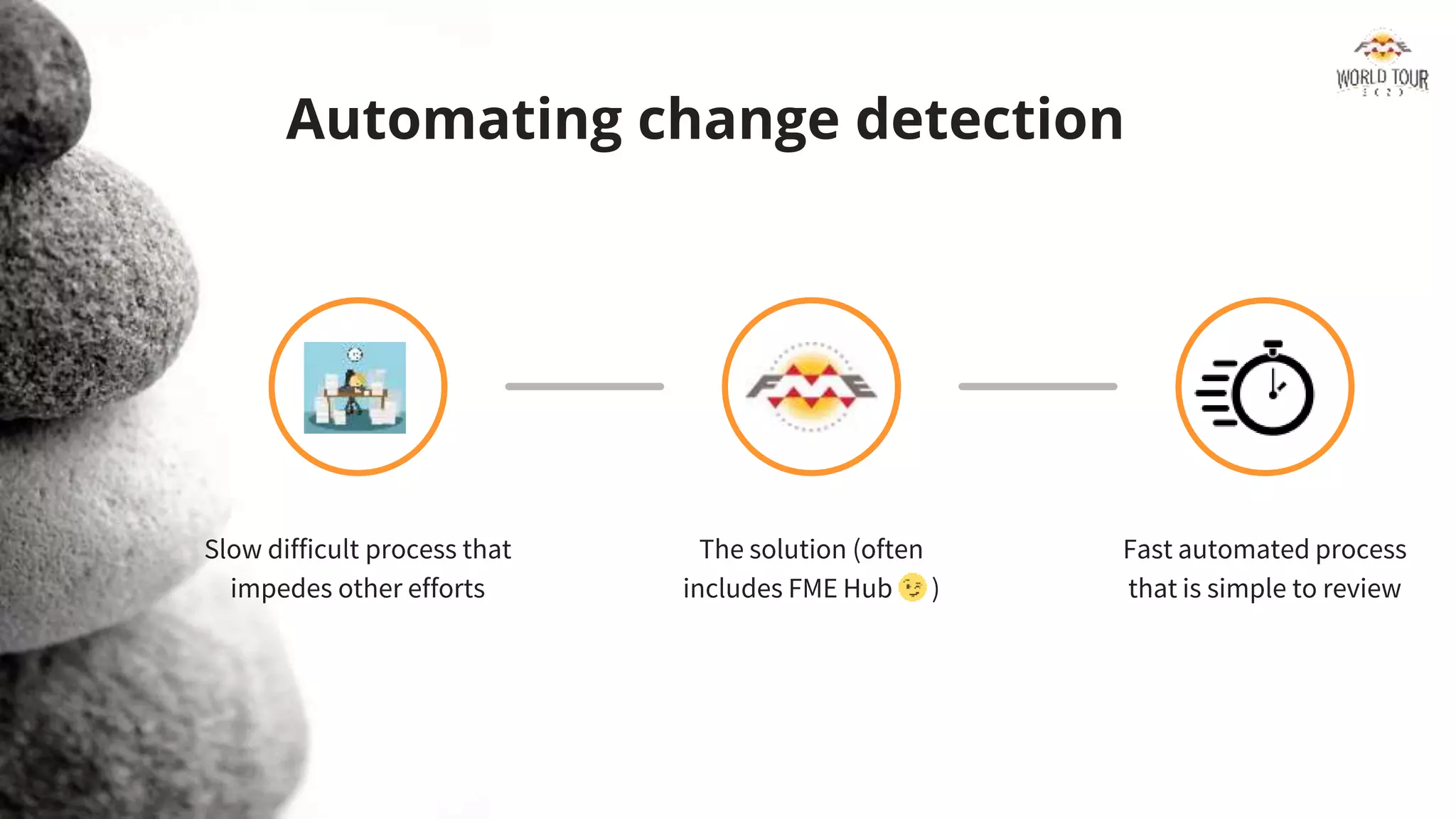
Automating change detection
Slow difficult process that
impedes other efforts
The solution (often
includes FME Hub )
Fast automated process
that is simple to review
FME helps 1898 and co a part of Burns
and McDonnell make our clients
successful!!
Always check
the FME Hub
Often it will have a solution to your problem
Thank you!
jschweppe@burnsmcd.com

Using the Hausdorff distance to identify significant changes in polygon shapes

  • 1.
    Using the Hausdorff distanceto identify significant changes in polygon shapes Justin Schweppe
  • 2.
    Hello! My name isJustin Schweppe, and I am a Senior Developer at 1898 & Co. a part of Burns & McDonnell. I have used FME for the past 6 years to make our clients successful!
  • 3.
    A ton oftime is wasted manually reviewing GIS data. We can fix that. This presentation will show how we were able to us the Hausdorff Distance to save time for our client.
  • 4.
    Today’s Problem Our clienthad the arduous task of maintaining two data sets. The GIS department would make updates to the boundaries of their parcels and the maintenance department would have to identify if these changes affected their dataset. This was a difficult and time consuming manual process. Ease Data Fatigue
  • 5.
    Automating Change Detection How do wedo that? Our client tasked us to automate this process We needed to figure out a process of automating this. Minor changes could be ignored and passed into as updates, but how do you determine what is minor. Using the difference between the area and the perimeter was not enough to accurately determine this. We needed something that was a little more sophisticated.
  • 6.
    The Solution: Hausdorffdistance Felix Hausdorff introduced the Hausdorff distance in his book Grundzüge der Mengenlehre in 1914. Informally, two sets are close in the Hausdorff distance if every point of either set is close to some point of the other set. The Hausdorff distance is the longest distance you can be forced to travel by an adversary who chooses a point in one of the two sets, from where you then must travel to the other set. In other words, it is the greatest of all the distances from a point in one set to the closest point in the other set.
  • 7.
    This is perfectfor our application However, it is a complicated formula and it might take considerable time to write from scratch. Fortunately FME has the great resource that is the FME hub.
  • 8.
    Putting it intoAction The only problem was our client was using an older version of FME Server, so I did have to backport the custom transformer.
  • 9.
    Automating change detection Slowdifficult process that impedes other efforts The solution (often includes FME Hub ) Fast automated process that is simple to review
  • 10.
    FME helps 1898and co a part of Burns and McDonnell make our clients successful!!
  • 11.
    Always check the FMEHub Often it will have a solution to your problem
  • 12.

Editor's Notes

  • #2 This presentation will show you how to use the Hausdorff distance to identify changes in polygon shapes.
  • #3 My name is Justin Schweppe, and I am a Senior Developer at 1898 & Co. a part of Burns & McDonnell. I have used FME for the past 6 years to make our clients successful!
  • #4 Manual processes waste a ton of time and are prone to mistakes. We can fix that with FME and in this case the help of a custom transformer that is available on the FME Hub.
  • #5 In this case a reviewer would have to look over the two datasets and identify the changes manually. They had to identify parcels that had their boundaries adjusted, parcels that were moved, parcels that combined, or parcels that were split. This was a very arduous task and they found themselves often falling behind because of data fatigue. By creating a process that allows them to review parcels that have been changed it eases their data fatigue and saves them a ton of time.
  • #6 The biggest problem is they did not care about minor changes. If a border was adjusted a foot or so, it could be passed into their dataset without review. The first attempts at classifying changes as minor or major was unfruitful as we were only comparing the attributes of the polygons themselves. Using the difference between the area and the perimeter was not enough to accurately determine this. We needed a more sophisticated method that reliably indicated minor or major changes.
  • #7 Felix Hausdorff introduced the Hausdorff distance in his book Grundzüge der Mengenlehre in 1914. Informally, two sets are close in the Hausdorff distance if every point of either set is close to some point of the other set. The Hausdorff distance is the longest distance you can be forced to travel by an adversary who chooses a point in one of the two sets, from where you then must travel to the other set. In other words, it is the greatest of all the distances from a point in one set to the closest point in the other set.
  • #8 The Hausdorff distance was perfect for our application, but it is complicated algorithm that would take some time to implement from scratch. Fortunately FME hub came to the rescue and we were able to use an available custom transformer that already had implemented this algorithm.
  • #9 The only problem that we had was our client was using an older version of FME server, so I had to backport the custom transformer. However, this was relatively easy compared to implementing the algorithm from scratch. By combining the Hausdorff distance, and our original parameters such as perimeter, and area we were able to generate a formula that derived a reliable different percentage. We then used a threshold to pass parcels that don’t need review into the main feature class and parcels that need review into a “needs review” feature class.
  • #10 Proof/Point 1: A: B: C: Main point (and sub-points)
  • #11 Repeat your message you started with
  • #12 A time-sensitive task to assign to your audience, or yourself.