www.enabledhealthcare.org
Predictive Analytics
Usage and Implications
in Healthcare
J. Bryan Bennett, Adjunct Professor and Predictive
Analytics SME, Northwestern University
June 6, 2014
Presented by: HIMSS Management Engineering and Process
Improvement (ME-PI) Community
www.enabledhealthcare.org
Agenda
 Predictive Analytics (PA) Versus Other
Types of Analytics
 Getting Started With a Healthcare
Predictive Analytics Program
 Areas Where Predictive Analytics Can be
Utilized Right Away
June 6, 20142@enabledhealth
www.enabledhealthcare.org
Predictive Analytics
Versus Other Types
of Analytics
www.enabledhealthcare.org
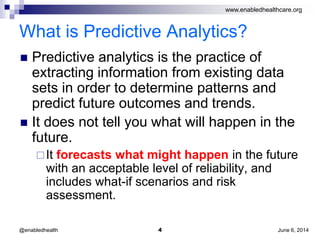
What is Predictive Analytics?
 Predictive analytics is the practice of
extracting information from existing data
sets in order to determine patterns and
predict future outcomes and trends.
 It does not tell you what will happen in the
future.
It forecasts what might happen in the future
with an acceptable level of reliability, and
includes what-if scenarios and risk
assessment.
June 6, 20144@enabledhealth
www.enabledhealthcare.org
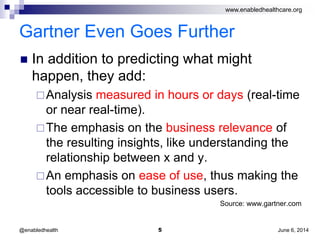
Gartner Even Goes Further
 In addition to predicting what might
happen, they add:
Analysis measured in hours or days (real-time
or near real-time).
The emphasis on the business relevance of
the resulting insights, like understanding the
relationship between x and y.
An emphasis on ease of use, thus making the
tools accessible to business users.
Source: www.gartner.com
June 6, 20145@enabledhealth
www.enabledhealthcare.org
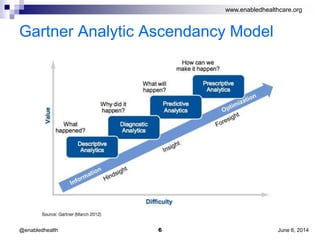
Gartner Analytic Ascendancy Model
June 6, 20146@enabledhealth
www.enabledhealthcare.org
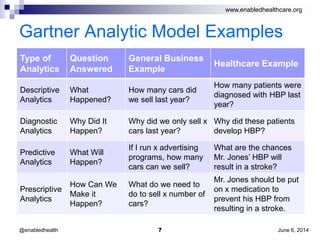
Gartner Analytic Model Examples
Type of
Analytics
Question
Answered
General Business
Example
Healthcare Example
Descriptive
Analytics
What
Happened?
How many cars did
we sell last year?
How many patients were
diagnosed with HBP last
year?
Diagnostic
Analytics
Why Did It
Happen?
Why did we only sell x
cars last year?
Why did these patients
develop HBP?
Predictive
Analytics
What Will
Happen?
If I run x advertising
programs, how many
cars can we sell?
What are the chances
Mr. Jones’ HBP will
result in a stroke?
Prescriptive
Analytics
How Can We
Make it
Happen?
What do we need to
do to sell x number of
cars?
Mr. Jones should be put
on x medication to
prevent his HBP from
resulting in a stroke.
June 6, 20147@enabledhealth
www.enabledhealthcare.org
Getting Started With a
Healthcare Predictive
Analytics Program
www.enabledhealthcare.org
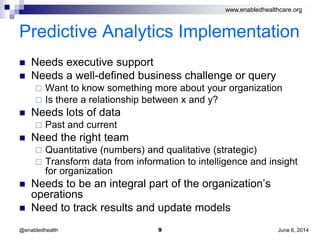
Predictive Analytics Implementation
 Needs executive support
 Needs a well-defined business challenge or query
 Want to know something more about your organization
 Is there a relationship between x and y?
 Needs lots of data
 Past and current
 Need the right team
 Quantitative (numbers) and qualitative (strategic)
 Transform data from information to intelligence and insight
for organization
 Needs to be an integral part of the organization’s
operations
 Need to track results and update models
June 6, 20149@enabledhealth
www.enabledhealthcare.org
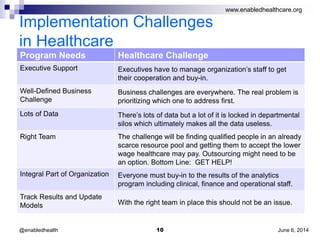
Implementation Challenges
in Healthcare
Program Needs Healthcare Challenge
Executive Support Executives have to manage organization’s staff to get
their cooperation and buy-in.
Well-Defined Business
Challenge
Business challenges are everywhere. The real problem is
prioritizing which one to address first.
Lots of Data There’s lots of data but a lot of it is locked in departmental
silos which ultimately makes all the data useless.
Right Team The challenge will be finding qualified people in an already
scarce resource pool and getting them to accept the lower
wage healthcare may pay. Outsourcing might need to be
an option. Bottom Line: GET HELP!
Integral Part of Organization Everyone must buy-in to the results of the analytics
program including clinical, finance and operational staff.
Track Results and Update
Models With the right team in place this should not be an issue.
June 6, 201410@enabledhealth
www.enabledhealthcare.org
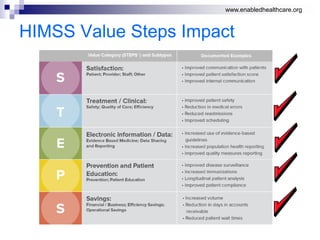
HIMSS Value Steps Impact
www.enabledhealthcare.org
Areas Where Predictive
Analytics Can Be Utilized
Right Away
www.enabledhealthcare.org
Areas Showing Benefits Now
 Improved Patient Flow
 Reduced Readmissions
 Disease Outbreak Prediction
 Emergency Room Risks
June 6, 201413@enabledhealth
www.enabledhealthcare.org
Improved Patient Flow
 Can help an organization predict which
resources will be needed at any given time
 Predicting patient flow versus patient
tracking
 Reduces bottlenecks and wait times
Especially in the emergency room
Increases patient satisfaction
June 6, 201414@enabledhealth
www.enabledhealthcare.org
Improving Patient Flow
 Admissions and discharges
 Efficient patient placement at admission
 Find bottlenecks and drive for earlier or later
discharge times
 Capacity management
 Identify underused beds and labs to better target
patient usage
 Improves patient care and increased revenues
 Transport and housekeeping
 Track job times and responsiveness to improve
turnover
June 6, 201415@enabledhealth
www.enabledhealthcare.org
Reduced Readmissions
 Risk of readmission in 30 days can be
predicted in order to assist with the
decision to release a patient
 Reduces cost of readmission and the
opportunity cost of a patient occupying a
bed that could be used by someone else
 Requires a proactive versus reactive
approach
June 6, 201416@enabledhealth
www.enabledhealthcare.org
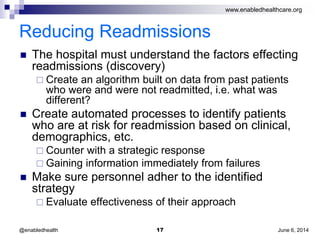
Reducing Readmissions
 The hospital must understand the factors effecting
readmissions (discovery)
 Create an algorithm built on data from past patients
who were and were not readmitted, i.e. what was
different?
 Create automated processes to identify patients
who are at risk for readmission based on clinical,
demographics, etc.
 Counter with a strategic response
 Gaining information immediately from failures
 Make sure personnel adher to the identified
strategy
 Evaluate effectiveness of their approach
June 6, 201417@enabledhealth
www.enabledhealthcare.org
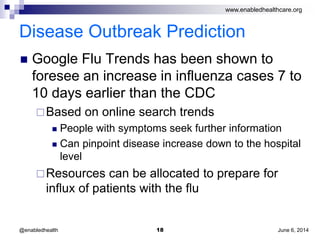
Disease Outbreak Prediction
 Google Flu Trends has been shown to
foresee an increase in influenza cases 7 to
10 days earlier than the CDC
Based on online search trends
 People with symptoms seek further information
 Can pinpoint disease increase down to the hospital
level
Resources can be allocated to prepare for
influx of patients with the flu
June 6, 201418@enabledhealth
www.enabledhealthcare.org
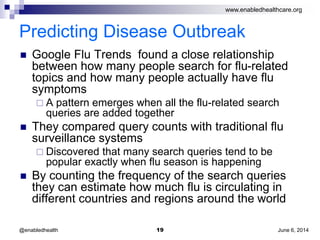
Predicting Disease Outbreak
 Google Flu Trends found a close relationship
between how many people search for flu-related
topics and how many people actually have flu
symptoms
 A pattern emerges when all the flu-related search
queries are added together
 They compared query counts with traditional flu
surveillance systems
 Discovered that many search queries tend to be
popular exactly when flu season is happening
 By counting the frequency of the search queries
they can estimate how much flu is circulating in
different countries and regions around the world
June 6, 201419@enabledhealth
www.enabledhealthcare.org
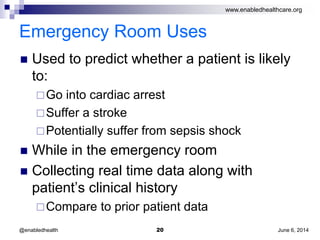
Emergency Room Uses
 Used to predict whether a patient is likely
to:
Go into cardiac arrest
Suffer a stroke
Potentially suffer from sepsis shock
 While in the emergency room
 Collecting real time data along with
patient’s clinical history
Compare to prior patient data
June 6, 201420@enabledhealth
www.enabledhealthcare.org
Questions and Answers
 Contact Information:
 J. Bryan Bennett
 Healthcare Information Manager, Data Scientist and
Professor
 E-mail
 bryan@enabledhealthcare.org
 Website / Blogs
 www.enabledhealthcare.com
 www.himssfuturecare/blog/1266
 Twitter
 @enabledhealth
June 6, 201421@enabledhealth

Predictive Analytics Usage and Implications in Healthcare

  • 1.
    www.enabledhealthcare.org Predictive Analytics Usage andImplications in Healthcare J. Bryan Bennett, Adjunct Professor and Predictive Analytics SME, Northwestern University June 6, 2014 Presented by: HIMSS Management Engineering and Process Improvement (ME-PI) Community
  • 2.
    www.enabledhealthcare.org Agenda  Predictive Analytics(PA) Versus Other Types of Analytics  Getting Started With a Healthcare Predictive Analytics Program  Areas Where Predictive Analytics Can be Utilized Right Away June 6, 20142@enabledhealth
  • 3.
  • 4.
    www.enabledhealthcare.org What is PredictiveAnalytics?  Predictive analytics is the practice of extracting information from existing data sets in order to determine patterns and predict future outcomes and trends.  It does not tell you what will happen in the future. It forecasts what might happen in the future with an acceptable level of reliability, and includes what-if scenarios and risk assessment. June 6, 20144@enabledhealth
  • 5.
    www.enabledhealthcare.org Gartner Even GoesFurther  In addition to predicting what might happen, they add: Analysis measured in hours or days (real-time or near real-time). The emphasis on the business relevance of the resulting insights, like understanding the relationship between x and y. An emphasis on ease of use, thus making the tools accessible to business users. Source: www.gartner.com June 6, 20145@enabledhealth
  • 6.
  • 7.
    www.enabledhealthcare.org Gartner Analytic ModelExamples Type of Analytics Question Answered General Business Example Healthcare Example Descriptive Analytics What Happened? How many cars did we sell last year? How many patients were diagnosed with HBP last year? Diagnostic Analytics Why Did It Happen? Why did we only sell x cars last year? Why did these patients develop HBP? Predictive Analytics What Will Happen? If I run x advertising programs, how many cars can we sell? What are the chances Mr. Jones’ HBP will result in a stroke? Prescriptive Analytics How Can We Make it Happen? What do we need to do to sell x number of cars? Mr. Jones should be put on x medication to prevent his HBP from resulting in a stroke. June 6, 20147@enabledhealth
  • 8.
    www.enabledhealthcare.org Getting Started Witha Healthcare Predictive Analytics Program
  • 9.
    www.enabledhealthcare.org Predictive Analytics Implementation Needs executive support  Needs a well-defined business challenge or query  Want to know something more about your organization  Is there a relationship between x and y?  Needs lots of data  Past and current  Need the right team  Quantitative (numbers) and qualitative (strategic)  Transform data from information to intelligence and insight for organization  Needs to be an integral part of the organization’s operations  Need to track results and update models June 6, 20149@enabledhealth
  • 10.
    www.enabledhealthcare.org Implementation Challenges in Healthcare ProgramNeeds Healthcare Challenge Executive Support Executives have to manage organization’s staff to get their cooperation and buy-in. Well-Defined Business Challenge Business challenges are everywhere. The real problem is prioritizing which one to address first. Lots of Data There’s lots of data but a lot of it is locked in departmental silos which ultimately makes all the data useless. Right Team The challenge will be finding qualified people in an already scarce resource pool and getting them to accept the lower wage healthcare may pay. Outsourcing might need to be an option. Bottom Line: GET HELP! Integral Part of Organization Everyone must buy-in to the results of the analytics program including clinical, finance and operational staff. Track Results and Update Models With the right team in place this should not be an issue. June 6, 201410@enabledhealth
  • 11.
  • 12.
  • 13.
    www.enabledhealthcare.org Areas Showing BenefitsNow  Improved Patient Flow  Reduced Readmissions  Disease Outbreak Prediction  Emergency Room Risks June 6, 201413@enabledhealth
  • 14.
    www.enabledhealthcare.org Improved Patient Flow Can help an organization predict which resources will be needed at any given time  Predicting patient flow versus patient tracking  Reduces bottlenecks and wait times Especially in the emergency room Increases patient satisfaction June 6, 201414@enabledhealth
  • 15.
    www.enabledhealthcare.org Improving Patient Flow Admissions and discharges  Efficient patient placement at admission  Find bottlenecks and drive for earlier or later discharge times  Capacity management  Identify underused beds and labs to better target patient usage  Improves patient care and increased revenues  Transport and housekeeping  Track job times and responsiveness to improve turnover June 6, 201415@enabledhealth
  • 16.
    www.enabledhealthcare.org Reduced Readmissions  Riskof readmission in 30 days can be predicted in order to assist with the decision to release a patient  Reduces cost of readmission and the opportunity cost of a patient occupying a bed that could be used by someone else  Requires a proactive versus reactive approach June 6, 201416@enabledhealth
  • 17.
    www.enabledhealthcare.org Reducing Readmissions  Thehospital must understand the factors effecting readmissions (discovery)  Create an algorithm built on data from past patients who were and were not readmitted, i.e. what was different?  Create automated processes to identify patients who are at risk for readmission based on clinical, demographics, etc.  Counter with a strategic response  Gaining information immediately from failures  Make sure personnel adher to the identified strategy  Evaluate effectiveness of their approach June 6, 201417@enabledhealth
  • 18.
    www.enabledhealthcare.org Disease Outbreak Prediction Google Flu Trends has been shown to foresee an increase in influenza cases 7 to 10 days earlier than the CDC Based on online search trends  People with symptoms seek further information  Can pinpoint disease increase down to the hospital level Resources can be allocated to prepare for influx of patients with the flu June 6, 201418@enabledhealth
  • 19.
    www.enabledhealthcare.org Predicting Disease Outbreak Google Flu Trends found a close relationship between how many people search for flu-related topics and how many people actually have flu symptoms  A pattern emerges when all the flu-related search queries are added together  They compared query counts with traditional flu surveillance systems  Discovered that many search queries tend to be popular exactly when flu season is happening  By counting the frequency of the search queries they can estimate how much flu is circulating in different countries and regions around the world June 6, 201419@enabledhealth
  • 20.
    www.enabledhealthcare.org Emergency Room Uses Used to predict whether a patient is likely to: Go into cardiac arrest Suffer a stroke Potentially suffer from sepsis shock  While in the emergency room  Collecting real time data along with patient’s clinical history Compare to prior patient data June 6, 201420@enabledhealth
  • 21.
    www.enabledhealthcare.org Questions and Answers Contact Information:  J. Bryan Bennett  Healthcare Information Manager, Data Scientist and Professor  E-mail  bryan@enabledhealthcare.org  Website / Blogs  www.enabledhealthcare.com  www.himssfuturecare/blog/1266  Twitter  @enabledhealth June 6, 201421@enabledhealth