,
The Usefulness of Self-
Help / Manual-Based &
Computer-assisted
Interventions
Dr Maria Livanou
Self-help: Term does not describe a
therapy, but a way of delivery
 Whether its manual-based, computerised or
computer-assisted it is not a therapy
approach per se but a mode of delivery
Its content could be based on different
approaches (e.g., cognitive behavioural,
person-centred, etc.)
Main idea:
 Therapy is delivered by the person who
needs it. Any interventions to be used, are
delivered by the person without any (or
with minimal) input by a practitioner or
mental health professional.
Why include self-help under Brief
Interventions (BIs)?
Even though they refer to the way of delivering
psychological help or support
 they often involve BIs (e.g., computer-assisted
mindfulness, or manualised cognitive restructuring, or
manualised or computerised exposure)
 their effectiveness needs to be considered separately
 even if they do involve interventions that are known to
be effective (mindfulness, or cognitive restructuring or
exposure), you need to consider whether there is any
evidence for the efficacy of their computerised or
manual-based versions
 their cost-effectiveness needs to be tested
Aims of this week’s learning
 Why use self-help / manual-based /
computerised / computer-assisted
interventions?
 Aims? Contexts? Advantages and
disadvantages? Effectiveness?
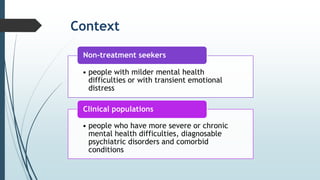
Context
• people with milder mental health
difficulties or with transient emotional
distress
Non-treatment seekers
• people who have more severe or chronic
mental health difficulties, diagnosable
psychiatric disorders and comorbid
conditions
Clinical populations
Why would we need to consider self-
help or manual-based or computerised
therapy?
Most of the people with mental health
difficulties do not seek treatment (Regier et al,
1993; Heffren and Hausdorf, 2016; Warner et al, 2012)
 e.g. anxiety and major depressive disorders are very
prevalent (Kessler et al, 2005; Goldberg et al, 2009) but
less than half the people with these problems see a
physician and only about a quarter of them receive
Basic Assumption: Psychological interventions can
be Operationalised
(…but can they?)
Some interventions could be formulated as a
standardised set of procedures that can be applied
to people with similar difficulties (e.g., cognitive
restructuring for people with mood difficulties, or exposure for people with
phobias)
 But, idiographic therapies do not lend themselves to
manualisation or standardised application across
different people
Self-help: CBT
 evidence spreading over 40 years showing
clients can apply BT and CBT by
themselves, sometimes with only minimal
support from therapist
(see Cuijpers et al, 2010)
Self-Help / Manual-based Therapy
 What is self-help about?
 Any benefits in it?
 Any potential problems?
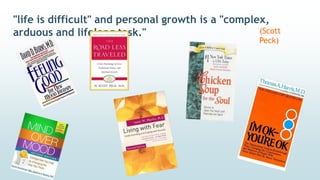
"life is difficult" and personal growth is a "complex,
arduous and lifelong task." (Scott
Peck)
What are they about?
 Overcoming depression, fears and anxiety,
drinking problems, managing stress, recovering
from trauma and PTSD, helping parents help
their children who have difficulties with
obsessive thoughts and compulsive behaviours,
coping with negative thoughts, overcoming
grief, being more assertive, etc.
Guided self-help versus other self-help
interventions
 It involves some input from a
professional therapist or coach, who
offers the person facilitative support in
the application of the manualised
intervention.
Guided self-help vs self-help vs
face-2-face
 Guided or not, self-help differs from face-2-
face treatment in the amount of therapist
time: Interaction is minimal
 usually by phone or email or via skype (or zoom,
etc.) or may take place face-to-face but reduced
in time
Cuijpers et al (2010)
The effectiveness of Guided Self-
Help
Meta-analysis including 21 studies; 14
aimed at adults
 6 depression, 7 panic, 3 social phobia, 2 specific
phobias, 3 phobias in general
Results: No differences between face-2-
face treatment and guided self-help
 They checked comparisons at post-treatment and
follow-up
 No significant differences in drop-out rates either
Criticism about Self-help Books?
 Many propose the obvious (recommendations
can be mainly common sense or common
knowledge).
 They propose models that oversimplify reality.
 When recommendations are based on the
author’s assumptions (i.e. it worked for me,
therefore it will work for you) it could
overlook the fact that the author is often very
different from the people reading the book.
It’s not the medium that counts; it’s the
intervention proposed through the
medium
The recommendations made in the self-help
books have to be based on evidence.
So, a self-help on a treatment that has been
tested and found effective is likely to be
helpful, whereas advice that has not been
tested may ‘sound good’ but may actually be
ineffective (or even harmful?)
)
It’s not the medium that counts; it’s the
intervention proposed through the
medium
 E.g., results from a Canadian study
(Wood, Perunovic, and Lee 2009) suggested
that people with low self-esteem felt worse
after repeating positive statements about
themselves.
repeating mantras
e.g. “I am a loveable person”
words or sounds or
phrases repeated to
help concentration
in meditation
)
Conclusions about Self-help manuals
 Can be as useful as therapist-delivered
therapy but
 only for some mental health problems
 if they include evidence-based suggestions /
recommendations
Computer-Assisted
Therapy
 a “small revolution” in the delivery of
mental health care (Carroll & Rounsaville, 2010)
 more than 100 different computer-
assisted programmes (Marks et al, 2007)
Justification
Most of the people with mental health
difficulties do not seek treatment (Regier et al,
1993; Heffren and Hausdorf, 2016; Warner et al, 2012) but
a large number of people in the western
world have access to PC (for example, 70% of the
people in the US, according to Carroll and Rounsaville, 2010)
People with mental health difficulties often
prefer not to reveal their symptoms or seek
treatment (Dain, 1994)
 PC-assisted therapy: relative anonymity,
Repeat: computer-assisted therapy
refers to
 The mode of delivering an existing
treatment. It is not an intervention by itself.
 Today there is a wide range of computer-
assisted therapies for various psychiatric
disorders
 variability also in how these approaches are
delivered, their effectiveness and how they
compare (in terms of effectiveness) to other
evidence-based treatments
Some are conceived as ‘online
bibliotherapy’
Providing information about psychiatric
disorders, treatment, resources for
extra help
 (eg, http://www.quitnet.com)
Others offer evidence-based
therapy
 E.g. CBT
with extensive use of multimedia features
(e.g. videotaped examples) to demonstrate
skills with interactive exercises that allow
users to assess their learning and practice
new strategies
HOW CAN THEY BE USED
An adjunct to standard treatment
 for example, the programme CBT4CBT is used to
improve outcomes for standard CBT of addiction (Carroll
et al, 2008)
For aftercare or continuing care
 to ensure that there is no relapse, once active
treatment is over
Early intervention (for milder problems) or
prevention for non-clinical or hard-to-reach
populations (Postel et al, 2005)
Strengths
 Improves access to treatment
 Reduces therapist time / cost of treatment
 Enhances engagement with treatment process
 Encourages independence (via self-help)
 Can be useful in psychoeducation
 Promotes monitoring / offers feedback
 Can help with skills-rehearsal
 Assesses treatment outcome (by collecting and analysing data and
displaying results graphically)
Ethical issues
(e.g., Sampson & Pyle, 1983)
 Confidentiality
 Determination of appropriateness of the specific
form of therapy
 Adequate introduction to the PC software to
reduce anxiety about using the system
 Follow-up consultation with a clinician if needed
 Up-to-date and accurate information
 Well-functioning hardware and software
UK: The first recommendation of CCBT by a
government regulatory body anywhere
 The NICE’s reappraisal (National Institute for Health and
Clinical Excellence, 2006) recommends for the NHS
two Computerised CBT systems:
Beating the Blues for mild and moderate
depression, and
FearFighter for phobia, panic and anxiety.
 In addition, NICE recognised the `absolute
clinical efficacy of OCFighter' (BTSteps) for
For a review see Marks et al, 2007
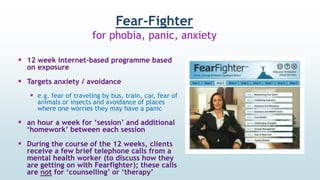
Fear-Fighter
for phobia, panic, anxiety
 12 week internet-based programme based
on exposure
 Targets anxiety / avoidance
 e.g. fear of traveling by bus, train, car, fear of
animals or insects and avoidance of places
where one worries they may have a panic
 an hour a week for ‘session’ and additional
‘homework’ between each session
 During the course of the 12 weeks, clients
receive a few brief telephone calls from a
mental health worker (to discuss how they
are getting on with Fearfighter); these calls
are not for ‘counselling’ or ‘therapy’
Effectiveness of CCBT for anxiety
and depression
 effect sizes are substantial both for the treatment of
anxiety and for the treatment of depression
 both short term and long term benefits
 good adherence and client-satisfaction from CCBT,
despite the significantly reduced amount of contact
with the clinician
 But, therapy should not be considered completely
computerised; most of the existing programmes
involve some input by a therapist
(e.g., Thase et al, 2018; Foroushani, et al., 2011; Adelman et al., 2014).
Summary & Conclusions
Overview of self-help manuals and
computerised or computer-assisted
interventions
 They can be effective and useful
 Not all approaches can be manualised
 Important that they are based on evidence-
based suggestions
 Important to keep in mind their limitations
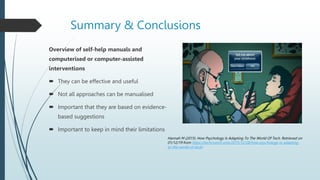
Hannah M (2015). How Psychology Is Adapting To The World Of Tech. Retrieved on
01/12/19 from https://techcrunch.com/2015/12/28/how-psychology-is-adapting-
to-the-world-of-tech/
REFERENCES
 Adelman, C. B., Panza, K. E., Bartley, C. A., Bontempo, A., & Bloch, M. H.
(2014). A meta-analysis of computerized cognitive-behavioral therapy for
the treatment of DSM-5 anxiety disorders. The Journal of Clinical Psychiatry,
75(7), e695-e704. doi:10.4088/JCP.13r08894
 Andrews G, Issakidis C, Sanderson K, Corry J, Lapsley H (2004) Utilising
survey data to inform public policy: comparison of the cost-effectiveness of
treatment of ten mental disorders. Br J Psychiatry 184: 526–533.
 Carroll KM, Ball SA, Martino S, et al. Computer-assisted cognitive-behavioral
therapy for addiction. A randomized clinical trial of ‘CBT4CBT’. Am J
Psychiatry 2008;165:881–888. [PubMed: 18450927]
 Carroll, K. M., & Rounsaville, B. J. (2010). Computer-assisted therapy in
psychiatry: be brave-it's a new world. Current psychiatry reports, 12(5),
426–432. https://doi.org/10.1007/s11920-010-0146-2
 Cuijpers P, Donker T, van Straten A, Li J, Andersson G (2010) Is guided self-
help as effective as face-to-face psychotherapy for depression and anxiety
disorders? A systematic review and meta-analysis. Psychological Medicine,
40, 1943–1957
 Dain N. Reflections on antipsychiatry and stigma in the history of American
REFERENCES
 Goldberg DP, Krueger RF, Andrews G, Hobbs MJ (2009) Emotional
disorders: Cluster 4 of the proposed meta-structure for DSM-V and ICD-11.
Psychol Med 39: 2043–2059.
 Kessler RC, Berglund P, Demler O, Walters EE (2005) Prevalence, severity,
and comorbidity of 12-month DSM-IV disorders in the National
Comorbidity Survey replication. Arch Gen Psychiatry 62(6): 617–621.
 Marks IM, Cavanagh K, Gega L. (2007). Hands on Help: Computer-Aided
Psychotherapy. Maudsley Monographs. Psychology Press.
 Postel MG, de Jong CA, de Haan HA. Does e-therapy for problem drinking
reach hidden populations? Am J Psychiatry 2005;162:2393.
 Regier DA, Narrow WE, Rae DS, et al. The de facto US mental health and
addictive disorders service system: Epidemiological Catchment Area
prospective one-year prevalence rates of disorders and services. Arch Gen
Psychiatry 1993;50:85–91.
 Sampson JP, Pyle KR (1983). Ethical issues involved with the use of
computer-assisted counseling, testing, and guidance systems. Personnel
and Guidance Journal; 61:283-287
 Warner, C. H., Appenzeller, G. N., Grieger, T., Belenkiy, S., Breitbach, J.,
Parker, J., … Hoge, C. (2011). Importance of anonymity to encourage
honest reporting in mental health screening after combat deployment.
Archives of General Psychiatry, 68(10), 1065–1071. doi:

SELF-HELP MANUAL-BASED COMPUTERISED OR COMPUTER-ASSISTED lecture notes (only slides, no audio).pptx

  • 1.
    , The Usefulness ofSelf- Help / Manual-Based & Computer-assisted Interventions Dr Maria Livanou
  • 2.
    Self-help: Term doesnot describe a therapy, but a way of delivery  Whether its manual-based, computerised or computer-assisted it is not a therapy approach per se but a mode of delivery Its content could be based on different approaches (e.g., cognitive behavioural, person-centred, etc.)
  • 3.
    Main idea:  Therapyis delivered by the person who needs it. Any interventions to be used, are delivered by the person without any (or with minimal) input by a practitioner or mental health professional.
  • 4.
    Why include self-helpunder Brief Interventions (BIs)? Even though they refer to the way of delivering psychological help or support  they often involve BIs (e.g., computer-assisted mindfulness, or manualised cognitive restructuring, or manualised or computerised exposure)  their effectiveness needs to be considered separately  even if they do involve interventions that are known to be effective (mindfulness, or cognitive restructuring or exposure), you need to consider whether there is any evidence for the efficacy of their computerised or manual-based versions  their cost-effectiveness needs to be tested
  • 5.
    Aims of thisweek’s learning  Why use self-help / manual-based / computerised / computer-assisted interventions?  Aims? Contexts? Advantages and disadvantages? Effectiveness?
  • 6.
    Context • people withmilder mental health difficulties or with transient emotional distress Non-treatment seekers • people who have more severe or chronic mental health difficulties, diagnosable psychiatric disorders and comorbid conditions Clinical populations
  • 7.
    Why would weneed to consider self- help or manual-based or computerised therapy? Most of the people with mental health difficulties do not seek treatment (Regier et al, 1993; Heffren and Hausdorf, 2016; Warner et al, 2012)  e.g. anxiety and major depressive disorders are very prevalent (Kessler et al, 2005; Goldberg et al, 2009) but less than half the people with these problems see a physician and only about a quarter of them receive
  • 8.
    Basic Assumption: Psychologicalinterventions can be Operationalised (…but can they?) Some interventions could be formulated as a standardised set of procedures that can be applied to people with similar difficulties (e.g., cognitive restructuring for people with mood difficulties, or exposure for people with phobias)  But, idiographic therapies do not lend themselves to manualisation or standardised application across different people
  • 9.
    Self-help: CBT  evidencespreading over 40 years showing clients can apply BT and CBT by themselves, sometimes with only minimal support from therapist (see Cuijpers et al, 2010)
  • 10.
    Self-Help / Manual-basedTherapy  What is self-help about?  Any benefits in it?  Any potential problems?
  • 11.
    "life is difficult"and personal growth is a "complex, arduous and lifelong task." (Scott Peck)
  • 12.
    What are theyabout?  Overcoming depression, fears and anxiety, drinking problems, managing stress, recovering from trauma and PTSD, helping parents help their children who have difficulties with obsessive thoughts and compulsive behaviours, coping with negative thoughts, overcoming grief, being more assertive, etc.
  • 13.
    Guided self-help versusother self-help interventions  It involves some input from a professional therapist or coach, who offers the person facilitative support in the application of the manualised intervention.
  • 14.
    Guided self-help vsself-help vs face-2-face  Guided or not, self-help differs from face-2- face treatment in the amount of therapist time: Interaction is minimal  usually by phone or email or via skype (or zoom, etc.) or may take place face-to-face but reduced in time
  • 15.
    Cuijpers et al(2010) The effectiveness of Guided Self- Help Meta-analysis including 21 studies; 14 aimed at adults  6 depression, 7 panic, 3 social phobia, 2 specific phobias, 3 phobias in general Results: No differences between face-2- face treatment and guided self-help  They checked comparisons at post-treatment and follow-up  No significant differences in drop-out rates either
  • 16.
    Criticism about Self-helpBooks?  Many propose the obvious (recommendations can be mainly common sense or common knowledge).  They propose models that oversimplify reality.  When recommendations are based on the author’s assumptions (i.e. it worked for me, therefore it will work for you) it could overlook the fact that the author is often very different from the people reading the book.
  • 17.
    It’s not themedium that counts; it’s the intervention proposed through the medium The recommendations made in the self-help books have to be based on evidence. So, a self-help on a treatment that has been tested and found effective is likely to be helpful, whereas advice that has not been tested may ‘sound good’ but may actually be ineffective (or even harmful?) )
  • 18.
    It’s not themedium that counts; it’s the intervention proposed through the medium  E.g., results from a Canadian study (Wood, Perunovic, and Lee 2009) suggested that people with low self-esteem felt worse after repeating positive statements about themselves. repeating mantras e.g. “I am a loveable person” words or sounds or phrases repeated to help concentration in meditation )
  • 19.
    Conclusions about Self-helpmanuals  Can be as useful as therapist-delivered therapy but  only for some mental health problems  if they include evidence-based suggestions / recommendations
  • 20.
    Computer-Assisted Therapy  a “smallrevolution” in the delivery of mental health care (Carroll & Rounsaville, 2010)  more than 100 different computer- assisted programmes (Marks et al, 2007)
  • 21.
    Justification Most of thepeople with mental health difficulties do not seek treatment (Regier et al, 1993; Heffren and Hausdorf, 2016; Warner et al, 2012) but a large number of people in the western world have access to PC (for example, 70% of the people in the US, according to Carroll and Rounsaville, 2010) People with mental health difficulties often prefer not to reveal their symptoms or seek treatment (Dain, 1994)  PC-assisted therapy: relative anonymity,
  • 22.
    Repeat: computer-assisted therapy refersto  The mode of delivering an existing treatment. It is not an intervention by itself.  Today there is a wide range of computer- assisted therapies for various psychiatric disorders  variability also in how these approaches are delivered, their effectiveness and how they compare (in terms of effectiveness) to other evidence-based treatments
  • 23.
    Some are conceivedas ‘online bibliotherapy’ Providing information about psychiatric disorders, treatment, resources for extra help  (eg, http://www.quitnet.com)
  • 24.
    Others offer evidence-based therapy E.g. CBT with extensive use of multimedia features (e.g. videotaped examples) to demonstrate skills with interactive exercises that allow users to assess their learning and practice new strategies
  • 25.
    HOW CAN THEYBE USED An adjunct to standard treatment  for example, the programme CBT4CBT is used to improve outcomes for standard CBT of addiction (Carroll et al, 2008) For aftercare or continuing care  to ensure that there is no relapse, once active treatment is over Early intervention (for milder problems) or prevention for non-clinical or hard-to-reach populations (Postel et al, 2005)
  • 26.
    Strengths  Improves accessto treatment  Reduces therapist time / cost of treatment  Enhances engagement with treatment process  Encourages independence (via self-help)  Can be useful in psychoeducation  Promotes monitoring / offers feedback  Can help with skills-rehearsal  Assesses treatment outcome (by collecting and analysing data and displaying results graphically)
  • 27.
    Ethical issues (e.g., Sampson& Pyle, 1983)  Confidentiality  Determination of appropriateness of the specific form of therapy  Adequate introduction to the PC software to reduce anxiety about using the system  Follow-up consultation with a clinician if needed  Up-to-date and accurate information  Well-functioning hardware and software
  • 28.
    UK: The firstrecommendation of CCBT by a government regulatory body anywhere  The NICE’s reappraisal (National Institute for Health and Clinical Excellence, 2006) recommends for the NHS two Computerised CBT systems: Beating the Blues for mild and moderate depression, and FearFighter for phobia, panic and anxiety.  In addition, NICE recognised the `absolute clinical efficacy of OCFighter' (BTSteps) for For a review see Marks et al, 2007
  • 29.
    Fear-Fighter for phobia, panic,anxiety  12 week internet-based programme based on exposure  Targets anxiety / avoidance  e.g. fear of traveling by bus, train, car, fear of animals or insects and avoidance of places where one worries they may have a panic  an hour a week for ‘session’ and additional ‘homework’ between each session  During the course of the 12 weeks, clients receive a few brief telephone calls from a mental health worker (to discuss how they are getting on with Fearfighter); these calls are not for ‘counselling’ or ‘therapy’
  • 30.
    Effectiveness of CCBTfor anxiety and depression  effect sizes are substantial both for the treatment of anxiety and for the treatment of depression  both short term and long term benefits  good adherence and client-satisfaction from CCBT, despite the significantly reduced amount of contact with the clinician  But, therapy should not be considered completely computerised; most of the existing programmes involve some input by a therapist (e.g., Thase et al, 2018; Foroushani, et al., 2011; Adelman et al., 2014).
  • 31.
    Summary & Conclusions Overviewof self-help manuals and computerised or computer-assisted interventions  They can be effective and useful  Not all approaches can be manualised  Important that they are based on evidence- based suggestions  Important to keep in mind their limitations Hannah M (2015). How Psychology Is Adapting To The World Of Tech. Retrieved on 01/12/19 from https://techcrunch.com/2015/12/28/how-psychology-is-adapting- to-the-world-of-tech/
  • 32.
    REFERENCES  Adelman, C.B., Panza, K. E., Bartley, C. A., Bontempo, A., & Bloch, M. H. (2014). A meta-analysis of computerized cognitive-behavioral therapy for the treatment of DSM-5 anxiety disorders. The Journal of Clinical Psychiatry, 75(7), e695-e704. doi:10.4088/JCP.13r08894  Andrews G, Issakidis C, Sanderson K, Corry J, Lapsley H (2004) Utilising survey data to inform public policy: comparison of the cost-effectiveness of treatment of ten mental disorders. Br J Psychiatry 184: 526–533.  Carroll KM, Ball SA, Martino S, et al. Computer-assisted cognitive-behavioral therapy for addiction. A randomized clinical trial of ‘CBT4CBT’. Am J Psychiatry 2008;165:881–888. [PubMed: 18450927]  Carroll, K. M., & Rounsaville, B. J. (2010). Computer-assisted therapy in psychiatry: be brave-it's a new world. Current psychiatry reports, 12(5), 426–432. https://doi.org/10.1007/s11920-010-0146-2  Cuijpers P, Donker T, van Straten A, Li J, Andersson G (2010) Is guided self- help as effective as face-to-face psychotherapy for depression and anxiety disorders? A systematic review and meta-analysis. Psychological Medicine, 40, 1943–1957  Dain N. Reflections on antipsychiatry and stigma in the history of American
  • 33.
    REFERENCES  Goldberg DP,Krueger RF, Andrews G, Hobbs MJ (2009) Emotional disorders: Cluster 4 of the proposed meta-structure for DSM-V and ICD-11. Psychol Med 39: 2043–2059.  Kessler RC, Berglund P, Demler O, Walters EE (2005) Prevalence, severity, and comorbidity of 12-month DSM-IV disorders in the National Comorbidity Survey replication. Arch Gen Psychiatry 62(6): 617–621.  Marks IM, Cavanagh K, Gega L. (2007). Hands on Help: Computer-Aided Psychotherapy. Maudsley Monographs. Psychology Press.  Postel MG, de Jong CA, de Haan HA. Does e-therapy for problem drinking reach hidden populations? Am J Psychiatry 2005;162:2393.  Regier DA, Narrow WE, Rae DS, et al. The de facto US mental health and addictive disorders service system: Epidemiological Catchment Area prospective one-year prevalence rates of disorders and services. Arch Gen Psychiatry 1993;50:85–91.  Sampson JP, Pyle KR (1983). Ethical issues involved with the use of computer-assisted counseling, testing, and guidance systems. Personnel and Guidance Journal; 61:283-287  Warner, C. H., Appenzeller, G. N., Grieger, T., Belenkiy, S., Breitbach, J., Parker, J., … Hoge, C. (2011). Importance of anonymity to encourage honest reporting in mental health screening after combat deployment. Archives of General Psychiatry, 68(10), 1065–1071. doi: