Dr. Julie A. Evans
CEO, Project Tomorrow
@JulieEvans_PT
March 19 2019
Using Speak Up
Data to Inform
Your Digital
Learning Plans
Special Leadership
Seminar for our
Speak Up Districts
Please share your name and district name
in the chat box!
Building our Speak Up professional
learning network!
• Welcome and introductions
• Refresher course: Speak Up 101
• Key trends we are watching – are you?
• Let’s dive into data!
• Using Speak Up data as a model
• The “Data2Information=Knowledge” Process
• If you only have 20 minutes to look at Speak Up data …
• Other ways we can support your efforts
• Your questions and comments
• Planning for Speak Up 2019-20
Today’s seminar agenda
 Nonprofit education organization supporting K-12 education
since 1996
 Mission is to ensure today’s students are well prepared for the
future
 Programs and research focus on role of digital tools within the
education ecosystem – believe in power of STEAM to support
student preparation for college and career success
o Speak Up Research Project on Digital Learning: supporting
the development of new leadership capacities within K-12
schools and districts through the effective use of insights
and views from K-12 stakeholders
About Project Tomorrow
About the Speak Up Project
(www.tomorrow.org/speakup)
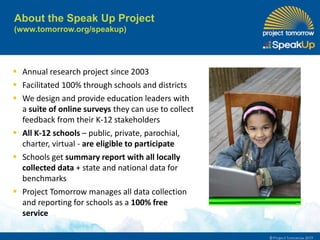
 Annual research project since 2003
 Facilitated 100% through schools and districts
 We design and provide education leaders with
a suite of online surveys they can use to collect

feedback from their K-12 stakeholders
 All K-12 schools – public, private, parochial,
charter, virtual - are eligible to participate
 Schools get summary report with all locally
collected data + state and national data for
benchmarks
 Project Tomorrow manages all data collection
and reporting for schools as a 100% free
service
We are very proud of our partnerships with these
organizations and many others!
About the Speak Up Project
(www.tomorrow.org/speakup)
About the Speak Up Project
(www.tomorrow.org/speakup)
Standard survey question topics include:
 Use of technology to support teaching & learning
 School climate for innovation
 College and career ready skill development/interest
 Leadership challenges
 Teachers’ needs for professional learning
 How do different stakeholders value digital learning
 Emerging trends w/digital tools, content and resources
 New classroom models: mobile, blended, flipped
 School to home communications
 Student safety online & digital citizenship
 Designing the ultimate school
Since 2003, over 5.7 million K-12 stakeholders have submitted a Speak Up survey
About the Speak Up Project
(www.tomorrow.org/speakup)
New question themes for 2018!
 Social emotional learning
 School safety – physical, mental health supports, cybersecurity
 Computer programming and coding – why important to learn?
 STEAM topics - exploration outside of school
 Student online behavior concerns
 Professional development modalities and evidence of competency
 Longevity of mobile devices
 Students’ experiences with YouTube
 Social media access through district networks
 Teacher referrals of digital content
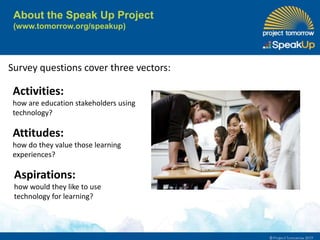
Survey questions cover three vectors:
Activities:
how are education stakeholders using
technology?
Attitudes:
how do they value those learning
experiences?
Aspirations:
how would they like to use
technology for learning?
About the Speak Up Project
(www.tomorrow.org/speakup)
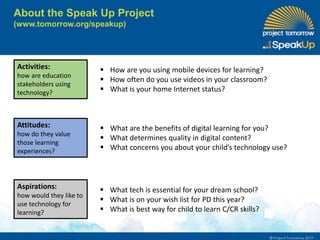
Activities:
how are education
stakeholders using
technology?
Attitudes:
how do they value
those learning
experiences?
Aspirations:
how would they like to
use technology for
learning?
About the Speak Up Project
(www.tomorrow.org/speakup)
 How are you using mobile devices for learning?
 How often do you use videos in your classroom?
 What is your home Internet status?
 What are the benefits of digital learning for you?
 What determines quality in digital content?
 What concerns you about your child’s technology use?
 What tech is essential for your dream school?
 What is on your wish list for PD this year?
 What is best way for child to learn C/CR skills?
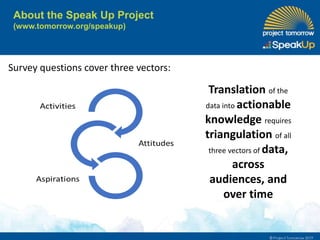
Survey questions cover three vectors:
About the Speak Up Project
(www.tomorrow.org/speakup)
Translation of the
data into actionable
knowledge requires
triangulation of all
three vectors of data,
across
audiences, and
over time
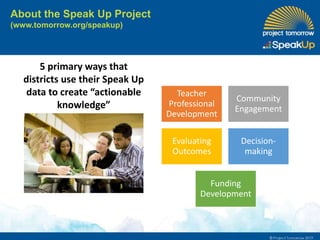
5 primary ways that
districts use their Speak Up
data to create “actionable
knowledge”
About the Speak Up Project
(www.tomorrow.org/speakup)
Teacher
Professional
Development
Community
Engagement
Evaluating
Outcomes
Decision-
making
Funding
Development
Leveraging your Speak Up Project data to inform
new discussions and better decision-making
around digital learning plans
“Without data, you are just another person with an
opinion …”
What do you see?
Are we all seeing the
same thing today?
Are our students, parents
and teachers seeing
different things than
we do?
How can we use the
feedback from our
stakeholders to improve
our sight?
• Welcome and introductions
• Refresher course: Speak Up 101
• Key trends we are watching – are you?
• Let’s dive into data!
• Using Speak Up data as a model
• The “Data2Information=Knowledge” Process
• If you only have 20 minutes to look at Speak Up data …
• Other ways we can support your efforts
• Your questions and comments
• Planning for Speak Up 2019-20
Today’s seminar agenda
Key trends from the Speak Up Research
• Greater emphasis on linking technology to students’ global skill preparation
• Interest, acceptance and implementation of new learning models
• Students’ self-directed digital learning outside of school influencing their
expectations for school
• Meet the new digital parent – with their new demands & higher aspirations
• Thinking beyond engagement to understanding tangible outcomes from
digital learning
• Increasing criticality for Internet connectivity – at school and at home
• Digital connectivity as a social justice issue
• Connections between leadership and digital effectiveness
• Digital learning is really a metaphor today for education transformation
Key trends from the Speak Up Research
• Greater emphasis on linking technology to students’ global skill preparation
• Interest, acceptance and implementation of new learning models
• Students’ self-directed digital learning outside of school influencing their
expectations for school
• Meet the new digital parent – with their new demands & higher aspirations
• Thinking beyond engagement to understanding tangible outcomes from
digital learning
• Increasing criticality for Internet connectivity – at school and at home
• Digital connectivity as a social justice issue
• Connections between leadership and digital effectiveness
• Digital learning is really a metaphor today for education transformation
What we can learn from the Speak Up data – translating the views of your
parents into actionable knowledge
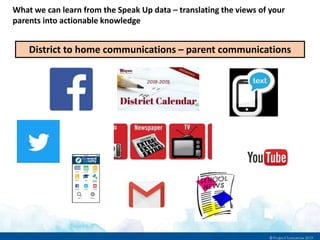
District to home communications – parent communications
What we can learn from the Speak Up data – translating the views of your
parents into actionable knowledge
District to home communications – parent communications
Example using national data:
 44% of parents say they are very satisfied with crisis/alert
communications from their school district (an additional 28%
say they are “satisfied”)
What we can learn from the Speak Up data – translating the views of your
parents into actionable knowledge
District to home communications – parent communications
Example using national data:
 32% of administrators say that Facebook
is an effective tool for communicating
crisis/alert information to parents
 30% say Twitter is an effective tool also
for crisis/alert communications
What we can learn from the Speak Up data – translating the views of your
parents into actionable knowledge
District to home communications – parent communications
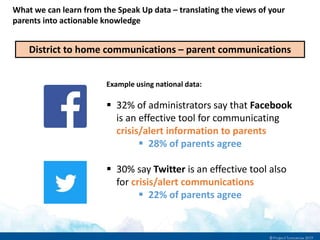
Example using national data:
 32% of administrators say that Facebook
is an effective tool for communicating
crisis/alert information to parents
 28% of parents agree
 30% say Twitter is an effective tool also
for crisis/alert communications
 22% of parents agree
What we can learn from the Speak Up data – translating the views of your
parents into actionable knowledge
District to home communications – parent communications
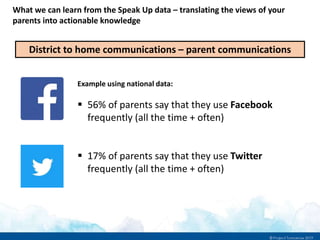
Example using national data:
 56% of parents say that they use Facebook
frequently (all the time + often)
 17% of parents say that they use Twitter
frequently (all the time + often)
What we can learn from the Speak Up data – translating the views of your
parents into actionable knowledge
District to home communications – parent communications
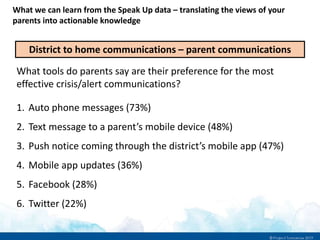
What tools do parents say are their preference for the most
effective crisis/alert communications?
1. Auto phone messages (73%)
2. Text message to a parent’s mobile device (48%)
3. Push notice coming through the district’s mobile app (47%)
4. Mobile app updates (36%)
5. Facebook (28%)
6. Twitter (22%)
What we can learn from the Speak Up data – translating the views of your
parents into actionable knowledge
District to home communications – parent communications
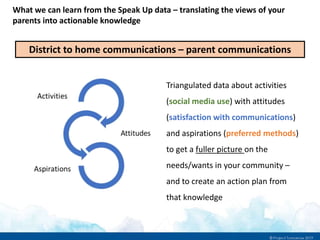
Triangulated data about activities
(social media use) with attitudes
(satisfaction with communications)
and aspirations (preferred methods)
to get a fuller picture on the
needs/wants in your community –
and to create an action plan from
that knowledge
What we can learn from the Speak Up data – translating the views of your
parents into actionable knowledge
District to home communications – parent communications
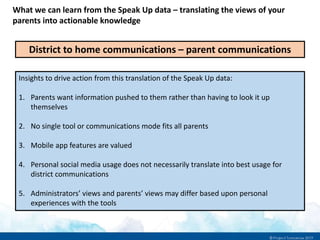
Insights to drive action from this translation of the Speak Up data:
1. Parents want information pushed to them rather than having to look it up
themselves
2. No single tool or communications mode fits all parents
3. Mobile app features are valued
4. Personal social media usage does not necessarily translate into best usage for
district communications
5. Administrators’ views and parents’ views may differ based upon personal
experiences with the tools
• Welcome and introductions
• Refresher course: Speak Up 101
• Key trends we are watching – are you?
• Let’s dive into data!
• Using Speak Up data as a model
• The “Data2Information=Knowledge” Process
• If you only have 20 minutes to look at Speak Up data …
• Other ways we can support your efforts
• Your questions and comments
• Planning for Speak Up 2019-20
Today’s seminar agenda
Let’s dive into data!
What types of data do you and other
education leaders in your district use to
inform planning in your district?
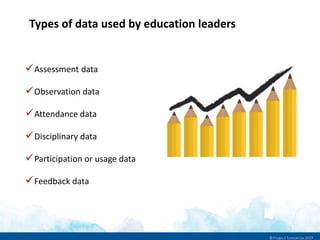
Assessment data
Observation data
Attendance data
Disciplinary data
Participation or usage data
Feedback data
Types of data used by education leaders
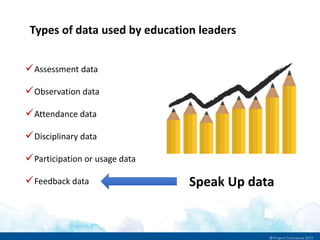
Assessment data
Observation data
Attendance data
Disciplinary data
Participation or usage data
Feedback data
Types of data used by education leaders
Speak Up data
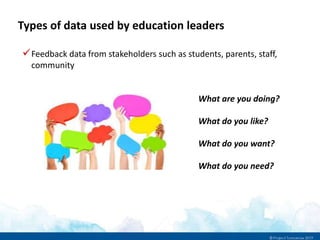
Types of data used by education leaders
Feedback data from stakeholders such as students, parents, staff,
community
What are you doing?
What do you like?
What do you want?
What do you need?
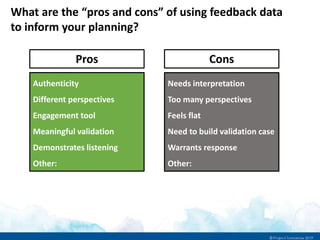
What are the “pros and cons” of using feedback data
to inform your planning?
Pros
Authenticity
Different perspectives
Engagement tool
Meaningful validation
Demonstrates listening
Other:
What are the “pros and cons” of using feedback data
to inform your planning?
Pros
Authenticity
Different perspectives
Engagement tool
Meaningful validation
Demonstrates listening
Other:
Cons
Needs interpretation
Too many perspectives
Feels flat
Need to build validation case
Warrants response
Other:
How do we go from this ….
… to this level of calm using data?
It is all about creating actionable knowledge
from your Speak Up data to inform your
digital learning plans
But how do we do that?
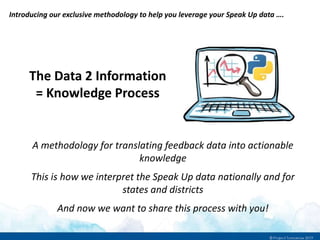
Introducing our exclusive methodology to help you leverage your Speak Up data ….
The Data 2 Information
= Knowledge Process
A methodology for translating feedback data into actionable
knowledge
This is how we interpret the Speak Up data nationally and for
states and districts
And now we want to share this process with you!
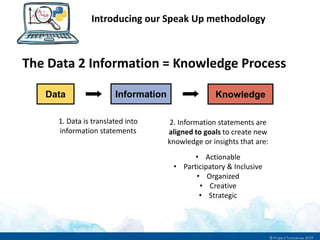
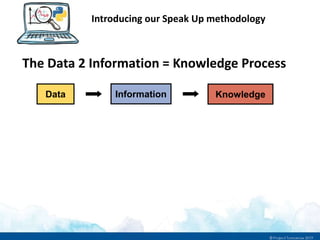
The Data 2 Information = Knowledge Process
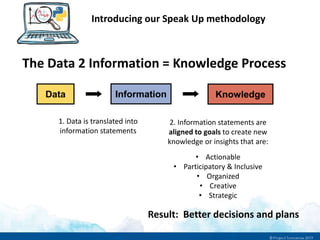
Data Information Knowledge
Introducing our Speak Up methodology
The Data 2 Information = Knowledge Process
Data Information Knowledge
Introducing our Speak Up methodology
1. Data is translated into
information statements
2. Information statements are
aligned to goals to create new
knowledge or insights that are:
• Actionable
• Participatory & Inclusive
• Organized
• Creative
• Strategic
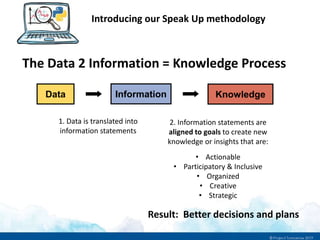
The Data 2 Information = Knowledge Process
Data Information Knowledge
Introducing our Speak Up methodology
1. Data is translated into
information statements
2. Information statements are
aligned to goals to create new
knowledge or insights that are:
• Actionable
• Participatory & Inclusive
• Organized
• Creative
• Strategic
Result: Better decisions and plans
The Data 2 Information = Knowledge Process
Let’s put this process to work . . . using the Speak Up data!
Introducing our Speak Up methodology
The Data 2 Information = Knowledge Process
Introducing our Speak Up methodology
Step 1: aligning the process to your goals – what are your goals?
The Data 2 Information = Knowledge Process
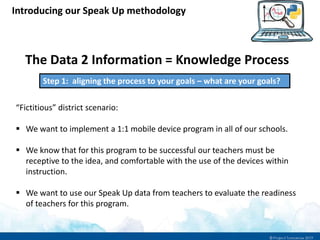
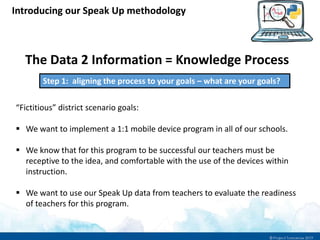
“Fictitious” district scenario:
 We want to implement a 1:1 mobile device program in all of our schools.
 We know that for this program to be successful our teachers must be
receptive to the idea, and comfortable with the use of the devices within
instruction.
 We want to use our Speak Up data from teachers to evaluate the readiness
of teachers for this program.
Introducing our Speak Up methodology
Step 1: aligning the process to your goals – what are your goals?
Introducing our Speak Up methodology
Using Speak Up data for the D2I=K Process
Teacher Data:
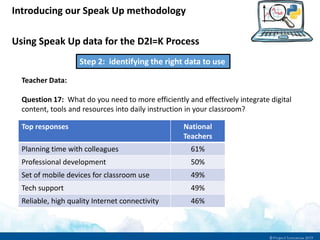
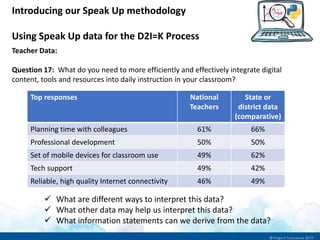
Question 17: What do you need to more efficiently and effectively integrate digital
content, tools and resources into daily instruction in your classroom?
Top responses National
Teachers
Planning time with colleagues 61%
Professional development 50%
Set of mobile devices for classroom use 49%
Tech support 49%
Reliable, high quality Internet connectivity 46%
Step 2: identifying the right data to use
Introducing our Speak Up methodology
Using Speak Up data for the D2I=K Process
Teacher Data:
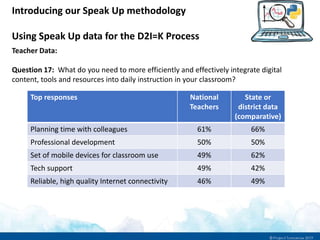
Question 17: What do you need to more efficiently and effectively integrate digital
content, tools and resources into daily instruction in your classroom?
Top responses National
Teachers
State or
district data
(comparative)
Planning time with colleagues 61% 66%
Professional development 50% 50%
Set of mobile devices for classroom use 49% 62%
Tech support 49% 42%
Reliable, high quality Internet connectivity 46% 49%
Introducing our Speak Up methodology
Using Speak Up data for the D2I=K Process
Teacher Data:
Question 17: What do you need to more efficiently and effectively integrate digital
content, tools and resources into daily instruction in your classroom?
Top responses National
Teachers
State or
district data
(comparative)
Planning time with colleagues 61% 66%
Professional development 50% 50%
Set of mobile devices for classroom use 49% 62%
Tech support 49% 42%
Reliable, high quality Internet connectivity 46% 49%
 What are different ways to interpret this data?
 What other data may help us interpret this data?
 What information statements can we derive from the data?
Introducing our Speak Up methodology
Using Speak Up data for the D2I=K Process
Teacher Data:
Question 17: What do you need to more efficiently and effectively integrate digital
content, tools and resources into daily instruction in your classroom?
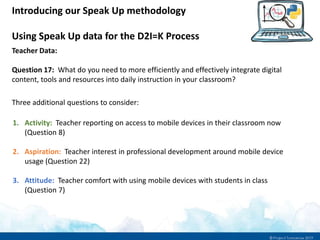
Three additional questions to consider:
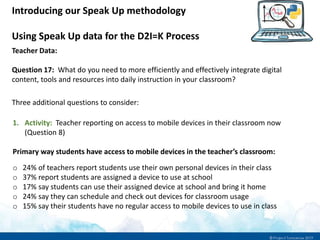
1. Activity: Teacher reporting on access to mobile devices in their classroom now
(Question 8)
2. Aspiration: Teacher interest in professional development around mobile device
usage (Question 22)
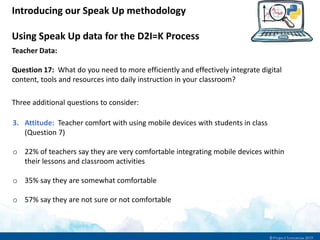
3. Attitude: Teacher comfort with using mobile devices with students in class
(Question 7)
Introducing our Speak Up methodology
Using Speak Up data for the D2I=K Process
Teacher Data:
Question 17: What do you need to more efficiently and effectively integrate digital
content, tools and resources into daily instruction in your classroom?
Three additional questions to consider:
1. Activity: Teacher reporting on access to mobile devices in their classroom now
(Question 8)
Primary way students have access to mobile devices in the teacher’s classroom:
o 24% of teachers report students use their own personal devices in their class
o 37% report students are assigned a device to use at school
o 17% say students can use their assigned device at school and bring it home
o 24% say they can schedule and check out devices for classroom usage
o 15% say their students have no regular access to mobile devices to use in class
Introducing our Speak Up methodology
Using Speak Up data for the D2I=K Process
Teacher Data:
Question 17: What do you need to more efficiently and effectively integrate digital
content, tools and resources into daily instruction in your classroom?
Three additional questions to consider:
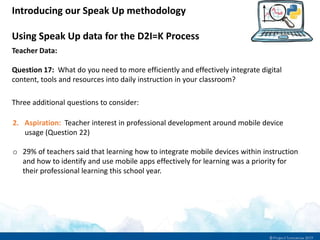
2. Aspiration: Teacher interest in professional development around mobile device
usage (Question 22)
o 29% of teachers said that learning how to integrate mobile devices within instruction
and how to identify and use mobile apps effectively for learning was a priority for
their professional learning this school year.
Introducing our Speak Up methodology
Using Speak Up data for the D2I=K Process
Teacher Data:
Question 17: What do you need to more efficiently and effectively integrate digital
content, tools and resources into daily instruction in your classroom?
Three additional questions to consider:
3. Attitude: Teacher comfort with using mobile devices with students in class
(Question 7)
o 22% of teachers say they are very comfortable integrating mobile devices within
their lessons and classroom activities
o 35% say they are somewhat comfortable
o 57% say they are not sure or not comfortable
Introducing our Speak Up methodology
Using Speak Up data for the D2I=K Process
Teacher Data:
Question 17: What do you need to more efficiently and effectively integrate digital
content, tools and resources into daily instruction in your classroom?
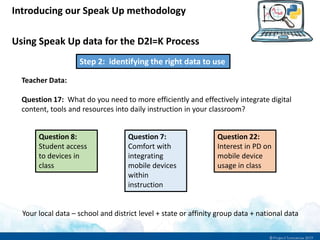
Step 2: identifying the right data to use
Question 8:
Student access
to devices in
class
Question 22:
Interest in PD on
mobile device
usage in class
Question 7:
Comfort with
integrating
mobile devices
within
instruction
Your local data – school and district level + state or affinity group data + national data
Introducing our Speak Up methodology
Using Speak Up data for the D2I=K Process
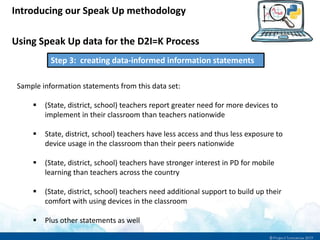
Step 3: creating data-informed information statements
Sample information statements from this data set:
 (State, district, school) teachers report greater need for more devices to
implement in their classroom than teachers nationwide
 State, district, school) teachers have less access and thus less exposure to
device usage in the classroom than their peers nationwide
 (State, district, school) teachers have stronger interest in PD for mobile
learning than teachers across the country
 (State, district, school) teachers need additional support to build up their
comfort with using devices in the classroom
 Plus other statements as well
Introducing our Speak Up methodology
Using Speak Up data for the D2I=K Process
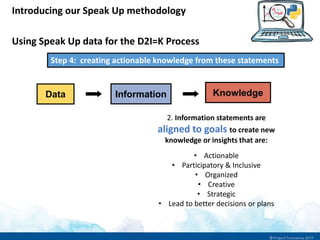
Step 4: creating actionable knowledge from these statements
2. Information statements are
aligned to goals to create new
knowledge or insights that are:
• Actionable
• Participatory & Inclusive
• Organized
• Creative
• Strategic
• Lead to better decisions or plans
Data Information
The Data 2 Information = Knowledge Process
“Fictitious” district scenario goals:
 We want to implement a 1:1 mobile device program in all of our schools.
 We know that for this program to be successful our teachers must be
receptive to the idea, and comfortable with the use of the devices within
instruction.
 We want to use our Speak Up data from teachers to evaluate the readiness
of teachers for this program.
Introducing our Speak Up methodology
Step 1: aligning the process to your goals – what are your goals?
The Data 2 Information = Knowledge Process
Introducing our Speak Up methodology
Step 4: creating actionable knowledge from these statements
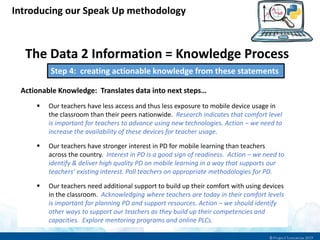
Actionable Knowledge: Translates data into next steps…
 Our teachers have less access and thus less exposure to mobile device usage in
the classroom than their peers nationwide. Research indicates that comfort level
is important for teachers to advance using new technologies. Action – we need to
increase the availability of these devices for teacher usage.
 Our teachers have stronger interest in PD for mobile learning than teachers
across the country. Interest in PD is a good sign of readiness. Action – we need to
identify & deliver high quality PD on mobile learning in a way that supports our
teachers’ existing interest. Poll teachers on appropriate methodologies for PD.
 Our teachers need additional support to build up their comfort with using devices
in the classroom. Acknowledging where teachers are today in their comfort levels
is important for planning PD and support resources. Action – we should identify
other ways to support our teachers as they build up their competencies and
capacities. Explore mentoring programs and online PLCs.
The Data 2 Information = Knowledge Process
Data Information Knowledge
Introducing our Speak Up methodology
1. Data is translated into
information statements
2. Information statements are
aligned to goals to create new
knowledge or insights that are:
• Actionable
• Participatory & Inclusive
• Organized
• Creative
• Strategic
Result: Better decisions and plans
Introducing our exclusive methodology to help you leverage your Speak Up data ….
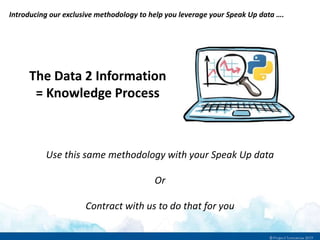
The Data 2 Information
= Knowledge Process
Use this same methodology with your Speak Up data
Or
Contract with us to do that for you
What if you only have 20 minutes
to review your Speak Up data,
what are the key questions to
look at today?
Julie’s tips for a 20 minute Speak Up data review
Big picture advice:
• Pay attention to your goals:
o Why did you participate in Speak Up?
o What did you want to know or validate?
o What audience feedback is valuable for your decisions?
• Your mileage may differ! Pay attention to the comparative data.
• There is no silver bullet here. The data will inform but it will not lead. You
are the leader.
• Participation numbers matter esp. if you want to base your decisions on the
data.
• We can provide additional support. Contact us!
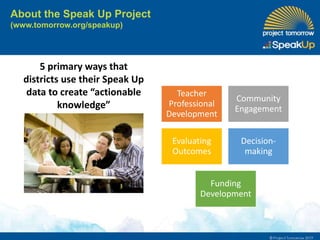
5 primary ways that
districts use their Speak Up
data to create “actionable
knowledge”
About the Speak Up Project
(www.tomorrow.org/speakup)
Teacher
Professional
Development
Community
Engagement
Evaluating
Outcomes
Decision-
making
Funding
Development
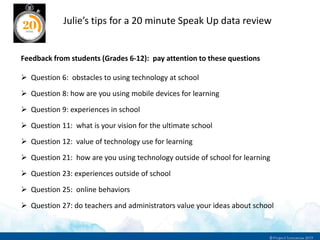
Julie’s tips for a 20 minute Speak Up data review
Feedback from students (Grades 6-12): pay attention to these questions
 Question 6: obstacles to using technology at school
 Question 8: how are you using mobile devices for learning
 Question 9: experiences in school
 Question 11: what is your vision for the ultimate school
 Question 12: value of technology use for learning
 Question 21: how are you using technology outside of school for learning
 Question 23: experiences outside of school
 Question 25: online behaviors
 Question 27: do teachers and administrators value your ideas about school
Julie’s tips for a 20 minute Speak Up data review
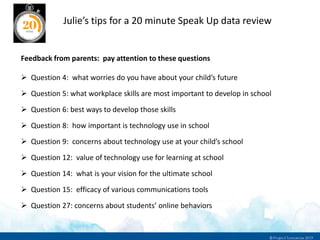
Feedback from parents: pay attention to these questions
 Question 4: what worries do you have about your child’s future
 Question 5: what workplace skills are most important to develop in school
 Question 6: best ways to develop those skills
 Question 8: how important is technology use in school
 Question 9: concerns about technology use at your child’s school
 Question 12: value of technology use for learning at school
 Question 14: what is your vision for the ultimate school
 Question 15: efficacy of various communications tools
 Question 27: concerns about students’ online behaviors
Julie’s tips for a 20 minute Speak Up data review
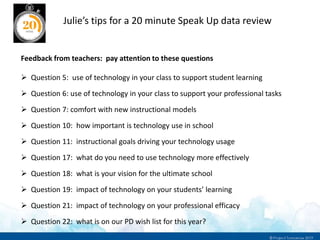
Feedback from teachers: pay attention to these questions
 Question 5: use of technology in your class to support student learning
 Question 6: use of technology in your class to support your professional tasks
 Question 7: comfort with new instructional models
 Question 10: how important is technology use in school
 Question 11: instructional goals driving your technology usage
 Question 17: what do you need to use technology more effectively
 Question 18: what is your vision for the ultimate school
 Question 19: impact of technology on your students’ learning
 Question 21: impact of technology on your professional efficacy
 Question 22: what is on our PD wish list for this year?
One of the most important questions on the Speak Up surveys:
Why you should pay extra attention to this question
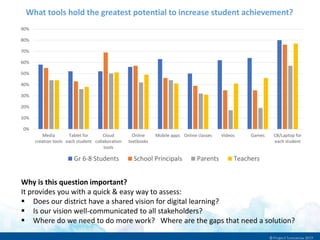
Imagine you were designing a dream school for
today’s students, what tools hold the greatest
potential to increase student achievement
and success?
Aspiration question
Asked across all audiences
Asked every year on the Speak Up surveys
Why is this question important?
It provides you with a quick & easy way to assess:
 Does our district have a shared vision for digital learning?
 Is our vision well-communicated to all stakeholders?
 Where do we need to do more work? Where are the gaps that need a solution?
0%
10%
20%
30%
40%
50%
60%
70%
80%
90%
Media
creation tools
Tablet for
each student
Cloud
collaboration
tools
Online
textbooks
Mobile apps Online classes Videos Games CB/Laptop for
each student
Gr 6-8 Students School Principals Parents Teachers
What tools hold the greatest potential to increase student achievement?
Introducing our exclusive methodology to help you leverage your Speak Up data ….
The Data 2 Information
= Knowledge Process
Your turn to dive
into the Speak
Up data!
Using the Speak Up data to inform your plans
Your homework activities:
• Select specific district goals as the foundation for the analysis work
• Identify the right data that can inform that your goals. Identify the questions
and the audiences that align to those goals.
• Review the data from those questions and then “translate” the data into
information statements about that data
• Using your experiential insights, create knowledge statements that make the
information statements actionable
• Write out 3-4 potential action steps that derive from the statements
• Bring others into your analysis! What do they think? Do they see the same
things?
• Got more questions? Contact us!
• Welcome and introductions
• Refresher course: Speak Up 101
• Key trends we are watching – are you?
• Let’s dive into data!
• Using Speak Up data as a model
• The “Data2Information=Knowledge” Process
• If you only have 20 minutes to look at Speak Up data …
• Other ways we can support your efforts
• Your questions and comments
• Planning for Speak Up 2019-20
Today’s seminar agenda
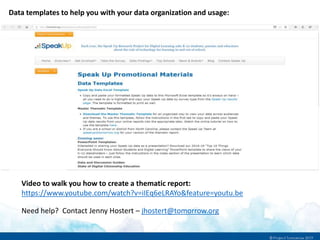
Data templates to help you with your data organization and usage:
Need help? Contact Jenny Hostert – jhostert@tomorrow.org
Video to walk you how to create a thematic report:
https://www.youtube.com/watch?v=iIEq6eLRAYo&feature=youtu.be
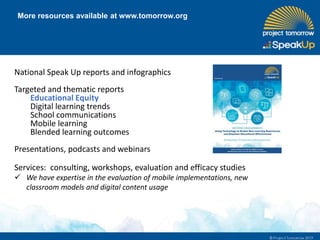
More resources available at www.tomorrow.org
National Speak Up reports and infographics
Targeted and thematic reports
Educational Equity
Digital learning trends
School communications
Mobile learning
Blended learning outcomes
Presentations, podcasts and webinars
Services: consulting, workshops, evaluation and efficacy studies
 We have expertise in the evaluation of mobile implementations, new
classroom models and digital content usage
Examples of additional consulting and workshop services we
can provide to support the effective use of the Speak Up data:
 Expanded version of today’s seminar – a workshop onsite exclusively for your
school or district team
 Additional analytics performed on your data
 Creation of a recommended list of “actions” from our analysis of your data
 Creation of infographics or narrative reports customized to your data
 Presentation of your key findings to your district or community organization
 Other workshops that we offer
o Messaging and metrics
o Communications for effective leadership
Want to explore these with us? Contact Julie Evans – jevans@tomorrow.org
Invitation for your school or district to
continue to participate in Speak Up
through the end of the school year
Online surveys for:
o K-12 students – individual +
group
o Parents – English and Spanish
o Teachers
o Librarians/Media Specialists
o School Site & District
Administrators
o Technology Leaders
o Community Members
Surveys open now through June 28, 2019
Learn more www.tomorrow.org/speakup
Your questions,
thoughts,
comments,
ideas
Let’s talk!
Getting ready for Speak Up 2019-20
Important things for you to know today:
1. Start planning now for your participation in Speak Up 2019-20!
2. Surveys will be open from August 2019 thru June 2020
 Participate when it makes sense for you
 Participate as often as you want – with different stakeholder audiences
3. Surveys include 3 formats now:
 Speak Up 360 – comprehensive, multi-topic surveys for all of your
stakeholder audiences
 Speak Up Snapshots – short, thematic surveys for specific audiences
 Speak Up Flash Indicators – poll type surveys for spot info on a very targeted
topic
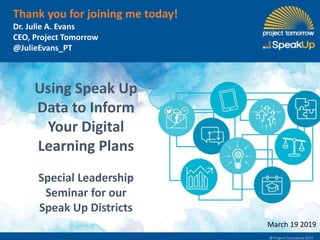
Thank you for joining me today!
Dr. Julie A. Evans
CEO, Project Tomorrow
@JulieEvans_PT
March 19 2019
Using Speak Up
Data to Inform
Your Digital
Learning Plans
Special Leadership
Seminar for our
Speak Up Districts

Using Speak Up Data to Inform Your Digital Learning Plans

  • 1.
    Dr. Julie A.Evans CEO, Project Tomorrow @JulieEvans_PT March 19 2019 Using Speak Up Data to Inform Your Digital Learning Plans Special Leadership Seminar for our Speak Up Districts
  • 2.
    Please share yourname and district name in the chat box! Building our Speak Up professional learning network!
  • 3.
    • Welcome andintroductions • Refresher course: Speak Up 101 • Key trends we are watching – are you? • Let’s dive into data! • Using Speak Up data as a model • The “Data2Information=Knowledge” Process • If you only have 20 minutes to look at Speak Up data … • Other ways we can support your efforts • Your questions and comments • Planning for Speak Up 2019-20 Today’s seminar agenda
  • 4.
     Nonprofit educationorganization supporting K-12 education since 1996  Mission is to ensure today’s students are well prepared for the future  Programs and research focus on role of digital tools within the education ecosystem – believe in power of STEAM to support student preparation for college and career success o Speak Up Research Project on Digital Learning: supporting the development of new leadership capacities within K-12 schools and districts through the effective use of insights and views from K-12 stakeholders About Project Tomorrow
  • 5.
    About the SpeakUp Project (www.tomorrow.org/speakup)  Annual research project since 2003  Facilitated 100% through schools and districts  We design and provide education leaders with a suite of online surveys they can use to collect feedback from their K-12 stakeholders  All K-12 schools – public, private, parochial, charter, virtual - are eligible to participate  Schools get summary report with all locally collected data + state and national data for benchmarks  Project Tomorrow manages all data collection and reporting for schools as a 100% free service
  • 6.
    We are veryproud of our partnerships with these organizations and many others! About the Speak Up Project (www.tomorrow.org/speakup)
  • 7.
    About the SpeakUp Project (www.tomorrow.org/speakup) Standard survey question topics include:  Use of technology to support teaching & learning  School climate for innovation  College and career ready skill development/interest  Leadership challenges  Teachers’ needs for professional learning  How do different stakeholders value digital learning  Emerging trends w/digital tools, content and resources  New classroom models: mobile, blended, flipped  School to home communications  Student safety online & digital citizenship  Designing the ultimate school Since 2003, over 5.7 million K-12 stakeholders have submitted a Speak Up survey
  • 8.
    About the SpeakUp Project (www.tomorrow.org/speakup) New question themes for 2018!  Social emotional learning  School safety – physical, mental health supports, cybersecurity  Computer programming and coding – why important to learn?  STEAM topics - exploration outside of school  Student online behavior concerns  Professional development modalities and evidence of competency  Longevity of mobile devices  Students’ experiences with YouTube  Social media access through district networks  Teacher referrals of digital content
  • 9.
    Survey questions coverthree vectors: Activities: how are education stakeholders using technology? Attitudes: how do they value those learning experiences? Aspirations: how would they like to use technology for learning? About the Speak Up Project (www.tomorrow.org/speakup)
  • 10.
    Activities: how are education stakeholdersusing technology? Attitudes: how do they value those learning experiences? Aspirations: how would they like to use technology for learning? About the Speak Up Project (www.tomorrow.org/speakup)  How are you using mobile devices for learning?  How often do you use videos in your classroom?  What is your home Internet status?  What are the benefits of digital learning for you?  What determines quality in digital content?  What concerns you about your child’s technology use?  What tech is essential for your dream school?  What is on your wish list for PD this year?  What is best way for child to learn C/CR skills?
  • 11.
    Survey questions coverthree vectors: About the Speak Up Project (www.tomorrow.org/speakup) Translation of the data into actionable knowledge requires triangulation of all three vectors of data, across audiences, and over time
  • 12.
    5 primary waysthat districts use their Speak Up data to create “actionable knowledge” About the Speak Up Project (www.tomorrow.org/speakup) Teacher Professional Development Community Engagement Evaluating Outcomes Decision- making Funding Development
  • 13.
    Leveraging your SpeakUp Project data to inform new discussions and better decision-making around digital learning plans “Without data, you are just another person with an opinion …”
  • 14.
    What do yousee? Are we all seeing the same thing today? Are our students, parents and teachers seeing different things than we do? How can we use the feedback from our stakeholders to improve our sight?
  • 15.
    • Welcome andintroductions • Refresher course: Speak Up 101 • Key trends we are watching – are you? • Let’s dive into data! • Using Speak Up data as a model • The “Data2Information=Knowledge” Process • If you only have 20 minutes to look at Speak Up data … • Other ways we can support your efforts • Your questions and comments • Planning for Speak Up 2019-20 Today’s seminar agenda
  • 16.
    Key trends fromthe Speak Up Research • Greater emphasis on linking technology to students’ global skill preparation • Interest, acceptance and implementation of new learning models • Students’ self-directed digital learning outside of school influencing their expectations for school • Meet the new digital parent – with their new demands & higher aspirations • Thinking beyond engagement to understanding tangible outcomes from digital learning • Increasing criticality for Internet connectivity – at school and at home • Digital connectivity as a social justice issue • Connections between leadership and digital effectiveness • Digital learning is really a metaphor today for education transformation
  • 17.
    Key trends fromthe Speak Up Research • Greater emphasis on linking technology to students’ global skill preparation • Interest, acceptance and implementation of new learning models • Students’ self-directed digital learning outside of school influencing their expectations for school • Meet the new digital parent – with their new demands & higher aspirations • Thinking beyond engagement to understanding tangible outcomes from digital learning • Increasing criticality for Internet connectivity – at school and at home • Digital connectivity as a social justice issue • Connections between leadership and digital effectiveness • Digital learning is really a metaphor today for education transformation
  • 18.
    What we canlearn from the Speak Up data – translating the views of your parents into actionable knowledge District to home communications – parent communications
  • 19.
    What we canlearn from the Speak Up data – translating the views of your parents into actionable knowledge District to home communications – parent communications Example using national data:  44% of parents say they are very satisfied with crisis/alert communications from their school district (an additional 28% say they are “satisfied”)
  • 20.
    What we canlearn from the Speak Up data – translating the views of your parents into actionable knowledge District to home communications – parent communications Example using national data:  32% of administrators say that Facebook is an effective tool for communicating crisis/alert information to parents  30% say Twitter is an effective tool also for crisis/alert communications
  • 21.
    What we canlearn from the Speak Up data – translating the views of your parents into actionable knowledge District to home communications – parent communications Example using national data:  32% of administrators say that Facebook is an effective tool for communicating crisis/alert information to parents  28% of parents agree  30% say Twitter is an effective tool also for crisis/alert communications  22% of parents agree
  • 22.
    What we canlearn from the Speak Up data – translating the views of your parents into actionable knowledge District to home communications – parent communications Example using national data:  56% of parents say that they use Facebook frequently (all the time + often)  17% of parents say that they use Twitter frequently (all the time + often)
  • 23.
    What we canlearn from the Speak Up data – translating the views of your parents into actionable knowledge District to home communications – parent communications What tools do parents say are their preference for the most effective crisis/alert communications? 1. Auto phone messages (73%) 2. Text message to a parent’s mobile device (48%) 3. Push notice coming through the district’s mobile app (47%) 4. Mobile app updates (36%) 5. Facebook (28%) 6. Twitter (22%)
  • 24.
    What we canlearn from the Speak Up data – translating the views of your parents into actionable knowledge District to home communications – parent communications Triangulated data about activities (social media use) with attitudes (satisfaction with communications) and aspirations (preferred methods) to get a fuller picture on the needs/wants in your community – and to create an action plan from that knowledge
  • 25.
    What we canlearn from the Speak Up data – translating the views of your parents into actionable knowledge District to home communications – parent communications Insights to drive action from this translation of the Speak Up data: 1. Parents want information pushed to them rather than having to look it up themselves 2. No single tool or communications mode fits all parents 3. Mobile app features are valued 4. Personal social media usage does not necessarily translate into best usage for district communications 5. Administrators’ views and parents’ views may differ based upon personal experiences with the tools
  • 26.
    • Welcome andintroductions • Refresher course: Speak Up 101 • Key trends we are watching – are you? • Let’s dive into data! • Using Speak Up data as a model • The “Data2Information=Knowledge” Process • If you only have 20 minutes to look at Speak Up data … • Other ways we can support your efforts • Your questions and comments • Planning for Speak Up 2019-20 Today’s seminar agenda
  • 27.
  • 28.
    What types ofdata do you and other education leaders in your district use to inform planning in your district?
  • 29.
    Assessment data Observation data Attendancedata Disciplinary data Participation or usage data Feedback data Types of data used by education leaders
  • 30.
    Assessment data Observation data Attendancedata Disciplinary data Participation or usage data Feedback data Types of data used by education leaders Speak Up data
  • 31.
    Types of dataused by education leaders Feedback data from stakeholders such as students, parents, staff, community What are you doing? What do you like? What do you want? What do you need?
  • 32.
    What are the“pros and cons” of using feedback data to inform your planning? Pros Authenticity Different perspectives Engagement tool Meaningful validation Demonstrates listening Other:
  • 33.
    What are the“pros and cons” of using feedback data to inform your planning? Pros Authenticity Different perspectives Engagement tool Meaningful validation Demonstrates listening Other: Cons Needs interpretation Too many perspectives Feels flat Need to build validation case Warrants response Other:
  • 34.
    How do wego from this ….
  • 35.
    … to thislevel of calm using data?
  • 36.
    It is allabout creating actionable knowledge from your Speak Up data to inform your digital learning plans But how do we do that?
  • 37.
    Introducing our exclusivemethodology to help you leverage your Speak Up data …. The Data 2 Information = Knowledge Process A methodology for translating feedback data into actionable knowledge This is how we interpret the Speak Up data nationally and for states and districts And now we want to share this process with you!
  • 38.
    The Data 2Information = Knowledge Process Data Information Knowledge Introducing our Speak Up methodology
  • 39.
    The Data 2Information = Knowledge Process Data Information Knowledge Introducing our Speak Up methodology 1. Data is translated into information statements 2. Information statements are aligned to goals to create new knowledge or insights that are: • Actionable • Participatory & Inclusive • Organized • Creative • Strategic
  • 40.
    The Data 2Information = Knowledge Process Data Information Knowledge Introducing our Speak Up methodology 1. Data is translated into information statements 2. Information statements are aligned to goals to create new knowledge or insights that are: • Actionable • Participatory & Inclusive • Organized • Creative • Strategic Result: Better decisions and plans
  • 41.
    The Data 2Information = Knowledge Process Let’s put this process to work . . . using the Speak Up data! Introducing our Speak Up methodology
  • 42.
    The Data 2Information = Knowledge Process Introducing our Speak Up methodology Step 1: aligning the process to your goals – what are your goals?
  • 43.
    The Data 2Information = Knowledge Process “Fictitious” district scenario:  We want to implement a 1:1 mobile device program in all of our schools.  We know that for this program to be successful our teachers must be receptive to the idea, and comfortable with the use of the devices within instruction.  We want to use our Speak Up data from teachers to evaluate the readiness of teachers for this program. Introducing our Speak Up methodology Step 1: aligning the process to your goals – what are your goals?
  • 44.
    Introducing our SpeakUp methodology Using Speak Up data for the D2I=K Process Teacher Data: Question 17: What do you need to more efficiently and effectively integrate digital content, tools and resources into daily instruction in your classroom? Top responses National Teachers Planning time with colleagues 61% Professional development 50% Set of mobile devices for classroom use 49% Tech support 49% Reliable, high quality Internet connectivity 46% Step 2: identifying the right data to use
  • 45.
    Introducing our SpeakUp methodology Using Speak Up data for the D2I=K Process Teacher Data: Question 17: What do you need to more efficiently and effectively integrate digital content, tools and resources into daily instruction in your classroom? Top responses National Teachers State or district data (comparative) Planning time with colleagues 61% 66% Professional development 50% 50% Set of mobile devices for classroom use 49% 62% Tech support 49% 42% Reliable, high quality Internet connectivity 46% 49%
  • 46.
    Introducing our SpeakUp methodology Using Speak Up data for the D2I=K Process Teacher Data: Question 17: What do you need to more efficiently and effectively integrate digital content, tools and resources into daily instruction in your classroom? Top responses National Teachers State or district data (comparative) Planning time with colleagues 61% 66% Professional development 50% 50% Set of mobile devices for classroom use 49% 62% Tech support 49% 42% Reliable, high quality Internet connectivity 46% 49%  What are different ways to interpret this data?  What other data may help us interpret this data?  What information statements can we derive from the data?
  • 47.
    Introducing our SpeakUp methodology Using Speak Up data for the D2I=K Process Teacher Data: Question 17: What do you need to more efficiently and effectively integrate digital content, tools and resources into daily instruction in your classroom? Three additional questions to consider: 1. Activity: Teacher reporting on access to mobile devices in their classroom now (Question 8) 2. Aspiration: Teacher interest in professional development around mobile device usage (Question 22) 3. Attitude: Teacher comfort with using mobile devices with students in class (Question 7)
  • 48.
    Introducing our SpeakUp methodology Using Speak Up data for the D2I=K Process Teacher Data: Question 17: What do you need to more efficiently and effectively integrate digital content, tools and resources into daily instruction in your classroom? Three additional questions to consider: 1. Activity: Teacher reporting on access to mobile devices in their classroom now (Question 8) Primary way students have access to mobile devices in the teacher’s classroom: o 24% of teachers report students use their own personal devices in their class o 37% report students are assigned a device to use at school o 17% say students can use their assigned device at school and bring it home o 24% say they can schedule and check out devices for classroom usage o 15% say their students have no regular access to mobile devices to use in class
  • 49.
    Introducing our SpeakUp methodology Using Speak Up data for the D2I=K Process Teacher Data: Question 17: What do you need to more efficiently and effectively integrate digital content, tools and resources into daily instruction in your classroom? Three additional questions to consider: 2. Aspiration: Teacher interest in professional development around mobile device usage (Question 22) o 29% of teachers said that learning how to integrate mobile devices within instruction and how to identify and use mobile apps effectively for learning was a priority for their professional learning this school year.
  • 50.
    Introducing our SpeakUp methodology Using Speak Up data for the D2I=K Process Teacher Data: Question 17: What do you need to more efficiently and effectively integrate digital content, tools and resources into daily instruction in your classroom? Three additional questions to consider: 3. Attitude: Teacher comfort with using mobile devices with students in class (Question 7) o 22% of teachers say they are very comfortable integrating mobile devices within their lessons and classroom activities o 35% say they are somewhat comfortable o 57% say they are not sure or not comfortable
  • 51.
    Introducing our SpeakUp methodology Using Speak Up data for the D2I=K Process Teacher Data: Question 17: What do you need to more efficiently and effectively integrate digital content, tools and resources into daily instruction in your classroom? Step 2: identifying the right data to use Question 8: Student access to devices in class Question 22: Interest in PD on mobile device usage in class Question 7: Comfort with integrating mobile devices within instruction Your local data – school and district level + state or affinity group data + national data
  • 52.
    Introducing our SpeakUp methodology Using Speak Up data for the D2I=K Process Step 3: creating data-informed information statements Sample information statements from this data set:  (State, district, school) teachers report greater need for more devices to implement in their classroom than teachers nationwide  State, district, school) teachers have less access and thus less exposure to device usage in the classroom than their peers nationwide  (State, district, school) teachers have stronger interest in PD for mobile learning than teachers across the country  (State, district, school) teachers need additional support to build up their comfort with using devices in the classroom  Plus other statements as well
  • 53.
    Introducing our SpeakUp methodology Using Speak Up data for the D2I=K Process Step 4: creating actionable knowledge from these statements 2. Information statements are aligned to goals to create new knowledge or insights that are: • Actionable • Participatory & Inclusive • Organized • Creative • Strategic • Lead to better decisions or plans Data Information
  • 54.
    The Data 2Information = Knowledge Process “Fictitious” district scenario goals:  We want to implement a 1:1 mobile device program in all of our schools.  We know that for this program to be successful our teachers must be receptive to the idea, and comfortable with the use of the devices within instruction.  We want to use our Speak Up data from teachers to evaluate the readiness of teachers for this program. Introducing our Speak Up methodology Step 1: aligning the process to your goals – what are your goals?
  • 55.
    The Data 2Information = Knowledge Process Introducing our Speak Up methodology Step 4: creating actionable knowledge from these statements Actionable Knowledge: Translates data into next steps…  Our teachers have less access and thus less exposure to mobile device usage in the classroom than their peers nationwide. Research indicates that comfort level is important for teachers to advance using new technologies. Action – we need to increase the availability of these devices for teacher usage.  Our teachers have stronger interest in PD for mobile learning than teachers across the country. Interest in PD is a good sign of readiness. Action – we need to identify & deliver high quality PD on mobile learning in a way that supports our teachers’ existing interest. Poll teachers on appropriate methodologies for PD.  Our teachers need additional support to build up their comfort with using devices in the classroom. Acknowledging where teachers are today in their comfort levels is important for planning PD and support resources. Action – we should identify other ways to support our teachers as they build up their competencies and capacities. Explore mentoring programs and online PLCs.
  • 56.
    The Data 2Information = Knowledge Process Data Information Knowledge Introducing our Speak Up methodology 1. Data is translated into information statements 2. Information statements are aligned to goals to create new knowledge or insights that are: • Actionable • Participatory & Inclusive • Organized • Creative • Strategic Result: Better decisions and plans
  • 57.
    Introducing our exclusivemethodology to help you leverage your Speak Up data …. The Data 2 Information = Knowledge Process Use this same methodology with your Speak Up data Or Contract with us to do that for you
  • 58.
    What if youonly have 20 minutes to review your Speak Up data, what are the key questions to look at today?
  • 59.
    Julie’s tips fora 20 minute Speak Up data review Big picture advice: • Pay attention to your goals: o Why did you participate in Speak Up? o What did you want to know or validate? o What audience feedback is valuable for your decisions? • Your mileage may differ! Pay attention to the comparative data. • There is no silver bullet here. The data will inform but it will not lead. You are the leader. • Participation numbers matter esp. if you want to base your decisions on the data. • We can provide additional support. Contact us!
  • 60.
    5 primary waysthat districts use their Speak Up data to create “actionable knowledge” About the Speak Up Project (www.tomorrow.org/speakup) Teacher Professional Development Community Engagement Evaluating Outcomes Decision- making Funding Development
  • 61.
    Julie’s tips fora 20 minute Speak Up data review Feedback from students (Grades 6-12): pay attention to these questions  Question 6: obstacles to using technology at school  Question 8: how are you using mobile devices for learning  Question 9: experiences in school  Question 11: what is your vision for the ultimate school  Question 12: value of technology use for learning  Question 21: how are you using technology outside of school for learning  Question 23: experiences outside of school  Question 25: online behaviors  Question 27: do teachers and administrators value your ideas about school
  • 62.
    Julie’s tips fora 20 minute Speak Up data review Feedback from parents: pay attention to these questions  Question 4: what worries do you have about your child’s future  Question 5: what workplace skills are most important to develop in school  Question 6: best ways to develop those skills  Question 8: how important is technology use in school  Question 9: concerns about technology use at your child’s school  Question 12: value of technology use for learning at school  Question 14: what is your vision for the ultimate school  Question 15: efficacy of various communications tools  Question 27: concerns about students’ online behaviors
  • 63.
    Julie’s tips fora 20 minute Speak Up data review Feedback from teachers: pay attention to these questions  Question 5: use of technology in your class to support student learning  Question 6: use of technology in your class to support your professional tasks  Question 7: comfort with new instructional models  Question 10: how important is technology use in school  Question 11: instructional goals driving your technology usage  Question 17: what do you need to use technology more effectively  Question 18: what is your vision for the ultimate school  Question 19: impact of technology on your students’ learning  Question 21: impact of technology on your professional efficacy  Question 22: what is on our PD wish list for this year?
  • 64.
    One of themost important questions on the Speak Up surveys: Why you should pay extra attention to this question
  • 65.
    Imagine you weredesigning a dream school for today’s students, what tools hold the greatest potential to increase student achievement and success? Aspiration question Asked across all audiences Asked every year on the Speak Up surveys
  • 66.
    Why is thisquestion important? It provides you with a quick & easy way to assess:  Does our district have a shared vision for digital learning?  Is our vision well-communicated to all stakeholders?  Where do we need to do more work? Where are the gaps that need a solution? 0% 10% 20% 30% 40% 50% 60% 70% 80% 90% Media creation tools Tablet for each student Cloud collaboration tools Online textbooks Mobile apps Online classes Videos Games CB/Laptop for each student Gr 6-8 Students School Principals Parents Teachers What tools hold the greatest potential to increase student achievement?
  • 67.
    Introducing our exclusivemethodology to help you leverage your Speak Up data …. The Data 2 Information = Knowledge Process Your turn to dive into the Speak Up data!
  • 68.
    Using the SpeakUp data to inform your plans Your homework activities: • Select specific district goals as the foundation for the analysis work • Identify the right data that can inform that your goals. Identify the questions and the audiences that align to those goals. • Review the data from those questions and then “translate” the data into information statements about that data • Using your experiential insights, create knowledge statements that make the information statements actionable • Write out 3-4 potential action steps that derive from the statements • Bring others into your analysis! What do they think? Do they see the same things? • Got more questions? Contact us!
  • 69.
    • Welcome andintroductions • Refresher course: Speak Up 101 • Key trends we are watching – are you? • Let’s dive into data! • Using Speak Up data as a model • The “Data2Information=Knowledge” Process • If you only have 20 minutes to look at Speak Up data … • Other ways we can support your efforts • Your questions and comments • Planning for Speak Up 2019-20 Today’s seminar agenda
  • 70.
    Data templates tohelp you with your data organization and usage: Need help? Contact Jenny Hostert – jhostert@tomorrow.org Video to walk you how to create a thematic report: https://www.youtube.com/watch?v=iIEq6eLRAYo&feature=youtu.be
  • 71.
    More resources availableat www.tomorrow.org National Speak Up reports and infographics Targeted and thematic reports Educational Equity Digital learning trends School communications Mobile learning Blended learning outcomes Presentations, podcasts and webinars Services: consulting, workshops, evaluation and efficacy studies  We have expertise in the evaluation of mobile implementations, new classroom models and digital content usage
  • 72.
    Examples of additionalconsulting and workshop services we can provide to support the effective use of the Speak Up data:  Expanded version of today’s seminar – a workshop onsite exclusively for your school or district team  Additional analytics performed on your data  Creation of a recommended list of “actions” from our analysis of your data  Creation of infographics or narrative reports customized to your data  Presentation of your key findings to your district or community organization  Other workshops that we offer o Messaging and metrics o Communications for effective leadership Want to explore these with us? Contact Julie Evans – jevans@tomorrow.org
  • 73.
    Invitation for yourschool or district to continue to participate in Speak Up through the end of the school year Online surveys for: o K-12 students – individual + group o Parents – English and Spanish o Teachers o Librarians/Media Specialists o School Site & District Administrators o Technology Leaders o Community Members Surveys open now through June 28, 2019 Learn more www.tomorrow.org/speakup
  • 74.
  • 75.
    Getting ready forSpeak Up 2019-20 Important things for you to know today: 1. Start planning now for your participation in Speak Up 2019-20! 2. Surveys will be open from August 2019 thru June 2020  Participate when it makes sense for you  Participate as often as you want – with different stakeholder audiences 3. Surveys include 3 formats now:  Speak Up 360 – comprehensive, multi-topic surveys for all of your stakeholder audiences  Speak Up Snapshots – short, thematic surveys for specific audiences  Speak Up Flash Indicators – poll type surveys for spot info on a very targeted topic
  • 76.
    Thank you forjoining me today! Dr. Julie A. Evans CEO, Project Tomorrow @JulieEvans_PT March 19 2019 Using Speak Up Data to Inform Your Digital Learning Plans Special Leadership Seminar for our Speak Up Districts