Alabama Speaks Up!
Speak Up 2012 Data Results
Planning for Speak Up 2013
Julie Evans, Project Tomorrow CEO
September 30, 2013
Today’s discussion – the big questions:


What are some realities about ed tech in our schools
today – from the perspective of Alabama students,
parents, teachers & administrators?



Do we have a shared vision for digital learning?



What are the big trends to watch?



How can your district participate in Speak Up 2013?

© 2013 Project Tomorrow
Today’s discussion – the big questions:


What are some realities about ed tech in our schools
today – from the perspective of Alabama students,
parents, teachers & administrators?



Do we have a shared vision for digital learning?



What are the big trends to watch?



How can your district participate in Speak Up 2013?

Use the 2012 data to demonstrate
value of participation
© 2013 Project Tomorrow
Project Tomorrow, a national
education nonprofit organization
Programs:

• Research & evaluation studies
• School and community programs
• Events for students
Mission: To ensure that today’s
students are prepared to become
tomorrow’s leaders, innovators and
engaged citizens of the world.
© 2013 Project Tomorrow
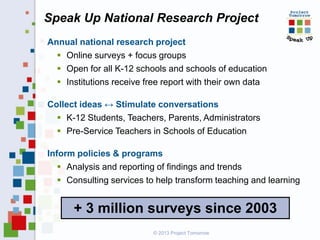
Speak Up National Research Project
Annual national research project
 Online surveys + focus groups
 Open for all K-12 schools and schools of education
 Institutions receive free report with their own data
Collect ideas ↔ Stimulate conversations
 K-12 Students, Teachers, Parents, Administrators
 Pre-Service Teachers in Schools of Education
Inform policies & programs
 Analysis and reporting of findings and trends
 Consulting services to help transform teaching and learning

+ 3 million surveys since 2003
© 2013 Project Tomorrow
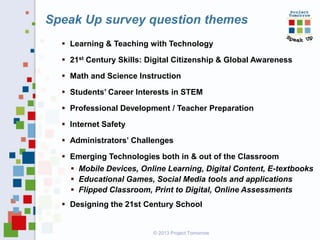
Speak Up survey question themes
 Learning & Teaching with Technology
 21st Century Skills: Digital Citizenship & Global Awareness
 Math and Science Instruction
 Students’ Career Interests in STEM
 Professional Development / Teacher Preparation
 Internet Safety

 Administrators’ Challenges
 Emerging Technologies both in & out of the Classroom
 Mobile Devices, Online Learning, Digital Content, E-textbooks
 Educational Games, Social Media tools and applications
 Flipped Classroom, Print to Digital, Online Assessments
 Designing the 21st Century School
© 2013 Project Tomorrow
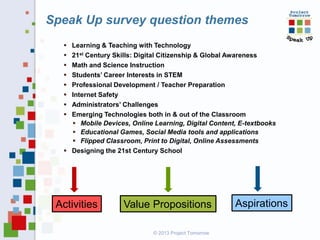
Speak Up survey question themes









Learning & Teaching with Technology
21st Century Skills: Digital Citizenship & Global Awareness
Math and Science Instruction
Students’ Career Interests in STEM
Professional Development / Teacher Preparation
Internet Safety
Administrators’ Challenges
Emerging Technologies both in & out of the Classroom
 Mobile Devices, Online Learning, Digital Content, E-textbooks
 Educational Games, Social Media tools and applications
 Flipped Classroom, Print to Digital, Online Assessments
 Designing the 21st Century School

Activities

Value Propositions
© 2013 Project Tomorrow

Aspirations
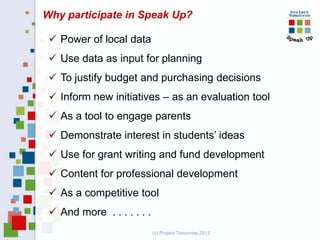
Why participate in Speak Up?
 Power of local data
 Use data as input for planning
 To justify budget and purchasing decisions
 Inform new initiatives – as an evaluation tool
.
 As a tool to engage parents

 Demonstrate interest in students’ ideas
 Use for grant writing and fund development
 Content for professional development

 As a competitive tool
 And more . . . . . . .
(c) Project Tomorrow 2013
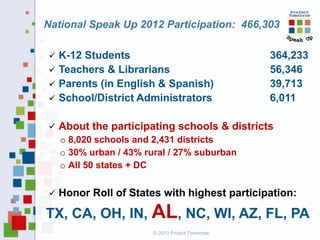
National Speak Up 2012 Participation: 466,303


K-12 Students
 Teachers & Librarians
 Parents (in English & Spanish)
 School/District Administrators


364,233
56,346
39,713
6,011

About the participating schools & districts
o 8,020 schools and 2,431 districts
o 30% urban / 43% rural / 27% suburban
o All 50 states + DC



Honor Roll of States with highest participation:

TX, CA, OH, IN, AL, NC, WI, AZ, FL, PA
© 2013 Project Tomorrow
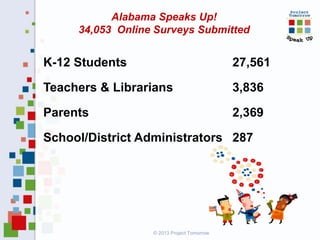
Alabama Speaks Up!
34,053 Online Surveys Submitted

K-12 Students

27,561

Teachers & Librarians

3,836

Parents

2,369

School/District Administrators 287

© 2013 Project Tomorrow
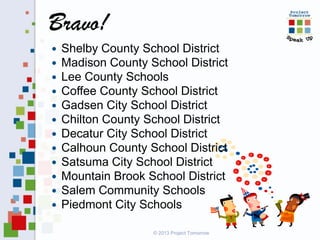
Bravo!













Shelby County School District
Madison County School District
Lee County Schools
Coffee County School District
Gadsen City School District
Chilton County School District
Decatur City School District
Calhoun County School District
Satsuma City School District
Mountain Brook School District
Salem Community Schools
Piedmont City Schools
© 2013 Project Tomorrow
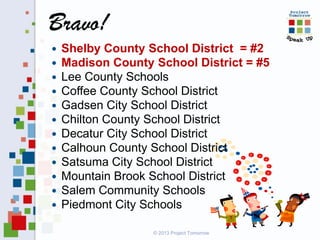
Bravo!













Shelby County School District = #2
Madison County School District = #5
Lee County Schools
Coffee County School District
Gadsen City School District
Chilton County School District
Decatur City School District
Calhoun County School District
Satsuma City School District
Mountain Brook School District
Salem Community Schools
Piedmont City Schools
© 2013 Project Tomorrow
Speak Up 2012
National Reports
© 2013 Project Tomorrow
Digital Conversion

Personalized
Learning
K-12 Digital Learner
Speak Up 2012 National Findings
From Chalkboards to Tablets

Digital Conversion

A shift in what we do, but
also our attitudes and
values
(c) Project Tomorrow 2013
Speak Up 2012 National Findings
From Chalkboards to Tablets

Digital Conversion

Why the new momentum in
K-12 education?

(c) Project Tomorrow 2013
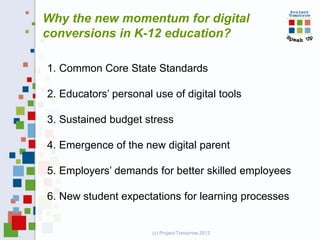
Why the new momentum for digital
conversions in K-12 education?
1. Common Core State Standards
2. Educators’ personal use of digital tools
3. Sustained budget stress
4. Emergence of the new digital parent
5. Employers’ demands for better skilled employees
6. New student expectations for learning processes

(c) Project Tomorrow 2013
What can the Speak Up
findings tell us about the

future of learning?

© 2013 Project Tomorrow
Speak Up National Findings: 2003 - 2012


Students function as a “Digital Advance Team”



Students regularly adopt and adapt emerging
technologies for learning



Students’ frustrations focus on the unsophisticated
use of technologies within education



Persistent digital disconnect between students and

adults


Exacerbation of lack of relevancy in current
education



Students want a more personalized learning
environment
© 2013 Project Tomorrow
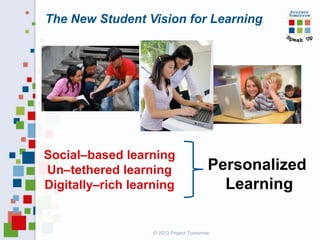
The New Student Vision for Learning

Social–based learning
Un–tethered learning
Digitally–rich learning

Personalized
Learning

© 2013 Project Tomorrow
Personalizing learning
through digital tools

8 things you need
to know about
ed tech in Alabama
(with some bonus
data!)
© 2013 Project Tomorrow
Be a Speak Up Analyst!

Your assignment:
 Debunk myths
 Uncover hidden digital divides
 Evaluate your vision
 Do you have a shared vision
of the future?
 How can the Speak Up data
help you?

(c) Project Tomorrow 2013
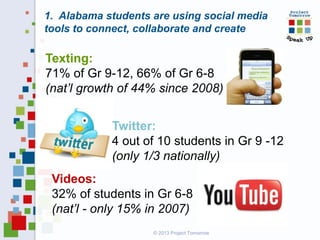
1. Alabama students are using social media
tools to connect, collaborate and create

Texting:
71% of Gr 9-12, 66% of Gr 6-8
(nat’l growth of 44% since 2008)
Twitter:
4 out of 10 students in Gr 9 -12
(only 1/3 nationally)
Videos:
32% of students in Gr 6-8
(nat’l - only 15% in 2007)
© 2013 Project Tomorrow
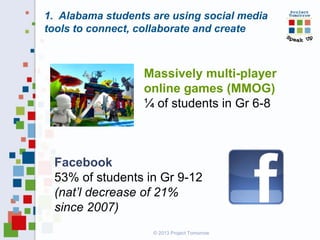
1. Alabama students are using social media
tools to connect, collaborate and create

Massively multi-player
online games (MMOG)
¼ of students in Gr 6-8

Facebook
53% of students in Gr 9-12
(nat’l decrease of 21%
since 2007)
© 2013 Project Tomorrow
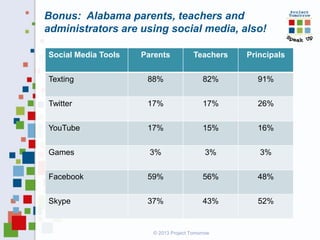
Bonus: Alabama parents, teachers and
administrators are using social media, also!
Social Media Tools

Parents

Teachers

Principals

Texting

88%

82%

91%

Twitter

17%

17%

26%

YouTube

17%

15%

16%

Games

3%

3%

3%

Facebook

59%

56%

48%

Skype

37%

43%

52%

© 2013 Project Tomorrow
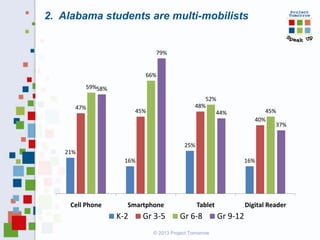
2. Alabama students are multi-mobilists

79%

66%
59%58%
47%

52%
48%
44%

45%

45%
40%
37%

25%
21%
16%

Cell Phone

16%

Smartphone

K-2

Gr 3-5

Tablet

Gr 6-8

© 2013 Project Tomorrow

Digital Reader

Gr 9-12
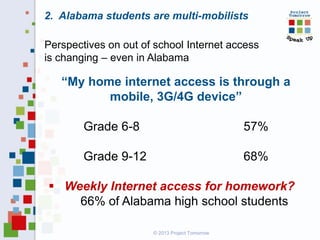
2. Alabama students are multi-mobilists
Perspectives on out of school Internet access
is changing – even in Alabama

“My home internet access is through a
mobile, 3G/4G device”
Grade 6-8

57%

Grade 9-12

68%

 Weekly Internet access for homework?
66% of Alabama high school students
© 2013 Project Tomorrow
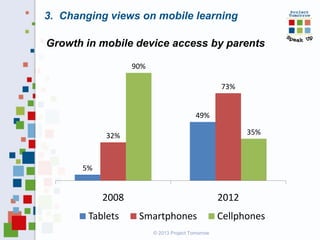
3. Changing views on mobile learning
Growth in mobile device access by parents
90%
73%

49%
35%

32%

5%

2008
Tablets

2012
Smartphones
© 2013 Project Tomorrow

Cellphones
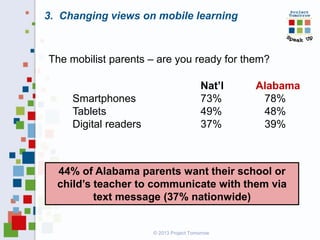
3. Changing views on mobile learning

The mobilist parents – are you ready for them?

Smartphones
Tablets
Digital readers

Nat’l
73%
49%
37%

Alabama
78%
48%
39%

44% of Alabama parents want their school or
child’s teacher to communicate with them via
text message (37% nationwide)

© 2013 Project Tomorrow
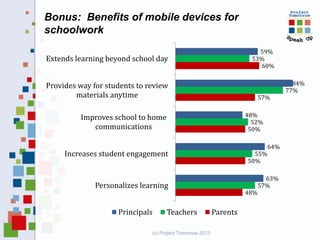
Bonus: Benefits of mobile devices for
schoolwork
59%
53%
60%

Extends learning beyond school day
Provides way for students to review
materials anytime

57%
48%
52%
50%

Improves school to home
communications
Increases student engagement

55%
50%

Personalizes learning
Principals

Teachers

(c) Project Tomorrow 2013

48%

Parents

64%

63%
57%

84%
77%
4. The BYOD story

New Speak Up Question on the 2012 survey:

Parents: What if there were two classes – one
allowed use of student owned devices and one
did not . . . .
How likely is it that you would want your
child in the class that allowed the devices?

© 2013 Project Tomorrow
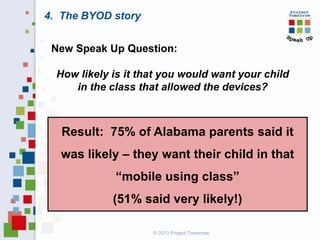
4. The BYOD story
New Speak Up Question:
How likely is it that you would want your child
in the class that allowed the devices?

Result: 75% of Alabama parents said it
was likely – they want their child in that
“mobile using class”

(51% said very likely!)
© 2013 Project Tomorrow
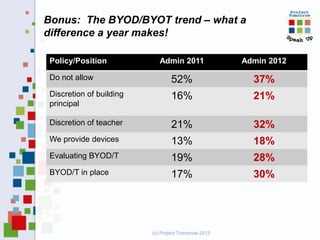
Bonus: The BYOD/BYOT trend – what a
difference a year makes!
Policy/Position

Admin 2011

Admin 2012

Do not allow

52%

37%

Discretion of building
principal

16%

21%

Discretion of teacher

21%

32%

We provide devices

13%

18%

Evaluating BYOD/T

19%

28%

BYOD/T in place

17%

30%

(c) Project Tomorrow 2013
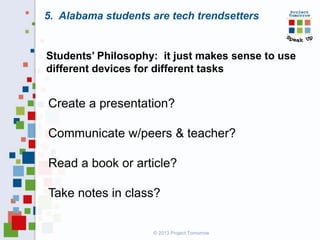
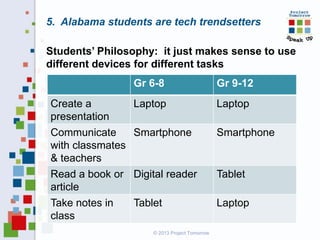
5. Alabama students are tech trendsetters

Students’ Philosophy: it just makes sense to use
different devices for different tasks

Create a presentation?

Communicate w/peers & teacher?
Read a book or article?

Take notes in class?

© 2013 Project Tomorrow
5. Alabama students are tech trendsetters
Students’ Philosophy: it just makes sense to use
different devices for different tasks

Gr 6-8
Create a
presentation
Communicate
with classmates
& teachers
Read a book or
article
Take notes in
class

Gr 9-12

Laptop

Laptop

Smartphone

Smartphone

Digital reader

Tablet

Tablet

Laptop

© 2013 Project Tomorrow
6. Today’s students still face obstacles
using technology at school for learning

Obstacles, barriers, challenges
How has this changed in the
past ten years?
From 2003 to 2012 …..

© 2013 Project Tomorrow
Speak Up 2012 National Findings
From Chalkboards to Tablets

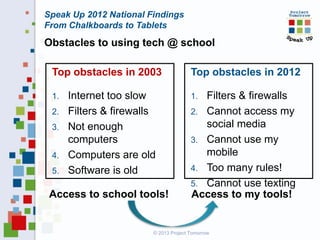
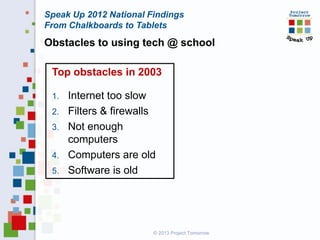
Obstacles to using tech @ school
Top obstacles in 2003
Internet too slow
2. Filters & firewalls
3. Not enough
computers
4. Computers are old
5. Software is old
1.

© 2013 Project Tomorrow
Speak Up 2012 National Findings
From Chalkboards to Tablets

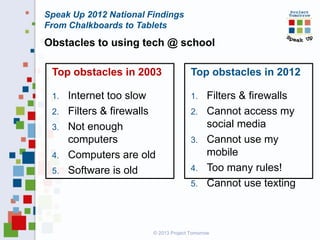
Obstacles to using tech @ school
Top obstacles in 2003

Top obstacles in 2012

Internet too slow
2. Filters & firewalls
3. Not enough
computers
4. Computers are old
5. Software is old

1.

1.

Filters & firewalls
2. Cannot access my
social media
3. Cannot use my
mobile
4. Too many rules!
5. Cannot use texting

© 2013 Project Tomorrow
Speak Up 2012 National Findings
From Chalkboards to Tablets

Obstacles to using tech @ school
Top obstacles in 2003

Top obstacles in 2012

Internet too slow
2. Filters & firewalls
3. Not enough
computers
4. Computers are old
5. Software is old

1.

1.

Access to school tools!

Filters & firewalls
2. Cannot access my
social media
3. Cannot use my
mobile
4. Too many rules!
5. Cannot use texting
Access to my tools!

© 2013 Project Tomorrow
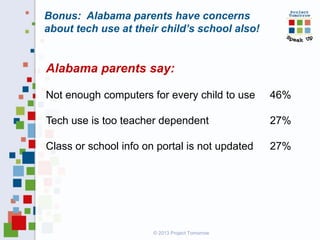
Bonus: Alabama parents have concerns
about tech use at their child’s school also!

Alabama parents say:
Not enough computers for every child to use

46%

Tech use is too teacher dependent

27%

Class or school info on portal is not updated

27%

© 2013 Project Tomorrow
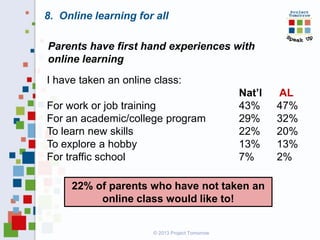
8. Online learning for all
Parents have first hand experiences with
online learning
I have taken an online class:
For work or job training
For an academic/college program
To learn new skills
To explore a hobby
For traffic school

Nat’l
43%
29%
22%
13%
7%

22% of parents who have not taken an
online class would like to!

© 2013 Project Tomorrow

AL
47%
32%
20%
13%
2%
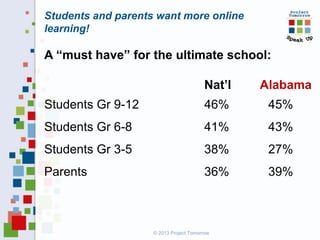
Students and parents want more online
learning!

A “must have” for the ultimate school:

Nat’l

Alabama

Students Gr 9-12

46%

45%

Students Gr 6-8

41%

43%

Students Gr 3-5

38%

27%

Parents

36%

39%

© 2013 Project Tomorrow
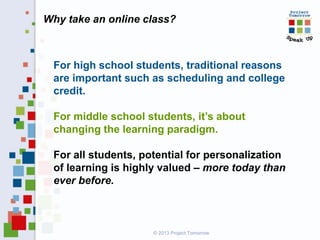
Why take an online class?

For high school students, traditional reasons
are important such as scheduling and college
credit.
For middle school students, it’s about
changing the learning paradigm.
For all students, potential for personalization
of learning is highly valued – more today than
ever before.

© 2013 Project Tomorrow
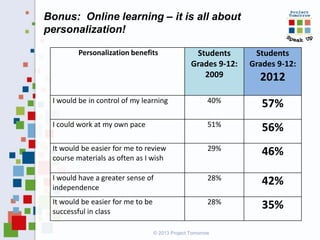
Bonus: Online learning – it is all about
personalization!
Personalization benefits

Students
Grades 9-12:
2009

Students
Grades 9-12:

I would be in control of my learning

40%

57%

I could work at my own pace

51%

56%

It would be easier for me to review
course materials as often as I wish

29%

46%

I would have a greater sense of
independence

28%

42%

It would be easier for me to be
successful in class

28%

35%

© 2013 Project Tomorrow

2012
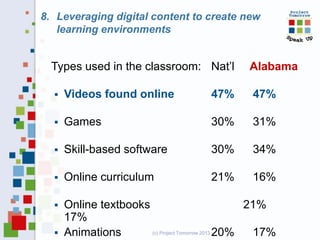
8. Leveraging digital content to create new
learning environments

Types used in the classroom: Nat’l

Alabama



Videos found online

47%

47%



Games

30%

31%



Skill-based software

30%

34%



Online curriculum

21%

16%



Online textbooks
21%
17%
(c) Project Tomorrow 2013 20%
Animations
17%


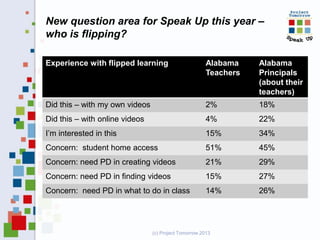
New question area for Speak Up this year –
who is flipping?
Experience with flipped learning

Alabama
Teachers

Alabama
Principals
(about their
teachers)

Did this – with my own videos

2%

18%

Did this – with online videos

4%

22%

I’m interested in this

15%

34%

Concern: student home access

51%

45%

Concern: need PD in creating videos

21%

29%

Concern: need PD in finding videos

15%

27%

Concern: need PD in what to do in class

14%

26%

(c) Project Tomorrow 2013
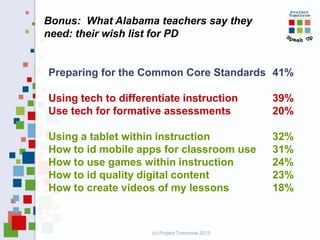
Bonus: What Alabama teachers say they
need: their wish list for PD

Preparing for the Common Core Standards 41%
Using tech to differentiate instruction
Use tech for formative assessments

39%
20%

Using a tablet within instruction
How to id mobile apps for classroom use
How to use games within instruction
How to id quality digital content
How to create videos of my lessons

32%
31%
24%
23%
18%

(c) Project Tomorrow 2013
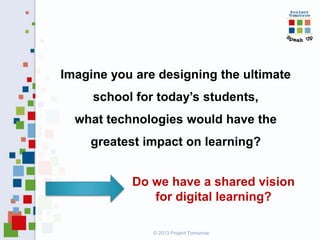
Imagine you are designing the ultimate
school for today’s students,
what technologies would have the
greatest impact on learning?
Do we have a shared vision
for digital learning?
© 2013 Project Tomorrow
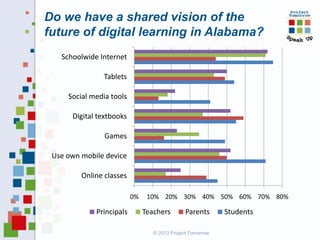
Do we have a shared vision of the
future of digital learning in Alabama?
Schoolwide Internet
Tablets
Social media tools
Digital textbooks
Games
Use own mobile device

Online classes
0%

Principals

10% 20% 30% 40% 50% 60% 70% 80%

Teachers

Parents

© 2013 Project Tomorrow

Students
Schoolwide Internet
Tablets
Social media tools
Digital textbooks
Games
Use own mobile device
Online classes
0%

Principals

Teachers

20%

40%

Parents

60%

80%

Students

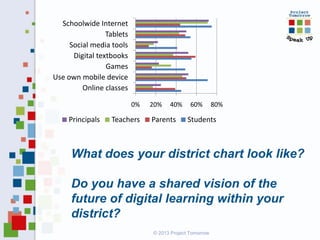
What does your district chart look like?
Do you have a shared vision of the
future of digital learning within your
district?
© 2013 Project Tomorrow
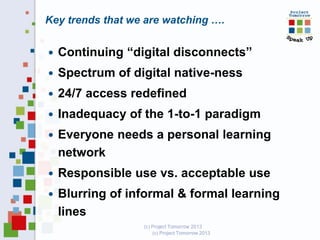
Key trends that we are watching ….


Continuing “digital disconnects”



Spectrum of digital native-ness



24/7 access redefined



Inadequacy of the 1-to-1 paradigm



Everyone needs a personal learning
network



Responsible use vs. acceptable use



Blurring of informal & formal learning
lines
(c) Project Tomorrow 2013
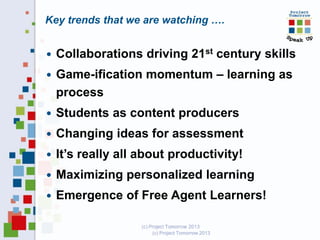
Key trends that we are watching ….


Collaborations driving 21st century skills



Game-ification momentum – learning as
process



Students as content producers



Changing ideas for assessment



It’s really all about productivity!



Maximizing personalized learning



Emergence of Free Agent Learners!
(c) Project Tomorrow 2013
More Speak Up? www.tomorrow.org
National Speak Up Findings and reports
Targeted and thematic reports
Online learning trends
Mobile learning & social media
Print to digital migration
Social learning
Intelligent adaptive software
New digital parent series
Presentations, podcasts and webinars
Services: consulting, workshops, evaluation and efficacy
studies

© 2013 Project Tomorrow
Quick Facts about Speak Up 2013
Surveys open from Oct 2 thru Dec 20
Surveys: K-12 students, parents, teachers,
librarians, principals, district admin, tech leaders,
community members
PT support team: Jenny and Monique
Data back to you in February
Congressional briefings/national reports in April/May

© 2013 Project Tomorrow
What’s new for Speak Up 2013?
New question topics

New survey: community members
Password or secret word not required for survey taking
All schools registered already!

Learn more about www.tomorrow.org/speakup

© 2013 Project Tomorrow
Your thoughts, comments, questions
(c) Project Tomorrow 2013
Julie Evans
Project Tomorrow
jevans@tomorrow.org
949-609-4660 x15
Twitter: JulieEvans_PT
and SpeakUpEd
Copyright Project Tomorrow 2013
This work is the intellectual property of the author. Permission is granted
for this material to be shared for non-commercial, educational
purposes, provided that this copyright statement appears on the
reproduced materials and notice is given that the copying is by permission
of the author. To disseminate otherwise or to republish requires written
permission from the author.
© 2013 Project Tomorrow

Alabama Speaks Up 2013

  • 1.
    Alabama Speaks Up! SpeakUp 2012 Data Results Planning for Speak Up 2013 Julie Evans, Project Tomorrow CEO September 30, 2013
  • 2.
    Today’s discussion –the big questions:  What are some realities about ed tech in our schools today – from the perspective of Alabama students, parents, teachers & administrators?  Do we have a shared vision for digital learning?  What are the big trends to watch?  How can your district participate in Speak Up 2013? © 2013 Project Tomorrow
  • 3.
    Today’s discussion –the big questions:  What are some realities about ed tech in our schools today – from the perspective of Alabama students, parents, teachers & administrators?  Do we have a shared vision for digital learning?  What are the big trends to watch?  How can your district participate in Speak Up 2013? Use the 2012 data to demonstrate value of participation © 2013 Project Tomorrow
  • 4.
    Project Tomorrow, anational education nonprofit organization Programs: • Research & evaluation studies • School and community programs • Events for students Mission: To ensure that today’s students are prepared to become tomorrow’s leaders, innovators and engaged citizens of the world. © 2013 Project Tomorrow
  • 5.
    Speak Up NationalResearch Project Annual national research project  Online surveys + focus groups  Open for all K-12 schools and schools of education  Institutions receive free report with their own data Collect ideas ↔ Stimulate conversations  K-12 Students, Teachers, Parents, Administrators  Pre-Service Teachers in Schools of Education Inform policies & programs  Analysis and reporting of findings and trends  Consulting services to help transform teaching and learning + 3 million surveys since 2003 © 2013 Project Tomorrow
  • 6.
    Speak Up surveyquestion themes  Learning & Teaching with Technology  21st Century Skills: Digital Citizenship & Global Awareness  Math and Science Instruction  Students’ Career Interests in STEM  Professional Development / Teacher Preparation  Internet Safety  Administrators’ Challenges  Emerging Technologies both in & out of the Classroom  Mobile Devices, Online Learning, Digital Content, E-textbooks  Educational Games, Social Media tools and applications  Flipped Classroom, Print to Digital, Online Assessments  Designing the 21st Century School © 2013 Project Tomorrow
  • 7.
    Speak Up surveyquestion themes         Learning & Teaching with Technology 21st Century Skills: Digital Citizenship & Global Awareness Math and Science Instruction Students’ Career Interests in STEM Professional Development / Teacher Preparation Internet Safety Administrators’ Challenges Emerging Technologies both in & out of the Classroom  Mobile Devices, Online Learning, Digital Content, E-textbooks  Educational Games, Social Media tools and applications  Flipped Classroom, Print to Digital, Online Assessments  Designing the 21st Century School Activities Value Propositions © 2013 Project Tomorrow Aspirations
  • 8.
    Why participate inSpeak Up?  Power of local data  Use data as input for planning  To justify budget and purchasing decisions  Inform new initiatives – as an evaluation tool .  As a tool to engage parents  Demonstrate interest in students’ ideas  Use for grant writing and fund development  Content for professional development  As a competitive tool  And more . . . . . . . (c) Project Tomorrow 2013
  • 9.
    National Speak Up2012 Participation: 466,303  K-12 Students  Teachers & Librarians  Parents (in English & Spanish)  School/District Administrators  364,233 56,346 39,713 6,011 About the participating schools & districts o 8,020 schools and 2,431 districts o 30% urban / 43% rural / 27% suburban o All 50 states + DC  Honor Roll of States with highest participation: TX, CA, OH, IN, AL, NC, WI, AZ, FL, PA © 2013 Project Tomorrow
  • 10.
    Alabama Speaks Up! 34,053Online Surveys Submitted K-12 Students 27,561 Teachers & Librarians 3,836 Parents 2,369 School/District Administrators 287 © 2013 Project Tomorrow
  • 11.
    Bravo!             Shelby County SchoolDistrict Madison County School District Lee County Schools Coffee County School District Gadsen City School District Chilton County School District Decatur City School District Calhoun County School District Satsuma City School District Mountain Brook School District Salem Community Schools Piedmont City Schools © 2013 Project Tomorrow
  • 12.
    Bravo!             Shelby County SchoolDistrict = #2 Madison County School District = #5 Lee County Schools Coffee County School District Gadsen City School District Chilton County School District Decatur City School District Calhoun County School District Satsuma City School District Mountain Brook School District Salem Community Schools Piedmont City Schools © 2013 Project Tomorrow
  • 13.
    Speak Up 2012 NationalReports © 2013 Project Tomorrow
  • 14.
  • 15.
    Speak Up 2012National Findings From Chalkboards to Tablets Digital Conversion A shift in what we do, but also our attitudes and values (c) Project Tomorrow 2013
  • 16.
    Speak Up 2012National Findings From Chalkboards to Tablets Digital Conversion Why the new momentum in K-12 education? (c) Project Tomorrow 2013
  • 17.
    Why the newmomentum for digital conversions in K-12 education? 1. Common Core State Standards 2. Educators’ personal use of digital tools 3. Sustained budget stress 4. Emergence of the new digital parent 5. Employers’ demands for better skilled employees 6. New student expectations for learning processes (c) Project Tomorrow 2013
  • 18.
    What can theSpeak Up findings tell us about the future of learning? © 2013 Project Tomorrow
  • 19.
    Speak Up NationalFindings: 2003 - 2012  Students function as a “Digital Advance Team”  Students regularly adopt and adapt emerging technologies for learning  Students’ frustrations focus on the unsophisticated use of technologies within education  Persistent digital disconnect between students and adults  Exacerbation of lack of relevancy in current education  Students want a more personalized learning environment © 2013 Project Tomorrow
  • 20.
    The New StudentVision for Learning Social–based learning Un–tethered learning Digitally–rich learning Personalized Learning © 2013 Project Tomorrow
  • 21.
    Personalizing learning through digitaltools 8 things you need to know about ed tech in Alabama (with some bonus data!) © 2013 Project Tomorrow
  • 22.
    Be a SpeakUp Analyst! Your assignment:  Debunk myths  Uncover hidden digital divides  Evaluate your vision  Do you have a shared vision of the future?  How can the Speak Up data help you? (c) Project Tomorrow 2013
  • 23.
    1. Alabama studentsare using social media tools to connect, collaborate and create Texting: 71% of Gr 9-12, 66% of Gr 6-8 (nat’l growth of 44% since 2008) Twitter: 4 out of 10 students in Gr 9 -12 (only 1/3 nationally) Videos: 32% of students in Gr 6-8 (nat’l - only 15% in 2007) © 2013 Project Tomorrow
  • 24.
    1. Alabama studentsare using social media tools to connect, collaborate and create Massively multi-player online games (MMOG) ¼ of students in Gr 6-8 Facebook 53% of students in Gr 9-12 (nat’l decrease of 21% since 2007) © 2013 Project Tomorrow
  • 25.
    Bonus: Alabama parents,teachers and administrators are using social media, also! Social Media Tools Parents Teachers Principals Texting 88% 82% 91% Twitter 17% 17% 26% YouTube 17% 15% 16% Games 3% 3% 3% Facebook 59% 56% 48% Skype 37% 43% 52% © 2013 Project Tomorrow
  • 26.
    2. Alabama studentsare multi-mobilists 79% 66% 59%58% 47% 52% 48% 44% 45% 45% 40% 37% 25% 21% 16% Cell Phone 16% Smartphone K-2 Gr 3-5 Tablet Gr 6-8 © 2013 Project Tomorrow Digital Reader Gr 9-12
  • 27.
    2. Alabama studentsare multi-mobilists Perspectives on out of school Internet access is changing – even in Alabama “My home internet access is through a mobile, 3G/4G device” Grade 6-8 57% Grade 9-12 68%  Weekly Internet access for homework? 66% of Alabama high school students © 2013 Project Tomorrow
  • 28.
    3. Changing viewson mobile learning Growth in mobile device access by parents 90% 73% 49% 35% 32% 5% 2008 Tablets 2012 Smartphones © 2013 Project Tomorrow Cellphones
  • 29.
    3. Changing viewson mobile learning The mobilist parents – are you ready for them? Smartphones Tablets Digital readers Nat’l 73% 49% 37% Alabama 78% 48% 39% 44% of Alabama parents want their school or child’s teacher to communicate with them via text message (37% nationwide) © 2013 Project Tomorrow
  • 30.
    Bonus: Benefits ofmobile devices for schoolwork 59% 53% 60% Extends learning beyond school day Provides way for students to review materials anytime 57% 48% 52% 50% Improves school to home communications Increases student engagement 55% 50% Personalizes learning Principals Teachers (c) Project Tomorrow 2013 48% Parents 64% 63% 57% 84% 77%
  • 31.
    4. The BYODstory New Speak Up Question on the 2012 survey: Parents: What if there were two classes – one allowed use of student owned devices and one did not . . . . How likely is it that you would want your child in the class that allowed the devices? © 2013 Project Tomorrow
  • 32.
    4. The BYODstory New Speak Up Question: How likely is it that you would want your child in the class that allowed the devices? Result: 75% of Alabama parents said it was likely – they want their child in that “mobile using class” (51% said very likely!) © 2013 Project Tomorrow
  • 33.
    Bonus: The BYOD/BYOTtrend – what a difference a year makes! Policy/Position Admin 2011 Admin 2012 Do not allow 52% 37% Discretion of building principal 16% 21% Discretion of teacher 21% 32% We provide devices 13% 18% Evaluating BYOD/T 19% 28% BYOD/T in place 17% 30% (c) Project Tomorrow 2013
  • 34.
    5. Alabama studentsare tech trendsetters Students’ Philosophy: it just makes sense to use different devices for different tasks Create a presentation? Communicate w/peers & teacher? Read a book or article? Take notes in class? © 2013 Project Tomorrow
  • 35.
    5. Alabama studentsare tech trendsetters Students’ Philosophy: it just makes sense to use different devices for different tasks Gr 6-8 Create a presentation Communicate with classmates & teachers Read a book or article Take notes in class Gr 9-12 Laptop Laptop Smartphone Smartphone Digital reader Tablet Tablet Laptop © 2013 Project Tomorrow
  • 36.
    6. Today’s studentsstill face obstacles using technology at school for learning Obstacles, barriers, challenges How has this changed in the past ten years? From 2003 to 2012 ….. © 2013 Project Tomorrow
  • 37.
    Speak Up 2012National Findings From Chalkboards to Tablets Obstacles to using tech @ school Top obstacles in 2003 Internet too slow 2. Filters & firewalls 3. Not enough computers 4. Computers are old 5. Software is old 1. © 2013 Project Tomorrow
  • 38.
    Speak Up 2012National Findings From Chalkboards to Tablets Obstacles to using tech @ school Top obstacles in 2003 Top obstacles in 2012 Internet too slow 2. Filters & firewalls 3. Not enough computers 4. Computers are old 5. Software is old 1. 1. Filters & firewalls 2. Cannot access my social media 3. Cannot use my mobile 4. Too many rules! 5. Cannot use texting © 2013 Project Tomorrow
  • 39.
    Speak Up 2012National Findings From Chalkboards to Tablets Obstacles to using tech @ school Top obstacles in 2003 Top obstacles in 2012 Internet too slow 2. Filters & firewalls 3. Not enough computers 4. Computers are old 5. Software is old 1. 1. Access to school tools! Filters & firewalls 2. Cannot access my social media 3. Cannot use my mobile 4. Too many rules! 5. Cannot use texting Access to my tools! © 2013 Project Tomorrow
  • 40.
    Bonus: Alabama parentshave concerns about tech use at their child’s school also! Alabama parents say: Not enough computers for every child to use 46% Tech use is too teacher dependent 27% Class or school info on portal is not updated 27% © 2013 Project Tomorrow
  • 41.
    8. Online learningfor all Parents have first hand experiences with online learning I have taken an online class: For work or job training For an academic/college program To learn new skills To explore a hobby For traffic school Nat’l 43% 29% 22% 13% 7% 22% of parents who have not taken an online class would like to! © 2013 Project Tomorrow AL 47% 32% 20% 13% 2%
  • 42.
    Students and parentswant more online learning! A “must have” for the ultimate school: Nat’l Alabama Students Gr 9-12 46% 45% Students Gr 6-8 41% 43% Students Gr 3-5 38% 27% Parents 36% 39% © 2013 Project Tomorrow
  • 43.
    Why take anonline class? For high school students, traditional reasons are important such as scheduling and college credit. For middle school students, it’s about changing the learning paradigm. For all students, potential for personalization of learning is highly valued – more today than ever before. © 2013 Project Tomorrow
  • 44.
    Bonus: Online learning– it is all about personalization! Personalization benefits Students Grades 9-12: 2009 Students Grades 9-12: I would be in control of my learning 40% 57% I could work at my own pace 51% 56% It would be easier for me to review course materials as often as I wish 29% 46% I would have a greater sense of independence 28% 42% It would be easier for me to be successful in class 28% 35% © 2013 Project Tomorrow 2012
  • 45.
    8. Leveraging digitalcontent to create new learning environments Types used in the classroom: Nat’l Alabama  Videos found online 47% 47%  Games 30% 31%  Skill-based software 30% 34%  Online curriculum 21% 16%  Online textbooks 21% 17% (c) Project Tomorrow 2013 20% Animations 17% 
  • 46.
    New question areafor Speak Up this year – who is flipping? Experience with flipped learning Alabama Teachers Alabama Principals (about their teachers) Did this – with my own videos 2% 18% Did this – with online videos 4% 22% I’m interested in this 15% 34% Concern: student home access 51% 45% Concern: need PD in creating videos 21% 29% Concern: need PD in finding videos 15% 27% Concern: need PD in what to do in class 14% 26% (c) Project Tomorrow 2013
  • 47.
    Bonus: What Alabamateachers say they need: their wish list for PD Preparing for the Common Core Standards 41% Using tech to differentiate instruction Use tech for formative assessments 39% 20% Using a tablet within instruction How to id mobile apps for classroom use How to use games within instruction How to id quality digital content How to create videos of my lessons 32% 31% 24% 23% 18% (c) Project Tomorrow 2013
  • 48.
    Imagine you aredesigning the ultimate school for today’s students, what technologies would have the greatest impact on learning? Do we have a shared vision for digital learning? © 2013 Project Tomorrow
  • 49.
    Do we havea shared vision of the future of digital learning in Alabama? Schoolwide Internet Tablets Social media tools Digital textbooks Games Use own mobile device Online classes 0% Principals 10% 20% 30% 40% 50% 60% 70% 80% Teachers Parents © 2013 Project Tomorrow Students
  • 50.
    Schoolwide Internet Tablets Social mediatools Digital textbooks Games Use own mobile device Online classes 0% Principals Teachers 20% 40% Parents 60% 80% Students What does your district chart look like? Do you have a shared vision of the future of digital learning within your district? © 2013 Project Tomorrow
  • 51.
    Key trends thatwe are watching ….  Continuing “digital disconnects”  Spectrum of digital native-ness  24/7 access redefined  Inadequacy of the 1-to-1 paradigm  Everyone needs a personal learning network  Responsible use vs. acceptable use  Blurring of informal & formal learning lines (c) Project Tomorrow 2013
  • 52.
    Key trends thatwe are watching ….  Collaborations driving 21st century skills  Game-ification momentum – learning as process  Students as content producers  Changing ideas for assessment  It’s really all about productivity!  Maximizing personalized learning  Emergence of Free Agent Learners! (c) Project Tomorrow 2013
  • 53.
    More Speak Up?www.tomorrow.org National Speak Up Findings and reports Targeted and thematic reports Online learning trends Mobile learning & social media Print to digital migration Social learning Intelligent adaptive software New digital parent series Presentations, podcasts and webinars Services: consulting, workshops, evaluation and efficacy studies © 2013 Project Tomorrow
  • 54.
    Quick Facts aboutSpeak Up 2013 Surveys open from Oct 2 thru Dec 20 Surveys: K-12 students, parents, teachers, librarians, principals, district admin, tech leaders, community members PT support team: Jenny and Monique Data back to you in February Congressional briefings/national reports in April/May © 2013 Project Tomorrow
  • 55.
    What’s new forSpeak Up 2013? New question topics New survey: community members Password or secret word not required for survey taking All schools registered already! Learn more about www.tomorrow.org/speakup © 2013 Project Tomorrow
  • 56.
    Your thoughts, comments,questions (c) Project Tomorrow 2013
  • 57.
    Julie Evans Project Tomorrow jevans@tomorrow.org 949-609-4660x15 Twitter: JulieEvans_PT and SpeakUpEd Copyright Project Tomorrow 2013 This work is the intellectual property of the author. Permission is granted for this material to be shared for non-commercial, educational purposes, provided that this copyright statement appears on the reproduced materials and notice is given that the copying is by permission of the author. To disseminate otherwise or to republish requires written permission from the author. © 2013 Project Tomorrow