
Stacking the Deck:
Using Hidden Networks to Identify
   and Develop High Potentials
              Presented By:
        Maya Townsend & Keli Trejo
          Partnering Resources
The Point

                HR leaders can achieve
                  more trustworthy,
                    complete, and
                 nuanced information
                about high potentials
                     by using the
                 organization’s hidden
                      networks.


2
Learning Objectives
    • Why and how employees develop networks of relationships to
      help get work done
    • The types of networks that typically form in organizations and
      the 3 critical roles in networks
    • How the 3 critical roles can help HR professionals identify and
      develop more effective and accurate succession and
      development programs
    • Case studies of how companies have used network analysis to
      develop the workforce
    • Plans for applying network knowledge to current and upcoming
      human capital development and succession planning efforts


3
About Us
    We help organizations address complex collaboration and change challenges
                    Maya Townsend, Founder & Lead Consultant
                    •   Specializes in using network knowledge to help organizations with
                        large scale change
                    •   Rich experience in organization change, collaboration, and talent
                        assessment
                    •   Author: Chief Learning Officer, Talent Management, CIO.Com, Mass
                        High Tech, et al.
                    •   Presenter: NEHRA, PMI, Gartner, et al.
                    •   Chocolate fanatic


                    Keli Trejo, Lead Consultant
                    •   20+ years HR experience, including OD, Executive
                        Coaching, Business Partner, HR Leadership roles
                    •   Significant change management roles through multi-year HR
                        transformations
                    •   Deep experience with leadership development and succession
                        management
                    •   Strong, collaborative client and HR partner relationships
                    •   Artist


4
ABOUT NETWORKS


6
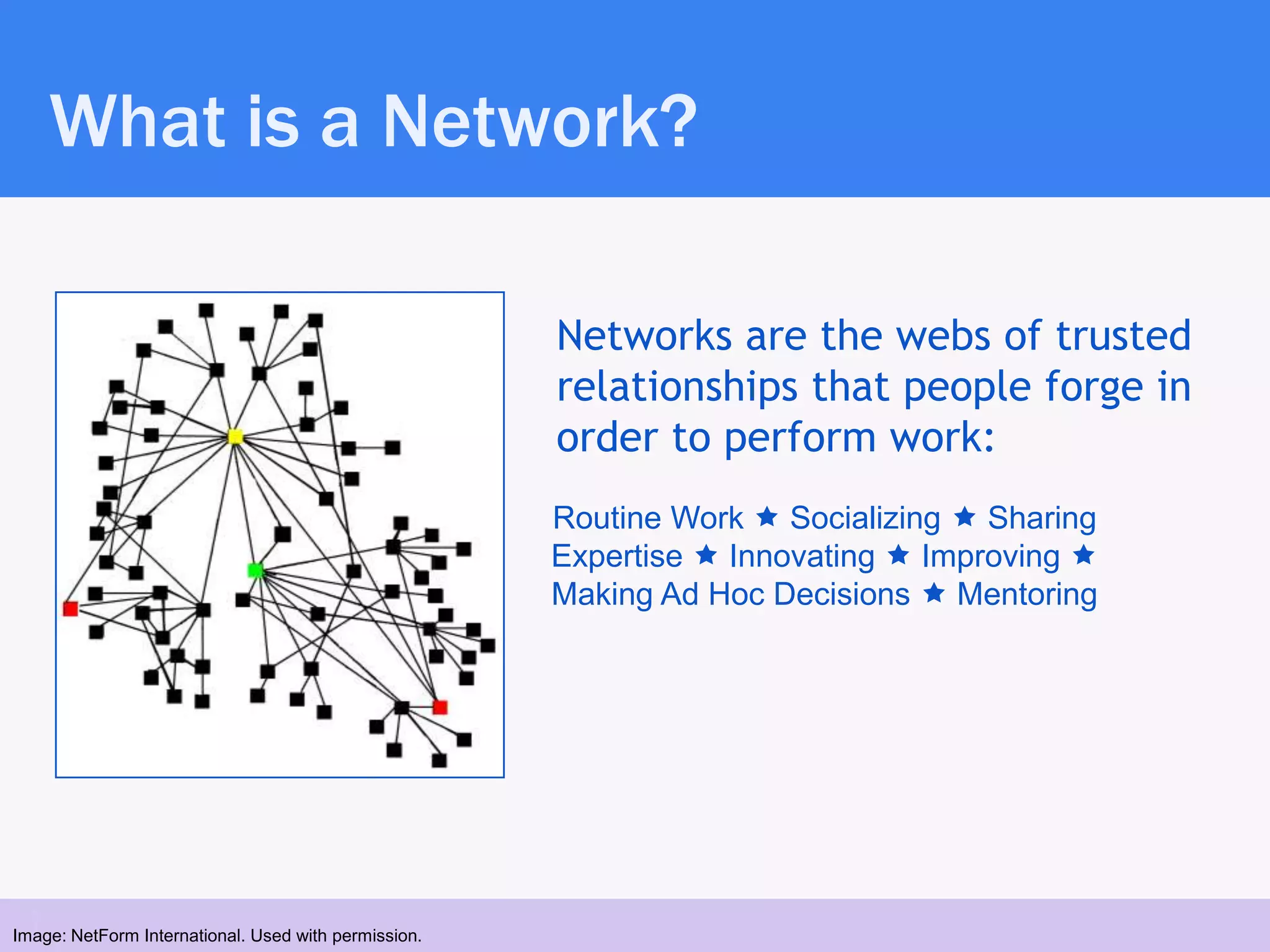
What is a Network?

                                                      Networks are the webs of trusted
                                                      relationships that people forge in
                                                      order to perform work:
                                                      Routine Work  Socializing  Sharing
                                                      Expertise  Innovating  Improving 
                                                      Making Ad Hoc Decisions  Mentoring


  7
Image: NetForm International. Used with permission.
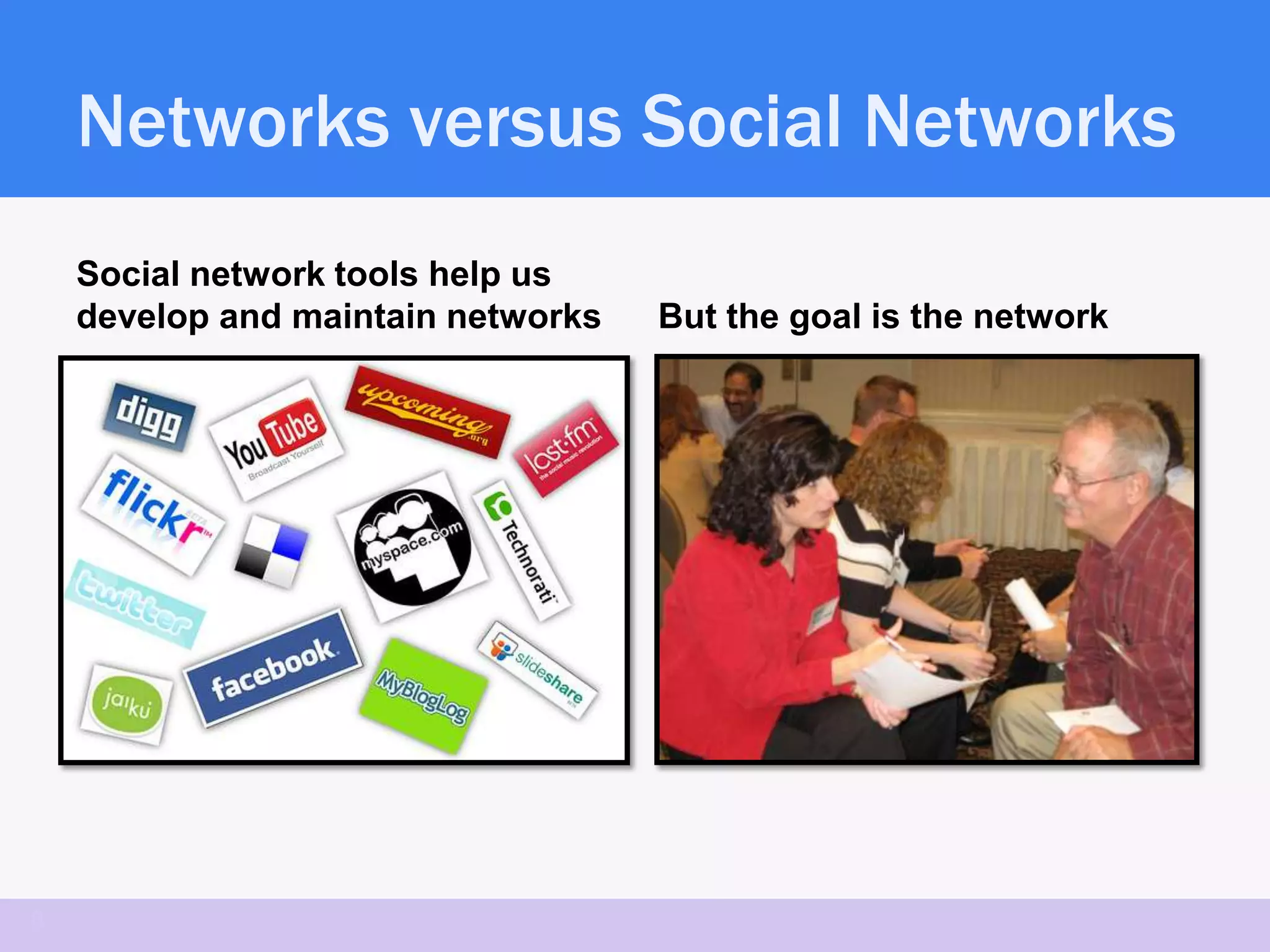
Networks versus Social Networks
    Social network tools help us
    develop and maintain networks   But the goal is the network


8
WHY ARE NETWORKS
    IMPORTANT?


9
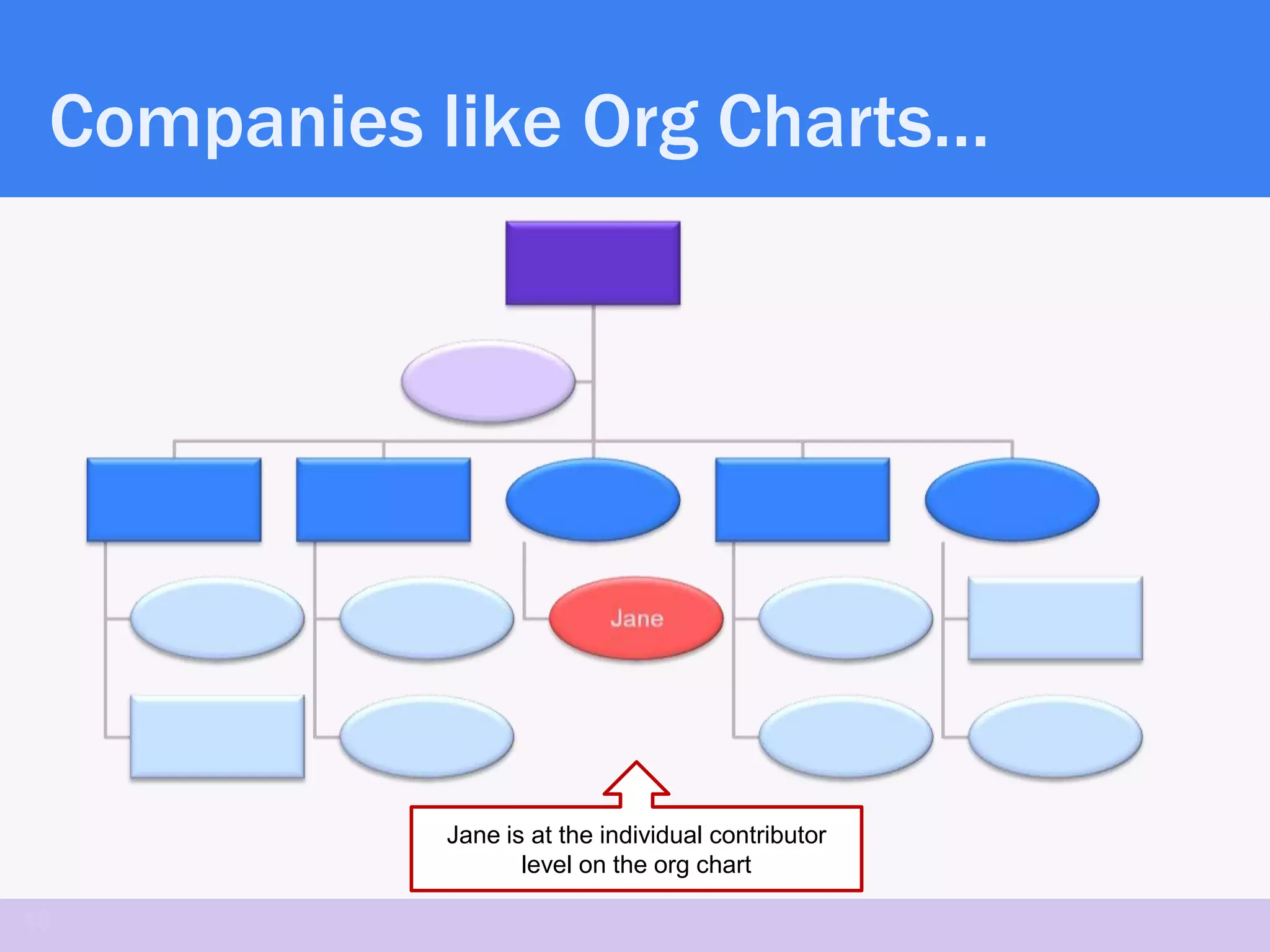
Companies like Org Charts…


           Jane is at the individual contributor
                  level on the org chart

10
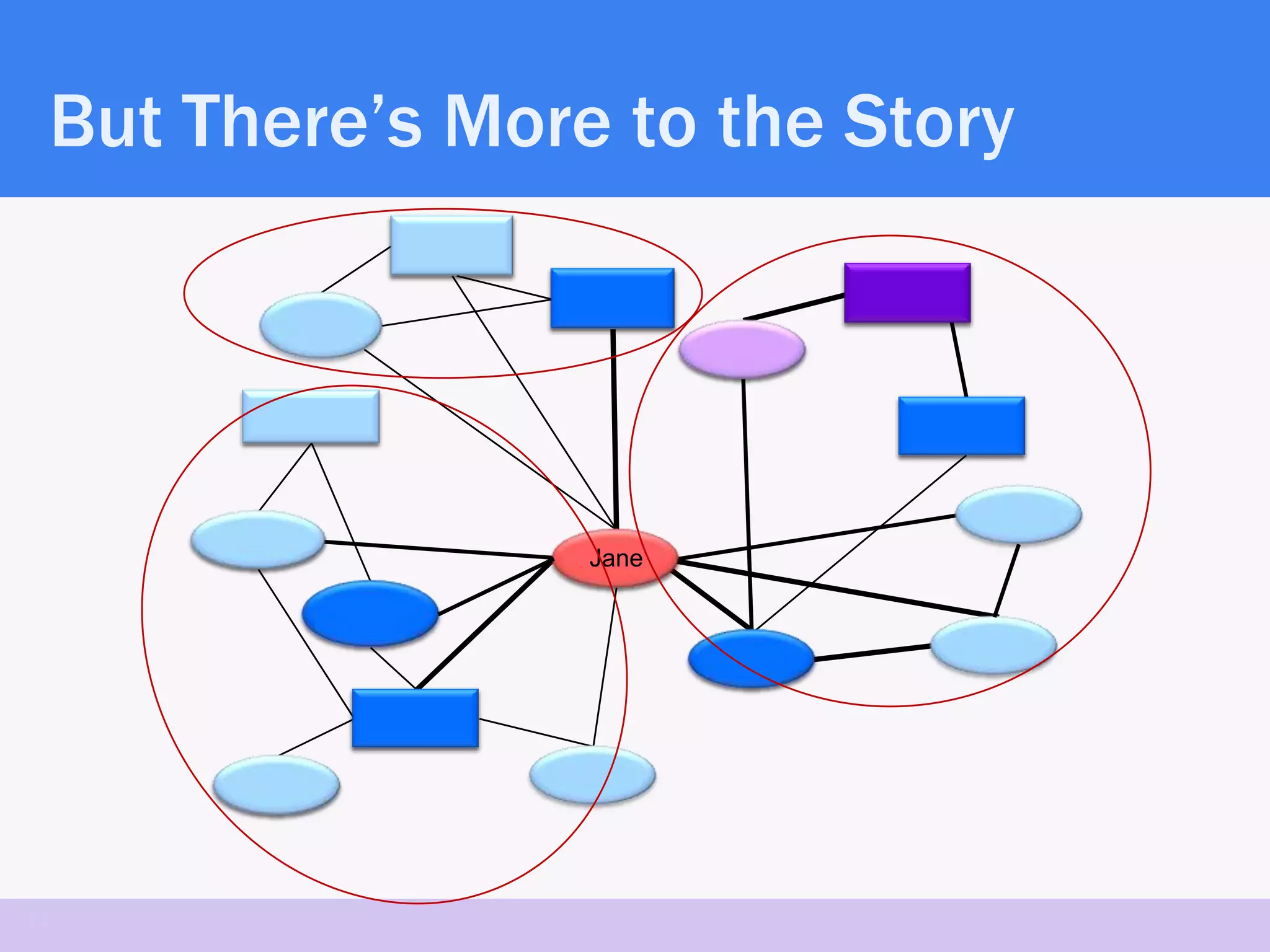
But There’s More to the Story


                 Jane


11
It’s Not
      Just the
     Grapevine


12
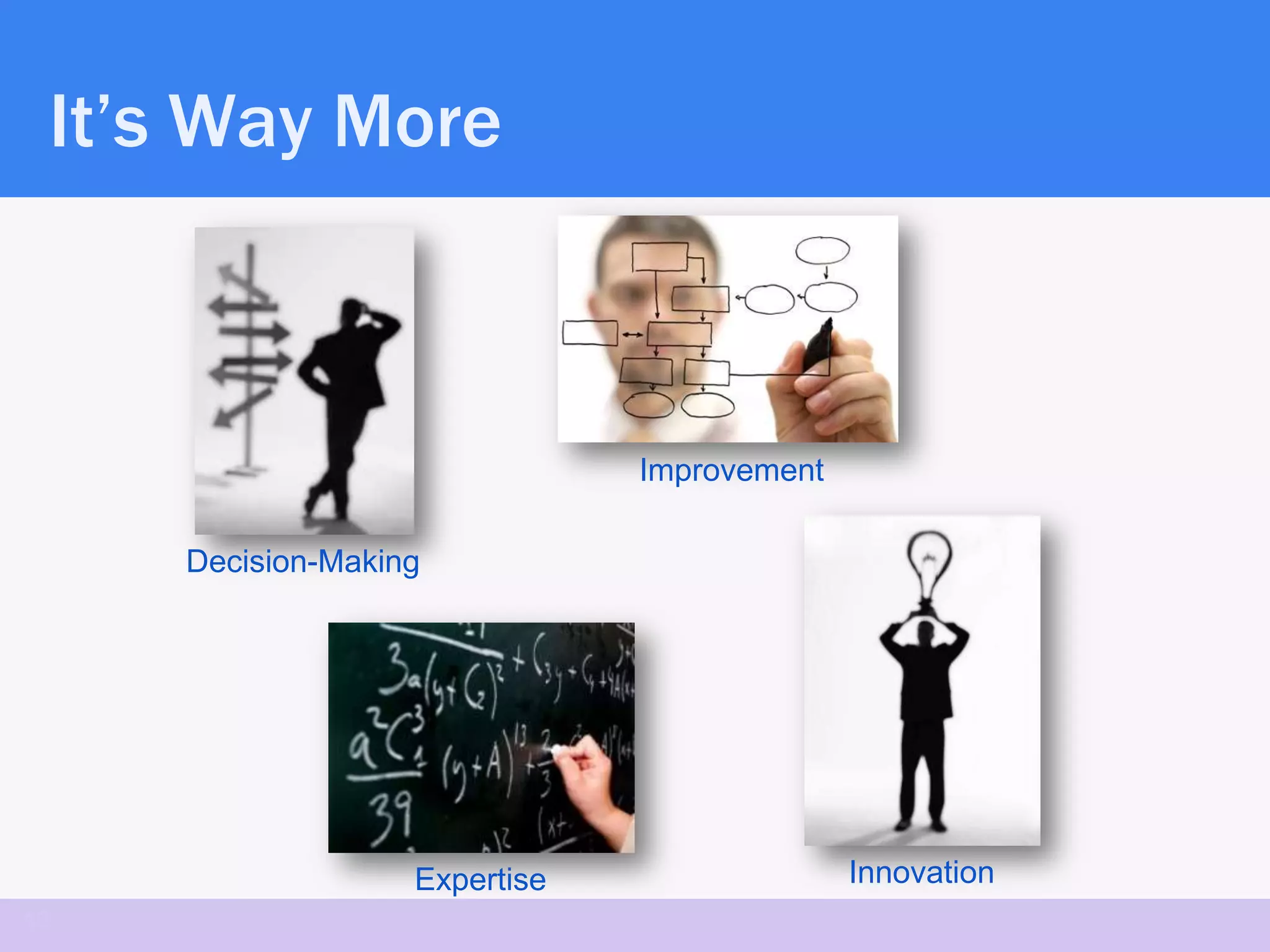
It’s Way More


                               Improvement

     Decision-Making


                   Expertise                 Innovation
13
CASE STUDY:
     SUCCESSION PLANNING


14
The R&D Organization

                                                        Jerry, CEO of the R&D
                                            Jerry   organization, is ready to retire.
                                                     Here’s the top three levels of
                                                     his organization (lower levels
                                                         hidden for simplicity).


 15
Case: Netform, Inc. Used with permission.
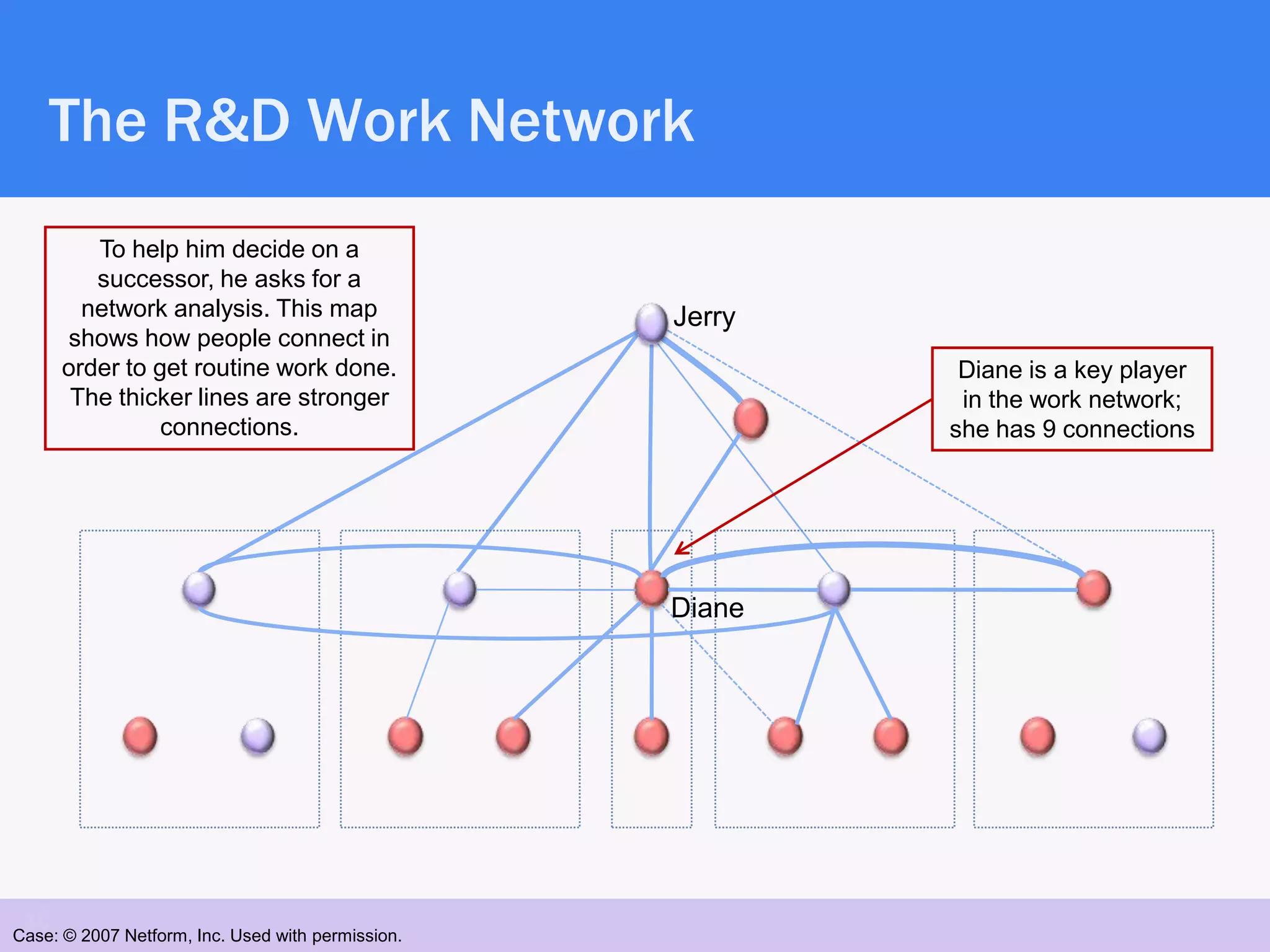
The R&D Work Network
         To help him decide on a
         successor, he asks for a
        network analysis. This map                 Jerry
      shows how people connect in
      order to get routine work done.                       Diane is a key player
       The thicker lines are stronger                       in the work network;
                connections.                               she has 9 connections


                                                   Diane


 16
Case: © 2007 Netform, Inc. Used with permission.
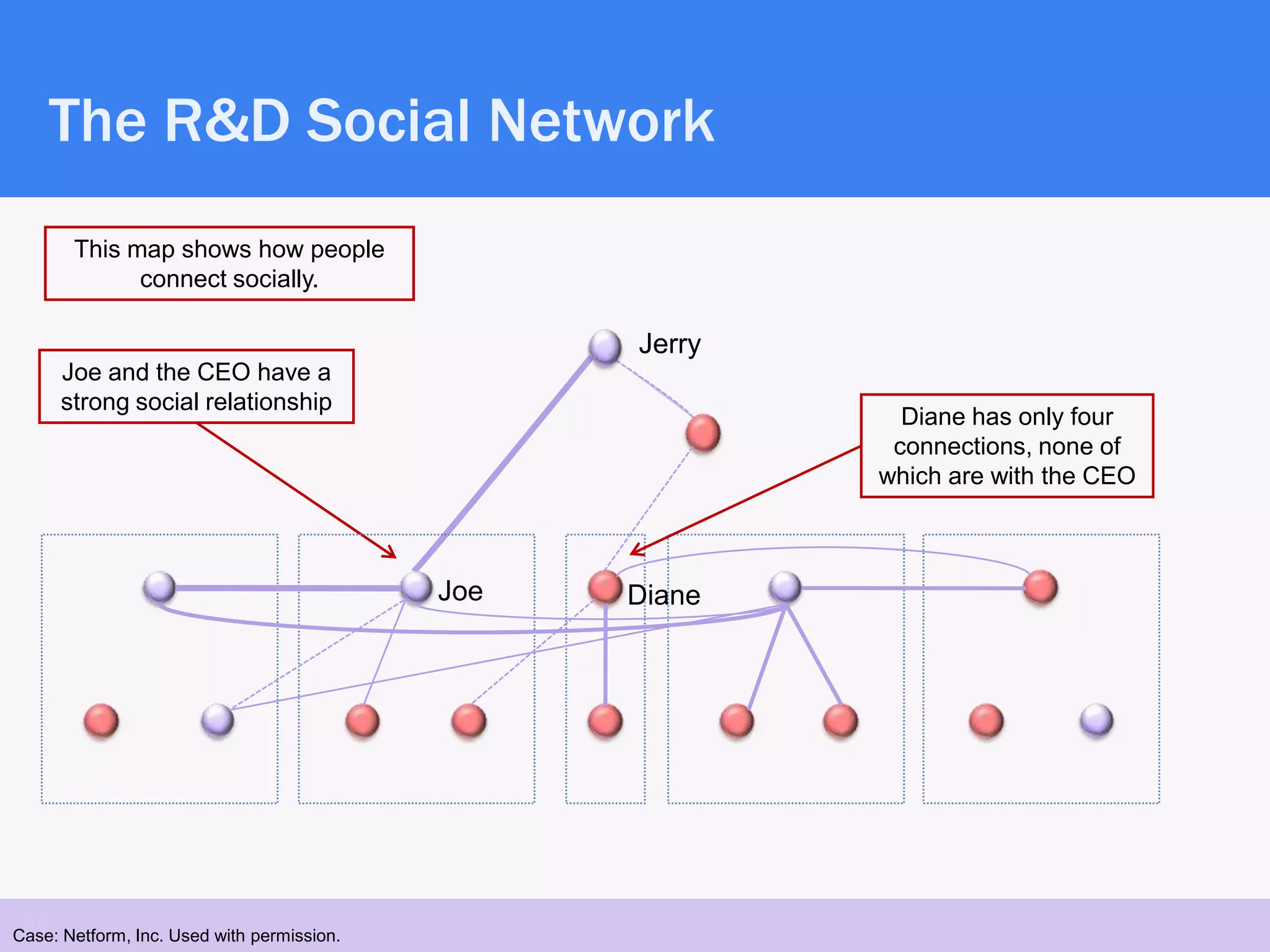
The R&D Social Network
       This map shows how people
             connect socially.

                                                  Jerry
      Joe and the CEO have a
      strong social relationship
                                                            Diane has only four
                                                           connections, none of
                                                          which are with the CEO


                                            Joe   Diane


 17
Case: Netform, Inc. Used with permission.
Your Turn

      Howdy, neighbor!
     Who should Jerry appoint as his successor? Why?

         Who do you think Jerry did appoint as his
                   successor? Why?


18
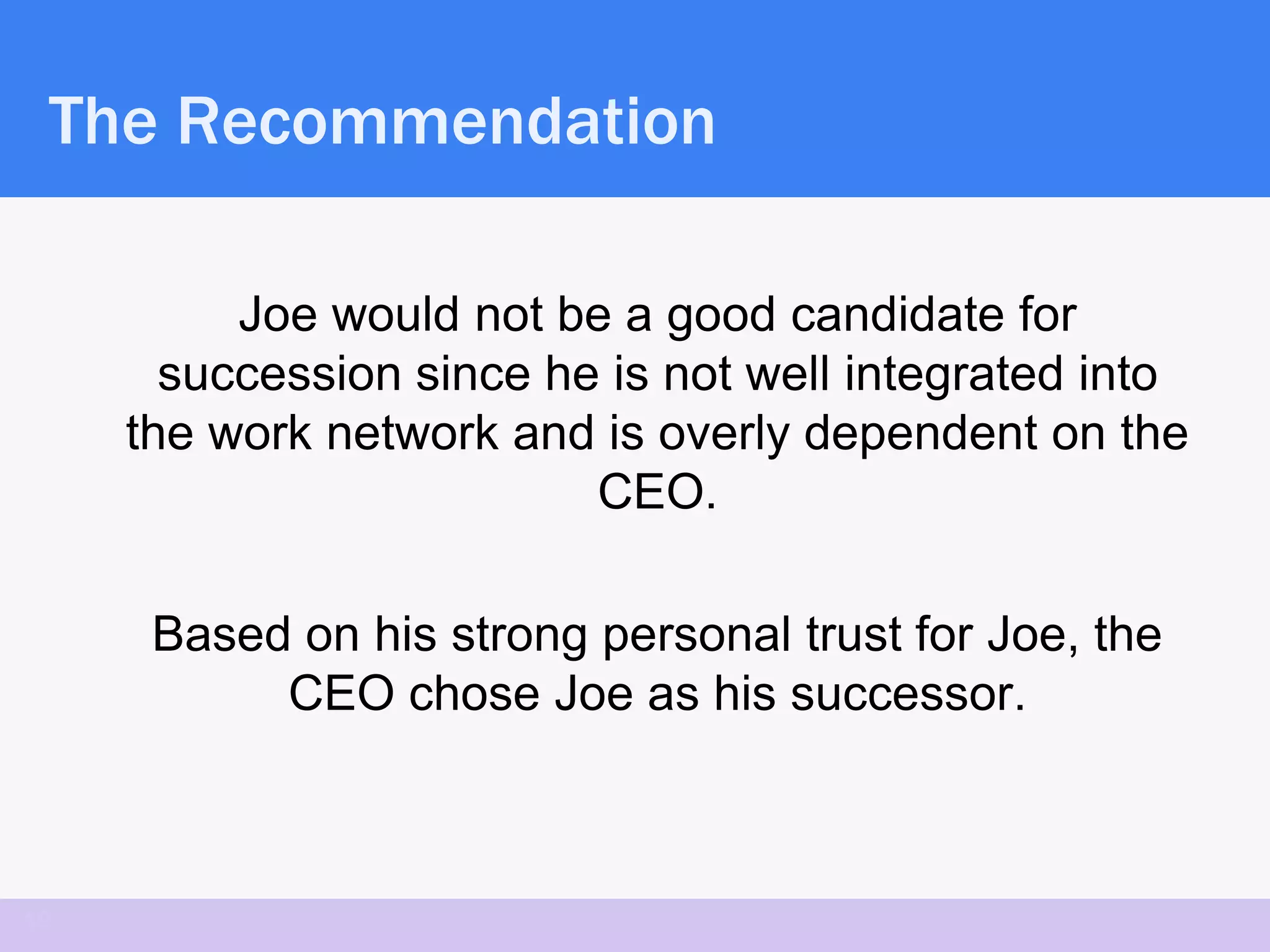
The Recommendation

          Joe would not be a good candidate for
       succession since he is not well integrated into
     the work network and is overly dependent on the
                          CEO.

      Based on his strong personal trust for Joe, the
           CEO chose Joe as his successor.


19
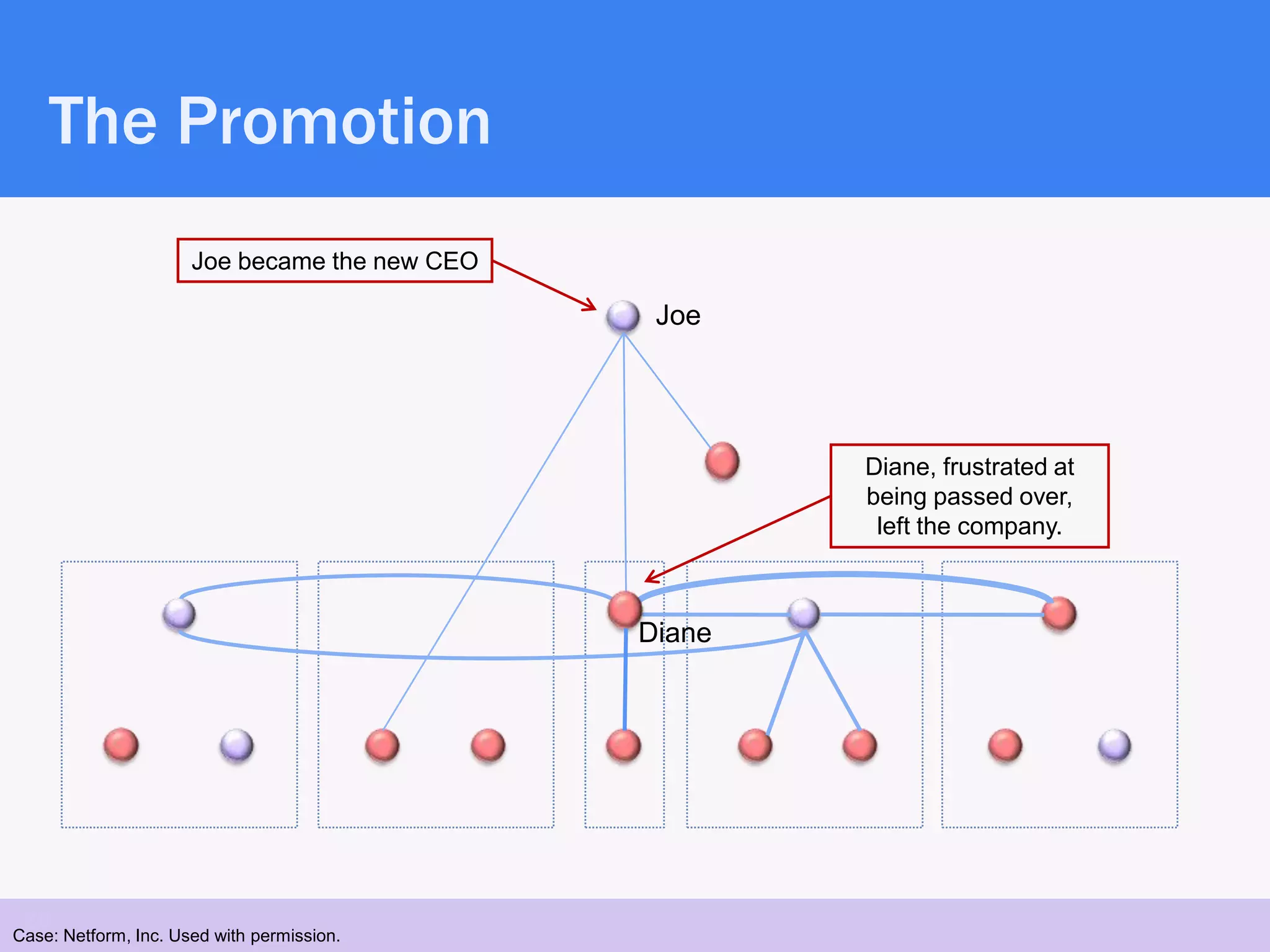
The Promotion
                      Joe became the new CEO

                                                Joe


                                                       Diane, frustrated at
                                                       being passed over,
                                                        left the company.


                                               Diane


 20
Case: Netform, Inc. Used with permission.
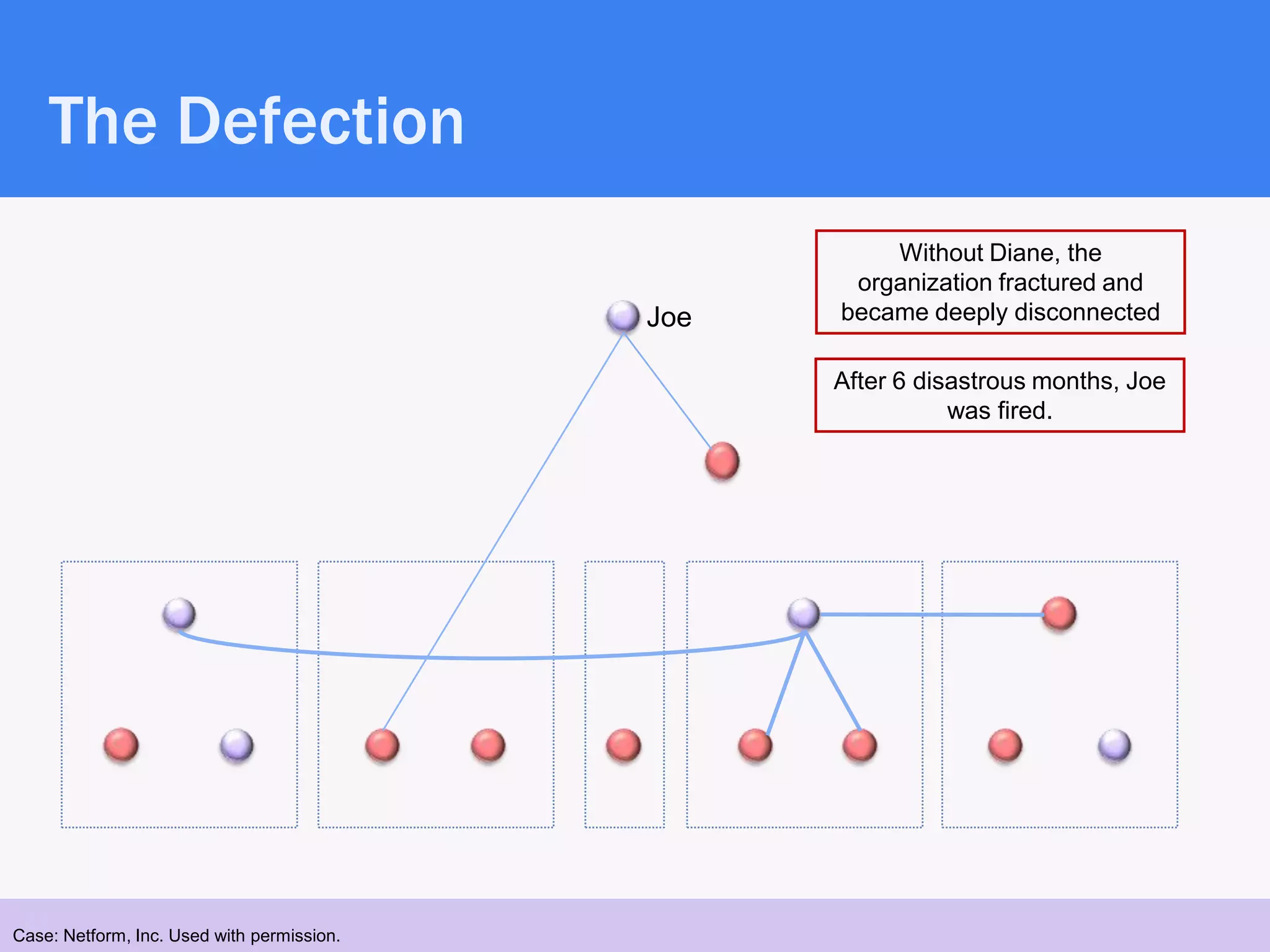
The Defection
                                                      Without Diane, the
                                                   organization fractured and
                                            Joe   became deeply disconnected

                                                  After 6 disastrous months, Joe
                                                             was fired.


 21
Case: Netform, Inc. Used with permission.
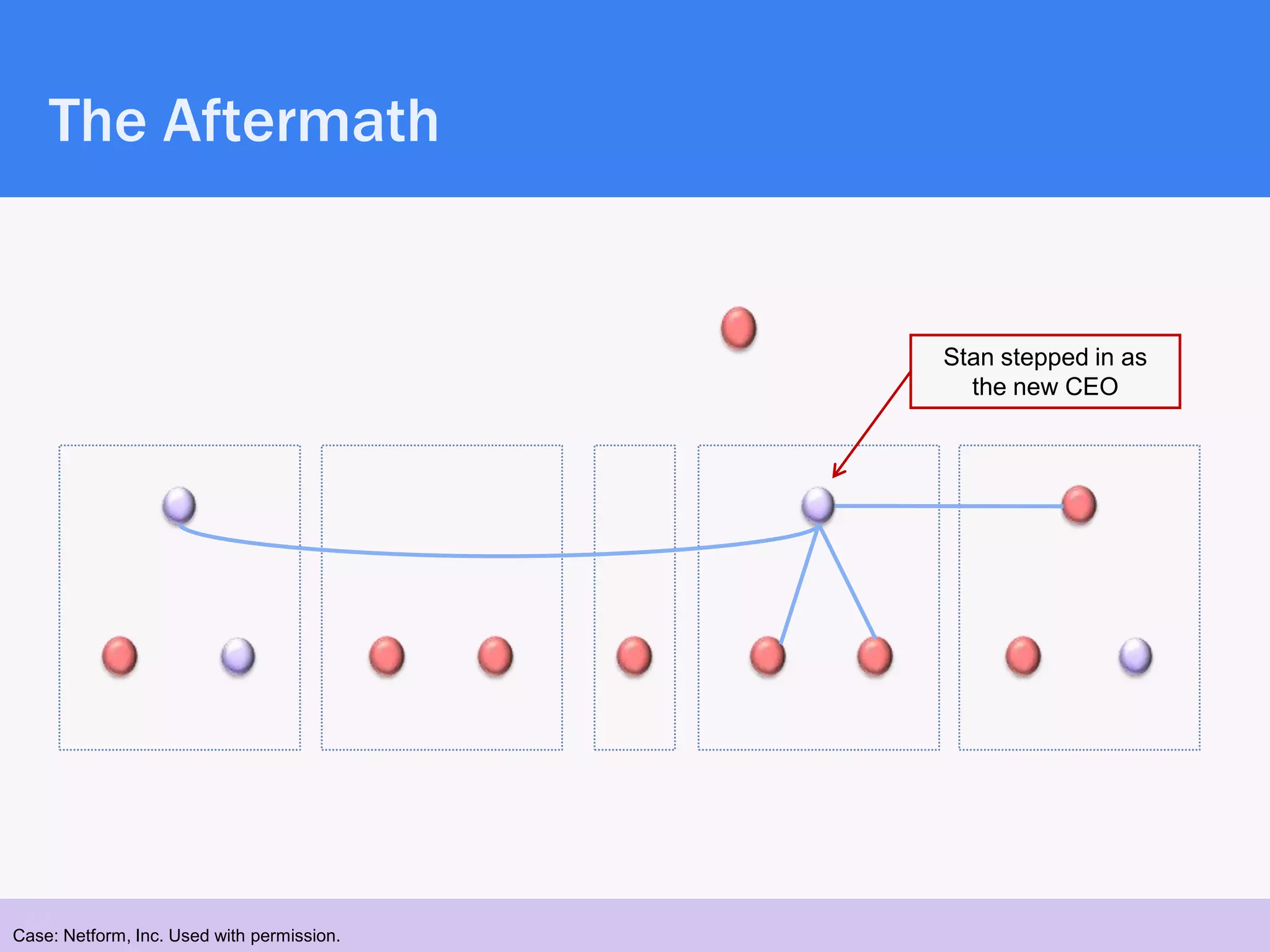
The Aftermath


                                            Stan stepped in as
                                              the new CEO


 22
Case: Netform, Inc. Used with permission.
HUMAN CAPITAL ASSESSMENT


23
Quick Case: Who’s the High Performer?
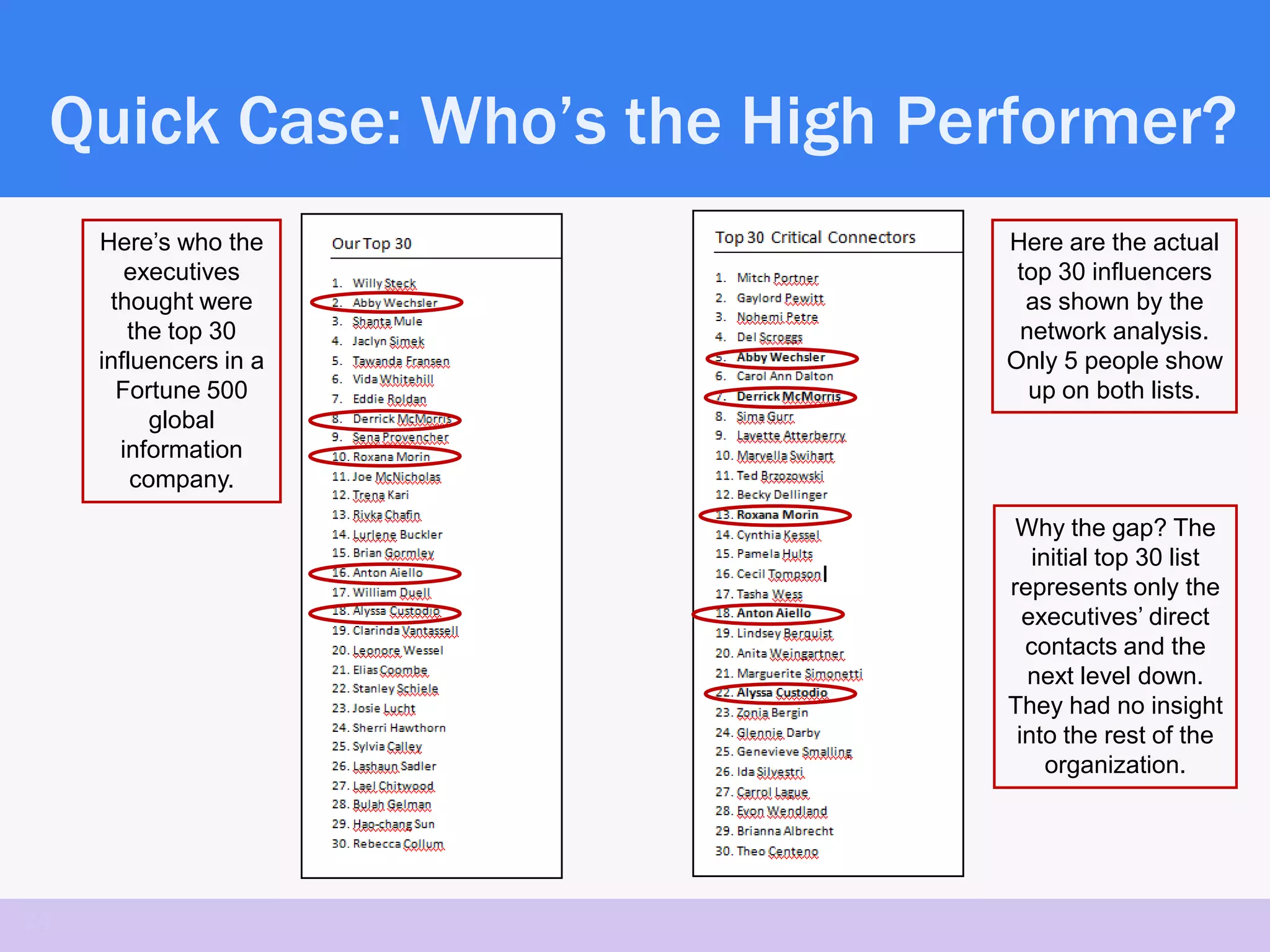
     Here’s who the           Here are the actual
        executives             top 30 influencers
      thought were              as shown by the
        the top 30             network analysis.
     influencers in a         Only 5 people show
       Fortune 500              up on both lists.
           global
       information
         company.
                               Why the gap? The
                                 initial top 30 list
                              represents only the
                                executives’ direct
                                contacts and the
                                next level down.
                              They had no insight
                               into the rest of the
                                   organization.


24
Quick Case: Critical Connector Lost
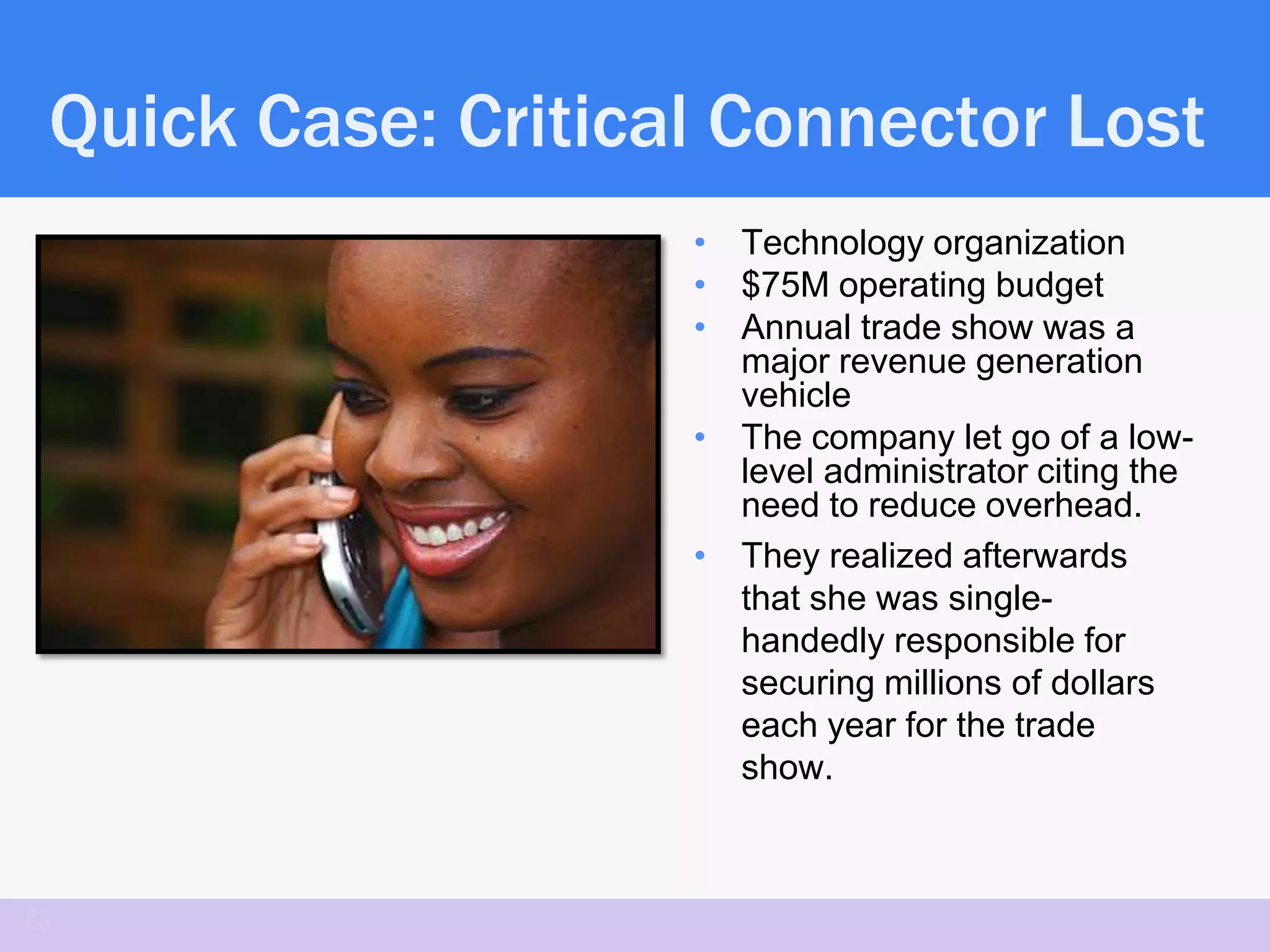
                    • Technology organization
                    • $75M operating budget
                    • Annual trade show was a
                      major revenue generation
                      vehicle
                    • The company let go of a low-
                      level administrator citing the
                      need to reduce overhead.
                    • They realized afterwards
                      that she was single-
                      handedly responsible for
                      securing millions of dollars
                      each year for the trade
                      show.


25
Quick Case: Critical Connectors Saved
                                                                                • Situation: Merger of two
                                                                                  container plants required
                                                                                  decisions about staff retention
                                                                                  and outsourcing
                                                                                • Results: Leaders identified and
                                                                                  retained people previously on
                                                                                  the layoff list:
                                                                                        ►    Two employees who provided a
                                                                                             steady source of innovation that
                                                                                             were previously slated for
                                                                                             retirement
                                                                                        ►    The group of employees that
                                                                                             were responsible for helping a
                                                                                             star achieve


 26
From Stephenson (2008): “Building a Culture of Trust” and Stephenson (2005): “Trafficking in Trust.”
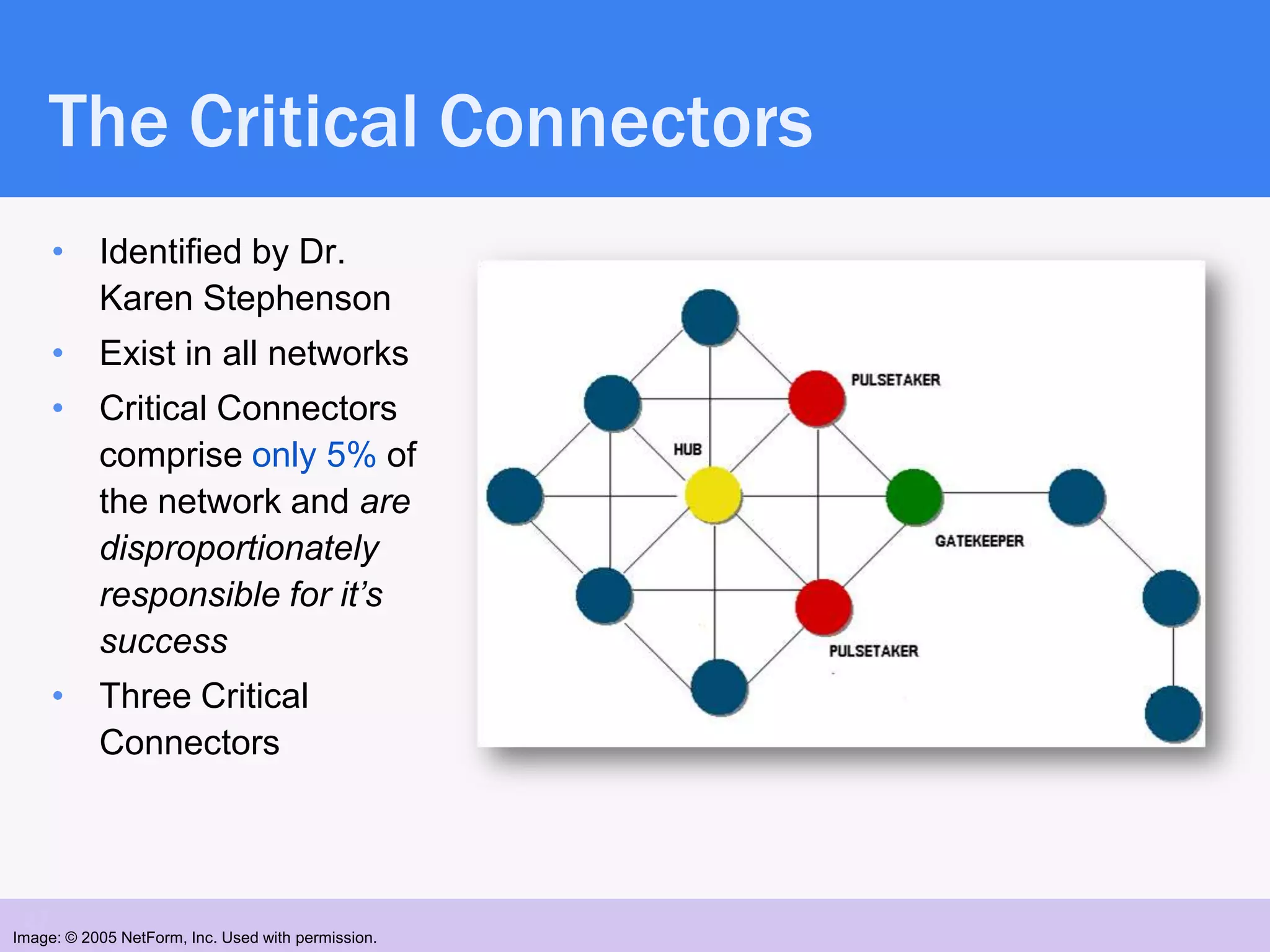
The Critical Connectors
      • Identified by Dr.
        Karen Stephenson
      • Exist in all networks
      • Critical Connectors
        comprise only 5% of
        the network and are
        disproportionately
        responsible for it’s
        success
      • Three Critical
        Connectors


 27
Image: © 2005 NetForm, Inc. Used with permission.
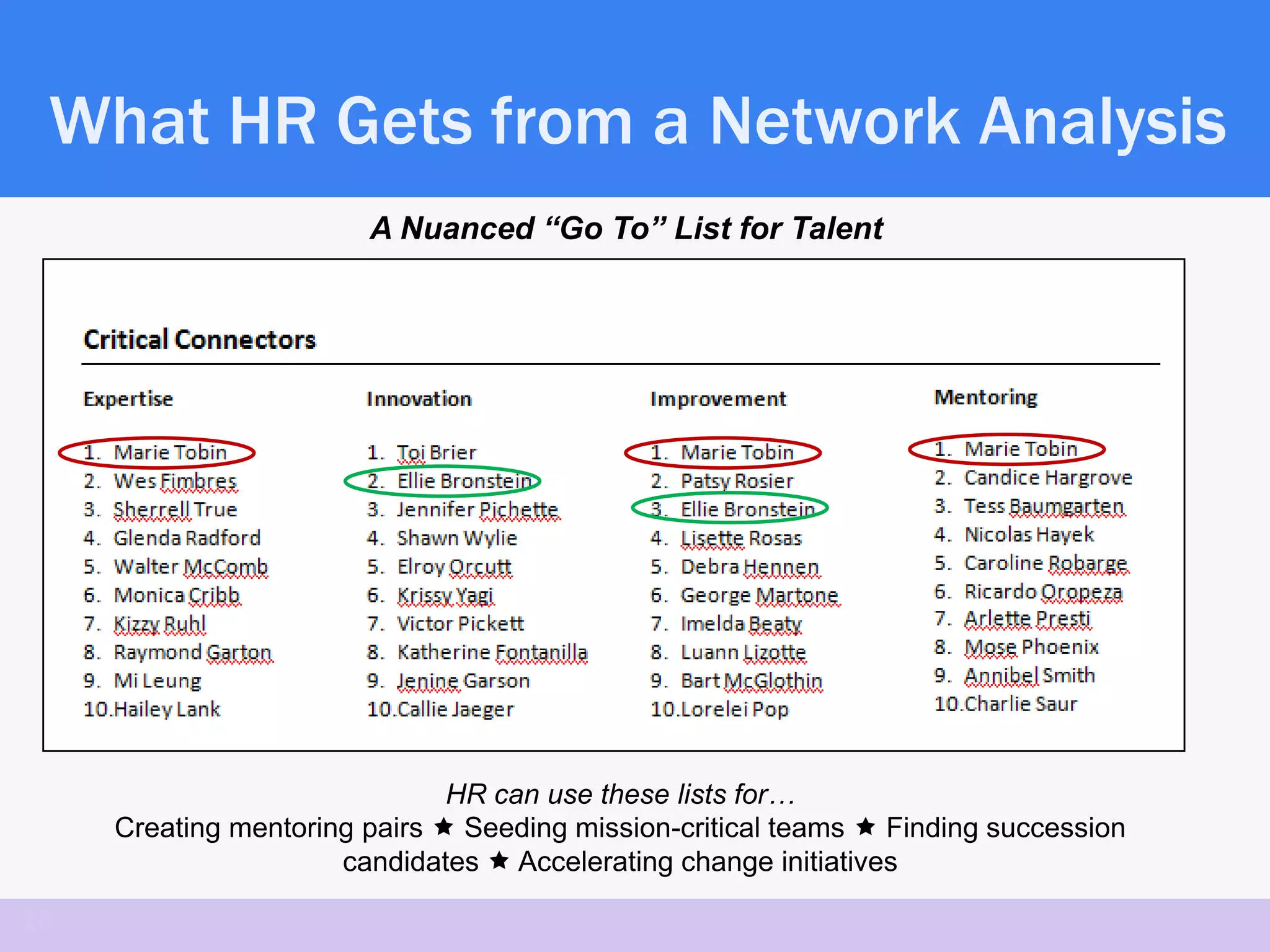
What HR Gets from a Network Analysis
                        A Nuanced “Go To” List for Talent


                               HR can use these lists for…
     Creating mentoring pairs  Seeding mission-critical teams  Finding succession
                      candidates  Accelerating change initiatives

28
HUMAN CAPITAL DEVELOPMENT


29
Development & Networks
      • Critical connectors have
        specific attributes that help
        them develop others more
        successfully
              ►    We can use critical connectors to
                   help accelerate on-
                   boarding, leader
                   integration, team
                   development, and so on


      • High performers use networks
        in specific ways that help
        them be successful
              ►    The top 20% of employees are
                   more likely to build and maintain
                   personal networks
Adapted from Cross, Thomas, & Light, How Top Talent Uses Networks and Where Rising Stars Get Trapped and The Organizational Network
 30
Fieldbook, by Cross, Singer, Colella, Thomas, & Silverstone.
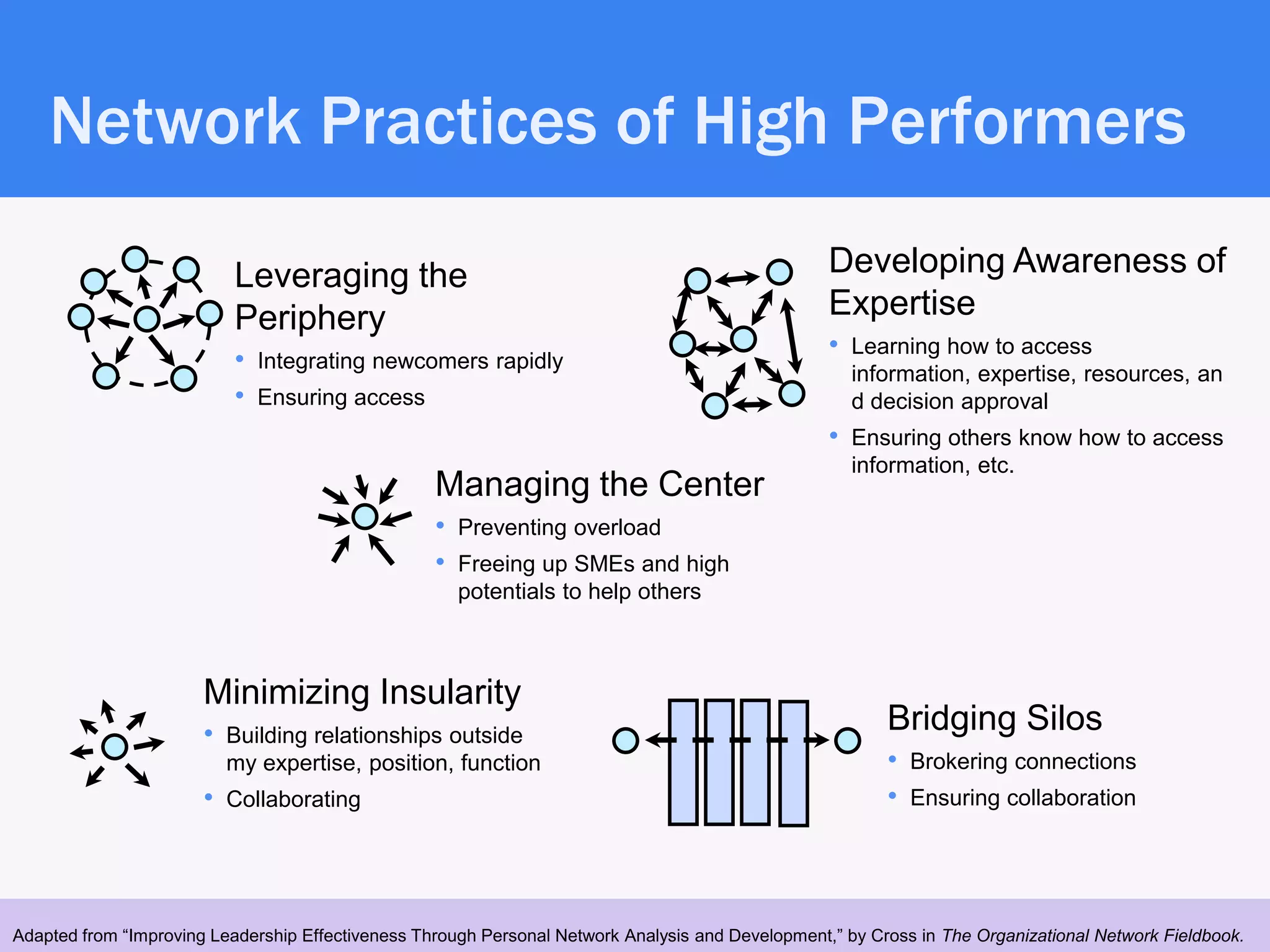
Network Practices of High Performers

                           Leveraging the                                                          Developing Awareness of
                           Periphery                                                               Expertise
                                                                                                   • Learning how to access
                           • Integrating newcomers rapidly                                            information, expertise, resources, an
                           • Ensuring access                                                          d decision approval
                                                                                                   • Ensuring others know how to access
                                                                                                      information, etc.
                                                   Managing the Center
                                                   •   Preventing overload
                                                   •   Freeing up SMEs and high
                                                       potentials to help others


                       Minimizing Insularity
                       • Building relationships outside                                                   Bridging Silos
                          my expertise, position, function                                                • Brokering connections
                       • Collaborating                                                                    • Ensuring collaboration


 31
3131
Adapted from “Improving Leadership Effectiveness Through Personal Network Analysis and Development,” by Cross in The Organizational Network Fieldbook.
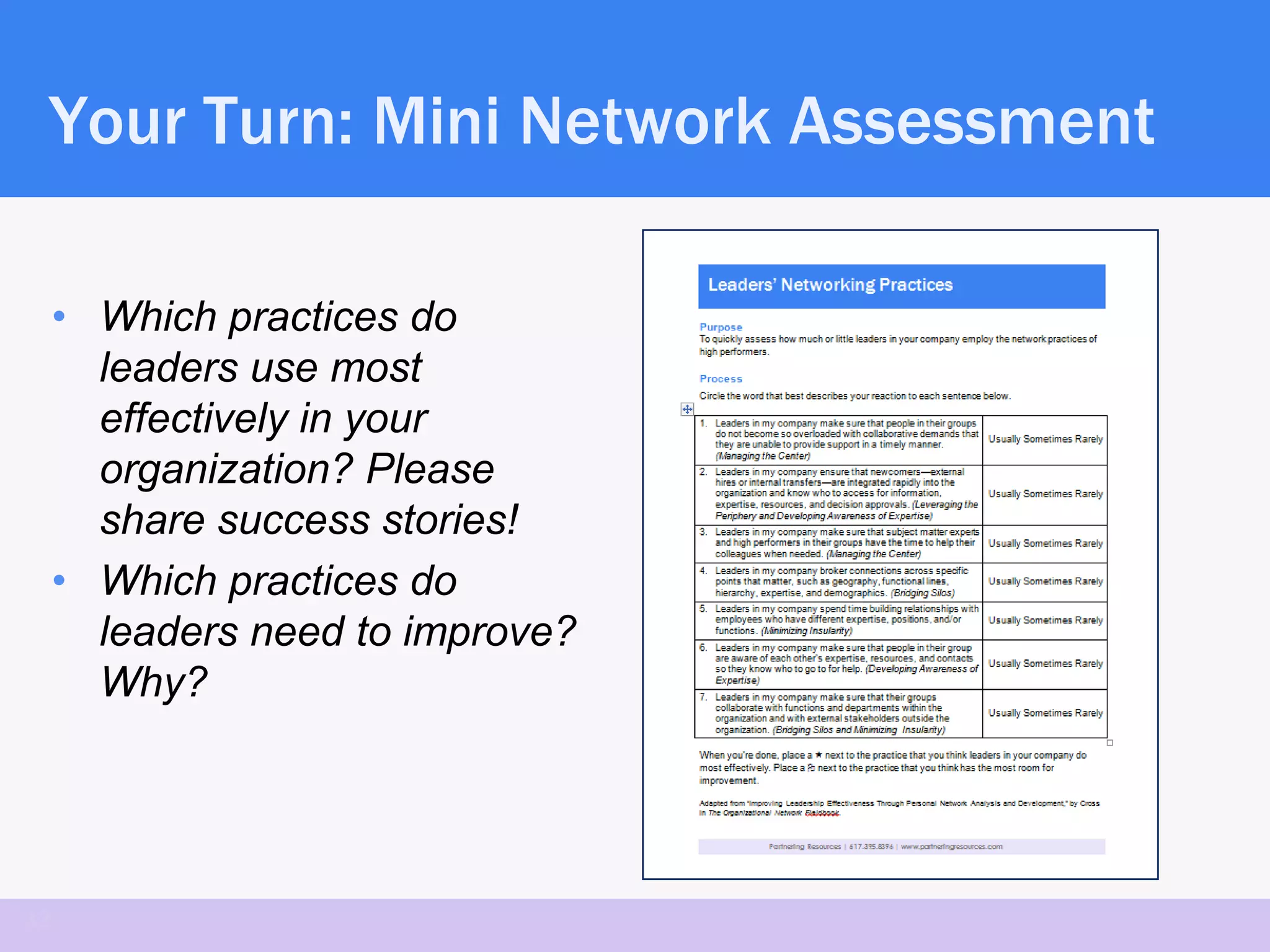
Your Turn: Mini Network Assessment

     • Which practices do
       leaders use most
       effectively in your
       organization? Please
       share success stories!
     • Which practices do
       leaders need to improve?
       Why?


32
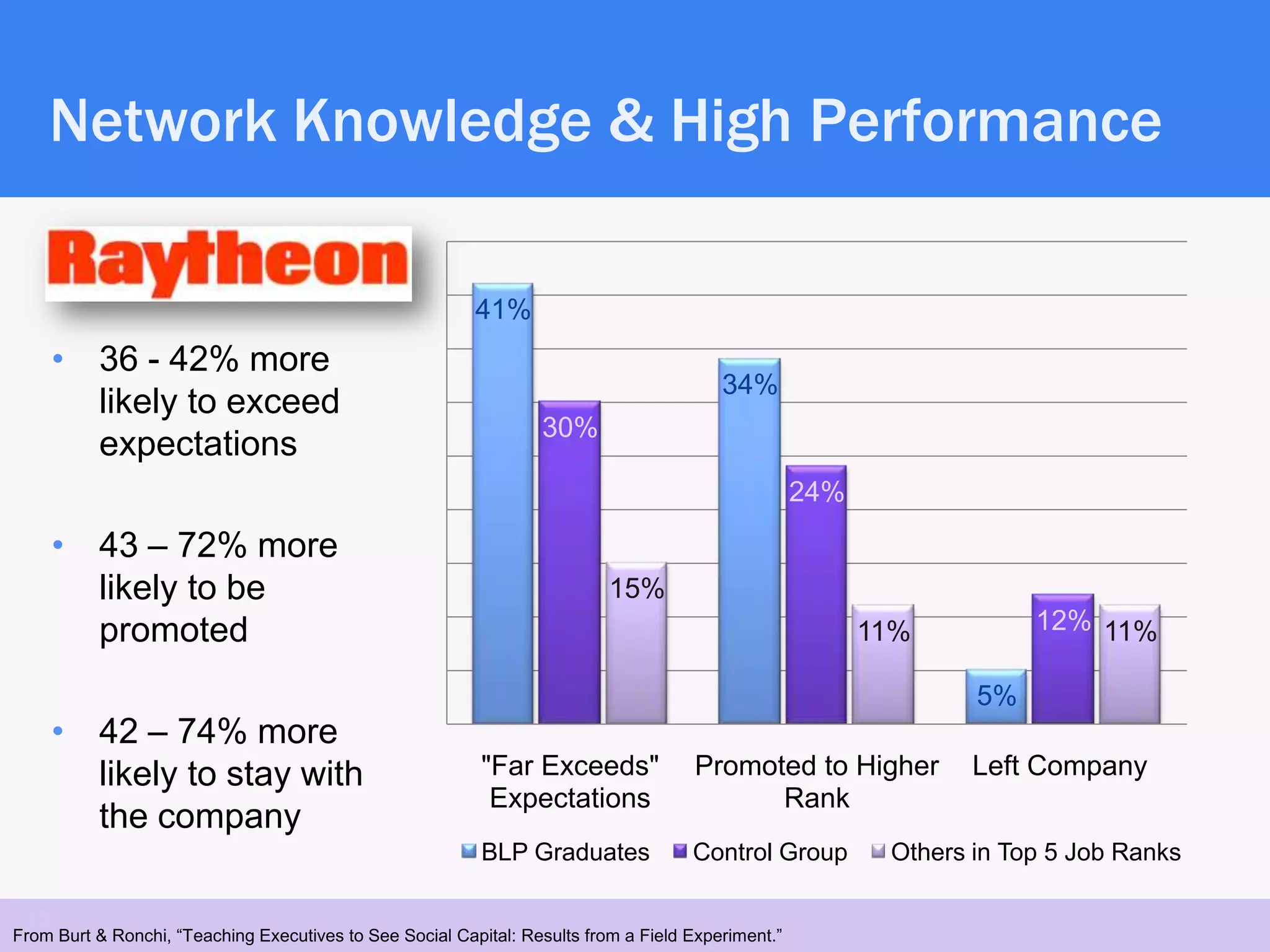
Network Knowledge & High Performance

                                                          41%
      • 36 - 42% more
                                                                                         34%
        likely to exceed
                                                                  30%
        expectations
                                                                                                    24%
      • 43 – 72% more
        likely to be                                                       15%
        promoted                                                                                          11%          12% 11%

                                                                                                                  5%
      • 42 – 74% more
        likely to stay with                                "Far Exceeds"             Promoted to Higher           Left Company
                                                            Expectations                   Rank
        the company
                                                           BLP Graduates             Control Group         Others in Top 5 Job Ranks

 33
From Burt & Ronchi, “Teaching Executives to See Social Capital: Results from a Field Experiment.”
WHAT YOU CAN DO


34
What You Can Do
 1.   Map your networks
 2.   Analyze the data
 3.   Engage, grow, and leverage critical connectors
 4.   Evolve the networks


35
Stacking the Deck
Using Hidden Networks to Identify and Develop High
Performers
Maya Townsend & Keli Trejo
Web: partneringresources.com
Blog: partneringresources.com/blog
Twitter: mayapare
Email: maya@partneringresources.com / keli@partneringresources.com
Phone: 617.395.8396 / 508.212.2268

Using Hidden Networks to Identify and Develop High Potentials

  • 1.
    Stacking the Deck: UsingHidden Networks to Identify and Develop High Potentials Presented By: Maya Townsend & Keli Trejo Partnering Resources
  • 2.
    The Point HR leaders can achieve more trustworthy, complete, and nuanced information about high potentials by using the organization’s hidden networks. 2
  • 3.
    Learning Objectives • Why and how employees develop networks of relationships to help get work done • The types of networks that typically form in organizations and the 3 critical roles in networks • How the 3 critical roles can help HR professionals identify and develop more effective and accurate succession and development programs • Case studies of how companies have used network analysis to develop the workforce • Plans for applying network knowledge to current and upcoming human capital development and succession planning efforts 3
  • 4.
    About Us We help organizations address complex collaboration and change challenges Maya Townsend, Founder & Lead Consultant • Specializes in using network knowledge to help organizations with large scale change • Rich experience in organization change, collaboration, and talent assessment • Author: Chief Learning Officer, Talent Management, CIO.Com, Mass High Tech, et al. • Presenter: NEHRA, PMI, Gartner, et al. • Chocolate fanatic Keli Trejo, Lead Consultant • 20+ years HR experience, including OD, Executive Coaching, Business Partner, HR Leadership roles • Significant change management roles through multi-year HR transformations • Deep experience with leadership development and succession management • Strong, collaborative client and HR partner relationships • Artist 4
  • 5.
  • 6.
    What is aNetwork? Networks are the webs of trusted relationships that people forge in order to perform work: Routine Work  Socializing  Sharing Expertise  Innovating  Improving  Making Ad Hoc Decisions  Mentoring 7 Image: NetForm International. Used with permission.
  • 7.
    Networks versus SocialNetworks Social network tools help us develop and maintain networks But the goal is the network 8
  • 8.
    WHY ARE NETWORKS IMPORTANT? 9
  • 9.
    Companies like OrgCharts… Jane is at the individual contributor level on the org chart 10
  • 10.
    But There’s Moreto the Story Jane 11
  • 11.
    It’s Not Just the Grapevine 12
  • 12.
    It’s Way More Improvement Decision-Making Expertise Innovation 13
  • 13.
    CASE STUDY: SUCCESSION PLANNING 14
  • 14.
    The R&D Organization Jerry, CEO of the R&D Jerry organization, is ready to retire. Here’s the top three levels of his organization (lower levels hidden for simplicity). 15 Case: Netform, Inc. Used with permission.
  • 15.
    The R&D WorkNetwork To help him decide on a successor, he asks for a network analysis. This map Jerry shows how people connect in order to get routine work done. Diane is a key player The thicker lines are stronger in the work network; connections. she has 9 connections Diane 16 Case: © 2007 Netform, Inc. Used with permission.
  • 16.
    The R&D SocialNetwork This map shows how people connect socially. Jerry Joe and the CEO have a strong social relationship Diane has only four connections, none of which are with the CEO Joe Diane 17 Case: Netform, Inc. Used with permission.
  • 17.
    Your Turn Howdy, neighbor! Who should Jerry appoint as his successor? Why? Who do you think Jerry did appoint as his successor? Why? 18
  • 18.
    The Recommendation Joe would not be a good candidate for succession since he is not well integrated into the work network and is overly dependent on the CEO. Based on his strong personal trust for Joe, the CEO chose Joe as his successor. 19
  • 19.
    The Promotion Joe became the new CEO Joe Diane, frustrated at being passed over, left the company. Diane 20 Case: Netform, Inc. Used with permission.
  • 20.
    The Defection Without Diane, the organization fractured and Joe became deeply disconnected After 6 disastrous months, Joe was fired. 21 Case: Netform, Inc. Used with permission.
  • 21.
    The Aftermath Stan stepped in as the new CEO 22 Case: Netform, Inc. Used with permission.
  • 22.
  • 23.
    Quick Case: Who’sthe High Performer? Here’s who the Here are the actual executives top 30 influencers thought were as shown by the the top 30 network analysis. influencers in a Only 5 people show Fortune 500 up on both lists. global information company. Why the gap? The initial top 30 list represents only the executives’ direct contacts and the next level down. They had no insight into the rest of the organization. 24
  • 24.
    Quick Case: CriticalConnector Lost • Technology organization • $75M operating budget • Annual trade show was a major revenue generation vehicle • The company let go of a low- level administrator citing the need to reduce overhead. • They realized afterwards that she was single- handedly responsible for securing millions of dollars each year for the trade show. 25
  • 25.
    Quick Case: CriticalConnectors Saved • Situation: Merger of two container plants required decisions about staff retention and outsourcing • Results: Leaders identified and retained people previously on the layoff list: ► Two employees who provided a steady source of innovation that were previously slated for retirement ► The group of employees that were responsible for helping a star achieve 26 From Stephenson (2008): “Building a Culture of Trust” and Stephenson (2005): “Trafficking in Trust.”
  • 26.
    The Critical Connectors • Identified by Dr. Karen Stephenson • Exist in all networks • Critical Connectors comprise only 5% of the network and are disproportionately responsible for it’s success • Three Critical Connectors 27 Image: © 2005 NetForm, Inc. Used with permission.
  • 27.
    What HR Getsfrom a Network Analysis A Nuanced “Go To” List for Talent HR can use these lists for… Creating mentoring pairs  Seeding mission-critical teams  Finding succession candidates  Accelerating change initiatives 28
  • 28.
  • 29.
    Development & Networks • Critical connectors have specific attributes that help them develop others more successfully ► We can use critical connectors to help accelerate on- boarding, leader integration, team development, and so on • High performers use networks in specific ways that help them be successful ► The top 20% of employees are more likely to build and maintain personal networks Adapted from Cross, Thomas, & Light, How Top Talent Uses Networks and Where Rising Stars Get Trapped and The Organizational Network 30 Fieldbook, by Cross, Singer, Colella, Thomas, & Silverstone.
  • 30.
    Network Practices ofHigh Performers Leveraging the Developing Awareness of Periphery Expertise • Learning how to access • Integrating newcomers rapidly information, expertise, resources, an • Ensuring access d decision approval • Ensuring others know how to access information, etc. Managing the Center • Preventing overload • Freeing up SMEs and high potentials to help others Minimizing Insularity • Building relationships outside Bridging Silos my expertise, position, function • Brokering connections • Collaborating • Ensuring collaboration 31 3131 Adapted from “Improving Leadership Effectiveness Through Personal Network Analysis and Development,” by Cross in The Organizational Network Fieldbook.
  • 31.
    Your Turn: MiniNetwork Assessment • Which practices do leaders use most effectively in your organization? Please share success stories! • Which practices do leaders need to improve? Why? 32
  • 32.
    Network Knowledge &High Performance 41% • 36 - 42% more 34% likely to exceed 30% expectations 24% • 43 – 72% more likely to be 15% promoted 11% 12% 11% 5% • 42 – 74% more likely to stay with "Far Exceeds" Promoted to Higher Left Company Expectations Rank the company BLP Graduates Control Group Others in Top 5 Job Ranks 33 From Burt & Ronchi, “Teaching Executives to See Social Capital: Results from a Field Experiment.”
  • 33.
  • 34.
    What You CanDo 1. Map your networks 2. Analyze the data 3. Engage, grow, and leverage critical connectors 4. Evolve the networks 35
  • 35.
    Stacking the Deck UsingHidden Networks to Identify and Develop High Performers Maya Townsend & Keli Trejo Web: partneringresources.com Blog: partneringresources.com/blog Twitter: mayapare Email: maya@partneringresources.com / keli@partneringresources.com Phone: 617.395.8396 / 508.212.2268

Editor's Notes

  • #4 MESSAGE:
  • #8 MESSAGE: Networks are the trusted webs of relationships that people form in every organization in order to get things done.
  • #9 MESSAGE: Networks are the goal. Social networks are tools used to build and connect with networks.
  • #11 MESSAGE: Organization charts are important, but don’t tell the whole story.
  • #12 MESSAGE: Networks can show you the people who keep the company running.
  • #13 MESSAGE: Networks aren’t just about the grapevine.
  • #15 MESSAGE: Networks are an important consideration in succession planning
  • #18 The social network looks very different. Overwhelmed by work, Diane has little opportunity to socialize.Joe has a strong relationship with the CEO.
  • #24 MESSAGE: Networks can help generate more accurate assessments of human capital
  • #25 MESSAGE: We don’t always know who our high performers are despite our best efforts.One company’s leadership team identified the 30 individuals they thought would be highly connected. Then, after a network analysis, they matched their list to the results. Only five people from the initial list were actual critical connectors. It turned out that the other 25 on the initial list were only one or two steps away from the leaders: direct contacts or contacts of direct contacts. But, since the leaders' personal networks were limited (as everyone’s are), they couldn’t see the connectors outside their personal networks. It was a wake-up call. The leadership team rethought their talent development strategies and created special plans to leverage the actual key connectors.
  • #26 MESSAGE: Not knowing people in the network can cost millions.In one such example, a software company let go of a low-level administrator citing the need to reduce overhead in the organization. Little did they know that this woman was single-handedly responsible for securing millions of dollars each year by nagging companies until they finally sent in sponsorship checks for the annual trade conference. Once she left, the leaders realized their error, but the damage was already done. Her expertise about the sponsors, and how best to influence them, left with her.
  • #28 MESSAGE: The key to managing networks is understanding critical connectors
  • #30 MESSAGE: Networks can help with human capital development.
  • #31 MESSAGE: High performers do specific things with their networks. Build high-quality relationshipsManage the Center: Minimize bottlenecks and acknowledge / develop high performers. Position selves at key network points and leverage people around them.Leverage the Periphery: Rapidly integrate newcomers and reengage under-connected high performersSelectively Bridge Silos: Reach across important differences such as geography, function, etc.Develop Awareness of Expertise: Invest in relationships to extend expertise, balance biases, and prevent career traps.Minimize Insularity: Cultivate select ties with internal & external experts and stakeholders.
  • #34 MESSAGE: It pays to help people develop high performer networks.Burt & Ronchi “Teaching Executives to See Social Capital” in Social Science ResearchExecutives active in a network learning course were over 2 times more likely to far exceed expectations on performance reviews than the control group Active executives were 3 times more likely to be promoted to a higher rank than the control group Active executives were less likely to leave the company
  • #37 MESSAGE: Analysis helps you find the riches in your network.This is where many organizations thrive. We’ve covered some of the things to look for in the network: single points of failure, weak links, hubs, gatekeepers, pulsetakers, structural over-dependency, missing links, unaligned links, too many links, and orphans. Analysis helps Leaders identify and correct these risks. This is also the time to build redundancy into the system, mitigate potential risks, and act on opportunities.In this case study…
  • #39 MESSAGE: Thank you!!!