Presentation to PMI, Central Massachusetts Chapter
5/11/2010


                              The Hidden Web
                              Inside the Informal Networks that Drive Project
                              Performance
                              Project Management Institute
                              Central Massachusetts Chapter
                              May 11, 2010

                              Maya Townsend, Founder
                              Partnering Resources


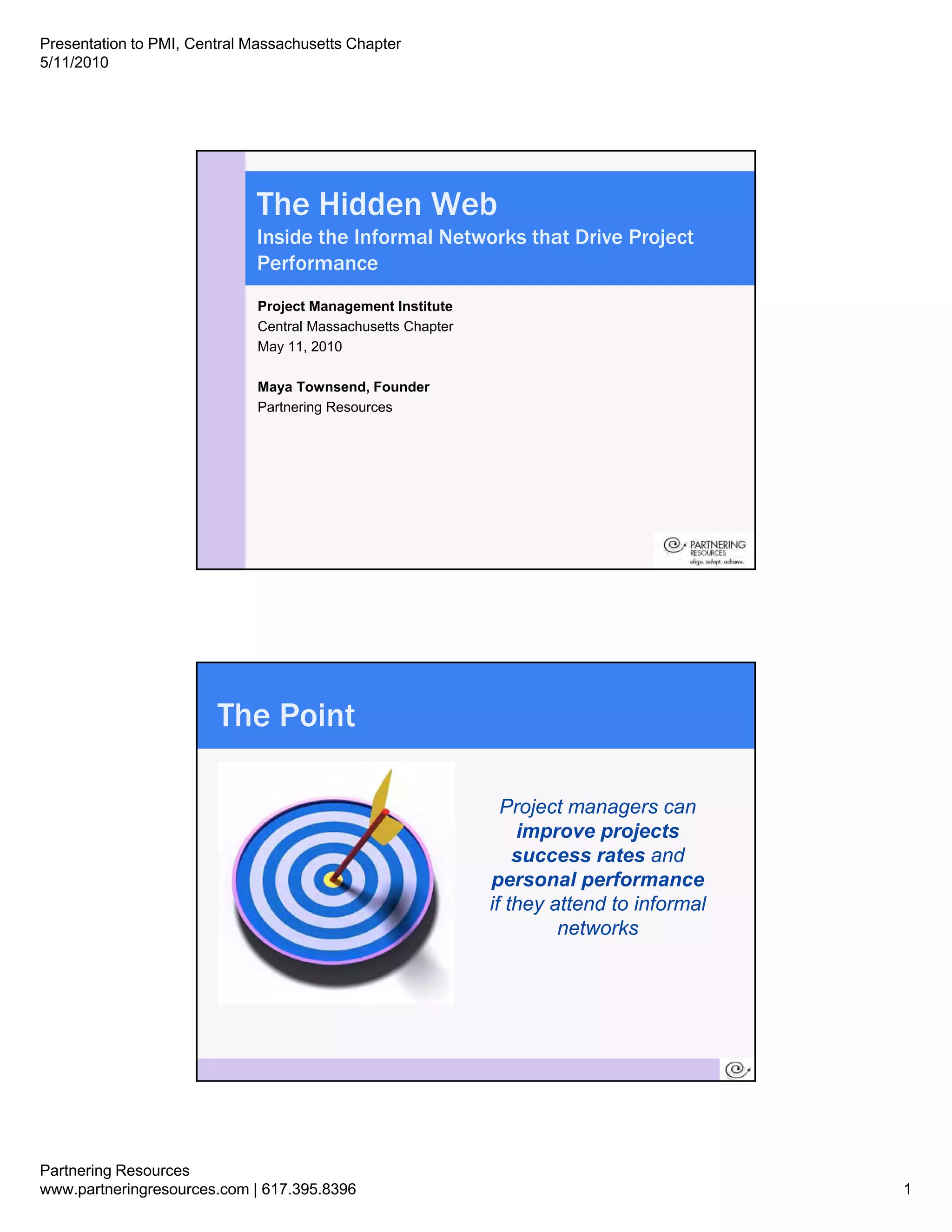
                           The Point

                                                                Project
                                                                P j t managers can
                                                                  improve projects
                                                                  success rates and
                                                              personal performance
                                                              if they attend to informal
                                                                       networks


                       2


Partnering Resources
www.partneringresources.com | 617.395.8396                                                 1
Presentation to PMI, Central Massachusetts Chapter
5/11/2010


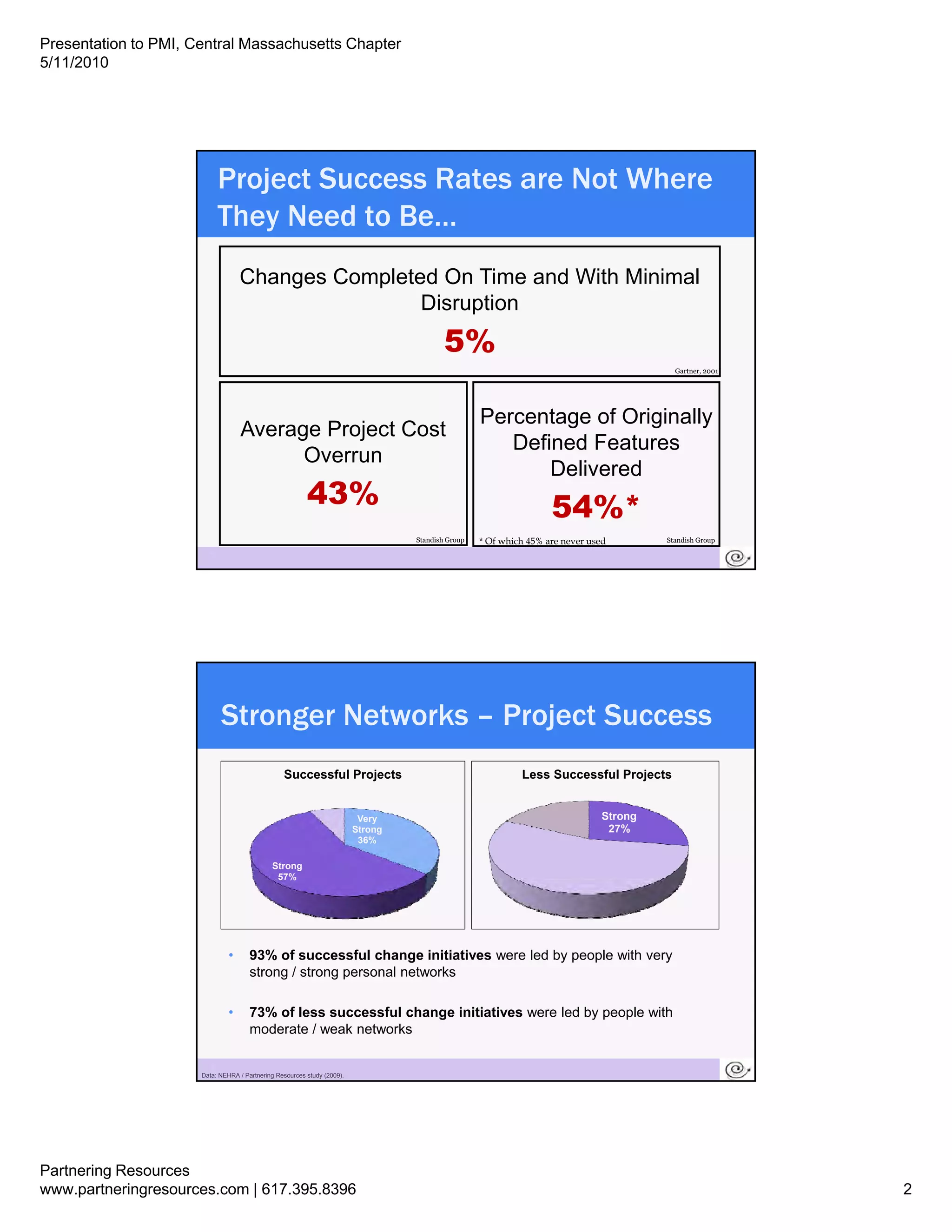
                            Project Success Rates are Not Where
                            They Need to Be…
                                   Changes Completed On Time and With Minimal
                                                   Disruption
                                                                                          5%
                                                                                                                                         Gartner, 2001


                                                                                                   Percentage of Originally
                                   Average Project Cost
                                                                                                      Defined Features
                                         Overrun
                                                                                                          Delivered
                                                         43%                                                       54%*
                                                                                  Standish Group   * Of which 45% are never used       Standish Group

                        3


                            Stronger Networks – Project Success
                                                 Successful Projects                                        Less Successful Projects


                                                                          Very                                                Strong
                                                                         Strong                                                27%
                                                                          36%

                                             Strong
                                              57%


                               •      93% of successful change initiatives were led by people with very
                                      strong / strong personal networks

                               •      73% of less successful change initiatives were led by people with
                                      moderate / weak networks

                        4
                      Data: NEHRA / Partnering Resources study (2009).


Partnering Resources
www.partneringresources.com | 617.395.8396                                                                                                               2
Presentation to PMI, Central Massachusetts Chapter
5/11/2010


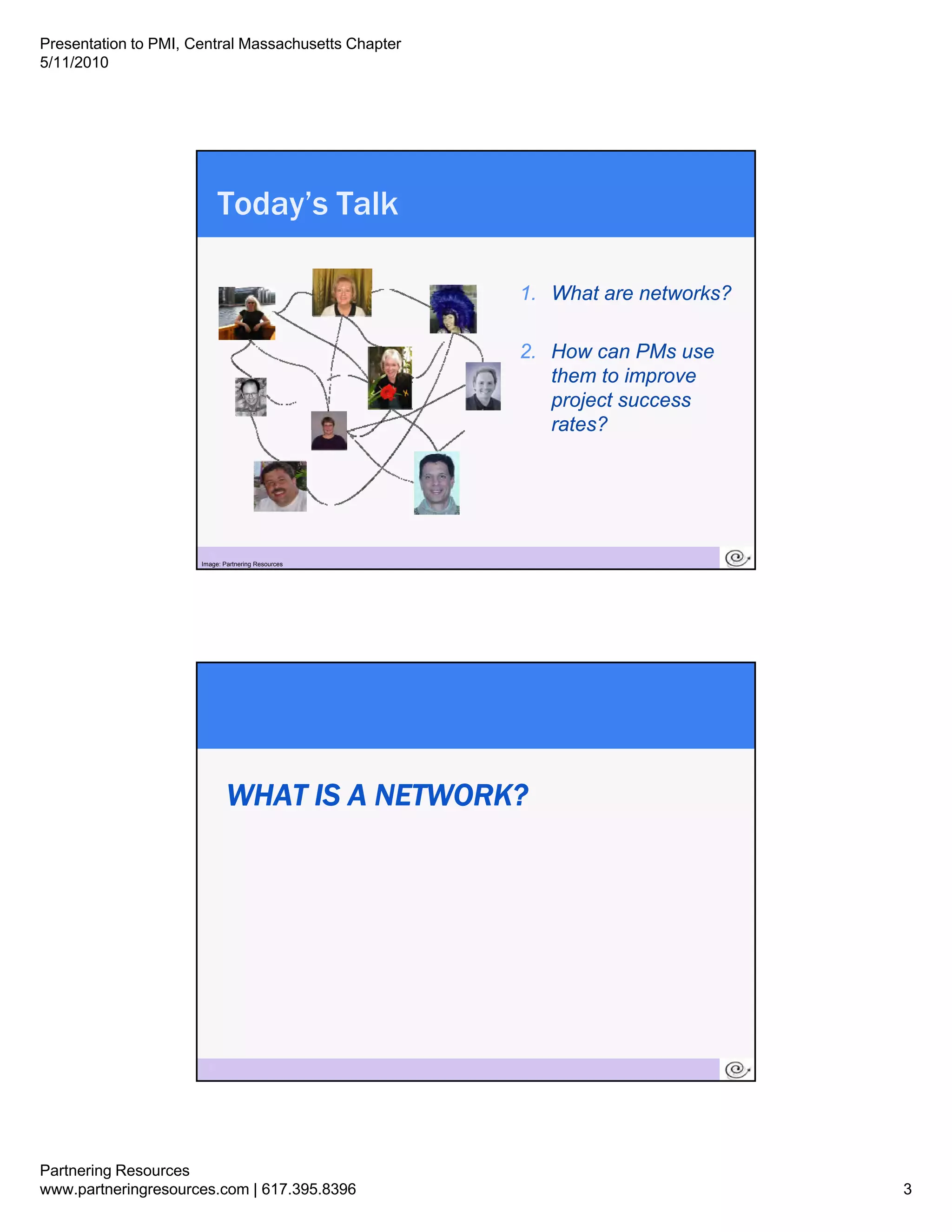
                            Today’s Talk

                                                     1.
                                                     1 What are networks?

                                                     2. How can PMs use
                                                        them to improve
                                                        project success
                                                        rates?


                        5
                      Image: Partnering Resources


                              WHAT IS A NETWORK?


                        6


Partnering Resources
www.partneringresources.com | 617.395.8396                                  3
Presentation to PMI, Central Massachusetts Chapter
5/11/2010


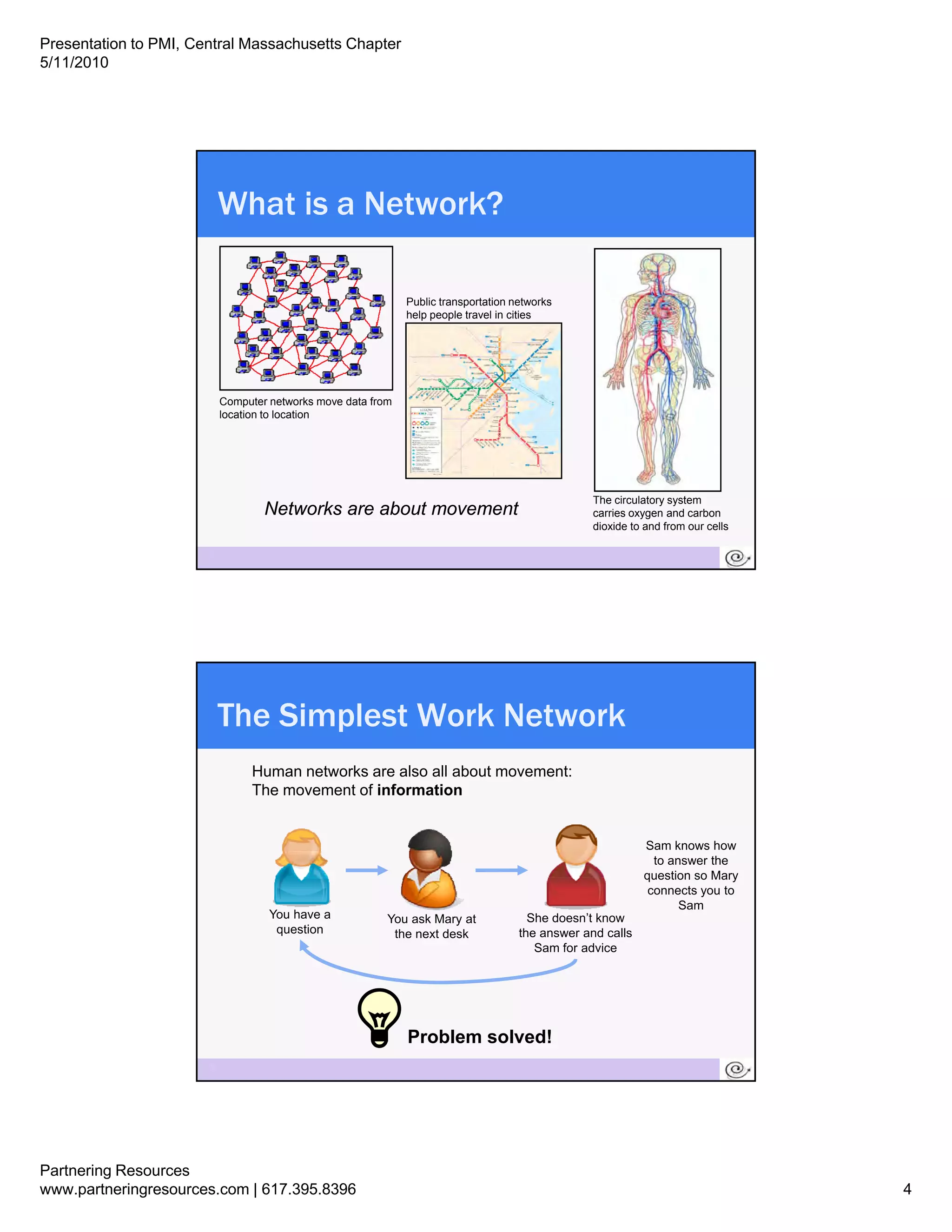
                           What is a Network?

                                                              Public transportation networks
                                                              help people travel in cities


                           Computer networks move data from
                           location to location


                                                                                                  The circulatory system
                                   Networks are about movement                                    carries oxygen and carbon
                                                                                                  dioxide to and from our cells

                       7


                           The Simplest Work Network
                                 Human networks are also all about movement:
                                 The movement of information


                                                                                                            Sam knows how
                                                                                                              to answer the
                                                                                                            question so Mary
                                                                                                             connects you to
                                                                                                                   Sam
                                    You have a            You ask Mary at              She doesn’t know
                                     question              the next desk             the answer and calls
                                                                                        Sam for advice


                                                              Problem solved!
                       8


Partnering Resources
www.partneringresources.com | 617.395.8396                                                                                        4
Presentation to PMI, Central Massachusetts Chapter
5/11/2010


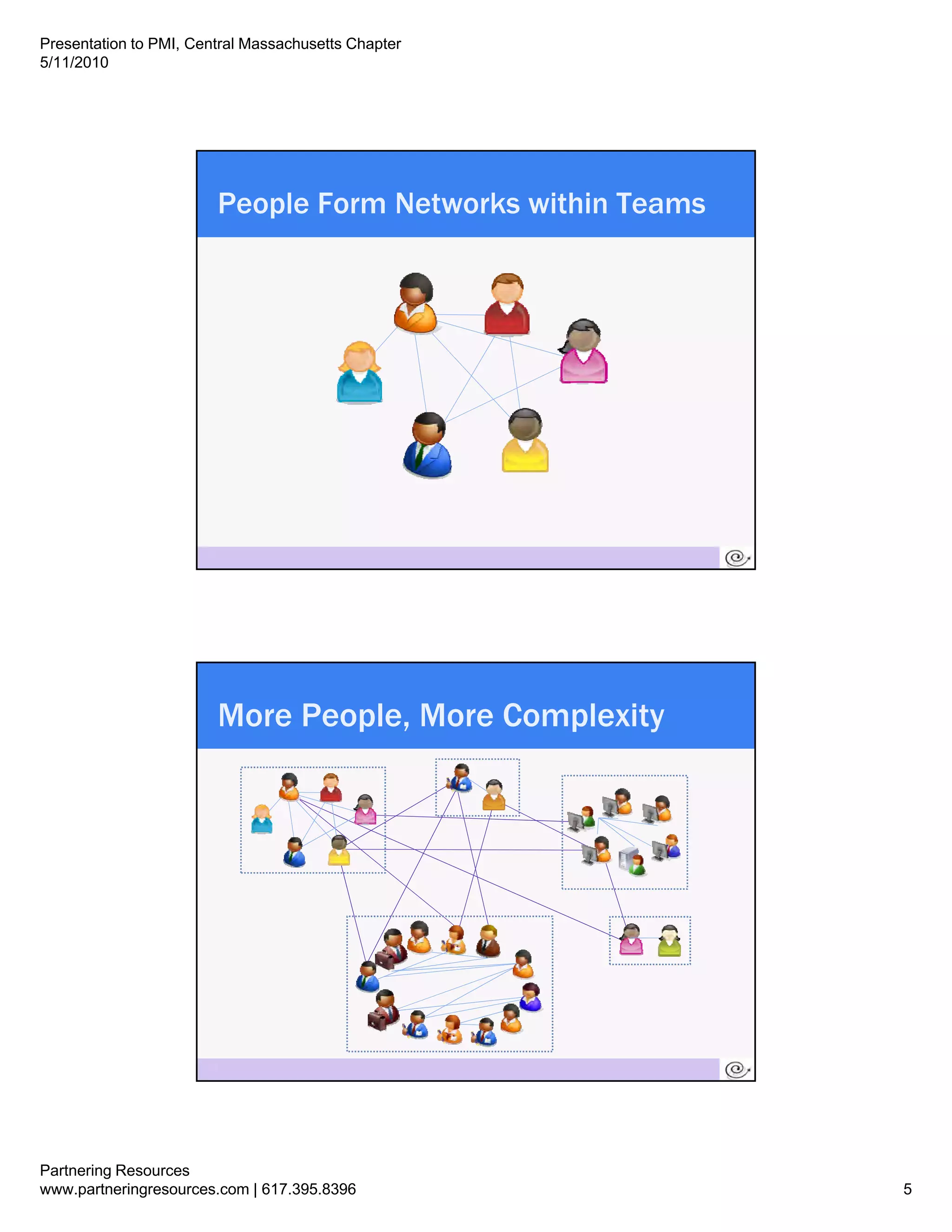
                           People Form Networks within Teams


                       9


                           More People, More Complexity


                       10


Partnering Resources
www.partneringresources.com | 617.395.8396                     5
Presentation to PMI, Central Massachusetts Chapter
5/11/2010


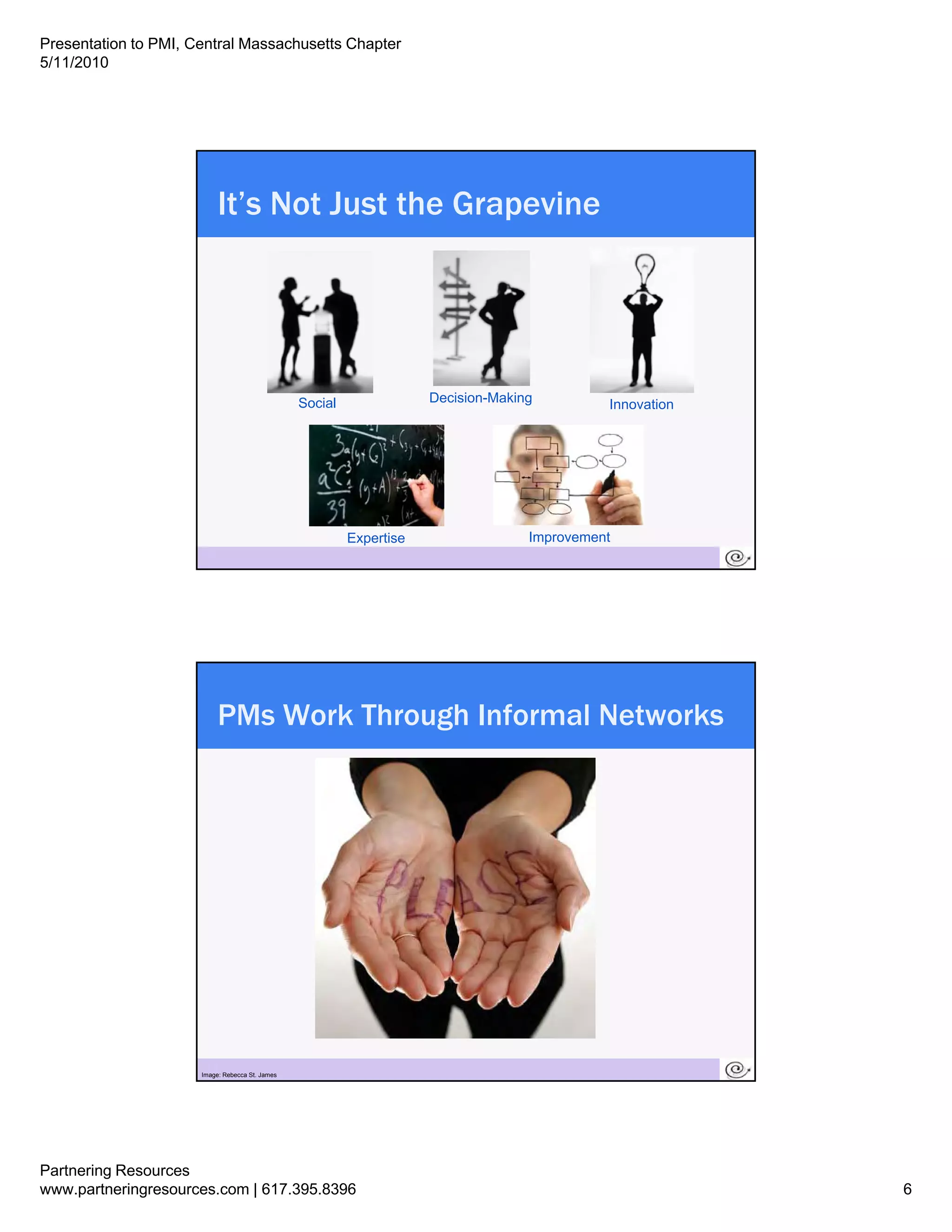
                           It’s Not Just the Grapevine


                                                 Social               Decision-Making         Innovation


                                                          Expertise                 Improvement
                       11


                           PMs Work Through Informal Networks


                       12
                      Image: Rebecca St. James


Partnering Resources
www.partneringresources.com | 617.395.8396                                                                 6
Presentation to PMI, Central Massachusetts Chapter
5/11/2010


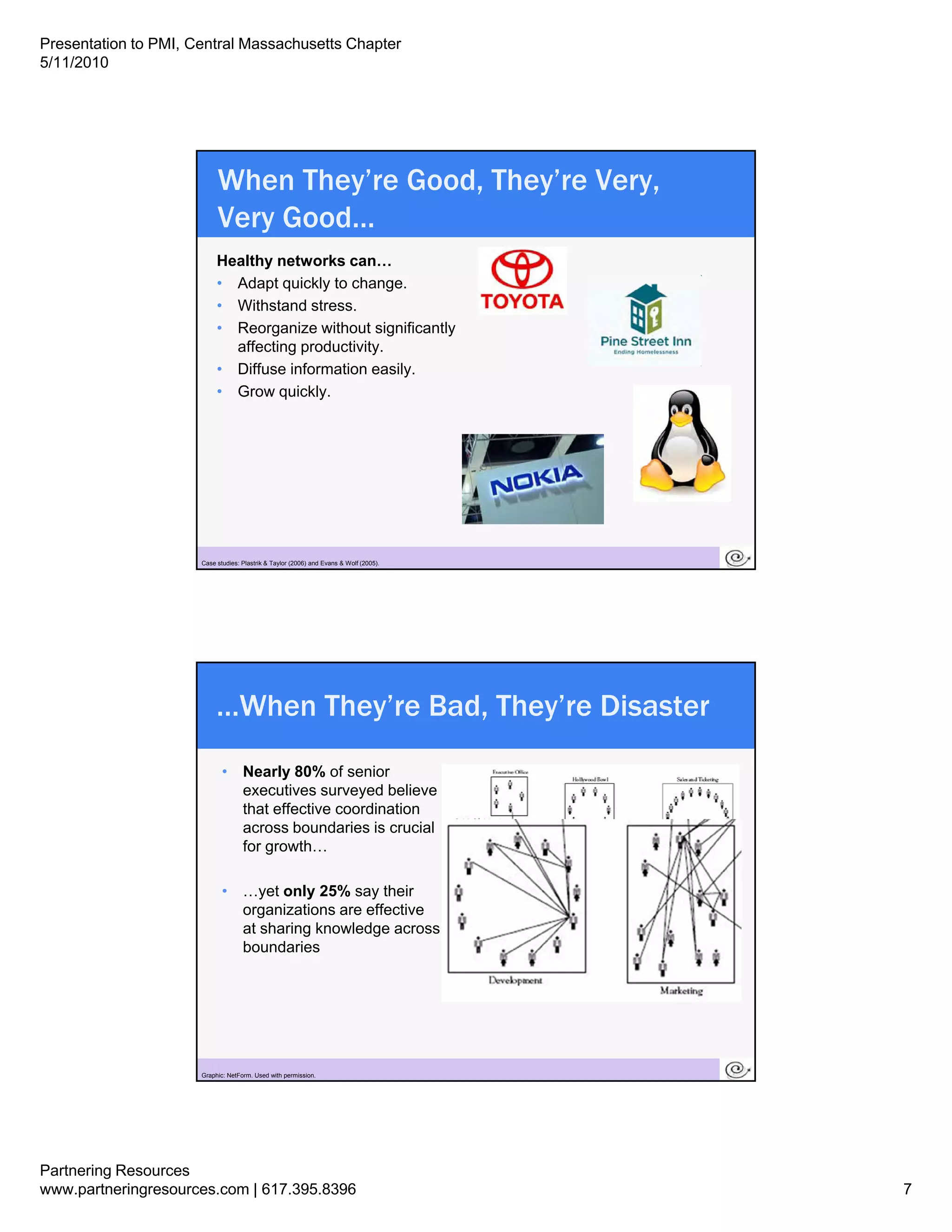
                           When They’re Good, They’re Very,
                           Very Good…
                           Healthy networks can…
                           • Adapt q
                                 p quickly to change.
                                          y          g
                           • Withstand stress.
                           • Reorganize without significantly
                             affecting productivity.
                           • Diffuse information easily.
                           • Grow quickly.


                       13
                      Case studies: Plastrik & Taylor (2006) and Evans & Wolf (2005).


                           …When They’re Bad, They’re Disaster
                             • Nearly 80% of senior
                               executives surveyed believe
                               that effective coordination
                               across boundaries is crucial
                               for growth…

                             • …yet only 25% say their
                               organizations are effective
                               at sharing knowledge across
                               boundaries
                               b    d i


                       14
                      Graphic: NetForm. Used with permission.


Partnering Resources
www.partneringresources.com | 617.395.8396                                              7
Presentation to PMI, Central Massachusetts Chapter
5/11/2010


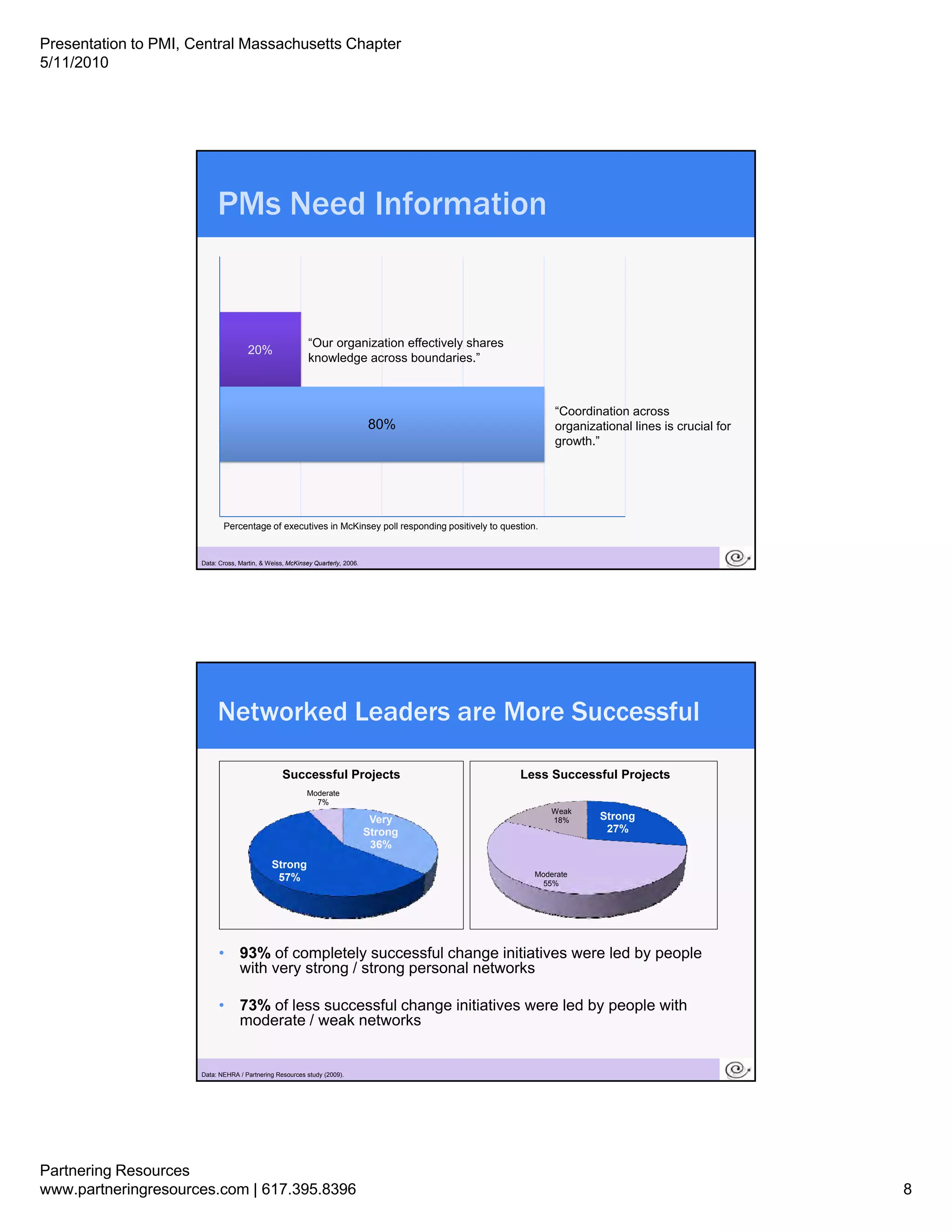
                           PMs Need Information


                                                           “Our organization effectively shares
                                      20%
                                                           knowledge across boundaries.”


                                                                                                            “Coordination across
                                                                                80%                         organizational lines is crucial for
                                                                                                            growth.”


                             Percentage of executives in McKinsey poll responding positively to question.


                       15
                      Data: Cross, Martin, & Weiss, McKinsey Quarterly, 2006.


                           Networked Leaders are More Successful

                                                  Successful Projects                               Less Successful Projects
                                                          Moderate
                                                            7%
                                                                                                            Weak
                                                                                 Very                       18%     Strong
                                                                                Strong                               27%
                                                                                 36%
                                              Strong
                                               57%                                                      Moderate
                                                                                                         55%


                            • 93% of completely successful change initiatives were led by people
                              with very strong / strong personal networks

                            • 73% of less successful change initiatives were led by people with
                              moderate / weak networks

                       16
                      Data: NEHRA / Partnering Resources study (2009).


Partnering Resources
www.partneringresources.com | 617.395.8396                                                                                                        8
Presentation to PMI, Central Massachusetts Chapter
5/11/2010


                            HOW CAN PROJECT MANAGERS
                            USE NETWORKS TO IMPROVE
                            PROJECT SUCCESS RATES?


                       17


                        Four Techniques
                        1.   Know your networks
                        2.
                        2    Build t
                             B ild strong networks
                                             t   k
                        3.   Understand the project network
                        4.   Build your project network


                       18


Partnering Resources
www.partneringresources.com | 617.395.8396                    9
Presentation to PMI, Central Massachusetts Chapter
5/11/2010


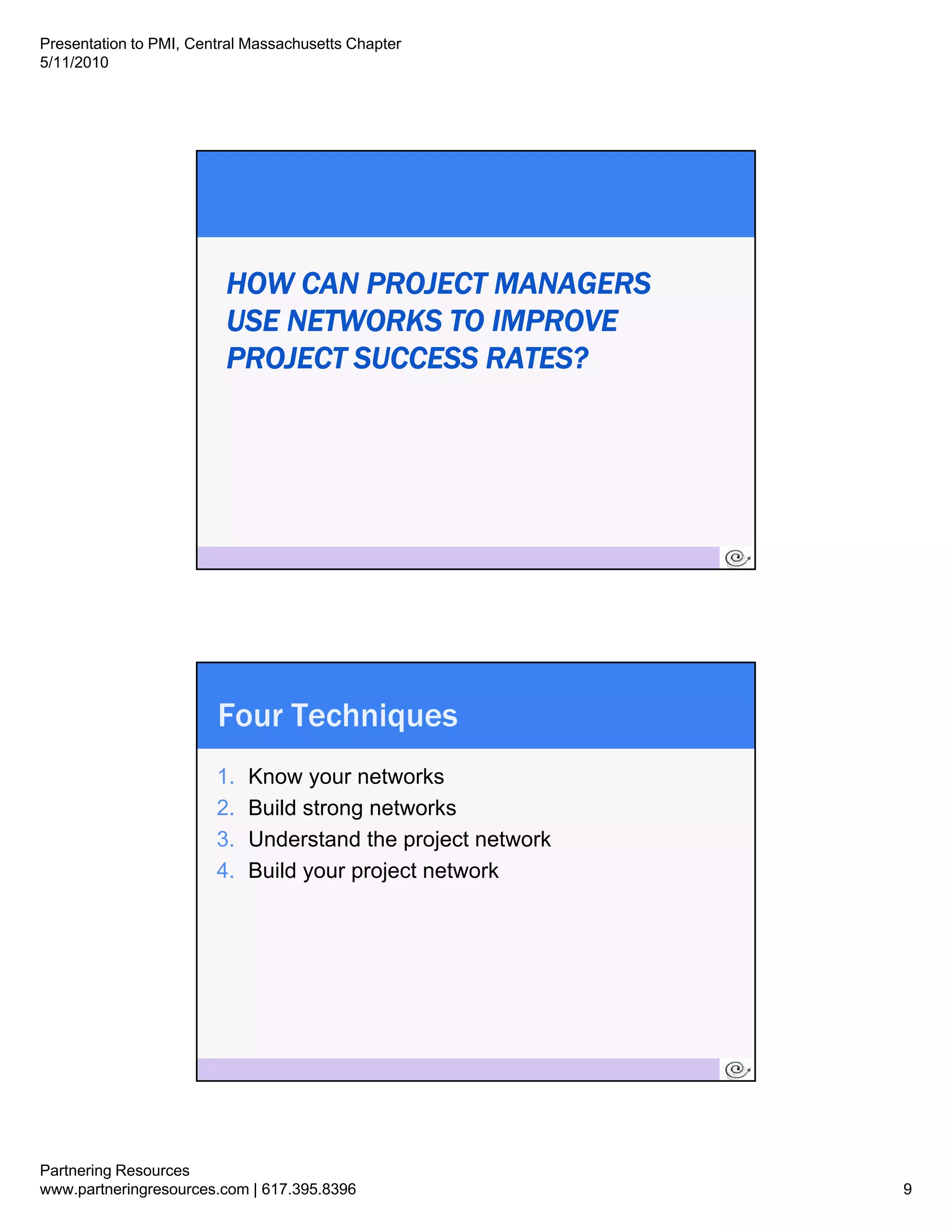
                           1. Know Your networks


                       19
                      Image: Partnering Resources.


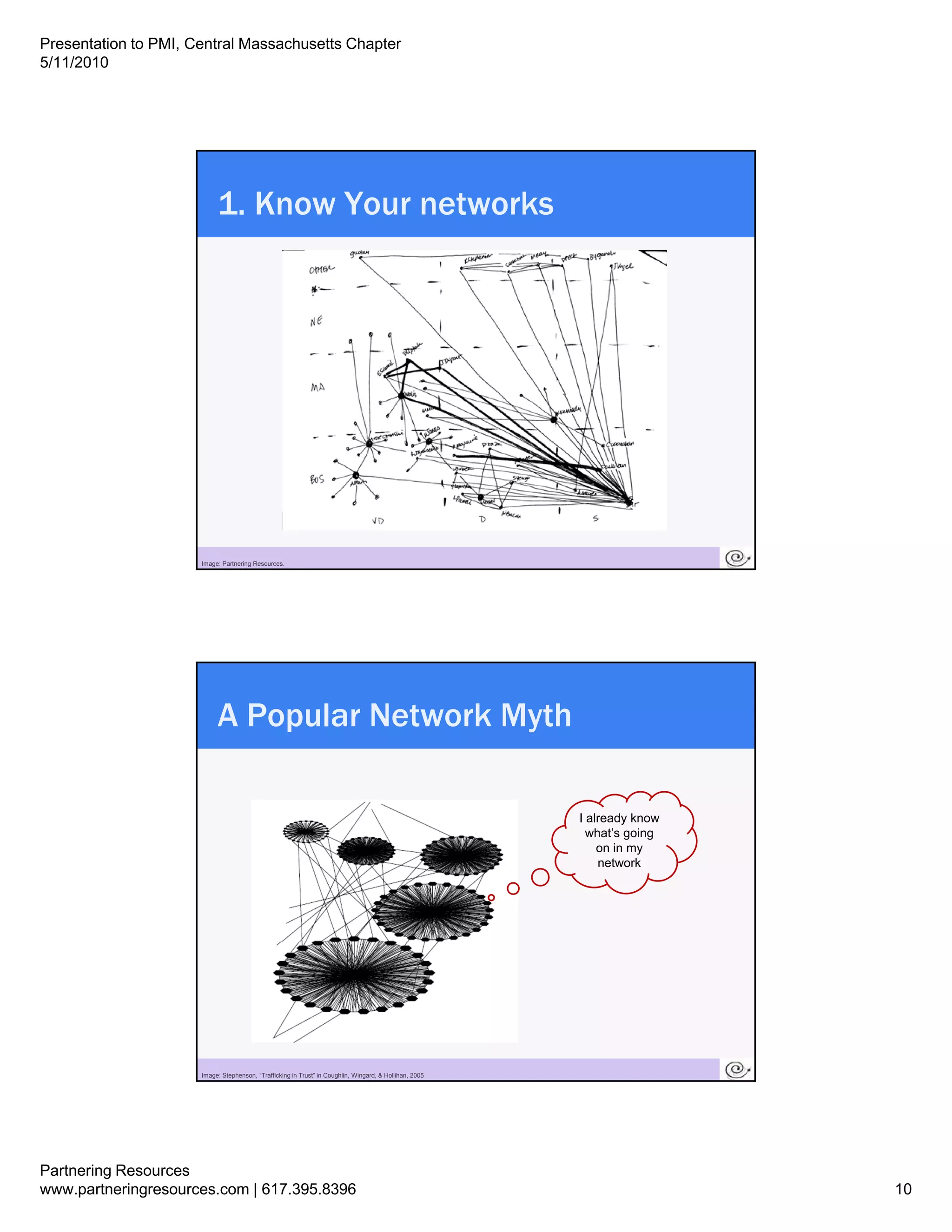
                           A Popular Network Myth

                                                                                                         I already know
                                                                                                           what’s going
                                                                                                             on in my
                                                                                                             network


                       20
                      Image: Stephenson, “Trafficking in Trust” in Coughlin, Wingard, & Hollihan, 2005


Partnering Resources
www.partneringresources.com | 617.395.8396                                                                                10
Presentation to PMI, Central Massachusetts Chapter
5/11/2010


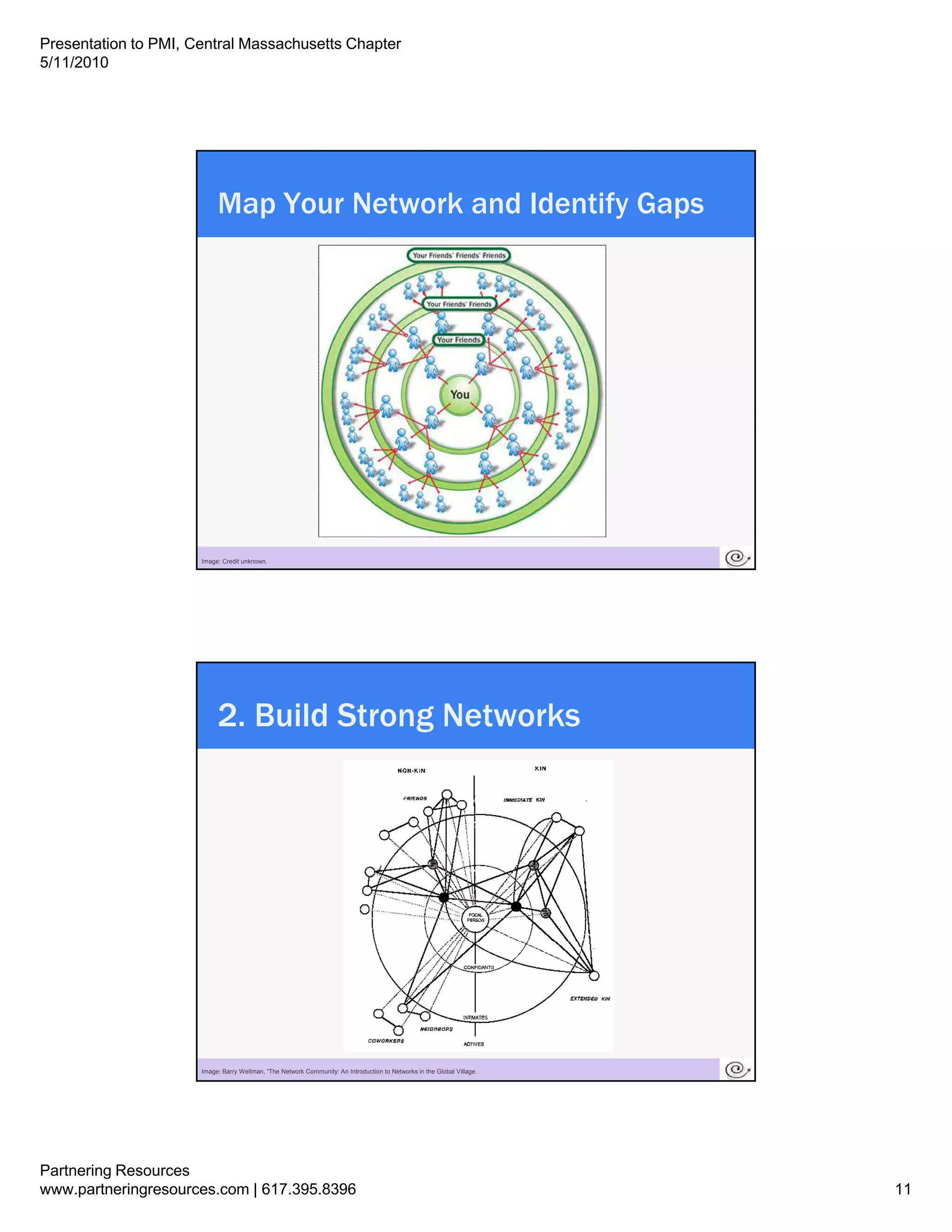
                           Map Your Network and Identify Gaps


                       21
                      Image: Credit unknown.


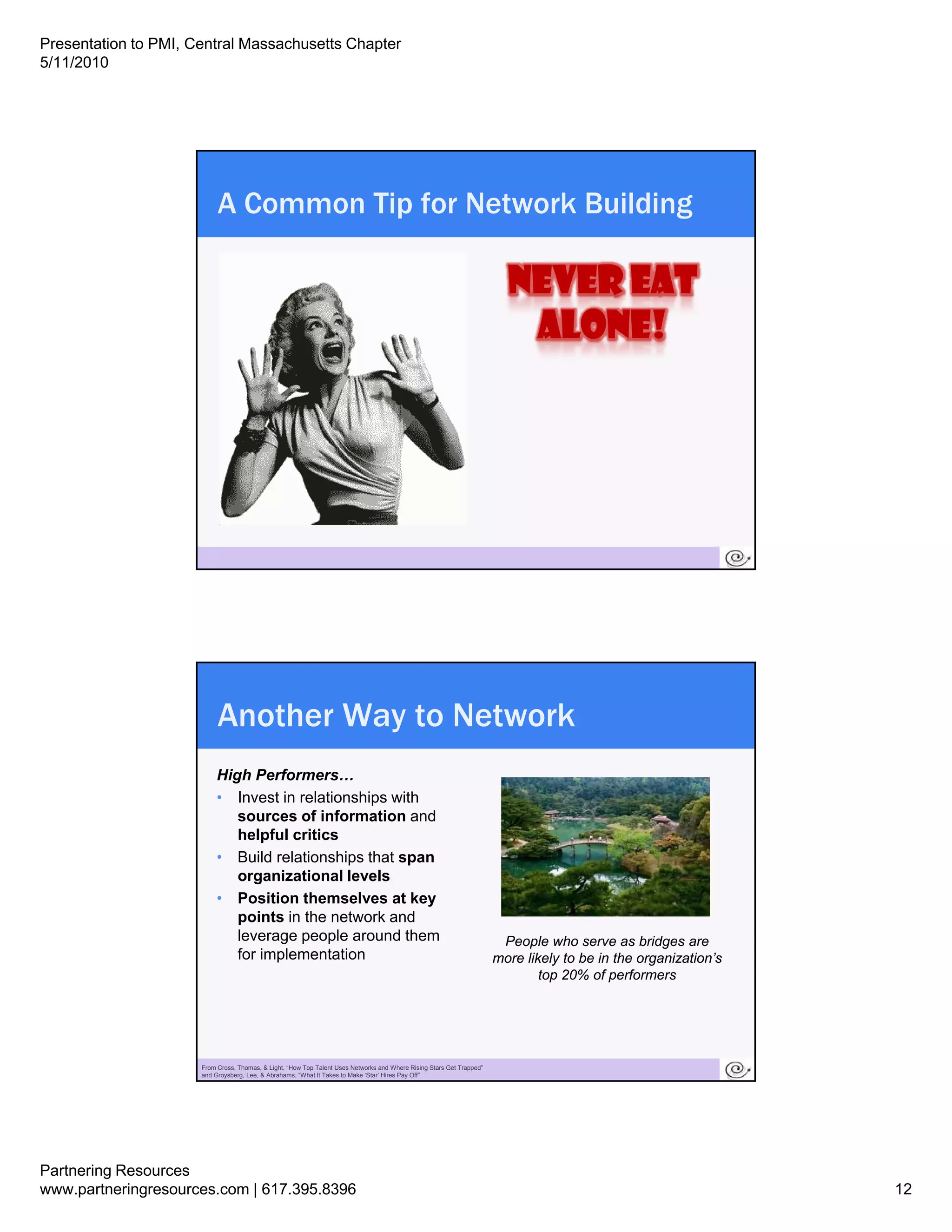
                           2. Build Strong Networks


                       22
                      Image: Barry Wellman, “The Network Community: An Introduction to Networks in the Global Village.


Partnering Resources
www.partneringresources.com | 617.395.8396                                                                               11
Presentation to PMI, Central Massachusetts Chapter
5/11/2010


                           A Common Tip for Network Building


                       23


                           Another Way to Network
                           High Performers…
                           • Invest in relationships with
                              sources of information and
                              helpful critics
                           • Build relationships that span
                              organizational levels
                           • Position themselves at key
                              points in the network and
                              leverage p p around them
                                    g people                                                                            People who serve as bridges are
                              for implementation                                                                       more likely to be in the organization’s
                                                                                                                               top 20% of performers


                       24
                      From Cross, Thomas, & Light, “How Top Talent Uses Networks and Where Rising Stars Get Trapped”
                      and Groysberg, Lee, & Abrahams, “What It Takes to Make ‘Star’ Hires Pay Off”


Partnering Resources
www.partneringresources.com | 617.395.8396                                                                                                                       12
Presentation to PMI, Central Massachusetts Chapter
5/11/2010


                           Key to Building Your Network


                       25
                      Photo: Sizumaru’s Photo Stream, Flickr.


                           The Minimalist Approach

                                                                1.
                                                                1 Schedule 1 coffee meeting / month


                                                                2. Forward 1 email / week


                                                                3. Walk around the office and talk
                                                                   with people 1 time / day

                       26


Partnering Resources
www.partneringresources.com | 617.395.8396                                                            13
Presentation to PMI, Central Massachusetts Chapter
5/11/2010


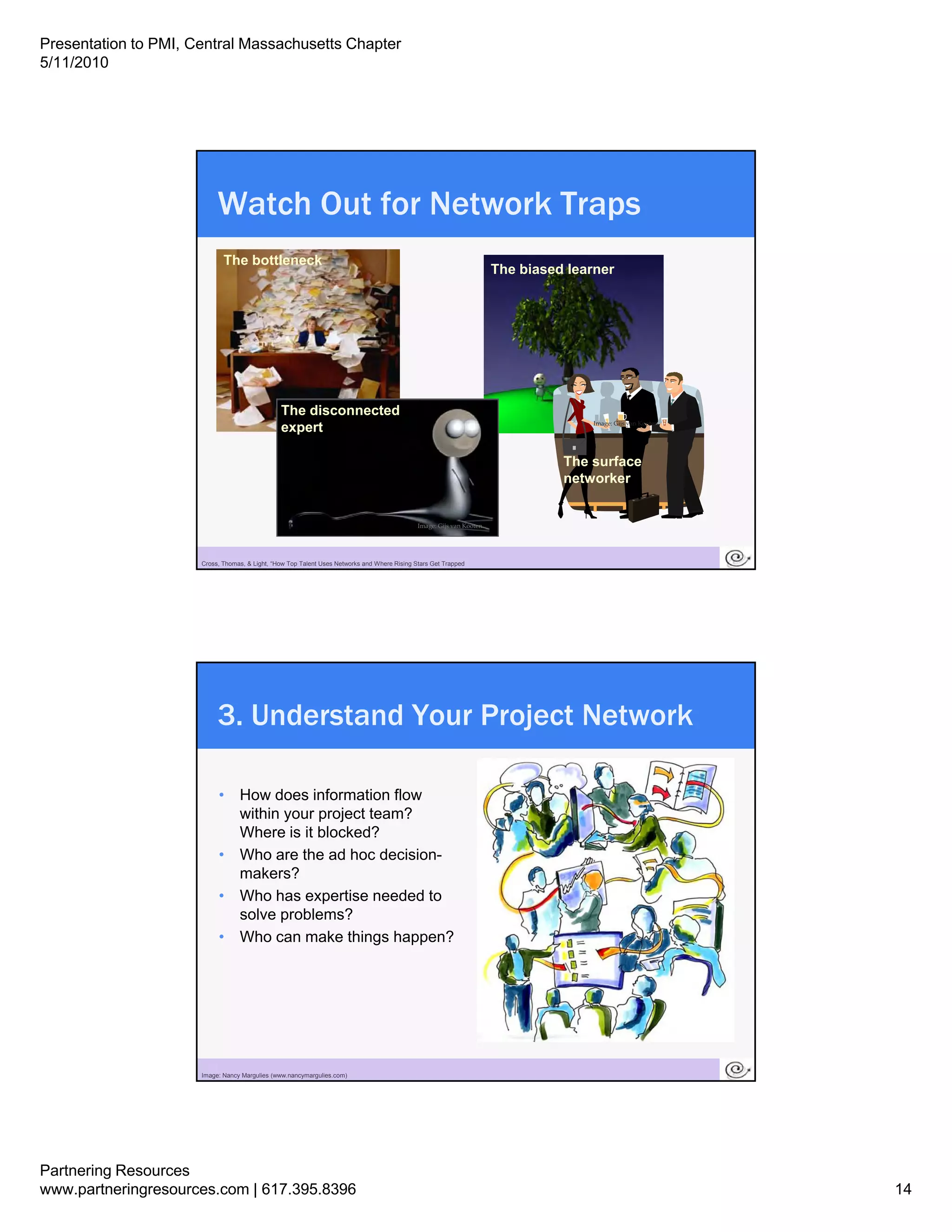
                           Watch Out for Network Traps
                             The bottleneck
                                                                                                                       The biased learner


                                                The disconnected
                                                                                                                                     Image: Gijs van Kooten
                                                expert

                                                                                                                                 The surface
                                                                                                                                 networker


                                                                                              Image: Gijs van Kooten


                       27
                      Cross, Thomas, & Light, “How Top Talent Uses Networks and Where Rising Stars Get Trapped


                           3. Understand Your Project Network

                            • How does information flow
                              within your project team?
                              Where is it blocked?
                            • Who are the ad hoc decision-
                              makers?
                            • Who has expertise needed to
                              solve problems?
                            • Who can make things happen?


                       28
                      Image: Nancy Margulies (www.nancymargulies.com)


Partnering Resources
www.partneringresources.com | 617.395.8396                                                                                                                    14
Presentation to PMI, Central Massachusetts Chapter
5/11/2010


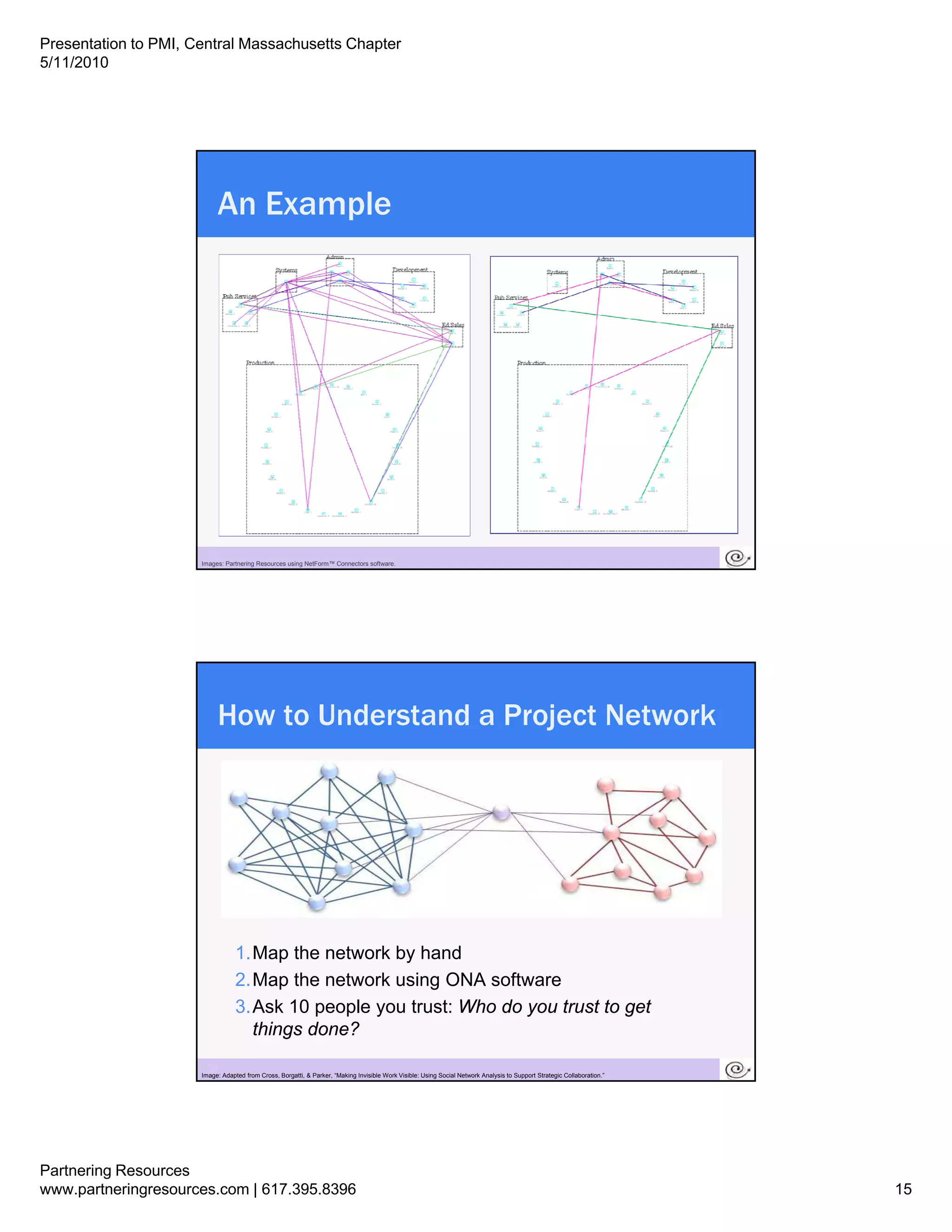
                           An Example


                       29
                      Images: Partnering Resources using NetForm™ Connectors software.


                           How to Understand a Project Network


                                  1.Map the network by hand
                                  2.Map the network using ONA software
                                  3.Ask 10 people you trust: Who do you trust to get
                                    things done?
                       30
                      Image: Adapted from Cross, Borgatti, & Parker, “Making Invisible Work Visible: Using Social Network Analysis to Support Strategic Collaboration.”


Partnering Resources
www.partneringresources.com | 617.395.8396                                                                                                                                15
Presentation to PMI, Central Massachusetts Chapter
5/11/2010


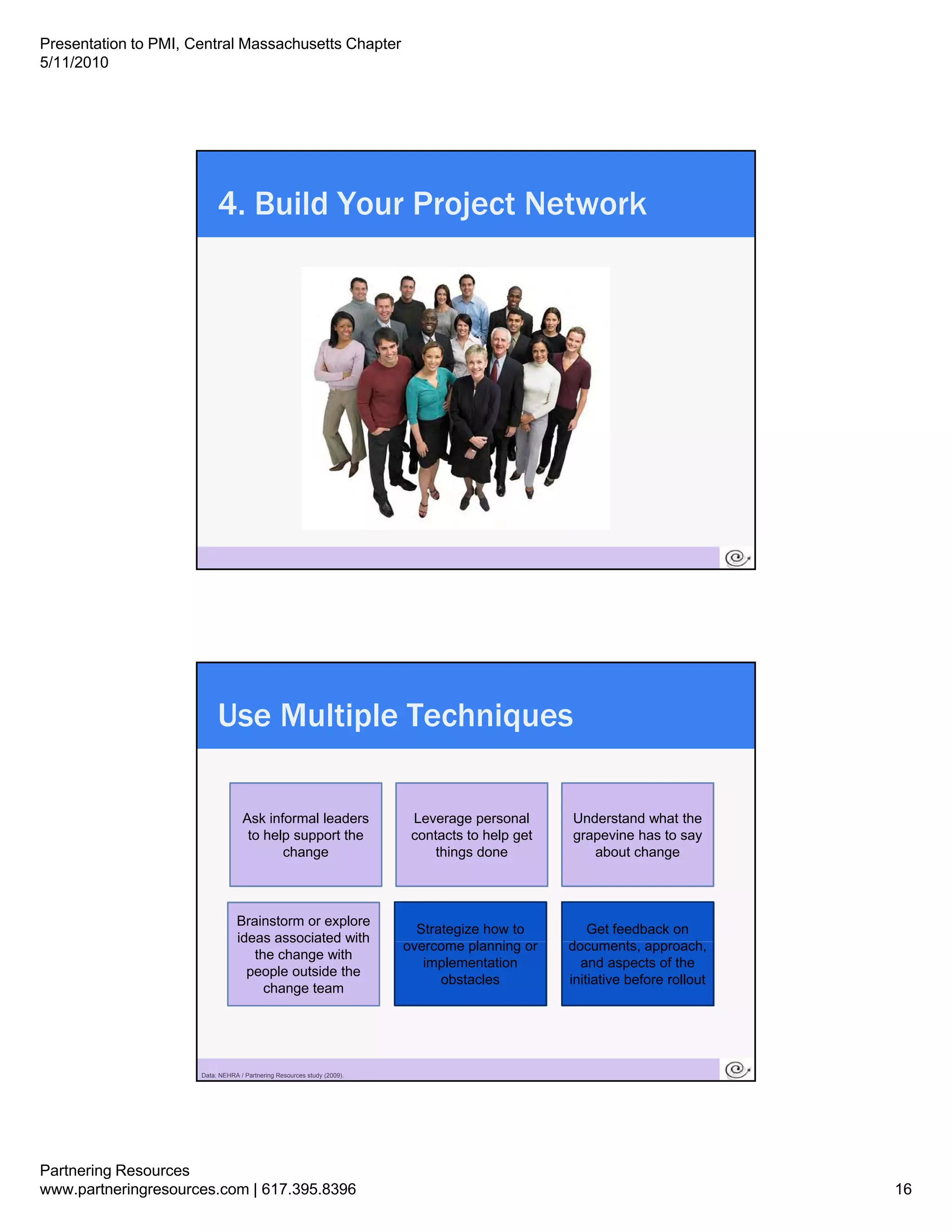
                           4. Build Your Project Network


                       31


                           Use Multiple Techniques

                                   Ask informal leaders                   Leverage personal      Understand what the
                                    to help support the                   contacts to help get   grapevine has to say
                                          change                              things done           about change


                                 Brainstorm or explore
                                                                           Strategize how to         Get feedback on
                                 ideas associated with
                                                                         overcome planning or
                                                                                     l   i       documents, approach,
                                                                                                 d          t           h
                                    the change with
                                                                            implementation         and aspects of the
                                   people outside the
                                                                               obstacles         initiative before rollout
                                      change team


                       32
                      Data: NEHRA / Partnering Resources study (2009).


Partnering Resources
www.partneringresources.com | 617.395.8396                                                                                   16
Presentation to PMI, Central Massachusetts Chapter
5/11/2010


                           Key Takeaways
                          •      Stronger networks : better performance
                          •      Understand
                                 U d t d your networks and your gaps
                                                       t  k     d
                          •      Understand and build the project network
                          •      Nurture relationships with information sources,
                                 helpful critics, and boundary spanners


                       33


                           Let’s Leverage Our Networks!


                            What stands out as most
                            relevant to your work?

                            What questions do you
                            have?


                       34
                      Image: Nancy Margulies (www.nancymargulies.com)


Partnering Resources
www.partneringresources.com | 617.395.8396                                         17
Presentation to PMI, Central Massachusetts Chapter
5/11/2010


                            About the Presenter

                            • Founder of management consulting firm Partnering Resources.
                            • S
                              Specializes in identifying the hidden web of relationships that d i
                                   i li     i id tif i th hidd         b f l ti     hi th t drive
                              organization performance and helping leaders reach across the “white
                              spaces” to develop solutions that stick.
                            • Client list includes Alcatel-Lucent, eCopy, eTeck, Fidelity, Financial Profiles,
                              Hanover Insurance Group, Merrimack Pharmaceutical, and Novartis, as well
                              as public and third sector companies such as Andover / Phillips Academy,
                              Close to Home, National Air and Space Administration, National Braille
                              Press, and Project Harmony.
                            • Teaches leadership, strategy, and alignment at Boston University Corporate
                              Education Center and Northeastern University.
                            • Published by CIO Com Chief Learning Officer, Mass High Tech, and other
                                              CIO.Com,                 Officer              Tech
                              magazines and journals.
                            • Serves on the Editorial Review Board for OD Practitioner, the premier
                              organization development practitioner journal in the United States.
                            • Likes chocolate a lot.

                              Contact: 617.395.8396 o maya@partneringresources.com o www.partneringresources.com


                       35


                        References
                        Articles & Research
                        • Cross, R., Borgatti, S.P., & Parker, A. (Winter 2002). “Making Invisible Work Visible: Using Social Network Analysis to
                          Suppo t Strategic Co abo at o California a age e t e e
                          Support St ateg c Collaboration.” Ca o a Management Review.
                        • Cross, Martin, & Weiss (2006). “Mapping the Value of Employee Collaboration. McKinsey Quarterly.
                        • Kleiner, A. (2002). “Karen Stephenson’s Quantum Theory of Trust.” strategy + business. Available at www.strategy-
                          business.com.
                        • Stephenson, K. (2005). “Trafficking in Trust.” In Enlightened Power (Coughlin, Wingard, & Hollihan, ed.). Available at
                          www.drkaren.us/KS_publications01.htm.
                        • Townsend, M. (2009). “Leveraging Human Networks to Accelerate Learning.” Available at bit.ly/3V0iF4.
                        • Townsend, M. (2008). “The Three Most Important Positions You Don’t Know About Yet.” Available at
                          www.partneringresources.com/resources.html.
                        • Townsend, M. & Yeung, S. (2009). “Informal Networks Linked to Change Success.” Available at bit.ly/17wANX.
                        • Evans & Wolf (2005). “Collaboration Rules.” Harvard Business Review.


                        Books
                        • Anklam, P. (2007). Net Work: A Practical Guide to Creating and Sustaining Networks at Work and in the World.
                        • Cohen, D. & Prusak, L. (2001). In Good Company: How Social Capital Makes Organizations Work.
                        • Cross, R., & Parker, A. (2004). The Hidden Power of Social Networks: Understanding How Work Really Gets Done in
                          Organizations.

                       36


Partnering Resources
www.partneringresources.com | 617.395.8396                                                                                                          18

Hidden Web

  • 1.
    Presentation to PMI,Central Massachusetts Chapter 5/11/2010 The Hidden Web Inside the Informal Networks that Drive Project Performance Project Management Institute Central Massachusetts Chapter May 11, 2010 Maya Townsend, Founder Partnering Resources The Point Project P j t managers can improve projects success rates and personal performance if they attend to informal networks 2 Partnering Resources www.partneringresources.com | 617.395.8396 1
  • 2.
    Presentation to PMI,Central Massachusetts Chapter 5/11/2010 Project Success Rates are Not Where They Need to Be… Changes Completed On Time and With Minimal Disruption 5% Gartner, 2001 Percentage of Originally Average Project Cost Defined Features Overrun Delivered 43% 54%* Standish Group * Of which 45% are never used Standish Group 3 Stronger Networks – Project Success Successful Projects Less Successful Projects Very Strong Strong 27% 36% Strong 57% • 93% of successful change initiatives were led by people with very strong / strong personal networks • 73% of less successful change initiatives were led by people with moderate / weak networks 4 Data: NEHRA / Partnering Resources study (2009). Partnering Resources www.partneringresources.com | 617.395.8396 2
  • 3.
    Presentation to PMI,Central Massachusetts Chapter 5/11/2010 Today’s Talk 1. 1 What are networks? 2. How can PMs use them to improve project success rates? 5 Image: Partnering Resources WHAT IS A NETWORK? 6 Partnering Resources www.partneringresources.com | 617.395.8396 3
  • 4.
    Presentation to PMI,Central Massachusetts Chapter 5/11/2010 What is a Network? Public transportation networks help people travel in cities Computer networks move data from location to location The circulatory system Networks are about movement carries oxygen and carbon dioxide to and from our cells 7 The Simplest Work Network Human networks are also all about movement: The movement of information Sam knows how to answer the question so Mary connects you to Sam You have a You ask Mary at She doesn’t know question the next desk the answer and calls Sam for advice Problem solved! 8 Partnering Resources www.partneringresources.com | 617.395.8396 4
  • 5.
    Presentation to PMI,Central Massachusetts Chapter 5/11/2010 People Form Networks within Teams 9 More People, More Complexity 10 Partnering Resources www.partneringresources.com | 617.395.8396 5
  • 6.
    Presentation to PMI,Central Massachusetts Chapter 5/11/2010 It’s Not Just the Grapevine Social Decision-Making Innovation Expertise Improvement 11 PMs Work Through Informal Networks 12 Image: Rebecca St. James Partnering Resources www.partneringresources.com | 617.395.8396 6
  • 7.
    Presentation to PMI,Central Massachusetts Chapter 5/11/2010 When They’re Good, They’re Very, Very Good… Healthy networks can… • Adapt q p quickly to change. y g • Withstand stress. • Reorganize without significantly affecting productivity. • Diffuse information easily. • Grow quickly. 13 Case studies: Plastrik & Taylor (2006) and Evans & Wolf (2005). …When They’re Bad, They’re Disaster • Nearly 80% of senior executives surveyed believe that effective coordination across boundaries is crucial for growth… • …yet only 25% say their organizations are effective at sharing knowledge across boundaries b d i 14 Graphic: NetForm. Used with permission. Partnering Resources www.partneringresources.com | 617.395.8396 7
  • 8.
    Presentation to PMI,Central Massachusetts Chapter 5/11/2010 PMs Need Information “Our organization effectively shares 20% knowledge across boundaries.” “Coordination across 80% organizational lines is crucial for growth.” Percentage of executives in McKinsey poll responding positively to question. 15 Data: Cross, Martin, & Weiss, McKinsey Quarterly, 2006. Networked Leaders are More Successful Successful Projects Less Successful Projects Moderate 7% Weak Very 18% Strong Strong 27% 36% Strong 57% Moderate 55% • 93% of completely successful change initiatives were led by people with very strong / strong personal networks • 73% of less successful change initiatives were led by people with moderate / weak networks 16 Data: NEHRA / Partnering Resources study (2009). Partnering Resources www.partneringresources.com | 617.395.8396 8
  • 9.
    Presentation to PMI,Central Massachusetts Chapter 5/11/2010 HOW CAN PROJECT MANAGERS USE NETWORKS TO IMPROVE PROJECT SUCCESS RATES? 17 Four Techniques 1. Know your networks 2. 2 Build t B ild strong networks t k 3. Understand the project network 4. Build your project network 18 Partnering Resources www.partneringresources.com | 617.395.8396 9
  • 10.
    Presentation to PMI,Central Massachusetts Chapter 5/11/2010 1. Know Your networks 19 Image: Partnering Resources. A Popular Network Myth I already know what’s going on in my network 20 Image: Stephenson, “Trafficking in Trust” in Coughlin, Wingard, & Hollihan, 2005 Partnering Resources www.partneringresources.com | 617.395.8396 10
  • 11.
    Presentation to PMI,Central Massachusetts Chapter 5/11/2010 Map Your Network and Identify Gaps 21 Image: Credit unknown. 2. Build Strong Networks 22 Image: Barry Wellman, “The Network Community: An Introduction to Networks in the Global Village. Partnering Resources www.partneringresources.com | 617.395.8396 11
  • 12.
    Presentation to PMI,Central Massachusetts Chapter 5/11/2010 A Common Tip for Network Building 23 Another Way to Network High Performers… • Invest in relationships with sources of information and helpful critics • Build relationships that span organizational levels • Position themselves at key points in the network and leverage p p around them g people People who serve as bridges are for implementation more likely to be in the organization’s top 20% of performers 24 From Cross, Thomas, & Light, “How Top Talent Uses Networks and Where Rising Stars Get Trapped” and Groysberg, Lee, & Abrahams, “What It Takes to Make ‘Star’ Hires Pay Off” Partnering Resources www.partneringresources.com | 617.395.8396 12
  • 13.
    Presentation to PMI,Central Massachusetts Chapter 5/11/2010 Key to Building Your Network 25 Photo: Sizumaru’s Photo Stream, Flickr. The Minimalist Approach 1. 1 Schedule 1 coffee meeting / month 2. Forward 1 email / week 3. Walk around the office and talk with people 1 time / day 26 Partnering Resources www.partneringresources.com | 617.395.8396 13
  • 14.
    Presentation to PMI,Central Massachusetts Chapter 5/11/2010 Watch Out for Network Traps The bottleneck The biased learner The disconnected Image: Gijs van Kooten expert The surface networker Image: Gijs van Kooten 27 Cross, Thomas, & Light, “How Top Talent Uses Networks and Where Rising Stars Get Trapped 3. Understand Your Project Network • How does information flow within your project team? Where is it blocked? • Who are the ad hoc decision- makers? • Who has expertise needed to solve problems? • Who can make things happen? 28 Image: Nancy Margulies (www.nancymargulies.com) Partnering Resources www.partneringresources.com | 617.395.8396 14
  • 15.
    Presentation to PMI,Central Massachusetts Chapter 5/11/2010 An Example 29 Images: Partnering Resources using NetForm™ Connectors software. How to Understand a Project Network 1.Map the network by hand 2.Map the network using ONA software 3.Ask 10 people you trust: Who do you trust to get things done? 30 Image: Adapted from Cross, Borgatti, & Parker, “Making Invisible Work Visible: Using Social Network Analysis to Support Strategic Collaboration.” Partnering Resources www.partneringresources.com | 617.395.8396 15
  • 16.
    Presentation to PMI,Central Massachusetts Chapter 5/11/2010 4. Build Your Project Network 31 Use Multiple Techniques Ask informal leaders Leverage personal Understand what the to help support the contacts to help get grapevine has to say change things done about change Brainstorm or explore Strategize how to Get feedback on ideas associated with overcome planning or l i documents, approach, d t h the change with implementation and aspects of the people outside the obstacles initiative before rollout change team 32 Data: NEHRA / Partnering Resources study (2009). Partnering Resources www.partneringresources.com | 617.395.8396 16
  • 17.
    Presentation to PMI,Central Massachusetts Chapter 5/11/2010 Key Takeaways • Stronger networks : better performance • Understand U d t d your networks and your gaps t k d • Understand and build the project network • Nurture relationships with information sources, helpful critics, and boundary spanners 33 Let’s Leverage Our Networks! What stands out as most relevant to your work? What questions do you have? 34 Image: Nancy Margulies (www.nancymargulies.com) Partnering Resources www.partneringresources.com | 617.395.8396 17
  • 18.
    Presentation to PMI,Central Massachusetts Chapter 5/11/2010 About the Presenter • Founder of management consulting firm Partnering Resources. • S Specializes in identifying the hidden web of relationships that d i i li i id tif i th hidd b f l ti hi th t drive organization performance and helping leaders reach across the “white spaces” to develop solutions that stick. • Client list includes Alcatel-Lucent, eCopy, eTeck, Fidelity, Financial Profiles, Hanover Insurance Group, Merrimack Pharmaceutical, and Novartis, as well as public and third sector companies such as Andover / Phillips Academy, Close to Home, National Air and Space Administration, National Braille Press, and Project Harmony. • Teaches leadership, strategy, and alignment at Boston University Corporate Education Center and Northeastern University. • Published by CIO Com Chief Learning Officer, Mass High Tech, and other CIO.Com, Officer Tech magazines and journals. • Serves on the Editorial Review Board for OD Practitioner, the premier organization development practitioner journal in the United States. • Likes chocolate a lot. Contact: 617.395.8396 o maya@partneringresources.com o www.partneringresources.com 35 References Articles & Research • Cross, R., Borgatti, S.P., & Parker, A. (Winter 2002). “Making Invisible Work Visible: Using Social Network Analysis to Suppo t Strategic Co abo at o California a age e t e e Support St ateg c Collaboration.” Ca o a Management Review. • Cross, Martin, & Weiss (2006). “Mapping the Value of Employee Collaboration. McKinsey Quarterly. • Kleiner, A. (2002). “Karen Stephenson’s Quantum Theory of Trust.” strategy + business. Available at www.strategy- business.com. • Stephenson, K. (2005). “Trafficking in Trust.” In Enlightened Power (Coughlin, Wingard, & Hollihan, ed.). Available at www.drkaren.us/KS_publications01.htm. • Townsend, M. (2009). “Leveraging Human Networks to Accelerate Learning.” Available at bit.ly/3V0iF4. • Townsend, M. (2008). “The Three Most Important Positions You Don’t Know About Yet.” Available at www.partneringresources.com/resources.html. • Townsend, M. & Yeung, S. (2009). “Informal Networks Linked to Change Success.” Available at bit.ly/17wANX. • Evans & Wolf (2005). “Collaboration Rules.” Harvard Business Review. Books • Anklam, P. (2007). Net Work: A Practical Guide to Creating and Sustaining Networks at Work and in the World. • Cohen, D. & Prusak, L. (2001). In Good Company: How Social Capital Makes Organizations Work. • Cross, R., & Parker, A. (2004). The Hidden Power of Social Networks: Understanding How Work Really Gets Done in Organizations. 36 Partnering Resources www.partneringresources.com | 617.395.8396 18