


Creating on-boarding programs that set employees up for successPartnering ResourcesMaya Townsend, FounderWelcome!  Now Get To Work
On-boarding Counts64%of new executives hired from the outside fail at their new jobsSnell, A. (2006). “Researching on-boarding best practice.” HR Review.40% of senior managers hired from the outside fail within 18 months of hireWells, S. J. (2005). “Diving in.” HR Magazine.70% of leaders express dissatisfaction with their on-boarding experienceCashman, K. & Smye, M. (2007). “Onboarding. Leadership Excellence.46% of newly hired employees fail within 18 months of hireLeadership IQ Study, 2009.
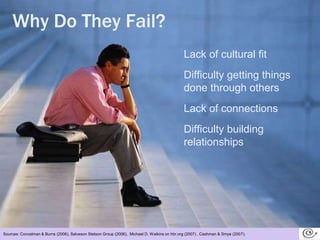
Why Do They Fail?Lack of cultural fitDifficulty getting things done through othersLack of connectionsDifficulty building relationshipsSources: Concelman & Burns (2006), Salveson Stetson Group (2006),  Michael D. Watkins on hbr.org (2007) , Cashman & Smye (2007).
How can organizations succeed?
Get C-Level Support
Start Before They StartImage: Anton Chernenko
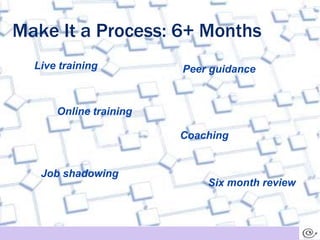
Make It a Process: 6+ MonthsLive trainingPeer guidanceOnline trainingCoachingJob shadowingSix month review
Make the First Day a Win
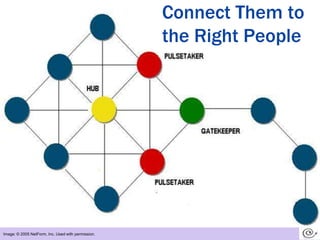
Connect Them to the Right PeopleImage: © 2005 NetForm, Inc. Used with permission.
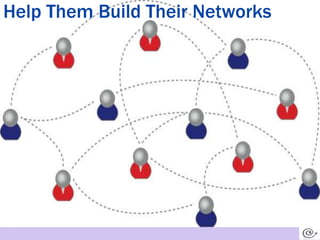
Help Them Build Their Networks
Check In On Progress
Why is the network piece so important?
Network Critical Connectors Integrate New Hires Quickly & EffectivelyExist in all networksCritical Connectors comprise only 5% of the networkThree Critical Connectors HubsGatekeepersPulsetakersConnecting new employees to pulsetakers accelerates the on-boarding processImage: © 2005 NetForm, Inc. Used with permission.
High Performers Have Stronger NetworksBuild high-quality relationshipsInvest in relationships to extend expertise, balance biases, and prevent career trapsPosition selves at key network points and leverage people around themCultivate select ties with external expertsThe top 20% of employees are more likely to build and maintain personal networksSource: Cross, Thomas, & Light, How Top Talent Uses Networks and Where Rising Stars Get Trapped
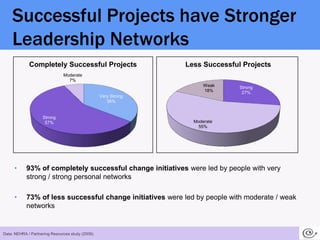
Successful Projects have Stronger Leadership Networks93% of completely successful change initiatives were led by people with very strong / strong personal networks73% of less successful change initiatives were led by people with moderate / weak networks Data: NEHRA / Partnering Resources study (2009).
How have companies leveraged networks to successfully integrate new employees?
Success Story #1Network ComponentsJob shadowingManager coachingManager-facilitated 2-day trainingAdditional Components16-week blended learning curriculum Self-guided e-learning On-the-job activitiesResult$4 million return on a program that cost $931,000Source: Sussman, D. (2005). “Getting up to speed.” T+D.
Success Story #2Network ComponentsCustomized new leader transition guideInternal peer coach interviewsCreates a detailed orientation guideTeam introductionHR facilitated session with leader and direct reports 90 days of peer guidanceAdditional Components6-month check in360-degree feedback Review of accomplishments and areas needing further development.ResultSuccessfully turned around a situation of high attrition, low performance, and stalled programsSource: Johnson, L. (2006).  Harvard Management Update.
ContactMaya Townsend, founder of Partnering Resources, helps leaders identify the hidden web of relationships that drive organization performance. Partnering Resources’ client list includes Alcatel-Lucent, eCopy, eTeck, Fidelity, Financial Profiles, Hanover Insurance Group, and Merrimack Pharmaceutical, as well as organizations such as Andover / Phillips Academy, National Air and Space Administration, and the National Braille Press. Maya teaches leadership, strategy, and alignment at Boston University Corporate Education Center and Northeastern University. Her articles have appeared in  CIO.Com, Chief Learning Officer, Mass High Tech, and publications. She serves on the Editorial Review Board for OD Practitioner, the premier OD practitioner journal in the United States.Partnering Resources is the exclusive East Coast provider of NetForm organization network analysis. NetForm software, developed by Dr. Karen Stephenson, is built on complex mathematical algorithms developed over 30+ years of research with 400+ companies.For more information:Phone: 617.395.8396Email: maya@partneringresources.comExplore: www.partneringresources.comPresentation © 2009 Partnering Resources.

Welcome! Now Get to Work

  • 1.
    Creating on-boarding programsthat set employees up for successPartnering ResourcesMaya Townsend, FounderWelcome! Now Get To Work
  • 2.
    On-boarding Counts64%of newexecutives hired from the outside fail at their new jobsSnell, A. (2006). “Researching on-boarding best practice.” HR Review.40% of senior managers hired from the outside fail within 18 months of hireWells, S. J. (2005). “Diving in.” HR Magazine.70% of leaders express dissatisfaction with their on-boarding experienceCashman, K. & Smye, M. (2007). “Onboarding. Leadership Excellence.46% of newly hired employees fail within 18 months of hireLeadership IQ Study, 2009.
  • 3.
    Why Do TheyFail?Lack of cultural fitDifficulty getting things done through othersLack of connectionsDifficulty building relationshipsSources: Concelman & Burns (2006), Salveson Stetson Group (2006), Michael D. Watkins on hbr.org (2007) , Cashman & Smye (2007).
  • 4.
  • 5.
  • 6.
    Start Before TheyStartImage: Anton Chernenko
  • 7.
    Make It aProcess: 6+ MonthsLive trainingPeer guidanceOnline trainingCoachingJob shadowingSix month review
  • 8.
  • 9.
    Connect Them tothe Right PeopleImage: © 2005 NetForm, Inc. Used with permission.
  • 10.
    Help Them BuildTheir Networks
  • 11.
    Check In OnProgress
  • 12.
    Why is thenetwork piece so important?
  • 13.
    Network Critical ConnectorsIntegrate New Hires Quickly & EffectivelyExist in all networksCritical Connectors comprise only 5% of the networkThree Critical Connectors HubsGatekeepersPulsetakersConnecting new employees to pulsetakers accelerates the on-boarding processImage: © 2005 NetForm, Inc. Used with permission.
  • 14.
    High Performers HaveStronger NetworksBuild high-quality relationshipsInvest in relationships to extend expertise, balance biases, and prevent career trapsPosition selves at key network points and leverage people around themCultivate select ties with external expertsThe top 20% of employees are more likely to build and maintain personal networksSource: Cross, Thomas, & Light, How Top Talent Uses Networks and Where Rising Stars Get Trapped
  • 15.
    Successful Projects haveStronger Leadership Networks93% of completely successful change initiatives were led by people with very strong / strong personal networks73% of less successful change initiatives were led by people with moderate / weak networks Data: NEHRA / Partnering Resources study (2009).
  • 16.
    How have companiesleveraged networks to successfully integrate new employees?
  • 17.
    Success Story #1NetworkComponentsJob shadowingManager coachingManager-facilitated 2-day trainingAdditional Components16-week blended learning curriculum Self-guided e-learning On-the-job activitiesResult$4 million return on a program that cost $931,000Source: Sussman, D. (2005). “Getting up to speed.” T+D.
  • 18.
    Success Story #2NetworkComponentsCustomized new leader transition guideInternal peer coach interviewsCreates a detailed orientation guideTeam introductionHR facilitated session with leader and direct reports 90 days of peer guidanceAdditional Components6-month check in360-degree feedback Review of accomplishments and areas needing further development.ResultSuccessfully turned around a situation of high attrition, low performance, and stalled programsSource: Johnson, L. (2006). Harvard Management Update.
  • 19.
    ContactMaya Townsend, founderof Partnering Resources, helps leaders identify the hidden web of relationships that drive organization performance. Partnering Resources’ client list includes Alcatel-Lucent, eCopy, eTeck, Fidelity, Financial Profiles, Hanover Insurance Group, and Merrimack Pharmaceutical, as well as organizations such as Andover / Phillips Academy, National Air and Space Administration, and the National Braille Press. Maya teaches leadership, strategy, and alignment at Boston University Corporate Education Center and Northeastern University. Her articles have appeared in CIO.Com, Chief Learning Officer, Mass High Tech, and publications. She serves on the Editorial Review Board for OD Practitioner, the premier OD practitioner journal in the United States.Partnering Resources is the exclusive East Coast provider of NetForm organization network analysis. NetForm software, developed by Dr. Karen Stephenson, is built on complex mathematical algorithms developed over 30+ years of research with 400+ companies.For more information:Phone: 617.395.8396Email: maya@partneringresources.comExplore: www.partneringresources.comPresentation © 2009 Partnering Resources.

Editor's Notes

  • #7 Have everything ready Day One: desk, email, welcome activities
  • #8 Not just a 1-week event, but an extended process
  • #14 Organizational DNA