Using Big Data for Policy
Problems
B E Y O N D P R E D I C T I O N :
A PRESENTATION BY ERGASHOV ABDULLAJON
Health Policy Risk Allocation Health Inspection
2 0 1 8 | B E Y O N D P R E D I C T I O N
Supervised Machine Learning
TOPICS WE WILL DISCUSS
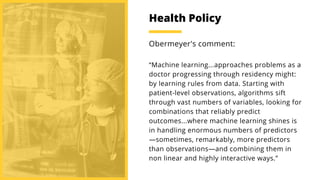
“Machine learning...approaches problems as a
doctor progressing through residency might:
by learning rules from data. Starting with
patient-level observations, algorithms sift
through vast numbers of variables, looking for
combinations that reliably predict
outcomes...where machine learning shines is
in handling enormous numbers of predictors
—sometimes, remarkably, more predictors
than observations—and combining them in
non linear and highly interactive ways.”
Obermeyer's comment:
Health Policy
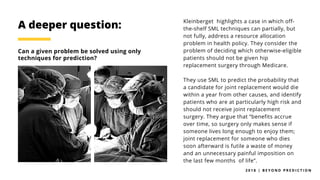
Kleinberget highlights a case in which off-
the-shelf SML techniques can partially, but
not fully, address a resource allocation
problem in health policy. They consider the
problem of deciding which otherwise-eligible
patients should not be given hip
replacement surgery through Medicare.
They use SML to predict the probability that
a candidate for joint replacement would die
within a year from other causes, and identify
patients who are at particularly high risk and
should not receive joint replacement
surgery. They argue that “benefits accrue
over time, so surgery only makes sense if
someone lives long enough to enjoy them;
joint replacement for someone who dies
soon afterward is futile a waste of money
and an unnecessary painful imposition on
the last few months of life”.
A deeper question:
Can a given problem be solved using only
techniques for prediction?
2 0 1 8 | B E Y O N D P R E D I C T I O N
ALPHA-ARCHITECT
More Sophisticated Machine
Learning Models Seem to
Provide Better Prediction
Important Words
2 0 1 8 | B E Y O N D P R E D I C T I O N
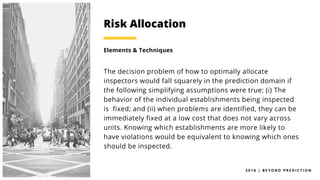
The decision problem of how to optimally allocate
inspectors would fall squarely in the prediction domain if
the following simplifying assumptions were true: (i) The
behavior of the individual establishments being inspected
is fixed; and (ii) when problems are identified, they can be
immediately fixed at a low cost that does not vary across
units. Knowing which establishments are more likely to
have violations would be equivalent to knowing which ones
should be inspected.
Risk Allocation
Elements & Techniques
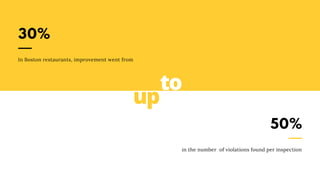
30%
In Boston restaurants, improvement went from
50%
in the number of violations found per inspection
up
to
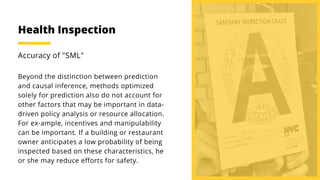
Beyond the distinction between prediction
and causal inference, methods optimized
solely for prediction also do not account for
other factors that may be important in data-
driven policy analysis or resource allocation.
For ex-ample, incentives and manipulability
can be important. If a building or restaurant
owner anticipates a low probability of being
inspected based on these characteristics, he
or she may reduce efforts for safety.
Accuracy of "SML"
Health Inspection
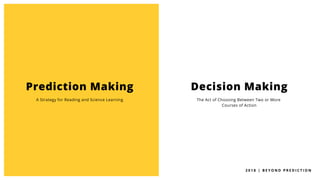
A Strategy for Reading and Science Learning
Prediction Making
The Act of Choosing Between Two or More
Courses of Action
Decision Making
2 0 1 8 | B E Y O N D P R E D I C T I O N
THANK YOUBeyond Prediction: Using Big Data for Policy Problems

Using Big Data For Policy Problems

  • 1.
    Using Big Datafor Policy Problems B E Y O N D P R E D I C T I O N : A PRESENTATION BY ERGASHOV ABDULLAJON
  • 2.
    Health Policy RiskAllocation Health Inspection 2 0 1 8 | B E Y O N D P R E D I C T I O N Supervised Machine Learning TOPICS WE WILL DISCUSS
  • 3.
    “Machine learning...approaches problemsas a doctor progressing through residency might: by learning rules from data. Starting with patient-level observations, algorithms sift through vast numbers of variables, looking for combinations that reliably predict outcomes...where machine learning shines is in handling enormous numbers of predictors —sometimes, remarkably, more predictors than observations—and combining them in non linear and highly interactive ways.” Obermeyer's comment: Health Policy
  • 4.
    Kleinberget highlights acase in which off- the-shelf SML techniques can partially, but not fully, address a resource allocation problem in health policy. They consider the problem of deciding which otherwise-eligible patients should not be given hip replacement surgery through Medicare. They use SML to predict the probability that a candidate for joint replacement would die within a year from other causes, and identify patients who are at particularly high risk and should not receive joint replacement surgery. They argue that “benefits accrue over time, so surgery only makes sense if someone lives long enough to enjoy them; joint replacement for someone who dies soon afterward is futile a waste of money and an unnecessary painful imposition on the last few months of life”. A deeper question: Can a given problem be solved using only techniques for prediction? 2 0 1 8 | B E Y O N D P R E D I C T I O N
  • 5.
    ALPHA-ARCHITECT More Sophisticated Machine Learning Models Seemto Provide Better Prediction Important Words
  • 6.
    2 0 18 | B E Y O N D P R E D I C T I O N The decision problem of how to optimally allocate inspectors would fall squarely in the prediction domain if the following simplifying assumptions were true: (i) The behavior of the individual establishments being inspected is fixed; and (ii) when problems are identified, they can be immediately fixed at a low cost that does not vary across units. Knowing which establishments are more likely to have violations would be equivalent to knowing which ones should be inspected. Risk Allocation Elements & Techniques
  • 7.
    30% In Boston restaurants,improvement went from 50% in the number of violations found per inspection up to
  • 8.
    Beyond the distinctionbetween prediction and causal inference, methods optimized solely for prediction also do not account for other factors that may be important in data- driven policy analysis or resource allocation. For ex-ample, incentives and manipulability can be important. If a building or restaurant owner anticipates a low probability of being inspected based on these characteristics, he or she may reduce efforts for safety. Accuracy of "SML" Health Inspection
  • 9.
    A Strategy forReading and Science Learning Prediction Making The Act of Choosing Between Two or More Courses of Action Decision Making 2 0 1 8 | B E Y O N D P R E D I C T I O N
  • 10.
    THANK YOUBeyond Prediction:Using Big Data for Policy Problems