DISEASE PREDICTION
SYSTEM USING PYTHON
BY
S.SAI VARUN 22891A66I0
P.KESHAV
RAO 22891A66H5
S.SRUJAN 22891A66J1
GUIDE NAME:
MR.R.PRAVEEN KUMAR
INTRODUCTION TO
DISEASE PREDICTION
Importance of Disease Prediction
in Healthcare
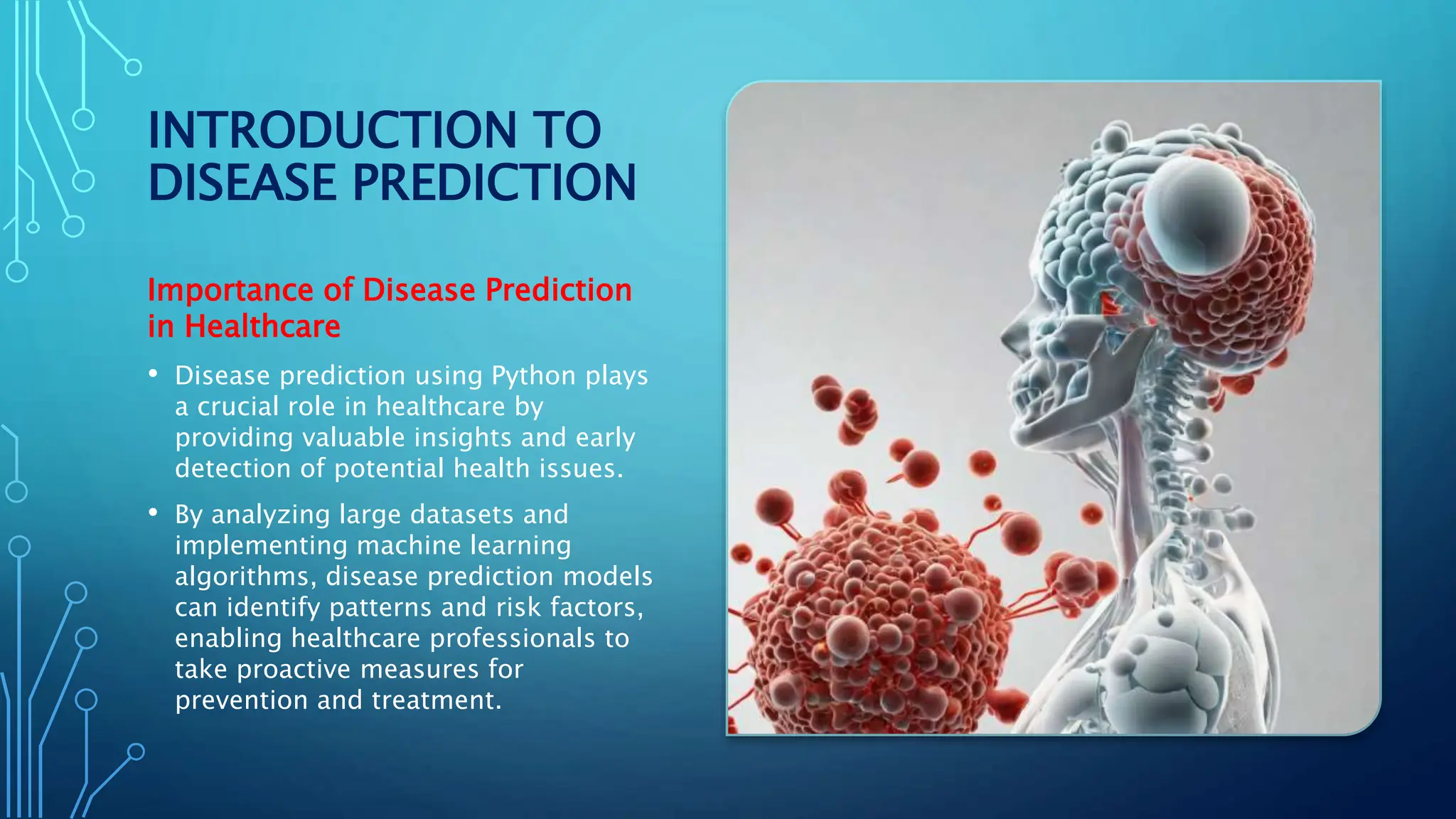
• Disease prediction using Python plays
a crucial role in healthcare by
providing valuable insights and early
detection of potential health issues.
• By analyzing large datasets and
implementing machine learning
algorithms, disease prediction models
can identify patterns and risk factors,
enabling healthcare professionals to
take proactive measures for
prevention and treatment.
DATA COLLECTION AND PREPROCESSING
Data Sources
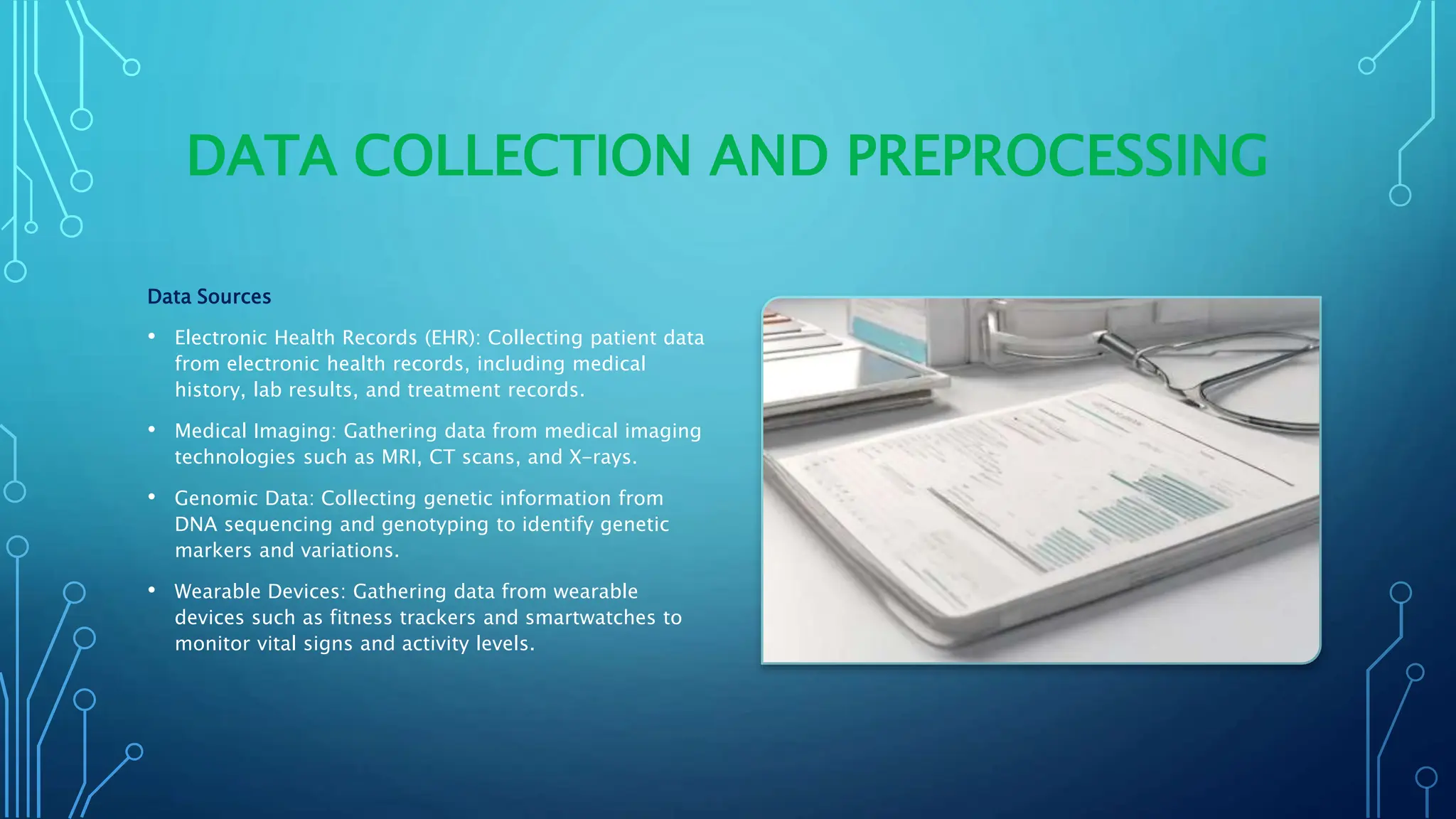
• Electronic Health Records (EHR): Collecting patient data
from electronic health records, including medical
history, lab results, and treatment records.
• Medical Imaging: Gathering data from medical imaging
technologies such as MRI, CT scans, and X-rays.
• Genomic Data: Collecting genetic information from
DNA sequencing and genotyping to identify genetic
markers and variations.
• Wearable Devices: Gathering data from wearable
devices such as fitness trackers and smartwatches to
monitor vital signs and activity levels.
DATA PREPROCESSING
• Data Cleaning: Removing irrelevant or
duplicate data, handling missing values,
and correcting errors or inconsistencies.
• Feature Extraction: Selecting relevant
features from the collected data and
transforming them into a suitable format
for analysis.
• Normalization and Scaling: Standardizing
the range and distribution of data to
ensure fair comparison and accurate
analysis.
PREDICTIVE ANALYTICS IN HEALTHCARE
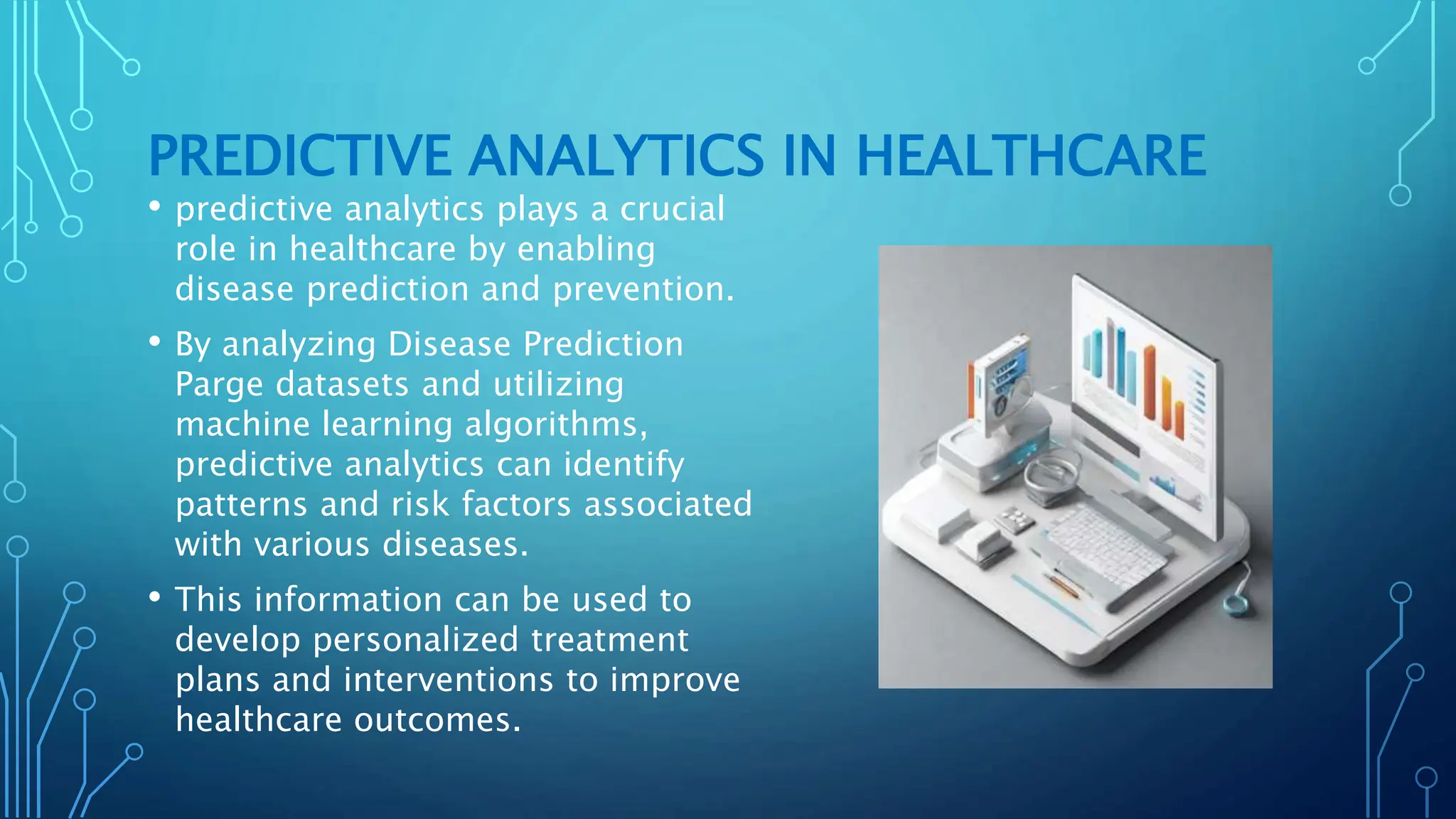
• predictive analytics plays a crucial
role in healthcare by enabling
disease prediction and prevention.
• By analyzing Disease Prediction
Parge datasets and utilizing
machine learning algorithms,
predictive analytics can identify
patterns and risk factors associated
with various diseases.
• This information can be used to
develop personalized treatment
plans and interventions to improve
healthcare outcomes.
CHALLENGES AND FUTURE DIRECTIONS
• Current Challenges
• Data Quality: Ensuring the accuracy and reliability of the data
used for disease prediction is a major challenge.
• Interpretability: Understanding and interpreting the predictions
made by machine learning models can be difficult, especially
for complex diseases.
• Ethical Considerations: Ensuring the privacy and security of
patient data while using it for disease prediction is a critical
challenge.
HEART DISEASE PREDICTION
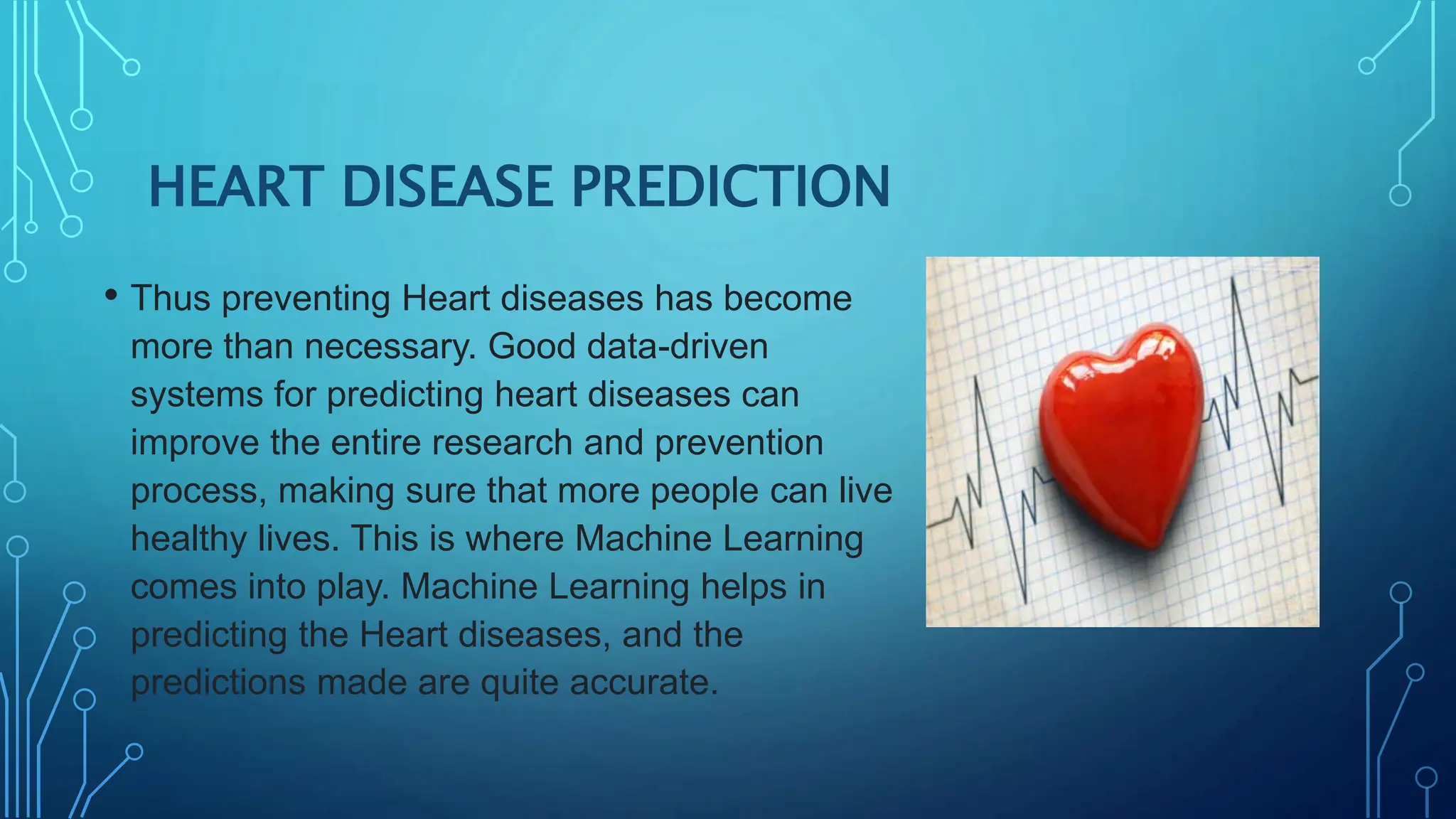
• Thus preventing Heart diseases has become
more than necessary. Good data-driven
systems for predicting heart diseases can
improve the entire research and prevention
process, making sure that more people can live
healthy lives. This is where Machine Learning
comes into play. Machine Learning helps in
predicting the Heart diseases, and the
predictions made are quite accurate.
DIABETES PREDICTION
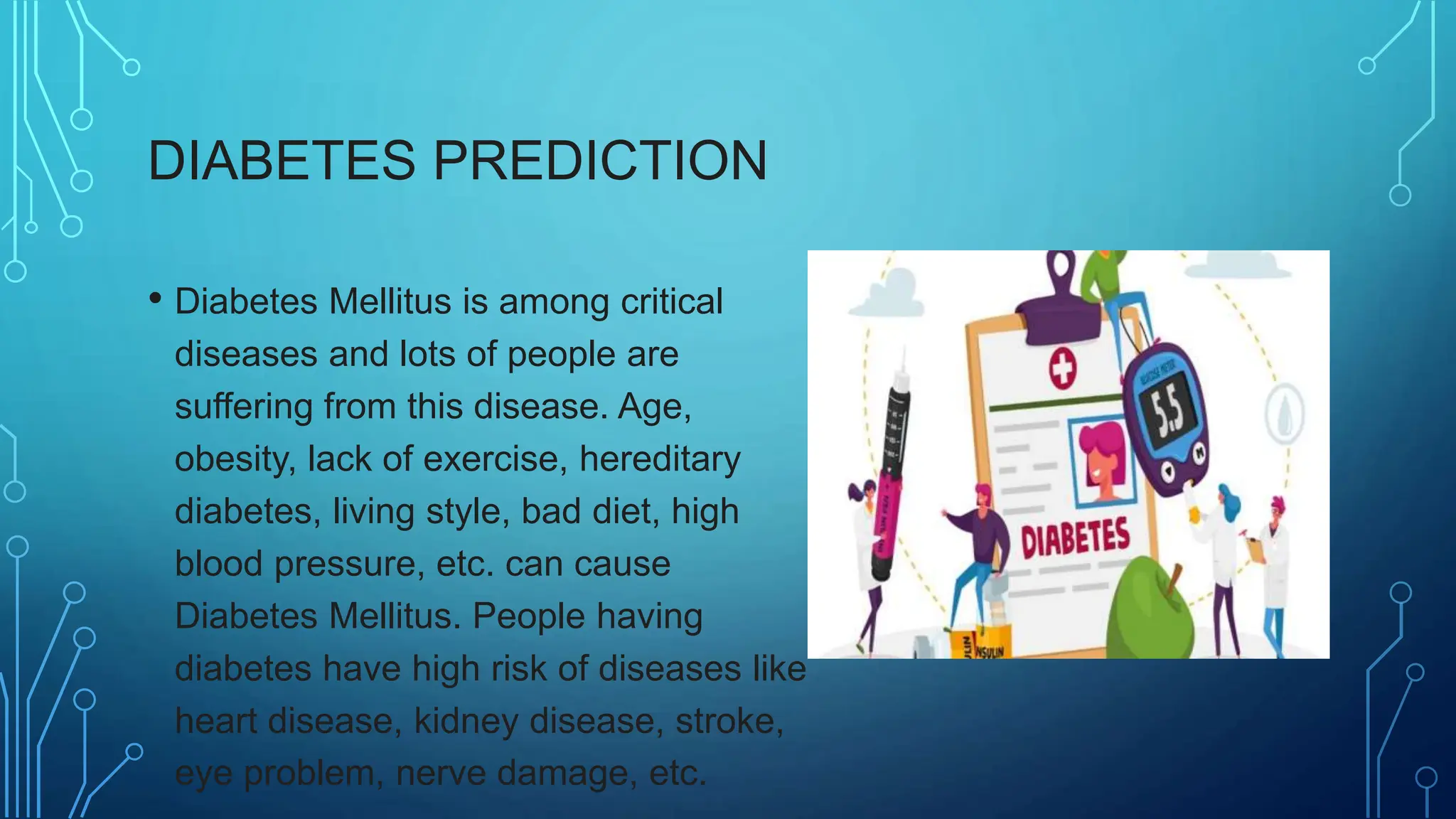
• Diabetes Mellitus is among critical
diseases and lots of people are
suffering from this disease. Age,
obesity, lack of exercise, hereditary
diabetes, living style, bad diet, high
blood pressure, etc. can cause
Diabetes Mellitus. People having
diabetes have high risk of diseases like
heart disease, kidney disease, stroke,
eye problem, nerve damage, etc.
DETECTION OF PARKINSON’S DISEASE
•
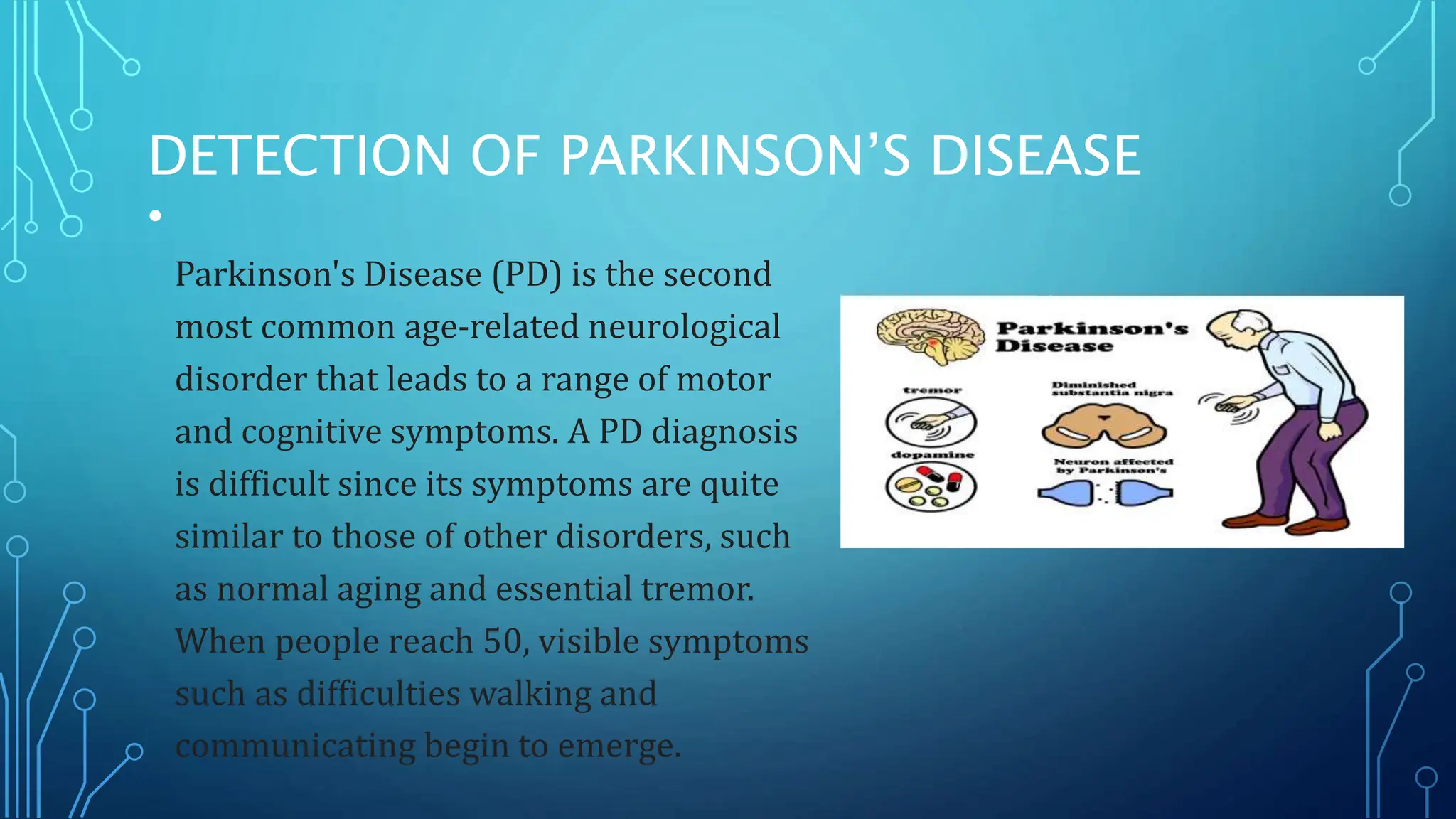
Parkinson's Disease (PD) is the second
most common age-related neurological
disorder that leads to a range of motor
and cognitive symptoms. A PD diagnosis
is difficult since its symptoms are quite
similar to those of other disorders, such
as normal aging and essential tremor.
When people reach 50, visible symptoms
such as difficulties walking and
communicating begin to emerge.
EXPECTED OUTPUT
• Disease Prediction using Machine Learning is the system that is used to predict the diseases from the
symptoms which are given by the patients or any user. The system processes the symptoms provided by
the user as input and gives the output as the probability of the disea
Disease prediction system using python.pptx

Disease prediction system using python.pptx

  • 1.
    DISEASE PREDICTION SYSTEM USINGPYTHON BY S.SAI VARUN 22891A66I0 P.KESHAV RAO 22891A66H5 S.SRUJAN 22891A66J1 GUIDE NAME: MR.R.PRAVEEN KUMAR
  • 2.
    INTRODUCTION TO DISEASE PREDICTION Importanceof Disease Prediction in Healthcare • Disease prediction using Python plays a crucial role in healthcare by providing valuable insights and early detection of potential health issues. • By analyzing large datasets and implementing machine learning algorithms, disease prediction models can identify patterns and risk factors, enabling healthcare professionals to take proactive measures for prevention and treatment.
  • 3.
    DATA COLLECTION ANDPREPROCESSING Data Sources • Electronic Health Records (EHR): Collecting patient data from electronic health records, including medical history, lab results, and treatment records. • Medical Imaging: Gathering data from medical imaging technologies such as MRI, CT scans, and X-rays. • Genomic Data: Collecting genetic information from DNA sequencing and genotyping to identify genetic markers and variations. • Wearable Devices: Gathering data from wearable devices such as fitness trackers and smartwatches to monitor vital signs and activity levels.
  • 4.
    DATA PREPROCESSING • DataCleaning: Removing irrelevant or duplicate data, handling missing values, and correcting errors or inconsistencies. • Feature Extraction: Selecting relevant features from the collected data and transforming them into a suitable format for analysis. • Normalization and Scaling: Standardizing the range and distribution of data to ensure fair comparison and accurate analysis.
  • 5.
    PREDICTIVE ANALYTICS INHEALTHCARE • predictive analytics plays a crucial role in healthcare by enabling disease prediction and prevention. • By analyzing Disease Prediction Parge datasets and utilizing machine learning algorithms, predictive analytics can identify patterns and risk factors associated with various diseases. • This information can be used to develop personalized treatment plans and interventions to improve healthcare outcomes.
  • 6.
    CHALLENGES AND FUTUREDIRECTIONS • Current Challenges • Data Quality: Ensuring the accuracy and reliability of the data used for disease prediction is a major challenge. • Interpretability: Understanding and interpreting the predictions made by machine learning models can be difficult, especially for complex diseases. • Ethical Considerations: Ensuring the privacy and security of patient data while using it for disease prediction is a critical challenge.
  • 7.
    HEART DISEASE PREDICTION •Thus preventing Heart diseases has become more than necessary. Good data-driven systems for predicting heart diseases can improve the entire research and prevention process, making sure that more people can live healthy lives. This is where Machine Learning comes into play. Machine Learning helps in predicting the Heart diseases, and the predictions made are quite accurate.
  • 8.
    DIABETES PREDICTION • DiabetesMellitus is among critical diseases and lots of people are suffering from this disease. Age, obesity, lack of exercise, hereditary diabetes, living style, bad diet, high blood pressure, etc. can cause Diabetes Mellitus. People having diabetes have high risk of diseases like heart disease, kidney disease, stroke, eye problem, nerve damage, etc.
  • 9.
    DETECTION OF PARKINSON’SDISEASE • Parkinson's Disease (PD) is the second most common age-related neurological disorder that leads to a range of motor and cognitive symptoms. A PD diagnosis is difficult since its symptoms are quite similar to those of other disorders, such as normal aging and essential tremor. When people reach 50, visible symptoms such as difficulties walking and communicating begin to emerge.
  • 10.
    EXPECTED OUTPUT • DiseasePrediction using Machine Learning is the system that is used to predict the diseases from the symptoms which are given by the patients or any user. The system processes the symptoms provided by the user as input and gives the output as the probability of the disea