International Research Journal of Engineering and Technology (IRJET) e-ISSN: 2395-0056
Volume: 10 Issue: 02 | Feb 2023 www.irjet.net p-ISSN: 2395-0072
© 2023, IRJET | Impact Factor value: 8.226 | ISO 9001:2008 Certified Journal | Page 493
1,2,3 Student, Department of Computer Engineering, SVKM’s NMIMS Mukesh Patel School of Technology
Management and Engineering, Shirpur, Maharashtra, India
-------------------------------------------------------------------------------------------------
Abstract: Machine Learning and data mining
technologieshaverevolutionizedthehealthcareindustry
by uncovering new, efficient ways to diagnose diseases.
This research focuses on analyzing a variety of studies
that employedpredictive modelling for predicting heart
disease, diabetes and breast cancer amongst other
illnesses. Through employing an innovative Multi-
Disease Prediction System based on users' given
symptoms as inputted into the system, researchers are
discovering effective methods in reducing time
constraints while still achieving successful performance
outcomes when diagnosing various medical issues. The
Multi Disease Prediction System employs predictive
modelling to identify diseases with incredible accuracy.
By examining the user's symptoms, it can determine
what medical conditions could be causing that
particular set of signs and indicate the likelihoodofeach
potential illness – delivering a powerful tool for
detection straight into your hands.
Key words: Machine Learning, Data Mining, Diabetes, Heart
Disease, Breast Cancer, Decision Tree, Support Vector
Machine (SVM), Random Forest (RF), Convolutional neural
network (CNN), K Nearest Neighbor (KNN), Naive Bayes.
1. INTRODUCTION
Multiple Disease Prediction Using System Learningisa
machine thatpredictsillnessbasedonlyoninformation
supplied by the user. Machine learning gives the
medical field a strong platform for solving problems
quickly and effectively. The healthcare industry is
transforming with the rise of innovative technologies
that provide reliable resultsassoonasapatientoruser
inputs their symptoms. Rather than making an
appointment and visiting a hospital, now you can get
accurate solutions online fromthecomfortofyourown
home. In this way, technology has made it possible for
These study focus on disease like Diabetes, Heart
Disease, Breast Cancer, Kidney Disease, Hepatitis.
Diabetes: Diabetes is a metabolic disorder that affects
millions worldwide. It can cause high blood sugar
levels and if left unchecked, result in serious health
complications such as vision loss or heart disease.
Diabetes falls into two main categories – Type 1, in
which the immune system targets the cells that
produces Insulin, and Type 2, in which insulin
resistance leads to high blood sugar levels. Ofthese,it's
estimated that 90-95% of cases are due to Type 2
diabetes - making it one of today’s most significant
global public health issues.
Heart Disease: Heart disease is a dangerous and
pervasive health issue that affects the heart, blood
vessels and even has an effect on our lives. Coronary
artery disease being one of the most common types of
such diseases usually builds up slowly as plaque
formations block arteries supplyingessentialnutrients
everyone to receive timely medical assistance
whatever their needs may be. This system serves as a
suggestion system to doctors and the health industry
for the treatment of the patient, and any subsequent
actions regarding the treatment are completely the
responsibility of the doctors. Data sets from different
websites about health have been gathered for the
system that predicts diseases. The customer will be
able to figure out how likely it is that using the signs
and symptoms of a disease. Nowadays, the health
industry is a big part of how people get better from
their illnesses. This will helpthehealthindustrygetthe
word out and help the user if they don't want to go to
the hospital or any other clinics. This system tells
doctors and the health industry how to treat a patient,
and only the doctors can decide what to do next.
Multiple Disease Prediction System: A Review
Urvaang Naik1, Vipul Mashruwala2, Kunj Joshi3
International Research Journal of Engineering and Technology (IRJET) e-ISSN: 2395-0056
Volume: 10 Issue: 02 | Feb 2023 www.irjet.net p-ISSN: 2395-0072
© 2023, IRJET | Impact Factor value: 8.226 | ISO 9001:2008 Certified Journal | Page 494
to the heart muscles; in turn creating more severe
issues with time if left untreated.
Hepatitis: Our livers are the hardworking organ
responsible for keeping us healthy, but can be
impacted by several forms of hepatitis. Thisdangerous
condition is typically caused by viruses such as
Hepatitis A, B and C or from excessive alcohol
consumption, pollutants in our environment and
certain drugs or medical disorders. It's important to
know how to protect ourselves from this inflammation
that affects our liver function-avitalelementofoverall
wellbeing.
Breast Cancer: Breast cancer is a devastating disease
that can affect anyone, regardless of age or gender. It
starts when cells in the breast start growing and
multiplying abnormally-quicklydividingoutofcontrol
until they spread to other areas throughout the body
via blood vessels and lymph nodes. If left untreated it
can become metastaticwithfar-reachingconsequences
for those who suffer from it.
Chronic Kidney Disease:Chronic renal diseaserefers
to a group of conditions that are harmfultothekidneys
and diminish their ability to keep a healthy body by
filtering waste from the blood. High blood pressure,
anaemia (a low blood count), bone fragility, an
unhealthy diet, and nerve damage are all potential
complications. There is an increased risk of getting
heart disease and blood vessel disorders in those who
have kidney illness. These problems may become
apparent slowly but surely over the course of time.
Chronic renal disease may frequently have its
progression halted if it is diagnosed and treated in a
timely manner.
2. MATERIALS AND METHODS
2.1 . System Architecture
The purpose of this system is to identify cases of
potentially fatal diseases and provide early analytic
insights that can help physicians anticipate patterns in
disease trends. Using both data mining and machine
learning algorithms, the platform is able to quickly
analyze patient information to predict possible
outcomes - giving doctors an opportunity for timely
intervention before it's too late.
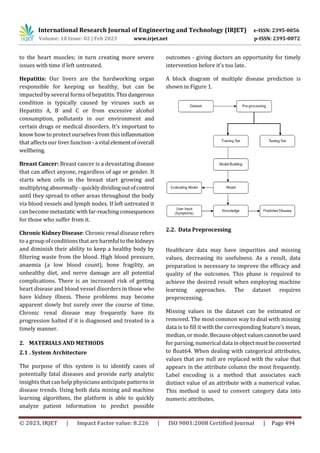
A block diagram of multiple disease prediction is
shown in Figure 1.
2.2. Data Preprocessing
Healthcare data may have impurities and missing
values, decreasing its usefulness. As a result, data
preparation is necessary to improve the efficacy and
quality of the outcomes. This phase is required to
achieve the desired result when employing machine
learning approaches. The dataset requires
preprocessing.
Missing values in the dataset can be estimated or
removed. The most common way to deal with missing
data is to fill it with the corresponding feature's mean,
median, or mode. Because objectvaluescannotbeused
for parsing, numerical datainobjectmustbeconverted
to float64. When dealing with categorical attributes,
values that are null are replaced with the value that
appears in the attribute column the most frequently.
Label encoding is a method that associates each
distinct value of an attribute with a numerical value.
This method is used to convert category data into
numeric attributes.
International Research Journal of Engineering and Technology (IRJET) e-ISSN: 2395-0056
Volume: 10 Issue: 02 | Feb 2023 www.irjet.net p-ISSN: 2395-0072
© 2023, IRJET | Impact Factor value: 8.226 | ISO 9001:2008 Certified Journal | Page 495
After replacing and encoding the data, it should be
trained, validated, and tested. The process of training
an algorithm to develop a model is called data training.
A validation subset of the dataset is used to validate or
improve various model fits. Use data tests to test
model hypotheses.
3. METHODOLOGY
Data mining is one of the most essential and widely
utilized technologies in the industry today for
performing data analysis and gaining insight into the
data. Approaches to data mining include Artificial
Intelligence, Machine Learning, andstatisticalanalysis,
among other things. In this work, a machine learning
technique is utilized to predict disease. Machine
learning is a collection of tools and techniques that
computers may use to turn unstructured data into
useful information.
There are two types of machine learning algorithms in
use right now. In supervised learning, problems with
classification and regression areubiquitous.It'swidely
used in predictive analytics since it creates a model
from data that includes outcomes or reactions. The
model is trained using labelled data. Unsupervised
learning is used when the outcome or answers are
uncertain, and the model is trained using unlabeled
data. Two of the most common uses of this type of
learning are pattern recognition and descriptive
modelling.
This study discusses the use of different machine
learning methods to predict disease. These algorithms
include Naïve Bayes, K-Nearest Neighbors (KNN),
Support Vector Machine (SVM), Decision Tree,Logistic
Regression, Random Forest, AdaBoost, and XGBoost is
another technique.
3.1 Logistic Regression
Logistic regression is a widely used technique used for
building machine learning models by analyzing datato
detect relationships between independent and
dependent factors. Data can beorganizedintonominal,
ordinal or interval values which are then analyzed
using the sigmoid function - an advanced cost function
in contrast to linear regressions more basic approach.
Logistic Regression provides valuable insights on both
classification and regression type problems giving it
broad capability across many different use cases.
3.2 KNN
KNN is an effective nonparametric machine learning
technique that classifies objects based on their
proximity to neighboring points. It takes into
consideration an adjustable number of marked data-
points (known as the K parameter) when deciding
which category or value an unknown object should
belong to, making it useful for both classification and
regressions tasks alike.Despiteits"delayed"effect -i.e.,
not immediately utilizing training set knowledge in
order to determine whattypesomethingbelongswith–
KNN offers a versatile option within supervised
artificial intelligence modelling techniques. The K-
Nearest Neighbor algorithm is often referred to as the
"lazy learner" due to its unique approach of waiting
until it's time for classification before putting in any
real work. Instead, the dataset is stored and only used
when needed.
3.3 Random Forest
Random Forest is a commonly used supervised
learning technique, combining the power of ensemble
learning and decision trees to create a powerful model
that accurately predicts outcomes while effectively
avoiding overfitting. By utilizing multiple classifierson
subsets of data simultaneously, The Random Forests
algorithm has established itself as one of the most
reliable technique available for solving classification
and regressionissueswithinmachinelearningsystems.
3.4 SVM
Support vector machines is a commonly used
technique for tackling complex supervised learning
tasks. By transforming the input data into an n-
dimensional space using specialized kernels, SVM
algorithms can accurately determine decision
boundaries and classify previously unseen points
without issue. By transformingtheinputdataintoann-
dimensional space using specialized kernels, SVM
International Research Journal of Engineering and Technology (IRJET) e-ISSN: 2395-0056
Volume: 10 Issue: 02 | Feb 2023 www.irjet.net p-ISSN: 2395-0072
© 2023, IRJET | Impact Factor value: 8.226 | ISO 9001:2008 Certified Journal | Page 496
algorithms can accurately determine decision
boundaries and classify previously unseen points
without issue. These kernel functions come in three
varieties: linear, polynomial or radial basis —allowing
them to find the best boundary even when problems
cannot be broken up easily.
3.5 Decision Tree
Decision trees offer an efficient and effective way of
mapping data to insights. By usingatree-likestructure,
they can quickly sort classification problems into
neatly organized categories based on the records'
attributes. As such, these models are commonly
utilized by many industries in order to uncover new
perspectives from their datasets. Choice nodes, which
can have multiple branches, are used for decision
making. The most difficult problem in developing a
decision tree is determining the optimal attributes of
the root node and sub-nodes. To overcome such
challenges, we use information gain and the Gini index
approach.
3.5 Naive Bayes
Naive Bayes is a powerful supervised learning
technique, helping solve complex classification
problems by harnessing the power of Bayes Theorem.
Through probability-based predictions, it can tackle
challenging tasks with greater accuracy and efficiency
than simple models alone. This classifier determines
where an example will fall into one of several
categories. When it comes to data preparation, the
Naive Bayes technique is known for its great precision
and quickness. It's typically applied to large datasets.
After steps of execution, characterization, estimation,
and forecast, the Naive Bayes Algorithm is a
probabilistic calculation that is sequential. Its
advantage is that it does not necessitateahugeamount
of training data.
3.6 Ada-boost
Adaptive Boosting (AdaBoost) is an innovative
approach to creating ensembles that can consistently
achieve higher accuracy than any one low-performing
model. It works by setting classifier weights and
training the data samples at each step, ultimately
resulting in a single-level decision tree—or Decision
Stump. With this method of constructing iterative
models which are trained interactively on different
weighted samples, AdaBoost provides consistent high-
performance predictions for detection of anomalous
observations.
AdaBoost shouldfulfilltworequirements:Interactively
training the classifier on various weighted training
samples is recommended,witheachiterationaimingto
fit the samples as closely as possible while reducing
training error.
3.7 XG-Boost
XGBoost is a powerful and reliable open-source
approach for predictive analytics that combines the
power of hundreds or thousands of weak models into
one strong model. An efficient implementation of
gradient-boosted trees,XGBoostutilizesacombination
of convex loss function and regularization terms such
as L1 and L2 to minimize error - creating highly
accurate predictions with minimal effort.
The iterative training process creates successive
regression trees which are then merged together for a
consolidated response; making it possible for
organizations in any field to unlock potential insights
from their data sets more quickly than ever before
4. LITERATURE SURVEY
4.1. Diagnosing the Stage of Hepatitis C Using
Machine Learning [1]
Hepatitis C is quite common around the world. The
number of new cases of hepatitis C that are reported
each year around the globe is between 3 and 4 million.
globe. With the use of reliable and up-to-date disease
prediction, individuals can obtain information on the
stage of their Hepatitis C infection by using a variety of
non-invasive blood biochemical indicators in
conjunctionwithpatientclinicaldata.MachineLearning
techniques have proven to be a successful alternative
method for identifying the stage of this chronic liver
disease and preventing side effects of a biopsy. This
study presents an exciting breakthrough in the field of
healthcare diagnosis: an intelligent hepatitis C stage
International Research Journal of Engineering and Technology (IRJET) e-ISSN: 2395-0056
Volume: 10 Issue: 02 | Feb 2023 www.irjet.net p-ISSN: 2395-0072
© 2023, IRJET | Impact Factor value: 8.226 | ISO 9001:2008 Certified Journal | Page 497
system (IHSDS) powered by machine learning. By
carefully selecting 19 features out of 29 from the UCI
library, this IHSDS was able to achieve remarkable
results when compared against earlier models; its
precision value soared to 98.89% during training and
94.44% throughout validation! These truly promising
figures highlight the potential for such powerful
machine-learning tools as diagnostic aids within
medical practice - potentiallyallowingustoimproveon
traditional methods with greater accuracy than ever
before.
4.2. Multiple Disease Prediction System [2]
In the modernworld, artificialintelligenceandmachine
learning are extremely important. We can find them
everywhere, from autonomous vehicles to the medical
industry. Medical professionals are now leveraging the
power of machine learning to create a multi-disease
prediction system that takes immense amounts of
patient data and processes it with unprecedented
accuracy, bringing us ever closer to ensuring our
patients stay healthy. Instead of relying on outdated
methods capable only of predicting one disease at a
time - oftennot correctly- we canrestassuredknowing
this newsystem offers reliable predictions everysingle
time. Heart, liver, and diabetes are the three ailments
we are now thinking about, but there may be many
more added in the future. The system will output if the
user has the disease or not whentheuserentersseveral
disease-related parameters. Numerous people could
benefit from this research because it allows for
condition monitoring and medication administration.
This system analysis is important because it takes into
account all of the components that contribute to the
onset of the diseases that are being studied, which
makes it possible to identify them more efficiently and
accurately.
4.3. Multiple disease prediction using Machine
learning algorithms [3]
Interdisciplinary data mining is revolutionizing the
healthcare sector by providing a fast and efficient way
to evaluate medical treatments. By studying past
database statistics, this field of research has allowed us
to gain insights into manydiseases, such asheartissues
related to diabetes - an illness that disproportionately
affects those living with it. However, current
classification techniques are still unable to accurately
predict cardiac problems for diabetics due its
complexity in nature.
Cleveland data collections are used by the framework.
The data is pre-processed before being put into
machine learning algorithms such as SVM, KNN, and
Decision Tree. Classified data flows into these
algorithms. The prediction then uses the classification
data as training data. TheaboveapproachhasaNavies-
Bayes accuracy of 0.77, an SVM accuracy of 0.87, and a
decision tree accuracy of 0.90. Decision trees are
generally considered the most reliable method for
these datasets.
4.4. Prediction of Hepatitis Disease Using
Machine Learning Technique [4]
The human liver plays an important role in the
body. One of the illnesses that seriously impairs
liver function is Hepatitis, a serious illness that
causes inflammatory response in the liver.
Hepatitis is a deadly disease that affects people all
over the world. Vital body functions can be
jeopardized if appropriate measuresarenottaken
promptly. The disease is cured if it is detected
early and correctly diagnosed. The datasets
needed for this work are drawn from the UCI
repository and selected with various clinical
scenarios in mind. There are 155 instances in this
dataset and 20 attributes. In this data set, one of
the same attributes determines how long patients
with hepatitis survive.
On the basis of accuracy, a comparative study of
various techniques is carried out. We used SVM, KNN,
and neural networks in this work. We achieved an
accuracy of 89.58% using SVM, an accuracy of 85.29%
using KNN, and an accuracy of 96.15 percentage using
ANN, resulting in a good prediction for disease
diagnosis.
4.5. Kidney Disease Diagnosis Based on
Machine Learning [5]
Kidney disease is difficult to recognize. In addition, not
only there is a lot ofmedical data on kidneydisease,but
it also has a complex structure. Methods for extracting
and processing large amounts of medical data must
become more efficientand comprehensive. In addition,
machine learning technology can help medical
professionals improvetheaccuracyofdiseasediagnosis
and predict disease risk in patients.
International Research Journal of Engineering and Technology (IRJET) e-ISSN: 2395-0056
Volume: 10 Issue: 02 | Feb 2023 www.irjet.net p-ISSN: 2395-0072
© 2023, IRJET | Impact Factor value: 8.226 | ISO 9001:2008 Certified Journal | Page 498
The prediction dataset was obtained from the UCI
repositorycontaining 400 samplesfromkidneydisease
patients inIndia. Patients are classifiedaccordingtothe
presence or absence of kidney disease. This dataset
contains 250 patient records and 150 patients. Age,
gender, total bilirubin, directbilirubin,totalproteinand
albumin are included in the 25 indicators. These
datasets were then used to compare predictive
outcomes for diseasediagnosisusinglogisticregression
and BP neural network models. Logistic regression is
89% and BP is 96%. As a result, the BP neural network
outperformed logistic regression in diagnosing renal
disease.
4.6. Kidney Disease Diagnosis using
Classification Algorithm [6]
Recently, kidney disease has become a big problem.
Diabetes, high blood pressure, leading an unhealthy
lifestyle, eating junk food, being dehydrated, having
arterial disease, and other factors are the primary
contributors to kidney disease. Blood tests are used to
diagnose kidney disease in its earlystages.Routinetest
results make it difficult for doctors to make accurate
diagnostic decisions. Machine learning algorithms are
highly effectiveinpredictingandanalysingpatientdata
during early stages of disease.
The mean imputation method handles missing values
in the dataset and uses the Label Encoder method to
convert the nominal dataset to a numeric dataset.
Naive Bayes classifiers, K nearest neighbours(K-NN),
bagging, decision trees, and random forest classifiers
are applied to the training data set and test results are
obtained and recorded. The results demonstrate that
the decision tree algorithm enhanced kidney disease
diagnostic accuracy by 98%.
4.7. Identification and Prediction of Chronic
DiseasesUsing Machine LearningApproach [7]
Making an accurate diagnosis is a difficult process, and
it can be even more challenging to predict when
someone might suffer from certain chronic diseases. In
this paper, we propose using cutting-edge machine
learning techniquesinordertoaccuratelyidentifythose
who are at risk of developing such illnesses. To ensure
that the categorization system works effectively, data
mining will play a vital role. We will leverage CNNs for
automatic feature extraction as well as disease
prediction while KNN algorithms provide calculations
on how close or far away our results are from exact
matches in existing datasets. The data set was created
bycompiling illness symptoms, a person's lifestyle,and
information related to doctor consultations. These
factors are all taken into consideration throughout this
generic prediction and diagnosis. Finally, this paper
compares the suggested approach with a number of
techniques,includingLogisticregression,decisiontrees,
and Naive Bayesian.
4.8. Prediction of Breast Cancer, Comparative
Review of Machine Learning Techniques, and
Their Analysis [8]
Breast cancer-related tumorscanoccurinbreasttissue.
It is one of the leading causes of mortality for women
worldwide and the most common kind of cancer in
females. In order to predict breast cancer, this article
compares and contrastsdatamining,deeplearning,and
machine learning methodologies. Breast cancer
diagnosis and prognosis have attracted the attentionof
numerous researchers. Machine Learning and Data
Mining are powerfultoolsforpredictingoutcomes,such
as the presence of breast cancer. This study aims to
explore a variety of current approaches in order to
identify the most effective method that can accurately
process large datasets. We look at existing research on
ML algorithms used for this purpose, so beginners will
gain an understanding of how these systems work and
be equipped with knowledge relevant to deep learning
models too. Our aim is not only compare/contrast
existing strategies but also identify those methods best
suited for working through huge datasets with
extraordinary accuracy rates.
4.9. A Machine Learning Model for Early
Prediction of Multiple Diseases to Cure Lives
[9]
It is preferable to predict illness based on
symptoms as opposed to consulting a physician.
This lessens the pressure on the medical
personnel and OPD wait times. We propose a
system thatissimple,inexpensive,and timesaving.
Our proposed system is revolutionizing the
connectionbetweendoctorsandpatients,enabling
them to better collaborate in attaining their goals.
Utilizing advanced algorithms such as Decision
Trees, Naive Bayes, Random Forests and Artificial
Neural Networks (ANN), it can accurately predict
diseases based on a mere five user-specified
symptoms - transforming traditional medical
diagnoses for improved efficiency.
International Research Journal of Engineering and Technology (IRJET) e-ISSN: 2395-0056
Volume: 10 Issue: 02 | Feb 2023 www.irjet.net p-ISSN: 2395-0072
© 2023, IRJET | Impact Factor value: 8.226 | ISO 9001:2008 Certified Journal | Page 499
Our system examines and merges more datasets
from different populations to produce more
effective results. The system thus refines and
improves the results. The accuracy for the above
model is Decision Tree: 95.12%, Random Forest:
95.11%, Navy Bayes: 95.21%, ANN: 95.12%. In
addition, our system’s database is an incredibly
useful resource for healthcare professionals,
enabling them to store vital patient information
and quickly recall existing diseases.It'sapowerful
tool in providing the most up-to-date treatment
possible. It is a system that helps to improve
health and make health management easier.
4.10. Multi Disease Prediction System [10]
A multi-illness prediction system built on predictive
modelling uses the patient's symptoms as input to
forecast their condition. The system calculates the
possibilitythat the disease maymanifestitselfbasedon
the patient's symptoms as input. The Random Forest
Classifier is used to make predictions, and we also use
Deep Learning Models (CNN) to make predictions for
Malaria and Pneumonia. This method ismore accurate,
and we develop a web allocation system for prediction
systems. This paper explored the effectivenessofNaive
Bayes and five other classifiers on real-world medical
tasks, using 15 datasets culled from the UCI Machine
Learning Library. Logistic Regression, Decision Tree
(DT), Neural Network (NN) and a simple rule-based
method were all compared side byside toobservetheir
performance in comparison with that of Naive Bayes.
The experimental results showed that Naive Bayes'
predicted accuracy results are superior to those of
other methods in8 of the 15 data sets. It was found that
treating chronic illness on a worldwide scale is
inefficient in terms of both time and money. Thus, the
authors conducted this research to make predictions
about the likelihood of sickness.
5. Evaluation Metrices
The three most crucial evaluation criteria are
precision, recall, and accuracy. The four
cardinalities oftheconfusionmatrixcan beusedto
define all of these measurements: The four
categories are True positives (TP), False Positives
(FP), False negatives (FN) and True negatives
(TN). The ratio of true predictions for a class is
used to assess precision, while the ratio ofTPand
(TP+FN) is used for calculating recall. The
percentageofcasescorrectlycategorizedisknown
as accuracy. The sensitivity and specificity of the
data were also considered. The ratio of correctly
identified positive to correctly classified negative
forecastsdeterminessensitivity,while theratioof
correctly classified negative to correctly classified
positive forecasts determines specificity.
6. CONCLUSION
This study examined the potential of using a
Machine Learning algorithm to accurately predict
several diseases and forecast future illnesses
based on patient-provided symptoms. It was
believed that this cutting-edgemethodologycould
reduce rates of chronic conditions by detecting
them earlier, as well as bringdowncostsrelatedto
diagnosis and treatment for those affected. The
findings suggestaninnovativenewsystemwith no
user threshold – meaning anyone canbenefitfrom
its use. By raising awareness about early-stage
signs or signals of disease, we are one step closer
towards helping people detect potentially life-
changing medical problems in their earlieststages
before it’s too late.
International Research Journal of Engineering and Technology (IRJET) e-ISSN: 2395-0056
Volume: 10 Issue: 02 | Feb 2023 www.irjet.net p-ISSN: 2395-0072
© 2023, IRJET | Impact Factor value: 8.226 | ISO 9001:2008 Certified Journal | Page 500
7. REFERENCES
[1] Butt MB, Alfayad M, Saqib S, Khan MA, Ahmad
M, Khan MA, Elmitwally NS. Diagnosing the
stage of hepatitis C using machine learning.
Journal of Healthcare Engineering. 2021 Dec
10;2021.
[2] Singh A, Yadav A, Shah S, Nagpure R. Multiple
Disease Prediction System. International
Research Journal of Engineering and
Technology 2022.
[3] ArumugamK,NavedM,ShindePP,Leiva-Chauca
O, Huaman-OsorioA,Gonzales-YanacT.Multiple
disease prediction using Machine learning
algorithms. Materials Today:Proceedings.2021
Aug 2.
[4] ArumugamK,NavedM,ShindePP,Leiva-Chauca
O, Huaman-OsorioA,Gonzales-YanacT.Multiple
disease prediction using Machine learning
algorithms. Materials Today:Proceedings.2021
Aug 2.
[5] Wang B. Kidney Disease Diagnosis Based on
Machine Learning. In2020 International
Conference on Computing and Data Science
(CDS) 2020 Aug 1 (pp. 307-310). IEEE.
[6] Pushpalatha S, Stella A. Kidney Disease
DiagnosisusingClassificationAlgorithm.In2021
Fifth International Conference on I-SMAC (IoT
in Social, Mobile, Analytics and Cloud) (I-SMAC)
2021 Nov 11 (pp. 1285-1288). IEEE.
[7] Alanazi R. Identification and prediction of
chronic diseases using machine learning
approach. Journal of Healthcare Engineering.
2022 Feb 25;2022.
[8] Fatima N, Liu L, Hong S, Ahmed H. Prediction of
breast cancer, comparative review of machine
learning techniques, and their analysis. IEEE
Access. 2020 Aug 14;8:150360-76.
[9] Kumar A, Pathak MA. Amachine learningmodel
for early prediction of multiple diseases to cure
lives. Turkish Journal of Computer and
Mathematics Education(TURCOMAT).2021Jun
5;12(6):4013-23.
[10] Mandem D, Prajna B. Multi Disease Prediction
System. International Journal of Innovative
Research in Technology. 2021.
[11] Dutta S, Bandyopadhyay SK. A voting ensemble
approach for hepatitis disease detection.
medRxiv. 2020 Jan 1.
[12] Kumar N, Narayan Das N, Gupta D, Gupta K,
Bindra J. Efficient automated disease diagnosis
using machine learning models. Journal of
Healthcare Engineering. 2021 May 4;2021.
[13] Kokol P, Jurman J, Bogovič T, Završnik T,
Završnik J, Blažun Vošner H. Supporting Real
World Decision Making in Coronary Diseases
Using Machine Learning. INQUIRY: The Journal
of Health Care Organization, Provision, and
Financing. 2021 May;58:0046958021997338.
[14] Chavda K. Design and Development of Online
Portal for Diagnosis of Multiple Diseases using
AI. Int J Res Appl Sci Eng Technol. 2019 Mar
31;7(3):555–60.
[15] Sruthi G, Ram CL, Sai MK, Singh BP, Majhotra N,
Sharma N. Cancer Prediction using Machine
Learning. In: Proceedings of 2nd International
Conference on Innovative Practices in
Technology and Management, ICIPTM 2022.
Institute of Electrical andElectronics Engineers
Inc.; 2022. p. 217–21.
[16] Shaji S, Ajina SR, Priya R VS. Chronic Kidney
Disease Prediction using Machine Learning.
[17] Kunjir A, Sawant H, Shaikh NF. Data mining and
visualization for prediction of multiple diseases
in healthcare. In2017 International Conference
on Big Data Analytics and Computational
International Research Journal of Engineering and Technology (IRJET) e-ISSN: 2395-0056
Volume: 10 Issue: 02 | Feb 2023 www.irjet.net p-ISSN: 2395-0072
© 2023, IRJET | Impact Factor value: 8.226 | ISO 9001:2008 Certified Journal | Page 501
Intelligence (ICBDAC) 2017 Mar 23 (pp. 329-
334). IEEE.
[18] Moreno-Ibarra MA, Villuendas-Rey Y, Lytras
MD, Yáñez-Márquez C, Salgado-Ramírez JC.
Classification of diseases using machine
learning algorithms: A comparative study.
Mathematics. 2021 Jul 31;9(15):1817.
[19] Uddin S, Khan A, Hossain ME, Moni MA.
Comparing different supervised machine
learning algorithms for disease prediction.BMC
medical informatics and decision making. 2019
Dec;19(1):1-6.
[20] Kate RJ, Perez RM, Mazumdar D, Pasupathy KS,
Nilakantan V. Prediction and detection models
for acute kidney injury in hospitalized older
adults. BMC medical informatics and decision
making. 2016 Dec;16(1):1-1.

Multiple Disease Prediction System: A Review

  • 1.
    International Research Journalof Engineering and Technology (IRJET) e-ISSN: 2395-0056 Volume: 10 Issue: 02 | Feb 2023 www.irjet.net p-ISSN: 2395-0072 © 2023, IRJET | Impact Factor value: 8.226 | ISO 9001:2008 Certified Journal | Page 493 1,2,3 Student, Department of Computer Engineering, SVKM’s NMIMS Mukesh Patel School of Technology Management and Engineering, Shirpur, Maharashtra, India ------------------------------------------------------------------------------------------------- Abstract: Machine Learning and data mining technologieshaverevolutionizedthehealthcareindustry by uncovering new, efficient ways to diagnose diseases. This research focuses on analyzing a variety of studies that employedpredictive modelling for predicting heart disease, diabetes and breast cancer amongst other illnesses. Through employing an innovative Multi- Disease Prediction System based on users' given symptoms as inputted into the system, researchers are discovering effective methods in reducing time constraints while still achieving successful performance outcomes when diagnosing various medical issues. The Multi Disease Prediction System employs predictive modelling to identify diseases with incredible accuracy. By examining the user's symptoms, it can determine what medical conditions could be causing that particular set of signs and indicate the likelihoodofeach potential illness – delivering a powerful tool for detection straight into your hands. Key words: Machine Learning, Data Mining, Diabetes, Heart Disease, Breast Cancer, Decision Tree, Support Vector Machine (SVM), Random Forest (RF), Convolutional neural network (CNN), K Nearest Neighbor (KNN), Naive Bayes. 1. INTRODUCTION Multiple Disease Prediction Using System Learningisa machine thatpredictsillnessbasedonlyoninformation supplied by the user. Machine learning gives the medical field a strong platform for solving problems quickly and effectively. The healthcare industry is transforming with the rise of innovative technologies that provide reliable resultsassoonasapatientoruser inputs their symptoms. Rather than making an appointment and visiting a hospital, now you can get accurate solutions online fromthecomfortofyourown home. In this way, technology has made it possible for These study focus on disease like Diabetes, Heart Disease, Breast Cancer, Kidney Disease, Hepatitis. Diabetes: Diabetes is a metabolic disorder that affects millions worldwide. It can cause high blood sugar levels and if left unchecked, result in serious health complications such as vision loss or heart disease. Diabetes falls into two main categories – Type 1, in which the immune system targets the cells that produces Insulin, and Type 2, in which insulin resistance leads to high blood sugar levels. Ofthese,it's estimated that 90-95% of cases are due to Type 2 diabetes - making it one of today’s most significant global public health issues. Heart Disease: Heart disease is a dangerous and pervasive health issue that affects the heart, blood vessels and even has an effect on our lives. Coronary artery disease being one of the most common types of such diseases usually builds up slowly as plaque formations block arteries supplyingessentialnutrients everyone to receive timely medical assistance whatever their needs may be. This system serves as a suggestion system to doctors and the health industry for the treatment of the patient, and any subsequent actions regarding the treatment are completely the responsibility of the doctors. Data sets from different websites about health have been gathered for the system that predicts diseases. The customer will be able to figure out how likely it is that using the signs and symptoms of a disease. Nowadays, the health industry is a big part of how people get better from their illnesses. This will helpthehealthindustrygetthe word out and help the user if they don't want to go to the hospital or any other clinics. This system tells doctors and the health industry how to treat a patient, and only the doctors can decide what to do next. Multiple Disease Prediction System: A Review Urvaang Naik1, Vipul Mashruwala2, Kunj Joshi3
  • 2.
    International Research Journalof Engineering and Technology (IRJET) e-ISSN: 2395-0056 Volume: 10 Issue: 02 | Feb 2023 www.irjet.net p-ISSN: 2395-0072 © 2023, IRJET | Impact Factor value: 8.226 | ISO 9001:2008 Certified Journal | Page 494 to the heart muscles; in turn creating more severe issues with time if left untreated. Hepatitis: Our livers are the hardworking organ responsible for keeping us healthy, but can be impacted by several forms of hepatitis. Thisdangerous condition is typically caused by viruses such as Hepatitis A, B and C or from excessive alcohol consumption, pollutants in our environment and certain drugs or medical disorders. It's important to know how to protect ourselves from this inflammation that affects our liver function-avitalelementofoverall wellbeing. Breast Cancer: Breast cancer is a devastating disease that can affect anyone, regardless of age or gender. It starts when cells in the breast start growing and multiplying abnormally-quicklydividingoutofcontrol until they spread to other areas throughout the body via blood vessels and lymph nodes. If left untreated it can become metastaticwithfar-reachingconsequences for those who suffer from it. Chronic Kidney Disease:Chronic renal diseaserefers to a group of conditions that are harmfultothekidneys and diminish their ability to keep a healthy body by filtering waste from the blood. High blood pressure, anaemia (a low blood count), bone fragility, an unhealthy diet, and nerve damage are all potential complications. There is an increased risk of getting heart disease and blood vessel disorders in those who have kidney illness. These problems may become apparent slowly but surely over the course of time. Chronic renal disease may frequently have its progression halted if it is diagnosed and treated in a timely manner. 2. MATERIALS AND METHODS 2.1 . System Architecture The purpose of this system is to identify cases of potentially fatal diseases and provide early analytic insights that can help physicians anticipate patterns in disease trends. Using both data mining and machine learning algorithms, the platform is able to quickly analyze patient information to predict possible outcomes - giving doctors an opportunity for timely intervention before it's too late. A block diagram of multiple disease prediction is shown in Figure 1. 2.2. Data Preprocessing Healthcare data may have impurities and missing values, decreasing its usefulness. As a result, data preparation is necessary to improve the efficacy and quality of the outcomes. This phase is required to achieve the desired result when employing machine learning approaches. The dataset requires preprocessing. Missing values in the dataset can be estimated or removed. The most common way to deal with missing data is to fill it with the corresponding feature's mean, median, or mode. Because objectvaluescannotbeused for parsing, numerical datainobjectmustbeconverted to float64. When dealing with categorical attributes, values that are null are replaced with the value that appears in the attribute column the most frequently. Label encoding is a method that associates each distinct value of an attribute with a numerical value. This method is used to convert category data into numeric attributes.
  • 3.
    International Research Journalof Engineering and Technology (IRJET) e-ISSN: 2395-0056 Volume: 10 Issue: 02 | Feb 2023 www.irjet.net p-ISSN: 2395-0072 © 2023, IRJET | Impact Factor value: 8.226 | ISO 9001:2008 Certified Journal | Page 495 After replacing and encoding the data, it should be trained, validated, and tested. The process of training an algorithm to develop a model is called data training. A validation subset of the dataset is used to validate or improve various model fits. Use data tests to test model hypotheses. 3. METHODOLOGY Data mining is one of the most essential and widely utilized technologies in the industry today for performing data analysis and gaining insight into the data. Approaches to data mining include Artificial Intelligence, Machine Learning, andstatisticalanalysis, among other things. In this work, a machine learning technique is utilized to predict disease. Machine learning is a collection of tools and techniques that computers may use to turn unstructured data into useful information. There are two types of machine learning algorithms in use right now. In supervised learning, problems with classification and regression areubiquitous.It'swidely used in predictive analytics since it creates a model from data that includes outcomes or reactions. The model is trained using labelled data. Unsupervised learning is used when the outcome or answers are uncertain, and the model is trained using unlabeled data. Two of the most common uses of this type of learning are pattern recognition and descriptive modelling. This study discusses the use of different machine learning methods to predict disease. These algorithms include Naïve Bayes, K-Nearest Neighbors (KNN), Support Vector Machine (SVM), Decision Tree,Logistic Regression, Random Forest, AdaBoost, and XGBoost is another technique. 3.1 Logistic Regression Logistic regression is a widely used technique used for building machine learning models by analyzing datato detect relationships between independent and dependent factors. Data can beorganizedintonominal, ordinal or interval values which are then analyzed using the sigmoid function - an advanced cost function in contrast to linear regressions more basic approach. Logistic Regression provides valuable insights on both classification and regression type problems giving it broad capability across many different use cases. 3.2 KNN KNN is an effective nonparametric machine learning technique that classifies objects based on their proximity to neighboring points. It takes into consideration an adjustable number of marked data- points (known as the K parameter) when deciding which category or value an unknown object should belong to, making it useful for both classification and regressions tasks alike.Despiteits"delayed"effect -i.e., not immediately utilizing training set knowledge in order to determine whattypesomethingbelongswith– KNN offers a versatile option within supervised artificial intelligence modelling techniques. The K- Nearest Neighbor algorithm is often referred to as the "lazy learner" due to its unique approach of waiting until it's time for classification before putting in any real work. Instead, the dataset is stored and only used when needed. 3.3 Random Forest Random Forest is a commonly used supervised learning technique, combining the power of ensemble learning and decision trees to create a powerful model that accurately predicts outcomes while effectively avoiding overfitting. By utilizing multiple classifierson subsets of data simultaneously, The Random Forests algorithm has established itself as one of the most reliable technique available for solving classification and regressionissueswithinmachinelearningsystems. 3.4 SVM Support vector machines is a commonly used technique for tackling complex supervised learning tasks. By transforming the input data into an n- dimensional space using specialized kernels, SVM algorithms can accurately determine decision boundaries and classify previously unseen points without issue. By transformingtheinputdataintoann- dimensional space using specialized kernels, SVM
  • 4.
    International Research Journalof Engineering and Technology (IRJET) e-ISSN: 2395-0056 Volume: 10 Issue: 02 | Feb 2023 www.irjet.net p-ISSN: 2395-0072 © 2023, IRJET | Impact Factor value: 8.226 | ISO 9001:2008 Certified Journal | Page 496 algorithms can accurately determine decision boundaries and classify previously unseen points without issue. These kernel functions come in three varieties: linear, polynomial or radial basis —allowing them to find the best boundary even when problems cannot be broken up easily. 3.5 Decision Tree Decision trees offer an efficient and effective way of mapping data to insights. By usingatree-likestructure, they can quickly sort classification problems into neatly organized categories based on the records' attributes. As such, these models are commonly utilized by many industries in order to uncover new perspectives from their datasets. Choice nodes, which can have multiple branches, are used for decision making. The most difficult problem in developing a decision tree is determining the optimal attributes of the root node and sub-nodes. To overcome such challenges, we use information gain and the Gini index approach. 3.5 Naive Bayes Naive Bayes is a powerful supervised learning technique, helping solve complex classification problems by harnessing the power of Bayes Theorem. Through probability-based predictions, it can tackle challenging tasks with greater accuracy and efficiency than simple models alone. This classifier determines where an example will fall into one of several categories. When it comes to data preparation, the Naive Bayes technique is known for its great precision and quickness. It's typically applied to large datasets. After steps of execution, characterization, estimation, and forecast, the Naive Bayes Algorithm is a probabilistic calculation that is sequential. Its advantage is that it does not necessitateahugeamount of training data. 3.6 Ada-boost Adaptive Boosting (AdaBoost) is an innovative approach to creating ensembles that can consistently achieve higher accuracy than any one low-performing model. It works by setting classifier weights and training the data samples at each step, ultimately resulting in a single-level decision tree—or Decision Stump. With this method of constructing iterative models which are trained interactively on different weighted samples, AdaBoost provides consistent high- performance predictions for detection of anomalous observations. AdaBoost shouldfulfilltworequirements:Interactively training the classifier on various weighted training samples is recommended,witheachiterationaimingto fit the samples as closely as possible while reducing training error. 3.7 XG-Boost XGBoost is a powerful and reliable open-source approach for predictive analytics that combines the power of hundreds or thousands of weak models into one strong model. An efficient implementation of gradient-boosted trees,XGBoostutilizesacombination of convex loss function and regularization terms such as L1 and L2 to minimize error - creating highly accurate predictions with minimal effort. The iterative training process creates successive regression trees which are then merged together for a consolidated response; making it possible for organizations in any field to unlock potential insights from their data sets more quickly than ever before 4. LITERATURE SURVEY 4.1. Diagnosing the Stage of Hepatitis C Using Machine Learning [1] Hepatitis C is quite common around the world. The number of new cases of hepatitis C that are reported each year around the globe is between 3 and 4 million. globe. With the use of reliable and up-to-date disease prediction, individuals can obtain information on the stage of their Hepatitis C infection by using a variety of non-invasive blood biochemical indicators in conjunctionwithpatientclinicaldata.MachineLearning techniques have proven to be a successful alternative method for identifying the stage of this chronic liver disease and preventing side effects of a biopsy. This study presents an exciting breakthrough in the field of healthcare diagnosis: an intelligent hepatitis C stage
  • 5.
    International Research Journalof Engineering and Technology (IRJET) e-ISSN: 2395-0056 Volume: 10 Issue: 02 | Feb 2023 www.irjet.net p-ISSN: 2395-0072 © 2023, IRJET | Impact Factor value: 8.226 | ISO 9001:2008 Certified Journal | Page 497 system (IHSDS) powered by machine learning. By carefully selecting 19 features out of 29 from the UCI library, this IHSDS was able to achieve remarkable results when compared against earlier models; its precision value soared to 98.89% during training and 94.44% throughout validation! These truly promising figures highlight the potential for such powerful machine-learning tools as diagnostic aids within medical practice - potentiallyallowingustoimproveon traditional methods with greater accuracy than ever before. 4.2. Multiple Disease Prediction System [2] In the modernworld, artificialintelligenceandmachine learning are extremely important. We can find them everywhere, from autonomous vehicles to the medical industry. Medical professionals are now leveraging the power of machine learning to create a multi-disease prediction system that takes immense amounts of patient data and processes it with unprecedented accuracy, bringing us ever closer to ensuring our patients stay healthy. Instead of relying on outdated methods capable only of predicting one disease at a time - oftennot correctly- we canrestassuredknowing this newsystem offers reliable predictions everysingle time. Heart, liver, and diabetes are the three ailments we are now thinking about, but there may be many more added in the future. The system will output if the user has the disease or not whentheuserentersseveral disease-related parameters. Numerous people could benefit from this research because it allows for condition monitoring and medication administration. This system analysis is important because it takes into account all of the components that contribute to the onset of the diseases that are being studied, which makes it possible to identify them more efficiently and accurately. 4.3. Multiple disease prediction using Machine learning algorithms [3] Interdisciplinary data mining is revolutionizing the healthcare sector by providing a fast and efficient way to evaluate medical treatments. By studying past database statistics, this field of research has allowed us to gain insights into manydiseases, such asheartissues related to diabetes - an illness that disproportionately affects those living with it. However, current classification techniques are still unable to accurately predict cardiac problems for diabetics due its complexity in nature. Cleveland data collections are used by the framework. The data is pre-processed before being put into machine learning algorithms such as SVM, KNN, and Decision Tree. Classified data flows into these algorithms. The prediction then uses the classification data as training data. TheaboveapproachhasaNavies- Bayes accuracy of 0.77, an SVM accuracy of 0.87, and a decision tree accuracy of 0.90. Decision trees are generally considered the most reliable method for these datasets. 4.4. Prediction of Hepatitis Disease Using Machine Learning Technique [4] The human liver plays an important role in the body. One of the illnesses that seriously impairs liver function is Hepatitis, a serious illness that causes inflammatory response in the liver. Hepatitis is a deadly disease that affects people all over the world. Vital body functions can be jeopardized if appropriate measuresarenottaken promptly. The disease is cured if it is detected early and correctly diagnosed. The datasets needed for this work are drawn from the UCI repository and selected with various clinical scenarios in mind. There are 155 instances in this dataset and 20 attributes. In this data set, one of the same attributes determines how long patients with hepatitis survive. On the basis of accuracy, a comparative study of various techniques is carried out. We used SVM, KNN, and neural networks in this work. We achieved an accuracy of 89.58% using SVM, an accuracy of 85.29% using KNN, and an accuracy of 96.15 percentage using ANN, resulting in a good prediction for disease diagnosis. 4.5. Kidney Disease Diagnosis Based on Machine Learning [5] Kidney disease is difficult to recognize. In addition, not only there is a lot ofmedical data on kidneydisease,but it also has a complex structure. Methods for extracting and processing large amounts of medical data must become more efficientand comprehensive. In addition, machine learning technology can help medical professionals improvetheaccuracyofdiseasediagnosis and predict disease risk in patients.
  • 6.
    International Research Journalof Engineering and Technology (IRJET) e-ISSN: 2395-0056 Volume: 10 Issue: 02 | Feb 2023 www.irjet.net p-ISSN: 2395-0072 © 2023, IRJET | Impact Factor value: 8.226 | ISO 9001:2008 Certified Journal | Page 498 The prediction dataset was obtained from the UCI repositorycontaining 400 samplesfromkidneydisease patients inIndia. Patients are classifiedaccordingtothe presence or absence of kidney disease. This dataset contains 250 patient records and 150 patients. Age, gender, total bilirubin, directbilirubin,totalproteinand albumin are included in the 25 indicators. These datasets were then used to compare predictive outcomes for diseasediagnosisusinglogisticregression and BP neural network models. Logistic regression is 89% and BP is 96%. As a result, the BP neural network outperformed logistic regression in diagnosing renal disease. 4.6. Kidney Disease Diagnosis using Classification Algorithm [6] Recently, kidney disease has become a big problem. Diabetes, high blood pressure, leading an unhealthy lifestyle, eating junk food, being dehydrated, having arterial disease, and other factors are the primary contributors to kidney disease. Blood tests are used to diagnose kidney disease in its earlystages.Routinetest results make it difficult for doctors to make accurate diagnostic decisions. Machine learning algorithms are highly effectiveinpredictingandanalysingpatientdata during early stages of disease. The mean imputation method handles missing values in the dataset and uses the Label Encoder method to convert the nominal dataset to a numeric dataset. Naive Bayes classifiers, K nearest neighbours(K-NN), bagging, decision trees, and random forest classifiers are applied to the training data set and test results are obtained and recorded. The results demonstrate that the decision tree algorithm enhanced kidney disease diagnostic accuracy by 98%. 4.7. Identification and Prediction of Chronic DiseasesUsing Machine LearningApproach [7] Making an accurate diagnosis is a difficult process, and it can be even more challenging to predict when someone might suffer from certain chronic diseases. In this paper, we propose using cutting-edge machine learning techniquesinordertoaccuratelyidentifythose who are at risk of developing such illnesses. To ensure that the categorization system works effectively, data mining will play a vital role. We will leverage CNNs for automatic feature extraction as well as disease prediction while KNN algorithms provide calculations on how close or far away our results are from exact matches in existing datasets. The data set was created bycompiling illness symptoms, a person's lifestyle,and information related to doctor consultations. These factors are all taken into consideration throughout this generic prediction and diagnosis. Finally, this paper compares the suggested approach with a number of techniques,includingLogisticregression,decisiontrees, and Naive Bayesian. 4.8. Prediction of Breast Cancer, Comparative Review of Machine Learning Techniques, and Their Analysis [8] Breast cancer-related tumorscanoccurinbreasttissue. It is one of the leading causes of mortality for women worldwide and the most common kind of cancer in females. In order to predict breast cancer, this article compares and contrastsdatamining,deeplearning,and machine learning methodologies. Breast cancer diagnosis and prognosis have attracted the attentionof numerous researchers. Machine Learning and Data Mining are powerfultoolsforpredictingoutcomes,such as the presence of breast cancer. This study aims to explore a variety of current approaches in order to identify the most effective method that can accurately process large datasets. We look at existing research on ML algorithms used for this purpose, so beginners will gain an understanding of how these systems work and be equipped with knowledge relevant to deep learning models too. Our aim is not only compare/contrast existing strategies but also identify those methods best suited for working through huge datasets with extraordinary accuracy rates. 4.9. A Machine Learning Model for Early Prediction of Multiple Diseases to Cure Lives [9] It is preferable to predict illness based on symptoms as opposed to consulting a physician. This lessens the pressure on the medical personnel and OPD wait times. We propose a system thatissimple,inexpensive,and timesaving. Our proposed system is revolutionizing the connectionbetweendoctorsandpatients,enabling them to better collaborate in attaining their goals. Utilizing advanced algorithms such as Decision Trees, Naive Bayes, Random Forests and Artificial Neural Networks (ANN), it can accurately predict diseases based on a mere five user-specified symptoms - transforming traditional medical diagnoses for improved efficiency.
  • 7.
    International Research Journalof Engineering and Technology (IRJET) e-ISSN: 2395-0056 Volume: 10 Issue: 02 | Feb 2023 www.irjet.net p-ISSN: 2395-0072 © 2023, IRJET | Impact Factor value: 8.226 | ISO 9001:2008 Certified Journal | Page 499 Our system examines and merges more datasets from different populations to produce more effective results. The system thus refines and improves the results. The accuracy for the above model is Decision Tree: 95.12%, Random Forest: 95.11%, Navy Bayes: 95.21%, ANN: 95.12%. In addition, our system’s database is an incredibly useful resource for healthcare professionals, enabling them to store vital patient information and quickly recall existing diseases.It'sapowerful tool in providing the most up-to-date treatment possible. It is a system that helps to improve health and make health management easier. 4.10. Multi Disease Prediction System [10] A multi-illness prediction system built on predictive modelling uses the patient's symptoms as input to forecast their condition. The system calculates the possibilitythat the disease maymanifestitselfbasedon the patient's symptoms as input. The Random Forest Classifier is used to make predictions, and we also use Deep Learning Models (CNN) to make predictions for Malaria and Pneumonia. This method ismore accurate, and we develop a web allocation system for prediction systems. This paper explored the effectivenessofNaive Bayes and five other classifiers on real-world medical tasks, using 15 datasets culled from the UCI Machine Learning Library. Logistic Regression, Decision Tree (DT), Neural Network (NN) and a simple rule-based method were all compared side byside toobservetheir performance in comparison with that of Naive Bayes. The experimental results showed that Naive Bayes' predicted accuracy results are superior to those of other methods in8 of the 15 data sets. It was found that treating chronic illness on a worldwide scale is inefficient in terms of both time and money. Thus, the authors conducted this research to make predictions about the likelihood of sickness. 5. Evaluation Metrices The three most crucial evaluation criteria are precision, recall, and accuracy. The four cardinalities oftheconfusionmatrixcan beusedto define all of these measurements: The four categories are True positives (TP), False Positives (FP), False negatives (FN) and True negatives (TN). The ratio of true predictions for a class is used to assess precision, while the ratio ofTPand (TP+FN) is used for calculating recall. The percentageofcasescorrectlycategorizedisknown as accuracy. The sensitivity and specificity of the data were also considered. The ratio of correctly identified positive to correctly classified negative forecastsdeterminessensitivity,while theratioof correctly classified negative to correctly classified positive forecasts determines specificity. 6. CONCLUSION This study examined the potential of using a Machine Learning algorithm to accurately predict several diseases and forecast future illnesses based on patient-provided symptoms. It was believed that this cutting-edgemethodologycould reduce rates of chronic conditions by detecting them earlier, as well as bringdowncostsrelatedto diagnosis and treatment for those affected. The findings suggestaninnovativenewsystemwith no user threshold – meaning anyone canbenefitfrom its use. By raising awareness about early-stage signs or signals of disease, we are one step closer towards helping people detect potentially life- changing medical problems in their earlieststages before it’s too late.
  • 8.
    International Research Journalof Engineering and Technology (IRJET) e-ISSN: 2395-0056 Volume: 10 Issue: 02 | Feb 2023 www.irjet.net p-ISSN: 2395-0072 © 2023, IRJET | Impact Factor value: 8.226 | ISO 9001:2008 Certified Journal | Page 500 7. REFERENCES [1] Butt MB, Alfayad M, Saqib S, Khan MA, Ahmad M, Khan MA, Elmitwally NS. Diagnosing the stage of hepatitis C using machine learning. Journal of Healthcare Engineering. 2021 Dec 10;2021. [2] Singh A, Yadav A, Shah S, Nagpure R. Multiple Disease Prediction System. International Research Journal of Engineering and Technology 2022. [3] ArumugamK,NavedM,ShindePP,Leiva-Chauca O, Huaman-OsorioA,Gonzales-YanacT.Multiple disease prediction using Machine learning algorithms. Materials Today:Proceedings.2021 Aug 2. [4] ArumugamK,NavedM,ShindePP,Leiva-Chauca O, Huaman-OsorioA,Gonzales-YanacT.Multiple disease prediction using Machine learning algorithms. Materials Today:Proceedings.2021 Aug 2. [5] Wang B. Kidney Disease Diagnosis Based on Machine Learning. In2020 International Conference on Computing and Data Science (CDS) 2020 Aug 1 (pp. 307-310). IEEE. [6] Pushpalatha S, Stella A. Kidney Disease DiagnosisusingClassificationAlgorithm.In2021 Fifth International Conference on I-SMAC (IoT in Social, Mobile, Analytics and Cloud) (I-SMAC) 2021 Nov 11 (pp. 1285-1288). IEEE. [7] Alanazi R. Identification and prediction of chronic diseases using machine learning approach. Journal of Healthcare Engineering. 2022 Feb 25;2022. [8] Fatima N, Liu L, Hong S, Ahmed H. Prediction of breast cancer, comparative review of machine learning techniques, and their analysis. IEEE Access. 2020 Aug 14;8:150360-76. [9] Kumar A, Pathak MA. Amachine learningmodel for early prediction of multiple diseases to cure lives. Turkish Journal of Computer and Mathematics Education(TURCOMAT).2021Jun 5;12(6):4013-23. [10] Mandem D, Prajna B. Multi Disease Prediction System. International Journal of Innovative Research in Technology. 2021. [11] Dutta S, Bandyopadhyay SK. A voting ensemble approach for hepatitis disease detection. medRxiv. 2020 Jan 1. [12] Kumar N, Narayan Das N, Gupta D, Gupta K, Bindra J. Efficient automated disease diagnosis using machine learning models. Journal of Healthcare Engineering. 2021 May 4;2021. [13] Kokol P, Jurman J, Bogovič T, Završnik T, Završnik J, Blažun Vošner H. Supporting Real World Decision Making in Coronary Diseases Using Machine Learning. INQUIRY: The Journal of Health Care Organization, Provision, and Financing. 2021 May;58:0046958021997338. [14] Chavda K. Design and Development of Online Portal for Diagnosis of Multiple Diseases using AI. Int J Res Appl Sci Eng Technol. 2019 Mar 31;7(3):555–60. [15] Sruthi G, Ram CL, Sai MK, Singh BP, Majhotra N, Sharma N. Cancer Prediction using Machine Learning. In: Proceedings of 2nd International Conference on Innovative Practices in Technology and Management, ICIPTM 2022. Institute of Electrical andElectronics Engineers Inc.; 2022. p. 217–21. [16] Shaji S, Ajina SR, Priya R VS. Chronic Kidney Disease Prediction using Machine Learning. [17] Kunjir A, Sawant H, Shaikh NF. Data mining and visualization for prediction of multiple diseases in healthcare. In2017 International Conference on Big Data Analytics and Computational
  • 9.
    International Research Journalof Engineering and Technology (IRJET) e-ISSN: 2395-0056 Volume: 10 Issue: 02 | Feb 2023 www.irjet.net p-ISSN: 2395-0072 © 2023, IRJET | Impact Factor value: 8.226 | ISO 9001:2008 Certified Journal | Page 501 Intelligence (ICBDAC) 2017 Mar 23 (pp. 329- 334). IEEE. [18] Moreno-Ibarra MA, Villuendas-Rey Y, Lytras MD, Yáñez-Márquez C, Salgado-Ramírez JC. Classification of diseases using machine learning algorithms: A comparative study. Mathematics. 2021 Jul 31;9(15):1817. [19] Uddin S, Khan A, Hossain ME, Moni MA. Comparing different supervised machine learning algorithms for disease prediction.BMC medical informatics and decision making. 2019 Dec;19(1):1-6. [20] Kate RJ, Perez RM, Mazumdar D, Pasupathy KS, Nilakantan V. Prediction and detection models for acute kidney injury in hospitalized older adults. BMC medical informatics and decision making. 2016 Dec;16(1):1-1.