© 2015 IntegratedACO
NAACOS Innovation Session
© 2015 IntegratedACO
Save Lives.
Save Money.
Let’s do Both.
NAACOS Innovation Session
Why We Are Here
I was part of the problem.
Who Are We?
Vipul Mankad
M.D. Founder and Senior Medical Adviser,
IACO (2013-present); Senior Medical Adviser-
CMS (2005-2006); RWJ Health Policy Fellow-
US Senate (2003-2004);
Eric Weaver
MHA, President (CEO), IACO, Focus on
Leadership, Physician Practice and Information
Management
Joydeep Ghosh
Directs data mining and predictive modeling
operations for ACOs, currently the
Schlumberger Centennial Chair Professor of
Electrical and Computer Engineering at the
University of Texas, Austin
Provider Locations
Midland/Odessa 10
San Antonio 14
Austin 13
Weatherford 1
Alpine 1
Bastrop 1
Port Lavaca 8
Integrated ACO LLC
 Track 1, Advance Payment Model,
January 1, 2013
 Independent Practices (Primary Care)
 Underserved region of West Texas
with high numbers of Hispanics
 Vast geographic area
 Physicians:
28 in 2013 > 48 in 2015
 Beneficiaries:
 7,177 in 2013 (PY1)
 13,000 + currently
 90% EHR penetration
 9 Platforms
 Initial Skepticism,
Resistance and lack of
Awareness
 Will ACA be repealed?
 Will Supreme Court
overrule it?
 We don’t need more
work.
 Haven’t we seen this
before with HMO’s?
 Why would I want to
spend more time with
patients and compromise
FFS revenue?
 Opportunities
 No capital outlay for
physicians (advance
payment model ACO)
 Fast deployment with
CMS funding
 Low risk - high reward
(Shared Savings in PY1)
 Physician autonomy
 Capture quality
incentives
 Prepare for new value-
based reimbursement
 Free care coordination
 Better Care for Patients
Our Experience with MD Recruitment
 Physician Ownership, Incentives
and Governance
 No Conflict of interest - reduction of
unnecessary hospitalizations for
Ambulatory Care Sensitive Admissions
(ACSA)
 Executive leadership
 Medical Leadership in each region
 Well-defined Care Coordination
protocols
 CHF and Diabetes
 Clinical and Predictive analytics
ACO Strengths
 One of only 6 Advance Payment ACOs to create a
surplus
 Per capita expenditure benchmark: $12,203
 Actual Per Capita expenditure: $11,668
 Reduction from $81.4 MM to $77.8 MM
 Approximately 4.5% cost reduction in PY1
 Successfully reported on 100% of quality
measures
 Returned $1.54 MM and created a surplus of
$208,000
 50% performance bonus and 50% reinvestment
Performance Year 1 Results
 Integrated Data Warehouse and EHR Penetration
 Versatility in EHR interfacing methodologies
 Automated Quality monitoring and GPRO reporting tool
 Clinical Analytics to measure compliance and deviation from EBM guidelines
 Powerful algorithm for prediction of preventable admissions for CHF patients.
 Psychographic segmentation of patient population based on personality type to
personalize care coordination intervention
Innovations
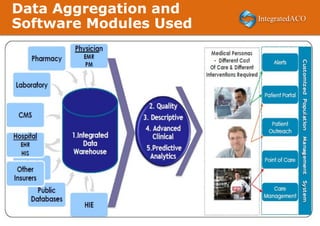
Data Aggregation and
Software Modules Used
Predictive Analytics in an ACO
 Small number of patients generate large proportion of
costs
 Top 5% generate 43-47 % of the costs (CBO and
AHRQ)
 Not the same 5% each year
 Some of the 5% from last year died
 Problem solved (at least temporarily, e.g. bypass
for AMI)
 Which 5% will generate the cost in the next 5
months?
 How to predict and prevent Ambulatory Care
Sensitive Admissions?
Ambulatory Care Sensitive Admissions
What’s in the CHF Model ?
 325 Features in the Model
 Demographics (sex, race, age)
 Population Level Data (high school graduation and median
income)
 Healthcare Usage (Outpatient, inpatient, SNF, HHA and Hospice)
 ICD-9 Codes during past 1 month and 12 months
 Chronic conditions
 Utilizes a Lasso regularization technique to:
 Reduce the number of predictors in a generalized linear model.
 Identify important predictors.
 Select among redundant predictors.
 Produce shrinkage estimates with potentially lower predictive
errors than ordinary least squares.
Goal of Model – To predict accurately which
patients will be in top 1%/5%/20% of
preventable admissions
Prediction of CHF Admissions
 Area Under the Curve (AUC or ROC Curve)
 False positive versus true positive
 Random Prediction 50%
 AUC greater than 70% is excellent
 Measures error rate (specificity versus
sensitivity)
 Lift Value or Gain Chart
 How well the model sorts the patient from a
no model selection
 Power of Prediction over random (no model)
selection
Prediction of CHF Admissions
(C-statistic: AUC 0.89 with a Lift of 17.6 at 1%)
ROC and Lift Results
Model AUC Lift at 1% Lift at 5% Lift at
10%
Chronic PQI 0.8365 18.5208* 6.6667 5.5556
Acute PQI 0.7956 NA 5.000 4.1667
CHF 0.8937 17.6492** 11.7648 7.0588
Pneumonia 0.8393 8.0010*** 8.0000 4.8000
* Predictive power is 18.5 times the random selection
** Predictive power 17.6 times the random selection
*** Predictive power is 8 times the random selection
Innovation and Differentiation
 Unlike other predictive models developed from grouped data, our
system builds the model from individual (i.e. non-grouped)
 More than 325 features are used in analysis
 Innovative use of publicly available socioeconomic data
 C-statistic in 0.9 range with strong lift at 1-5%
 AUC of 50% is considered random.
 A model with AUC of 70% is considered good.
Cost Effective Use of
Care Coordinators
 7,000 Medicare Beneficiaries in PY1
 35 Care Coordinators needed to achieve
1:200 ratio for all ACO patients ($2.8M/yr at
10% effectiveness)
 2 Care Coordinators needed if 5% of
population (most likely to generate future
costs) is selected ($140k/yr at 50%
effectiveness)
 Challenge: Identify 5% of patients most prone
to ACSA admissions in the near future (e.g.,
within next 6 months)
 1 CHF admission = $10,000-18,000
 Our ACO’s New Innovation
(In Development)
 granular view of each
segment
 customized patient
engagement approach
for care coordination
 Adapt messaging to
individual personality
Psychographic Profiling
CustomizedPopulationManagementSystem
Alerts
Patient Portal
Patient Outreach
Point of Care
Care
Management
Who uses Psychographics?
Industry Recognition of
our ACO’s Predictive Algorithm
 Our innovation will be receiving a national award,
LEADING EDGE FOR INNOVATION, at HIMSS15
later this month.
Contact Information
Eric Weaver, CEO
eric.weaver@integrated-aco.com
Questions?

Integrated ACO selected for the NAACOS Innovation Showcase

  • 1.
    © 2015 IntegratedACO NAACOSInnovation Session
  • 2.
    © 2015 IntegratedACO SaveLives. Save Money. Let’s do Both. NAACOS Innovation Session
  • 3.
    Why We AreHere I was part of the problem.
  • 4.
    Who Are We? VipulMankad M.D. Founder and Senior Medical Adviser, IACO (2013-present); Senior Medical Adviser- CMS (2005-2006); RWJ Health Policy Fellow- US Senate (2003-2004); Eric Weaver MHA, President (CEO), IACO, Focus on Leadership, Physician Practice and Information Management Joydeep Ghosh Directs data mining and predictive modeling operations for ACOs, currently the Schlumberger Centennial Chair Professor of Electrical and Computer Engineering at the University of Texas, Austin
  • 5.
    Provider Locations Midland/Odessa 10 SanAntonio 14 Austin 13 Weatherford 1 Alpine 1 Bastrop 1 Port Lavaca 8
  • 6.
    Integrated ACO LLC Track 1, Advance Payment Model, January 1, 2013  Independent Practices (Primary Care)  Underserved region of West Texas with high numbers of Hispanics  Vast geographic area  Physicians: 28 in 2013 > 48 in 2015  Beneficiaries:  7,177 in 2013 (PY1)  13,000 + currently  90% EHR penetration  9 Platforms
  • 7.
     Initial Skepticism, Resistanceand lack of Awareness  Will ACA be repealed?  Will Supreme Court overrule it?  We don’t need more work.  Haven’t we seen this before with HMO’s?  Why would I want to spend more time with patients and compromise FFS revenue?  Opportunities  No capital outlay for physicians (advance payment model ACO)  Fast deployment with CMS funding  Low risk - high reward (Shared Savings in PY1)  Physician autonomy  Capture quality incentives  Prepare for new value- based reimbursement  Free care coordination  Better Care for Patients Our Experience with MD Recruitment
  • 8.
     Physician Ownership,Incentives and Governance  No Conflict of interest - reduction of unnecessary hospitalizations for Ambulatory Care Sensitive Admissions (ACSA)  Executive leadership  Medical Leadership in each region  Well-defined Care Coordination protocols  CHF and Diabetes  Clinical and Predictive analytics ACO Strengths
  • 9.
     One ofonly 6 Advance Payment ACOs to create a surplus  Per capita expenditure benchmark: $12,203  Actual Per Capita expenditure: $11,668  Reduction from $81.4 MM to $77.8 MM  Approximately 4.5% cost reduction in PY1  Successfully reported on 100% of quality measures  Returned $1.54 MM and created a surplus of $208,000  50% performance bonus and 50% reinvestment Performance Year 1 Results
  • 10.
     Integrated DataWarehouse and EHR Penetration  Versatility in EHR interfacing methodologies  Automated Quality monitoring and GPRO reporting tool  Clinical Analytics to measure compliance and deviation from EBM guidelines  Powerful algorithm for prediction of preventable admissions for CHF patients.  Psychographic segmentation of patient population based on personality type to personalize care coordination intervention Innovations
  • 11.
  • 12.
    Predictive Analytics inan ACO  Small number of patients generate large proportion of costs  Top 5% generate 43-47 % of the costs (CBO and AHRQ)  Not the same 5% each year  Some of the 5% from last year died  Problem solved (at least temporarily, e.g. bypass for AMI)  Which 5% will generate the cost in the next 5 months?  How to predict and prevent Ambulatory Care Sensitive Admissions?
  • 13.
  • 14.
  • 15.
    What’s in theCHF Model ?  325 Features in the Model  Demographics (sex, race, age)  Population Level Data (high school graduation and median income)  Healthcare Usage (Outpatient, inpatient, SNF, HHA and Hospice)  ICD-9 Codes during past 1 month and 12 months  Chronic conditions  Utilizes a Lasso regularization technique to:  Reduce the number of predictors in a generalized linear model.  Identify important predictors.  Select among redundant predictors.  Produce shrinkage estimates with potentially lower predictive errors than ordinary least squares. Goal of Model – To predict accurately which patients will be in top 1%/5%/20% of preventable admissions
  • 16.
    Prediction of CHFAdmissions  Area Under the Curve (AUC or ROC Curve)  False positive versus true positive  Random Prediction 50%  AUC greater than 70% is excellent  Measures error rate (specificity versus sensitivity)  Lift Value or Gain Chart  How well the model sorts the patient from a no model selection  Power of Prediction over random (no model) selection
  • 17.
    Prediction of CHFAdmissions (C-statistic: AUC 0.89 with a Lift of 17.6 at 1%)
  • 18.
    ROC and LiftResults Model AUC Lift at 1% Lift at 5% Lift at 10% Chronic PQI 0.8365 18.5208* 6.6667 5.5556 Acute PQI 0.7956 NA 5.000 4.1667 CHF 0.8937 17.6492** 11.7648 7.0588 Pneumonia 0.8393 8.0010*** 8.0000 4.8000 * Predictive power is 18.5 times the random selection ** Predictive power 17.6 times the random selection *** Predictive power is 8 times the random selection
  • 19.
    Innovation and Differentiation Unlike other predictive models developed from grouped data, our system builds the model from individual (i.e. non-grouped)  More than 325 features are used in analysis  Innovative use of publicly available socioeconomic data  C-statistic in 0.9 range with strong lift at 1-5%  AUC of 50% is considered random.  A model with AUC of 70% is considered good.
  • 20.
    Cost Effective Useof Care Coordinators  7,000 Medicare Beneficiaries in PY1  35 Care Coordinators needed to achieve 1:200 ratio for all ACO patients ($2.8M/yr at 10% effectiveness)  2 Care Coordinators needed if 5% of population (most likely to generate future costs) is selected ($140k/yr at 50% effectiveness)  Challenge: Identify 5% of patients most prone to ACSA admissions in the near future (e.g., within next 6 months)  1 CHF admission = $10,000-18,000
  • 21.
     Our ACO’sNew Innovation (In Development)  granular view of each segment  customized patient engagement approach for care coordination  Adapt messaging to individual personality Psychographic Profiling CustomizedPopulationManagementSystem Alerts Patient Portal Patient Outreach Point of Care Care Management
  • 22.
  • 23.
    Industry Recognition of ourACO’s Predictive Algorithm  Our innovation will be receiving a national award, LEADING EDGE FOR INNOVATION, at HIMSS15 later this month.
  • 24.
    Contact Information Eric Weaver,CEO eric.weaver@integrated-aco.com Questions?