Forms of
Poetry
Reading Standard 3.1
Determine and articulate the relationship between the
purposes and characteristics of different forms of poetry
(e.g., ballad, epic, lyric, couplet, ode, and sonnet).
I love
poetry!
 Sometimes poetry has no particular form or rhyme
scheme; these types of poems are called free verse poems.
 Traditionally, however, poems have a particular
format and/ or rhyming pattern.
The subject matter and form of a poem may put it in
a particular category like ballad, epic, lyric, sonnet,
ode, elegy, narrative, haiku etc.
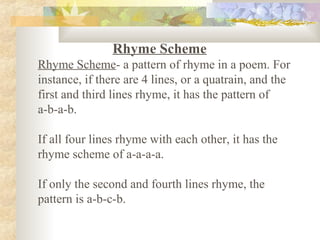
Rhyme Scheme
Rhyme Scheme- a pattern of rhyme in a poem. For
instance, if there are 4 lines, or a quatrain, and the
first and third lines rhyme, it has the pattern of
a-b-a-b.
If all four lines rhyme with each other, it has the
rhyme scheme of a-a-a-a.
If only the second and fourth lines rhyme, the
pattern is a-b-c-b.
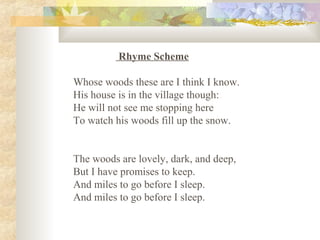
Rhyme Scheme
Whose woods these are I think I know.
His house is in the village though:
He will not see me stopping here
To watch his woods fill up the snow.
The woods are lovely, dark, and deep,
But I have promises to keep.
And miles to go before I sleep.
The Sonnet:
A fourteen-line poem
Expresses author’s feelings
Has a particular end rhyme pattern (ABABCDCD…)
Usually ends in a rhymed couplet (two lines with end rhyme)
Shakespeare wrote over 100 sonnets
Lyric Poem
Lyric Poem- a short poem in which a single speaker expresses
personal thoughts and feelings
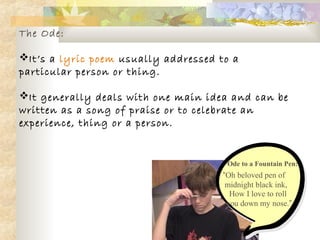
The Ode:
It’s a lyric poem usually addressed to a
particular person or thing.
It generally deals with one main idea and can be
written as a song of praise or to celebrate an
experience, thing or a person.
Ode to a Fountain Pen:
“Oh beloved pen of
midnight black ink,
How I love to roll
you down my nose.”
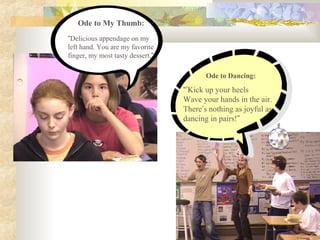
Ode to My Thumb:
“Delicious appendage on my
left hand. You are my favorite
finger, my most tasty dessert.”
Ode to Dancing:
“’Kick up your heels
Wave your hands in the air.
There’s nothing as joyful as
dancing in pairs!”
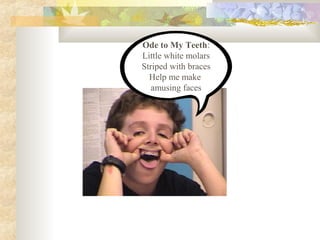
Ode to My Teeth:
Little white molars
Striped with braces
Help me make
amusing faces
A ballad is a songlike poem that tells a story, often a sad story
of betrayal, death, or loss.
•Ballads usually have a regular, steady rhythm, a simple
rhyme pattern, and a refrain, or a repeated part of a poem, all
of which make them easy to memorize.
•Usually follows a-b-c-b rhyme scheme.
•Historically ballads were passed down orally from person to
person rather than in writing.
Steady rhythm,
simple rhyme pattern,
and refrain.
That’s easy!!
Narrative Poem: Tells a story
Elegy: A poem written for someone who has died, often a
tribute. Most are written in formal writing and a serious tone.
Couplets: two rhyming lines of poetry that are consecutive.
Haiku: consists of 17 unrhymed syllables, organized into three
lines, and doesn’t rhyme:
Line 1: 5 syllables
Line 2: 7 syllables
Line 3: 5 syllables
Most describe nature, a moment of beauty which keeps you
thinking or feeling.
Lymerick: an amusing verse of five lines:
Lines 1, 2, and 5 ryhme and lines 3 and 4 rhyme.
Line 5 refers to line 1
Lines 3 and 4 are usually shorter than the other lines.
The rhyming pattern is AABBA
EX: There once was a musical king
Who suddenly started to sing.
The birds of the sky
All started to fly
Right over that talented king
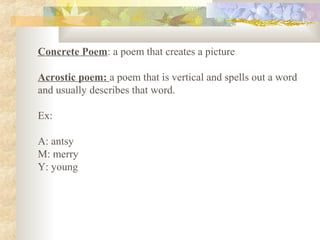
Concrete Poem: a poem that creates a picture
Acrostic poem: a poem that is vertical and spells out a word
and usually describes that word.
Ex:
A: antsy
M: merry
Y: young
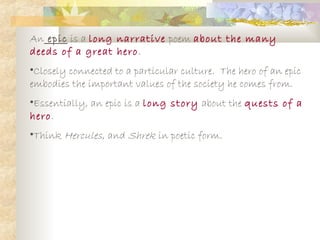
An epic is a long narrative poem about the many
deeds of a great hero.
•Closely connected to a particular culture. The hero of an epic
embodies the important values of the society he comes from.
•Essentially, an epic is a long story about the quests of a
hero.
•Think Hercules, and Shrek in poetic form.

Forms of poetry updated

  • 1.
    Forms of Poetry Reading Standard3.1 Determine and articulate the relationship between the purposes and characteristics of different forms of poetry (e.g., ballad, epic, lyric, couplet, ode, and sonnet). I love poetry!
  • 2.
     Sometimes poetryhas no particular form or rhyme scheme; these types of poems are called free verse poems.  Traditionally, however, poems have a particular format and/ or rhyming pattern. The subject matter and form of a poem may put it in a particular category like ballad, epic, lyric, sonnet, ode, elegy, narrative, haiku etc.
  • 3.
    Rhyme Scheme Rhyme Scheme-a pattern of rhyme in a poem. For instance, if there are 4 lines, or a quatrain, and the first and third lines rhyme, it has the pattern of a-b-a-b. If all four lines rhyme with each other, it has the rhyme scheme of a-a-a-a. If only the second and fourth lines rhyme, the pattern is a-b-c-b.
  • 4.
    Rhyme Scheme Whose woodsthese are I think I know. His house is in the village though: He will not see me stopping here To watch his woods fill up the snow. The woods are lovely, dark, and deep, But I have promises to keep. And miles to go before I sleep. And miles to go before I sleep.
  • 5.
    The Sonnet: A fourteen-linepoem Expresses author’s feelings Has a particular end rhyme pattern (ABABCDCD…) Usually ends in a rhymed couplet (two lines with end rhyme) Shakespeare wrote over 100 sonnets
  • 6.
    Lyric Poem Lyric Poem-a short poem in which a single speaker expresses personal thoughts and feelings
  • 7.
    The Ode: It’s alyric poem usually addressed to a particular person or thing. It generally deals with one main idea and can be written as a song of praise or to celebrate an experience, thing or a person. Ode to a Fountain Pen: “Oh beloved pen of midnight black ink, How I love to roll you down my nose.”
  • 8.
    Ode to MyThumb: “Delicious appendage on my left hand. You are my favorite finger, my most tasty dessert.” Ode to Dancing: “’Kick up your heels Wave your hands in the air. There’s nothing as joyful as dancing in pairs!”
  • 9.
    Ode to MyTeeth: Little white molars Striped with braces Help me make amusing faces
  • 10.
    A ballad isa songlike poem that tells a story, often a sad story of betrayal, death, or loss. •Ballads usually have a regular, steady rhythm, a simple rhyme pattern, and a refrain, or a repeated part of a poem, all of which make them easy to memorize. •Usually follows a-b-c-b rhyme scheme. •Historically ballads were passed down orally from person to person rather than in writing. Steady rhythm, simple rhyme pattern, and refrain. That’s easy!!
  • 11.
    Narrative Poem: Tellsa story Elegy: A poem written for someone who has died, often a tribute. Most are written in formal writing and a serious tone. Couplets: two rhyming lines of poetry that are consecutive. Haiku: consists of 17 unrhymed syllables, organized into three lines, and doesn’t rhyme: Line 1: 5 syllables Line 2: 7 syllables Line 3: 5 syllables Most describe nature, a moment of beauty which keeps you thinking or feeling.
  • 12.
    Lymerick: an amusingverse of five lines: Lines 1, 2, and 5 ryhme and lines 3 and 4 rhyme. Line 5 refers to line 1 Lines 3 and 4 are usually shorter than the other lines. The rhyming pattern is AABBA EX: There once was a musical king Who suddenly started to sing. The birds of the sky All started to fly Right over that talented king
  • 13.
    Concrete Poem: apoem that creates a picture Acrostic poem: a poem that is vertical and spells out a word and usually describes that word. Ex: A: antsy M: merry Y: young
  • 14.
    An epic isa long narrative poem about the many deeds of a great hero. •Closely connected to a particular culture. The hero of an epic embodies the important values of the society he comes from. •Essentially, an epic is a long story about the quests of a hero. •Think Hercules, and Shrek in poetic form.