Using Analogies to Teach
Thinking, Language & Content
to ELLs
Prepared by
Jeanette Gordon
Illinois Resource
Center
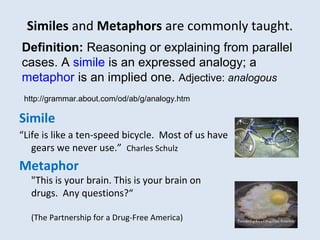
Similes and Metaphors are commonly taught.
Simile
“Life is like a ten-speed bicycle. Most of us have
gears we never use.” Charles Schulz
Metaphor
"This is your brain. This is your brain on
drugs. Any questions?“
(The Partnership for a Drug-Free America)
Definition: Reasoning or explaining from parallel
cases. A simile is an expressed analogy; a
metaphor is an implied one. Adjective: analogous
http://grammar.about.com/od/ab/g/analogy.htm
Copyblogger “Metaphor, Simile and Analogy:
What’s the Difference?” by Brian Clark
Metaphor
• A metaphor is a figure of speech that uses one thing
to mean another and makes a comparison between
the two. The key words here are “one thing
to mean another.”
Simile
• A simile compares two different things in order to
create a new meaning. In this case, we are made
explicitly aware that a comparison is being made due
to the use of “like” or “as”
Analogy
• An analogy is comparable to metaphor and simile in
that it shows how two different things are similar,
but it’s a bit more complex. Rather than a figure of
speech, an analogy is more of a logical argument.
The presenter of an analogy will often demonstrate
how two things are alike by pointing out shared
characteristics, with the goal of showing that if two
things are similar in some ways, they are similar in
other ways as well.
Source: Copyblogger “Metaphor, Simile and Analogy:
What’s the Difference?” by Brian Clark
Why Use Analogies
• Higher-order thinking promotes engagement
and retention.
• ELLs can understand and communicate
complex relationships with limited language.
• The same concept can be represented in more
than one type of relationship which helps
refine understanding and promote cognitive
flexibility.
• New unfamiliar learning can be connected and
taught using a familiar context
Teach Analogies by Type
Antonyms
Synonyms
Descriptive
Performer to Action
Object and Function
Object and Location
Part to Whole
Item to Category
Object and Related Object
Object to Group
Cause and Effect
Effect and Cause
Effort and Result
Result and Effort
Problem and Solution
Degree of a Characteristic
Things that Go Together
Types of Rhyme
Source of types:
www.fibonicci.com/verbal-reasoning/word-analogies/examples-types/
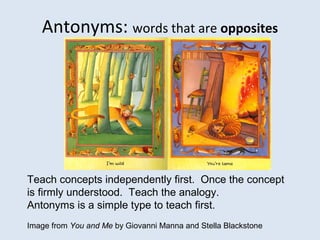
Antonyms: words that are opposites
Teach concepts independently first. Once the concept
is firmly understood. Teach the analogy.
Antonyms is a simple type to teach first.
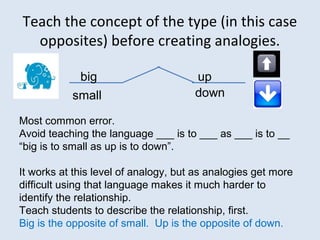
Image from You and Me by Giovanni Manna and Stella Blackstone
Teach the concept of the type (in this case
opposites) before creating analogies.
big
small
up
Most common error.
Avoid teaching the language ___ is to ___ as ___ is to __
“big is to small as up is to down”.
It works at this level of analogy, but as analogies get more
difficult using that language makes it much harder to
identify the relationship.
Teach students to describe the relationship, first.
Big is the opposite of small. Up is the opposite of down.
down
Free SAT Prep1.com
What not to do
• The biggest mistake we have encountered
with analogies are students who want to insist
on approaching them by saying "Wallet is to
money as ..." While this may sound official, it
is the wrong way to approach the analogies
questions.
• http://www.freesat1prep.com/sat/verbal/analogies/
“The right way to approach the SAT analogies
• Make up a short sentence that includes both
words in the analogy. Example:
A wallet contains money. (It's supposed to
anyway.) Try to keep this sentence short and
use an active verb whenever possible.
• If you still have a problem (say because the
sentence you created fits most or even all of the
answer choices) go back and make the question
more specific.”
http://www.freesat1prep.com/sat/verbal/analogies/
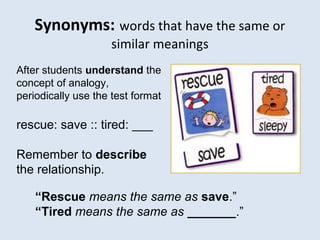
Synonyms: words that have the same or
similar meanings
“Rescue means the same as save.”
“Tired means the same as _______.”
After students understand the
concept of analogy,
periodically use the test format
rescue: save :: tired: ___
Remember to describe
the relationship.
Descriptive:
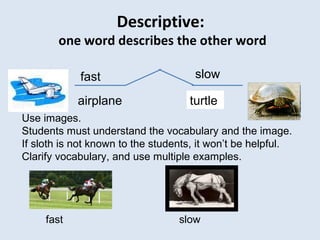
one word describes the other word
airplane
fast
sloth
slow
Use images.
Students must understand the vocabulary and the image.
If sloth is not known to the students, it won’t be helpful.
Clarify vocabulary, and use multiple examples.
turtle
fast slow
More Descriptive
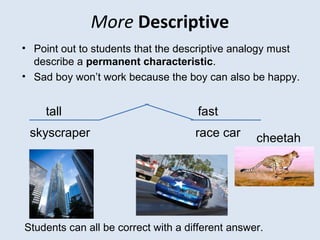
• Point out to students that the descriptive analogy must
describe a permanent characteristic.
• Sad boy won’t work because the boy can also be happy.
fasttall
skyscraper
Students can all be correct with a different answer.
cheetahrace car
Performer and Action
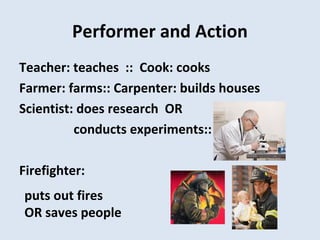
Teacher: teaches :: Cook: cooks
Farmer: farms:: Carpenter: builds houses
Scientist: does research OR
conducts experiments::
Firefighter:
puts out fires
OR saves people
Performer to Action
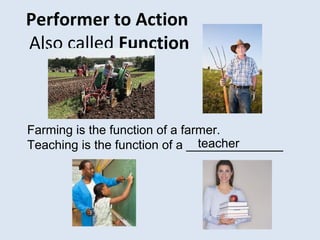
Also called Function
Farming is the function of a farmer.
Teaching is the function of a ______________teacher
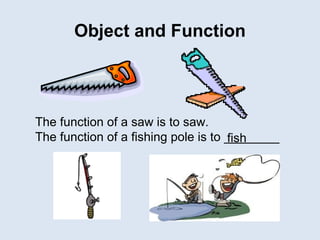
Object and Function
The function of a saw is to saw.
The function of a fishing pole is to ________fish
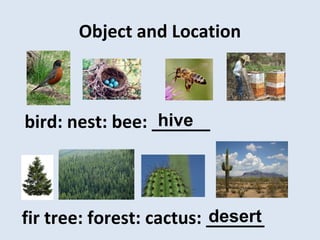
Object and Location
bird: nest: bee: ______hive
fir tree: forest: cactus: ______desert
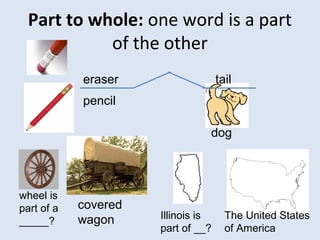
Part to whole: one word is a part
of the other
eraser
pencil
tail
dog
wheel is
part of a
_____?
covered
wagon Illinois is
part of __?
The United States
of America
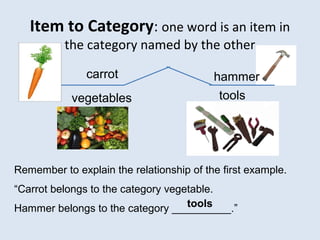
Item to Category: one word is an item in
the category named by the other
carrot
vegetables
hammer
tools
Remember to explain the relationship of the first example.
“Carrot belongs to the category vegetable.
Hammer belongs to the category __________.”tools
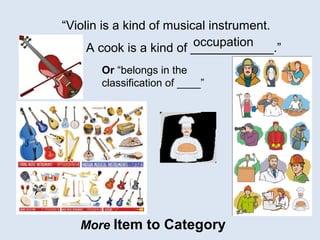
“Violin is a kind of musical instrument.
A cook is a kind of ____________.”occupation
Or “belongs in the
classification of ____”
More Item to Category
Object and Related Object
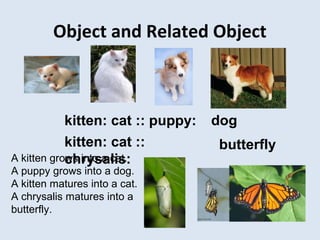
kitten: cat :: puppy: dog
kitten: cat ::
chrysalis:
butterfly
A kitten grows into a cat.
A puppy grows into a dog.
A kitten matures into a cat.
A chrysalis matures into a
butterfly.
Object and Group
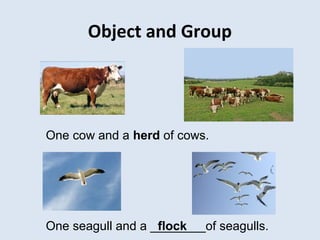
One cow and a herd of cows.
One seagull and a ________of seagulls.flock
More Object and Group
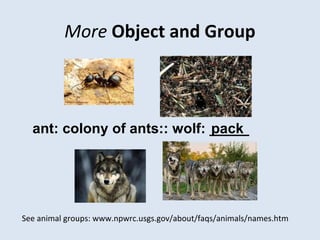
ant: colony of ants:: wolf: _____
See animal groups: www.npwrc.usgs.gov/about/faqs/animals/names.htm
pack
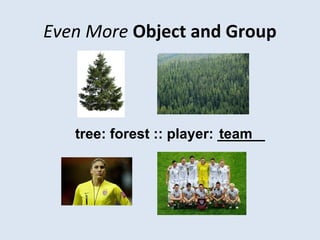
Even More Object and Group
teamtree: forest :: player: ______
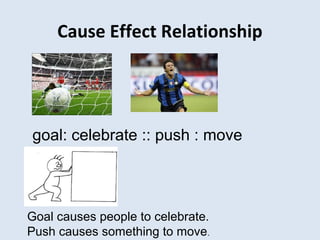
Cause Effect Relationship
goal: celebrate :: push : move
Goal causes people to celebrate.
Push causes something to move.
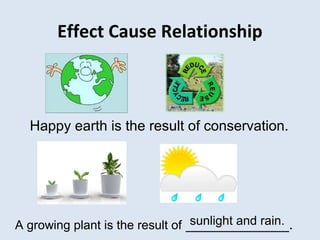
Effect Cause Relationship
Happy earth is the result of conservation.
A growing plant is the result of _____________.sunlight and rain.
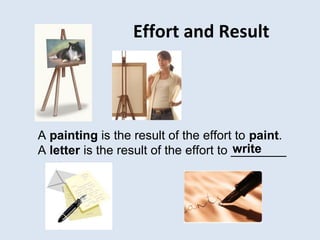
Effort and Result
A painting is the result of the effort to paint.
A letter is the result of the effort to ________write
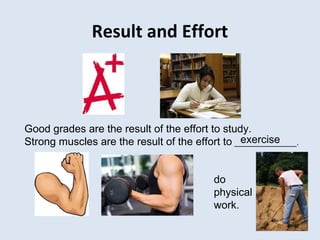
Result and Effort
Good grades are the result of the effort to study.
Strong muscles are the result of the effort to ______________.exercise
do
physical
work.
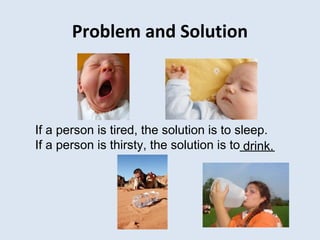
Problem and Solution
If a person is tired, the solution is to sleep.
If a person is thirsty, the solution is to_____drink.
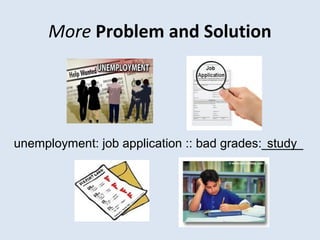
More Problem and Solution
unemployment: job application :: bad grades:______study
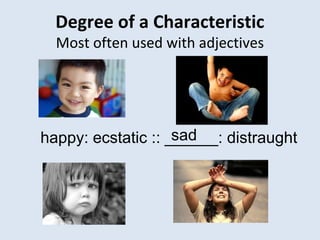
Degree of a Characteristic
Most often used with adjectives
happy: ecstatic :: ______: distraughtsad
More Degree of a Characteristic
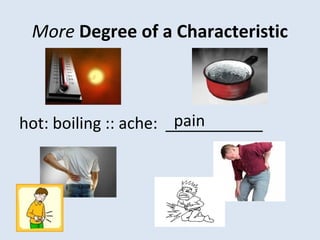
hot: boiling :: ache: ___________pain
Things That Go Together
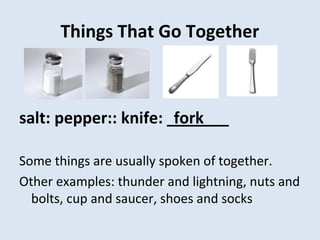
salt: pepper:: knife: _______
Some things are usually spoken of together.
Other examples: thunder and lightning, nuts and
bolts, cup and saucer, shoes and socks
fork
Types of Rhymes
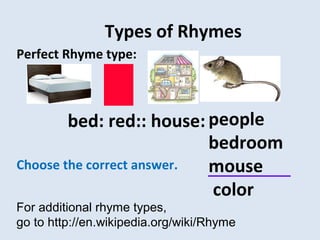
Perfect Rhyme type:
bed: red:: house:
Choose the correct answer.
For additional rhyme types,
go to http://en.wikipedia.org/wiki/Rhyme
people
bedroom
mouse
color
Rick Wormeli Resource
Rick Wormeli’s book provides an
excellent orientation to the use
of metaphors and analogies.
One chapter is devoted to ELLs
Note: The example used for the
following TWA strategy is
adapted from Elma Torres, a
winner of a metaphor content by
Rick Wormeli. Read other winner
submissions and his comments
on the site.
http://www.stenhouse.com/html/news_167.htm
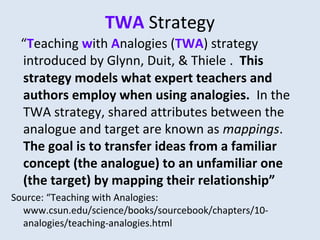
TWA Strategy
“Teaching with Analogies (TWA) strategy
introduced by Glynn, Duit, & Thiele . This
strategy models what expert teachers and
authors employ when using analogies. In the
TWA strategy, shared attributes between the
analogue and target are known as mappings.
The goal is to transfer ideas from a familiar
concept (the analogue) to an unfamiliar one
(the target) by mapping their relationship”
Source: “Teaching with Analogies:
www.csun.edu/science/books/sourcebook/chapters/10-
analogies/teaching-analogies.html
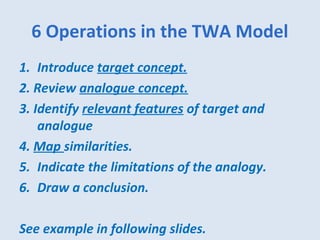
6 Operations in the TWA Model
1. Introduce target concept.
2. Review analogue concept. 
3. Identify relevant features of target and 
analogue
4. Map similarities.
5. Indicate the limitations of the analogy.
6. Draw a conclusion.
See example in following slides.
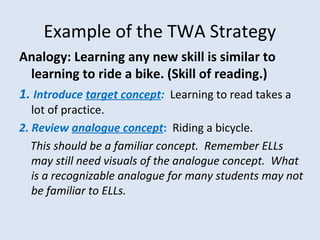
Example of the TWA Strategy
Analogy: Learning any new skill is similar to
learning to ride a bike. (Skill of reading.)
1. Introduce target concept:  Learning to read takes a 
lot of practice.
2. Review analogue concept:  Riding a bicycle.  
    This should be a familiar concept. Remember ELLs
may still need visuals of the analogue concept. What
is a recognizable analogue for many students may not
be familiar to ELLs.
3. Identify relevant features of target and 
analogue
– Modeling, 
– Try with support from others. 
– Try on your own. 
– Practice in more difficult situations.
– Use the skill throughout life
     4. Map similarities
        Specify how each relevant feature is similar.
    
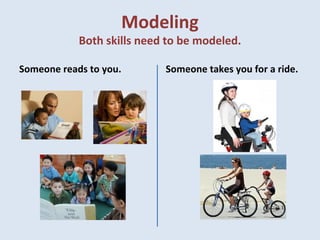
Modeling
Both skills need to be modeled.
Someone reads to you. Someone takes you for a ride.
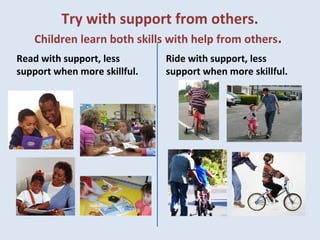
Try with support from others.
Children learn both skills with help from others.
Read with support, less
support when more skillful.
Ride with support, less
support when more skillful.
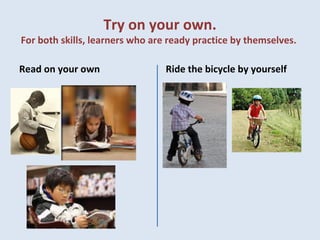
Try on your own.
For both skills, learners who are ready practice by themselves.
Read on your own Ride the bicycle by yourself
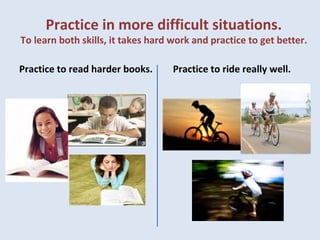
Practice in more difficult situations.
To learn both skills, it takes hard work and practice to get better.
Practice to read harder books. Practice to ride really well.
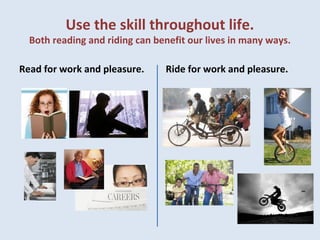
Use the skill throughout life.
Both reading and riding can benefit our lives in many ways.
Read for work and pleasure. Ride for work and pleasure.
5. Indicate the limitations of the analogy.
– Some students may have no experience with learning to 
ride a bike.  
– The skill of reading is more complex, with modeling, 
support and practice for each new reading skill being 
taught.
– Reading is a needed skill, not a skill of choice.
5. Draw a conclusion.    The students develop a basic 
understanding of the process of learning to read with 
the analogy of learning to ride a bike.
         
 Original source for TWA:  Glynn, S. M., R. Duit, & R. B. Thiele (1995). Teaching 
science with analogies: A strategy for constructing knowledge. In S. M. 
Glynn and R. Duit (Eds.).Learning science in the schools: Research reforming
practice (pp. 247-273). Mahwah, NJ: Erlbaum.
Teaching Teachers to Use 
Analogies
• Site to promote use of analogies in science.  
• Teaching Materials
• Resources to teach using analogies in 
Educational Methods courses
• Analogy aptitude pre/post survey
•  Free videos with examples of analogies
• PowerPoint Presentations
• http://www.physics.nau.edu/~james/Teachin
gTeachersAnalogies.htm

Using analogies to teach english language learners

  • 1.
    Using Analogies toTeach Thinking, Language & Content to ELLs Prepared by Jeanette Gordon Illinois Resource Center
  • 2.
    Similes and Metaphorsare commonly taught. Simile “Life is like a ten-speed bicycle. Most of us have gears we never use.” Charles Schulz Metaphor "This is your brain. This is your brain on drugs. Any questions?“ (The Partnership for a Drug-Free America) Definition: Reasoning or explaining from parallel cases. A simile is an expressed analogy; a metaphor is an implied one. Adjective: analogous http://grammar.about.com/od/ab/g/analogy.htm
  • 3.
    Copyblogger “Metaphor, Simileand Analogy: What’s the Difference?” by Brian Clark Metaphor • A metaphor is a figure of speech that uses one thing to mean another and makes a comparison between the two. The key words here are “one thing to mean another.” Simile • A simile compares two different things in order to create a new meaning. In this case, we are made explicitly aware that a comparison is being made due to the use of “like” or “as”
  • 4.
    Analogy • An analogyis comparable to metaphor and simile in that it shows how two different things are similar, but it’s a bit more complex. Rather than a figure of speech, an analogy is more of a logical argument. The presenter of an analogy will often demonstrate how two things are alike by pointing out shared characteristics, with the goal of showing that if two things are similar in some ways, they are similar in other ways as well. Source: Copyblogger “Metaphor, Simile and Analogy: What’s the Difference?” by Brian Clark
  • 5.
    Why Use Analogies •Higher-order thinking promotes engagement and retention. • ELLs can understand and communicate complex relationships with limited language. • The same concept can be represented in more than one type of relationship which helps refine understanding and promote cognitive flexibility. • New unfamiliar learning can be connected and taught using a familiar context
  • 6.
    Teach Analogies byType Antonyms Synonyms Descriptive Performer to Action Object and Function Object and Location Part to Whole Item to Category Object and Related Object Object to Group Cause and Effect Effect and Cause Effort and Result Result and Effort Problem and Solution Degree of a Characteristic Things that Go Together Types of Rhyme Source of types: www.fibonicci.com/verbal-reasoning/word-analogies/examples-types/
  • 7.
    Antonyms: words thatare opposites Teach concepts independently first. Once the concept is firmly understood. Teach the analogy. Antonyms is a simple type to teach first. Image from You and Me by Giovanni Manna and Stella Blackstone
  • 8.
    Teach the conceptof the type (in this case opposites) before creating analogies. big small up Most common error. Avoid teaching the language ___ is to ___ as ___ is to __ “big is to small as up is to down”. It works at this level of analogy, but as analogies get more difficult using that language makes it much harder to identify the relationship. Teach students to describe the relationship, first. Big is the opposite of small. Up is the opposite of down. down
  • 9.
    Free SAT Prep1.com Whatnot to do • The biggest mistake we have encountered with analogies are students who want to insist on approaching them by saying "Wallet is to money as ..." While this may sound official, it is the wrong way to approach the analogies questions. • http://www.freesat1prep.com/sat/verbal/analogies/
  • 10.
    “The right wayto approach the SAT analogies • Make up a short sentence that includes both words in the analogy. Example: A wallet contains money. (It's supposed to anyway.) Try to keep this sentence short and use an active verb whenever possible. • If you still have a problem (say because the sentence you created fits most or even all of the answer choices) go back and make the question more specific.” http://www.freesat1prep.com/sat/verbal/analogies/
  • 11.
    Synonyms: words thathave the same or similar meanings “Rescue means the same as save.” “Tired means the same as _______.” After students understand the concept of analogy, periodically use the test format rescue: save :: tired: ___ Remember to describe the relationship.
  • 12.
    Descriptive: one word describesthe other word airplane fast sloth slow Use images. Students must understand the vocabulary and the image. If sloth is not known to the students, it won’t be helpful. Clarify vocabulary, and use multiple examples. turtle fast slow
  • 13.
    More Descriptive • Pointout to students that the descriptive analogy must describe a permanent characteristic. • Sad boy won’t work because the boy can also be happy. fasttall skyscraper Students can all be correct with a different answer. cheetahrace car
  • 14.
    Performer and Action Teacher:teaches :: Cook: cooks Farmer: farms:: Carpenter: builds houses Scientist: does research OR conducts experiments:: Firefighter: puts out fires OR saves people
  • 15.
    Performer to Action Alsocalled Function Farming is the function of a farmer. Teaching is the function of a ______________teacher
  • 16.
    Object and Function Thefunction of a saw is to saw. The function of a fishing pole is to ________fish
  • 17.
    Object and Location bird:nest: bee: ______hive fir tree: forest: cactus: ______desert
  • 18.
    Part to whole:one word is a part of the other eraser pencil tail dog wheel is part of a _____? covered wagon Illinois is part of __? The United States of America
  • 19.
    Item to Category:one word is an item in the category named by the other carrot vegetables hammer tools Remember to explain the relationship of the first example. “Carrot belongs to the category vegetable. Hammer belongs to the category __________.”tools
  • 20.
    “Violin is akind of musical instrument. A cook is a kind of ____________.”occupation Or “belongs in the classification of ____” More Item to Category
  • 21.
    Object and RelatedObject kitten: cat :: puppy: dog kitten: cat :: chrysalis: butterfly A kitten grows into a cat. A puppy grows into a dog. A kitten matures into a cat. A chrysalis matures into a butterfly.
  • 22.
    Object and Group Onecow and a herd of cows. One seagull and a ________of seagulls.flock
  • 23.
    More Object andGroup ant: colony of ants:: wolf: _____ See animal groups: www.npwrc.usgs.gov/about/faqs/animals/names.htm pack
  • 24.
    Even More Objectand Group teamtree: forest :: player: ______
  • 25.
    Cause Effect Relationship goal:celebrate :: push : move Goal causes people to celebrate. Push causes something to move.
  • 26.
    Effect Cause Relationship Happyearth is the result of conservation. A growing plant is the result of _____________.sunlight and rain.
  • 27.
    Effort and Result Apainting is the result of the effort to paint. A letter is the result of the effort to ________write
  • 28.
    Result and Effort Goodgrades are the result of the effort to study. Strong muscles are the result of the effort to ______________.exercise do physical work.
  • 29.
    Problem and Solution Ifa person is tired, the solution is to sleep. If a person is thirsty, the solution is to_____drink.
  • 30.
    More Problem andSolution unemployment: job application :: bad grades:______study
  • 31.
    Degree of aCharacteristic Most often used with adjectives happy: ecstatic :: ______: distraughtsad
  • 32.
    More Degree ofa Characteristic hot: boiling :: ache: ___________pain
  • 33.
    Things That GoTogether salt: pepper:: knife: _______ Some things are usually spoken of together. Other examples: thunder and lightning, nuts and bolts, cup and saucer, shoes and socks fork
  • 34.
    Types of Rhymes PerfectRhyme type: bed: red:: house: Choose the correct answer. For additional rhyme types, go to http://en.wikipedia.org/wiki/Rhyme people bedroom mouse color
  • 35.
    Rick Wormeli Resource RickWormeli’s book provides an excellent orientation to the use of metaphors and analogies. One chapter is devoted to ELLs Note: The example used for the following TWA strategy is adapted from Elma Torres, a winner of a metaphor content by Rick Wormeli. Read other winner submissions and his comments on the site. http://www.stenhouse.com/html/news_167.htm
  • 36.
    TWA Strategy “Teaching withAnalogies (TWA) strategy introduced by Glynn, Duit, & Thiele . This strategy models what expert teachers and authors employ when using analogies. In the TWA strategy, shared attributes between the analogue and target are known as mappings. The goal is to transfer ideas from a familiar concept (the analogue) to an unfamiliar one (the target) by mapping their relationship” Source: “Teaching with Analogies: www.csun.edu/science/books/sourcebook/chapters/10- analogies/teaching-analogies.html
  • 37.
    6 Operations inthe TWA Model 1. Introduce target concept. 2. Review analogue concept.  3. Identify relevant features of target and  analogue 4. Map similarities. 5. Indicate the limitations of the analogy. 6. Draw a conclusion. See example in following slides.
  • 38.
    Example of the TWA Strategy Analogy: Learning anynew skill is similar to learning to ride a bike. (Skill of reading.) 1. Introduce target concept:  Learning to read takes a  lot of practice. 2. Review analogue concept:  Riding a bicycle.       This should be a familiar concept. Remember ELLs may still need visuals of the analogue concept. What is a recognizable analogue for many students may not be familiar to ELLs.
  • 39.
    3. Identify relevant features of target and  analogue – Modeling,  –Try with support from others.  – Try on your own.  – Practice in more difficult situations. – Use the skill throughout life      4. Map similarities         Specify how each relevant feature is similar.     
  • 40.
    Modeling Both skills needto be modeled. Someone reads to you. Someone takes you for a ride.
  • 41.
    Try with supportfrom others. Children learn both skills with help from others. Read with support, less support when more skillful. Ride with support, less support when more skillful.
  • 42.
    Try on yourown. For both skills, learners who are ready practice by themselves. Read on your own Ride the bicycle by yourself
  • 43.
    Practice in moredifficult situations. To learn both skills, it takes hard work and practice to get better. Practice to read harder books. Practice to ride really well.
  • 44.
    Use the skillthroughout life. Both reading and riding can benefit our lives in many ways. Read for work and pleasure. Ride for work and pleasure.
  • 45.
    5. Indicate the limitations of the analogy. – Some students may have no experience with learning to  ride a bike.   –The skill of reading is more complex, with modeling,  support and practice for each new reading skill being  taught. – Reading is a needed skill, not a skill of choice. 5. Draw a conclusion.    The students develop a basic  understanding of the process of learning to read with  the analogy of learning to ride a bike.            Original source for TWA:  Glynn, S. M., R. Duit, & R. B. Thiele (1995). Teaching  science with analogies: A strategy for constructing knowledge. In S. M.  Glynn and R. Duit (Eds.).Learning science in the schools: Research reforming practice (pp. 247-273). Mahwah, NJ: Erlbaum.
  • 46.
    Teaching Teachers to Use  Analogies • Site to promote use of analogies in science.   • Teaching Materials •Resources to teach using analogies in  Educational Methods courses • Analogy aptitude pre/post survey •  Free videos with examples of analogies • PowerPoint Presentations • http://www.physics.nau.edu/~james/Teachin gTeachersAnalogies.htm