Microsoft Excel 2010
®
Using Advanced Functions and
Conditional Formatting
Objectives
 Use the IF function
 Use structured references in formulas
 Nest the IF function
New Perspectives on Microsoft Excel
2010 2
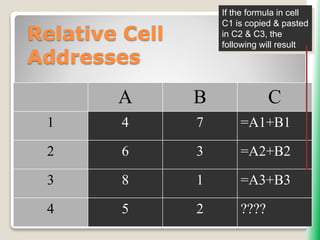
Relative Cell
Addresses
A B C
1 4 7 =A1+B1
2 6 3 =A2+B2
3 8 1 =A3+B3
4 5 2 ????
If the formula in cell
C1 is copied & pasted
in C2 & C3, the
following will result
Objectives
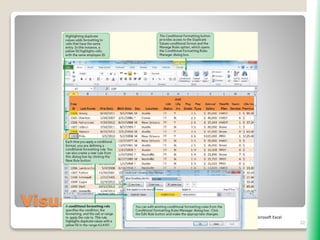
 Use conditional formatting to highlight
duplicate values
 Summarize data using the COUNTIF,
SUMIF, and AVERAGEIF functions
New Perspectives on Microsoft Excel
2010 4
Visual Overview
New Perspectives on Microsoft Excel
2010 5
Working with Logical Functions
 Logical functions (IF, AND, and OR)
determine whether a condition is true or
false
 Conditions use a comparison operator
(<, <=, =, <>, >, or >=) to compare two
values
 Combine two or more functions in one
formula to create more complex
conditions
New Perspectives on Microsoft Excel
2010 6
Inserting Calculated Columns
in an Excel Table
 Entering a formula in one cell of a column
automatically copies the formula to all
cells in that column
 To modify the formula in a calculated
column:
◦ Edit the formula in any cell in the column
◦ Formulas in all cells in the column are modified
 To edit only one cell in a calculated
column:
◦ Enter a value or a formula that is different from
all others in that column
New Perspectives on Microsoft Excel
2010 7
Creating Excel Table Fields
 Create fields that require the least
maintenance
 Store smallest unit of data possible in a
field
 Apply a text format to fields with
numerical text data
New Perspectives on Microsoft Excel
2010 8
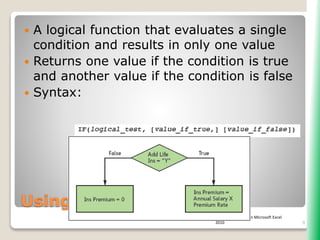
Using the IF Function
 A logical function that evaluates a single
condition and results in only one value
 Returns one value if the condition is true
and another value if the condition is false
 Syntax:
New Perspectives on Microsoft Excel
2010 9
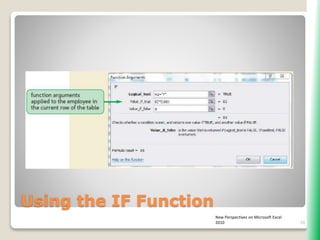
Using the IF Function
New Perspectives on Microsoft Excel
2010 10
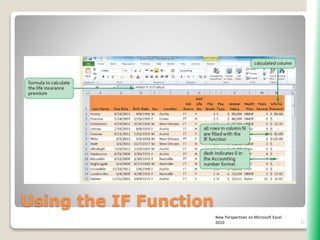
Using the IF Function
New Perspectives on Microsoft Excel
2010 11
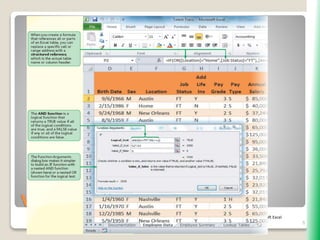
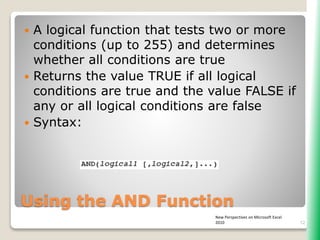
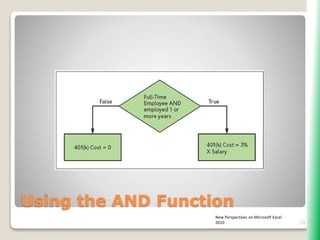
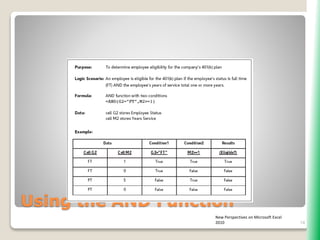
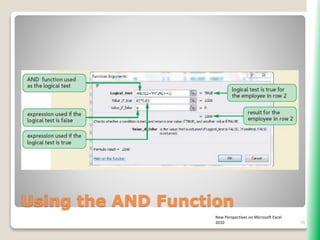
Using the AND Function
 A logical function that tests two or more
conditions (up to 255) and determines
whether all conditions are true
 Returns the value TRUE if all logical
conditions are true and the value FALSE if
any or all logical conditions are false
 Syntax:
New Perspectives on Microsoft Excel
2010 12
Using the AND Function
New Perspectives on Microsoft Excel
2010 13
Using the AND Function
New Perspectives on Microsoft Excel
2010 14
Using the AND Function
New Perspectives on Microsoft Excel
2010 15
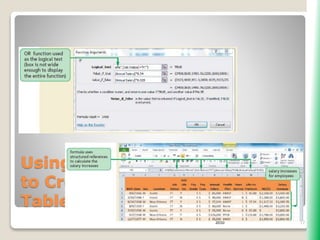
Using Structured References
to Create Formulas in Excel
Tables
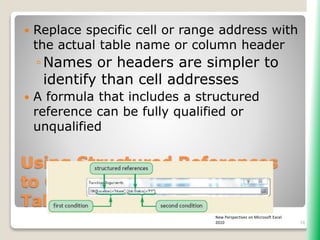
 Replace specific cell or range address with
the actual table name or column header
◦Names or headers are simpler to
identify than cell addresses
 A formula that includes a structured
reference can be fully qualified or
unqualified
New Perspectives on Microsoft Excel
2010 16
Using Structured References
to Create Formulas in Excel
Tables
New Perspectives on Microsoft Excel
2010 17
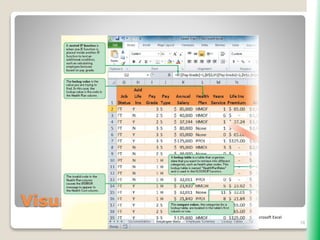
Visual Overview
New Perspectives on Microsoft Excel
2010 18
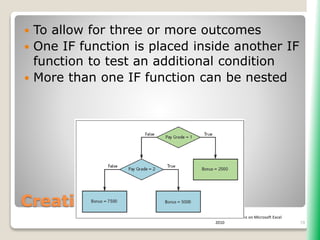
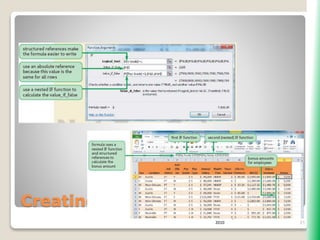
Creating Nested IFs
 To allow for three or more outcomes
 One IF function is placed inside another IF
function to test an additional condition
 More than one IF function can be nested
New Perspectives on Microsoft Excel
2010 19
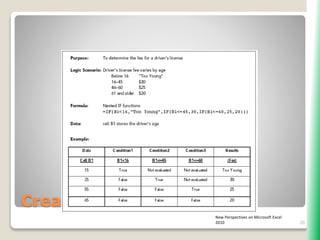
Creating Nested IFs
New Perspectives on Microsoft Excel
2010 20
Creating Nested IFs
New Perspectives on Microsoft Excel
2010 21
Visual Overview
New Perspectives on Microsoft Excel
2010 22
Conditional Formatting
New Perspectives on Microsoft Excel
2010 23
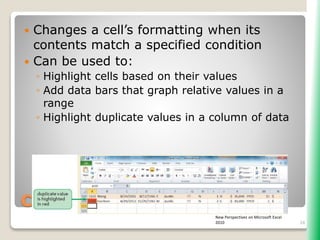
Conditional Formatting
 Changes a cell’s formatting when its
contents match a specified condition
 Can be used to:
◦ Highlight cells based on their values
◦ Add data bars that graph relative values in a
range
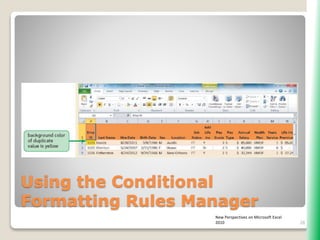
◦ Highlight duplicate values in a column of data
New Perspectives on Microsoft Excel
2010 24
New Perspectives on Microsoft Excel
2010 25
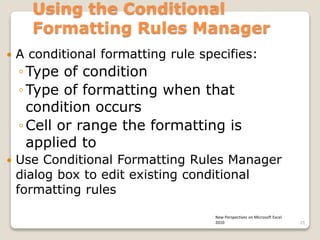
Using the Conditional
Formatting Rules Manager
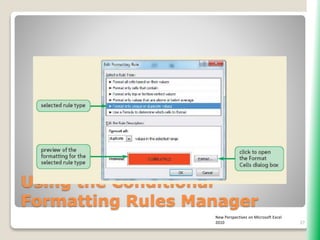
 A conditional formatting rule specifies:
◦Type of condition
◦Type of formatting when that
condition occurs
◦Cell or range the formatting is
applied to
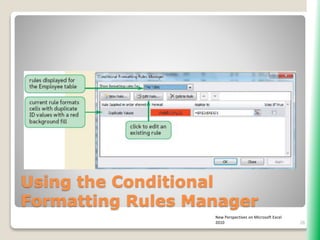
 Use Conditional Formatting Rules Manager
dialog box to edit existing conditional
formatting rules
Using the Conditional
Formatting Rules Manager
New Perspectives on Microsoft Excel
2010 26
Using the Conditional
Formatting Rules Manager
New Perspectives on Microsoft Excel
2010 27
Using the Conditional
Formatting Rules Manager
New Perspectives on Microsoft Excel
2010 28
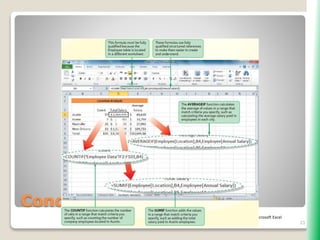
Summarizing Data Conditionally
 Use COUNTIF, SUMIF, and AVERAGEIF
functions to calculate a conditional count,
sum, or average using only cells that
meet a particular condition
New Perspectives on Microsoft Excel
2010 29
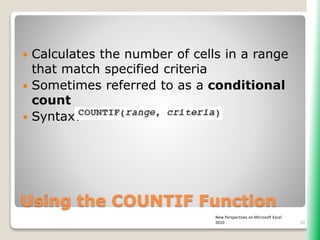
Using the COUNTIF Function
 Calculates the number of cells in a range
that match specified criteria
 Sometimes referred to as a conditional
count
 Syntax:
New Perspectives on Microsoft Excel
2010 30
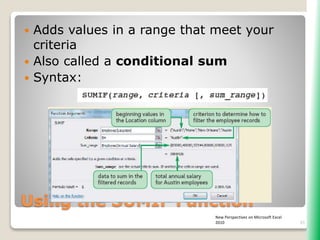
Using the SUMIF Function
 Adds values in a range that meet your
criteria
 Also called a conditional sum
 Syntax:
New Perspectives on Microsoft Excel
2010 31
Using the AVERAGEIF Function
New Perspectives on Microsoft Excel
2010 32

USING ADVANCED FUNCTIONS AND CONITIONAL FORMATTING EXCEL

  • 1.
    Microsoft Excel 2010 ® UsingAdvanced Functions and Conditional Formatting
  • 2.
    Objectives  Use theIF function  Use structured references in formulas  Nest the IF function New Perspectives on Microsoft Excel 2010 2
  • 3.
    Relative Cell Addresses A BC 1 4 7 =A1+B1 2 6 3 =A2+B2 3 8 1 =A3+B3 4 5 2 ???? If the formula in cell C1 is copied & pasted in C2 & C3, the following will result
  • 4.
    Objectives  Use conditionalformatting to highlight duplicate values  Summarize data using the COUNTIF, SUMIF, and AVERAGEIF functions New Perspectives on Microsoft Excel 2010 4
  • 5.
    Visual Overview New Perspectiveson Microsoft Excel 2010 5
  • 6.
    Working with LogicalFunctions  Logical functions (IF, AND, and OR) determine whether a condition is true or false  Conditions use a comparison operator (<, <=, =, <>, >, or >=) to compare two values  Combine two or more functions in one formula to create more complex conditions New Perspectives on Microsoft Excel 2010 6
  • 7.
    Inserting Calculated Columns inan Excel Table  Entering a formula in one cell of a column automatically copies the formula to all cells in that column  To modify the formula in a calculated column: ◦ Edit the formula in any cell in the column ◦ Formulas in all cells in the column are modified  To edit only one cell in a calculated column: ◦ Enter a value or a formula that is different from all others in that column New Perspectives on Microsoft Excel 2010 7
  • 8.
    Creating Excel TableFields  Create fields that require the least maintenance  Store smallest unit of data possible in a field  Apply a text format to fields with numerical text data New Perspectives on Microsoft Excel 2010 8
  • 9.
    Using the IFFunction  A logical function that evaluates a single condition and results in only one value  Returns one value if the condition is true and another value if the condition is false  Syntax: New Perspectives on Microsoft Excel 2010 9
  • 10.
    Using the IFFunction New Perspectives on Microsoft Excel 2010 10
  • 11.
    Using the IFFunction New Perspectives on Microsoft Excel 2010 11
  • 12.
    Using the ANDFunction  A logical function that tests two or more conditions (up to 255) and determines whether all conditions are true  Returns the value TRUE if all logical conditions are true and the value FALSE if any or all logical conditions are false  Syntax: New Perspectives on Microsoft Excel 2010 12
  • 13.
    Using the ANDFunction New Perspectives on Microsoft Excel 2010 13
  • 14.
    Using the ANDFunction New Perspectives on Microsoft Excel 2010 14
  • 15.
    Using the ANDFunction New Perspectives on Microsoft Excel 2010 15
  • 16.
    Using Structured References toCreate Formulas in Excel Tables  Replace specific cell or range address with the actual table name or column header ◦Names or headers are simpler to identify than cell addresses  A formula that includes a structured reference can be fully qualified or unqualified New Perspectives on Microsoft Excel 2010 16
  • 17.
    Using Structured References toCreate Formulas in Excel Tables New Perspectives on Microsoft Excel 2010 17
  • 18.
    Visual Overview New Perspectiveson Microsoft Excel 2010 18
  • 19.
    Creating Nested IFs To allow for three or more outcomes  One IF function is placed inside another IF function to test an additional condition  More than one IF function can be nested New Perspectives on Microsoft Excel 2010 19
  • 20.
    Creating Nested IFs NewPerspectives on Microsoft Excel 2010 20
  • 21.
    Creating Nested IFs NewPerspectives on Microsoft Excel 2010 21
  • 22.
    Visual Overview New Perspectiveson Microsoft Excel 2010 22
  • 23.
    Conditional Formatting New Perspectiveson Microsoft Excel 2010 23
  • 24.
    Conditional Formatting  Changesa cell’s formatting when its contents match a specified condition  Can be used to: ◦ Highlight cells based on their values ◦ Add data bars that graph relative values in a range ◦ Highlight duplicate values in a column of data New Perspectives on Microsoft Excel 2010 24
  • 25.
    New Perspectives onMicrosoft Excel 2010 25 Using the Conditional Formatting Rules Manager  A conditional formatting rule specifies: ◦Type of condition ◦Type of formatting when that condition occurs ◦Cell or range the formatting is applied to  Use Conditional Formatting Rules Manager dialog box to edit existing conditional formatting rules
  • 26.
    Using the Conditional FormattingRules Manager New Perspectives on Microsoft Excel 2010 26
  • 27.
    Using the Conditional FormattingRules Manager New Perspectives on Microsoft Excel 2010 27
  • 28.
    Using the Conditional FormattingRules Manager New Perspectives on Microsoft Excel 2010 28
  • 29.
    Summarizing Data Conditionally Use COUNTIF, SUMIF, and AVERAGEIF functions to calculate a conditional count, sum, or average using only cells that meet a particular condition New Perspectives on Microsoft Excel 2010 29
  • 30.
    Using the COUNTIFFunction  Calculates the number of cells in a range that match specified criteria  Sometimes referred to as a conditional count  Syntax: New Perspectives on Microsoft Excel 2010 30
  • 31.
    Using the SUMIFFunction  Adds values in a range that meet your criteria  Also called a conditional sum  Syntax: New Perspectives on Microsoft Excel 2010 31
  • 32.
    Using the AVERAGEIFFunction New Perspectives on Microsoft Excel 2010 32