
KPMG GLOBAL ENERGY INSTITUTE
Floating LNG:
Revolution and
evolution for the
global industry?
kpmg.com/energy
KPMG INTERNATIONAL
LNG report series
Overview 02
Introduction 03
The voyage to FLNG 04
FLNG emerges 05
Global context of floating LNG 06
Ten reasons companies choose FLNG 07
Key considerations and risks for FLNG developers 10
Conclusion 17
What are the key actions for FLNG proponents? 18
KPMG Global LNG Advisory Competitive Advantage19
Further LNG Insights20
KPMG Global Energy Centers21
Contents
Cover image: Photographic Services, Shell International Ltd.
© 2014 KPMG International Cooperative (“KPMG International”). KPMG International provides no client services and is a Swiss entity with which the independent member firms of the KPMG network are affiliated.
This report is intended to provide an overview of the
developments that the liquefied natural gas (LNG)
industry is facing during its unprecedented wave
of expansion. Security of energy supply has always
been one of the critical issues many countries face.
Unlocking potential reserves economically and
rapidly is essential to deliver energy security and can
potentially affect trade flows profoundly. Floating LNG
is an emerging technology for such fast and cost-
effective development of new gas resources.
This is the second in a series of LNG reports that
will provide deeper insights on specific elements
of governance, jurisdiction, stakeholders and
opportunity.
Overview
Hilda Mulock Houwer
Partner and Global Advisory Leader
Energy  Natural Resources
KPMG in Qatar
With 22 years of consulting and auditing experience in the
oil and gas, energy and mining industries, Hilda Mulock
Houwer has provided advisory services across the
entire oil and gas value chain from strategy development
to strategy implementation. Hilda has experience
in operational excellence, process transformation,
procurement, change management and financial process
redesign.
2Floating LNG: Revolution and evolution for the global industry?
© 2014 KPMG International Cooperative (“KPMG International”). KPMG International provides no client services and is a Swiss entity with which the independent member firms of the KPMG network are affiliated.
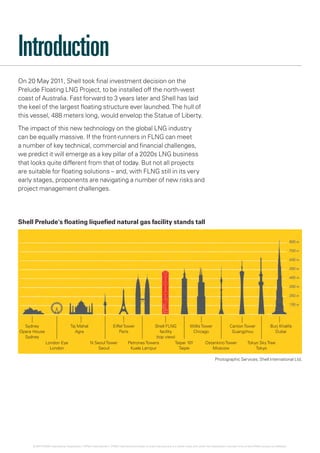
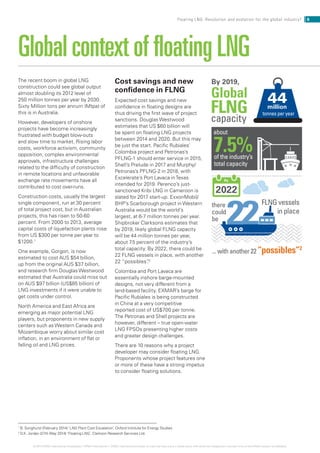
On 20 May 2011, Shell took final investment decision on the
Prelude Floating LNG Project, to be installed off the north-west
coast of Australia. Fast forward to 3 years later and Shell has laid
the keel of the largest floating structure ever launched.The hull of
this vessel, 488 meters long, would envelop the Statue of Liberty.
The impact of this new technology on the global LNG industry
can be equally massive. If the front-runners in FLNG can meet
a number of key technical, commercial and financial challenges,
we predict it will emerge as a key pillar of a 2020s LNG business
that looks quite different from that of today. But not all projects
are suitable for floating solutions – and, with FLNG still in its very
early stages, proponents are navigating a number of new risks and
project management challenges.
Introduction
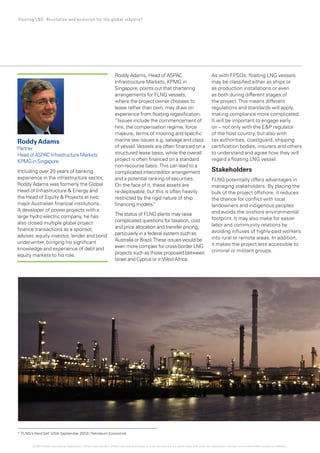
Shell Prelude's floating liquefied natural gas facility stands tall
Photographic Services, Shell International Ltd.
Sydney
Opera House
Sydney
London Eye
London
Taj Mahal
Agra
N Seoul Tower
Seoul
Taipei 101
Taipei
Ostankino Tower
Moscow
Tokyo Sky Tree
Tokyo
Eiffel Tower
Paris
Shell FLNG
facility
(top view)
Willis Tower
Chicago
Canton Tower
Guangzhou
Burj Khalifa
Dubai
Petronas Towers
Kuala Lampur
3
© 2014 KPMG International Cooperative (“KPMG International”). KPMG International provides no client services and is a Swiss entity with which the independent member firms of the KPMG network are affiliated.
It has been a long voyage for FLNG.
Research began in the 1970s.The initial
detailed designs were made in the early
1990s with associated efforts to start
an FLNG project around the turn of
the millennium, but the emergence of
Qatar as a dominant exporter and falling
costs for giant onshore liquefaction
trains halted progress.Today, growing
demand, high prices, environmental and
community challenges and steep costs
for the infrastructure of land-based
projects, have led several leading LNG
players – includingWoodside, Shell,
Petronas, ExxonMobil and Inpex – to
take another look.
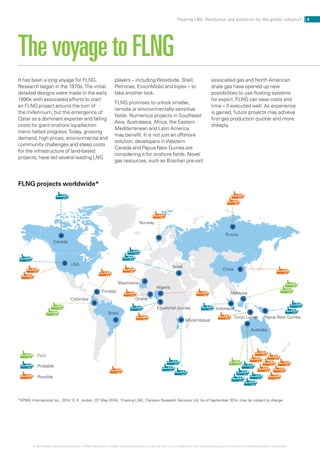
FLNG promises to unlock smaller,
remote or environmentally-sensitive
fields. Numerous projects in Southeast
Asia, Australasia, Africa, the Eastern
Mediterranean and Latin America
may benefit. It is not just an offshore
solution; developers inWestern
Canada and Papua New Guinea are
considering it for onshore fields. Novel
gas resources, such as Brazilian pre-salt
associated gas and North American
shale gas have opened up new
possibilities to use floating systems
for export. FLNG can save costs and
time – if executed well. As experience
is gained, future projects may achieve
first gas production quicker and more
cheaply.
The voyage to FLNG
Firm
Probable
Possible
Israel
Canada
USA
Equatorial Guinea
Colombia
Mozambique
Malaysia
Indonesia
Australia
Papua New Guinea
Trinidad
China
Ghana
Timor Leste
Nigeria
Russia
Mauritania
Brazil
Norway
FLNG projects worldwide*
*KPMG International Inc., 2014; D. K. Jordan, (27 May 2014), ‘Floating LNG’, Clarkson Research Services Ltd. As of September 2014; may be subject to change.
4Floating LNG: Revolution and evolution for the global industry?
© 2014 KPMG International Cooperative (“KPMG International”). KPMG International provides no client services and is a Swiss entity with which the independent member firms of the KPMG network are affiliated.
There are two scenarios for the future
development of floating LNG. It may
become a niche technology that is
applied by a few companies to solve
specific problems, with land-based
configurations remaining the default.
This could happen if the first FLNG
plants encounter cost or operational
difficulties or if land-based costs fall
as the current construction boom
ebbs. For smaller offshore gas fields,
compressed natural gas or small-scale
gas-to-liquids may become viable
competitors.
However, in the second scenario, if the
first few projects are successful, FLNG
can emerge as a standard approach
that eases the industry’s problems with
cost inflation and opens it up to a much
wider range of fields and companies.
The concurrent development of
floating regasification giving access
to a range of smaller markets, and the
development of new pricing methods
and unconventional gas-to-LNG
projects, may lead towards a faster-
moving, more diverse – and more
flexible global LNG industry.
In a 2 September 2014 interview with
Bruce Steenson, General Manager
of Integrated Gas Programs and
Innovation for Shell International
Exploration and Production B.V., he
compares the prospects for FLNG
to floating production, storage and
offloading vessels (FPSOs). “From the
first oil FPSO in 1977, over a period of
1977 to 2000, 50 FPSOs were slowly
installed.  Between 2000 and 2010,
came another 100.“
Is FLNG, in short, a refinement
or a transformation? Why should
companies choose FLNG over a land-
based plant? And, what is required to
make an FLNG project successful?
FLNG emerges
Bruce Steenson
General Manager of Integrated
Gas Programs and Innovation
Shell International Exploration and
Production B.V.
Bruce has spent more than 30 years
working for Shell on development
projects in the Middle East, Central Asia,
Europe, South America and Australia
in roles spanning well engineering,
production technology, process
engineering and development project
management. He is currently Managing
Shell’s LNG Programs and Innovation in
their Integrated Gas business.
FloatingLNGandthe
developmentofnew
pricingmethodsand
unconventionalgas-to-LNG
projects,mayleadtowards
afaster-moving,more
diverse–andmoreflexible
globalLNGindustry.
5 Floating LNG: Revolution and evolution for the global industry?
© 2014 KPMG International Cooperative (“KPMG International”). KPMG International provides no client services and is a Swiss entity with which the independent member firms of the KPMG network are affiliated.
The recent boom in global LNG
construction could see global output
almost doubling its 2012 level of
250 million tonnes per year by 2030.
Sixty Million tons per annum (Mtpa) of
this is in Australia.
However, developers of onshore
projects have become increasingly
frustrated with budget blow-outs
and slow time to market. Rising labor
costs, workforce activism, community
opposition, complex environmental
approvals, infrastructure challenges
related to the difficulty of construction
in remote locations and unfavorable
exchange rate movements have all
contributed to cost over-runs.
Construction costs, usually the largest
single component, run at 30 percent
of total project cost, but in Australian
projects, this has risen to 50-60
percent. From 2000 to 2013, average
capital costs of liquefaction plants rose
from US $300 per tonne per year to
$1200.1
One example, Gorgon, is now
estimated to cost AUS $54 billion,
up from the original AUS $37 billion,
and research firm Douglas Westwood
estimated that Australia could miss out
on AUS $97 billion (US$85 billion) of
LNG investments if it were unable to
get costs under control.
North America and East Africa are
emerging as major potential LNG
players, but proponents in new supply
centers such as Western Canada and
Mozambique worry about similar cost
inflation, in an environment of flat or
falling oil and LNG prices.
Global context of floating LNG
1
B. Songhurst (February 2014) ‘LNG Plant Cost Escalation’, Oxford Institute for Energy Studies
2
D.K. Jordan (27th May 2014) ‘Floating LNG’, Clarkson Research Services Ltd.
Cost savings and new
confidence in FLNG
Expected cost savings and new
confidence in floating designs are
thus driving the first wave of project
sanctions. Douglas Westwood
estimates that US $60 billion will
be spent on floating LNG projects
between 2014 and 2020. But this may
be just the start. Pacific Rubiales’
Colombia project and Petronas’s
PFLNG-1 should enter service in 2015,
Shell’s Prelude in 2017 and Murphy/
Petronas’s PFLNG-2 in 2018, with
Excelerate’s Port Lavaca inTexas
intended for 2019. Perenco’s just-
sanctioned Kribi LNG in Cameroon is
slated for 2017 start-up. ExxonMobil/
BHP’s Scarborough project in Western
Australia would be the world’s
largest, at 6-7 million tonnes per year.
Shipbroker Clarksons estimates that
by 2019, likely global FLNG capacity
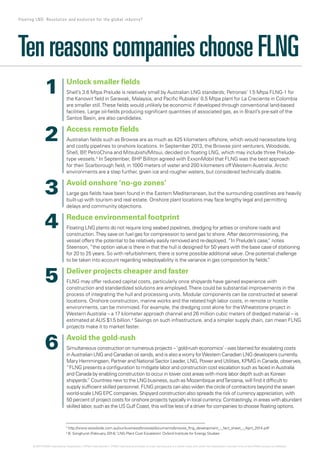
will be 44 million tonnes per year,
about 7.5 percent of the industry’s
total capacity. By 2022, there could be
22 FLNG vessels in place, with another
22 “possibles”.2
Colombia and Port Lavaca are
essentially inshore barge-mounted
designs, not very different from a
land-based facility. EXMAR’s barge for
Pacific Rubiales is being constructed
in China at a very competitive
reported cost of US$700 per tonne.
The Petronas and Shell projects are
however, different – true open-water
LNG FPSOs presenting higher costs
and greater design challenges.
There are 10 reasons why a project
developer may consider floating LNG.
Proponents whose project features one
or more of these have a strong impetus
to consider floating solutions.
6Floating LNG: Revolution and evolution for the global industry?
© 2014 KPMG International Cooperative (“KPMG International”). KPMG International provides no client services and is a Swiss entity with which the independent member firms of the KPMG network are affiliated.
there
could
be
capacity
about
7.5%of the industry’s
total capacity
44million
tonnes per year
2022
By 2019,
By
... with another 22 “possibles”2
FLNG vessels
in place
FLNG
Global
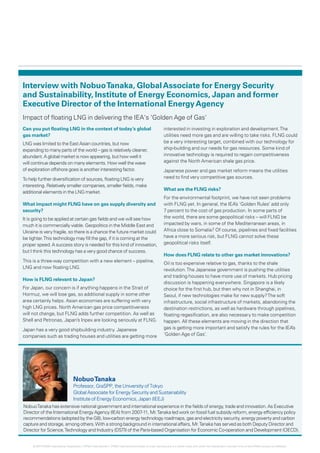
TenreasonscompanieschooseFLNG
Unlock smaller fields
Shell’s 3.6 Mtpa Prelude is relatively small by Australian LNG standards; Petronas’ 1.5 Mtpa FLNG-1 for
the Kanowit field in Sarawak, Malaysia, and Pacific Rubiales’ 0.5 Mtpa plant for La Creciente in Colombia
are smaller still.These fields would unlikely be economic if developed through conventional land-based
facilities. Large oil-fields producing significant quantities of associated gas, as in Brazil’s pre-salt of the
Santos Basin, are also candidates.
Access remote fields
Australian fields such as Browse are as much as 425 kilometers offshore, which would necessitate long
and costly pipelines to onshore locations. In September 2013, the Browse joint venturers,Woodside,
Shell, BP, PetroChina and Mitsubishi/Mitsui, decided on floating LNG, which may include three Prelude-
type vessels.3
In September, BHP Billiton agreed with ExxonMobil that FLNG was the best approach
for their Scarborough field, in 1000 meters of water and 200 kilometers offWestern Australia. Arctic
environments are a step further, given ice and rougher waters, but considered technically doable.
Avoid onshore ‘no-go zones’
Large gas fields have been found in the Eastern Mediterranean, but the surrounding coastlines are heavily
built-up with tourism and real estate. Onshore plant locations may face lengthy legal and permitting
delays and community objections.
Reduce environmental footprint
Floating LNG plants do not require long seabed pipelines, dredging for jetties or onshore roads and
construction.They save on fuel gas for compression to send gas to shore. After decommissioning, the
vessel offers the potential to be relatively easily removed and re-deployed. “In Prelude’s case,” notes
Steenson, “the option value is there in that the hull is designed for 50 years with the base case of stationing
for 20 to 25 years. So with refurbishment, there is some possible additional value. One potential challenge
to be taken into account regarding redeployability is the variance in gas composition by fields.”
Deliver projects cheaper and faster
FLNG may offer reduced capital costs, particularly once shipyards have gained experience with
construction and standardized solutions are employed.There could be substantial improvements in the
process of integrating the hull and processing units. Modular components can be constructed at several
locations. Onshore construction, marine works and the related high labor costs, in remote or hostile
environments, can be minimized. For example, the dredging cost alone for theWheatstone project in
Western Australia – a 17 kilometer approach channel and 26 million cubic meters of dredged material – is
estimated at AUS $1.5 billion.4
Savings on such infrastructure, and a simpler supply chain, can mean FLNG
projects make it to market faster.
Avoid the gold-rush
Simultaneous construction on numerous projects – ‘gold-rush economics’ - was blamed for escalating costs
in Australian LNG and Canadian oil sands, and is also a worry forWestern Canadian LNG developers currently.
Mary Hemmingsen, Partner and National Sector Leader, LNG, Power and Utilities, KPMG in Canada, observes,
“FLNG presents a configuration to mitigate labor and construction cost escalation such as faced in Australia
and Canada by enabling construction to occur in lower cost areas with more labor depth such as Korean
shipyards.” Countries new to the LNG business, such as Mozambique andTanzania, will find it difficult to
supply sufficient skilled personnel. FLNG projects can also widen the circle of contractors beyond the seven
world-scale LNG EPC companies. Shipyard construction also spreads the risk of currency appreciation, with
50 percent of project costs for onshore projects typically in local currency. Contrastingly, in areas with abundant
skilled labor, such as the US Gulf Coast, this will be less of a driver for companies to choose floating options.
3
http://www.woodside.com.au/our-business/browse/documents/browse_flng_development_-_fact_sheet_-_April_2014.pdf
4
B. Songhurst (February 2014) ‘LNG Plant Cost Escalation’ Oxford Institute for Energy Studies
1
2
3
4
5
6
7 Floating LNG: Revolution and evolution for the global industry?
© 2014 KPMG International Cooperative (“KPMG International”). KPMG International provides no client services and is a Swiss entity with which the independent member firms of the KPMG network are affiliated.
Put projects in a safe pair of hands
“If you look at LNG around the world, the logistics of getting a
skilled workforce to the site and keeping them there can be hugely
challenging and costly, notes Steenson. ”You don’t have that issue
with a floating facility built in a yard. For example at Asian ship yards,
25,000 to 35,000 people are coming into the yard daily. So all of
that logistics and infrastructure are already set up with productivity
being more predictable and safety performance established.”Several
shipyards have related capabilities in constructing oil FPSOs and LNG
tankers.The “design one, build many” philosophy may be applied
by shipyards that can develop a high level of expertise in FLNG.
The Prelude design is designed for rich gas, but features modules
that could be added or removed to suit other gas compositions and
increase liquefaction output. Other concepts than LNG FPSOs are
also being considered – semi-submersibles and spars.
Achieve peace of mind from security
worries
Certain areas of LNG development, such asWest Africa and the
Eastern Mediterranean, have security concerns. Onshore fields and
pipelines have frequently come under attack in parts ofWest Africa
and the Middle East in recent years. Placing the facility offshore
makes it less accessible to would-be attackers or saboteurs and
can be supplemented with other defensive measures such as
remote monitoring and barriers to make it difficult to scale the
vessel.That said, piracy is a known risk and still requires safety
precautions, including international cooperation in the case of the
Eastern Mediterranean.
Mitigate political risk5
Onshore LNG plants represent a huge sunk investment, making the
project developer vulnerable to a change of mind from the political
authorities – which can include tax increases, nationalization
or outright expropriation. In an extreme case, in which a host
government seeks to expropriate an asset, or in which security
conditions become intolerable, the FLNG plant can be sailed away,
saving at least some of the project’s value, and perhaps redeployed
elsewhere.This option is unlikely ever to be used, but its existence
does improve the owner’s bargaining position.
Access other financing options
Financing of floating LNG projects is still in its infancy and will require
greater experience from lending banks.With more corporations
seeking to enter the LNG game, previously the near-exclusive
preserve of the majors, innovative financing choices are becoming
more important. Smaller companies, in particular, may benefit from
other financing opportunities such as leasing the LNG vessel, taking
advantage of tax incentives or accessing concessionary or export
financing for shipping.The greater security offshore may make it
easier to access financing for more risky host countries.
Mary Hemmingsen
Partner, National Sector Leader, LNG,
Power and Utilities
KPMG in Canada
Mary Hemmingsen brings over 20 years
of experience as a North American
energy business leader in asset
management and related business
development.This includes leadership in
the development and delivery of policy,
strategy and initiatives for energy,
power, utilities and related infrastructure
businesses in a range of capacities in
both the public and private sector and
for major utilities and global energy and
asset managers.
7
8
9
10
5
See, for instance, ‘No paper chase:Transforming risk management at energy and natural resources companies’, KPMG (2014)
8Floating LNG: Revolution and evolution for the global industry?
© 2014 KPMG International Cooperative (“KPMG International”). KPMG International provides no client services and is a Swiss entity with which the independent member firms of the KPMG network are affiliated.
Interview with NobuoTanaka, GlobalAssociate for Energy Security
and Sustainability, Institute of Energy Economics, Japan and former
Executive Director of the International EnergyAgency
Impact of floating LNG in delivering the IEA's 'Golden Age of Gas'
Can you put floating LNG in the context of today’s global
gas market?
LNG was limited to the EastAsian countries, but now
expanding to many parts of the world – gas is relatively cleaner,
abundant.A global market is now appearing, but how well it
will continue depends on many elements. How well the wave
of exploration offshore goes is another interesting factor.
To help further diversification of sources, floating LNG is very
interesting. Relatively smaller companies, smaller fields, make
additional elements in the LNG market.
What impact might FLNG have on gas supply diversity and
security?
It is going to be applied at certain gas fields and we will see how
much it is commercially viable. Geopolitics in the Middle East and
Ukraine is very fragile, so there is a chance the future market could
be tighter.This technology may fill the gap, if it is coming at the
proper speed. A success story is needed for this kind of innovation,
but I think this technology has a very good chance of success.
This is a three-way competition with a new element – pipeline,
LNG and now floating LNG.
How is FLNG relevant to Japan?
For Japan, our concern is if anything happens in the Strait of
Hormuz, we will lose gas, so additional supply in some other
area certainly helps. Asian economies are suffering with very
high LNG prices. North American gas price competitiveness
will not change, but FLNG adds further competition. As well as
Shell and Petronas, Japan’s Inpex are looking seriously at FLNG.
Japan has a very good shipbuilding industry. Japanese
companies such as trading houses and utilities are getting more
interested in investing in exploration and development.The
utilities need more gas and are willing to take risks. FLNG could
be a very interesting target, combined with our technology for
ship-building and our needs for gas resources. Some kind of
innovative technology is required to regain competitiveness
against the North American shale gas price.
Japanese power and gas market reform means the utilities
need to find very competitive gas sources.
What are the FLNG risks?
For the environmental footprint, we have not seen problems
with FLNG yet. In general, the IEA’s ‘Golden Rules’ add only
7 percent to the cost of gas production. In some parts of
the world, there are some geopolitical risks – will FLNG be
impacted by wars, in some of the Mediterranean areas, in
Africa close to Somalia? Of course, pipelines and fixed facilities
have a more serious risk, but FLNG cannot solve these
geopolitical risks itself.
How does FLNG relate to other gas market innovations?
Oil is too expensive relative to gas, thanks to the shale
revolution.The Japanese government is pushing the utilities
and trading houses to have more use of markets. Hub pricing
discussion is happening everywhere. Singapore is a likely
choice for the first hub, but then why not in Shanghai, in
Seoul, if new technologies make for new supply?The soft
infrastructure, social infrastructure of markets, abandoning the
destination restrictions, as well as hardware through pipelines,
floating regasification, are also necessary to make competition
happen. All these elements are moving in the direction that
gas is getting more important and satisfy the rules for the IEA’s
‘Golden Age of Gas’.
NobuoTanaka
Professor, GraSPP, the University of Tokyo
GlobalAssociate for Energy Security and Sustainability
Institute of Energy Economics, Japan (IEEJ)
NobuoTanaka has extensive national government and international experience in the fields of energy, trade and innovation.As Executive
Director of the International EnergyAgency (IEA) from 2007-11, Mr.Tanaka led work on fossil fuel subsidy reform, energy efficiency policy
recommendations (adopted by the G8), low-carbon energy technology roadmaps, gas and electricity security, energy poverty and carbon
capture and storage, among others.With a strong background in international affairs, Mr.Tanaka has served as both Deputy Director and
Director for Science,Technology and Industry (DSTI) of the Paris-based Organisation for Economic Co-operation and Development (OECD).
9
© 2014 KPMG International Cooperative (“KPMG International”). KPMG International provides no client services and is a Swiss entity with which the independent member firms of the KPMG network are affiliated.
Keyconsiderationsandrisksfor
FLNGdevelopers
Proponents of floating projects have to
consider what they need to get right,
and which risks they have to manage.
Most of the elements for a successful
FLNG project are likely to be the
same as for a conventional onshore
LNG development. As the first FLNG
projects are still in the construction
phase, we are only at the early stages
of identifying key success factors and
lessons learned. It is vital to track initial
indications and determine analogies
with other projects, such as FPSOs, to
ensure the first wave of FLNG projects
are delivered as effectively as possible.
Failure in one of the early projects could
deter new developers, worry financiers
and host governments and set the
technology back years.
Mina Sekiguchi
Managing Director, Head of Energy 
Infrastructure, KPMG in Japan
and Head of Energy  Natural Resources
KPMG inAsia Pacific
As head of KPMG in Japan’s Energy
 Infrastructure sector and the Head
of KPMG in Asia Pacific’s Energy
 Natural Resources sector, Mina
Sekiguchi focuses on advising power
and utilities, oil and gas, Japanese
major trading companies and large
power machinery manufacturers.With
7 years of corporate finance advisory
experience, Mina provided MA
advisory services to major Japanese
clients, including multiple cross-border
MA transactions.
10Floating LNG: Revolution and evolution for the global industry?
© 2014 KPMG International Cooperative (“KPMG International”). KPMG International provides no client services and is a Swiss entity with which the independent member firms of the KPMG network are affiliated.
Technology
Floating liquefaction is a relatively
new technology, compared to floating
regasification which has quickly
established itself as a standard
approach. Managing shipyard
construction of FPSOs is now routine
for oil and gas companies. Floating
liquefaction should not present any
excessive technical challenges.
However, it does require a specialized
LNG containment system to prevent
sloshing; topsides modules including
gas pre-treatment and liquefaction;
and safe systems for offloading
cryogenic liquid in potentially difficult
sea conditions, including the possible
development of flexible hoses. New
risk registers will need to be built and
analyzed. Cyber security issues on a
new type of offshore facility should
be considered. Production processes
have to be kept away from living
quarters – sharing experiences from
onshore LNG plants in confined sites
such as British Columbia. Weather
conditions will have to be factored into
installation and operational schedules.
Maintenance schedules are also
different from onshore, due to the
limited number of accommodation
spaces on-board – Shell’s plan
for Prelude includes increased
routine maintenance during normal
operations.6
Cost and project
management
Cost reduction is one of the key
reasons to choose floating LNG.
Standardization is important as a way
to save costs, but systems cannot be
perfectly standard, which may limit
the redeployment of vessels. For
example, Australian facilities will have
6
J. Marshall and I. Grose (May 2014) ‘Shell Australia – preparing to operate Prelude FLNG’ Australian Petroleum Production  Exploration
Association conference
7
M. Haney, M. Loffman and S. Robertson (5th February 2014) ‘FPSO industry must re-think supply chain’ Offshore Magazine,Volume 74, Issue 2.
The Japanese angle
As the world’s largest LNG market,
and one of the leading ship-builders,
Japan has a particular interest in
FLNG. Following the 2011 Fukushima
Daiichi nuclear disaster and the
shut-down of its nuclear fleet, LNG
imports increased by 25 percent and
“Japan is currently wasting USD
$40 billion a year for extra purchases
of gas and oil for thermal power”,
as NobuoTanaka notes [KPMG –
Nuclear Power: Its role in shaping
energy policies in Asia Pacific].
Japan is acutely aware of its
dependence on oil and LNG shipped
through the Straits of Hormuz and
Malacca, and on threats to global gas
supplies from crises such as in the
Ukraine. Additionally, its utilities are
coming under increasing pressure to
reduce the costs of electricity to their
customers.
With nearly half of proposed FLNG
projects in Asia-Pacific, including
Japanese giant Inpex’s Abadi in
Indonesia, Japan is a likely major
customer for FLNG.The country
hopes that a more diverse supply,
coming to market faster, will drive
down prices and increase security.
FLNG is one component of a broader
strategy emphasizing the introduction
of new price benchmarks based on
US gas prices and traded Asian hubs,
and accessing Russian pipeline gas
and North American exports fed by
shale gas.
Japanese companies are well-placed
to develop FLNG alliances between
upstream, utilities, shipbuilding
and Engineering, Procurement and
Construction (EPC) companies, a
model that may apply to South Korea
and China too.
to be cyclone-resistant. Prelude can
withstand a category 5 cyclone – while
this is not needed in East Africa.
Costs may fall significantly with
experience. However, using floating
systems is not a panacea. A recent
study7
pointed out that companies
were struggling to deliver FPSO
vessels on time and budget: nine
examples studied had on average
38 percent cost-overruns and were
16 months late. FLNG vessels will have
to avoid such pitfalls.
Requirements for helping to mitigate
such risks are:
•	 	Allow	sufficient	time	on	front-end	
engineering; consider options and
uncertainties carefully.
•	 	Do	not	over-engineer	the	detailed	
design phase.
•	 	Pursue	standardization,	not	one-off	
designs.
11 Floating LNG: Revolution and evolution for the global industry?
•	 Issue tenders with achievable,
realistic and action-based
deadlines.
•	 Give careful consideration to
integration of hull and topsides.
•	 If local content requirements require
the use of inexperienced shipyards,
then ensure this is accounted for
in time and cost planning, and that
attention is given to helping these
shipyards improve their skills and
quality control.
•	 Avoid conflicts of interest between
different suppliers who may
variously be seeking to reduce
costs, keep on schedule or maximize
scope and variation orders.
•	 Ensure sufficient construction slots
at the shipyard are available and that
the project is viewed by the shipyard
as a top priority.
•	 Commission sufficient FLNG
projects in a short period, for yards
to generate and retain experience.
If only a few projects are being built
with gaps between, consider how
knowledge from previous jobs can
be retained.
•	 For operators, do not try to put too
much of the financial and risk burden
on contractors.
Supply chain management may be
simpler than for onshore projects, but
still requires integrating work from
many different locations: for Prelude,
the hull is built in South Korea, the
turret in Dubai, subsea systems in
Malaysia, control systems in Singapore
and onshore bases in Broome and
Darwin, Australia. KBR believes
that, “Key factors for success will
include proper front end loading and
successful interface management
between traditional LNG and marine
disciplines.”8
Even if capital costs can be lower than
traditional projects, EmmaWild, Head of
Upstream Advisory Practice, KPMG in
the UK, notes that“Operating costs may
be higher and there may be increased
operational challenges offshore, such as
lower uptime. Floating projects may also
miss out on synergies available where
several projects share common utilities
and marine works, as in Qatar, the US Gulf
Coast import terminal conversions and
possibly Mozambique.” Floating projects
will also miss out on the advantageous
brownfield economics that expansions of
land-based plants enjoy.
12Floating LNG: Revolution and evolution for the global industry?
© 2014 KPMG International Cooperative (“KPMG International”). KPMG International provides no client services and is a Swiss entity with which the independent member firms of the KPMG network are affiliated.
8
N.White (2nd July 2013) ‘Drivers, Challenges and Solutions for FLNG’ KBR presentation to IE Australia Perth Oil  Gas Facilities Group
Interview with Kimiho Sakurai, Section 5 Leader, Business Development
Unit 2, Chiyoda Corporation
As an EPC contractor, what are some of the key issues for project management in FLNG?
Project management itself is essentially the same with
other onshore projects, but we need to call in specialists
for offshore, vessel construction, etc., and to evaluate
metocean conditions (tides, waves, hurricanes) that impact
design. Further, project execution plan after sail away of
FLNG also needs to be considered in extra. LNG design,
compared with onshore, would be basically the same, but
since the space is limited on board, we need to achieve
a cost effective compact design and safety for on board
personnel at the same time.
For megaprojects, we form a consortium with shipyards
and bring them to the first layer of contractors, to share
risk and motivate them to be efficient. Some aspects are
different from their traditional work, for example, the need
for cryogenic pipes. We are already working with shipyards
to solve these issues – they see FLNG as a big opportunity.
There are also many interfaces to manage. For an onshore
project, Chiyoda can totally manage the EPC, but for FLNG,
turret suppliers, shipbuilders and subsea can be key players.
Chiyoda has an alliance with Xodus, a specialist for offshore
upstream and is now targeting FLNG subsea portion such
as risers and offshore production, which are also a very
significant amount of the project.
We have been successful in collaborating with clients
and investors from the very initial stage of the projects
and willing to continuously provide our LNG and project
management professionalism in order to realize EPCI in
the future with us. Since there is no FLNG in commercial
operation yet, we form “one team” with the client to
improve the development plan and design by mitigating
risks of any kind and providing cost reduction at the
same time. Our mission is to ensure the FLNG operates
successfully and we always consider “what is the best
for the project”.We wish to expand our Reliability No. 1
contractor to FLNG business, as well as we created for
onshore LNG.
Kimiho Sakurai
Section 5 Leader, Business Development Unit 2
Chiyoda Corporation
Mr. Sakurai is responsible for Business Development of FLNG / Floater worldwide, hydrocarbon business
development over the Middle East, Russia, CIS, Europe, Oceania, and LatinAmerica regions. In previous
roles, he was Director of Chiyoda International Indonesia, responsible for overall corporate activities of
Chiyoda subsidiary in Indonesia, cum General Manager, Regional Business Development, South EastAsia and
responsible for business development activities across South EastAsia.
EmmaWild
Head of UpstreamAdvisory Practice
KPMG in the UK
EmmaWild is an upstream specialist with a background and education in both chemical
and reservoir engineering.With 20 years of international experience in the oil and gas
sector and financial services, her primary focus is on transactions, corporate finance
valuations, debt advisory and strategy. Prior to KPMG, she acted asTechnical Advisor for
a large UK financial services institution and holds various senior reservoir engineering
and business development/new ventures roles globally.
13 Floating LNG: Revolution and evolution for the global industry?
© 2014 KPMG International Cooperative (“KPMG International”). KPMG International provides no client services and is a Swiss entity with which the independent member firms of the KPMG network are affiliated.
Potential FLNG developers
will be closely watching
the first few projects.
If these go smoothly,
with no serious budget
over-runs, delays or
technical problems, other
companies will gain
confidence.
With more than 500 large crude oil
tankers, FPSOs and LNG tankers in
service, construction of a few FLNG
vessels should not tax shipyard
capacity, but some may be expanded
and retooled to specialize in such
projects. LNG proponents, especially
supermajors, may benefit from building
a portfolio of FLNG projects. Alliances
between EP companies, EPC
contractors and shipyards can develop
the ship-builders’ capabilities for these
vessels and maximize the benefits
from learning and standardization.
EP companies, however that have
advocated FLNG for a long time, such
as Shell and Petronas, will also need to
protect their intellectual property and
competitive edge. Shell has worked on
Prelude with a consortium ofTechnip
and Samsung as long-term technology
partners.
Potential FLNG developers will be
closely watching the first few projects.
If these go smoothly, with no serious
budget over-runs, delays or technical
problems, other companies will
gain confidence.This is particularly
important for smaller companies, which
could not absorb the costs and risks of
an unsuccessful development.
Financing, legal, tax and
regulation
Shell will own the Prelude facility,
but other companies are looking at
leasing, withTeekay, SBM Offshore
and BW Offshore interested in
constructing FLNG ships for lease,
as with ordinary FPSOs. Leased
ships may be smaller, 2-3 million
tonnes per year rather than Prelude’s
3.6 Mtpa, and use simpler liquefaction
technology.This widens the circle of
potential developers.
Project finance will also only be readily
available once FLNG has proved its
viability. As Jonathan Smith, Partner,
Energy and Natural Resources and Oil
and Gas Sector Leader, KPMG Australia
notes however, “with Prelude costing
an estimated AUS $12 billion, FLNG
projects will still largely be the domain
of supermajors.” Companies will need
to work closely with finance providers
to understand what they need to see
to establish the technical reliability and
bankability of their project and reduce
the risk premium attached to project
lending and EPC contracts.
Jonathan E. Smith
Partner, Energy and Natural Resources
Oil and Gas Sector Leader
KPMG Australia
Jonathan Smith brings over 25 years
of experience in systems and process
improvement. He specializes in assisting
finance leaders in capital intensive
industries on performance improvement
of finance operations through CFO
advisory, financial transformation and cost
optimization/transparency. Jonathan has
published on the role of the CFO in the
development of corporate strategy, cost
optimization and developing a cost culture
in LNG/CSG projects.
14Floating LNG: Revolution and evolution for the global industry?
© 2014 KPMG International Cooperative (“KPMG International”). KPMG International provides no client services and is a Swiss entity with which the independent member firms of the KPMG network are affiliated.
Roddy Adams, Head of ASPAC
Infrastructure Markets, KPMG in
Singapore, points out that chartering
arrangements for FLNG vessels,
where the project owner chooses to
lease rather than own, may draw on
experience from floating regasification.
“Issues include the commencement of
hire, the compensation regime, force
majeure, terms of mooring and specific
marine law issues e.g. salvage and class
of vessel.Vessels are often financed on a
structured lease basis, while the overall
project is often financed on a standard
non-recourse basis. This can lead to a
complicated intercreditor arrangement
and a potential ranking of securities.
On the face of it, these assets are
re-deployable, but this is often heavily
restricted by the rigid nature of ship
financing models.”
The status of FLNG plants may raise
complicated questions for taxation, cost
and price allocation and transfer pricing,
particularly in a federal system such as
Australia or Brazil.These issues would be
even more complex for cross-border LNG
projects such as those proposed between
Israel and Cyprus or inWest Africa.
As with FPSOs, floating LNG vessels
may be classified either as ships or
as production installations or even
as both during different stages of
the project.This means different
regulations and standards will apply,
making compliance more complicated.
It will be important to engage early
on – not only with the EP regulator
of the host country, but also with
tax authorities, coastguard, shipping
certification bodies, insurers and others
to understand and agree how they will
regard a floating LNG vessel.
Stakeholders
FLNG potentially offers advantages in
managing stakeholders. By placing the
bulk of the project offshore, it reduces
the chance for conflict with local
landowners and indigenous peoples
and avoids the onshore environmental
footprint. It may also make for easier
labor and community relations by
avoiding influxes of highly-paid workers
into rural or remote areas. In addition,
it makes the project less accessible to
criminal or militant groups.
9
‘FLNG’s Hard Sell’ (25th September 2013), Petroleum Economist
RoddyAdams
Partner
Head ofASPAC Infrastructure Markets
KPMG in Singapore
Including over 20 years of banking
experience in the infrastructure sector,
Roddy Adams was formerly the Global
Head of Infrastructure  Energy and
the Head of Equity  Projects at two
major Australian financial institutions.
A developer of power projects with a
large hydro electric company, he has
also closed multiple global project
finance transactions as a sponsor,
adviser, equity investor, lender and bond
underwriter, bringing his significant
knowledge and experience of debt and
equity markets to his role.
15 Floating LNG: Revolution and evolution for the global industry?
© 2014 KPMG International Cooperative (“KPMG International”). KPMG International provides no client services and is a Swiss entity with which the independent member firms of the KPMG network are affiliated.
10
‘FLNG Gets Serious’ (August 2010), GasToday
Other stakeholders, however, may
need careful engagement. National
labor unions may object to perceived
outsourcing of jobs to overseas
shipyards: Brazil is one country with
stringent local content requirements.
Governments may seek onshore
construction to generate employment.9
In the Sunrise project in the Joint
Development Area betweenTimor
Leste and Australia, Woodside argued
that a floating plant would be US
$5 billion cheaper than an onshore
plant inTimor Leste. But theTimorese
government prefers a plant on land,
believing that it would create more jobs
and have a lower technical risk.10
As a
result, the project has stalled.
Provincial or state-level governments
may prefer onshore plants to gain
a share of revenues that would
otherwise go to the federal level and
to attract related community projects
such as schools and medical facilities.
Like Western Australia, Israel and
Mozambique, governments may have
gas reservation policies that require
a proportion of gas be devoted to
domestic consumers, requiring a
pipeline to land even from floating
plants.
To meet these concerns, companies are
likely to have to place some infrastructure
onshore – for example, supply bases,
heliports and FLNG training centers –
and possibly even do the ship-building
in-country, requiring upskilling of local
yards. Shell, for instance, has stressed
that 70 percent of annual operating
costs will be spent in Australia,
with policies to encourage local and
indigenous suppliers. Proponents will
have to commit to local employment
and education, especially in developing
countries such as Mozambique and
Tanzania which are trying to build a skilled
workforce.They will have to articulate a
clear case that lower costs – and indeed
projects going ahead that would not
otherwise be economically viable –
mean higher tax revenues. And they will
have to explain convincingly, the other
advantages of FLNG such as reduced
environmental impact.
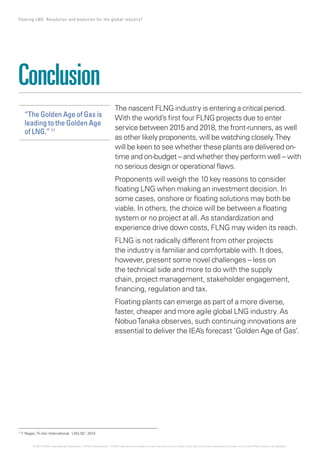
It will be important to
engage early on – not only
with the EP regulator
of the host country, but
also with tax authorities,
coastguard, shipping
certification bodies and
others to understand and
agree how they will regard
a floating LNG vessel.
16Floating LNG: Revolution and evolution for the global industry?
© 2014 KPMG International Cooperative (“KPMG International”). KPMG International provides no client services and is a Swiss entity with which the independent member firms of the KPMG network are affiliated.
The nascent FLNG industry is entering a critical period.
With the world’s first four FLNG projects due to enter
service between 2015 and 2018, the front-runners, as well
as other likely proponents, will be watching closely.They
will be keen to see whether these plants are delivered on-
time and on-budget – and whether they perform well – with
no serious design or operational flaws.
Proponents will weigh the 10 key reasons to consider
floating LNG when making an investment decision. In
some cases, onshore or floating solutions may both be
viable. In others, the choice will be between a floating
system or no project at all. As standardization and
experience drive down costs, FLNG may widen its reach.
FLNG is not radically different from other projects
the industry is familiar and comfortable with. It does,
however, present some novel challenges – less on
the technical side and more to do with the supply
chain, project management, stakeholder engagement,
financing, regulation and tax.
Floating plants can emerge as part of a more diverse,
faster, cheaper and more agile global LNG industry. As
NobuoTanaka observes, such continuing innovations are
essential to deliver the IEA’s forecast ‘Golden Age of Gas’.
Conclusion
“The Golden Age of Gas is
leading to the Golden Age
of LNG.” 11
11
T. Regan,Tri-Zen International, 'LNG 50', 2014.
17 Floating LNG: Revolution and evolution for the global industry?
© 2014 KPMG International Cooperative (“KPMG International”). KPMG International provides no client services and is a Swiss entity with which the independent member firms of the KPMG network are affiliated.
Whatarethekeyactionsfor
FLNGproponents?
Consider how floating solutions may reshape the global LNG industry – to gauge the impact
not just on FLNG ventures, but also on land-based LNG and other gas projects.
Understand the reasons for choosing a floating solution over a land-based plant. Not all
factors are applicable to every project. Some projects may only be viable with a floating
plant; others may present a real choice. Land-based, inshore and true blue-water FLNG
plants also present different issues. Align with project partners and host governments early
on regarding the criteria for concept selection.
Monitor the progress of the early FLNG projects and understand the challenges they
meet and how they are overcome. Gather relevant data on cost and schedule to judge the
economics of future projects and scope for improvement.
Consider what is different about FLNG projects – and what is common to all LNG
investments. Understand the supply chain and the differences in project management.
Learn from FPSO construction how to manage issues such as shipyard capacity and hull-
topsides integration.
Begin building alliances with EPC companies, shipyards and potential local service
providers.
Understand regulatory, legal, financing and tax issues well ahead of investment decisions.
Engage with relevant stakeholders early and identify key risks and mitigation strategies.
18Floating LNG: Revolution and evolution for the global industry?
© 2014 KPMG International Cooperative (“KPMG International”). KPMG International provides no client services and is a Swiss entity with which the independent member firms of the KPMG network are affiliated.
For today’s oil and gas companies, dealing with complexity has become a competitive challenge. Global competition, novel
stakeholders and environmental concerns introduce new layers into business decisions.
A leading global provider of professional services to the LNG industry, KPMG member firms have successfully assisted
clients in addressing business issues and major risks.
KPMGGlobalLNGCompetitive
Advantage
Business issues and risks KPMG member firm advisory services
•	
•	
Capital	projects
	Real-time	assurance	
management
on	capital	expenditure	
Managing capital projects, contract processes and providing
assurance are the focus of our Major Projects Advisory group.
•	
•	
•	
Risk	identification
Enterprise	risk	management
Outsource	or	insource?
Mitigating risks through tools and methodologies that address
demand planning, supply and inventory management, strategic
sourcing and contract management.
•	
•	
Business	operations	strategy
Demand	side	management
Organizational effectiveness, business readiness for LNG and
operational excellence.
•	
•	
•	
•	
Issue	recognition	and	strategy	development
Business	operations	strategy
Capitalizing	on	different	technology	investments
Quality	reporting
Designing or improving current business processes, including
implementing technology focusing on logistic, supply chain and
procurement management, are services that member firms’
advisory teams have delivered successfully.
•	
•	
•	
Talent	transformation
Business	operations	strategy
IT	projects	implementation
Implementing appropriate size Human Resource strategies with
the right enabling technologies is a key focus area to address
labor-related risks.
•	
•	
•	
Major	project	assurance
Enterprise	risk	management
Corporate	governance	improvements
Utilizing KPMG experts across our global network, advising
businesses on implementing governance processes, risk
management and ensuring compliance with legislation, including
taxation.
•	
•	
•	
	Managing	major	capital	expenditure	projects	and	
energy investment requirements
Major	transaction	management
	Managing	mergers,	acquisitions,	joint	ventures	and	
other third-party relationships
Project structuring, raising development phase equity, transaction
advisory (financial modeling; development of country/project
specific contractual frameworks), progressing these to support
bankability, including advising in gas sales and purchase, and
power purchase agreements. Advisory support can be provided
during procurement and financing of capital projects.
•	
•	
•	
•	
	Meeting	increasing	regulatory,	government	and	
multiple stakeholder demands
	Managing	major	capital	expenditure	projects	and	
energy investment requirements
Security	of	supply
Talent	management
Managing relationships between IOCs and NOCs is critical to
ensuring a balance between political and commercial objectives,
such as royalty and taxation, security of supply, employment
and infrastructure development. We assist IOCs and NOCs
in creating a stable and attractive investment environment by
developing policy and governance structures.
19 Floating LNG: Revolution and evolution for the global industry?
© 2014 KPMG International Cooperative (“KPMG International”). KPMG International provides no client services and is a Swiss entity with which the independent member firms of the KPMG network are affiliated.
Webcasts: December 2014
Floating LNG: Revolution and evolution for the global industry?
Webcast replay
Major LNG projects (or visit kpmg.com/energy)
KPMG’s African
Diversified
Industrial
Sector
kpmg.co.za
KPMG’s Focus on
Liquified Natural
Gas (LNG) in
Southern and
Eastern Africa
kpmg.com
Major LNG projects: Navigating the new terrain
The LNG industry is approaching an unprecedented wave of expansion as new projects
inWestern Canada, the US Gulf Coast and East Africa pose technical challenges, but
more importantly – non-technical challenges.
KPMG’s Focus on Liquefied Natural Gas (LNG) in Southern and
EasternAfrica
Liquified Natural Gas (LNG) is a key component of the global energy supply mix and it
is a core strategic focus area for global oil and gas companies.
KPMG Global Energy Institute 4th Cocktail Reception:
“Singapore – as an LNG hub
The Global Energy Institute inaugural event inTokyo presented the latest insights on
Singapore as an LNG hub, including challenges and opportunities faced by the ASEAN
regions.
For further publications, videos and other information on LNG, visit: kpmg.com/LNG
FurtherLNGInsights
20Floating LNG: Revolution and evolution for the global industry?
© 2014 KPMG International Cooperative (“KPMG International”). KPMG International provides no client services and is a Swiss entity with which the independent member firms of the KPMG network are affiliated.
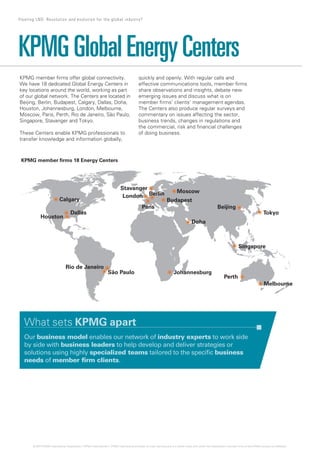
centersKPMG member firms offer global connectivity.
We have 18 dedicated Global Energy Centers in
key locations around the world, working as part
of our global network. The Centers are located in
Beijing, Berlin, Budapest, Calgary, Dallas, Doha,
Houston, Johannesburg, London, Melbourne,
Moscow, Paris, Perth, Rio de Janeiro, São Paulo,
Singapore, Stavanger and Tokyo.
These Centers enable KPMG professionals to
transfer knowledge and information globally,
quickly and openly. With regular calls and
effective communications tools, member firms
share observations and insights, debate new
emerging issues and discuss what is on
member firms’ clients’ management agendas.
The Centers also produce regular surveys and
commentary on issues affecting the sector,
business trends, changes in regulations and
the commercial, risk and financial challenges
of doing business.
Calgary
Houston
Dallas
Rio de Janeiro
São Paulo
Beijing
Tokyo
Moscow
London Berlin
Budapest
Stavanger
Doha
Paris
Johannesburg
Singapore
Melbourne
Perth
KPMG member firms 18 Energy Centers
What sets KPMG apart
Our business model enables our network of industry experts to work side
by side with business leaders to help develop and deliver strategies or
solutions using highly specialized teams tailored to the specific business
needs of member firm clients.
KPMGGlobalEnergyCenters
21 Floating LNG: Revolution and evolution for the global industry?
© 2014 KPMG International Cooperative (“KPMG International”). KPMG International provides no client services and is a Swiss entity with which the independent member firms of the KPMG network are affiliated.
The KPMG Global Energy Institute (GEI):
Launched in 2007, the GEI is a worldwide
knowledge-sharing forum on current and
emerging industry issues.This vehicle
for accessing thought leadership, events,
webcasts and podcasts about key industry
topics and trends provides a way for you to
share your perspectives on the challenges
and opportunities facing the energy industry –
arming you with new tools to better navigate
the changes in this dynamic arena.
Register today to become a member of the
KPMG Global Energy Institute
Visit kpmg.com/energy
The KPMG Global Energy Conference
(GEC): The GEC is KPMG’s premier event for
executives in the energy industry. Presented
by the KPMG Global Energy Institute, these
conferences are held in both Houston and
Singapore and bring together energy executives
from around the world in a series of interactive
discussions with industry luminaries.The goal
of these conferences is to provide participants
with new insights, tools and strategies to help
them manage industry-related issues and
challenges.
#KPMG_GEI
#KPMGGEC
© 2014 KPMG International Cooperative (“KPMG International”). KPMG International provides no client services and is a Swiss entity with which the independent member firms of the KPMG network are affiliated.
Contact us
Hilda Mulock Houwer
Partner and GlobalAdvisory Leader
Energy  Natural Resources
KPMG in Qatar
T: +974 44576444
E: hildamulockhouwer@kpmg.com
Mary Hemmingsen
Partner, National Sector Leader,
LNG, Power and Utilities
KPMG in Canada
T: +1 416 777 8896
E: mhemmingsen@kpmg.ca
Mina Sekiguchi
Managing Director, Head of Energy 
Infrastructure, KPMG in Japan and
Head of Energy  Natural Resources
KPMG inAsia Pacific
T: +81335485555
E: mina.sekiguchi@jp.kpmg.com
Jonathan Smith
Partner, Energy and Natural Resources
Oil and Gas Sector Leader
KPMGAustralia
T: +61 8 9263 4895
E: jesmith1@kpmg.com.au
RoddyAdams
Partner,
Head ofASPAC Infrastructure Markets
KPMG in Singapore
T: +65 6213 2552
E: roddyadams@kpmg.com.sg
EmmaWild
Head of UpstreamAdvisory Practice
KPMG in the UK
T: +44 (0)20 7311 6008
E: emma.j.wild@kpmg.co.uk
The information contained herein is of a general nature and is not intended to address the circumstances of any particular individual
or entity. Although we endeavor to provide accurate and timely information, there can be no guarantee that such information is
accurate as of the date it is received or that it will continue to be accurate in the future. No one should act on such information
without appropriate professional advice after a thorough examination of the particular situation.
© 2014 KPMG International Cooperative (“KPMG International”), a Swiss entity. Member firms of the KPMG network of independent
firms are affiliated with KPMG International. KPMG International provides no client services. No member firm has any authority to
obligate or bind KPMG International or any other member firm vis-à-vis third parties, nor does KPMG International have any such
authority to obligate or bind any member firm. All rights reserved.
The KPMG name, logo and “cutting through complexity” are registered trademarks or trademarks of KPMG International.
Designed by Evalueserve.
Publication name: Floating LNG: Revolution and evolution for the global industry?
Publication number: 131838
Publication date: November 2014
kpmg.com/energy
kpmg.com/LNG
kpmg.com/socialmedia kpmg.com/app

FloatingLNGRevolutionEvolution

  • 1.
    KPMG GLOBAL ENERGYINSTITUTE Floating LNG: Revolution and evolution for the global industry? kpmg.com/energy KPMG INTERNATIONAL LNG report series
  • 2.
    Overview 02 Introduction 03 Thevoyage to FLNG 04 FLNG emerges 05 Global context of floating LNG 06 Ten reasons companies choose FLNG 07 Key considerations and risks for FLNG developers 10 Conclusion 17 What are the key actions for FLNG proponents? 18 KPMG Global LNG Advisory Competitive Advantage19 Further LNG Insights20 KPMG Global Energy Centers21 Contents Cover image: Photographic Services, Shell International Ltd. © 2014 KPMG International Cooperative (“KPMG International”). KPMG International provides no client services and is a Swiss entity with which the independent member firms of the KPMG network are affiliated.
  • 3.
    This report isintended to provide an overview of the developments that the liquefied natural gas (LNG) industry is facing during its unprecedented wave of expansion. Security of energy supply has always been one of the critical issues many countries face. Unlocking potential reserves economically and rapidly is essential to deliver energy security and can potentially affect trade flows profoundly. Floating LNG is an emerging technology for such fast and cost- effective development of new gas resources. This is the second in a series of LNG reports that will provide deeper insights on specific elements of governance, jurisdiction, stakeholders and opportunity. Overview Hilda Mulock Houwer Partner and Global Advisory Leader Energy Natural Resources KPMG in Qatar With 22 years of consulting and auditing experience in the oil and gas, energy and mining industries, Hilda Mulock Houwer has provided advisory services across the entire oil and gas value chain from strategy development to strategy implementation. Hilda has experience in operational excellence, process transformation, procurement, change management and financial process redesign. 2Floating LNG: Revolution and evolution for the global industry? © 2014 KPMG International Cooperative (“KPMG International”). KPMG International provides no client services and is a Swiss entity with which the independent member firms of the KPMG network are affiliated.
  • 4.
    On 20 May2011, Shell took final investment decision on the Prelude Floating LNG Project, to be installed off the north-west coast of Australia. Fast forward to 3 years later and Shell has laid the keel of the largest floating structure ever launched.The hull of this vessel, 488 meters long, would envelop the Statue of Liberty. The impact of this new technology on the global LNG industry can be equally massive. If the front-runners in FLNG can meet a number of key technical, commercial and financial challenges, we predict it will emerge as a key pillar of a 2020s LNG business that looks quite different from that of today. But not all projects are suitable for floating solutions – and, with FLNG still in its very early stages, proponents are navigating a number of new risks and project management challenges. Introduction Shell Prelude's floating liquefied natural gas facility stands tall Photographic Services, Shell International Ltd. Sydney Opera House Sydney London Eye London Taj Mahal Agra N Seoul Tower Seoul Taipei 101 Taipei Ostankino Tower Moscow Tokyo Sky Tree Tokyo Eiffel Tower Paris Shell FLNG facility (top view) Willis Tower Chicago Canton Tower Guangzhou Burj Khalifa Dubai Petronas Towers Kuala Lampur 3 © 2014 KPMG International Cooperative (“KPMG International”). KPMG International provides no client services and is a Swiss entity with which the independent member firms of the KPMG network are affiliated.
  • 5.
    It has beena long voyage for FLNG. Research began in the 1970s.The initial detailed designs were made in the early 1990s with associated efforts to start an FLNG project around the turn of the millennium, but the emergence of Qatar as a dominant exporter and falling costs for giant onshore liquefaction trains halted progress.Today, growing demand, high prices, environmental and community challenges and steep costs for the infrastructure of land-based projects, have led several leading LNG players – includingWoodside, Shell, Petronas, ExxonMobil and Inpex – to take another look. FLNG promises to unlock smaller, remote or environmentally-sensitive fields. Numerous projects in Southeast Asia, Australasia, Africa, the Eastern Mediterranean and Latin America may benefit. It is not just an offshore solution; developers inWestern Canada and Papua New Guinea are considering it for onshore fields. Novel gas resources, such as Brazilian pre-salt associated gas and North American shale gas have opened up new possibilities to use floating systems for export. FLNG can save costs and time – if executed well. As experience is gained, future projects may achieve first gas production quicker and more cheaply. The voyage to FLNG Firm Probable Possible Israel Canada USA Equatorial Guinea Colombia Mozambique Malaysia Indonesia Australia Papua New Guinea Trinidad China Ghana Timor Leste Nigeria Russia Mauritania Brazil Norway FLNG projects worldwide* *KPMG International Inc., 2014; D. K. Jordan, (27 May 2014), ‘Floating LNG’, Clarkson Research Services Ltd. As of September 2014; may be subject to change. 4Floating LNG: Revolution and evolution for the global industry? © 2014 KPMG International Cooperative (“KPMG International”). KPMG International provides no client services and is a Swiss entity with which the independent member firms of the KPMG network are affiliated.
  • 6.
    There are twoscenarios for the future development of floating LNG. It may become a niche technology that is applied by a few companies to solve specific problems, with land-based configurations remaining the default. This could happen if the first FLNG plants encounter cost or operational difficulties or if land-based costs fall as the current construction boom ebbs. For smaller offshore gas fields, compressed natural gas or small-scale gas-to-liquids may become viable competitors. However, in the second scenario, if the first few projects are successful, FLNG can emerge as a standard approach that eases the industry’s problems with cost inflation and opens it up to a much wider range of fields and companies. The concurrent development of floating regasification giving access to a range of smaller markets, and the development of new pricing methods and unconventional gas-to-LNG projects, may lead towards a faster- moving, more diverse – and more flexible global LNG industry. In a 2 September 2014 interview with Bruce Steenson, General Manager of Integrated Gas Programs and Innovation for Shell International Exploration and Production B.V., he compares the prospects for FLNG to floating production, storage and offloading vessels (FPSOs). “From the first oil FPSO in 1977, over a period of 1977 to 2000, 50 FPSOs were slowly installed.  Between 2000 and 2010, came another 100.“ Is FLNG, in short, a refinement or a transformation? Why should companies choose FLNG over a land- based plant? And, what is required to make an FLNG project successful? FLNG emerges Bruce Steenson General Manager of Integrated Gas Programs and Innovation Shell International Exploration and Production B.V. Bruce has spent more than 30 years working for Shell on development projects in the Middle East, Central Asia, Europe, South America and Australia in roles spanning well engineering, production technology, process engineering and development project management. He is currently Managing Shell’s LNG Programs and Innovation in their Integrated Gas business. FloatingLNGandthe developmentofnew pricingmethodsand unconventionalgas-to-LNG projects,mayleadtowards afaster-moving,more diverse–andmoreflexible globalLNGindustry. 5 Floating LNG: Revolution and evolution for the global industry? © 2014 KPMG International Cooperative (“KPMG International”). KPMG International provides no client services and is a Swiss entity with which the independent member firms of the KPMG network are affiliated.
  • 7.
    The recent boomin global LNG construction could see global output almost doubling its 2012 level of 250 million tonnes per year by 2030. Sixty Million tons per annum (Mtpa) of this is in Australia. However, developers of onshore projects have become increasingly frustrated with budget blow-outs and slow time to market. Rising labor costs, workforce activism, community opposition, complex environmental approvals, infrastructure challenges related to the difficulty of construction in remote locations and unfavorable exchange rate movements have all contributed to cost over-runs. Construction costs, usually the largest single component, run at 30 percent of total project cost, but in Australian projects, this has risen to 50-60 percent. From 2000 to 2013, average capital costs of liquefaction plants rose from US $300 per tonne per year to $1200.1 One example, Gorgon, is now estimated to cost AUS $54 billion, up from the original AUS $37 billion, and research firm Douglas Westwood estimated that Australia could miss out on AUS $97 billion (US$85 billion) of LNG investments if it were unable to get costs under control. North America and East Africa are emerging as major potential LNG players, but proponents in new supply centers such as Western Canada and Mozambique worry about similar cost inflation, in an environment of flat or falling oil and LNG prices. Global context of floating LNG 1 B. Songhurst (February 2014) ‘LNG Plant Cost Escalation’, Oxford Institute for Energy Studies 2 D.K. Jordan (27th May 2014) ‘Floating LNG’, Clarkson Research Services Ltd. Cost savings and new confidence in FLNG Expected cost savings and new confidence in floating designs are thus driving the first wave of project sanctions. Douglas Westwood estimates that US $60 billion will be spent on floating LNG projects between 2014 and 2020. But this may be just the start. Pacific Rubiales’ Colombia project and Petronas’s PFLNG-1 should enter service in 2015, Shell’s Prelude in 2017 and Murphy/ Petronas’s PFLNG-2 in 2018, with Excelerate’s Port Lavaca inTexas intended for 2019. Perenco’s just- sanctioned Kribi LNG in Cameroon is slated for 2017 start-up. ExxonMobil/ BHP’s Scarborough project in Western Australia would be the world’s largest, at 6-7 million tonnes per year. Shipbroker Clarksons estimates that by 2019, likely global FLNG capacity will be 44 million tonnes per year, about 7.5 percent of the industry’s total capacity. By 2022, there could be 22 FLNG vessels in place, with another 22 “possibles”.2 Colombia and Port Lavaca are essentially inshore barge-mounted designs, not very different from a land-based facility. EXMAR’s barge for Pacific Rubiales is being constructed in China at a very competitive reported cost of US$700 per tonne. The Petronas and Shell projects are however, different – true open-water LNG FPSOs presenting higher costs and greater design challenges. There are 10 reasons why a project developer may consider floating LNG. Proponents whose project features one or more of these have a strong impetus to consider floating solutions. 6Floating LNG: Revolution and evolution for the global industry? © 2014 KPMG International Cooperative (“KPMG International”). KPMG International provides no client services and is a Swiss entity with which the independent member firms of the KPMG network are affiliated. there could be capacity about 7.5%of the industry’s total capacity 44million tonnes per year 2022 By 2019, By ... with another 22 “possibles”2 FLNG vessels in place FLNG Global
  • 8.
    TenreasonscompanieschooseFLNG Unlock smaller fields Shell’s3.6 Mtpa Prelude is relatively small by Australian LNG standards; Petronas’ 1.5 Mtpa FLNG-1 for the Kanowit field in Sarawak, Malaysia, and Pacific Rubiales’ 0.5 Mtpa plant for La Creciente in Colombia are smaller still.These fields would unlikely be economic if developed through conventional land-based facilities. Large oil-fields producing significant quantities of associated gas, as in Brazil’s pre-salt of the Santos Basin, are also candidates. Access remote fields Australian fields such as Browse are as much as 425 kilometers offshore, which would necessitate long and costly pipelines to onshore locations. In September 2013, the Browse joint venturers,Woodside, Shell, BP, PetroChina and Mitsubishi/Mitsui, decided on floating LNG, which may include three Prelude- type vessels.3 In September, BHP Billiton agreed with ExxonMobil that FLNG was the best approach for their Scarborough field, in 1000 meters of water and 200 kilometers offWestern Australia. Arctic environments are a step further, given ice and rougher waters, but considered technically doable. Avoid onshore ‘no-go zones’ Large gas fields have been found in the Eastern Mediterranean, but the surrounding coastlines are heavily built-up with tourism and real estate. Onshore plant locations may face lengthy legal and permitting delays and community objections. Reduce environmental footprint Floating LNG plants do not require long seabed pipelines, dredging for jetties or onshore roads and construction.They save on fuel gas for compression to send gas to shore. After decommissioning, the vessel offers the potential to be relatively easily removed and re-deployed. “In Prelude’s case,” notes Steenson, “the option value is there in that the hull is designed for 50 years with the base case of stationing for 20 to 25 years. So with refurbishment, there is some possible additional value. One potential challenge to be taken into account regarding redeployability is the variance in gas composition by fields.” Deliver projects cheaper and faster FLNG may offer reduced capital costs, particularly once shipyards have gained experience with construction and standardized solutions are employed.There could be substantial improvements in the process of integrating the hull and processing units. Modular components can be constructed at several locations. Onshore construction, marine works and the related high labor costs, in remote or hostile environments, can be minimized. For example, the dredging cost alone for theWheatstone project in Western Australia – a 17 kilometer approach channel and 26 million cubic meters of dredged material – is estimated at AUS $1.5 billion.4 Savings on such infrastructure, and a simpler supply chain, can mean FLNG projects make it to market faster. Avoid the gold-rush Simultaneous construction on numerous projects – ‘gold-rush economics’ - was blamed for escalating costs in Australian LNG and Canadian oil sands, and is also a worry forWestern Canadian LNG developers currently. Mary Hemmingsen, Partner and National Sector Leader, LNG, Power and Utilities, KPMG in Canada, observes, “FLNG presents a configuration to mitigate labor and construction cost escalation such as faced in Australia and Canada by enabling construction to occur in lower cost areas with more labor depth such as Korean shipyards.” Countries new to the LNG business, such as Mozambique andTanzania, will find it difficult to supply sufficient skilled personnel. FLNG projects can also widen the circle of contractors beyond the seven world-scale LNG EPC companies. Shipyard construction also spreads the risk of currency appreciation, with 50 percent of project costs for onshore projects typically in local currency. Contrastingly, in areas with abundant skilled labor, such as the US Gulf Coast, this will be less of a driver for companies to choose floating options. 3 http://www.woodside.com.au/our-business/browse/documents/browse_flng_development_-_fact_sheet_-_April_2014.pdf 4 B. Songhurst (February 2014) ‘LNG Plant Cost Escalation’ Oxford Institute for Energy Studies 1 2 3 4 5 6 7 Floating LNG: Revolution and evolution for the global industry? © 2014 KPMG International Cooperative (“KPMG International”). KPMG International provides no client services and is a Swiss entity with which the independent member firms of the KPMG network are affiliated.
  • 9.
    Put projects ina safe pair of hands “If you look at LNG around the world, the logistics of getting a skilled workforce to the site and keeping them there can be hugely challenging and costly, notes Steenson. ”You don’t have that issue with a floating facility built in a yard. For example at Asian ship yards, 25,000 to 35,000 people are coming into the yard daily. So all of that logistics and infrastructure are already set up with productivity being more predictable and safety performance established.”Several shipyards have related capabilities in constructing oil FPSOs and LNG tankers.The “design one, build many” philosophy may be applied by shipyards that can develop a high level of expertise in FLNG. The Prelude design is designed for rich gas, but features modules that could be added or removed to suit other gas compositions and increase liquefaction output. Other concepts than LNG FPSOs are also being considered – semi-submersibles and spars. Achieve peace of mind from security worries Certain areas of LNG development, such asWest Africa and the Eastern Mediterranean, have security concerns. Onshore fields and pipelines have frequently come under attack in parts ofWest Africa and the Middle East in recent years. Placing the facility offshore makes it less accessible to would-be attackers or saboteurs and can be supplemented with other defensive measures such as remote monitoring and barriers to make it difficult to scale the vessel.That said, piracy is a known risk and still requires safety precautions, including international cooperation in the case of the Eastern Mediterranean. Mitigate political risk5 Onshore LNG plants represent a huge sunk investment, making the project developer vulnerable to a change of mind from the political authorities – which can include tax increases, nationalization or outright expropriation. In an extreme case, in which a host government seeks to expropriate an asset, or in which security conditions become intolerable, the FLNG plant can be sailed away, saving at least some of the project’s value, and perhaps redeployed elsewhere.This option is unlikely ever to be used, but its existence does improve the owner’s bargaining position. Access other financing options Financing of floating LNG projects is still in its infancy and will require greater experience from lending banks.With more corporations seeking to enter the LNG game, previously the near-exclusive preserve of the majors, innovative financing choices are becoming more important. Smaller companies, in particular, may benefit from other financing opportunities such as leasing the LNG vessel, taking advantage of tax incentives or accessing concessionary or export financing for shipping.The greater security offshore may make it easier to access financing for more risky host countries. Mary Hemmingsen Partner, National Sector Leader, LNG, Power and Utilities KPMG in Canada Mary Hemmingsen brings over 20 years of experience as a North American energy business leader in asset management and related business development.This includes leadership in the development and delivery of policy, strategy and initiatives for energy, power, utilities and related infrastructure businesses in a range of capacities in both the public and private sector and for major utilities and global energy and asset managers. 7 8 9 10 5 See, for instance, ‘No paper chase:Transforming risk management at energy and natural resources companies’, KPMG (2014) 8Floating LNG: Revolution and evolution for the global industry? © 2014 KPMG International Cooperative (“KPMG International”). KPMG International provides no client services and is a Swiss entity with which the independent member firms of the KPMG network are affiliated.
  • 10.
    Interview with NobuoTanaka,GlobalAssociate for Energy Security and Sustainability, Institute of Energy Economics, Japan and former Executive Director of the International EnergyAgency Impact of floating LNG in delivering the IEA's 'Golden Age of Gas' Can you put floating LNG in the context of today’s global gas market? LNG was limited to the EastAsian countries, but now expanding to many parts of the world – gas is relatively cleaner, abundant.A global market is now appearing, but how well it will continue depends on many elements. How well the wave of exploration offshore goes is another interesting factor. To help further diversification of sources, floating LNG is very interesting. Relatively smaller companies, smaller fields, make additional elements in the LNG market. What impact might FLNG have on gas supply diversity and security? It is going to be applied at certain gas fields and we will see how much it is commercially viable. Geopolitics in the Middle East and Ukraine is very fragile, so there is a chance the future market could be tighter.This technology may fill the gap, if it is coming at the proper speed. A success story is needed for this kind of innovation, but I think this technology has a very good chance of success. This is a three-way competition with a new element – pipeline, LNG and now floating LNG. How is FLNG relevant to Japan? For Japan, our concern is if anything happens in the Strait of Hormuz, we will lose gas, so additional supply in some other area certainly helps. Asian economies are suffering with very high LNG prices. North American gas price competitiveness will not change, but FLNG adds further competition. As well as Shell and Petronas, Japan’s Inpex are looking seriously at FLNG. Japan has a very good shipbuilding industry. Japanese companies such as trading houses and utilities are getting more interested in investing in exploration and development.The utilities need more gas and are willing to take risks. FLNG could be a very interesting target, combined with our technology for ship-building and our needs for gas resources. Some kind of innovative technology is required to regain competitiveness against the North American shale gas price. Japanese power and gas market reform means the utilities need to find very competitive gas sources. What are the FLNG risks? For the environmental footprint, we have not seen problems with FLNG yet. In general, the IEA’s ‘Golden Rules’ add only 7 percent to the cost of gas production. In some parts of the world, there are some geopolitical risks – will FLNG be impacted by wars, in some of the Mediterranean areas, in Africa close to Somalia? Of course, pipelines and fixed facilities have a more serious risk, but FLNG cannot solve these geopolitical risks itself. How does FLNG relate to other gas market innovations? Oil is too expensive relative to gas, thanks to the shale revolution.The Japanese government is pushing the utilities and trading houses to have more use of markets. Hub pricing discussion is happening everywhere. Singapore is a likely choice for the first hub, but then why not in Shanghai, in Seoul, if new technologies make for new supply?The soft infrastructure, social infrastructure of markets, abandoning the destination restrictions, as well as hardware through pipelines, floating regasification, are also necessary to make competition happen. All these elements are moving in the direction that gas is getting more important and satisfy the rules for the IEA’s ‘Golden Age of Gas’. NobuoTanaka Professor, GraSPP, the University of Tokyo GlobalAssociate for Energy Security and Sustainability Institute of Energy Economics, Japan (IEEJ) NobuoTanaka has extensive national government and international experience in the fields of energy, trade and innovation.As Executive Director of the International EnergyAgency (IEA) from 2007-11, Mr.Tanaka led work on fossil fuel subsidy reform, energy efficiency policy recommendations (adopted by the G8), low-carbon energy technology roadmaps, gas and electricity security, energy poverty and carbon capture and storage, among others.With a strong background in international affairs, Mr.Tanaka has served as both Deputy Director and Director for Science,Technology and Industry (DSTI) of the Paris-based Organisation for Economic Co-operation and Development (OECD). 9 © 2014 KPMG International Cooperative (“KPMG International”). KPMG International provides no client services and is a Swiss entity with which the independent member firms of the KPMG network are affiliated.
  • 11.
    Keyconsiderationsandrisksfor FLNGdevelopers Proponents of floatingprojects have to consider what they need to get right, and which risks they have to manage. Most of the elements for a successful FLNG project are likely to be the same as for a conventional onshore LNG development. As the first FLNG projects are still in the construction phase, we are only at the early stages of identifying key success factors and lessons learned. It is vital to track initial indications and determine analogies with other projects, such as FPSOs, to ensure the first wave of FLNG projects are delivered as effectively as possible. Failure in one of the early projects could deter new developers, worry financiers and host governments and set the technology back years. Mina Sekiguchi Managing Director, Head of Energy Infrastructure, KPMG in Japan and Head of Energy Natural Resources KPMG inAsia Pacific As head of KPMG in Japan’s Energy Infrastructure sector and the Head of KPMG in Asia Pacific’s Energy Natural Resources sector, Mina Sekiguchi focuses on advising power and utilities, oil and gas, Japanese major trading companies and large power machinery manufacturers.With 7 years of corporate finance advisory experience, Mina provided MA advisory services to major Japanese clients, including multiple cross-border MA transactions. 10Floating LNG: Revolution and evolution for the global industry? © 2014 KPMG International Cooperative (“KPMG International”). KPMG International provides no client services and is a Swiss entity with which the independent member firms of the KPMG network are affiliated.
  • 12.
    © 2014 KPMGInternational Cooperative (“KPMG International”). KPMG International provides no client services and is a Swiss entity with which the independent member firms of the KPMG network are affiliated. Technology Floating liquefaction is a relatively new technology, compared to floating regasification which has quickly established itself as a standard approach. Managing shipyard construction of FPSOs is now routine for oil and gas companies. Floating liquefaction should not present any excessive technical challenges. However, it does require a specialized LNG containment system to prevent sloshing; topsides modules including gas pre-treatment and liquefaction; and safe systems for offloading cryogenic liquid in potentially difficult sea conditions, including the possible development of flexible hoses. New risk registers will need to be built and analyzed. Cyber security issues on a new type of offshore facility should be considered. Production processes have to be kept away from living quarters – sharing experiences from onshore LNG plants in confined sites such as British Columbia. Weather conditions will have to be factored into installation and operational schedules. Maintenance schedules are also different from onshore, due to the limited number of accommodation spaces on-board – Shell’s plan for Prelude includes increased routine maintenance during normal operations.6 Cost and project management Cost reduction is one of the key reasons to choose floating LNG. Standardization is important as a way to save costs, but systems cannot be perfectly standard, which may limit the redeployment of vessels. For example, Australian facilities will have 6 J. Marshall and I. Grose (May 2014) ‘Shell Australia – preparing to operate Prelude FLNG’ Australian Petroleum Production Exploration Association conference 7 M. Haney, M. Loffman and S. Robertson (5th February 2014) ‘FPSO industry must re-think supply chain’ Offshore Magazine,Volume 74, Issue 2. The Japanese angle As the world’s largest LNG market, and one of the leading ship-builders, Japan has a particular interest in FLNG. Following the 2011 Fukushima Daiichi nuclear disaster and the shut-down of its nuclear fleet, LNG imports increased by 25 percent and “Japan is currently wasting USD $40 billion a year for extra purchases of gas and oil for thermal power”, as NobuoTanaka notes [KPMG – Nuclear Power: Its role in shaping energy policies in Asia Pacific]. Japan is acutely aware of its dependence on oil and LNG shipped through the Straits of Hormuz and Malacca, and on threats to global gas supplies from crises such as in the Ukraine. Additionally, its utilities are coming under increasing pressure to reduce the costs of electricity to their customers. With nearly half of proposed FLNG projects in Asia-Pacific, including Japanese giant Inpex’s Abadi in Indonesia, Japan is a likely major customer for FLNG.The country hopes that a more diverse supply, coming to market faster, will drive down prices and increase security. FLNG is one component of a broader strategy emphasizing the introduction of new price benchmarks based on US gas prices and traded Asian hubs, and accessing Russian pipeline gas and North American exports fed by shale gas. Japanese companies are well-placed to develop FLNG alliances between upstream, utilities, shipbuilding and Engineering, Procurement and Construction (EPC) companies, a model that may apply to South Korea and China too. to be cyclone-resistant. Prelude can withstand a category 5 cyclone – while this is not needed in East Africa. Costs may fall significantly with experience. However, using floating systems is not a panacea. A recent study7 pointed out that companies were struggling to deliver FPSO vessels on time and budget: nine examples studied had on average 38 percent cost-overruns and were 16 months late. FLNG vessels will have to avoid such pitfalls. Requirements for helping to mitigate such risks are: • Allow sufficient time on front-end engineering; consider options and uncertainties carefully. • Do not over-engineer the detailed design phase. • Pursue standardization, not one-off designs. 11 Floating LNG: Revolution and evolution for the global industry?
  • 13.
    • Issue tenderswith achievable, realistic and action-based deadlines. • Give careful consideration to integration of hull and topsides. • If local content requirements require the use of inexperienced shipyards, then ensure this is accounted for in time and cost planning, and that attention is given to helping these shipyards improve their skills and quality control. • Avoid conflicts of interest between different suppliers who may variously be seeking to reduce costs, keep on schedule or maximize scope and variation orders. • Ensure sufficient construction slots at the shipyard are available and that the project is viewed by the shipyard as a top priority. • Commission sufficient FLNG projects in a short period, for yards to generate and retain experience. If only a few projects are being built with gaps between, consider how knowledge from previous jobs can be retained. • For operators, do not try to put too much of the financial and risk burden on contractors. Supply chain management may be simpler than for onshore projects, but still requires integrating work from many different locations: for Prelude, the hull is built in South Korea, the turret in Dubai, subsea systems in Malaysia, control systems in Singapore and onshore bases in Broome and Darwin, Australia. KBR believes that, “Key factors for success will include proper front end loading and successful interface management between traditional LNG and marine disciplines.”8 Even if capital costs can be lower than traditional projects, EmmaWild, Head of Upstream Advisory Practice, KPMG in the UK, notes that“Operating costs may be higher and there may be increased operational challenges offshore, such as lower uptime. Floating projects may also miss out on synergies available where several projects share common utilities and marine works, as in Qatar, the US Gulf Coast import terminal conversions and possibly Mozambique.” Floating projects will also miss out on the advantageous brownfield economics that expansions of land-based plants enjoy. 12Floating LNG: Revolution and evolution for the global industry? © 2014 KPMG International Cooperative (“KPMG International”). KPMG International provides no client services and is a Swiss entity with which the independent member firms of the KPMG network are affiliated. 8 N.White (2nd July 2013) ‘Drivers, Challenges and Solutions for FLNG’ KBR presentation to IE Australia Perth Oil  Gas Facilities Group
  • 14.
    Interview with KimihoSakurai, Section 5 Leader, Business Development Unit 2, Chiyoda Corporation As an EPC contractor, what are some of the key issues for project management in FLNG? Project management itself is essentially the same with other onshore projects, but we need to call in specialists for offshore, vessel construction, etc., and to evaluate metocean conditions (tides, waves, hurricanes) that impact design. Further, project execution plan after sail away of FLNG also needs to be considered in extra. LNG design, compared with onshore, would be basically the same, but since the space is limited on board, we need to achieve a cost effective compact design and safety for on board personnel at the same time. For megaprojects, we form a consortium with shipyards and bring them to the first layer of contractors, to share risk and motivate them to be efficient. Some aspects are different from their traditional work, for example, the need for cryogenic pipes. We are already working with shipyards to solve these issues – they see FLNG as a big opportunity. There are also many interfaces to manage. For an onshore project, Chiyoda can totally manage the EPC, but for FLNG, turret suppliers, shipbuilders and subsea can be key players. Chiyoda has an alliance with Xodus, a specialist for offshore upstream and is now targeting FLNG subsea portion such as risers and offshore production, which are also a very significant amount of the project. We have been successful in collaborating with clients and investors from the very initial stage of the projects and willing to continuously provide our LNG and project management professionalism in order to realize EPCI in the future with us. Since there is no FLNG in commercial operation yet, we form “one team” with the client to improve the development plan and design by mitigating risks of any kind and providing cost reduction at the same time. Our mission is to ensure the FLNG operates successfully and we always consider “what is the best for the project”.We wish to expand our Reliability No. 1 contractor to FLNG business, as well as we created for onshore LNG. Kimiho Sakurai Section 5 Leader, Business Development Unit 2 Chiyoda Corporation Mr. Sakurai is responsible for Business Development of FLNG / Floater worldwide, hydrocarbon business development over the Middle East, Russia, CIS, Europe, Oceania, and LatinAmerica regions. In previous roles, he was Director of Chiyoda International Indonesia, responsible for overall corporate activities of Chiyoda subsidiary in Indonesia, cum General Manager, Regional Business Development, South EastAsia and responsible for business development activities across South EastAsia. EmmaWild Head of UpstreamAdvisory Practice KPMG in the UK EmmaWild is an upstream specialist with a background and education in both chemical and reservoir engineering.With 20 years of international experience in the oil and gas sector and financial services, her primary focus is on transactions, corporate finance valuations, debt advisory and strategy. Prior to KPMG, she acted asTechnical Advisor for a large UK financial services institution and holds various senior reservoir engineering and business development/new ventures roles globally. 13 Floating LNG: Revolution and evolution for the global industry? © 2014 KPMG International Cooperative (“KPMG International”). KPMG International provides no client services and is a Swiss entity with which the independent member firms of the KPMG network are affiliated.
  • 15.
    Potential FLNG developers willbe closely watching the first few projects. If these go smoothly, with no serious budget over-runs, delays or technical problems, other companies will gain confidence. With more than 500 large crude oil tankers, FPSOs and LNG tankers in service, construction of a few FLNG vessels should not tax shipyard capacity, but some may be expanded and retooled to specialize in such projects. LNG proponents, especially supermajors, may benefit from building a portfolio of FLNG projects. Alliances between EP companies, EPC contractors and shipyards can develop the ship-builders’ capabilities for these vessels and maximize the benefits from learning and standardization. EP companies, however that have advocated FLNG for a long time, such as Shell and Petronas, will also need to protect their intellectual property and competitive edge. Shell has worked on Prelude with a consortium ofTechnip and Samsung as long-term technology partners. Potential FLNG developers will be closely watching the first few projects. If these go smoothly, with no serious budget over-runs, delays or technical problems, other companies will gain confidence.This is particularly important for smaller companies, which could not absorb the costs and risks of an unsuccessful development. Financing, legal, tax and regulation Shell will own the Prelude facility, but other companies are looking at leasing, withTeekay, SBM Offshore and BW Offshore interested in constructing FLNG ships for lease, as with ordinary FPSOs. Leased ships may be smaller, 2-3 million tonnes per year rather than Prelude’s 3.6 Mtpa, and use simpler liquefaction technology.This widens the circle of potential developers. Project finance will also only be readily available once FLNG has proved its viability. As Jonathan Smith, Partner, Energy and Natural Resources and Oil and Gas Sector Leader, KPMG Australia notes however, “with Prelude costing an estimated AUS $12 billion, FLNG projects will still largely be the domain of supermajors.” Companies will need to work closely with finance providers to understand what they need to see to establish the technical reliability and bankability of their project and reduce the risk premium attached to project lending and EPC contracts. Jonathan E. Smith Partner, Energy and Natural Resources Oil and Gas Sector Leader KPMG Australia Jonathan Smith brings over 25 years of experience in systems and process improvement. He specializes in assisting finance leaders in capital intensive industries on performance improvement of finance operations through CFO advisory, financial transformation and cost optimization/transparency. Jonathan has published on the role of the CFO in the development of corporate strategy, cost optimization and developing a cost culture in LNG/CSG projects. 14Floating LNG: Revolution and evolution for the global industry? © 2014 KPMG International Cooperative (“KPMG International”). KPMG International provides no client services and is a Swiss entity with which the independent member firms of the KPMG network are affiliated.
  • 16.
    Roddy Adams, Headof ASPAC Infrastructure Markets, KPMG in Singapore, points out that chartering arrangements for FLNG vessels, where the project owner chooses to lease rather than own, may draw on experience from floating regasification. “Issues include the commencement of hire, the compensation regime, force majeure, terms of mooring and specific marine law issues e.g. salvage and class of vessel.Vessels are often financed on a structured lease basis, while the overall project is often financed on a standard non-recourse basis. This can lead to a complicated intercreditor arrangement and a potential ranking of securities. On the face of it, these assets are re-deployable, but this is often heavily restricted by the rigid nature of ship financing models.” The status of FLNG plants may raise complicated questions for taxation, cost and price allocation and transfer pricing, particularly in a federal system such as Australia or Brazil.These issues would be even more complex for cross-border LNG projects such as those proposed between Israel and Cyprus or inWest Africa. As with FPSOs, floating LNG vessels may be classified either as ships or as production installations or even as both during different stages of the project.This means different regulations and standards will apply, making compliance more complicated. It will be important to engage early on – not only with the EP regulator of the host country, but also with tax authorities, coastguard, shipping certification bodies, insurers and others to understand and agree how they will regard a floating LNG vessel. Stakeholders FLNG potentially offers advantages in managing stakeholders. By placing the bulk of the project offshore, it reduces the chance for conflict with local landowners and indigenous peoples and avoids the onshore environmental footprint. It may also make for easier labor and community relations by avoiding influxes of highly-paid workers into rural or remote areas. In addition, it makes the project less accessible to criminal or militant groups. 9 ‘FLNG’s Hard Sell’ (25th September 2013), Petroleum Economist RoddyAdams Partner Head ofASPAC Infrastructure Markets KPMG in Singapore Including over 20 years of banking experience in the infrastructure sector, Roddy Adams was formerly the Global Head of Infrastructure Energy and the Head of Equity Projects at two major Australian financial institutions. A developer of power projects with a large hydro electric company, he has also closed multiple global project finance transactions as a sponsor, adviser, equity investor, lender and bond underwriter, bringing his significant knowledge and experience of debt and equity markets to his role. 15 Floating LNG: Revolution and evolution for the global industry? © 2014 KPMG International Cooperative (“KPMG International”). KPMG International provides no client services and is a Swiss entity with which the independent member firms of the KPMG network are affiliated.
  • 17.
    10 ‘FLNG Gets Serious’(August 2010), GasToday Other stakeholders, however, may need careful engagement. National labor unions may object to perceived outsourcing of jobs to overseas shipyards: Brazil is one country with stringent local content requirements. Governments may seek onshore construction to generate employment.9 In the Sunrise project in the Joint Development Area betweenTimor Leste and Australia, Woodside argued that a floating plant would be US $5 billion cheaper than an onshore plant inTimor Leste. But theTimorese government prefers a plant on land, believing that it would create more jobs and have a lower technical risk.10 As a result, the project has stalled. Provincial or state-level governments may prefer onshore plants to gain a share of revenues that would otherwise go to the federal level and to attract related community projects such as schools and medical facilities. Like Western Australia, Israel and Mozambique, governments may have gas reservation policies that require a proportion of gas be devoted to domestic consumers, requiring a pipeline to land even from floating plants. To meet these concerns, companies are likely to have to place some infrastructure onshore – for example, supply bases, heliports and FLNG training centers – and possibly even do the ship-building in-country, requiring upskilling of local yards. Shell, for instance, has stressed that 70 percent of annual operating costs will be spent in Australia, with policies to encourage local and indigenous suppliers. Proponents will have to commit to local employment and education, especially in developing countries such as Mozambique and Tanzania which are trying to build a skilled workforce.They will have to articulate a clear case that lower costs – and indeed projects going ahead that would not otherwise be economically viable – mean higher tax revenues. And they will have to explain convincingly, the other advantages of FLNG such as reduced environmental impact. It will be important to engage early on – not only with the EP regulator of the host country, but also with tax authorities, coastguard, shipping certification bodies and others to understand and agree how they will regard a floating LNG vessel. 16Floating LNG: Revolution and evolution for the global industry? © 2014 KPMG International Cooperative (“KPMG International”). KPMG International provides no client services and is a Swiss entity with which the independent member firms of the KPMG network are affiliated.
  • 18.
    The nascent FLNGindustry is entering a critical period. With the world’s first four FLNG projects due to enter service between 2015 and 2018, the front-runners, as well as other likely proponents, will be watching closely.They will be keen to see whether these plants are delivered on- time and on-budget – and whether they perform well – with no serious design or operational flaws. Proponents will weigh the 10 key reasons to consider floating LNG when making an investment decision. In some cases, onshore or floating solutions may both be viable. In others, the choice will be between a floating system or no project at all. As standardization and experience drive down costs, FLNG may widen its reach. FLNG is not radically different from other projects the industry is familiar and comfortable with. It does, however, present some novel challenges – less on the technical side and more to do with the supply chain, project management, stakeholder engagement, financing, regulation and tax. Floating plants can emerge as part of a more diverse, faster, cheaper and more agile global LNG industry. As NobuoTanaka observes, such continuing innovations are essential to deliver the IEA’s forecast ‘Golden Age of Gas’. Conclusion “The Golden Age of Gas is leading to the Golden Age of LNG.” 11 11 T. Regan,Tri-Zen International, 'LNG 50', 2014. 17 Floating LNG: Revolution and evolution for the global industry? © 2014 KPMG International Cooperative (“KPMG International”). KPMG International provides no client services and is a Swiss entity with which the independent member firms of the KPMG network are affiliated.
  • 19.
    Whatarethekeyactionsfor FLNGproponents? Consider how floatingsolutions may reshape the global LNG industry – to gauge the impact not just on FLNG ventures, but also on land-based LNG and other gas projects. Understand the reasons for choosing a floating solution over a land-based plant. Not all factors are applicable to every project. Some projects may only be viable with a floating plant; others may present a real choice. Land-based, inshore and true blue-water FLNG plants also present different issues. Align with project partners and host governments early on regarding the criteria for concept selection. Monitor the progress of the early FLNG projects and understand the challenges they meet and how they are overcome. Gather relevant data on cost and schedule to judge the economics of future projects and scope for improvement. Consider what is different about FLNG projects – and what is common to all LNG investments. Understand the supply chain and the differences in project management. Learn from FPSO construction how to manage issues such as shipyard capacity and hull- topsides integration. Begin building alliances with EPC companies, shipyards and potential local service providers. Understand regulatory, legal, financing and tax issues well ahead of investment decisions. Engage with relevant stakeholders early and identify key risks and mitigation strategies. 18Floating LNG: Revolution and evolution for the global industry? © 2014 KPMG International Cooperative (“KPMG International”). KPMG International provides no client services and is a Swiss entity with which the independent member firms of the KPMG network are affiliated.
  • 20.
    For today’s oiland gas companies, dealing with complexity has become a competitive challenge. Global competition, novel stakeholders and environmental concerns introduce new layers into business decisions. A leading global provider of professional services to the LNG industry, KPMG member firms have successfully assisted clients in addressing business issues and major risks. KPMGGlobalLNGCompetitive Advantage Business issues and risks KPMG member firm advisory services • • Capital projects Real-time assurance management on capital expenditure Managing capital projects, contract processes and providing assurance are the focus of our Major Projects Advisory group. • • • Risk identification Enterprise risk management Outsource or insource? Mitigating risks through tools and methodologies that address demand planning, supply and inventory management, strategic sourcing and contract management. • • Business operations strategy Demand side management Organizational effectiveness, business readiness for LNG and operational excellence. • • • • Issue recognition and strategy development Business operations strategy Capitalizing on different technology investments Quality reporting Designing or improving current business processes, including implementing technology focusing on logistic, supply chain and procurement management, are services that member firms’ advisory teams have delivered successfully. • • • Talent transformation Business operations strategy IT projects implementation Implementing appropriate size Human Resource strategies with the right enabling technologies is a key focus area to address labor-related risks. • • • Major project assurance Enterprise risk management Corporate governance improvements Utilizing KPMG experts across our global network, advising businesses on implementing governance processes, risk management and ensuring compliance with legislation, including taxation. • • • Managing major capital expenditure projects and energy investment requirements Major transaction management Managing mergers, acquisitions, joint ventures and other third-party relationships Project structuring, raising development phase equity, transaction advisory (financial modeling; development of country/project specific contractual frameworks), progressing these to support bankability, including advising in gas sales and purchase, and power purchase agreements. Advisory support can be provided during procurement and financing of capital projects. • • • • Meeting increasing regulatory, government and multiple stakeholder demands Managing major capital expenditure projects and energy investment requirements Security of supply Talent management Managing relationships between IOCs and NOCs is critical to ensuring a balance between political and commercial objectives, such as royalty and taxation, security of supply, employment and infrastructure development. We assist IOCs and NOCs in creating a stable and attractive investment environment by developing policy and governance structures. 19 Floating LNG: Revolution and evolution for the global industry? © 2014 KPMG International Cooperative (“KPMG International”). KPMG International provides no client services and is a Swiss entity with which the independent member firms of the KPMG network are affiliated.
  • 21.
    Webcasts: December 2014 FloatingLNG: Revolution and evolution for the global industry? Webcast replay Major LNG projects (or visit kpmg.com/energy) KPMG’s African Diversified Industrial Sector kpmg.co.za KPMG’s Focus on Liquified Natural Gas (LNG) in Southern and Eastern Africa kpmg.com Major LNG projects: Navigating the new terrain The LNG industry is approaching an unprecedented wave of expansion as new projects inWestern Canada, the US Gulf Coast and East Africa pose technical challenges, but more importantly – non-technical challenges. KPMG’s Focus on Liquefied Natural Gas (LNG) in Southern and EasternAfrica Liquified Natural Gas (LNG) is a key component of the global energy supply mix and it is a core strategic focus area for global oil and gas companies. KPMG Global Energy Institute 4th Cocktail Reception: “Singapore – as an LNG hub The Global Energy Institute inaugural event inTokyo presented the latest insights on Singapore as an LNG hub, including challenges and opportunities faced by the ASEAN regions. For further publications, videos and other information on LNG, visit: kpmg.com/LNG FurtherLNGInsights 20Floating LNG: Revolution and evolution for the global industry? © 2014 KPMG International Cooperative (“KPMG International”). KPMG International provides no client services and is a Swiss entity with which the independent member firms of the KPMG network are affiliated.
  • 22.
    centersKPMG member firmsoffer global connectivity. We have 18 dedicated Global Energy Centers in key locations around the world, working as part of our global network. The Centers are located in Beijing, Berlin, Budapest, Calgary, Dallas, Doha, Houston, Johannesburg, London, Melbourne, Moscow, Paris, Perth, Rio de Janeiro, São Paulo, Singapore, Stavanger and Tokyo. These Centers enable KPMG professionals to transfer knowledge and information globally, quickly and openly. With regular calls and effective communications tools, member firms share observations and insights, debate new emerging issues and discuss what is on member firms’ clients’ management agendas. The Centers also produce regular surveys and commentary on issues affecting the sector, business trends, changes in regulations and the commercial, risk and financial challenges of doing business. Calgary Houston Dallas Rio de Janeiro São Paulo Beijing Tokyo Moscow London Berlin Budapest Stavanger Doha Paris Johannesburg Singapore Melbourne Perth KPMG member firms 18 Energy Centers What sets KPMG apart Our business model enables our network of industry experts to work side by side with business leaders to help develop and deliver strategies or solutions using highly specialized teams tailored to the specific business needs of member firm clients. KPMGGlobalEnergyCenters 21 Floating LNG: Revolution and evolution for the global industry? © 2014 KPMG International Cooperative (“KPMG International”). KPMG International provides no client services and is a Swiss entity with which the independent member firms of the KPMG network are affiliated.
  • 23.
    The KPMG GlobalEnergy Institute (GEI): Launched in 2007, the GEI is a worldwide knowledge-sharing forum on current and emerging industry issues.This vehicle for accessing thought leadership, events, webcasts and podcasts about key industry topics and trends provides a way for you to share your perspectives on the challenges and opportunities facing the energy industry – arming you with new tools to better navigate the changes in this dynamic arena. Register today to become a member of the KPMG Global Energy Institute Visit kpmg.com/energy The KPMG Global Energy Conference (GEC): The GEC is KPMG’s premier event for executives in the energy industry. Presented by the KPMG Global Energy Institute, these conferences are held in both Houston and Singapore and bring together energy executives from around the world in a series of interactive discussions with industry luminaries.The goal of these conferences is to provide participants with new insights, tools and strategies to help them manage industry-related issues and challenges. #KPMG_GEI #KPMGGEC © 2014 KPMG International Cooperative (“KPMG International”). KPMG International provides no client services and is a Swiss entity with which the independent member firms of the KPMG network are affiliated.
  • 24.
    Contact us Hilda MulockHouwer Partner and GlobalAdvisory Leader Energy Natural Resources KPMG in Qatar T: +974 44576444 E: hildamulockhouwer@kpmg.com Mary Hemmingsen Partner, National Sector Leader, LNG, Power and Utilities KPMG in Canada T: +1 416 777 8896 E: mhemmingsen@kpmg.ca Mina Sekiguchi Managing Director, Head of Energy  Infrastructure, KPMG in Japan and Head of Energy Natural Resources KPMG inAsia Pacific T: +81335485555 E: mina.sekiguchi@jp.kpmg.com Jonathan Smith Partner, Energy and Natural Resources Oil and Gas Sector Leader KPMGAustralia T: +61 8 9263 4895 E: jesmith1@kpmg.com.au RoddyAdams Partner, Head ofASPAC Infrastructure Markets KPMG in Singapore T: +65 6213 2552 E: roddyadams@kpmg.com.sg EmmaWild Head of UpstreamAdvisory Practice KPMG in the UK T: +44 (0)20 7311 6008 E: emma.j.wild@kpmg.co.uk The information contained herein is of a general nature and is not intended to address the circumstances of any particular individual or entity. Although we endeavor to provide accurate and timely information, there can be no guarantee that such information is accurate as of the date it is received or that it will continue to be accurate in the future. No one should act on such information without appropriate professional advice after a thorough examination of the particular situation. © 2014 KPMG International Cooperative (“KPMG International”), a Swiss entity. Member firms of the KPMG network of independent firms are affiliated with KPMG International. KPMG International provides no client services. No member firm has any authority to obligate or bind KPMG International or any other member firm vis-à-vis third parties, nor does KPMG International have any such authority to obligate or bind any member firm. All rights reserved. The KPMG name, logo and “cutting through complexity” are registered trademarks or trademarks of KPMG International. Designed by Evalueserve. Publication name: Floating LNG: Revolution and evolution for the global industry? Publication number: 131838 Publication date: November 2014 kpmg.com/energy kpmg.com/LNG kpmg.com/socialmedia kpmg.com/app