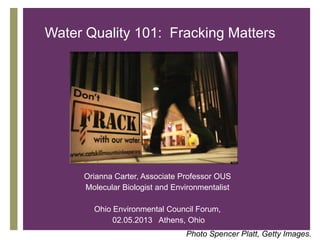
Water Quality 101: Fracking Matters


   +

       Orianna Carter, Associate Professor OUS
       Molecular Biologist and Environmentalist

         Ohio Environmental Council Forum,
              02.05.2013 Athens, Ohio
                                  Photo Spencer Platt, Getty Images.
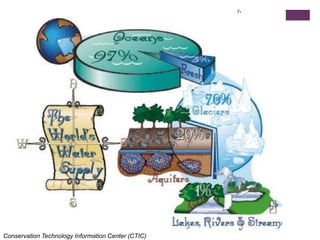
Conservation Technology Information Center (CTIC)
+                                              AP Photo by M.
                                               Hutmacher
                                               The Wichita Eagle,
―The 2012 Drought gripped
the USA as the widest since
1956―, National Oceanic and
Atmospheric Administration.

Over 55% of continental U.S.
experienced moderate to
extreme drought by July.


                               UNITED STATES
                               DROUGHT 2012
                               HuffPost Green Editors

                               Presented by
                                      Dr. Orianna Carter
+
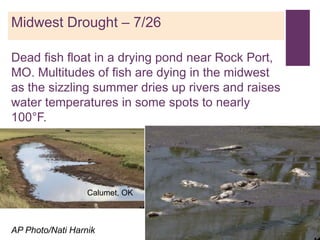
Midwest Drought – 7/26

Dead fish float in a drying pond near Rock Port,
MO. Multitudes of fish are dying in the midwest
as the sizzling summer dries up rivers and raises
water temperatures in some spots to nearly
100°F.


                  Calumet, OK


AP Photo/Nati Harnik
+
Noblesville, IN 7/16

Boats sit on the bottom of a dry cove at Morse
Reservoir, down 6‘ and lowering by 1‘ per 5 days
in efforts to provide water for drought-ridden
Indianapolis.


                  AP Photo/Michael Conroy
+
England, AK 7/27

The USDA granted a disaster declaration
for 69 of Arkansas' 75 counties due to the
drought.


   AP Photo/Danny Johnston
PRINCETON, IN – 7/17
+
Drought-damaged corn


The corn and soybean belt is
experiencing one of the worst
droughts in more than five decades.

              70% of Illinois, the nation's number two corn
              producing state, was classified as experiencing
              drought.

              Over 10 days of triple digit temperatures with
              little rain over 2 months forced many farmers to
              call 2012 a total loss.


Photo S. Olson/Getty Images
+Waltonville, IL 7/16

Illinois Gov. Pat Quinn (with Farm Bureau Pres.
Philip Nelson, R) says the state will offer an
array of debt restructuring and loan programs to
farmers and ranchers affected by the drought.


                                         AP Photo/Jim Suhr
+
     Water as a Sustainable Resource
        Fresh water is needed for human consumption, crop irrigation,
         animal stock and forestry

        Communities bear the burden of water contamination clean up,
         which costs many millions of taxpayer dollars.

        Understaffed EPA struggles to resolve toxic waste seepage at
         30,000 superfund sites which threaten our water supply

        Limited supply with the nation‘s aquifers being depleted in some
         areas by overuse

        Climate Change

        None of these problems are addressed by the gas industry which
         will be exacerbating each critical status


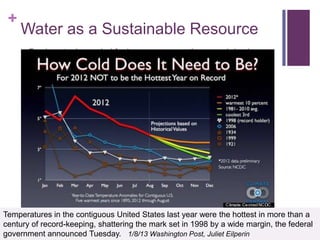
Temperatures in the contiguous United States last year were the hottest in more than a
century of record-keeping, shattering the mark set in 1998 by a wide margin, the federal
government announced Tuesday. 1/8/13 Washington Post, Juliet Eilperin
+
    What is a Watershed?
   Watershed:
       An area of land where all the water located within it drains into a
        common waterway.
       Includes groundwater and surface water

   Ohio Watershed Management (monitor, protect, restore):
       Headwaters - low regulation, high environmental sensitivity
       Middle reaches - human impact is significant
       Lakes - sediment & toxicity vulnerability
       Wetlands - filtering sponges, now protected in Ohio
       Ohio River & Lake Erie
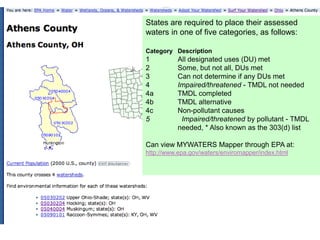
States are required to place their assessed
waters in one of five categories, as follows:

Category Description
1          All designated uses (DU) met
2          Some, but not all, DUs met
3          Can not determine if any DUs met
4          Impaired/threatened - TMDL not needed
4a         TMDL completed
4b         TMDL alternative
4c         Non-pollutant causes
5           Impaired/threatened by pollutant - TMDL
           needed, * Also known as the 303(d) list

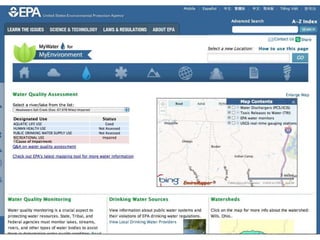
Can view MYWATERS Mapper through EPA at:
http://www.epa.gov/waters/enviromapper/index.html
WY
                      NE
                CO    KS


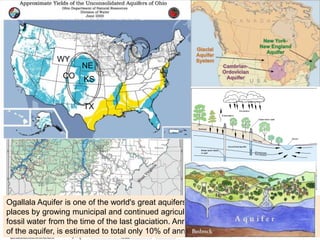
                      TX                               Ohio has abundant ground water
                                                       resources. Avg. rainfall 30-44‖ per
                                                       yr. Infiltration of 3-16‖ re- charges
                                                       our aquifers.


Ogallala Aquifer is one of the world's great aquifers, but is being rapidly depleted in
places by growing municipal and continued agricultural use. Ogallala contains primarily
fossil water from the time of the last glaciation. Annual recharge, in the more arid parts
of the aquifer, is estimated to total only 10% of annual depletion.
Nature study, published by researchers at McGill and Utrecht University in the
Netherlands, offers a map showing the regions where the use of water from these
aquifers vastly exceeds the rate at which they‘re being refilled by rain.
+                                                       Photo S. Platt, Getty


NYC - JANUARY 11.2012
Held on the City Hall steps, protestors
called for an end to controversial gas
drilling in growing alarm that
contamination of NY aquifers would
poison its public drinking water..                         shale rock

                                          Hydraulic Fracking Matters
+ Hydraulic Fracturing
                                      Under the authority granted in
 Ohio has 80,000 fractured wells, under the jurisdiction of
                                      Section 1509.32, any person
  ODNR, DMRM, and pertaining statutes containedmay file a written
                                      adversely affected in
                                      complaint with the chief. Although
  Chapter 1509 of the Ohio Revised Code (ORC). These
                                      this section specifically addresses
  laws were amended with Senate Bill 165, which became
                                      restoration violations, it is broadly
  effective on June 30, 2010.         applied for all violation. Division
                                      procedures require staff to address
                                      all complaints. A complaint may be
 Millions of gallons of high-pressure, chemical-laden e-mail, via
                                      received in writing, by
  water are pumped into an underground shale to free up
                                      phone, or in person. Complaints are
  natural gas.                        logged and tracked in an electronic
                                      log. Reports are maintained within
                                      the DMRM Risk Based Data
 Once fractures have been opened up in the rock and the
                                      Management System (RBDMS)
  water pressure is allowed to abate, and/or a hard copy complaint file.
                                       internal pressure
  from the rock causes fracking fluidsWhen water samplesthe collected
                                        to rise back to are
                                      and analyzed, analytical information
  surface, what the natural gas industry calls "flowback‖, a the
                                      is maintained (LIMS data), in
  briny mixture of minerals.          DMRM RBDMS-Water (RBDMS-W)
                                      data management system.
+
Mineral
Extraction

    3 Fossil Fuels:
        Coal
        Petroleum
        Natural Gas


    Marcellus Shale – major natural gas reservoir

    This industry is impacting our environment and waterways
+ Natural Gas
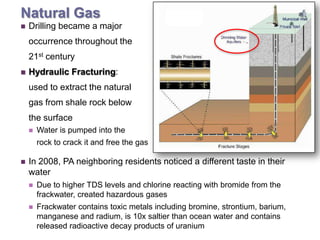
    Drilling became a major
     occurrence throughout the
     21st century
    Hydraulic Fracturing:
     used to extract the natural
     gas from shale rock below
     the surface
        Water is pumped into the
         rock to crack it and free the gas

    In 2008, PA neighboring residents noticed a different taste in their
     water
        Due to higher TDS levels and chlorine reacting with bromide from the
         frackwater, created hazardous gases
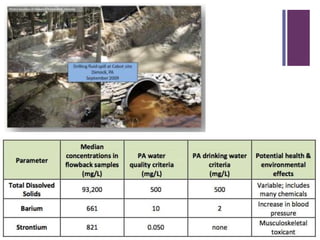
        Frackwater contains toxic metals including bromine, strontium, barium,
         manganese and radium, is 10x saltier than ocean water and contains
         released radioactive decay products of uranium
www.anga.us
+Fracking requires 5 million gallons of
water a ‗handful of times‘ per well

                              1000‘s Chemicals, still unknown, include
                                benzene, toluene and radioisotopes

                                Internal documents provide evidence
                               concrete failure rates are 6-7% in new
                                             drilled wells

                              Regulatory agencies cited (Clean Air and
                             Clean Water Acts; Safe Drinking Water Acts
                                        have limited powers

                              EPA environmental assessments are only
                                     on federal land, not yours

                               Benefits of low water usage & clean air
                             statistics referenced to coal fired plants, not
               www.anga.us             renewable energy sources
+Industry Response to Opponents
   Will disclose all chemicals used?
       Trade-secrets exempt from disclosure; harmful contaminants (heavy metals,
        radioactive material)) released to the surface.

   Optimizing the rules?
       Well casings known to fail over time as concrete degrades and pollutants leak into
        ecosystem, though new rules reduce well failure rates from 20 to 30 yrs.

   Minimizing/protecting groundwater, ensuring waste disposal?
       ―Solutions‖ include injecting flammable propane gel instead of water into wells. 30
        to 70% fracking wastes stays deep below ground, where fluid flow and displaced
        brines are associated with earth tremors. Remaining wastewater contaminants
        create risk to underground drinking water.

   Reducing the impact on roads, ecosystems and communities?
       1,000s truckloads per well –damaging infrastructure, turning rural communities into
        industrial sites. When industry leaves town, communities will be left with the legacy
        of pollution.
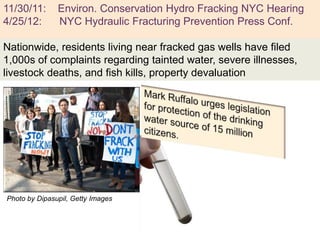
11/30/11:      Environ. Conservation Hydro Fracking NYC Hearing
 +
4/25/12:       NYC Hydraulic Fracturing Prevention Press Conf.

Nationwide, residents living near fracked gas wells have filed
1,000s of complaints regarding tainted water, severe illnesses,
livestock deaths, and fish kills, property devaluation


Photo by Dipasupil, Getty Images
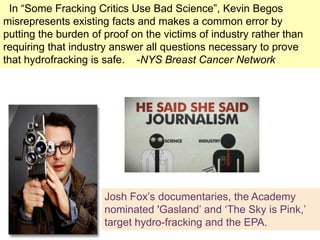
In ―Some Fracking Critics Use Bad Science‖, Kevin Begos
 +
misrepresents existing facts and makes a common error by
putting the burden of proof on the victims of industry rather than
requiring that industry answer all questions necessary to prove
that hydrofracking is safe. -NYS Breast Cancer Network


                      Josh Fox‘s documentaries, the Academy
                      nominated 'Gasland‘ and ‗The Sky is Pink,‘
                      target hydro-fracking and the EPA.
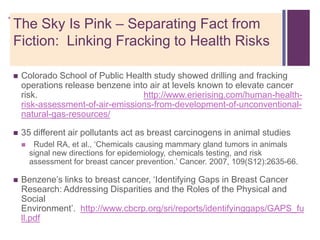
+The Sky Is Pink – Separating Fact from
Fiction: Linking Fracking to Health Risks

   Colorado School of Public Health study showed drilling and fracking
    operations release benzene into air at levels known to elevate cancer
    risk.                         http://www.erierising.com/human-health-
    risk-assessment-of-air-emissions-from-development-of-unconventional-
    natural-gas-resources/

   35 different air pollutants act as breast carcinogens in animal studies
        Rudel RA, et al., ‗Chemicals causing mammary gland tumors in animals
        signal new directions for epidemiology, chemicals testing, and risk
        assessment for breast cancer prevention.‘ Cancer. 2007, 109(S12):2635-66.

   Benzene‘s links to breast cancer, ‗Identifying Gaps in Breast Cancer
    Research: Addressing Disparities and the Roles of the Physical and
    Social
    Environment‘. http://www.cbcrp.org/sri/reports/identifyinggaps/GAPS_fu
    ll.pdf
+ burden of proof is on the nation‘s citizens
The

Linking groundwater pollution to Hydrofracking:

WY - EPA’s analysis of deep monitoring wells in aquifers show
synthetic chemicals (glycols and alcohols), consistent with gas
production and hydraulic fracturing fluids, benzene
concentrations well above Safe Drinking Water Act standards,
and high methane levels.
Linking earthquake incidence to Hydrofracking: LANCASHIRE –
                                   PRESTON,
OK, TX - Senior Research Scientist,10/07/11
                                     Cliff Frohlich, U Texas, Institute
Geophysics and USGS Seismologist, Oliver Boyd, concurred that the
latest string of Texas earthquakes show intense activity at fracking of
                                    Engineers on the drilling platform
epicenters and these events are notthe Cuadrilla shale fracking facility.
                                     coincidental.
                                   The controversial method has been
Data published on August 6, 2012 inblamed for two minor earthquakes in
                                    Journal Proceedings of the
National Academy of Sciences.      the surrounding region.
+
      Fracking Linked to Earthquakes
   Oklahoma‘s strongest recorded quake was in 2011, along with 180 minor
    tremors in TX occurred 10/08 thru 5/09.

   Seismologist Cliff Frohlich at U Tex-Austin analyzed seismic activity in shale
    in northern Texas and identified epicenters for 67 earthquakes — more than
    8X as many as reported by the National Earthquake Information Center —
    with magnitudes of 3.0 or less located within a few miles of one or more
    injection wells.

   All of the wells nearest the epicenters reported high rates of injection
    exceeding 150,000 barrels (17.6 million liters) of water per month.

   Data published on August 6, 2012 in Journal Proceedings of the National
    Academy of Sciences.
After Range Resources Protest
                          Assoc. Press By RAMIT PLUSHNICK-MASTI
    01/16/2013
•    2010-Fort Worth, TX: Reported drinking water "bubbling‖,
     federal government issued rare emergency order -
     homeowners were in immediate danger from wells saturated
     with flammable methane. As the case went to court, EPA hired
     a scientist to perform tests which linked nearby drilling activities
     to contaminated water.
       •   2012-EPA rescinded order, against their own compiled scientific
           evidence (confidential reports & interviews obtained by Assoc. Press).
       •                                 +
           Representing Range Resources, Attorney, D. Poole informed EPA
           officials in DC if EPA pursued a "scientifically baseless" action against
           them, Range Resources would refuse access to their drilling site for a
           national study on effects of hydraulic fracking.

•    2011- WY: EPA again linked hydraulic fracturing operations to
     water contamination and then softened its position after
     industry & GOP protested.
       •   In both cases, EPA refused to answer questions, stating it was shifting
           its ―focus away from litigation and toward a joint effort on the science
           and safety of energy extraction.‖
+


   Costs to owner of the contaminated TX well: $1,000/month to haul safe
    water.

   Another scientist investigating the TX contamination, Rob Jackson, Global
    Environment Change, Duke U., stated EPA‘s withdrawal was unusual as
    the gas could have originated from nearby gas extractions in the Barnett
    shale.
       Range Resources responded that isotopic testing is invalid, can‘t distinguish
        shale gas from other rock formations and natural gas migration.
       Range Resources insists happening since long before they arrived. Jackson
        noted it‘s "unrealistic" to suggest people could have tainted water and not notice.
       Range Resources accused all individuals whose investigations linked their drilling
        activities to the contaminated wells as ‗anti-industry‘.
+Disturbing Responses to Fracking

 Nationwide:1st major U.S. insurer to announce it won‘t cover
 fracking damage. According to internal memos, "We have
 determined that the exposures presented by hydraulic fracturing
 are too great to ignore.‖

 Global  Water: Oil and Gas Summit, Dubai 2012, water industry
 declares fracking will be the largest sector for profiting – a multi-
 billion dollar market.
    Companies make money both ends:
      selling water to drillers

      treating the toxic wastewater.


    Financial services industry: in on the action of trading polluted water!
Protests in Ohio – ecowatch.org
+
    Nov. 28, 2012: ODNR Public hearing request on proposed Athens
     County, Atha Class II injection well permit, by 50+ community
     members inside an ―open house‖ information forum was denied.
        Fracking waste dump into Class II wells (highly toxic toluene, benzene, and
         other neurotoxic, carcinogenic, and radioactive substances), regulated
         as hazardous (except oil & gas) under the Safe Drinking Water Act, Clean
         Water Act and hazardous waste regulations.‖
        ACFAN (Athens County Fracking Action Network) 100,000,000s gallons of
         highly radioactive fracking waste have been injected in Ohio injection wells
         in the past year. Nancy Pierce states, ―Ohio does not monitor drinking or
         groundwater around any Class II injection wells.‖

    Energy in Depth Ohio website, 11/30/13: ―ODNR‘s event was a
     positive opportunity for citizens around Athens County to learn more
     about Class II injection wells, and submit comments for public
     record. With only 30 people entering the building with no intention of
     gaining knowledge on the subject, it‘s clear there is a strong number of
     people in the Athens area eager to learn more about injection wells
     and the growing oil and gas industry in Ohio.‖
+
30,000,000,000,000 gals of waste
water injected underground in USA
    "In 10 to 100 years we are going to find out that most of our
     groundwater is polluted," said Mario Salazar, an engineer who
     worked for 25 years as a technical expert with the EPA's
     underground injection program in Washington. "A lot of people
     are going to get sick, and a lot of people may die.‖

    A ProPublica review of well records, case histories and
     government summaries of more than 220,000 well inspections
     found that structural failures inside injection wells are routine.
     From late 2007 to late 2010, one well integrity violation was
     issued for every six deep injection wells examined — more
     than 17,000 violations nationally.

    ‗THE POISON BENEATH US‘
+How to Cope With Hydrofracking in Your
 Neighborhood?
     Check   your water quality, often.
     Know    where your meat comes from.
     Keep   masks in your house in case air
      quality is low during high hydro-fracking
      activity.
     Be   earthquake ready.
     Move.


                                           WikiHow
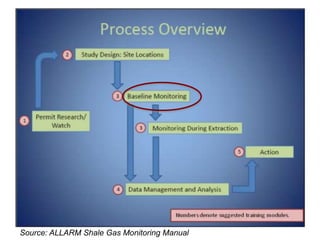
Source: ALLARM Shale Gas Monitoring Manual
+
    Taking Action, Keeping Safe
       Routinely run tests on tap water using test kits.

       Record baselines into data system.

       Remarkable values should be retested by a laboratory for a detailed
        analysis.

       Consider testing water sources surrounding residential homes using
        hand held meters and/or test kits provided by certified laboratory.

       Record detailed water data and report anything significant to EPA.

       Seek remedial efforts through local water company notifications and/or
        independently for private water supplies.

       Contact Advocacy Groups.
+
    Causes of Water Quality Change


       Water Quality:
         Describesthe health of a water body based on
         chemical, biological, and physical characteristics


       Two types of pollution:


         Point-sourcepollution
         Nonpoint-source pollution
+


       Section 1509.22 Ohio Revised Code gives authority to require an
        owner/operator of an oil/gas well to replace a water supply
        substantially disrupted by contamination, diminution or interruption
        resulting from oil and gas operation.

       Water well log records or call ODNR 614-265-6740
           www.ohiodnr.com/water/maptechs/wellogs/appNEW/
+
+
    Conductivity


       Measure of the water‘s ability to conduct an electrical current

       Depends directly on the amount of total dissolved solids (TDS)
        in the water
           Example: Saltwater has a higher conductivity than distilled water

       High levels alter the smell and taste of drinking water

       Causes gastrointestinal problems for humans

       Harmful for agriculture when used for irrigation
+
    Total Dissolved Solids - TDS


       Dissolved inorganic & organic substances, acceptable levels for
        human drinking water is 100 mg/l

       Major Contributors:
           Bicarbonate, Calcium, Silica, Chlorine, Magnesium, Phosphate
           organic based: detergents, disinfectants, pesticides, petroleum,
            industrial solvents
           inorganic based: fertilizers, NH3, chemical plant waste, pH change,
            urban run-off

       TDS levels can indicate increased levels of toxic substances

       Gives water a salty or metallic taste

       Usually calculated from conductivity using a conversion factor
           Ranges from 0.54-0.96
+How to monitor your tap water?
   Test early to establish a baseline for certain markers of tap water, stream
    or watershed health. Document location, time, date.

   Drilling wastewater includes salty brine and metals - take pH and
    conductivity readings when collecting samples.

   Collecting baseline data will make it easier to connect pollution to a new
    well. The goal of monitoring is to collect a year‘s worth of readings
    before any wells are drilled nearby.

   Measuring of two indicators - conductivity and TDS – which rise
    dramatically when streams are contaminated with fracking wastewater.

   Record your data. If those numbers triple, that amounts to a problem.

   High levels need to be sent to a laboratory for further testing. For oil/gas
    drilling, these might include:
       chlorides, sodium, barium, lead, pH, corrosion index, strontium, dissolved
        methane
+
                              Collecting Samples
                               For Lab Analysis
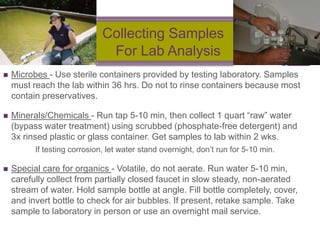
   Microbes - Use sterile containers provided by testing laboratory. Samples
    must reach the lab within 36 hrs. Do not to rinse containers because most
    contain preservatives.

   Minerals/Chemicals - Run tap 5-10 min, then collect 1 quart ―raw‖ water
    (bypass water treatment) using scrubbed (phosphate-free detergent) and
    3x rinsed plastic or glass container. Get samples to lab within 2 wks.
          If testing corrosion, let water stand overnight, don‘t run for 5-10 min.

   Special care for organics - Volatile, do not aerate. Run water 5-10 min,
    carefully collect from partially closed faucet in slow steady, non-aerated
    stream of water. Hold sample bottle at angle. Fill bottle completely, cover,
    and invert bottle to check for air bubbles. If present, retake sample. Take
    sample to laboratory in person or use an overnight mail service.
OEPA stores statewide ambient natural ground water data, & health implications for
each chemical: http://water.epa.gov/drink/contaminants/basicinformation/index.cfm
+
    Finding Laboratory Test Facilities
       Link to a water analysis interpretive tool:
           www.ndsu.edu/waterquality

       National Testing Laboratories:
           http://www.ntllabs.com/residential.html

       State Certified Laboratories:
           http://water.epa.gov/scitech/drinkingwater/labcert/statecertification.cfm

       Voinovich School & Russ College of Engineering
           Institute for Sustainable Energy and the Environment Laboratory

       Sierra Club of Ohio, Clean Water Program

       Local health districts or soil and water conservation offices
+ Laboratory Water Sample Parameters -
 Analysis of Physical and Chemical
 Tier   I - $170.00
  Barium,  Cl, Mg, K, Na, Stromium, S, TDS, Conductivity,
     Bromide

 Tier   II - $229.00
  Tier   I plus Ca, hardness, alkalinity, pH, Fe, Mn, Bromide

 Tier   III - $344.00
  Tier I & II plus
  BTEX (benzene, toluene, xylene, ethylbenzene, methane)
  VOC (Volatile Organics)

 *Recommended    by Am. Assoc. of Pediatrics be performed
 regularly before and during oil/gas drilling
User's Guide


Test Strips & Meters
+
Hand-held meters                                            ExStik® EC400
                                                            Conductivity / TDS / Salinity / Temperature
                                                            Meter

Features

•   Measures conductivity, TDS, salinity, and temperature
•   8 selectable unit: µS, mS, ppm, ppt, mg/L, g/L, °C and °F
•   Adjustable Conductivity to TDS ratio factor from 0.4 to 1.0
•   Large 3-1/2 digit display w/analog bar graph indicating trends              MODE
                                                                                HOLD


•   Data Hold, Auto Power off and low battery indication
•   Automatic Temperature Compensation of 2% per degree
•   Simultaneous display of Conductivity or TDS plus Temperature
•   Internal memory stores up to 15 readings for easy recall
•   Self calibration of electronics on power up
•   Easy to replace Conductivity cell module
•   Waterproof to IP57
•   Starting at $104.99
•   Kit option available (savings of $15)


                                                                           Order strips from:
                                                                           Omega.com
+
+ OEPA Environmental Laboratory
  Services
    Athens County Environmental Protection Agency (EPA)
        (740) 385-8501
        http:// www.epa.state.oh.us/sedo/x_athens.htm.

    ODNR‘s Div. of Mineral Resources Management mission to regulate,
     restore and protect requires regular laboratory analysis of samples to
     monitor the safety of Ohio's citizens and environment. The DMRM
     operates the Ohio EPA Drinking Water certified laboratories.

  OEPA 24-hr         emergency response hotline 1-800-282-9378
        Accidental or unauthorized releases of contaminants to the air,
         land or water such as spills, releases, intentional dumping or
         emissions.
+ Water Quality Resources
 Advocacy     Groups:
  Environmental Working Group: www.ewg.org
  Citizens Campaignwww.citizenscampaign.org/campaigns/hydro-
     fracking.asp
    Center for Health, Environment & Justice:
     http://chej.org/nofracking/ohio/
  Ohio   Chapter Sierra Club to join water monitoring:
      Ben.wickizer@sierraclub.org
      purplespirit@wildmail.com

 Local
     resource for Athens water stream health- MYWATERS
 Mapper:
    http://www.epa.gov/myenv/myenview2.html?minx=-
     82.19627&miny=39.29499&maxx=-
     82.00573&maxy=39.36271&ve=12,39.32850,-
     82.10444&pSearch=Athens,%20OH
+
    Taking Action, Keeping Safe
       Routinely run tests on tap water using test kits.

       Record baselines into data system.

       Remarkable values should be retested by a laboratory for a detailed
        analysis.

       Consider testing water sources surrounding residential homes using
        hand held meters and/or test kits provided by certified laboratory.

       Record detailed water data and report anything significant to EPA.

       Seek remedial efforts through local water company notifications and/or
        independently for private water supplies.

       Contact Ohio Dept. of Natural Resources, EPA, advocacy groups.
+
    Dr. Carter‘s Resources
       Josh Fox - http://www.gaslandthemovie.com/blog/?p=119

       USGS Science School - http://ga.water.usgs.gov/edu/gwdepletion.html

       Alliance Aquatic Resource Monitoring (ALLARM), Dickinson College, PA

       River Alert Information Network (RAIN) - www.3rain.org/education

       Mitchell, M. et al., ―Field Manual For Water Quality Monitoring‖ 1994

       American Natural Gas Alliance - www.anga.us

       Ohio EPA – www.epa.state.oh.us/

       HuffingtonPost - Green editors

       ―The Poison Beneath Us‖, Pro-Publica, 6-12-12

       Citizens Campaign
           http://www.citizenscampaign.org/campaigns/hydro-fracking.asp

       Sierra Club Ohio Chapter
           http://www.facebook.com/pages/Sierra-Club-Ohio-Chapter/342322600532

Fracking & Water Quality 101

  • 1.
    Water Quality 101:Fracking Matters + Orianna Carter, Associate Professor OUS Molecular Biologist and Environmentalist Ohio Environmental Council Forum, 02.05.2013 Athens, Ohio Photo Spencer Platt, Getty Images.
  • 2.
  • 3.
    + AP Photo by M. Hutmacher The Wichita Eagle, ―The 2012 Drought gripped the USA as the widest since 1956―, National Oceanic and Atmospheric Administration. Over 55% of continental U.S. experienced moderate to extreme drought by July. UNITED STATES DROUGHT 2012 HuffPost Green Editors Presented by Dr. Orianna Carter
  • 4.
    + Midwest Drought –7/26 Dead fish float in a drying pond near Rock Port, MO. Multitudes of fish are dying in the midwest as the sizzling summer dries up rivers and raises water temperatures in some spots to nearly 100°F. Calumet, OK AP Photo/Nati Harnik
  • 5.
    + Noblesville, IN 7/16 Boatssit on the bottom of a dry cove at Morse Reservoir, down 6‘ and lowering by 1‘ per 5 days in efforts to provide water for drought-ridden Indianapolis. AP Photo/Michael Conroy
  • 6.
    + England, AK 7/27 TheUSDA granted a disaster declaration for 69 of Arkansas' 75 counties due to the drought. AP Photo/Danny Johnston
  • 7.
    PRINCETON, IN –7/17 + Drought-damaged corn The corn and soybean belt is experiencing one of the worst droughts in more than five decades. 70% of Illinois, the nation's number two corn producing state, was classified as experiencing drought. Over 10 days of triple digit temperatures with little rain over 2 months forced many farmers to call 2012 a total loss. Photo S. Olson/Getty Images
  • 8.
    +Waltonville, IL 7/16 IllinoisGov. Pat Quinn (with Farm Bureau Pres. Philip Nelson, R) says the state will offer an array of debt restructuring and loan programs to farmers and ranchers affected by the drought. AP Photo/Jim Suhr
  • 9.
    + Water as a Sustainable Resource  Fresh water is needed for human consumption, crop irrigation, animal stock and forestry  Communities bear the burden of water contamination clean up, which costs many millions of taxpayer dollars.  Understaffed EPA struggles to resolve toxic waste seepage at 30,000 superfund sites which threaten our water supply  Limited supply with the nation‘s aquifers being depleted in some areas by overuse  Climate Change  None of these problems are addressed by the gas industry which will be exacerbating each critical status Temperatures in the contiguous United States last year were the hottest in more than a century of record-keeping, shattering the mark set in 1998 by a wide margin, the federal government announced Tuesday. 1/8/13 Washington Post, Juliet Eilperin
  • 10.
    + What is a Watershed?  Watershed:  An area of land where all the water located within it drains into a common waterway.  Includes groundwater and surface water  Ohio Watershed Management (monitor, protect, restore):  Headwaters - low regulation, high environmental sensitivity  Middle reaches - human impact is significant  Lakes - sediment & toxicity vulnerability  Wetlands - filtering sponges, now protected in Ohio  Ohio River & Lake Erie
  • 11.
    States are requiredto place their assessed waters in one of five categories, as follows: Category Description 1 All designated uses (DU) met 2 Some, but not all, DUs met 3 Can not determine if any DUs met 4 Impaired/threatened - TMDL not needed 4a TMDL completed 4b TMDL alternative 4c Non-pollutant causes 5 Impaired/threatened by pollutant - TMDL needed, * Also known as the 303(d) list Can view MYWATERS Mapper through EPA at: http://www.epa.gov/waters/enviromapper/index.html
  • 12.
    WY NE CO KS TX Ohio has abundant ground water resources. Avg. rainfall 30-44‖ per yr. Infiltration of 3-16‖ re- charges our aquifers. Ogallala Aquifer is one of the world's great aquifers, but is being rapidly depleted in places by growing municipal and continued agricultural use. Ogallala contains primarily fossil water from the time of the last glaciation. Annual recharge, in the more arid parts of the aquifer, is estimated to total only 10% of annual depletion.
  • 13.
    Nature study, publishedby researchers at McGill and Utrecht University in the Netherlands, offers a map showing the regions where the use of water from these aquifers vastly exceeds the rate at which they‘re being refilled by rain.
  • 14.
    + Photo S. Platt, Getty NYC - JANUARY 11.2012 Held on the City Hall steps, protestors called for an end to controversial gas drilling in growing alarm that contamination of NY aquifers would poison its public drinking water.. shale rock Hydraulic Fracking Matters
  • 15.
    + Hydraulic Fracturing Under the authority granted in  Ohio has 80,000 fractured wells, under the jurisdiction of Section 1509.32, any person ODNR, DMRM, and pertaining statutes containedmay file a written adversely affected in complaint with the chief. Although Chapter 1509 of the Ohio Revised Code (ORC). These this section specifically addresses laws were amended with Senate Bill 165, which became restoration violations, it is broadly effective on June 30, 2010. applied for all violation. Division procedures require staff to address all complaints. A complaint may be  Millions of gallons of high-pressure, chemical-laden e-mail, via received in writing, by water are pumped into an underground shale to free up phone, or in person. Complaints are natural gas. logged and tracked in an electronic log. Reports are maintained within the DMRM Risk Based Data  Once fractures have been opened up in the rock and the Management System (RBDMS) water pressure is allowed to abate, and/or a hard copy complaint file. internal pressure from the rock causes fracking fluidsWhen water samplesthe collected to rise back to are and analyzed, analytical information surface, what the natural gas industry calls "flowback‖, a the is maintained (LIMS data), in briny mixture of minerals. DMRM RBDMS-Water (RBDMS-W) data management system.
  • 16.
    + Mineral Extraction  3 Fossil Fuels:  Coal  Petroleum  Natural Gas  Marcellus Shale – major natural gas reservoir  This industry is impacting our environment and waterways
  • 17.
    + Natural Gas  Drilling became a major occurrence throughout the 21st century  Hydraulic Fracturing: used to extract the natural gas from shale rock below the surface  Water is pumped into the rock to crack it and free the gas  In 2008, PA neighboring residents noticed a different taste in their water  Due to higher TDS levels and chlorine reacting with bromide from the frackwater, created hazardous gases  Frackwater contains toxic metals including bromine, strontium, barium, manganese and radium, is 10x saltier than ocean water and contains released radioactive decay products of uranium
  • 18.
  • 19.
    +Fracking requires 5million gallons of water a ‗handful of times‘ per well 1000‘s Chemicals, still unknown, include benzene, toluene and radioisotopes Internal documents provide evidence concrete failure rates are 6-7% in new drilled wells Regulatory agencies cited (Clean Air and Clean Water Acts; Safe Drinking Water Acts have limited powers EPA environmental assessments are only on federal land, not yours Benefits of low water usage & clean air statistics referenced to coal fired plants, not www.anga.us renewable energy sources
  • 20.
    +Industry Response toOpponents  Will disclose all chemicals used?  Trade-secrets exempt from disclosure; harmful contaminants (heavy metals, radioactive material)) released to the surface.  Optimizing the rules?  Well casings known to fail over time as concrete degrades and pollutants leak into ecosystem, though new rules reduce well failure rates from 20 to 30 yrs.  Minimizing/protecting groundwater, ensuring waste disposal?  ―Solutions‖ include injecting flammable propane gel instead of water into wells. 30 to 70% fracking wastes stays deep below ground, where fluid flow and displaced brines are associated with earth tremors. Remaining wastewater contaminants create risk to underground drinking water.  Reducing the impact on roads, ecosystems and communities?  1,000s truckloads per well –damaging infrastructure, turning rural communities into industrial sites. When industry leaves town, communities will be left with the legacy of pollution.
  • 21.
    11/30/11: Environ. Conservation Hydro Fracking NYC Hearing + 4/25/12: NYC Hydraulic Fracturing Prevention Press Conf. Nationwide, residents living near fracked gas wells have filed 1,000s of complaints regarding tainted water, severe illnesses, livestock deaths, and fish kills, property devaluation Photo by Dipasupil, Getty Images
  • 22.
    In ―Some FrackingCritics Use Bad Science‖, Kevin Begos + misrepresents existing facts and makes a common error by putting the burden of proof on the victims of industry rather than requiring that industry answer all questions necessary to prove that hydrofracking is safe. -NYS Breast Cancer Network Josh Fox‘s documentaries, the Academy nominated 'Gasland‘ and ‗The Sky is Pink,‘ target hydro-fracking and the EPA.
  • 23.
    +The Sky IsPink – Separating Fact from Fiction: Linking Fracking to Health Risks  Colorado School of Public Health study showed drilling and fracking operations release benzene into air at levels known to elevate cancer risk. http://www.erierising.com/human-health- risk-assessment-of-air-emissions-from-development-of-unconventional- natural-gas-resources/  35 different air pollutants act as breast carcinogens in animal studies  Rudel RA, et al., ‗Chemicals causing mammary gland tumors in animals signal new directions for epidemiology, chemicals testing, and risk assessment for breast cancer prevention.‘ Cancer. 2007, 109(S12):2635-66.  Benzene‘s links to breast cancer, ‗Identifying Gaps in Breast Cancer Research: Addressing Disparities and the Roles of the Physical and Social Environment‘. http://www.cbcrp.org/sri/reports/identifyinggaps/GAPS_fu ll.pdf
  • 24.
    + burden ofproof is on the nation‘s citizens The Linking groundwater pollution to Hydrofracking: WY - EPA’s analysis of deep monitoring wells in aquifers show synthetic chemicals (glycols and alcohols), consistent with gas production and hydraulic fracturing fluids, benzene concentrations well above Safe Drinking Water Act standards, and high methane levels. Linking earthquake incidence to Hydrofracking: LANCASHIRE – PRESTON, OK, TX - Senior Research Scientist,10/07/11 Cliff Frohlich, U Texas, Institute Geophysics and USGS Seismologist, Oliver Boyd, concurred that the latest string of Texas earthquakes show intense activity at fracking of Engineers on the drilling platform epicenters and these events are notthe Cuadrilla shale fracking facility. coincidental. The controversial method has been Data published on August 6, 2012 inblamed for two minor earthquakes in Journal Proceedings of the National Academy of Sciences. the surrounding region.
  • 25.
    + Fracking Linked to Earthquakes  Oklahoma‘s strongest recorded quake was in 2011, along with 180 minor tremors in TX occurred 10/08 thru 5/09.  Seismologist Cliff Frohlich at U Tex-Austin analyzed seismic activity in shale in northern Texas and identified epicenters for 67 earthquakes — more than 8X as many as reported by the National Earthquake Information Center — with magnitudes of 3.0 or less located within a few miles of one or more injection wells.  All of the wells nearest the epicenters reported high rates of injection exceeding 150,000 barrels (17.6 million liters) of water per month.  Data published on August 6, 2012 in Journal Proceedings of the National Academy of Sciences.
  • 26.
    After Range ResourcesProtest Assoc. Press By RAMIT PLUSHNICK-MASTI 01/16/2013 • 2010-Fort Worth, TX: Reported drinking water "bubbling‖, federal government issued rare emergency order - homeowners were in immediate danger from wells saturated with flammable methane. As the case went to court, EPA hired a scientist to perform tests which linked nearby drilling activities to contaminated water. • 2012-EPA rescinded order, against their own compiled scientific evidence (confidential reports & interviews obtained by Assoc. Press). • + Representing Range Resources, Attorney, D. Poole informed EPA officials in DC if EPA pursued a "scientifically baseless" action against them, Range Resources would refuse access to their drilling site for a national study on effects of hydraulic fracking. • 2011- WY: EPA again linked hydraulic fracturing operations to water contamination and then softened its position after industry & GOP protested. • In both cases, EPA refused to answer questions, stating it was shifting its ―focus away from litigation and toward a joint effort on the science and safety of energy extraction.‖
  • 27.
    +  Costs to owner of the contaminated TX well: $1,000/month to haul safe water.  Another scientist investigating the TX contamination, Rob Jackson, Global Environment Change, Duke U., stated EPA‘s withdrawal was unusual as the gas could have originated from nearby gas extractions in the Barnett shale.  Range Resources responded that isotopic testing is invalid, can‘t distinguish shale gas from other rock formations and natural gas migration.  Range Resources insists happening since long before they arrived. Jackson noted it‘s "unrealistic" to suggest people could have tainted water and not notice.  Range Resources accused all individuals whose investigations linked their drilling activities to the contaminated wells as ‗anti-industry‘.
  • 28.
    +Disturbing Responses toFracking  Nationwide:1st major U.S. insurer to announce it won‘t cover fracking damage. According to internal memos, "We have determined that the exposures presented by hydraulic fracturing are too great to ignore.‖  Global Water: Oil and Gas Summit, Dubai 2012, water industry declares fracking will be the largest sector for profiting – a multi- billion dollar market.  Companies make money both ends:  selling water to drillers  treating the toxic wastewater.  Financial services industry: in on the action of trading polluted water!
  • 29.
    Protests in Ohio– ecowatch.org +  Nov. 28, 2012: ODNR Public hearing request on proposed Athens County, Atha Class II injection well permit, by 50+ community members inside an ―open house‖ information forum was denied.  Fracking waste dump into Class II wells (highly toxic toluene, benzene, and other neurotoxic, carcinogenic, and radioactive substances), regulated as hazardous (except oil & gas) under the Safe Drinking Water Act, Clean Water Act and hazardous waste regulations.‖  ACFAN (Athens County Fracking Action Network) 100,000,000s gallons of highly radioactive fracking waste have been injected in Ohio injection wells in the past year. Nancy Pierce states, ―Ohio does not monitor drinking or groundwater around any Class II injection wells.‖  Energy in Depth Ohio website, 11/30/13: ―ODNR‘s event was a positive opportunity for citizens around Athens County to learn more about Class II injection wells, and submit comments for public record. With only 30 people entering the building with no intention of gaining knowledge on the subject, it‘s clear there is a strong number of people in the Athens area eager to learn more about injection wells and the growing oil and gas industry in Ohio.‖
  • 30.
    + 30,000,000,000,000 gals ofwaste water injected underground in USA  "In 10 to 100 years we are going to find out that most of our groundwater is polluted," said Mario Salazar, an engineer who worked for 25 years as a technical expert with the EPA's underground injection program in Washington. "A lot of people are going to get sick, and a lot of people may die.‖  A ProPublica review of well records, case histories and government summaries of more than 220,000 well inspections found that structural failures inside injection wells are routine. From late 2007 to late 2010, one well integrity violation was issued for every six deep injection wells examined — more than 17,000 violations nationally.  ‗THE POISON BENEATH US‘
  • 31.
    +How to CopeWith Hydrofracking in Your Neighborhood?  Check your water quality, often.  Know where your meat comes from.  Keep masks in your house in case air quality is low during high hydro-fracking activity.  Be earthquake ready.  Move. WikiHow
  • 32.
    Source: ALLARM ShaleGas Monitoring Manual
  • 33.
    + Taking Action, Keeping Safe  Routinely run tests on tap water using test kits.  Record baselines into data system.  Remarkable values should be retested by a laboratory for a detailed analysis.  Consider testing water sources surrounding residential homes using hand held meters and/or test kits provided by certified laboratory.  Record detailed water data and report anything significant to EPA.  Seek remedial efforts through local water company notifications and/or independently for private water supplies.  Contact Advocacy Groups.
  • 34.
    + Causes of Water Quality Change  Water Quality:  Describesthe health of a water body based on chemical, biological, and physical characteristics  Two types of pollution:  Point-sourcepollution  Nonpoint-source pollution
  • 35.
    +  Section 1509.22 Ohio Revised Code gives authority to require an owner/operator of an oil/gas well to replace a water supply substantially disrupted by contamination, diminution or interruption resulting from oil and gas operation.  Water well log records or call ODNR 614-265-6740  www.ohiodnr.com/water/maptechs/wellogs/appNEW/
  • 36.
  • 37.
    + Conductivity  Measure of the water‘s ability to conduct an electrical current  Depends directly on the amount of total dissolved solids (TDS) in the water  Example: Saltwater has a higher conductivity than distilled water  High levels alter the smell and taste of drinking water  Causes gastrointestinal problems for humans  Harmful for agriculture when used for irrigation
  • 38.
    + Total Dissolved Solids - TDS  Dissolved inorganic & organic substances, acceptable levels for human drinking water is 100 mg/l  Major Contributors:  Bicarbonate, Calcium, Silica, Chlorine, Magnesium, Phosphate  organic based: detergents, disinfectants, pesticides, petroleum, industrial solvents  inorganic based: fertilizers, NH3, chemical plant waste, pH change, urban run-off  TDS levels can indicate increased levels of toxic substances  Gives water a salty or metallic taste  Usually calculated from conductivity using a conversion factor  Ranges from 0.54-0.96
  • 39.
    +How to monitoryour tap water?  Test early to establish a baseline for certain markers of tap water, stream or watershed health. Document location, time, date.  Drilling wastewater includes salty brine and metals - take pH and conductivity readings when collecting samples.  Collecting baseline data will make it easier to connect pollution to a new well. The goal of monitoring is to collect a year‘s worth of readings before any wells are drilled nearby.  Measuring of two indicators - conductivity and TDS – which rise dramatically when streams are contaminated with fracking wastewater.  Record your data. If those numbers triple, that amounts to a problem.  High levels need to be sent to a laboratory for further testing. For oil/gas drilling, these might include:  chlorides, sodium, barium, lead, pH, corrosion index, strontium, dissolved methane
  • 40.
    + Collecting Samples For Lab Analysis  Microbes - Use sterile containers provided by testing laboratory. Samples must reach the lab within 36 hrs. Do not to rinse containers because most contain preservatives.  Minerals/Chemicals - Run tap 5-10 min, then collect 1 quart ―raw‖ water (bypass water treatment) using scrubbed (phosphate-free detergent) and 3x rinsed plastic or glass container. Get samples to lab within 2 wks. If testing corrosion, let water stand overnight, don‘t run for 5-10 min.  Special care for organics - Volatile, do not aerate. Run water 5-10 min, carefully collect from partially closed faucet in slow steady, non-aerated stream of water. Hold sample bottle at angle. Fill bottle completely, cover, and invert bottle to check for air bubbles. If present, retake sample. Take sample to laboratory in person or use an overnight mail service.
  • 41.
    OEPA stores statewideambient natural ground water data, & health implications for each chemical: http://water.epa.gov/drink/contaminants/basicinformation/index.cfm
  • 42.
    + Finding Laboratory Test Facilities  Link to a water analysis interpretive tool:  www.ndsu.edu/waterquality  National Testing Laboratories:  http://www.ntllabs.com/residential.html  State Certified Laboratories:  http://water.epa.gov/scitech/drinkingwater/labcert/statecertification.cfm  Voinovich School & Russ College of Engineering  Institute for Sustainable Energy and the Environment Laboratory  Sierra Club of Ohio, Clean Water Program  Local health districts or soil and water conservation offices
  • 43.
    + Laboratory WaterSample Parameters - Analysis of Physical and Chemical  Tier I - $170.00  Barium, Cl, Mg, K, Na, Stromium, S, TDS, Conductivity, Bromide  Tier II - $229.00  Tier I plus Ca, hardness, alkalinity, pH, Fe, Mn, Bromide  Tier III - $344.00  Tier I & II plus  BTEX (benzene, toluene, xylene, ethylbenzene, methane)  VOC (Volatile Organics)  *Recommended by Am. Assoc. of Pediatrics be performed regularly before and during oil/gas drilling
  • 44.
    User's Guide Test Strips& Meters + Hand-held meters ExStik® EC400 Conductivity / TDS / Salinity / Temperature Meter Features • Measures conductivity, TDS, salinity, and temperature • 8 selectable unit: µS, mS, ppm, ppt, mg/L, g/L, °C and °F • Adjustable Conductivity to TDS ratio factor from 0.4 to 1.0 • Large 3-1/2 digit display w/analog bar graph indicating trends MODE HOLD • Data Hold, Auto Power off and low battery indication • Automatic Temperature Compensation of 2% per degree • Simultaneous display of Conductivity or TDS plus Temperature • Internal memory stores up to 15 readings for easy recall • Self calibration of electronics on power up • Easy to replace Conductivity cell module • Waterproof to IP57 • Starting at $104.99 • Kit option available (savings of $15) Order strips from: Omega.com
  • 45.
  • 46.
    + OEPA EnvironmentalLaboratory Services  Athens County Environmental Protection Agency (EPA)  (740) 385-8501  http:// www.epa.state.oh.us/sedo/x_athens.htm.  ODNR‘s Div. of Mineral Resources Management mission to regulate, restore and protect requires regular laboratory analysis of samples to monitor the safety of Ohio's citizens and environment. The DMRM operates the Ohio EPA Drinking Water certified laboratories.  OEPA 24-hr emergency response hotline 1-800-282-9378  Accidental or unauthorized releases of contaminants to the air, land or water such as spills, releases, intentional dumping or emissions.
  • 48.
    + Water QualityResources  Advocacy Groups:  Environmental Working Group: www.ewg.org  Citizens Campaignwww.citizenscampaign.org/campaigns/hydro- fracking.asp  Center for Health, Environment & Justice: http://chej.org/nofracking/ohio/  Ohio Chapter Sierra Club to join water monitoring:  Ben.wickizer@sierraclub.org  purplespirit@wildmail.com  Local resource for Athens water stream health- MYWATERS Mapper:  http://www.epa.gov/myenv/myenview2.html?minx=- 82.19627&miny=39.29499&maxx=- 82.00573&maxy=39.36271&ve=12,39.32850,- 82.10444&pSearch=Athens,%20OH
  • 50.
    + Taking Action, Keeping Safe  Routinely run tests on tap water using test kits.  Record baselines into data system.  Remarkable values should be retested by a laboratory for a detailed analysis.  Consider testing water sources surrounding residential homes using hand held meters and/or test kits provided by certified laboratory.  Record detailed water data and report anything significant to EPA.  Seek remedial efforts through local water company notifications and/or independently for private water supplies.  Contact Ohio Dept. of Natural Resources, EPA, advocacy groups.
  • 52.
    + Dr. Carter‘s Resources  Josh Fox - http://www.gaslandthemovie.com/blog/?p=119  USGS Science School - http://ga.water.usgs.gov/edu/gwdepletion.html  Alliance Aquatic Resource Monitoring (ALLARM), Dickinson College, PA  River Alert Information Network (RAIN) - www.3rain.org/education  Mitchell, M. et al., ―Field Manual For Water Quality Monitoring‖ 1994  American Natural Gas Alliance - www.anga.us  Ohio EPA – www.epa.state.oh.us/  HuffingtonPost - Green editors  ―The Poison Beneath Us‖, Pro-Publica, 6-12-12  Citizens Campaign  http://www.citizenscampaign.org/campaigns/hydro-fracking.asp  Sierra Club Ohio Chapter  http://www.facebook.com/pages/Sierra-Club-Ohio-Chapter/342322600532

Editor's Notes

  • #17 Pic From: Google Search – Marcellus Shale
  • #18 Pic From: Google Search – Natural gas drilling