User Engagement –  A Scientific Challenge Mounia Lalmas Yahoo! Research Barcelona [email_address] Ioannis Arapakis Ricardo Baeza-Yates Georges Dupret Janette Lehmann Lori McCay-Peet Vidhya Navalpakkam Elad Yom-Tov Collaborators
Outline Motivation and Definition Characteristics of User Engagement Current measurements Vision and focus Two “opposite” studies Models of user engagement Saliency and user engagement
Motivation User engagement is a quality of user experience that emphasizes the  positive  aspects of interaction – in particular the fact of being  captivated  by the technology.  Successful technologies are not just used,  they are engaged with .  A web interface that is boring, a multimedia presentation that does not captivate users’ attention or an online forum that fails to engender a sense of community are quickly dismissed with a simple mouse click.   (O’Brian and Toms, 2008)  User engagement is how we nurture and build a community. (John Byrne, Business Weeks’ online editor 2009)
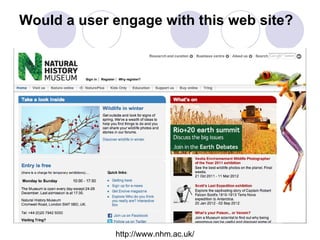
Would a user engage with this web site? http://www.nhm.ac.uk/
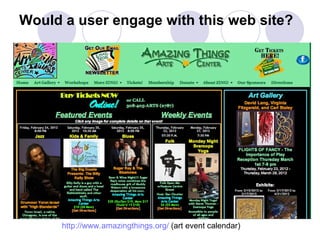
Would a user engage with this web site? http://www.amazingthings.org/  (art event calendar)
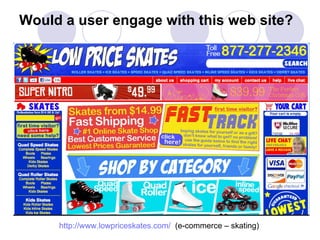
Would a user engage with this web site? http://www.lowpriceskates.com/   (e-commerce – skating)
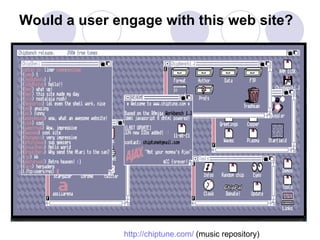
Would a user engage with this web site? http://chiptune.com/  (music repository)
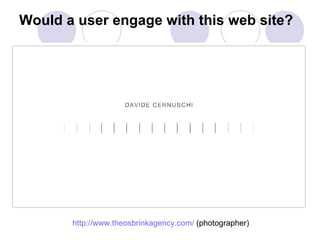
Would a user engage with this web site? http://www.theosbrinkagency.com/  (photographer)
What is user engagement? “ The emotional, cognitive and/or behavioural connection that exists, at any point in time  and  over time, between a user and a technological resource” “ Newish” field of research stemming from the increasing interaction between users  and  web services and technologies Current work focuses on two aspects What are the characteristics of user engagement? How can we measure user engagement? Subjective measures Objective measures
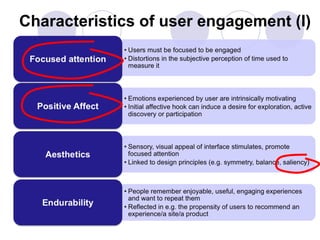
Characteristics of user engagement (I)
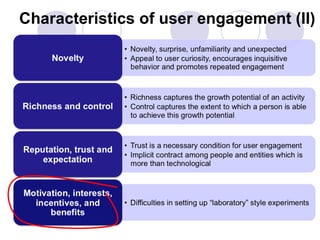
Characteristics of user engagement (II)
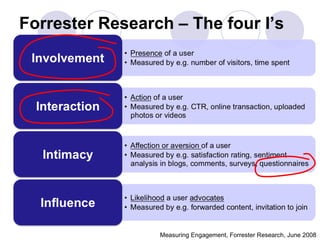
Forrester Research – The four I’s Measuring Engagement, Forrester Research, June 2008
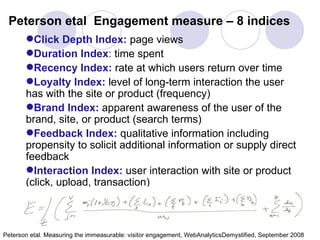
Peterson etal  Engagement measure – 8 indices Click Depth Index:  page views Duration Index :  time spent Recency Index:  rate at which users return over time Loyalty Index:  level of long-term interaction the user has with the site or product (frequency) Brand Index:  apparent awareness of the user of the brand, site, or product (search terms) Feedback Index:  qualitative information including propensity to solicit additional information or supply direct feedback Interaction Index:  user interaction with site or product (click, upload, transaction) Peterson etal. Measuring the immeasurable: visitor engagement, WebAnalyticsDemystified, September 2008
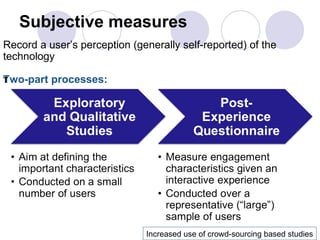
Subjective measures Record a user’s perception (generally self-reported) of the technology Two-part processes: Increased use of crowd-sourcing based studies
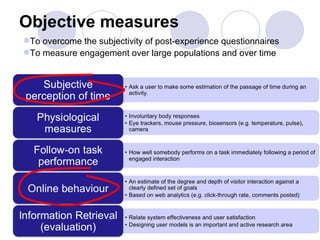
Objective measures To overcome the subjectivity of post-experience questionnaires To measure engagement over large populations and over time
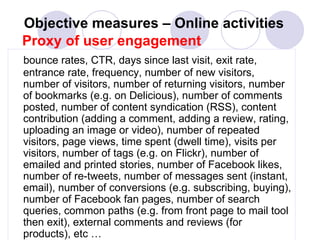
Objective measures –  Online activities   Proxy of user engagement bounce rates, CTR, days since last visit, exit rate, entrance rate, frequency, number of new visitors, number of visitors, number of returning visitors, number of bookmarks (e.g. on Delicious), number of comments posted, number of content syndication (RSS), content contribution (adding a comment, adding a review, rating, uploading an image or video), number of repeated visitors, page views, time spent (dwell time), visits per visitors, number of tags (e.g. on Flickr), number of emailed and printed stories, number of Facebook likes, number of re-tweets, number of messages sent (instant, email), number of conversions (e.g. subscribing, buying), number of Facebook fan pages, number of search queries, common paths (e.g. from front page to mail tool then exit), external comments and reviews (for products), etc …
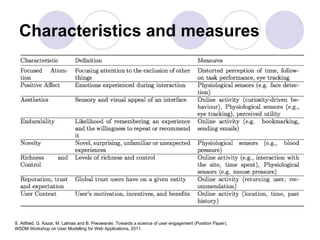
Characteristics and measures S. Attfield, G. Kazai, M. Lalmas and B. Piwowarski. Towards a science of user engagement (Position Paper),  WSDM Workshop on User Modelling for Web Applications, 2011.
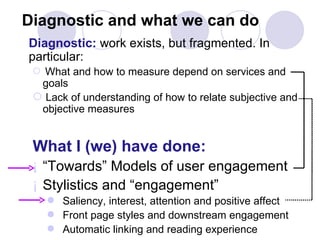
Diagnostic and what we can do Diagnostic:  work exists, but fragmented. In particular: What and how to measure depend on services and goals Lack of understanding of how to relate subjective and objective measures What I (we) have done: “ Towards” Models of user engagement Stylistics and “engagement” Saliency, interest, attention and positive affect Front page styles and downstream engagement Automatic linking and reading experience
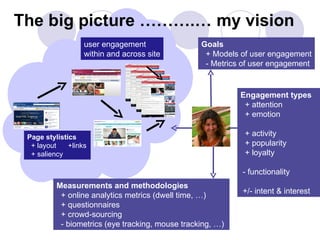
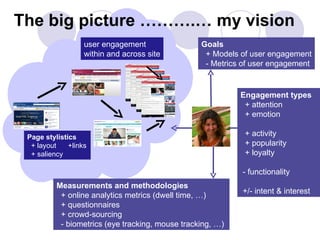
Page stylistics + layout  +links + saliency Measurements and methodologies + online analytics metrics (dwell time, …) + questionnaires + crowd-sourcing - biometrics (eye tracking, mouse tracking, …)  Goals + Models of user engagement - Metrics of user engagement Engagement types + attention + emotion + activity + popularity + loyalty - functionality +/- intent & interest user engagement  within and across site
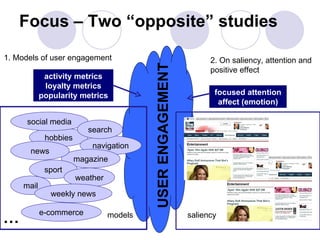
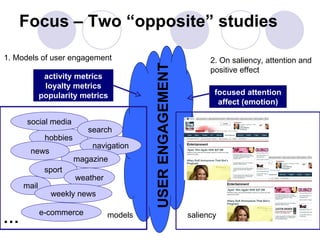
Focus – Two “opposite” studies models USER ENGAGEMENT 1. Models of user engagement 2. On saliency, attention and  positive effect  activity metrics loyalty metrics popularity metrics hobbies navigation social media e-commerce magazine sport news search weather mail weekly news … focused attention affect (emotion) saliency
1. Models of user engagement User engagement characteristics depend on the web application: e.g. reading mail or browsing a news portal results in different types of engagement Diversity of engagement Models of engagement through clustering using various criteria e.g. user types, temporal aspects
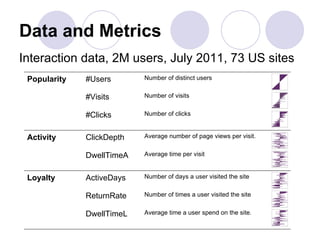
Data and Metrics Interaction data, 2M users, July 2011, 73 US sites Popularity #Users Number of distinct users #Visits Number of visits #Clicks Number of clicks Activity ClickDepth Average number of page views per visit. DwellTimeA Average time per visit Loyalty ActiveDays Number of days a user visited the site ReturnRate Number of times a user visited the site DwellTimeL Average time a user spend on the site.
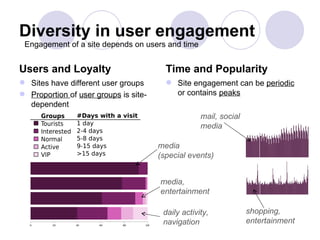
Diversity in user engagement Users and Loyalty Sites have different user groups Proportion  of  user groups  is site-dependent Time and Popularity Site engagement can be  periodic  or contains  peaks Engagement of a site depends on users and time mail, social media shopping, entertainment media (special events) daily activity, navigation media, entertainment
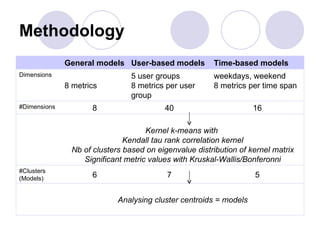
Methodology General models User-based models Time-based models Dimensions 8 metrics 5 user groups 8 metrics per user group weekdays, weekend 8 metrics per time span #Dimensions 8 40 16 Kernel k-means with  Kendall tau rank correlation kernel Nb of clusters based on eigenvalue distribution of kernel matrix Significant metric values with Kruskal-Wallis/Bonferonni #Clusters (Models) 6 7 5 Analysing cluster centroids = models
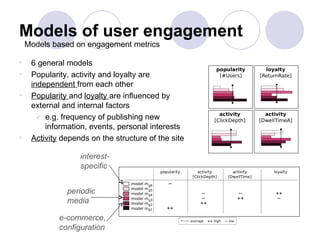
Models of user engagement 6 general models Popularity, activity and loyalty are  independent  from each other Popularity  and  loyalty  are influenced by external and internal factors  e.g. frequency of publishing new information, events, personal interests Activity  depends on the structure of the site Models based on engagement metrics interest-specific e-commerce, configuration periodic media
Models of user engagement User-based [7 models] Models based on engagement per  user group Time-based [5 models] Models based on engagement over  weekdays  and  weekend Models based on engagement metrics, user and time navigation game, sport hobbies, interest-specific daily news Sites of the same type (e.g. mainstream media) do not necessarily belong to the same model The groups of models describe different aspects of engagement, i.e. they are independent from each other
Relationships between models Groups of models are independent from each other Example:  Model  m u2   [high popularity and activity in all user groups, increasing loyalty] 50% to model  m t2   [ high popularity on weekends and high loyalty on weekdays ] 50% to model  m t3   [ high activity and loyalty on weekends ] Variance of Information  [0,5.61] General User Time General 0.00 3.50 4.23 User 3.50 0.00 4.25 Time 4.23 4.25 0.00
Models of user engagement –  Recap & Next User engagement is complex and standard metrics capture only a part of it User engagement depends on  users  and  time First step towards a  taxonomy  of models of user engagement …  and associated metrics Next Interaction between models Interaction between sites (complex networks) User demographics, time of the day, geo-location, etc
Focus – Two “opposite” studies models USER ENGAGEMENT 1. Models of user engagement 2. On saliency, attention and  positive effect  activity metrics loyalty metrics popularity metrics hobbies navigation social media e-commerce magazine sport news search weather mail weekly news … focused attention affect (emotion) saliency
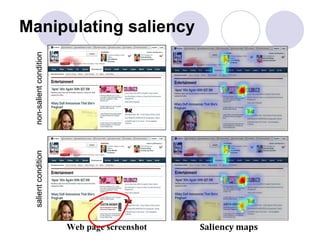
2.  Saliency, attention and positive affect How the visual catchiness ( saliency ) of “relevant” information impacts user engagement metrics such as focused attention and emotion (affect) focused attention  refers to the exclusion of other things affect  relates to the emotions experienced during the interaction Saliency model of visual attention developed by Itti and Koch  L. Itti and C. Koch. A saliency-based search mechanism for overt and covert shifts of visual attention. Vision Research, 40, 10-12 (2000).
Manipulating saliency salient condition non-salient condition Web page screenshot Saliency maps
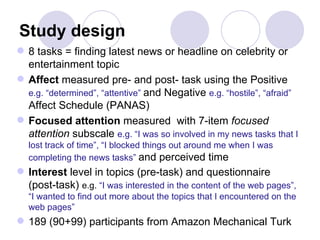
Study design 8 tasks = finding latest news or headline on celebrity or entertainment topic Affect  measured pre- and post- task using the Positive  e.g. “determined”, “attentive”  and Negative  e.g. “hostile”, “afraid ”   Affect Schedule (PANAS)  Focused attention  measured  with 7-item  focused attention  subscale   e.g. “ I was so involved in my news tasks that I lost track of time”,  “ I blocked things out around me when I was completing the news tasks ”  and perceived time Interest  level in topics (pre-task) and questionnaire (post-task)  e.g.  “I was interested in the content of the web pages”, “I wanted to find out more about the topics that I encountered on the web pages” 189 (90+99) participants from Amazon Mechanical Turk
PANAS  (10 positive items and 10 negative items) You feel this way right now, that is, at the present moment  [1 = very slightly or not at all; 2 = a little; 3 = moderately;  4 = quite a bit; 5 = extremely]  [randomize items] distressed, upset, guilty, scared, hostile, irritable, ashamed, nervous, jittery, afraid interested, excited, strong, enthusiastic, proud, alert, inspired, determined, attentive, active D. Watson, L.A. Clark & A. Tellegen. Development and validation of brief measures of positive and negative affect:  The PANAS Scales.  Journal of Personality and Social Psychology, 47 (1988).
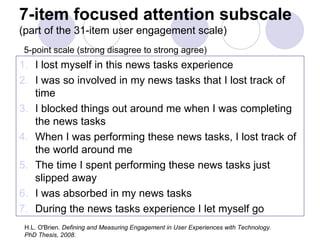
7-item focused attention subscale  (part of the 31-item user engagement scale)   5-point scale (strong disagree to strong agree) I lost myself in this news tasks experience I was so involved in my news tasks that I lost track of time I blocked things out around me when I was completing the news tasks When I was performing these news tasks, I lost track of the world around me The time I spent performing these news tasks just slipped away I was absorbed in my news tasks  During the news tasks experience I let myself go H.L. O'Brien.  Defining and Measuring Engagement in User Experiences with Technology.  PhD Thesis, 2008.
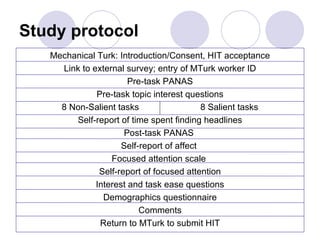
Study protocol Mechanical Turk: Introduction/Consent, HIT acceptance Link to external survey; entry of MTurk worker ID Pre-task PANAS Pre-task topic interest questions 8 Non-Salient tasks  8 Salient tasks Self-report of time spent finding headlines Post-task PANAS  Self-report of affect  Focused attention scale  Self-report of focused attention Interest and task ease questions Demographics questionnaire Comments Return to MTurk to submit HIT
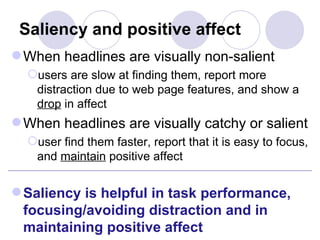
Saliency and positive affect When headlines are visually non-salient users are slow at finding them, report more distraction due to web page features, and show a  drop  in affect When headlines are visually catchy or salient user find them faster, report that it is easy to focus, and  maintain  positive affect Saliency is helpful in task performance, focusing/avoiding distraction and in maintaining positive affect
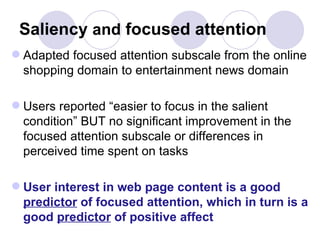
Saliency  and  focused attention Adapted focused attention subscale from the online shopping domain to entertainment news domain Users reported “easier to focus in the salient condition” BUT no significant improvement in the focused attention subscale or differences in perceived time spent on tasks User interest in web page content is a good  predictor  of focused attention, which in turn is a good  predictor  of positive affect
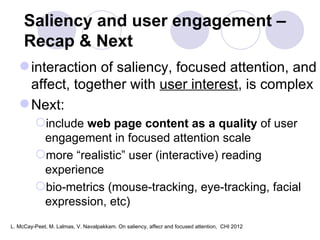
Saliency and user engagement –  Recap & Next interaction of saliency, focused attention, and affect, together with  user interest , is complex Next:  include  web page content as a quality  of user engagement in focused attention scale more “realistic” user (interactive) reading experience bio-metrics (mouse-tracking, eye-tracking, facial expression, etc) L. McCay-Peet, M. Lalmas, V. Navalpakkam. On saliency, affecr and focused attention,  CHI 2012
The big picture ……….… my vision Page stylistics + layout  +links + saliency Measurements and methodologies + online analytics metrics (dwell time, …) + questionnaires + crowd-sourcing - biometrics (eye tracking, mouse tracking, …)  Goals + Models of user engagement - Metrics of user engagement Engagement types + attention + emotion + activity + popularity + loyalty - functionality +/- intent & interest user engagement  within and across site
Gracias [email_address] www.dcs.gla.ac.uk/~mounia

User Engagement - A Scientific Challenge

  • 1.
    User Engagement – A Scientific Challenge Mounia Lalmas Yahoo! Research Barcelona [email_address] Ioannis Arapakis Ricardo Baeza-Yates Georges Dupret Janette Lehmann Lori McCay-Peet Vidhya Navalpakkam Elad Yom-Tov Collaborators
  • 2.
    Outline Motivation andDefinition Characteristics of User Engagement Current measurements Vision and focus Two “opposite” studies Models of user engagement Saliency and user engagement
  • 3.
    Motivation User engagementis a quality of user experience that emphasizes the positive aspects of interaction – in particular the fact of being captivated by the technology. Successful technologies are not just used, they are engaged with . A web interface that is boring, a multimedia presentation that does not captivate users’ attention or an online forum that fails to engender a sense of community are quickly dismissed with a simple mouse click. (O’Brian and Toms, 2008) User engagement is how we nurture and build a community. (John Byrne, Business Weeks’ online editor 2009)
  • 4.
    Would a userengage with this web site? http://www.nhm.ac.uk/
  • 5.
    Would a userengage with this web site? http://www.amazingthings.org/ (art event calendar)
  • 6.
    Would a userengage with this web site? http://www.lowpriceskates.com/ (e-commerce – skating)
  • 7.
    Would a userengage with this web site? http://chiptune.com/ (music repository)
  • 8.
    Would a userengage with this web site? http://www.theosbrinkagency.com/ (photographer)
  • 9.
    What is userengagement? “ The emotional, cognitive and/or behavioural connection that exists, at any point in time and over time, between a user and a technological resource” “ Newish” field of research stemming from the increasing interaction between users and web services and technologies Current work focuses on two aspects What are the characteristics of user engagement? How can we measure user engagement? Subjective measures Objective measures
  • 10.
  • 11.
    Characteristics of userengagement (II)
  • 12.
    Forrester Research –The four I’s Measuring Engagement, Forrester Research, June 2008
  • 13.
    Peterson etal Engagement measure – 8 indices Click Depth Index: page views Duration Index : time spent Recency Index: rate at which users return over time Loyalty Index: level of long-term interaction the user has with the site or product (frequency) Brand Index: apparent awareness of the user of the brand, site, or product (search terms) Feedback Index: qualitative information including propensity to solicit additional information or supply direct feedback Interaction Index: user interaction with site or product (click, upload, transaction) Peterson etal. Measuring the immeasurable: visitor engagement, WebAnalyticsDemystified, September 2008
  • 14.
    Subjective measures Recorda user’s perception (generally self-reported) of the technology Two-part processes: Increased use of crowd-sourcing based studies
  • 15.
    Objective measures Toovercome the subjectivity of post-experience questionnaires To measure engagement over large populations and over time
  • 16.
    Objective measures – Online activities Proxy of user engagement bounce rates, CTR, days since last visit, exit rate, entrance rate, frequency, number of new visitors, number of visitors, number of returning visitors, number of bookmarks (e.g. on Delicious), number of comments posted, number of content syndication (RSS), content contribution (adding a comment, adding a review, rating, uploading an image or video), number of repeated visitors, page views, time spent (dwell time), visits per visitors, number of tags (e.g. on Flickr), number of emailed and printed stories, number of Facebook likes, number of re-tweets, number of messages sent (instant, email), number of conversions (e.g. subscribing, buying), number of Facebook fan pages, number of search queries, common paths (e.g. from front page to mail tool then exit), external comments and reviews (for products), etc …
  • 17.
    Characteristics and measuresS. Attfield, G. Kazai, M. Lalmas and B. Piwowarski. Towards a science of user engagement (Position Paper), WSDM Workshop on User Modelling for Web Applications, 2011.
  • 18.
    Diagnostic and whatwe can do Diagnostic: work exists, but fragmented. In particular: What and how to measure depend on services and goals Lack of understanding of how to relate subjective and objective measures What I (we) have done: “ Towards” Models of user engagement Stylistics and “engagement” Saliency, interest, attention and positive affect Front page styles and downstream engagement Automatic linking and reading experience
  • 19.
    Page stylistics +layout +links + saliency Measurements and methodologies + online analytics metrics (dwell time, …) + questionnaires + crowd-sourcing - biometrics (eye tracking, mouse tracking, …) Goals + Models of user engagement - Metrics of user engagement Engagement types + attention + emotion + activity + popularity + loyalty - functionality +/- intent & interest user engagement within and across site
  • 20.
    Focus – Two“opposite” studies models USER ENGAGEMENT 1. Models of user engagement 2. On saliency, attention and positive effect activity metrics loyalty metrics popularity metrics hobbies navigation social media e-commerce magazine sport news search weather mail weekly news … focused attention affect (emotion) saliency
  • 21.
    1. Models ofuser engagement User engagement characteristics depend on the web application: e.g. reading mail or browsing a news portal results in different types of engagement Diversity of engagement Models of engagement through clustering using various criteria e.g. user types, temporal aspects
  • 22.
    Data and MetricsInteraction data, 2M users, July 2011, 73 US sites Popularity #Users Number of distinct users #Visits Number of visits #Clicks Number of clicks Activity ClickDepth Average number of page views per visit. DwellTimeA Average time per visit Loyalty ActiveDays Number of days a user visited the site ReturnRate Number of times a user visited the site DwellTimeL Average time a user spend on the site.
  • 23.
    Diversity in userengagement Users and Loyalty Sites have different user groups Proportion of user groups is site-dependent Time and Popularity Site engagement can be periodic or contains peaks Engagement of a site depends on users and time mail, social media shopping, entertainment media (special events) daily activity, navigation media, entertainment
  • 24.
    Methodology General modelsUser-based models Time-based models Dimensions 8 metrics 5 user groups 8 metrics per user group weekdays, weekend 8 metrics per time span #Dimensions 8 40 16 Kernel k-means with Kendall tau rank correlation kernel Nb of clusters based on eigenvalue distribution of kernel matrix Significant metric values with Kruskal-Wallis/Bonferonni #Clusters (Models) 6 7 5 Analysing cluster centroids = models
  • 25.
    Models of userengagement 6 general models Popularity, activity and loyalty are independent from each other Popularity and loyalty are influenced by external and internal factors e.g. frequency of publishing new information, events, personal interests Activity depends on the structure of the site Models based on engagement metrics interest-specific e-commerce, configuration periodic media
  • 26.
    Models of userengagement User-based [7 models] Models based on engagement per user group Time-based [5 models] Models based on engagement over weekdays and weekend Models based on engagement metrics, user and time navigation game, sport hobbies, interest-specific daily news Sites of the same type (e.g. mainstream media) do not necessarily belong to the same model The groups of models describe different aspects of engagement, i.e. they are independent from each other
  • 27.
    Relationships between modelsGroups of models are independent from each other Example: Model m u2 [high popularity and activity in all user groups, increasing loyalty] 50% to model m t2 [ high popularity on weekends and high loyalty on weekdays ] 50% to model m t3 [ high activity and loyalty on weekends ] Variance of Information [0,5.61] General User Time General 0.00 3.50 4.23 User 3.50 0.00 4.25 Time 4.23 4.25 0.00
  • 28.
    Models of userengagement – Recap & Next User engagement is complex and standard metrics capture only a part of it User engagement depends on users and time First step towards a taxonomy of models of user engagement … and associated metrics Next Interaction between models Interaction between sites (complex networks) User demographics, time of the day, geo-location, etc
  • 29.
    Focus – Two“opposite” studies models USER ENGAGEMENT 1. Models of user engagement 2. On saliency, attention and positive effect activity metrics loyalty metrics popularity metrics hobbies navigation social media e-commerce magazine sport news search weather mail weekly news … focused attention affect (emotion) saliency
  • 30.
    2. Saliency,attention and positive affect How the visual catchiness ( saliency ) of “relevant” information impacts user engagement metrics such as focused attention and emotion (affect) focused attention refers to the exclusion of other things affect relates to the emotions experienced during the interaction Saliency model of visual attention developed by Itti and Koch L. Itti and C. Koch. A saliency-based search mechanism for overt and covert shifts of visual attention. Vision Research, 40, 10-12 (2000).
  • 31.
    Manipulating saliency salientcondition non-salient condition Web page screenshot Saliency maps
  • 32.
    Study design 8tasks = finding latest news or headline on celebrity or entertainment topic Affect measured pre- and post- task using the Positive e.g. “determined”, “attentive” and Negative e.g. “hostile”, “afraid ” Affect Schedule (PANAS) Focused attention measured with 7-item focused attention subscale e.g. “ I was so involved in my news tasks that I lost track of time”, “ I blocked things out around me when I was completing the news tasks ” and perceived time Interest level in topics (pre-task) and questionnaire (post-task) e.g. “I was interested in the content of the web pages”, “I wanted to find out more about the topics that I encountered on the web pages” 189 (90+99) participants from Amazon Mechanical Turk
  • 33.
    PANAS (10positive items and 10 negative items) You feel this way right now, that is, at the present moment [1 = very slightly or not at all; 2 = a little; 3 = moderately; 4 = quite a bit; 5 = extremely] [randomize items] distressed, upset, guilty, scared, hostile, irritable, ashamed, nervous, jittery, afraid interested, excited, strong, enthusiastic, proud, alert, inspired, determined, attentive, active D. Watson, L.A. Clark & A. Tellegen. Development and validation of brief measures of positive and negative affect: The PANAS Scales. Journal of Personality and Social Psychology, 47 (1988).
  • 34.
    7-item focused attentionsubscale (part of the 31-item user engagement scale) 5-point scale (strong disagree to strong agree) I lost myself in this news tasks experience I was so involved in my news tasks that I lost track of time I blocked things out around me when I was completing the news tasks When I was performing these news tasks, I lost track of the world around me The time I spent performing these news tasks just slipped away I was absorbed in my news tasks During the news tasks experience I let myself go H.L. O'Brien. Defining and Measuring Engagement in User Experiences with Technology. PhD Thesis, 2008.
  • 35.
    Study protocol MechanicalTurk: Introduction/Consent, HIT acceptance Link to external survey; entry of MTurk worker ID Pre-task PANAS Pre-task topic interest questions 8 Non-Salient tasks 8 Salient tasks Self-report of time spent finding headlines Post-task PANAS Self-report of affect Focused attention scale Self-report of focused attention Interest and task ease questions Demographics questionnaire Comments Return to MTurk to submit HIT
  • 36.
    Saliency and positiveaffect When headlines are visually non-salient users are slow at finding them, report more distraction due to web page features, and show a drop in affect When headlines are visually catchy or salient user find them faster, report that it is easy to focus, and maintain positive affect Saliency is helpful in task performance, focusing/avoiding distraction and in maintaining positive affect
  • 37.
    Saliency and focused attention Adapted focused attention subscale from the online shopping domain to entertainment news domain Users reported “easier to focus in the salient condition” BUT no significant improvement in the focused attention subscale or differences in perceived time spent on tasks User interest in web page content is a good predictor of focused attention, which in turn is a good predictor of positive affect
  • 38.
    Saliency and userengagement – Recap & Next interaction of saliency, focused attention, and affect, together with user interest , is complex Next: include web page content as a quality of user engagement in focused attention scale more “realistic” user (interactive) reading experience bio-metrics (mouse-tracking, eye-tracking, facial expression, etc) L. McCay-Peet, M. Lalmas, V. Navalpakkam. On saliency, affecr and focused attention, CHI 2012
  • 39.
    The big picture……….… my vision Page stylistics + layout +links + saliency Measurements and methodologies + online analytics metrics (dwell time, …) + questionnaires + crowd-sourcing - biometrics (eye tracking, mouse tracking, …) Goals + Models of user engagement - Metrics of user engagement Engagement types + attention + emotion + activity + popularity + loyalty - functionality +/- intent & interest user engagement within and across site
  • 40.

Editor's Notes

  • #4 As said here it is important to differentiate between user experience and user engagement, the latter is an aspect of the former. User engagement related to the positive aspect of the interaction including that of being captivated. Providing technologies with which user engaged is very important, and this is true of any web service. And those are two nice quotes about the importance of engagement.
  • #11 Characteristics elaborate the notion of engagement over 3 broad dimensions: emotional, cognitive and behavioural. We identified 8 of them based on previous works / suggested by us. Attention -> exclusivity Affect -> lack of fun can lead as a barrier to shopping (O’Brian) Aesthetics -> promotes attention, stimulate curiosity Endurability -> does the experience meet the expectation?
  • #12 Novelty -> freshness of content / has to be carefully balanced Richness = complexity of thoughts and actions, increased complexity/ Affect = relates to the emotion experienced during the interaction (fun and enjoyment)
  • #15 The way it often work  A two-part process. One is very exploratory, it is important to “probe” carefully, so that indentify all dimension, usually conducted with a small number of users. Highly qualitative, and really the aim is to identify the important characteristics (work of Tom et al did this in 4 areas, online shopping, web searching, educational web casting, and video games). People in HCI knows how to do this well. Then from there, construct more focused studies, but larger scale, and actually measure them in a particular interactive experience, and again going back to the Dalhousie work, they did so for the online shopping scenario. Constructed an online questionnaire, and got 440 responses. Cleaning of data, and factor analysis to reduce the set of characteristics (100) to few key ones (down to 6). Again what I want to make it clear is the methodology, and here the fact we have qualitative data. Would be important to see how the questionnaire developed by them can be used in other area, other domain (IM different to news portal). Health  trust Film  aesthetics
  • #16 In the paper we propose a mapping between objective measures and engagement characteristics, e.g. focused attention can be measured by distorted perception of time, follow-on task performance, and eye tracking Online behaviour = can be large scale IR = special status (metrics) -> Simulated search, user models, linking to user satisfaction