An Engaging Click
Mounia Lalmas
Ya h o o L a b s
London
Search Solutions 2013
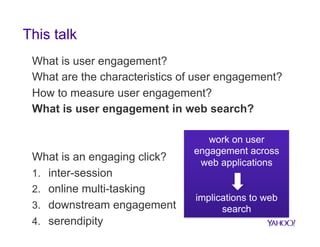
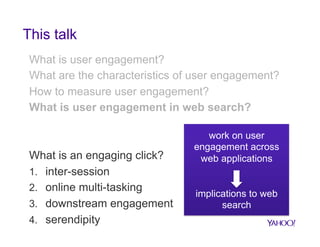
This talk
What is user engagement?
What are the characteristics of user engagement?
How to measure user engagement?
What is user engagement in web search?

What is an engaging click?
1.  inter-session
2.  online multi-tasking
3.  downstream engagement
4.  serendipity

work on user
engagement across
web applications

implications to web
search
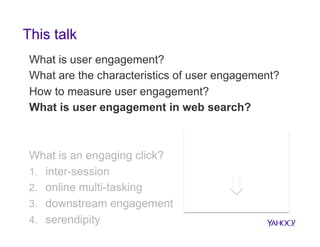
This talk
What is user engagement?
What are the characteristics of user engagement?
How to measure user engagement?
What is user engagement in web search?

What is an engaging click?
1.  inter-session
2.  online multi-tasking
3.  downstream engagement
4.  serendipity

Work on user
engagement across
web applications

Implications to search
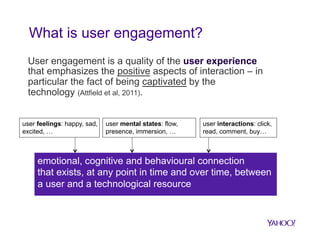
What is user engagement?
User engagement is a quality of the user experience
that emphasizes the positive aspects of interaction – in
particular the fact of being captivated by the
technology (Attfield et al, 2011).
user feelings: happy, sad,
excited, …

user mental states: flow,
presence, immersion, …

user interactions: click,
read, comment, buy…

emotional, cognitive and behavioural connection
that exists, at any point in time and over time, between
a user and a technological resource
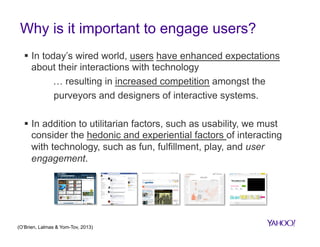
Why is it important to engage users?
§  In today’s wired world, users have enhanced expectations
about their interactions with technology
… resulting in increased competition amongst the
purveyors and designers of interactive systems.
§  In addition to utilitarian factors, such as usability, we must
consider the hedonic and experiential factors of interacting
with technology, such as fun, fulfillment, play, and user
engagement.

(O’Brien, Lalmas & Yom-Tov, 2013)
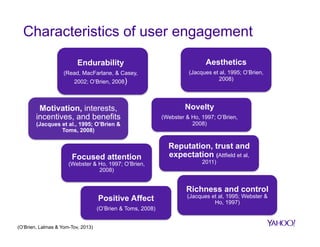
Characteristics of user engagement
Endurability

Aesthetics

(Read, MacFarlane, & Casey,

(Jacques et al, 1995; O’Brien,
2008)

2002; O’Brien, 2008)

Motivation, interests,
incentives, and benefits
(Jacques et al., 1995; O’Brien &
Toms, 2008)

Focused attention

(Webster & Ho, 1997; O’Brien,
2008)

Novelty
(Webster & Ho, 1997; O’Brien,
2008)

Reputation, trust and
expectation (Attfield et al,
2011)

Richness and control
Positive Affect
(O’Brien & Toms, 2008)
(O’Brien, Lalmas & Yom-Tov, 2013)

(Jacques et al, 1995; Webster &
Ho, 1997)
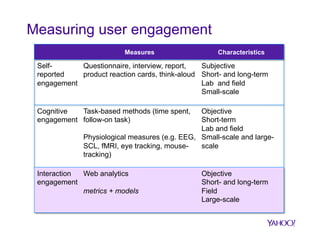
Measuring user engagement
Measures	
  

Characteristics	
  

SelfQuestionnaire, interview, report,
Subjective
reported
product reaction cards, think-aloud Short- and long-term
engagement
Lab and field
Small-scale
Cognitive
Task-based methods (time spent,
engagement follow-on task)

Objective
Short-term
Lab and field
Physiological measures (e.g. EEG, Small-scale and largeSCL, fMRI, eye tracking, mousescale
tracking)

Interaction
Web analytics
engagement
metrics + models

Objective
Short- and long-term
Field
Large-scale
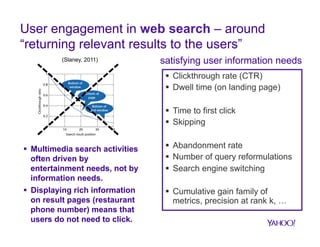
User engagement in web search – around
“returning relevant results to the users”
(Slaney, 2011)

satisfying user information needs
§  Clickthrough rate (CTR)
§  Dwell time (on landing page)
§  Time to first click
§  Skipping

§  Multimedia search activities
often driven by
entertainment needs, not by
information needs.
§  Displaying rich information
on result pages (restaurant
phone number) means that
users do not need to click.

§  Abandonment rate
§  Number of query reformulations
§  Search engine switching
§  Cumulative gain family of
metrics, precision at rank k, …
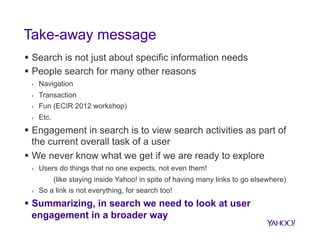
This talk
What is user engagement?
What are the characteristics of user engagement?
How to measure user engagement?
What is user engagement in web search?

What is an engaging click?
1.  inter-session
2.  online multi-tasking
3.  downstream engagement
4.  serendipity

work on user
engagement across
web applications

implications to web
search
(Dupret & Lalmas, 2013)

• 
• 

Domain: Yahoo Answers Japan
Study: Inter-session engagement metric

If users find a web application interesting,
engaging or useful, they will return to it sooner.
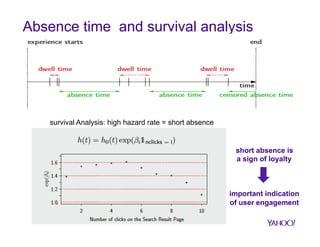
Absence time and survival analysis

survival Analysis: high hazard rate = short absence

short absence is
a sign of loyalty

important indication
of user engagement
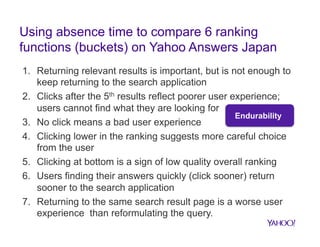
Using absence time to compare 6 ranking
functions (buckets) on Yahoo Answers Japan
1.  Returning relevant results is important, but is not enough to
keep returning to the search application
2.  Clicks after the 5th results reflect poorer user experience;
users cannot find what they are looking for
Endurability
3.  No click means a bad user experience
4.  Clicking lower in the ranking suggests more careful choice
from the user
5.  Clicking at bottom is a sign of low quality overall ranking
6.  Users finding their answers quickly (click sooner) return
sooner to the search application
7.  Returning to the same search result page is a worse user
experience than reformulating the query.
(Lehmann et al, 2013)

• 
• 

Domain: 700+ web applications
Study: Online multi-tasking

Online multi-tasking affects the way users interact
(or engage) with sites.
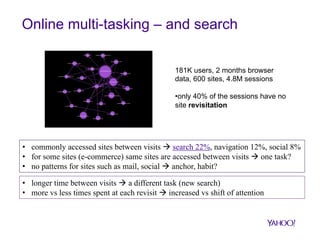
Online multi-tasking – and search
181K users, 2 months browser
data, 600 sites, 4.8M sessions
• only 40% of the sessions have no
site revisitation

•  commonly accessed sites between visits à search 22%, navigation 12%, social 8%
•  for some sites (e-commerce) same sites are accessed between visits à one task?
•  no patterns for sites such as mail, social à anchor, habit?
•  longer time between visits à a different task (new search)
•  more vs less times spent at each revisit à increased vs shift of attention
Revisitation patterns
average attention

mail sites [decreasing attention]

search sites [increasing attention]

auction sites [complex attention]

100% 54% 36% 26% 20% 17% 14% 12% 10%

100% 62% 41% 29% 21% 16% 13% 10% 8%

100% 69% 54% 44% 38% 33% 29% 26% 23%

100% 67% 54% 46% 41% 35% 31% 29% 26%

p-value < 0.05

p-value < 0.05
m = -0.288

p-value < 0.05
m = 0.063

p-value = 0.24
m = 0.142

●

0.8

●

12
11

11.2
0.4

●

●
●

●
●

●

10

●

●

1 2 3 4 5 6 7 8 9

1 2 3 4 5 6 7 8 9

0.4

●

●

1 2 3 4 5 6 7 8 9
0.8

●

●

●

11.0

●

Motivation, interests,
incentives, and benefits

k [kth visit on site]

0.0

0.0

§  10% users accessed a site 9+ times (23% for search sites); 28% at least four
1 2 3 4 5 6 7 8 9
1 2 3 4
1 times (44%7for search sites) 5 6 7 8 9
2 3 4 5 6
8 9
1 2 3 4 5 6 7 8 9
0.0

0.0

●

§  48% sites visited at least 9 times
§  Revisitation “level” depends on site

0.4

0.8

1 2 3 4 5 6 7 8 9
% of navigation type

●

● ●

●

0.4

● ●

●

10.8

12

●

●

●

●

●

0.8

●

●

11

11.2

● ●

13

●

●

10

●

10.8

% of total page views on site

proportion of users

k [kth visit on site]

k [kth visit on site]

k [kth visit on site]

Hyperlinking
§  Activity on site decreases with each Teleporting but activity on many search
revisit Backpaging
sites increases
(Yom-Tov et al, 2013)

• 
• 

Domain: Network of sites
Study: Downstream engagement

Success of a site depends on itself, but also on
how it is reached from other sites.
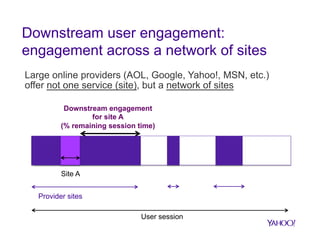
Downstream user engagement:
engagement across a network of sites
Large online providers (AOL, Google, Yahoo!, MSN, etc.)
offer not one service (site), but a network of sites
Downstream engagement
for site A
(% remaining session time)

Site A
Provider sites
User session
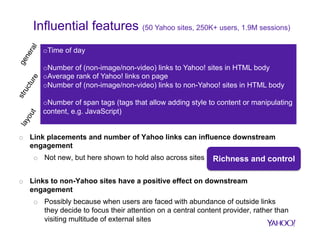
Influential features (50 Yahoo sites, 250K+ users, 1.9M sessions)
o Time of day
o Number of (non-image/non-video) links to Yahoo! sites in HTML body
o Average rank of Yahoo! links on page
o Number of (non-image/non-video) links to non-Yahoo! sites in HTML body
o Number of span tags (tags that allow adding style to content or manipulating
content, e.g. JavaScript)
o  Link placements and number of Yahoo links can influence downstream
engagement
o  Not new, but here shown to hold also across sites

Richness and control

o  Links to non-Yahoo sites have a positive effect on downstream
engagement
o  Possibly because when users are faced with abundance of outside links
they decide to focus their attention on a central content provider, rather than
visiting multitude of external sites
(Bordino, Mejova & Lalmas, 2013)

• 
• 

Domain: social media (Yahoo! Answers and Wikipedia)
Study: serendipity (in entity search)

Interesting search results may promote
serendipitous browsing.
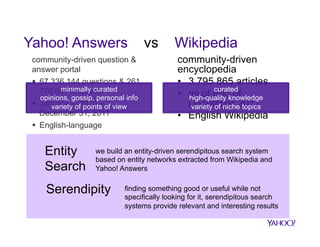
Yahoo! Answers
community-driven question &
answer portal
§  67 336 144 questions & 261
minimally curated
770 047 answers
opinions, gossip, personal info
§  January 1, 2010 –of view
variety of points
December 31, 2011
§  English-language

Entity
Search

vs

Wikipedia
community-driven
encyclopedia
•  3 795 865 articles
curated
•  as of endknowledge
high-quality of
December 2011
variety of niche topics
•  English Wikipedia

we build an entity-driven serendipitous search system
based on entity networks extracted from Wikipedia and
Yahoo! Answers

Serendipity

finding something good or useful while not
specifically looking for it, serendipitous search
systems provide relevant and interesting results
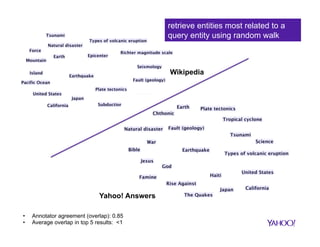
retrieve entities most related to a
query entity using random walk

Wikipedia

Yahoo! Answers
• 
• 

Annotator agreement (overlap): 0.85
Average overlap in top 5 results: <1
Serendipity

“making fortunate discoveries by

accident”
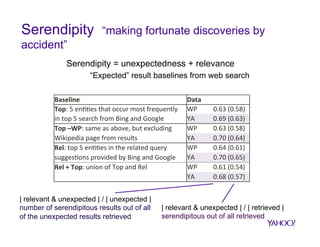
Serendipity = unexpectedness + relevance
“Expected” result baselines from web search
Baseline	
  
Top:	
  5	
  en&&es	
  that	
  occur	
  most	
  frequently	
  
in	
  top	
  5	
  search	
  from	
  Bing	
  and	
  Google	
  
Top	
  –WP:	
  same	
  as	
  above,	
  but	
  excluding	
  	
  
Wikipedia	
  page	
  from	
  results	
  
Rel:	
  top	
  5	
  en&&es	
  in	
  the	
  related	
  query	
  	
  
sugges&ons	
  provided	
  by	
  Bing	
  and	
  Google	
  
Rel	
  +	
  Top:	
  union	
  of	
  Top	
  and	
  Rel	
  

| relevant & unexpected | / | unexpected |
number of serendipitous results out of all
of the unexpected results retrieved

Data	
  
WP	
  
YA	
  
WP	
  
YA	
  
WP	
  
YA	
  
WP	
  
YA	
  

0.63	
  (0.58)	
  
0.69	
  (0.63)	
  
0.63	
  (0.58)	
  
0.70	
  (0.64)	
  
0.64	
  (0.61)	
  
0.70	
  (0.65)	
  
0.61	
  (0.54)	
  
0.68	
  (0.57)	
  

| relevant & unexpected | / | retrieved |
serendipitous out of all retrieved
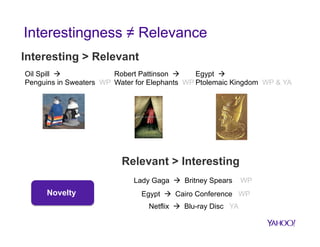
Interestingness ≠ Relevance
Interesting > Relevant
Oil Spill à
Robert Pattinson à
Egypt à
Penguins in Sweaters WP Water for Elephants WP Ptolemaic Kingdom WP & YA

Relevant > Interesting
Lady Gaga à Britney Spears

Novelty

WP

Egypt à Cairo Conference WP
Netflix à Blu-ray Disc YA
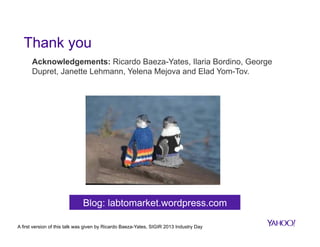
Take-away message
§  Search is not just about specific information needs
§  People search for many other reasons
› 

Navigation

› 
› 

Transaction
Fun (ECIR 2012 workshop)

› 

Etc.

§  Engagement in search is to view search activities as part of
the current overall task of a user
§  We never know what we get if we are ready to explore
› 

Users do things that no one expects, not even them!

› 

(like staying inside Yahoo! in spite of having many links to go elsewhere)
So a link is not everything, for search too!

§  Summarizing, in search we need to look at user
engagement in a broader way
Thank you
Acknowledgements: Ricardo Baeza-Yates, Ilaria Bordino, George
Dupret, Janette Lehmann, Yelena Mejova and Elad Yom-Tov.

Blog: labtomarket.wordpress.com
A first version of this talk was given by Ricardo Baeza-Yates, SIGIR 2013 Industry Day

An Engaging Click ... or how can user engagement measurement inform web search evaluation

  • 1.
    An Engaging Click MouniaLalmas Ya h o o L a b s London Search Solutions 2013
  • 2.
    This talk What isuser engagement? What are the characteristics of user engagement? How to measure user engagement? What is user engagement in web search? What is an engaging click? 1.  inter-session 2.  online multi-tasking 3.  downstream engagement 4.  serendipity work on user engagement across web applications implications to web search
  • 3.
    This talk What isuser engagement? What are the characteristics of user engagement? How to measure user engagement? What is user engagement in web search? What is an engaging click? 1.  inter-session 2.  online multi-tasking 3.  downstream engagement 4.  serendipity Work on user engagement across web applications Implications to search
  • 4.
    What is userengagement? User engagement is a quality of the user experience that emphasizes the positive aspects of interaction – in particular the fact of being captivated by the technology (Attfield et al, 2011). user feelings: happy, sad, excited, … user mental states: flow, presence, immersion, … user interactions: click, read, comment, buy… emotional, cognitive and behavioural connection that exists, at any point in time and over time, between a user and a technological resource
  • 5.
    Why is itimportant to engage users? §  In today’s wired world, users have enhanced expectations about their interactions with technology … resulting in increased competition amongst the purveyors and designers of interactive systems. §  In addition to utilitarian factors, such as usability, we must consider the hedonic and experiential factors of interacting with technology, such as fun, fulfillment, play, and user engagement. (O’Brien, Lalmas & Yom-Tov, 2013)
  • 6.
    Characteristics of userengagement Endurability Aesthetics (Read, MacFarlane, & Casey, (Jacques et al, 1995; O’Brien, 2008) 2002; O’Brien, 2008) Motivation, interests, incentives, and benefits (Jacques et al., 1995; O’Brien & Toms, 2008) Focused attention (Webster & Ho, 1997; O’Brien, 2008) Novelty (Webster & Ho, 1997; O’Brien, 2008) Reputation, trust and expectation (Attfield et al, 2011) Richness and control Positive Affect (O’Brien & Toms, 2008) (O’Brien, Lalmas & Yom-Tov, 2013) (Jacques et al, 1995; Webster & Ho, 1997)
  • 7.
    Measuring user engagement Measures   Characteristics   SelfQuestionnaire, interview, report, Subjective reported product reaction cards, think-aloud Short- and long-term engagement Lab and field Small-scale Cognitive Task-based methods (time spent, engagement follow-on task) Objective Short-term Lab and field Physiological measures (e.g. EEG, Small-scale and largeSCL, fMRI, eye tracking, mousescale tracking) Interaction Web analytics engagement metrics + models Objective Short- and long-term Field Large-scale
  • 8.
    User engagement inweb search – around “returning relevant results to the users” (Slaney, 2011) satisfying user information needs §  Clickthrough rate (CTR) §  Dwell time (on landing page) §  Time to first click §  Skipping §  Multimedia search activities often driven by entertainment needs, not by information needs. §  Displaying rich information on result pages (restaurant phone number) means that users do not need to click. §  Abandonment rate §  Number of query reformulations §  Search engine switching §  Cumulative gain family of metrics, precision at rank k, …
  • 9.
    This talk What isuser engagement? What are the characteristics of user engagement? How to measure user engagement? What is user engagement in web search? What is an engaging click? 1.  inter-session 2.  online multi-tasking 3.  downstream engagement 4.  serendipity work on user engagement across web applications implications to web search
  • 10.
    (Dupret & Lalmas,2013) •  •  Domain: Yahoo Answers Japan Study: Inter-session engagement metric If users find a web application interesting, engaging or useful, they will return to it sooner.
  • 11.
    Absence time andsurvival analysis survival Analysis: high hazard rate = short absence short absence is a sign of loyalty important indication of user engagement
  • 12.
    Using absence timeto compare 6 ranking functions (buckets) on Yahoo Answers Japan 1.  Returning relevant results is important, but is not enough to keep returning to the search application 2.  Clicks after the 5th results reflect poorer user experience; users cannot find what they are looking for Endurability 3.  No click means a bad user experience 4.  Clicking lower in the ranking suggests more careful choice from the user 5.  Clicking at bottom is a sign of low quality overall ranking 6.  Users finding their answers quickly (click sooner) return sooner to the search application 7.  Returning to the same search result page is a worse user experience than reformulating the query.
  • 13.
    (Lehmann et al,2013) •  •  Domain: 700+ web applications Study: Online multi-tasking Online multi-tasking affects the way users interact (or engage) with sites.
  • 14.
    Online multi-tasking –and search 181K users, 2 months browser data, 600 sites, 4.8M sessions • only 40% of the sessions have no site revisitation •  commonly accessed sites between visits à search 22%, navigation 12%, social 8% •  for some sites (e-commerce) same sites are accessed between visits à one task? •  no patterns for sites such as mail, social à anchor, habit? •  longer time between visits à a different task (new search) •  more vs less times spent at each revisit à increased vs shift of attention
  • 15.
    Revisitation patterns average attention mailsites [decreasing attention] search sites [increasing attention] auction sites [complex attention] 100% 54% 36% 26% 20% 17% 14% 12% 10% 100% 62% 41% 29% 21% 16% 13% 10% 8% 100% 69% 54% 44% 38% 33% 29% 26% 23% 100% 67% 54% 46% 41% 35% 31% 29% 26% p-value < 0.05 p-value < 0.05 m = -0.288 p-value < 0.05 m = 0.063 p-value = 0.24 m = 0.142 ● 0.8 ● 12 11 11.2 0.4 ● ● ● ● ● ● 10 ● ● 1 2 3 4 5 6 7 8 9 1 2 3 4 5 6 7 8 9 0.4 ● ● 1 2 3 4 5 6 7 8 9 0.8 ● ● ● 11.0 ● Motivation, interests, incentives, and benefits k [kth visit on site] 0.0 0.0 §  10% users accessed a site 9+ times (23% for search sites); 28% at least four 1 2 3 4 5 6 7 8 9 1 2 3 4 1 times (44%7for search sites) 5 6 7 8 9 2 3 4 5 6 8 9 1 2 3 4 5 6 7 8 9 0.0 0.0 ● §  48% sites visited at least 9 times §  Revisitation “level” depends on site 0.4 0.8 1 2 3 4 5 6 7 8 9 % of navigation type ● ● ● ● 0.4 ● ● ● 10.8 12 ● ● ● ● ● 0.8 ● ● 11 11.2 ● ● 13 ● ● 10 ● 10.8 % of total page views on site proportion of users k [kth visit on site] k [kth visit on site] k [kth visit on site] Hyperlinking §  Activity on site decreases with each Teleporting but activity on many search revisit Backpaging sites increases
  • 16.
    (Yom-Tov et al,2013) •  •  Domain: Network of sites Study: Downstream engagement Success of a site depends on itself, but also on how it is reached from other sites.
  • 17.
    Downstream user engagement: engagementacross a network of sites Large online providers (AOL, Google, Yahoo!, MSN, etc.) offer not one service (site), but a network of sites Downstream engagement for site A (% remaining session time) Site A Provider sites User session
  • 18.
    Influential features (50Yahoo sites, 250K+ users, 1.9M sessions) o Time of day o Number of (non-image/non-video) links to Yahoo! sites in HTML body o Average rank of Yahoo! links on page o Number of (non-image/non-video) links to non-Yahoo! sites in HTML body o Number of span tags (tags that allow adding style to content or manipulating content, e.g. JavaScript) o  Link placements and number of Yahoo links can influence downstream engagement o  Not new, but here shown to hold also across sites Richness and control o  Links to non-Yahoo sites have a positive effect on downstream engagement o  Possibly because when users are faced with abundance of outside links they decide to focus their attention on a central content provider, rather than visiting multitude of external sites
  • 19.
    (Bordino, Mejova &Lalmas, 2013) •  •  Domain: social media (Yahoo! Answers and Wikipedia) Study: serendipity (in entity search) Interesting search results may promote serendipitous browsing.
  • 20.
    Yahoo! Answers community-driven question& answer portal §  67 336 144 questions & 261 minimally curated 770 047 answers opinions, gossip, personal info §  January 1, 2010 –of view variety of points December 31, 2011 §  English-language Entity Search vs Wikipedia community-driven encyclopedia •  3 795 865 articles curated •  as of endknowledge high-quality of December 2011 variety of niche topics •  English Wikipedia we build an entity-driven serendipitous search system based on entity networks extracted from Wikipedia and Yahoo! Answers Serendipity finding something good or useful while not specifically looking for it, serendipitous search systems provide relevant and interesting results
  • 21.
    retrieve entities mostrelated to a query entity using random walk Wikipedia Yahoo! Answers •  •  Annotator agreement (overlap): 0.85 Average overlap in top 5 results: <1
  • 22.
    Serendipity “making fortunate discoveriesby accident” Serendipity = unexpectedness + relevance “Expected” result baselines from web search Baseline   Top:  5  en&&es  that  occur  most  frequently   in  top  5  search  from  Bing  and  Google   Top  –WP:  same  as  above,  but  excluding     Wikipedia  page  from  results   Rel:  top  5  en&&es  in  the  related  query     sugges&ons  provided  by  Bing  and  Google   Rel  +  Top:  union  of  Top  and  Rel   | relevant & unexpected | / | unexpected | number of serendipitous results out of all of the unexpected results retrieved Data   WP   YA   WP   YA   WP   YA   WP   YA   0.63  (0.58)   0.69  (0.63)   0.63  (0.58)   0.70  (0.64)   0.64  (0.61)   0.70  (0.65)   0.61  (0.54)   0.68  (0.57)   | relevant & unexpected | / | retrieved | serendipitous out of all retrieved
  • 23.
    Interestingness ≠ Relevance Interesting> Relevant Oil Spill à Robert Pattinson à Egypt à Penguins in Sweaters WP Water for Elephants WP Ptolemaic Kingdom WP & YA Relevant > Interesting Lady Gaga à Britney Spears Novelty WP Egypt à Cairo Conference WP Netflix à Blu-ray Disc YA
  • 24.
    Take-away message §  Searchis not just about specific information needs §  People search for many other reasons ›  Navigation ›  ›  Transaction Fun (ECIR 2012 workshop) ›  Etc. §  Engagement in search is to view search activities as part of the current overall task of a user §  We never know what we get if we are ready to explore ›  Users do things that no one expects, not even them! ›  (like staying inside Yahoo! in spite of having many links to go elsewhere) So a link is not everything, for search too! §  Summarizing, in search we need to look at user engagement in a broader way
  • 25.
    Thank you Acknowledgements: RicardoBaeza-Yates, Ilaria Bordino, George Dupret, Janette Lehmann, Yelena Mejova and Elad Yom-Tov. Blog: labtomarket.wordpress.com A first version of this talk was given by Ricardo Baeza-Yates, SIGIR 2013 Industry Day