Session, focus and engagement

                       Mounia Lalmas
            Yahoo! Research Barcelona
                     mounia@acm.org
A bit about myself
 1999-2008: Lecturer (assistant professor) to Professor at
  Queen Mary, University of London
 2008-2010 Microsoft Research/RAEng Research
  Professor at the University of Glasgow (and lived outside
  London)
 2011- Visiting Principal Scientist at Yahoo! Research
  Barcelona


 Research topics
    XML retrieval and evaluation (INEX)
    Quantum theory to model interactive information retrieval
    Aggregated search
    Bridging the digital divide
    Models and measures of user engagement
Message and Outline

 Interaction and search
   Beyond result relevance
   Beyond search session
 Towards “engagement”

   1. Motivations
   2. Engagement
   3. Future directions
1. Outline
 1. Motivations
    • Relevance in multimedia search
    • Relevance in focused retrieval
    • Online multi-tasking

 • Engagement

 • Future directions
Information Retrieval Over Query Sessions
  Retrieval Models & Ranking: How to analyze/model/predict user
   interactions and use these findings to improve retrieval
   performance? How can we adapt ranking/retrieval models and IR
   theory in the light of a sequence of user interactions.

  Evaluation & Test Collections: How can we evaluate retrieval
   system performance over entire query sessions? How can we build
   reusable test collections to study this IR task? How can we
   model/simulate user interactions over a session?

  User Interaction & Interfaces: How can we model user
   interactions so we can predict and improve the user experience
   over sessions? How can we design and perform user studies that
   reveal new information about users? How can we make use of
   implicit feedback from users?
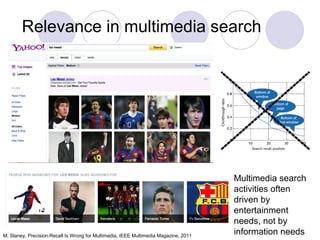
Relevance in multimedia search


                                                                                      Multimedia search
                                                                                      activities often
                                                                                      driven by
                                                                                      entertainment
                                                                                      needs, not by
M. Slaney, Precision-Recall Is Wrong for Multimedia, IEEE Multimedia Magazine, 2011
                                                                                      information needs
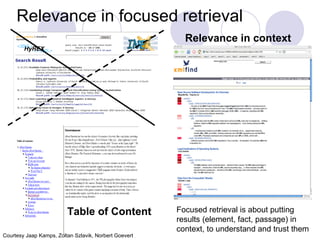
Relevance in focused retrieval
                                                         Relevance in context


                         Table of Content              Focused retrieval is about putting
                                                       results (element, fact, passage) in
                                                       context, to understand and trust them
Courtesy Jaap Kamps, Zoltan Szlavik, Norbert Goevert
Courtesy of Janette Lehmann


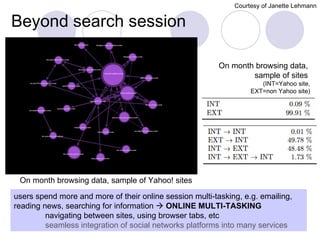
Beyond search session

                                                          On month browsing data,
                                                                  sample of sites
                                                                      (INT=Yahoo site,
                                                                   EXT=non Yahoo site)


 On month browsing data, sample of Yahoo! sites

users spend more and more of their online session multi-tasking, e.g. emailing,
reading news, searching for information  ONLINE MULTI-TASKING
         navigating between sites, using browser tabs, etc
         seamless integration of social networks platforms into many services
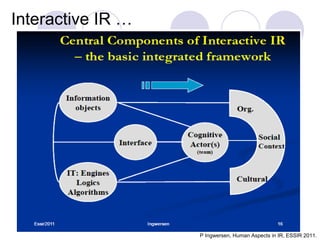
Interactive IR …


                   P Ingwersen, Human Aspects in IR, ESSIR 2011.
2. Outline
 1. Motivations

 • (User) Engagement
   • Definition
   • Characteristics
   • Measuring
   • Models

 • Future directions
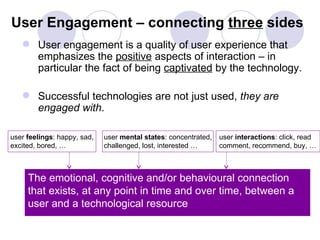
User Engagement – connecting three sides
    User engagement is a quality of user experience that
     emphasizes the positive aspects of interaction – in
     particular the fact of being captivated by the technology.

    Successful technologies are not just used, they are
     engaged with.

user feelings: happy, sad,   user mental states: concentrated,   user interactions: click, read
excited, bored, …            challenged, lost, interested …      comment, recommend, buy, …


     The emotional, cognitive and/or behavioural connection
     that exists, at any point in time and over time, between a
     user and a technological resource
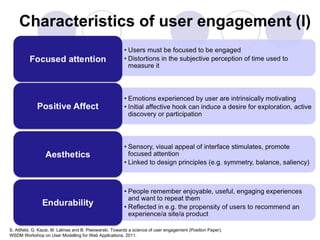
Characteristics of user engagement (I)


S. Attfield, G. Kazai, M. Lalmas and B. Piwowarski. Towards a science of user engagement (Position Paper),
WSDM Workshop on User Modelling for Web Applications, 2011.
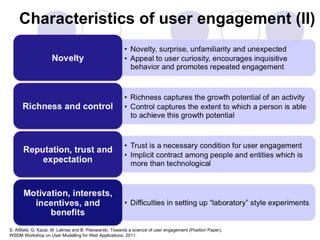
Characteristics of user engagement (II)


S. Attfield, G. Kazai, M. Lalmas and B. Piwowarski. Towards a science of user engagement (Position Paper),
WSDM Workshop on User Modelling for Web Applications, 2011.
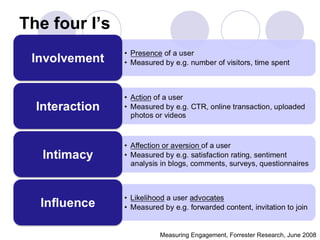
The four I’s


               Measuring Engagement, Forrester Research, June 2008
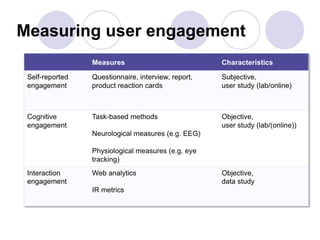
Measuring user engagement
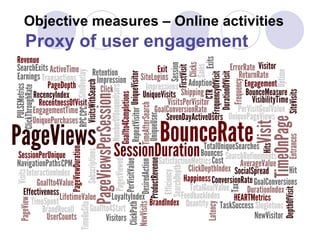
Objective measures – Online activities
Proxy of user engagement
Models of user engagement
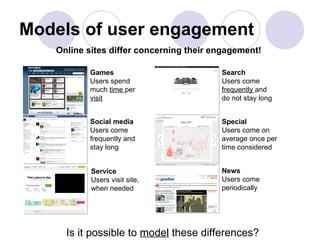
   Online sites differ concerning their engagement!

          Games                          Search
          Users spend                    Users come
          much time per                  frequently and
          visit                          do not stay long


          Social media                   Special
          Users come                     Users come on
          frequently and                 average once per
          stay long                      time considered


           Service                       News
           Users visit site,             Users come
           when needed                   periodically


     Is it possible to model these differences?
Data and Metrics
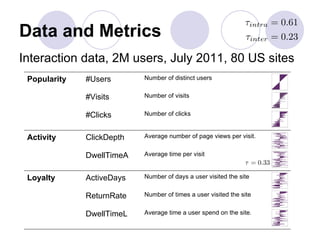
Interaction data, 2M users, July 2011, 80 US sites
 Popularity   #Users       Number of distinct users


              #Visits      Number of visits


              #Clicks      Number of clicks


 Activity     ClickDepth   Average number of page views per visit.


              DwellTimeA   Average time per visit


 Loyalty      ActiveDays   Number of days a user visited the site


              ReturnRate   Number of times a user visited the site


              DwellTimeL   Average time a user spend on the site.
Diversity in user engagement
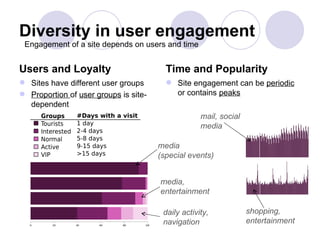
 Engagement of a site depends on users and time


Users and Loyalty                        Time and Popularity
 Sites have different user groups        Site engagement can be periodic
 Proportion of user groups is site-       or contains peaks
  dependent
                                                    mail, social
                                                    media

                                       media
                                       (special events)


                                       media,
                                       entertainment

                                        daily activity,            shopping,
                                        navigation                 entertainment
Methodology
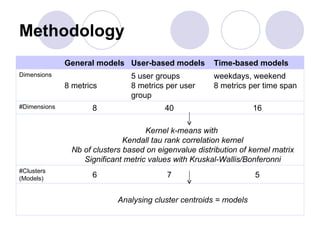
              General models User-based models         Time-based models
Dimensions                      5 user groups          weekdays, weekend
              8 metrics         8 metrics per user     8 metrics per time span
                                group
#Dimensions          8                   40                        16

                                    Kernel k-means with
                              Kendall tau rank correlation kernel
               Nb of clusters based on eigenvalue distribution of kernel matrix
                  Significant metric values with Kruskal-Wallis/Bonferonni
#Clusters
(Models)             6                    7                        5


                            Analysing cluster centroids = models
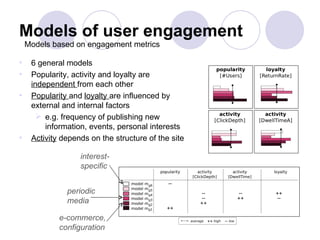
Models of user engagement
    Models based on engagement metrics

•    6 general models
•    Popularity, activity and loyalty are
     independent from each other
•    Popularity and loyalty are influenced by
     external and internal factors
        e.g. frequency of publishing new
         information, events, personal interests
•    Activity depends on the structure of the site

                   interest-
                   specific


               periodic
               media

             e-commerce,
             configuration
Models of user engagement
   Models based on engagement metrics, user and time


  User-based [7 models]                   Time-based [5 models]
   Models based on engagement per         Models based on engagement
    user group                              over weekdays and weekend

navigation     game, sport
                                         hobbies,             daily news
                                         interest-specific


   Sites of the same type (e.g. mainstream media) do not necessarily belong to
    the same model
   The groups of models describe different aspects of engagement, i.e. they are
    independent from each other
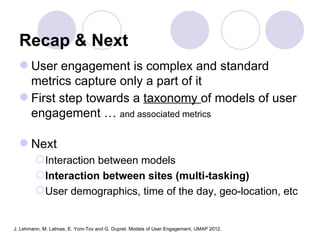
Recap & Next
   User engagement is complex and standard
    metrics capture only a part of it
   First step towards a taxonomy of models of user
    engagement … and associated metrics

   Next
         Interaction between models
         Interaction between sites (multi-tasking)
         User demographics, time of the day, geo-location, etc


J. Lehmann, M. Lalmas, E. Yom-Tov and G. Dupret. Models of User Engagement, UMAP 2012.
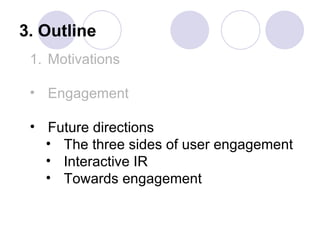
3. Outline
 1. Motivations

 • Engagement

 • Future directions
   • The three sides of user engagement
   • Interactive IR
   • Towards engagement
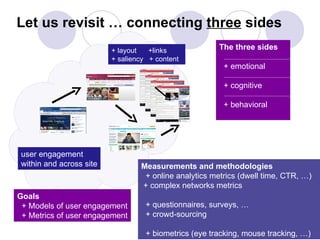
Let us revisit … connecting three sides
                          + layout   +links             The three sides
                          + saliency + content
                                                         + emotional

                                                         + cognitive

                                                         + behavioral


 user engagement
 within and across site           Measurements and methodologies
                                   + online analytics metrics (dwell time, CTR, …)
                                  + complex networks metrics
Goals
 + Models of user engagement        + questionnaires, surveys, …
 + Metrics of user engagement       + crowd-sourcing

                                    + biometrics (eye tracking, mouse tracking, …)
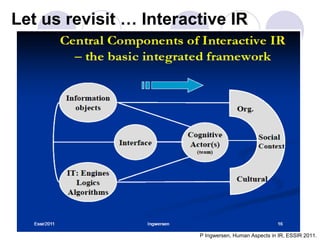
Let us revisit … Interactive IR


                        P Ingwersen, Human Aspects in IR, ESSIR 2011.
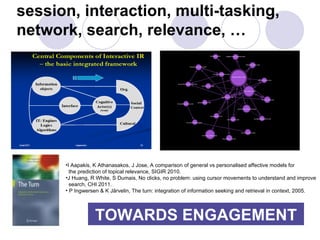
session, interaction, multi-tasking,
network, search, relevance, …


      •I Aapakis, K Athanasakos, J Jose, A comparison of general vs personalised affective models for
        the prediction of topical relevance, SIGIR 2010.
      •J Huang, R White, S Dumais, No clicks, no problem: using cursor movements to understand and improve
        search, CHI 2011.
      • P Ingwersen & K Järvelin, The turn: integration of information seeking and retrieval in context, 2005.


                  TOWARDS ENGAGEMENT
Information Retrieval Over Query Sessions
  Retrieval Models & Ranking: How to analyze/model/predict user
                                                          T e
                                                      EN nc
   interactions and use these findings to improve retrieval

                                                  EM eva
   performance? How can we adapt ranking/retrieval models and IR
   theory in the light of a sequence of user interactions.
                                            AG rel
 
                                    E aNG nd
     Evaluation & Test Collections: How can we evaluate retrieval
     system performance over S
                             D ion
                                 entire query sessions? How can we build
                           R s over a session?
     reusable test collections to study this IR task? How can we
                        A es
     model/simulate user interactions
                     W s
                TO nd
                    o
     User Interaction & Interfaces: How can we model user
                    ywe can predict and improve the user experience over
     interactions e
               b  so
     sessions? How can we design and perform user studies that reveal
     new information about users? How can we make use of implicit
     feedback from users?
Thank you
 mounia@acm.org               T e
                            EN nc
                         EM eva
 www.dcs.gla.ac.uk/~mounia

                       AG rel
                    NG nd
                  E a
               D S ion
              R s
             A es
           W s
       TO nd
          yo
       be

Session, focus and engagement

  • 1.
    Session, focus andengagement Mounia Lalmas Yahoo! Research Barcelona mounia@acm.org
  • 2.
    A bit aboutmyself  1999-2008: Lecturer (assistant professor) to Professor at Queen Mary, University of London  2008-2010 Microsoft Research/RAEng Research Professor at the University of Glasgow (and lived outside London)  2011- Visiting Principal Scientist at Yahoo! Research Barcelona  Research topics  XML retrieval and evaluation (INEX)  Quantum theory to model interactive information retrieval  Aggregated search  Bridging the digital divide  Models and measures of user engagement
  • 3.
    Message and Outline Interaction and search  Beyond result relevance  Beyond search session  Towards “engagement” 1. Motivations 2. Engagement 3. Future directions
  • 4.
    1. Outline 1.Motivations • Relevance in multimedia search • Relevance in focused retrieval • Online multi-tasking • Engagement • Future directions
  • 5.
    Information Retrieval OverQuery Sessions  Retrieval Models & Ranking: How to analyze/model/predict user interactions and use these findings to improve retrieval performance? How can we adapt ranking/retrieval models and IR theory in the light of a sequence of user interactions.  Evaluation & Test Collections: How can we evaluate retrieval system performance over entire query sessions? How can we build reusable test collections to study this IR task? How can we model/simulate user interactions over a session?  User Interaction & Interfaces: How can we model user interactions so we can predict and improve the user experience over sessions? How can we design and perform user studies that reveal new information about users? How can we make use of implicit feedback from users?
  • 6.
    Relevance in multimediasearch Multimedia search activities often driven by entertainment needs, not by M. Slaney, Precision-Recall Is Wrong for Multimedia, IEEE Multimedia Magazine, 2011 information needs
  • 7.
    Relevance in focusedretrieval Relevance in context Table of Content Focused retrieval is about putting results (element, fact, passage) in context, to understand and trust them Courtesy Jaap Kamps, Zoltan Szlavik, Norbert Goevert
  • 8.
    Courtesy of JanetteLehmann Beyond search session On month browsing data, sample of sites (INT=Yahoo site, EXT=non Yahoo site) On month browsing data, sample of Yahoo! sites users spend more and more of their online session multi-tasking, e.g. emailing, reading news, searching for information  ONLINE MULTI-TASKING navigating between sites, using browser tabs, etc seamless integration of social networks platforms into many services
  • 9.
    Interactive IR … P Ingwersen, Human Aspects in IR, ESSIR 2011.
  • 10.
    2. Outline 1.Motivations • (User) Engagement • Definition • Characteristics • Measuring • Models • Future directions
  • 11.
    User Engagement –connecting three sides  User engagement is a quality of user experience that emphasizes the positive aspects of interaction – in particular the fact of being captivated by the technology.  Successful technologies are not just used, they are engaged with. user feelings: happy, sad, user mental states: concentrated, user interactions: click, read excited, bored, … challenged, lost, interested … comment, recommend, buy, … The emotional, cognitive and/or behavioural connection that exists, at any point in time and over time, between a user and a technological resource
  • 12.
    Characteristics of userengagement (I) S. Attfield, G. Kazai, M. Lalmas and B. Piwowarski. Towards a science of user engagement (Position Paper), WSDM Workshop on User Modelling for Web Applications, 2011.
  • 13.
    Characteristics of userengagement (II) S. Attfield, G. Kazai, M. Lalmas and B. Piwowarski. Towards a science of user engagement (Position Paper), WSDM Workshop on User Modelling for Web Applications, 2011.
  • 14.
    The four I’s Measuring Engagement, Forrester Research, June 2008
  • 15.
  • 16.
    Objective measures –Online activities Proxy of user engagement
  • 17.
    Models of userengagement Online sites differ concerning their engagement! Games Search Users spend Users come much time per frequently and visit do not stay long Social media Special Users come Users come on frequently and average once per stay long time considered Service News Users visit site, Users come when needed periodically Is it possible to model these differences?
  • 18.
    Data and Metrics Interactiondata, 2M users, July 2011, 80 US sites Popularity #Users Number of distinct users #Visits Number of visits #Clicks Number of clicks Activity ClickDepth Average number of page views per visit. DwellTimeA Average time per visit Loyalty ActiveDays Number of days a user visited the site ReturnRate Number of times a user visited the site DwellTimeL Average time a user spend on the site.
  • 19.
    Diversity in userengagement Engagement of a site depends on users and time Users and Loyalty Time and Popularity  Sites have different user groups  Site engagement can be periodic  Proportion of user groups is site- or contains peaks dependent mail, social media media (special events) media, entertainment daily activity, shopping, navigation entertainment
  • 20.
    Methodology General models User-based models Time-based models Dimensions 5 user groups weekdays, weekend 8 metrics 8 metrics per user 8 metrics per time span group #Dimensions 8 40 16 Kernel k-means with Kendall tau rank correlation kernel Nb of clusters based on eigenvalue distribution of kernel matrix Significant metric values with Kruskal-Wallis/Bonferonni #Clusters (Models) 6 7 5 Analysing cluster centroids = models
  • 21.
    Models of userengagement Models based on engagement metrics • 6 general models • Popularity, activity and loyalty are independent from each other • Popularity and loyalty are influenced by external and internal factors  e.g. frequency of publishing new information, events, personal interests • Activity depends on the structure of the site interest- specific periodic media e-commerce, configuration
  • 22.
    Models of userengagement Models based on engagement metrics, user and time User-based [7 models] Time-based [5 models]  Models based on engagement per  Models based on engagement user group over weekdays and weekend navigation game, sport hobbies, daily news interest-specific  Sites of the same type (e.g. mainstream media) do not necessarily belong to the same model  The groups of models describe different aspects of engagement, i.e. they are independent from each other
  • 23.
    Recap & Next  User engagement is complex and standard metrics capture only a part of it  First step towards a taxonomy of models of user engagement … and associated metrics  Next  Interaction between models  Interaction between sites (multi-tasking)  User demographics, time of the day, geo-location, etc J. Lehmann, M. Lalmas, E. Yom-Tov and G. Dupret. Models of User Engagement, UMAP 2012.
  • 24.
    3. Outline 1.Motivations • Engagement • Future directions • The three sides of user engagement • Interactive IR • Towards engagement
  • 25.
    Let us revisit… connecting three sides + layout +links The three sides + saliency + content + emotional + cognitive + behavioral user engagement within and across site Measurements and methodologies + online analytics metrics (dwell time, CTR, …) + complex networks metrics Goals + Models of user engagement + questionnaires, surveys, … + Metrics of user engagement + crowd-sourcing + biometrics (eye tracking, mouse tracking, …)
  • 26.
    Let us revisit… Interactive IR P Ingwersen, Human Aspects in IR, ESSIR 2011.
  • 27.
    session, interaction, multi-tasking, network,search, relevance, … •I Aapakis, K Athanasakos, J Jose, A comparison of general vs personalised affective models for the prediction of topical relevance, SIGIR 2010. •J Huang, R White, S Dumais, No clicks, no problem: using cursor movements to understand and improve search, CHI 2011. • P Ingwersen & K Järvelin, The turn: integration of information seeking and retrieval in context, 2005. TOWARDS ENGAGEMENT
  • 28.
    Information Retrieval OverQuery Sessions  Retrieval Models & Ranking: How to analyze/model/predict user T e EN nc interactions and use these findings to improve retrieval EM eva performance? How can we adapt ranking/retrieval models and IR theory in the light of a sequence of user interactions. AG rel  E aNG nd Evaluation & Test Collections: How can we evaluate retrieval system performance over S D ion entire query sessions? How can we build R s over a session? reusable test collections to study this IR task? How can we A es model/simulate user interactions W s TO nd  o User Interaction & Interfaces: How can we model user ywe can predict and improve the user experience over interactions e b so sessions? How can we design and perform user studies that reveal new information about users? How can we make use of implicit feedback from users?
  • 29.
    Thank you mounia@acm.org T e EN nc EM eva www.dcs.gla.ac.uk/~mounia AG rel NG nd E a D S ion R s A es W s TO nd yo be

Editor's Notes

  • #13 Characteristics elaborate the notion of engagement over 3 broad dimensions: emotional, cognitive and behavioural. We identified 8 of them based on previous works / suggested by us. Attention -> exclusivity Affect -> lack of fun can lead as a barrier to shopping (O’Brian) Aesthetics -> promotes attention, stimulate curiosity Endurability -> does the experience meet the expectation?
  • #14 Novelty -> freshness of content / has to be carefully balanced Richness = complexity of thoughts and actions, increased complexity/ Affect = relates to the emotion experienced during the interaction (fun and enjoyment)