Using web analytics in public relations
Dana Chinn


                                     February 2010
Web analytics essentials

• Why measuring audiences is different now
• Behavioral vs. attitudinal
• “Famous metrics” vs. useful ones
• Basic site metrics
  Counting vs. calculating engagement

• Social media metrics
  Understanding followers, analyzing content


                                               2
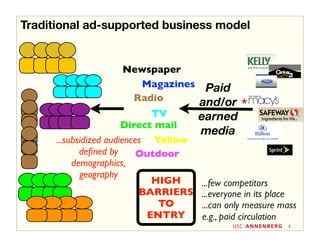
Traditional ad-supported business model


                         Newspaper
                             Magazines Paid
                           Radio      and/or
                               TV     earned
                        Direct mail
                                       media
      ...subsidized audiences Yellow
             defined by      Outdoor
           demographics,
             geography
                               HIGH    ...few competitors
                            BARRIERS ...everyone in its place
                                TO     ...can only measure mass
                              ENTRY    e.g., paid circulation
                                                             3
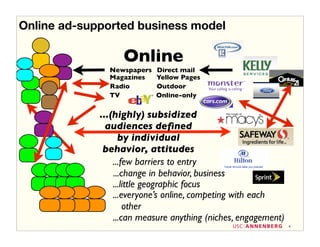
Online ad-supported business model

                   Online
               Newspapers   Direct mail
               Magazines    Yellow Pages
               Radio        Outdoor
               TV           Online-only


             ...(highly) subsidized
               audiences defined
                   by individual
              behavior, attitudes
                 ...few barriers to entry
                 ...change in behavior, business
                 ...little geographic focus
                 ...everyone’s online, competing with each
                     other
                 ...can measure anything (niches, engagement)
                                                                4
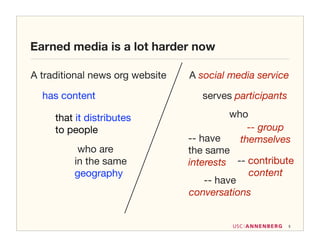
Earned media is a lot harder now

A traditional news org website   A social media service

  has content                       serves participants

     that it distributes                   who
     to people                                 -- group
                                 -- have     themselves
          who are                the same
         in the same             interests -- contribute
         geography                             content
                                     -- have
                                 conversations


                                                          5
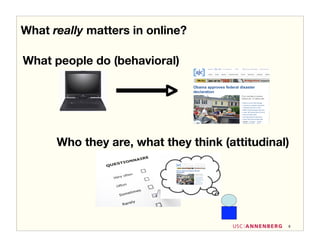
What really matters in online?

What people do (behavioral)


      Who they are, what they think (attitudinal)


                                                6
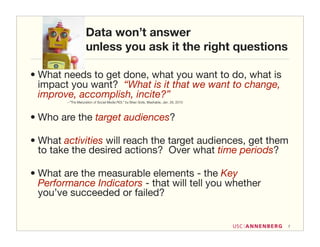
Data won’t answer
                    unless you ask it the right questions

• What needs to get done, what you want to do, what is
  impact you want? “What is it that we want to change,
  improve, accomplish, incite?”
        --”The Maturation of Social Media ROI,” by Brian Solis, Mashable, Jan. 26, 2010


• Who are the target audiences?

• What activities will reach the target audiences, get them
  to take the desired actions? Over what time periods?

• What are the measurable elements - the Key
  Performance Indicators - that will tell you whether
  you’ve succeeded or failed?


                                                                                          7
8
Some metrics are “famous” but useless
      “After the disaster in Haiti, [our site] hit
      168.6 million pageviews
      in the month of January. A new record.”

                                                    “We are the go-to source for California
                                                                       12.2 million
                                                    news....[our site had]

                                                    CALIFORNIANS....For the
                                                    month, we received 24,449,693

--From an internal communication of a
media organization, February 2010
                                                    visits.”
--The ”famous metrics” term comes from web analytics guru Avinash Kaushik                     9
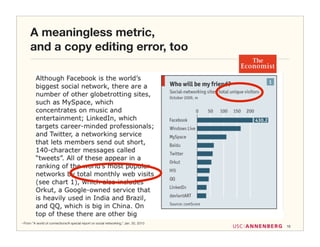
A meaningless metric,
      and a copy editing error, too


--From ”A world of connections/A special report on social networking,” Jan. 30, 2010
                                                                                       10
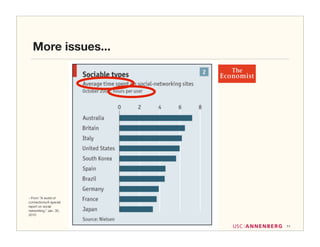
More issues...


--From ”A world of
connections/A special
report on social
networking,” Jan. 30,
2010


                        11
Internal vs. external numbers
Internal                         External
• Census data                    • Panel data
 100% of all visitors, visits,    Activity from a sample of self-
 page views for all sections      selected people. Only total site
                                  data for a limited number of sites.


• Internal data                  • External data
 Confidential                      Used to compare sites


• Omniture                       • comScore
  Google Analytics                 Nielsen
  WebTrends                        Compete
  etc.                             etc.

• Web Analytics                  • Interactive
  Association                      Advertising Bureau
                                                                        12
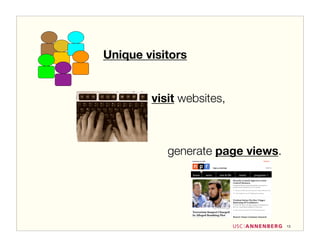
Unique visitors


        visit websites,


           generate page views.


                                  13
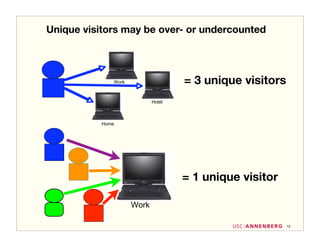
A “unique visitor” is actually a “unique computer”


                                                     14
Unique visitors may be over- or undercounted


              Work                  =33 unique visitors
                                    = unique visitors

                            Hotel


           Home


                                    = 1 unique visitor

                     Work

                                                          15
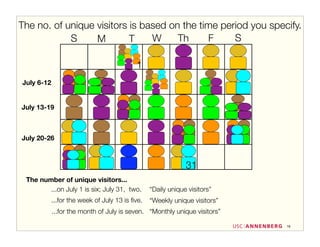
The no. of unique visitors is based on the time period you specify.
            S     M        T    W     Th     F     S

                                           1
July 6-12


July 13-19


July 20-26


                                                              31
 The number of unique visitors...
        ...on July 1 is six; July 31, two.       “Daily unique visitors”
            ...for the week of July 13 is five.   “Weekly unique visitors”
            ...for the month of July is seven. “Monthly unique visitors”

                                                                            16
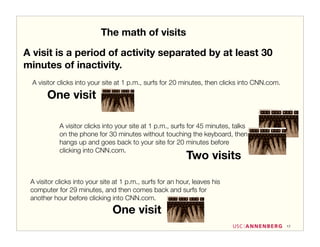
The math of visits

A visit is a period of activity separated by at least 30
minutes of inactivity.
  A visitor clicks into your site at 1 p.m., surfs for 20 minutes, then clicks into CNN.com.

       One visit

            A visitor clicks into your site at 1 p.m., surfs for 45 minutes, talks
            on the phone for 30 minutes without touching the keyboard, then
            hangs up and goes back to your site for 20 minutes before
            clicking into CNN.com.
                                                            Two visits

 A visitor clicks into your site at 1 p.m., surfs for an hour, leaves his
 computer for 29 minutes, and then comes back and surfs for
 another hour before clicking into CNN.com.
                                One visit
                                                                                               17
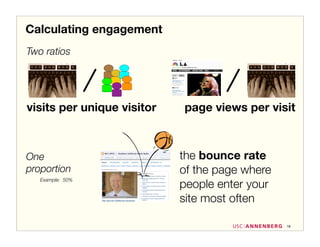
Calculating engagement
Two ratios


visits per unique visitor   page views per visit


One                         the bounce rate
proportion                  of the page where
                            people enter your
   Example: 50%


                            site most often

                                                18
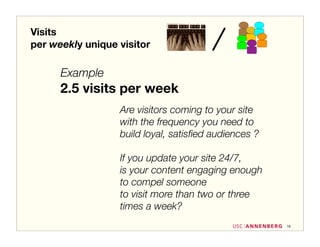
Visits
per weekly unique visitor

      Example
      2.5 visits per week
                  Are visitors coming to your site
                  with the frequency you need to
                  build loyal, satisfied audiences ?

                  If you update your site 24/7,
                  is your content engaging enough
                  to compel someone
                  to visit more than two or three
                  times a week?
                                                      19
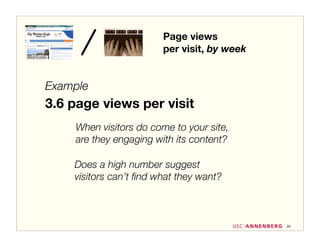
Page views
                        per visit, by week


Example
3.6 page views per visit
    When visitors do come to your site,
    are they engaging with its content?

    Does a high number suggest
    visitors can’t find what they want?


                                             20
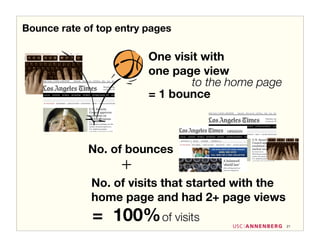
Bounce rate of top entry pages

                         One visit with
                         one page view
                                 to the home page
                         = 1 bounce


             No. of bounces
                   +
             No. of visits that started with the
             home page and had 2+ page views
              = 100% of visits                      21
Example
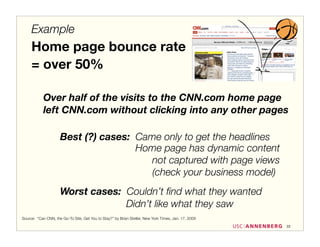
     Home page bounce rate
     = over 50%

            Over half of the visits to the CNN.com home page
            left CNN.com without clicking into any other pages

                     Best (?) cases: Came only to get the headlines
                                     Home page has dynamic content
                                        not captured with page views
                                        (check your business model)
                     Worst cases: Couldn’t find what they wanted
                                  Didn’t like what they saw
Source: “Can CNN, the Go-To Site, Get You to Stay?” by Brian Stetler, New York Times, Jan. 17, 2009
                                                                                                      22
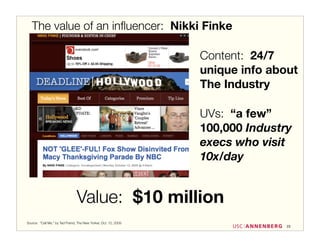
The value of an influencer: Nikki Finke

                                                                  Content: 24/7
                                                                  unique info about
                                                                  The Industry

                                                                  UVs: “a few”
                                                                  100,000 Industry
                                                                  execs who visit
                                                                  10x/day


                                 Value: $10 million
Source: “Call Me,” by Tad Friend, The New Yorker, Oct. 12, 2009
                                                                                 23
Each defined activity has its own
               Key Performance Indicators

Define success/failure with KPIs that indicate participation, engagement.
Use ratios, percents - not counts.

• Content: comments/post; bounce rate; percent positive/negative

• Twitter: PVs/URL; tweets/influencer; retweets/tweet

• Facebook: Percent of fans in target audience; discussion topics/influencer; wall
  posts/fan

• Photos/slideshows: percent of show viewed; percent of target audience who
  posted; comments/slideshow

• Videos: views/UV; percent of UVs who rated

• Attitudes: transparency; trust; are you adding value to the conversation?


                                                                                    24
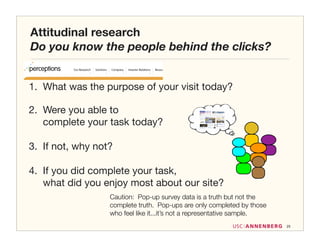
Attitudinal research
Do you know the people behind the clicks?


1. What was the purpose of your visit today?

2. Were you able to
   complete your task today?

3. If not, why not?

4. If you did complete your task,
   what did you enjoy most about our site?
                  Caution: Pop-up survey data is a truth but not the
                  complete truth. Pop-ups are only completed by those
                  who feel like it...it’s not a representative sample.
                                                                         25
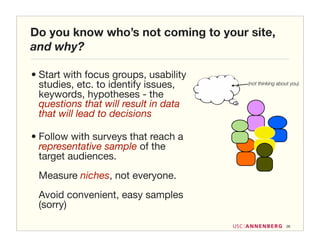
Do you know who’s not coming to your site,
and why?

• Start with focus groups, usability
  studies, etc. to identify issues,    (not thinking about you)

  keywords, hypotheses - the
  questions that will result in data
  that will lead to decisions

• Follow with surveys that reach a
  representative sample of the
  target audiences.
 Measure niches, not everyone.
 Avoid convenient, easy samples
 (sorry)
                                                         26
Social media:
   Not only are the technologies new,
   but the metrics are as well.
       --Online Media and Marketing Association Metrics and Measurement program, June 2009


                                                                                             27
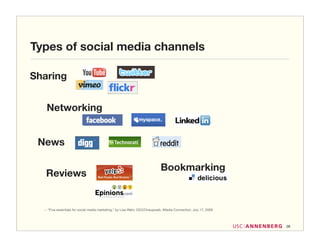
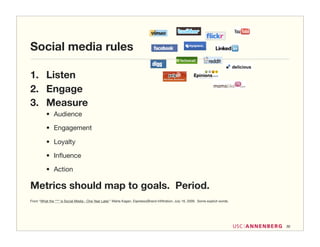
Types of social media channels

Sharing


   Networking


 News

                                                                             Bookmarking
   Reviews


  -- “Five essentials for social media marketing,” by Lisa Wehr, CEO/Oneupweb, iMedia Connection, July 17, 2009


                                                                                                                  28
Social media:
a constant stream of calls to action


                                    Brands earn the trust and loyalty of
                                    their customers by listening and
                                    responding.
                                                    --”The Maturation of Social Media ROI,” by Brian Solis, Mashable, Jan. 26, 2010


         ...the true value of a network
         is measured
         by the frequency of engagement
         of the participants.
               -- Interactive Advertising Bureau Social Media Ad Metrics Definitions, May 2009


                                                                                                                                 29
Social media rules

1. Listen
2. Engage
3. Measure
          • Audience

          • Engagement

          • Loyalty

          • Influence

          • Action

Metrics should map to goals. Period.
From “What the **** is Social Media - One Year Later,” Marta Kagan, Espresso|Brand Infiltration, July 16, 2009. Some explicit words.


                                                                                                                                      30
Step 1: Define the R


                       R OI  eturn         n    nvestment


                                     and


                        R OO  eturn         n        bjectve


                                                “What is it that we want
                                                to change, improve, accomplish, incite....?”


--”The Maturation of Social Media ROI,” by Brian Solis, Mashable, Jan. 26, 2010


                                                                                               31
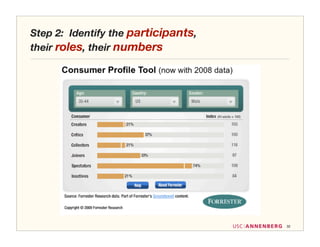
Step 2: Identify the participants,
their roles, their numbers


                                     32
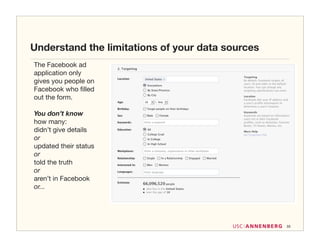
Understand the limitations of your data sources
The Facebook ad
application only
gives you people on
Facebook who filled
out the form.

You don’t know
how many:
didn’t give details
or
updated their status
or
told the truth
or
aren’t in Facebook
or...


                                                  33
Your clients want KPIs that show
                                                      proof of audience, participation
• Targeted audience reach, frequency
      • Audience profile
      • Unique visitors, active users; page views; visits, return visits; time spent
      • Growth; “conversation reach”
• Content relevance
      • Author (journalists, others) credibility; content freshness; influence
• Calls to action answered
      • Passive: downloads; games played; videos viewed; alerts subscribed/
        unsubscribed; widgets installed
      • Info submitted: comments posted; topics/forums created; photos, videos
        uploaded; poll votes; ratings, reviews, recommendations; contests entered
      • Interaction: friends reached; in/out links; reposts

Derived from Interactive Advertising Bureau Social Media Ad Metrics Definitions, May 2009


                                                                                           34
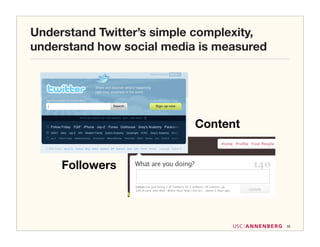
Understand Twitter’s simple complexity,
understand how social media is measured


                           Content


     Followers


                                          35
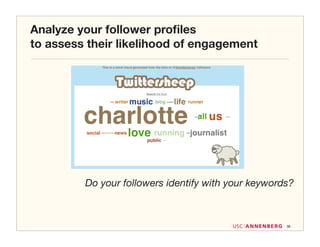
Analyze your follower profiles
to assess their likelihood of engagement


         Do your followers identify with your keywords?


                                                     36
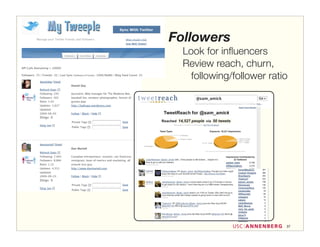
Followers
  Look for influencers
  Review reach, churn,
    following/follower ratio


                           37
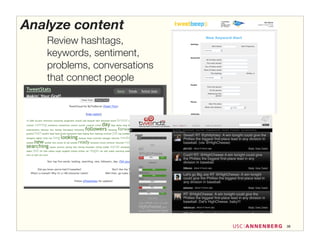
Analyze content
   Review hashtags,
   keywords, sentiment,
   problems, conversations
   that connect people


                             38
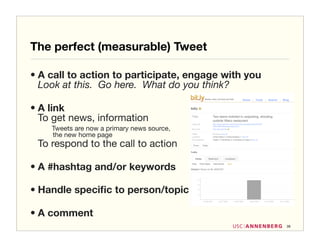
The perfect (measurable) Tweet

• A call to action to participate, engage with you
  Look at this. Go here. What do you think?

• A link
  To get news, information
    Tweets are now a primary news source,
    the new home page
 To respond to the call to action

• A #hashtag and/or keywords

• Handle specific to person/topic

• A comment
                                                     39
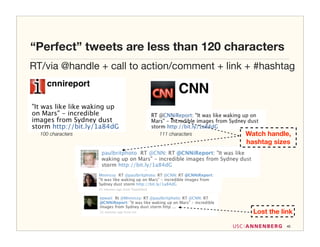
“Perfect” tweets are less than 120 characters
RT/via @handle + call to action/comment + link + #hashtag


  100 characters           111 characters     Watch handle,
                                              hashtag sizes


                                                Lost the link

                                                           40
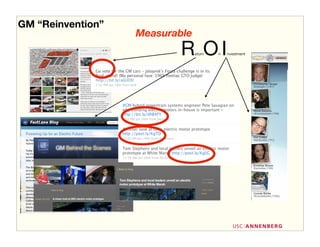
GM “Reinvention”
                   Measurable
                           R OI eturn   n   nvestment
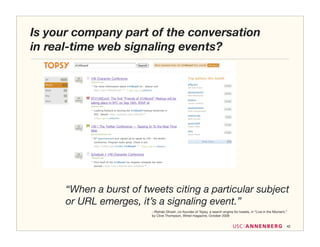
Is your company part of the conversation
in real-time web signaling events?


      “When a burst of tweets citing a particular subject
      or URL emerges, it’s a signaling event.”
                         --Rishab Ghosh, co-founder of Topsy, a search engine for tweets, in “Live in the Moment,”
                         by Clive Thompson, Wired magazine, October 2009


                                                                                                                 42
Define success by who your audiences are
and what they’re doing, thinking


                       Universal Studios Hollywood ad, 2007

                                                              43
Dana Chinn                      Blog
Lecturer                           http://www.newsnumbers.com

    chinn@usc.edu
    213-821-6259

Analytics for news orgs
bookmarks
  http://www.delicious.com/
danachinn

Presentations
   http://www.slideshare.net/
danachinn


                                                         44

Using web analytics in public relations

  • 1.
    Using web analyticsin public relations Dana Chinn February 2010
  • 2.
    Web analytics essentials •Why measuring audiences is different now • Behavioral vs. attitudinal • “Famous metrics” vs. useful ones • Basic site metrics Counting vs. calculating engagement • Social media metrics Understanding followers, analyzing content 2
  • 3.
    Traditional ad-supported businessmodel Newspaper Magazines Paid Radio and/or TV earned Direct mail media ...subsidized audiences Yellow defined by Outdoor demographics, geography HIGH ...few competitors BARRIERS ...everyone in its place TO ...can only measure mass ENTRY e.g., paid circulation 3
  • 4.
    Online ad-supported businessmodel Online Newspapers Direct mail Magazines Yellow Pages Radio Outdoor TV Online-only ...(highly) subsidized audiences defined by individual behavior, attitudes ...few barriers to entry ...change in behavior, business ...little geographic focus ...everyone’s online, competing with each other ...can measure anything (niches, engagement) 4
  • 5.
    Earned media isa lot harder now A traditional news org website A social media service has content serves participants that it distributes who to people -- group -- have themselves who are the same in the same interests -- contribute geography content -- have conversations 5
  • 6.
    What really mattersin online? What people do (behavioral) Who they are, what they think (attitudinal) 6
  • 7.
    Data won’t answer unless you ask it the right questions • What needs to get done, what you want to do, what is impact you want? “What is it that we want to change, improve, accomplish, incite?” --”The Maturation of Social Media ROI,” by Brian Solis, Mashable, Jan. 26, 2010 • Who are the target audiences? • What activities will reach the target audiences, get them to take the desired actions? Over what time periods? • What are the measurable elements - the Key Performance Indicators - that will tell you whether you’ve succeeded or failed? 7
  • 8.
  • 9.
    Some metrics are“famous” but useless “After the disaster in Haiti, [our site] hit 168.6 million pageviews in the month of January. A new record.” “We are the go-to source for California 12.2 million news....[our site had] CALIFORNIANS....For the month, we received 24,449,693 --From an internal communication of a media organization, February 2010 visits.” --The ”famous metrics” term comes from web analytics guru Avinash Kaushik 9
  • 10.
    A meaningless metric, and a copy editing error, too --From ”A world of connections/A special report on social networking,” Jan. 30, 2010 10
  • 11.
    More issues... --From ”Aworld of connections/A special report on social networking,” Jan. 30, 2010 11
  • 12.
    Internal vs. externalnumbers Internal External • Census data • Panel data 100% of all visitors, visits, Activity from a sample of self- page views for all sections selected people. Only total site data for a limited number of sites. • Internal data • External data Confidential Used to compare sites • Omniture • comScore Google Analytics Nielsen WebTrends Compete etc. etc. • Web Analytics • Interactive Association Advertising Bureau 12
  • 13.
    Unique visitors visit websites, generate page views. 13
  • 14.
    A “unique visitor”is actually a “unique computer” 14
  • 15.
    Unique visitors maybe over- or undercounted Work =33 unique visitors = unique visitors Hotel Home = 1 unique visitor Work 15
  • 16.
    The no. ofunique visitors is based on the time period you specify. S M T W Th F S 1 July 6-12 July 13-19 July 20-26 31 The number of unique visitors... ...on July 1 is six; July 31, two. “Daily unique visitors” ...for the week of July 13 is five. “Weekly unique visitors” ...for the month of July is seven. “Monthly unique visitors” 16
  • 17.
    The math ofvisits A visit is a period of activity separated by at least 30 minutes of inactivity. A visitor clicks into your site at 1 p.m., surfs for 20 minutes, then clicks into CNN.com. One visit A visitor clicks into your site at 1 p.m., surfs for 45 minutes, talks on the phone for 30 minutes without touching the keyboard, then hangs up and goes back to your site for 20 minutes before clicking into CNN.com. Two visits A visitor clicks into your site at 1 p.m., surfs for an hour, leaves his computer for 29 minutes, and then comes back and surfs for another hour before clicking into CNN.com. One visit 17
  • 18.
    Calculating engagement Two ratios visitsper unique visitor page views per visit One the bounce rate proportion of the page where people enter your Example: 50% site most often 18
  • 19.
    Visits per weekly uniquevisitor Example 2.5 visits per week Are visitors coming to your site with the frequency you need to build loyal, satisfied audiences ? If you update your site 24/7, is your content engaging enough to compel someone to visit more than two or three times a week? 19
  • 20.
    Page views per visit, by week Example 3.6 page views per visit When visitors do come to your site, are they engaging with its content? Does a high number suggest visitors can’t find what they want? 20
  • 21.
    Bounce rate oftop entry pages One visit with one page view to the home page = 1 bounce No. of bounces + No. of visits that started with the home page and had 2+ page views = 100% of visits 21
  • 22.
    Example Home page bounce rate = over 50% Over half of the visits to the CNN.com home page left CNN.com without clicking into any other pages Best (?) cases: Came only to get the headlines Home page has dynamic content not captured with page views (check your business model) Worst cases: Couldn’t find what they wanted Didn’t like what they saw Source: “Can CNN, the Go-To Site, Get You to Stay?” by Brian Stetler, New York Times, Jan. 17, 2009 22
  • 23.
    The value ofan influencer: Nikki Finke Content: 24/7 unique info about The Industry UVs: “a few” 100,000 Industry execs who visit 10x/day Value: $10 million Source: “Call Me,” by Tad Friend, The New Yorker, Oct. 12, 2009 23
  • 24.
    Each defined activityhas its own Key Performance Indicators Define success/failure with KPIs that indicate participation, engagement. Use ratios, percents - not counts. • Content: comments/post; bounce rate; percent positive/negative • Twitter: PVs/URL; tweets/influencer; retweets/tweet • Facebook: Percent of fans in target audience; discussion topics/influencer; wall posts/fan • Photos/slideshows: percent of show viewed; percent of target audience who posted; comments/slideshow • Videos: views/UV; percent of UVs who rated • Attitudes: transparency; trust; are you adding value to the conversation? 24
  • 25.
    Attitudinal research Do youknow the people behind the clicks? 1. What was the purpose of your visit today? 2. Were you able to complete your task today? 3. If not, why not? 4. If you did complete your task, what did you enjoy most about our site? Caution: Pop-up survey data is a truth but not the complete truth. Pop-ups are only completed by those who feel like it...it’s not a representative sample. 25
  • 26.
    Do you knowwho’s not coming to your site, and why? • Start with focus groups, usability studies, etc. to identify issues, (not thinking about you) keywords, hypotheses - the questions that will result in data that will lead to decisions • Follow with surveys that reach a representative sample of the target audiences. Measure niches, not everyone. Avoid convenient, easy samples (sorry) 26
  • 27.
    Social media: Not only are the technologies new, but the metrics are as well. --Online Media and Marketing Association Metrics and Measurement program, June 2009 27
  • 28.
    Types of socialmedia channels Sharing Networking News Bookmarking Reviews -- “Five essentials for social media marketing,” by Lisa Wehr, CEO/Oneupweb, iMedia Connection, July 17, 2009 28
  • 29.
    Social media: a constantstream of calls to action Brands earn the trust and loyalty of their customers by listening and responding. --”The Maturation of Social Media ROI,” by Brian Solis, Mashable, Jan. 26, 2010 ...the true value of a network is measured by the frequency of engagement of the participants. -- Interactive Advertising Bureau Social Media Ad Metrics Definitions, May 2009 29
  • 30.
    Social media rules 1.Listen 2. Engage 3. Measure • Audience • Engagement • Loyalty • Influence • Action Metrics should map to goals. Period. From “What the **** is Social Media - One Year Later,” Marta Kagan, Espresso|Brand Infiltration, July 16, 2009. Some explicit words. 30
  • 31.
    Step 1: Definethe R R OI eturn n nvestment and R OO eturn n bjectve “What is it that we want to change, improve, accomplish, incite....?” --”The Maturation of Social Media ROI,” by Brian Solis, Mashable, Jan. 26, 2010 31
  • 32.
    Step 2: Identifythe participants, their roles, their numbers 32
  • 33.
    Understand the limitationsof your data sources The Facebook ad application only gives you people on Facebook who filled out the form. You don’t know how many: didn’t give details or updated their status or told the truth or aren’t in Facebook or... 33
  • 34.
    Your clients wantKPIs that show proof of audience, participation • Targeted audience reach, frequency • Audience profile • Unique visitors, active users; page views; visits, return visits; time spent • Growth; “conversation reach” • Content relevance • Author (journalists, others) credibility; content freshness; influence • Calls to action answered • Passive: downloads; games played; videos viewed; alerts subscribed/ unsubscribed; widgets installed • Info submitted: comments posted; topics/forums created; photos, videos uploaded; poll votes; ratings, reviews, recommendations; contests entered • Interaction: friends reached; in/out links; reposts Derived from Interactive Advertising Bureau Social Media Ad Metrics Definitions, May 2009 34
  • 35.
    Understand Twitter’s simplecomplexity, understand how social media is measured Content Followers 35
  • 36.
    Analyze your followerprofiles to assess their likelihood of engagement Do your followers identify with your keywords? 36
  • 37.
    Followers Lookfor influencers Review reach, churn, following/follower ratio 37
  • 38.
    Analyze content Review hashtags, keywords, sentiment, problems, conversations that connect people 38
  • 39.
    The perfect (measurable)Tweet • A call to action to participate, engage with you Look at this. Go here. What do you think? • A link To get news, information Tweets are now a primary news source, the new home page To respond to the call to action • A #hashtag and/or keywords • Handle specific to person/topic • A comment 39
  • 40.
    “Perfect” tweets areless than 120 characters RT/via @handle + call to action/comment + link + #hashtag 100 characters 111 characters Watch handle, hashtag sizes Lost the link 40
  • 41.
    GM “Reinvention” Measurable R OI eturn n nvestment
  • 42.
    Is your companypart of the conversation in real-time web signaling events? “When a burst of tweets citing a particular subject or URL emerges, it’s a signaling event.” --Rishab Ghosh, co-founder of Topsy, a search engine for tweets, in “Live in the Moment,” by Clive Thompson, Wired magazine, October 2009 42
  • 43.
    Define success bywho your audiences are and what they’re doing, thinking Universal Studios Hollywood ad, 2007 43
  • 44.
    Dana Chinn Blog Lecturer http://www.newsnumbers.com chinn@usc.edu 213-821-6259 Analytics for news orgs bookmarks http://www.delicious.com/ danachinn Presentations http://www.slideshare.net/ danachinn 44