Improving Post-Click User
Engagement on Native Ads via
Survival Analysis	
Nicola Barbieri, Fabrizio Silvestri and Mounia Lalmas
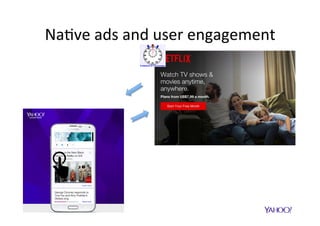
Na$ve	ads	and	user	engagement	
•  Es$mate	post-click	engagement	on	
mobile	na$ve	ads	
•  Integrate	predic$on	into	ranking	func$on	
to	promote	the	most	engaging	ads
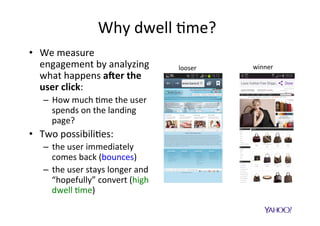
•  We	measure	
engagement	by	analyzing	
what	happens	a0er	the	
user	click:	
–  How	much	$me	the	user	
spends	on	the	landing	
page?		
•  Two	possibili$es:	
–  the	user	immediately	
comes	back	(bounces)	
–  the	user	stays	longer	and	
“hopefully”	convert	(high	
dwell	$me)	
looser	 winner	
Dwell	$me	based	user	engagement
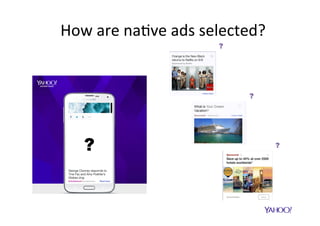
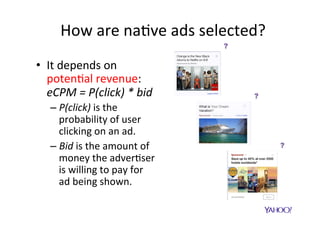
How	are	na$ve	ads	selected?	
?
?
?
?
?
?
?
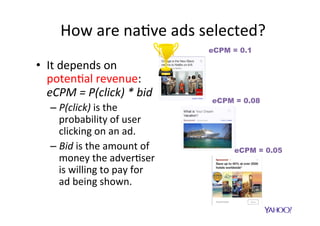
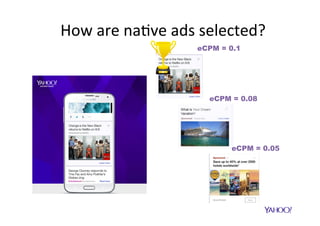
•  It	depends	on	
poten$al	revenue:	
eCPM	=	P(click)	*	bid	
– P(click)	is	the	
probability	of	user	
clicking	on	an	ad.	
– Bid	is	the	amount	of	
money	the	adver$ser	
is	willing	to	pay	for	
ad	being	shown.	
How	are	na$ve	ads	selected?
eCPM = 0.1
eCPM = 0.08
eCPM = 0.05
How	are	na$ve	ads	selected?
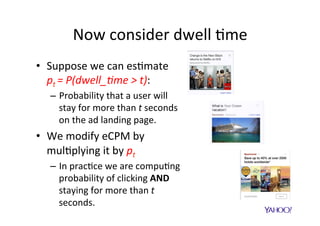
Now	consider	dwell	$me	
•  Suppose	we	can	es$mate			
pt	=	P(dwell_5me	>	t):	
–  Probability	that	a	user	will	
stay	for	more	than	t	seconds	
on	the	ad	landing	page.	
•  We	modify	eCPM	by	
mul$plying	it	by	pt	
–  In	prac$ce	we	are	compu$ng	
probability	of	clicking	AND	
staying	for	more	than	t	
seconds.
How	to	es$mate	pt?	
•  If	t	is	fixed	a-priori	it	is,	basically,	a	classifica$on	
problem:	
–  Logis$c	Regression	
–  Random	Forest	
–  …	
•  What	if	we	want	to	use	different	thresholds	
depending	on	factors	such	as,	users,	ad	category,	
etc.?	
–  Different	ad-hoc	models	
–  Survival	Analysis!
Survival	Analysis	
•  Stems	from	the	necessity	of	making	a	prognosis	
for	specific	pa$ents,	i.e.,	to	es$mate	the	
probability	of	surviving	a	specific	amount	of	$me.	
•  In	other	contexts,	the	response	is	not	‘survival’,	
but	a	8me	to	event:	
–  How	long	will	a	bulb	‘survive’	
–  Time	un$l	first	tooth	is	affected	with	caries	
–  Time	un$l	a	hard	drive	will	fail	
–  Time	un8l	users	return	to	mobile	news	stream	
–  …
Survival	Analysis	
•  Interest	is	then	in	the	survival	func$on:	
S(t)	=	P(Outcome	>	t)	à	probability	of	being	alive	a0er	8me	t		
								=	1	–	probability	of	dying	before	8me	t	
	
S(t)	=	probability	of	not	returning	to	stream	aZer	$me	t																																
								=	1	–	probability	of	returning	to	stream	before	$me	t	
	
•  Proper$es	of	S(t):	
–  S(0)	=	1 	 	à 	you	are	absolutely	certain	to	be	
alive	at	the	beginning	of	$me.	
–  S(+∞)	=0 	à 	you	will	eventually	die.	
–  S’(t)	>=	0 	à 	aZer	one	hour	you	cannot	have	
more	chances	to	live	than	before.
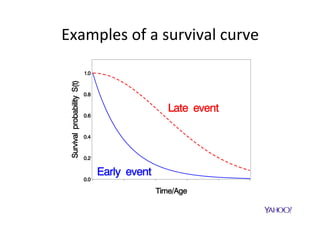
Examples	of	a	survival	curve	
higher	post-click		
engagement	
lower	post-click		
engagement
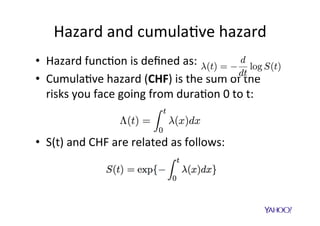
Hazard	and	cumula$ve	hazard	
•  Hazard	func$on	is	defined	as	
							rate	of	occurrence	(users	returning)	at	$me	t	
	
•  Cumula$ve	hazard	(CHF)	is	the	sum	of	the	
risks	(users	returning)	from	dura$on	0	to	t	
	
•  S(t)	and	H(t)	are	related	as	follows:	
h(t) =
d
dt
log (S(t))
H(t) =
Z t
0
h(u)du
S(t) = e H(t)
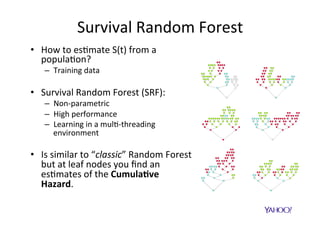
Survival	Random	Forest	
•  How	to	es$mate	S(t)	from	a	
popula$on?	
–  Training	data	
	
•  Survival	Random	Forest	(SRF):	
–  Non-parametric	
–  High	performance	
–  Learning	in	a	mul$-threading	
environment	
	
•  Is	similar	to	“classic”	Random	
Forest	but	at	leaf	nodes	you	find	
an	es$mates	of	the	Cumula8ve	
Hazard	H(t)
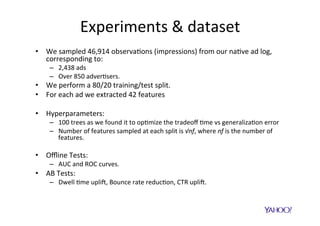
Experiments	&	dataset	
•  We	sampled	46,914	observa$ons	(impressions)	from	our	na$ve	ad	log,	
corresponding	to:	
–  2,438	ads	
–  Over	850	adver$sers.	
•  We	perform	a	80/20	training/test	split.	
•  For	each	ad	we	extracted	42	features	
•  Hyper-parameters:	
–  100	trees	as	we	found	it	to	op$mize	the	tradeoff	$me	vs	generaliza$on	
error	
–  Number	of	features	sampled	at	each	split	is	√nf,	where	nf	is	the	number	of	
features.	
•  Offline	Tests:	
–  AUC	and	ROC	curves.	
•  Onine	(A/B)	Tests:	
–  Dwell	$me	upliZ,	Bounce	rate	reduc$on,	CTR	upliZ.
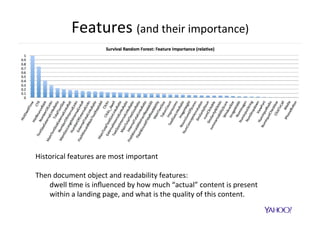
Features	(and	their	importance)	
Historical	features	are	most	important	
	
Then	document	object	and	readability	features:	
dwell	$me	is	influenced	by	how	much	“actual”	content	is	present	
within	a	landing	page,	and	what	is	the	quality	of	this	content.
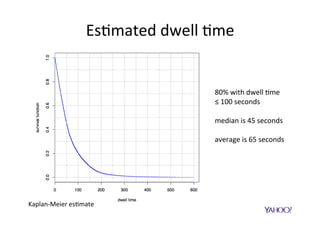
Es$mated	dwell	$me	
80%	with	dwell	$me	
≤	100	seconds	
	
median	is	45	seconds	
	
average	is	65	seconds	
Kaplan-Meier	es$mate
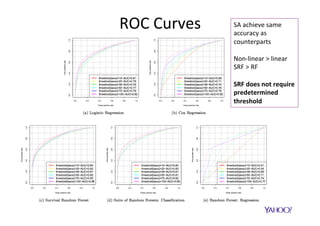
ROC	Curves	 SA	achieve	same	
accuracy	as	
counterparts		
	
Non-linear	>	linear	
SRF	>	RF		
	
SRF	does	not	require		
predetermined	
threshold
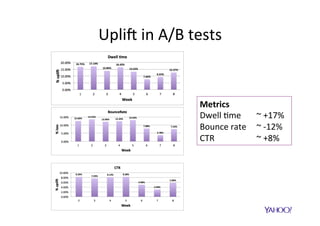
UpliZ	in	online	(A/B)	tes$ng	
Metrics	
Dwell	$me	 	+13%	
Bounce	rate	 		-10.3%	
CTR	 	 	 	+6.8%
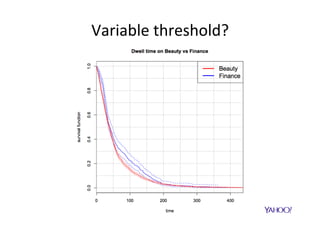
Variable	threshold?
Conclusions	and	future	work	
•  Survival	random	forest	based	(slightly)	outperforms	all	the	
other	compe$ng	model	and,	more	importantly,	it	allows	to	
compute	the	survival	at	different	thresholds.	
	
•  The	A/B	test	shows	an	improvement	in	user	experience:	
–  A	posi$ve	effect	on	CTR	
–  A	decrease	in	the	number	of	bounces,	and	
–  An	increases	in	average	dwell	$me.	
	
•  Future	work	includes:	
–  Personaliza$on	of	threshold	per	user,	per	ads,	and	per	ver$cal	
(category)	
–  Integrate	other	signals	related	to	revenue.
Appendix
Building	$me	and	OOB	error
Cumula$ve	hazard	func$on

Improving Post-Click User Engagement on Native Ads via Survival Analysis