Benghazi University
     Faculty of Information
         Technology
   Department of Graduate Studies

ABDELGHANI YOUNIS ABDELGHANI

          Presentation about
    USE CASE POINT ESTIMATION


                               2012/2013
Use Case Points Estimation
 INTRODUCTION:
 Use Case Points (UCP) is an estimation
  method that provides the ability to estimate
  an application’s size and effort from its
  use cases. Based on work by Gustav Karner
  in 1993, UCP analyzes the use case actors,
  scenarios and various technical and
  environmental factors and abstracts them
  into an equation.
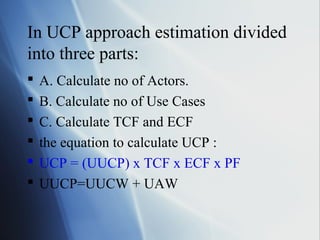
In UCP approach estimation divided
into three parts:
   A. Calculate no of Actors.
   B. Calculate no of Use Cases
   C. Calculate TCF and ECF
   the equation to calculate UCP :
   UCP = (UUCP) x TCF x ECF x PF
   UUCP=UUCW + UAW
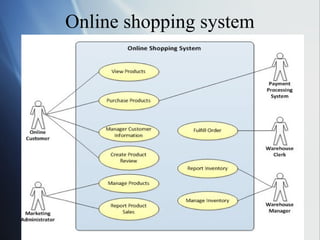
Online shopping system
Use Case Points Estimation
   UUCP : Unadjusted Use Case Weight
   TCF : Technical Complexity Factor
   ECF : Environmental Complexity Factor
   UUCW : Unadjusted Use Case Weight
   UAW : Unadjusted Actor Weight
   PF    : PRODUCTIVITY FACTOR
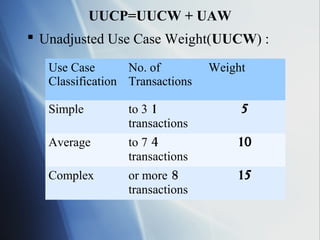
UUCP=UUCW + UAW
 Unadjusted Use Case Weight(UUCW) :

   Use Case       No. of         Weight
   Classification Transactions

   Simple         to 3 1              5
                  transactions
   Average        to 7 4             10
                  transactions
   Complex        or more 8          15
                  transactions
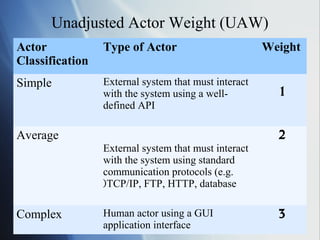
Unadjusted Actor Weight (UAW)
Actor            Type of Actor                        Weight
Classification
Simple           External system that must interact
                 with the system using a well-          1
                 defined API

Average                                                 2
                 External system that must interact
                 with the system using standard
                 communication protocols (e.g.
                 (TCP/IP, FTP, HTTP, database

Complex          Human actor using a GUI                3
                 application interface
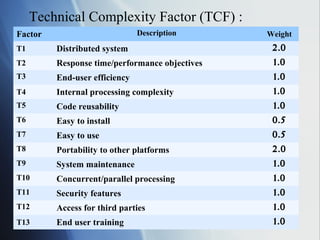
Technical Complexity Factor (TCF) :
Factor                         Description      Weight
T1       Distributed system                      2.0
T2       Response time/performance objectives    1.0
T3       End-user efficiency                     1.0
T4       Internal processing complexity          1.0
T5       Code reusability                        1.0
T6       Easy to install                         0.5
T7       Easy to use                             0.5
T8       Portability to other platforms          2.0
T9       System maintenance                      1.0
T10      Concurrent/parallel processing          1.0
T11      Security features                       1.0
T12      Access for third parties                1.0
T13      End user training                       1.0
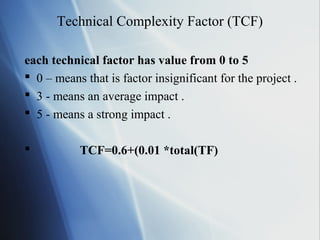
Technical Complexity Factor (TCF)

each technical factor has value from 0 to 5
 0 – means that is factor insignificant for the project .
 3 - means an average impact .
 5 - means a strong impact .

          TCF=0.6+(0.01 *total(TF)
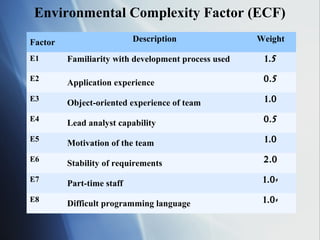
Environmental Complexity Factor (ECF)
Factor                     Description               Weight

E1       Familiarity with development process used    1.5

E2
         Application experience                       0.5

E3
         Object-oriented experience of team           1.0

E4                                                    0.5
         Lead analyst capability
E5
         Motivation of the team                       1.0

E6
         Stability of requirements                    2.0

E7                                                    1.0 -
         Part-time staff
E8                                                    1.0 -
         Difficult programming language
Environmental Complexity Factor (ECF)

each Environmental factor has value from 0 to 5
 0 – means that is factor insignificant for the
  project .
 3 - means an average impact .
 5 - means a strong impact .
 ECF =1.4+(-0.03 *total(EF)

        UCP = (UUCP) x TCF x ECF
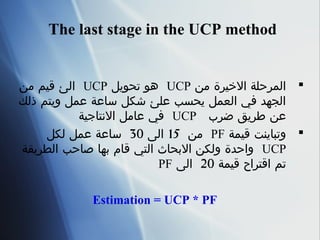
‫‪The last stage in the UCP method‬‬


‫‪ ‬المرحلة الخيرة من ‪ UCP‬هو تحويل ‪ UCP‬الئ قيم من‬
‫الجهد في العمل يحسب علئ شكل ساعة عمل ويتم ذلك‬
           ‫عن طريق ضرب ‪ UCP‬في عامل النتاجية‬
     ‫‪ ‬وتباينت قيمة ‪ PF‬من 51 الى 03 ساعة عمل لكل‬
‫‪ UCP‬واحدة ولكن البحاث التي قام بها صاحب الطريقة‬
                          ‫تم اقتراح قيمة 02 الى ‪PF‬‬

            ‫‪Estimation = UCP * PF‬‬
references
http://www.codeproject.com


http://www.ibm.com/developerworks/rational/library


http://www.modernanalyst.com/Resources
THANK YOU FOR YOUR
    ATTENTION

use case point estimation

  • 1.
    Benghazi University Faculty of Information Technology Department of Graduate Studies ABDELGHANI YOUNIS ABDELGHANI Presentation about USE CASE POINT ESTIMATION 2012/2013
  • 2.
    Use Case PointsEstimation  INTRODUCTION:  Use Case Points (UCP) is an estimation method that provides the ability to estimate an application’s size and effort from its use cases. Based on work by Gustav Karner in 1993, UCP analyzes the use case actors, scenarios and various technical and environmental factors and abstracts them into an equation.
  • 3.
    In UCP approachestimation divided into three parts:  A. Calculate no of Actors.  B. Calculate no of Use Cases  C. Calculate TCF and ECF  the equation to calculate UCP :  UCP = (UUCP) x TCF x ECF x PF  UUCP=UUCW + UAW
  • 4.
  • 5.
    Use Case PointsEstimation  UUCP : Unadjusted Use Case Weight  TCF : Technical Complexity Factor  ECF : Environmental Complexity Factor  UUCW : Unadjusted Use Case Weight  UAW : Unadjusted Actor Weight  PF : PRODUCTIVITY FACTOR
  • 6.
    UUCP=UUCW + UAW Unadjusted Use Case Weight(UUCW) : Use Case No. of Weight Classification Transactions Simple to 3 1 5 transactions Average to 7 4 10 transactions Complex or more 8 15 transactions
  • 7.
    Unadjusted Actor Weight(UAW) Actor Type of Actor Weight Classification Simple External system that must interact with the system using a well- 1 defined API Average 2 External system that must interact with the system using standard communication protocols (e.g. (TCP/IP, FTP, HTTP, database Complex Human actor using a GUI 3 application interface
  • 8.
    Technical Complexity Factor(TCF) : Factor Description Weight T1 Distributed system 2.0 T2 Response time/performance objectives 1.0 T3 End-user efficiency 1.0 T4 Internal processing complexity 1.0 T5 Code reusability 1.0 T6 Easy to install 0.5 T7 Easy to use 0.5 T8 Portability to other platforms 2.0 T9 System maintenance 1.0 T10 Concurrent/parallel processing 1.0 T11 Security features 1.0 T12 Access for third parties 1.0 T13 End user training 1.0
  • 9.
    Technical Complexity Factor(TCF) each technical factor has value from 0 to 5  0 – means that is factor insignificant for the project .  3 - means an average impact .  5 - means a strong impact .  TCF=0.6+(0.01 *total(TF)
  • 10.
    Environmental Complexity Factor(ECF) Factor Description Weight E1 Familiarity with development process used 1.5 E2 Application experience 0.5 E3 Object-oriented experience of team 1.0 E4 0.5 Lead analyst capability E5 Motivation of the team 1.0 E6 Stability of requirements 2.0 E7 1.0 - Part-time staff E8 1.0 - Difficult programming language
  • 11.
    Environmental Complexity Factor(ECF) each Environmental factor has value from 0 to 5  0 – means that is factor insignificant for the project .  3 - means an average impact .  5 - means a strong impact .  ECF =1.4+(-0.03 *total(EF)  UCP = (UUCP) x TCF x ECF
  • 12.
    ‫‪The last stagein the UCP method‬‬ ‫‪ ‬المرحلة الخيرة من ‪ UCP‬هو تحويل ‪ UCP‬الئ قيم من‬ ‫الجهد في العمل يحسب علئ شكل ساعة عمل ويتم ذلك‬ ‫عن طريق ضرب ‪ UCP‬في عامل النتاجية‬ ‫‪ ‬وتباينت قيمة ‪ PF‬من 51 الى 03 ساعة عمل لكل‬ ‫‪ UCP‬واحدة ولكن البحاث التي قام بها صاحب الطريقة‬ ‫تم اقتراح قيمة 02 الى ‪PF‬‬ ‫‪Estimation = UCP * PF‬‬
  • 13.
  • 14.
    THANK YOU FORYOUR ATTENTION