MSc Juan Luis Delgado


        MODEL OF GAME
                       =
         STYLE OF PLAY
(INDIVIDUAL & TEAM TACTICAL BEHAVIOR)
MSc Juan Luis Delgado


    “The best way to predict the future is to create it”

•    At the professional level the players must adapt to the model of game
     used by the coach, where performance is assessed by winning/losing
     (team-centered approach).

•    In youth level the model of the game should be just a tool to allow the
     prospective players to reach all their potential, where performance is
     evaluated by the realization of training aims (player-centered
     approach).

•    As a sportsmen we want to win the games, but when we are
     developing young players games is just a part of the training process.
MSc Juan Luis Delgado


    “The best way to predict the future is to create it”


•    As such, a given model of the game employed by any Academy team
     should be evaluated as to whether it maximizes individual players key
     performance factors (identified in the L.T.A.D.).

•    If we analyze the evolution of the players and the game during the last
     ten years, we can realize that everything is faster. It means that we
     should prepare our players to think and act much faster.

•    In conclusion: A model of the future player should be identified and
     agreed before a model of game is chosen.
MSc Juan Luis Delgado


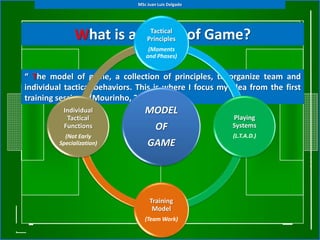
               What is a Model of Game?
                                   Tactical
                                  Principles
                                  (Moments
                                 and Phases)


“ The model of game, a collection of principles, to organize team and
individual tactical behaviors. This is where I focus my idea from the first
training session”. (Mourinho, 2002).
          Individual             MODEL
           Tactical                                     Playing
          Functions                   OF                Systems
           (Not Early                                   (L.T.A.D.)
         Specialization)          GAME


                                   Training
                                    Model
                                 (Team Work)
MSc Juan Luis Delgado


                 Principles of Game

Principles of the game (generals & specifics) are the behaviors
and patterns that the we want to see reflected by our players
and teams during the different moments and phases of the
game.

These behaviors and patterns articulated together are going
to make our identity signs or “Functional Organization”
MSc Juan Luis Delgado


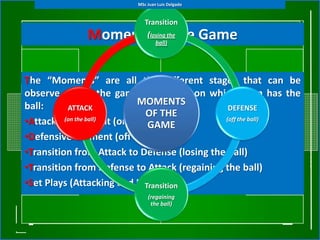
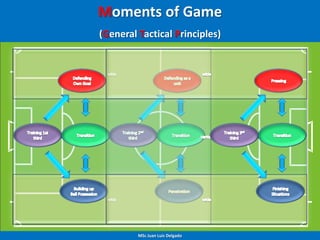
                           Transition
             Moments of the Game
                   (         losing the
                               ball)


The “Moments” are all the different stages that can be
observe during the game depending on which team has the
ball:                     MOMENTS
           ATTACK                              DEFENSE
                            OF THE
•Attacking Moment (on the ball)
          (on the ball)
                             GAME
                                              (off the ball)

•Defensive Moment (off the ball)
•Transition from Attack to Defense (losing the ball)
•Transition from Defense to Attack (regaining the ball)
•Set Plays (Attacking and Defending)
                            Transition
                            (regaining
                             the ball)
MSc Juan Luis Delgado


                     Attacking Moment
                  (General Tactical Principles)


1.   When we have the ball the most important target is to score by
     creating many chances.

2.   Using the space and time depending of team mates and opponents
     positions.

3.   Having a good positioning, and good first touch to be a team with high
     pace on the ball in order to disrupt and to unbalance the opponent's
     defensive structure.
MSc Juan Luis Delgado


                             Attacking Moment
                       (General Tactical Principles)
To develop an “attacking plan” with 3 stages: Building up, Penetration in the last
    third, and Finishing.


1. Building up (from goalkeeper, back 4 or after transition): Using different paces of the ball
    (variation between long and short passes and ball’s speed, circulation instead of running
    with the ball, playing from side to side/wide and depth , positional mobility/changing
    positions constantly).


2. Penetration: Creating spaces (spread out) width and depth, with an effective positional
    shape (triangles and diagonals). Using the spaces: finding out the “disorganization
    moment” to pass the ball through the space created.


3. Finnishing: "timing” (choosing the right time); zones (reaching “finishing positions”).
MSc Juan Luis Delgado


                        Defending Moment
                      (General Tactical Principles)
1.   Off the ball our aim is to avoid the opponent to score by:

     •   Creating pressure zone To determine, directing and pressuring the opponent in
         order to make them do mistakes to win the ball back.
     •   Collective Positional Organization, closing spaces and lines (width and depth); using
         space near and far away from the ball (covering each other near and far away from
         the ball).
     •   Taking the opponent to play where we want (side or central areas).


2.   Using the space and time depending of mates and opponents
     positioning and characteristics.

3.   Developing an “defending plan” with 3 stages: High pressure,
     Defending as a unit, and Defending our own goal.
MSc Juan Luis Delgado


       Transition from Attack to Defense
                  (General Tactical Principles)

1.   When we lose the possession, we will try to regain it by pressing the
     opponent on the ball and his nearest space, taking advantage of the
     opponent's offensive disruption.

2.   If we have not chance to regain the ball we will try to win time to
     organize yourself. (wide and depth)

3.   Avoiding the opponent playing forward and do not allow them to play
     “inside” our team.

4.   We can do “fault as a tactical tool” to stop the opponent’s
     counterattack.
MSc Juan Luis Delgado


       Transition from Defense to Attack
                  (General Tactical Principles)

1.   When we get the ball back, we should to take advantage of
     opponent’s lack of organization, to try score as soon as possible.

2.   Changing attitude quickly (from defensive to offensive), “opening the
     field” in width and depth and “passing forward” if is possible.

3.   If is not possible to play forward, we should pass the ball outside of
     “pressure zone” in order to ensure ball possession.
(General Tactical Principles) (Exercises Structure)
                      Moments of Game
Space                 Groups of 8, 9 or 10 players with or without   Unopposed   Low OP.   High OP.

(Large Side Groups)   (GK) (General Tactical Principles)


                                       MSc Juan Luis Delgado
MSc Juan Luis Delgado


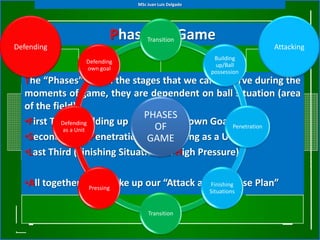
                       Phases of Game
                            Transition
Defending                                                       Attacking
                                                    Building
               Defending
                                                    up/Ball
               own goal
                                                   possession
  The “Phases” are all the stages that we can observe during the
  moments of game, they are dependent on ball situation (area
  of the field):
                               PHASES
  •First Third (Building up & Defending own Goal)Penetration
           Defending
                                 OF
            as a Unit
  •Second third (Penetration & Defending as a Unit)
                                GAME
  •Last Third (Finishing Situations & High Pressure)

  •All together they make up our “Attack and Defense Plan”
                 Pressing
                                           Finishing
                                                   Situations


                               Transition
MSc Juan Luis Delgado

                            Phases of Game
                         (Specific Tactical Principles)
                                      (Offensive Principles)
       Phase                                                        Principles
     Building up                          Wide & Deep                                              Support


     Penetration                        Creating Spaces                                  Getting through the spaces


 Finishing Situations                  Timing of finishing                                     Getting the Zones


                                     (Transition Principles)
       Phase                                                         Principles
from Defense to Attack      Passing the ball out of the pressure zone                          Counterattacking


     from Attack                    Pressing to win the ball                                 Pressing to win time
      to Defense

                                      (Defensive Principles)
       Phase                                                        Principles
 Defending Own Goal         Closing vital spaces               Avoiding to pass behind our         Marking and closing down
                                                                       defenders                        the opponents


 Defending as a Unit          Being compact                        Covering each other                    Squeezing


      Pressing           Taking the opponent where           Identifying the pressure moment          Collective Decision
                              we want to regain                                                       (Moving together)
(Specific Tactical Principles) (Exercise Structure)
                       Phases of Game
Space                  Groups of 4, 5, 6 or 7 players with or without   Unopposed   Low OP.   High OP.

(Medium Side Groups)   (GK) (Specific Tactical Principles)


                                         MSc Juan Luis Delgado
MSc Juan Luis Delgado


                        Playing Systems
                    (Structural Organization )

1.   Structural organization is the initial positioning that we are going to
     use, it’s our playing system(1-4-3-3, 1-4-4-2, 1-3-4-3, …).

2.   It has to foster with the L.T.A.D., Principles of game (generals and
     specifics) and Individual characteristics and capacities.

3.   We should “teach” our players to know how to play in at least 3
     different positions for every playing system, “avoiding an early
     specialization”. It will ensure our players are expose to different game
     situations (variability of motor patterns), providing them the
     opportunity to improve their “Technical ”, “Physical” and “Tactical”
     skills.
MSc Juan Luis Delgado


                          Playing Systems
                      (Structural Organization )

1.   To develop all player’s potential the Academy L.T.A.D. should integrate
     all the possible scenarios regarding team shapes/formations of play.

2.   Previously to design a playing system of play we should answer some
     questions such:
     •   Which is the best shape or formation for our players (player centered)?
     •   How many players do we want to be involved in the different moments and
         phases ?
     •   Where we want to regain the ball?
     •   Which possible variations we should take in case of special factors (weather and
         field conditions, temporary result, player sending off…)?


3.   The answer to these questions will depend on several things (age, skill
     level, individual needs…).
MSc Juan Luis Delgado


                      Tactical Functions
                  (Individual Tactical Behavior)

1.   Each player should carry out defensive and offensive functions. It will
     be just a “guide” to help him in making better decisions. We must
     encourage them to be creative and to fell free and self-responsible
     inside the field.

2.   In the same way we should provide them “positional references”
     depending where ball is located.

3.   As a coaches, during the game, we will focus our feedback on these
     “tactical behaviors”, to assess decision making processes instead on
     technical executions.
MSc Juan Luis Delgado


                          Training Model
                       (Tactical Periodization)
     “Technical Staff, as a responsible of all the training process have to
     know the aims, loads and effects of all their exercises, then they are
     able to choose the proper one in the proper moment”
     (Van Gaal, 1997).
1.   Our aim is to improve our “players skills” and their “knowledge” about the
     game, then we have to design exercises to achieve these standards. Each
     “Tactical Exercise” should be created in order to train a certain tactical
     principle.

2.   Tactical and Technical Periodization must be “fitted” and “integrated” within
     Physiological Periodization. Such approach will allow us to improve our
     players performance in a general and specific manner (game related).

3.   To organize training exercises and sessions in this way we must take into
     consideration which physiological mechanisms are being trained while we
     doing any tactical or technical exercise.
MSc Juan Luis Delgado


                             Training Model
                         (Tactical Periodization)
4. Physiologists and S&C should “guide” Coaches to learn how Physiological and
     Tactical-Technical aspects have to be interrelated. It is possible by managing
     factors such:
     •    Volume
     •    Intensity
     •    Distance
     •    Density (space/number of players)
     •    Recovery (series, exercises, sessions)


5.   Team work between Coaches, S&C and Performance Enhancement staff is vital
      to design and apply an “Optimal Periodization” in order to help our players to
      reach their full potential. Each expert has to be decision maker in his area of
      expertise.
The ultimate measure of a man is not where he
stands in moments of comfort and convenience, but
     where he stands at times of challenge and
                   controversy.
Martin Luther King Jr.


                   THANKS A LOT
                         juanluisdelgado@hotmail.com