FULL VERSION @
https://payhip.com/b/XeOp
WWW.PAYHIP.COM/OLIVEIRAUL
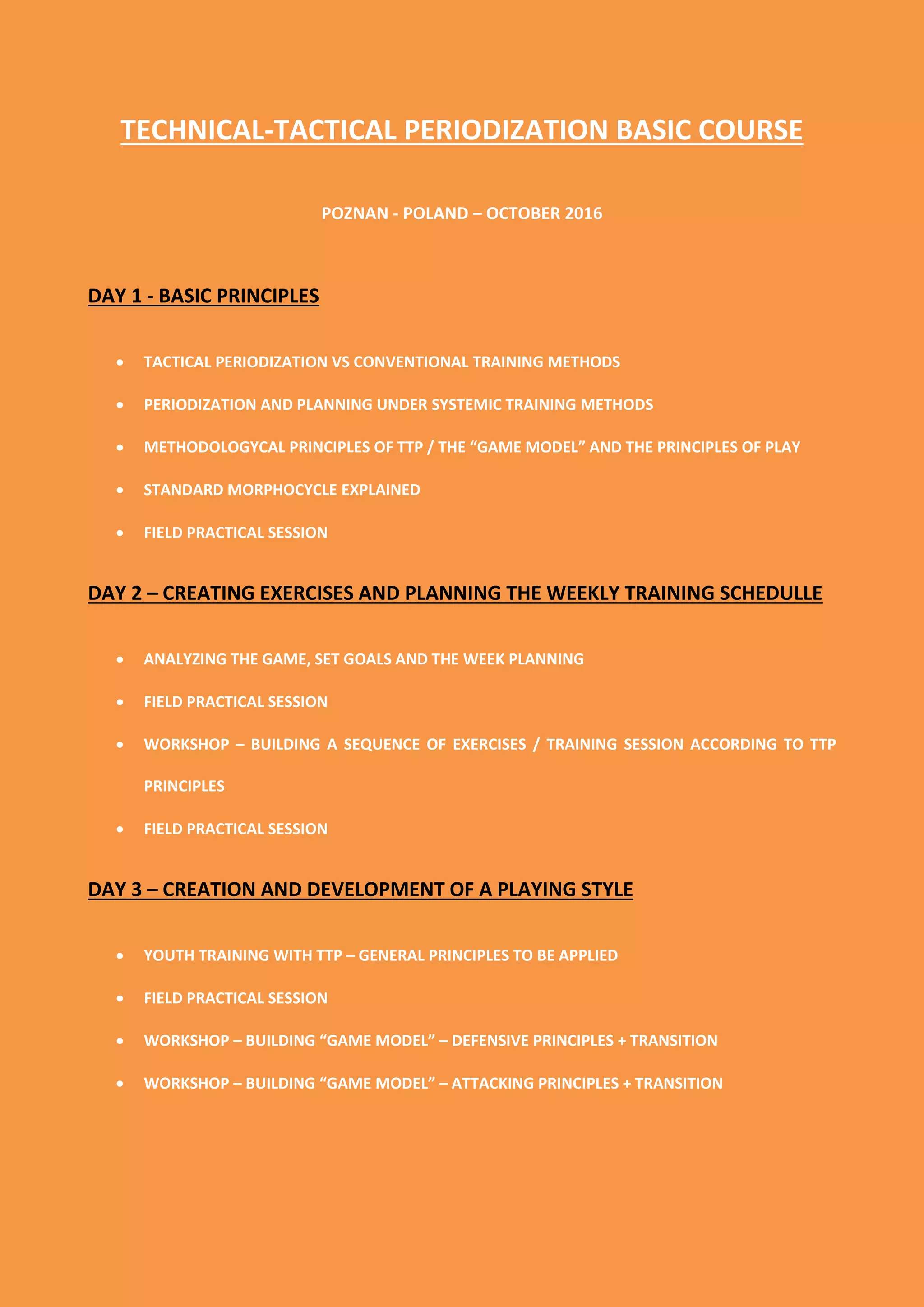
TECHNICAL-TACTICAL PERIODIZATION BASIC COURSE
POZNAN - POLAND – OCTOBER 2016
DAY 1 - BASIC PRINCIPLES
 TACTICAL PERIODIZATION VS CONVENTIONAL TRAINING METHODS
 PERIODIZATION AND PLANNING UNDER SYSTEMIC TRAINING METHODS
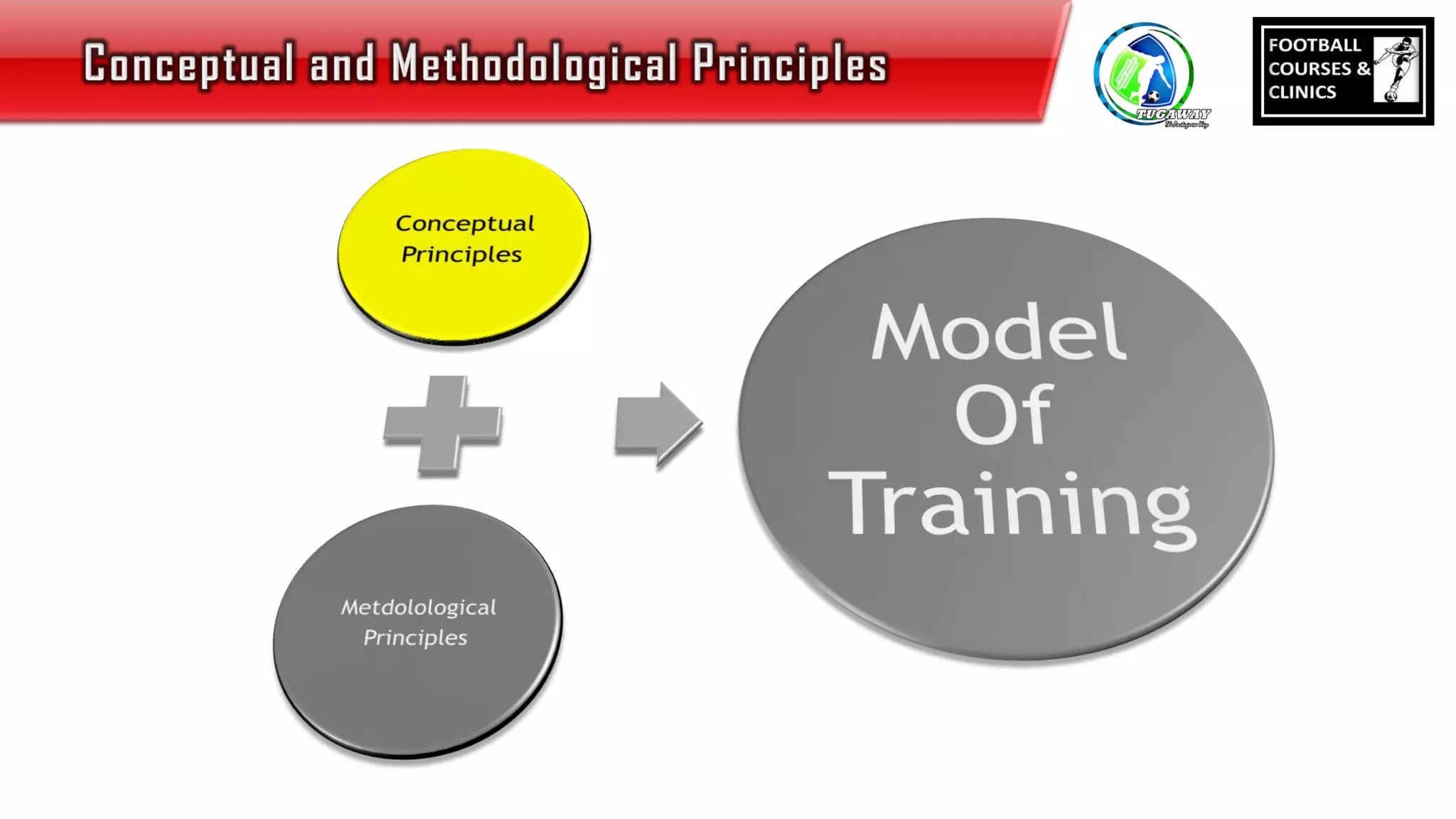
 METHODOLOGYCAL PRINCIPLES OF TTP / THE “GAME MODEL” AND THE PRINCIPLES OF PLAY
 STANDARD MORPHOCYCLE EXPLAINED
 FIELD PRACTICAL SESSION
DAY 2 – CREATING EXERCISES AND PLANNING THE WEEKLY TRAINING SCHEDULLE
 ANALYZING THE GAME, SET GOALS AND THE WEEK PLANNING
 FIELD PRACTICAL SESSION
 WORKSHOP – BUILDING A SEQUENCE OF EXERCISES / TRAINING SESSION ACCORDING TO TTP
PRINCIPLES
 FIELD PRACTICAL SESSION
DAY 3 – CREATION AND DEVELOPMENT OF A PLAYING STYLE
 YOUTH TRAINING WITH TTP – GENERAL PRINCIPLES TO BE APPLIED
 FIELD PRACTICAL SESSION
 WORKSHOP – BUILDING “GAME MODEL” – DEFENSIVE PRINCIPLES + TRANSITION
 WORKSHOP – BUILDING “GAME MODEL” – ATTACKING PRINCIPLES + TRANSITION
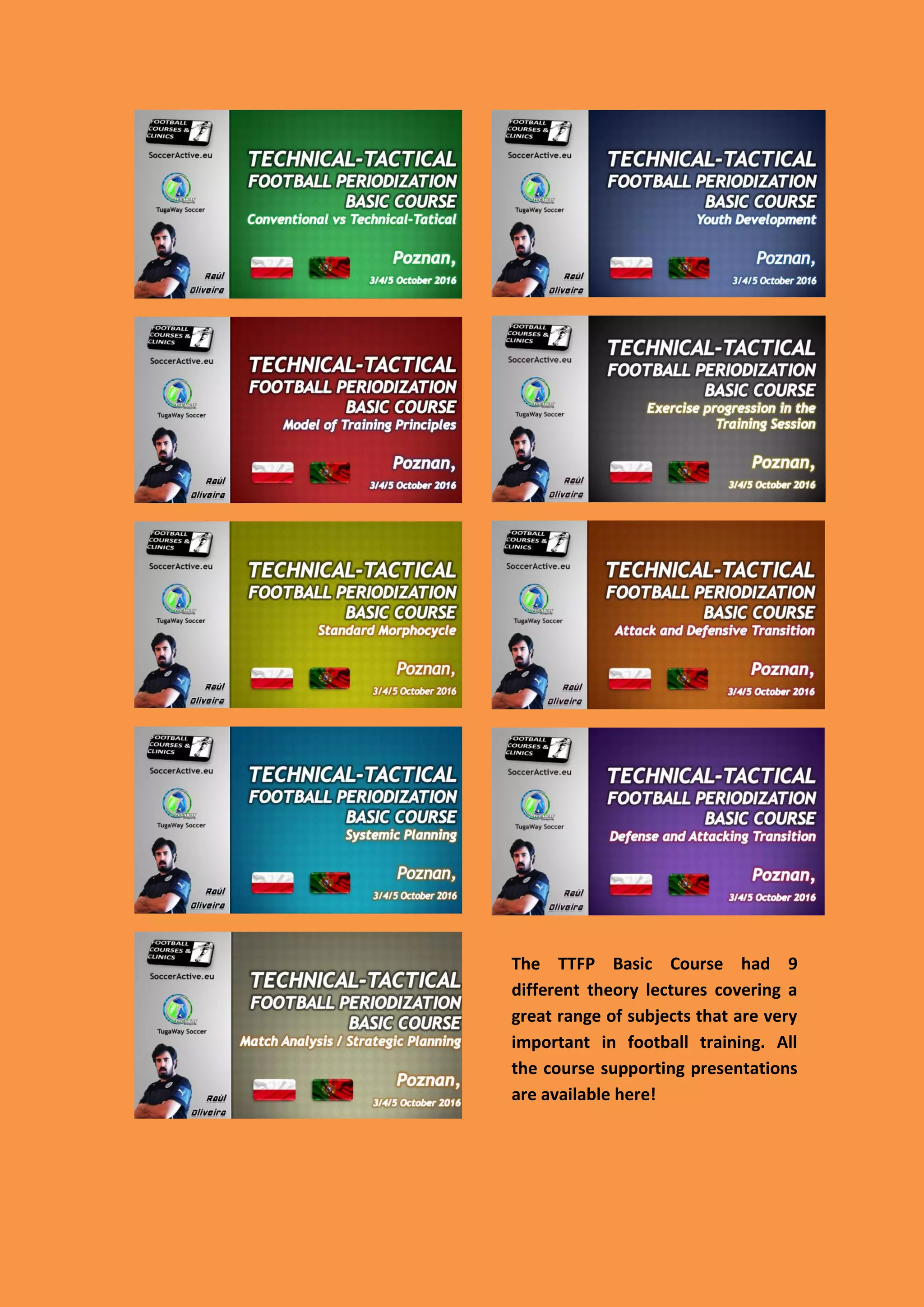
The TTFP Basic Course had 9
different theory lectures covering a
great range of subjects that are very
important in football training. All
the course supporting presentations
are available here!
SoccerActive.eu
TugaWay Soccer
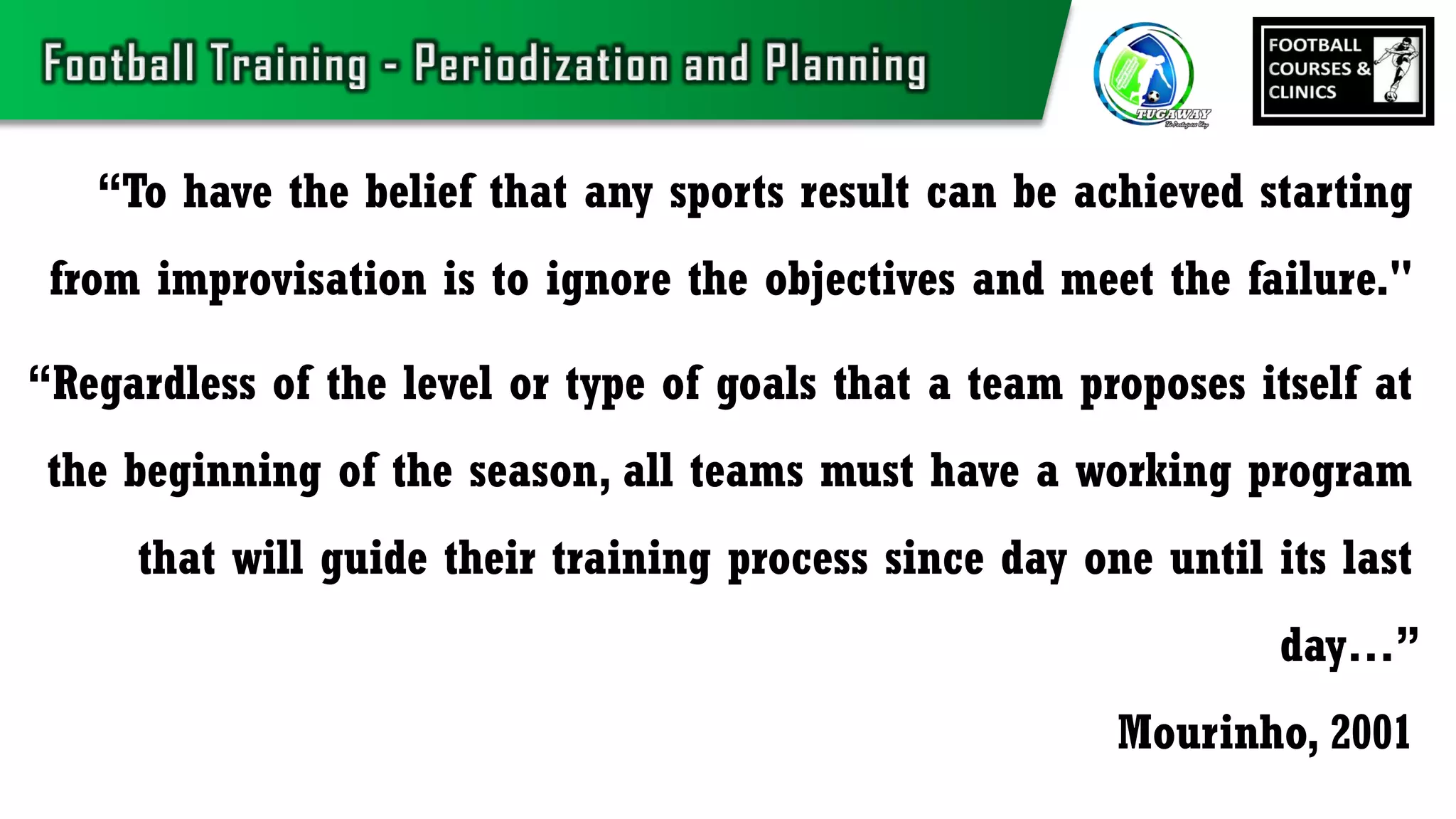
“To have the belief that any sports result can be achieved starting
from improvisation is to ignore the objectives and meet the failure."
“Regardless of the level or type of goals that a team proposes itself at
the beginning of the season, all teams must have a working program
that will guide their training process since day one until its last
day…”
Mourinho, 2001
How to make our players better football players?
By playing and training Football!
JUST AS SIMPLE AS THAT!
"We can differentiate traditional analytical training where
the different factors are trained in isolation, the integrated
training, which uses the ball but where the fundamental
concerns are not very different from the traditional one;
and there is my way of training, which is called Tactical
Periodization. It has nothing to do with the previous two
even though many people could think so.”
Mourinho (in Gaiteiro, 2006)
SoccerActive.eu
TugaWay Soccer
What do we want from our TEAM?
We want our team to present an organization, in
accordance with a group of playing ideas that we
have, with the goal of solving the problems, always
unpredictable, that the game presents to us!
We can do that by
TRAINING BETTER!
Training needs to be understood as a process of learning-
teaching, it cannot be simply a process of exercitation!
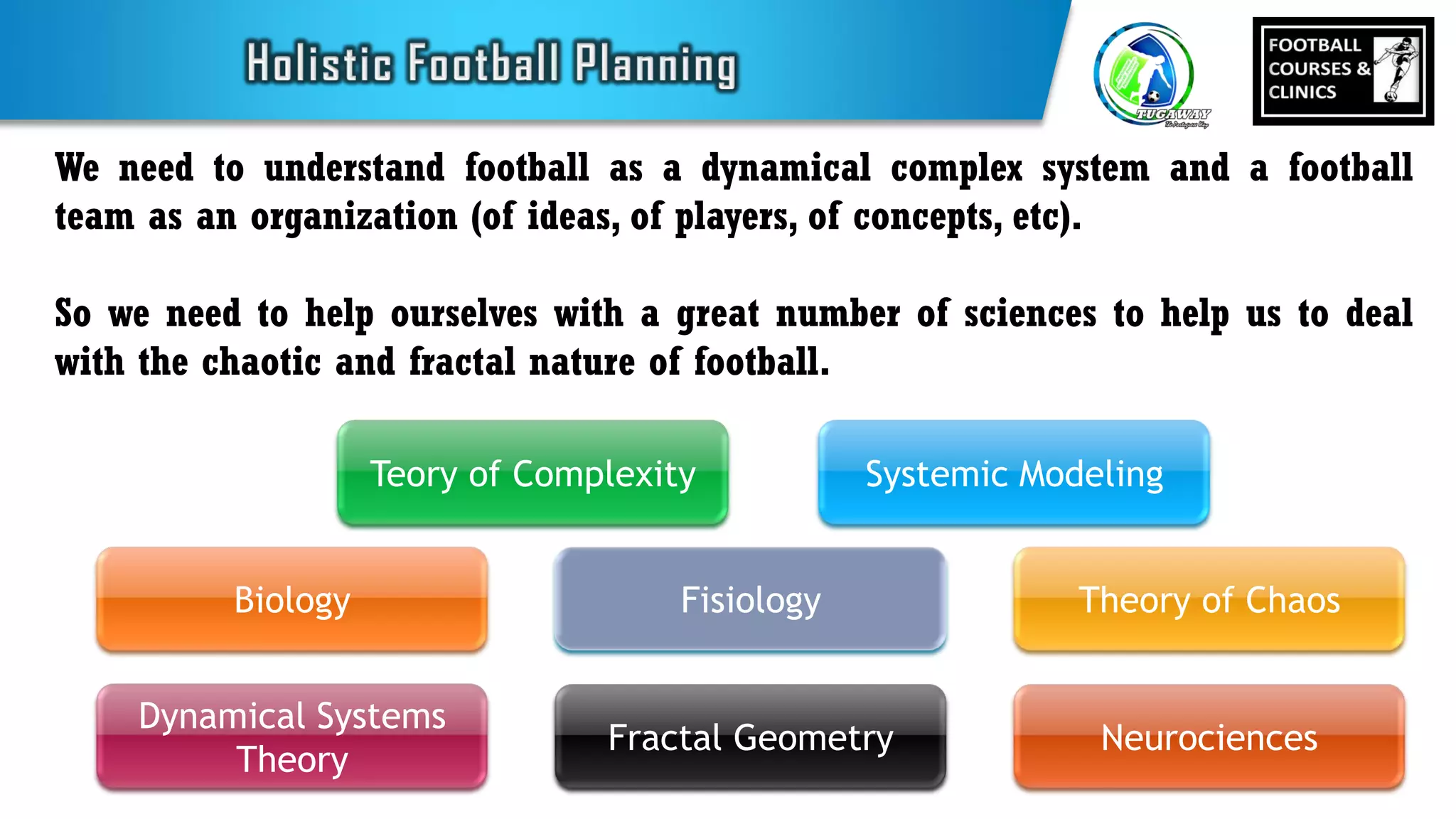
We need to understand football as a dynamical complex system and a football
team as an organization (of ideas, of players, of concepts, etc).
So we need to help ourselves with a great number of sciences to help us to deal
with the chaotic and fractal nature of football.
Teory of Complexity
Neurociences
Systemic Modeling
Theory of Chaos
Dynamical Systems
Theory
Fractal Geometry
Biology Fisiology
SoccerActive.eu
TugaWay Soccer
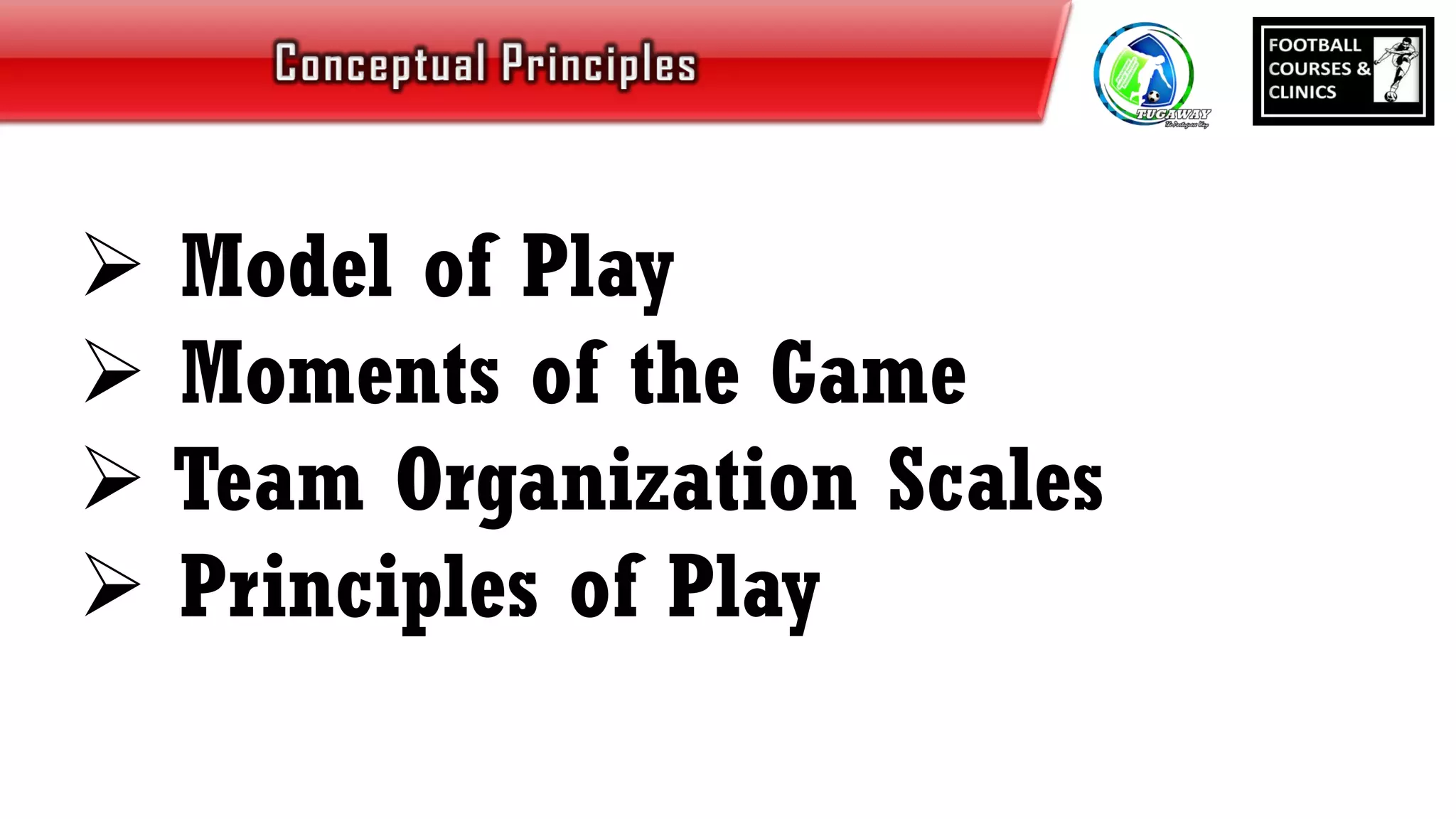
 Model of Play
 Moments of the Game
 Team Organization Scales
 Principles of Play
SoccerActive.eu
TugaWay Soccer
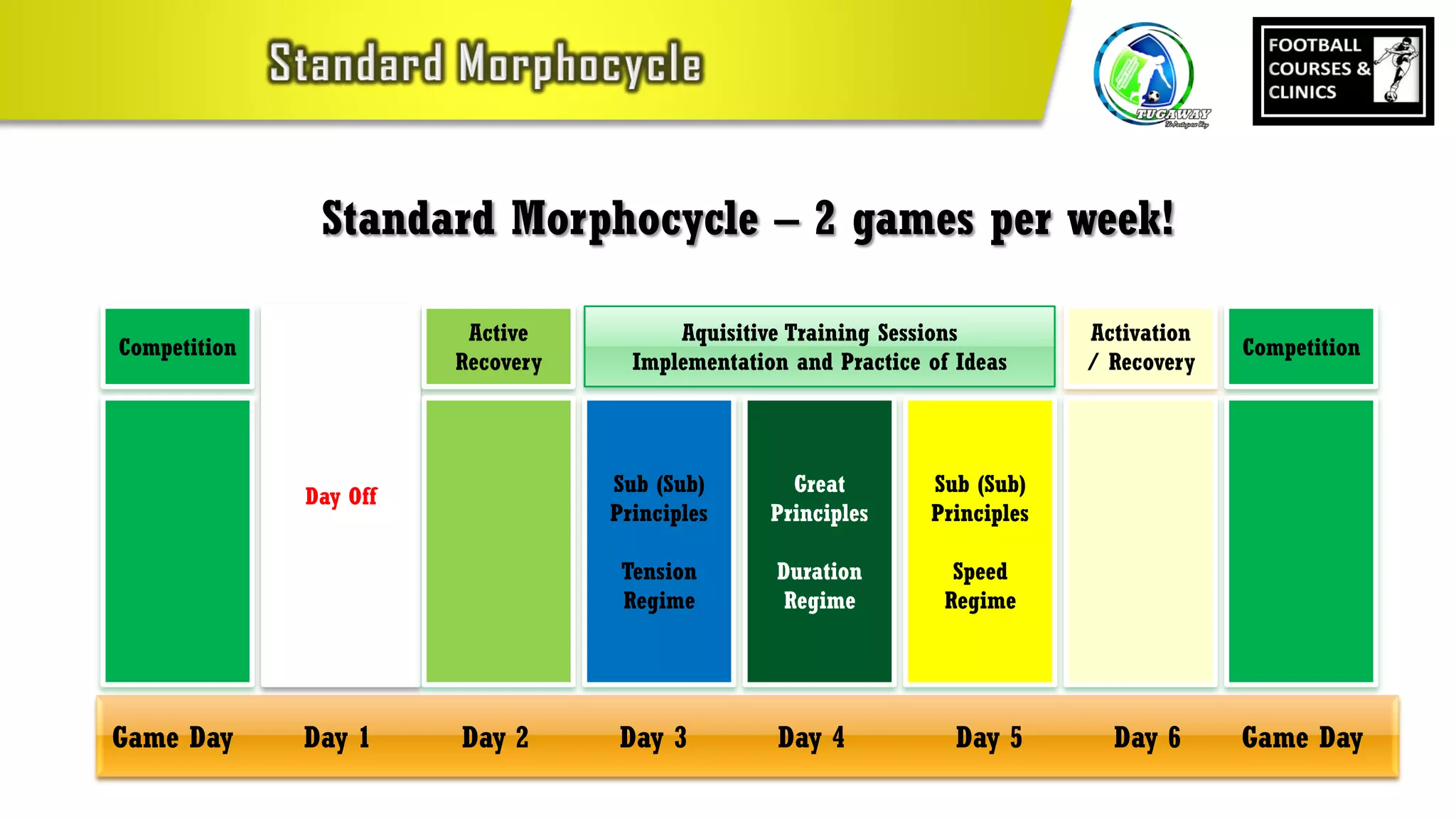
MORPHOLOGY is a branch of biology dealing with the study of the form and structure of
organisms and their specific structural features.
MORPHOCYCLE because the type training and its development along the week is deeply
interconnected with our organization, our organic shape as a team.
The development of our team as a whole, in its complete form with all training sessions
connect to this goal!
OPPOSED TO
The work on separated and/or isolated sessions or capacities is not a solution under this
methodology!
Game Day Day 1 Day 2 Day 3 Day 4 Day 5 Day 6 Game Day
Day Off
Active
Recovery
Aquisitive Training Sessions
Implementation and Practice of Ideas
Activation
/ Recovery
Competition
Standard Morphocycle – 2 games per week!
Competition
Sub (Sub)
Principles
Tension
Regime
Great
Principles
Duration
Regime
Sub (Sub)
Principles
Speed
Regime
SoccerActive.eu
TugaWay Soccer
Can we trust all our eyes
can see?
OBSERVATION is the active acquisition of information from a primary source. In
living beings, observation employs the SENSES.
In science, observation can also involve the recording of data via the use of
instruments. The term may also refer to any DATA collected during the scientific
activity.
Observations can be QUALITATIVE, that is, only the absence or presence of a
property is noted, or QUANTITATIVE if a numerical value is attached to the
observed phenomenon by COUNTING or MEASURING.
SoccerActive.eu
TugaWay Soccer
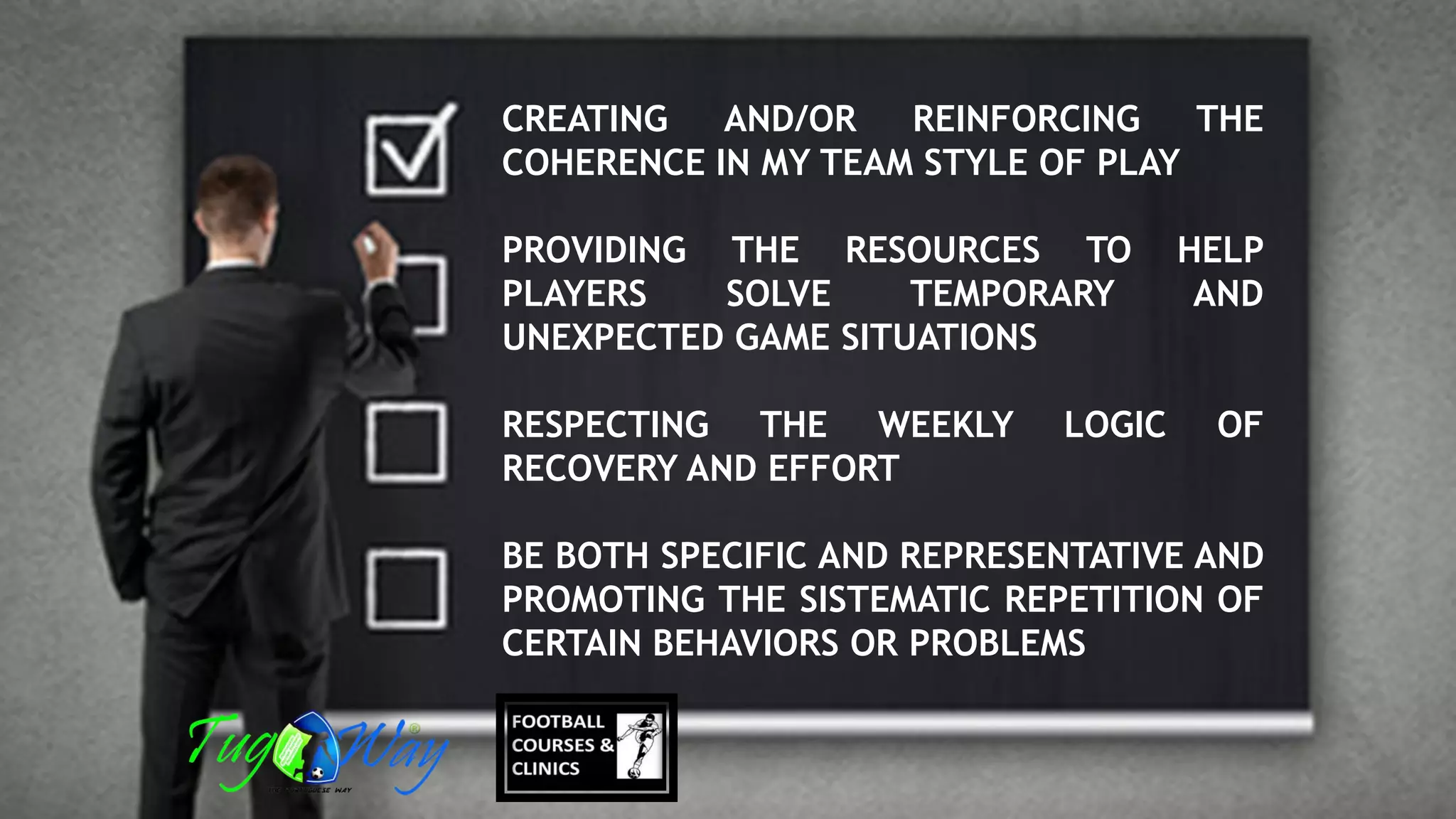
CREATING AND/OR REINFORCING THE
COHERENCE IN MY TEAM STYLE OF PLAY
PROVIDING THE RESOURCES TO HELP
PLAYERS SOLVE TEMPORARY AND
UNEXPECTED GAME SITUATIONS
RESPECTING THE WEEKLY LOGIC OF
RECOVERY AND EFFORT
BE BOTH SPECIFIC AND REPRESENTATIVE AND
PROMOTING THE SISTEMATIC REPETITION OF
CERTAIN BEHAVIORS OR PROBLEMS
SoccerActive.eu
TugaWay Soccer
The long term development is many times used as an excuse to delay the objectives
from one season to the next and so on…
Its important to have a balance with short term objectives (development) that are
different from game results… although winning is always important!
Long Term goals should be established according to a Model of Play(er) and a
culture of the club.
The targets in Youth are always directed to the individual development but is there
anything in Football that is not related with collective tasks?
A good team is the best support to a good development!
Talent is contagious, the more you have, the more you will get!!
The coach will be the better, the more he helps the youth player in its training,
but even more decisive than that is that the coach must not be an obstacle the
player development. Developing players it’s not the same as Formatting them!
The increasingly abundant quantity and variety of information that young people
have access to leads them to not accept what they are told by the mere authority
of who says it.
The answer will be given by practice, by experimenting success factors associated
with consistency of principles, attitudes and feedback from the coach.
SoccerActive.eu
TugaWay Soccer
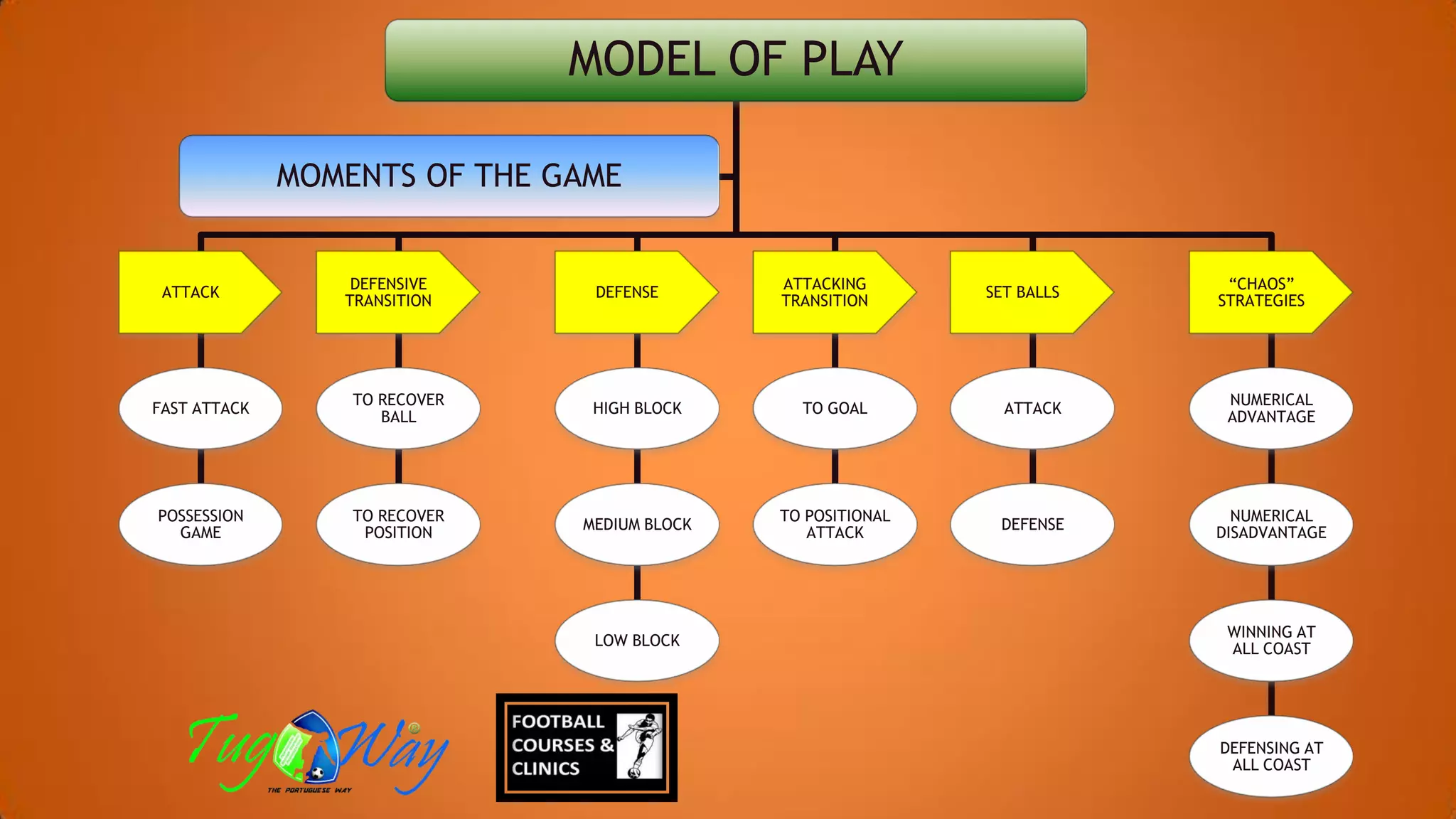
MODEL OF PLAY
ATTACK
FAST ATTACK
POSSESSION
GAME
DEFENSIVE
TRANSITION
TO RECOVER
BALL
TO RECOVER
POSITION
DEFENSE
HIGH BLOCK
MEDIUM BLOCK
LOW BLOCK
ATTACKING
TRANSITION
TO GOAL
TO POSITIONAL
ATTACK
SET BALLS
ATTACK
DEFENSE
“CHAOS”
STRATEGIES
NUMERICAL
ADVANTAGE
NUMERICAL
DISADVANTAGE
WINNING AT
ALL COAST
DEFENSING AT
ALL COAST
MOMENTS OF THE GAME
MODEL OF PLAY
ATTACK
FAST ATTACK
POSSESSION
GAME
DEFENSIVE
TRANSITION
TO RECOVER
BALL
TO RECOVER
POSITION
DEFENSE
HIGH BLOCK
MEDIUM BLOCK
LOW BLOCK
ATTACKING
TRANSITION
TO GOAL
TO POSITIONAL
ATTACK
SET BALLS
ATTACK
DEFENSE
“CHAOS”
STRATEGIES
NUMERICAL
ADVANTAGE
NUMERICAL
DISADVANTAGE
WINNING AT
ALL COAST
DEFENSING AT
ALL COAST
MOMENTS OF THE GAME
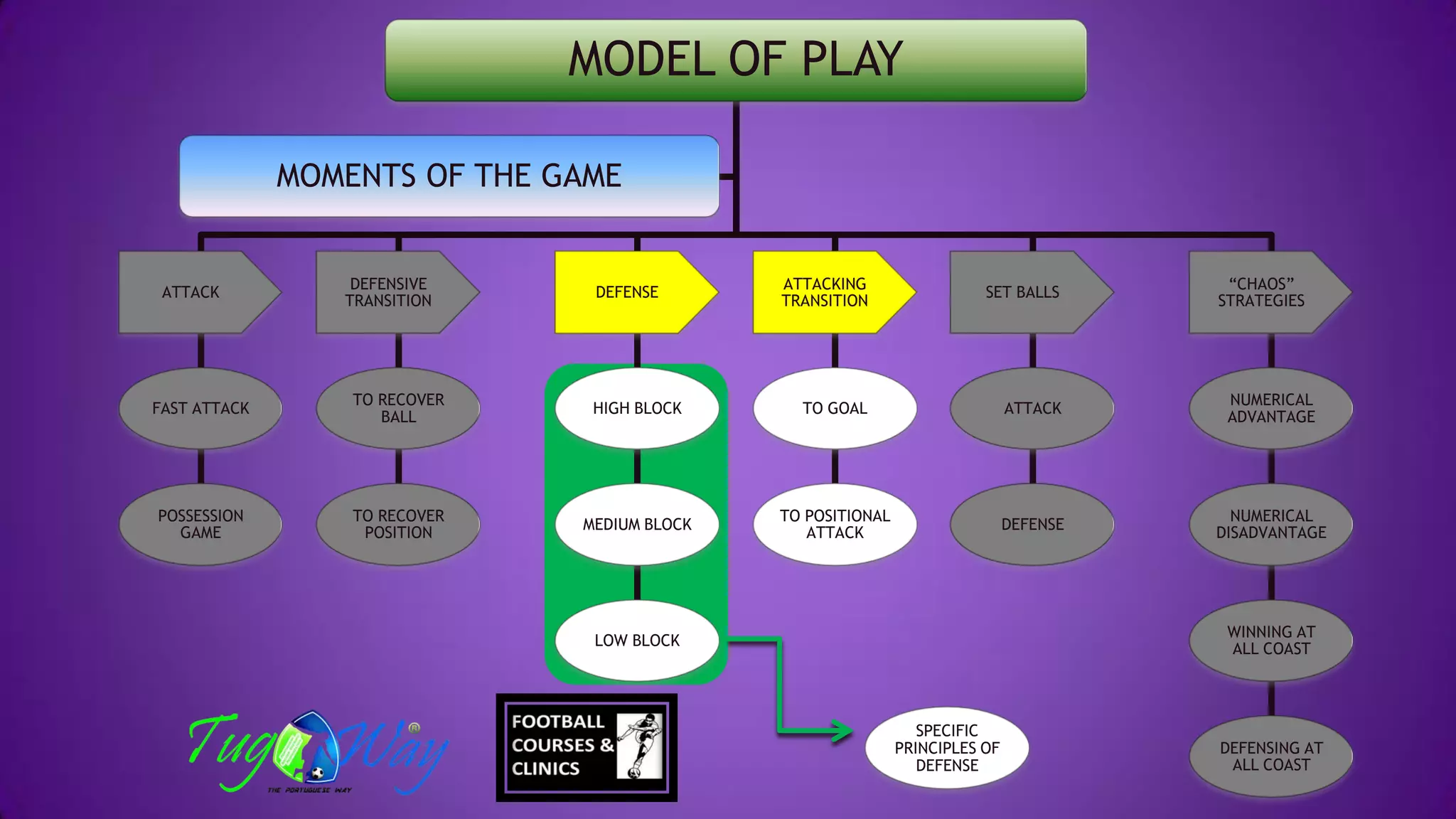
SPECIFIC
PRINCIPLES OF
DEFENSE
Starting from the basic specific
principles of defense that will apply to
all kind of defending situations, its
important to established different
ways to defend in accordance to the
position on the field we ar
“occupying”...
Defending in a “high block” has
different demands and obligations
from a “medium block” or “low
block”...
SoccerActive.eu
TugaWay Soccer
But as coaches we need to set a
number of principles to the different
moments of the team in the game,
never forgetting that they are
connected and that what we are trying
to do is establish an order in a system
that by its nature is constantly
changing its charactheristics...
So we are setting a start to something
and not the end in itself!
The role of the coach is to establish IN
TRAINING what are the indicators that
should molde the decision from the
player. What is important to analyze
and know in this moment?
Being PROACTIVE about the
development of the game is a key
charactheristic from the best teams...
They are already prepared to attack
while they are still defending and vice-
versa!
MODEL OF PLAY
ATTACK
FAST ATTACK
POSSESSION
GAME
DEFENSIVE
TRANSITION
TO RECOVER
BALL
TO RECOVER
POSITION
DEFENSE
HIGH BLOCK
MEDIUM BLOCK
LOW BLOCK
ATTACKING
TRANSITION
TO GOAL
TO POSITIONAL
ATTACK
SET BALLS
ATTACK
DEFENSE
“CHAOS”
STRATEGIES
NUMERICAL
ADVANTAGE
NUMERICAL
DISADVANTAGE
WINNING AT
ALL COAST
DEFENSING AT
ALL COAST
MOMENTS OF THE GAME

TECHNICAL - TACTICAL FOOTBALL PERIODIZATION

  • 2.
  • 3.
    TECHNICAL-TACTICAL PERIODIZATION BASICCOURSE POZNAN - POLAND – OCTOBER 2016 DAY 1 - BASIC PRINCIPLES  TACTICAL PERIODIZATION VS CONVENTIONAL TRAINING METHODS  PERIODIZATION AND PLANNING UNDER SYSTEMIC TRAINING METHODS  METHODOLOGYCAL PRINCIPLES OF TTP / THE “GAME MODEL” AND THE PRINCIPLES OF PLAY  STANDARD MORPHOCYCLE EXPLAINED  FIELD PRACTICAL SESSION DAY 2 – CREATING EXERCISES AND PLANNING THE WEEKLY TRAINING SCHEDULLE  ANALYZING THE GAME, SET GOALS AND THE WEEK PLANNING  FIELD PRACTICAL SESSION  WORKSHOP – BUILDING A SEQUENCE OF EXERCISES / TRAINING SESSION ACCORDING TO TTP PRINCIPLES  FIELD PRACTICAL SESSION DAY 3 – CREATION AND DEVELOPMENT OF A PLAYING STYLE  YOUTH TRAINING WITH TTP – GENERAL PRINCIPLES TO BE APPLIED  FIELD PRACTICAL SESSION  WORKSHOP – BUILDING “GAME MODEL” – DEFENSIVE PRINCIPLES + TRANSITION  WORKSHOP – BUILDING “GAME MODEL” – ATTACKING PRINCIPLES + TRANSITION
  • 5.
    The TTFP BasicCourse had 9 different theory lectures covering a great range of subjects that are very important in football training. All the course supporting presentations are available here!
  • 6.
  • 7.
    “To have thebelief that any sports result can be achieved starting from improvisation is to ignore the objectives and meet the failure." “Regardless of the level or type of goals that a team proposes itself at the beginning of the season, all teams must have a working program that will guide their training process since day one until its last day…” Mourinho, 2001
  • 8.
    How to makeour players better football players? By playing and training Football! JUST AS SIMPLE AS THAT!
  • 9.
    "We can differentiatetraditional analytical training where the different factors are trained in isolation, the integrated training, which uses the ball but where the fundamental concerns are not very different from the traditional one; and there is my way of training, which is called Tactical Periodization. It has nothing to do with the previous two even though many people could think so.” Mourinho (in Gaiteiro, 2006)
  • 10.
  • 11.
    What do wewant from our TEAM? We want our team to present an organization, in accordance with a group of playing ideas that we have, with the goal of solving the problems, always unpredictable, that the game presents to us!
  • 12.
    We can dothat by TRAINING BETTER! Training needs to be understood as a process of learning- teaching, it cannot be simply a process of exercitation!
  • 13.
    We need tounderstand football as a dynamical complex system and a football team as an organization (of ideas, of players, of concepts, etc). So we need to help ourselves with a great number of sciences to help us to deal with the chaotic and fractal nature of football. Teory of Complexity Neurociences Systemic Modeling Theory of Chaos Dynamical Systems Theory Fractal Geometry Biology Fisiology
  • 14.
  • 17.
     Model ofPlay  Moments of the Game  Team Organization Scales  Principles of Play
  • 18.
  • 19.
    MORPHOLOGY is abranch of biology dealing with the study of the form and structure of organisms and their specific structural features. MORPHOCYCLE because the type training and its development along the week is deeply interconnected with our organization, our organic shape as a team. The development of our team as a whole, in its complete form with all training sessions connect to this goal! OPPOSED TO The work on separated and/or isolated sessions or capacities is not a solution under this methodology!
  • 20.
    Game Day Day1 Day 2 Day 3 Day 4 Day 5 Day 6 Game Day Day Off Active Recovery Aquisitive Training Sessions Implementation and Practice of Ideas Activation / Recovery Competition Standard Morphocycle – 2 games per week! Competition Sub (Sub) Principles Tension Regime Great Principles Duration Regime Sub (Sub) Principles Speed Regime
  • 21.
  • 22.
    Can we trustall our eyes can see?
  • 24.
    OBSERVATION is theactive acquisition of information from a primary source. In living beings, observation employs the SENSES. In science, observation can also involve the recording of data via the use of instruments. The term may also refer to any DATA collected during the scientific activity. Observations can be QUALITATIVE, that is, only the absence or presence of a property is noted, or QUANTITATIVE if a numerical value is attached to the observed phenomenon by COUNTING or MEASURING.
  • 25.
  • 27.
    CREATING AND/OR REINFORCINGTHE COHERENCE IN MY TEAM STYLE OF PLAY PROVIDING THE RESOURCES TO HELP PLAYERS SOLVE TEMPORARY AND UNEXPECTED GAME SITUATIONS RESPECTING THE WEEKLY LOGIC OF RECOVERY AND EFFORT BE BOTH SPECIFIC AND REPRESENTATIVE AND PROMOTING THE SISTEMATIC REPETITION OF CERTAIN BEHAVIORS OR PROBLEMS
  • 29.
  • 30.
    The long termdevelopment is many times used as an excuse to delay the objectives from one season to the next and so on… Its important to have a balance with short term objectives (development) that are different from game results… although winning is always important! Long Term goals should be established according to a Model of Play(er) and a culture of the club. The targets in Youth are always directed to the individual development but is there anything in Football that is not related with collective tasks? A good team is the best support to a good development! Talent is contagious, the more you have, the more you will get!!
  • 32.
    The coach willbe the better, the more he helps the youth player in its training, but even more decisive than that is that the coach must not be an obstacle the player development. Developing players it’s not the same as Formatting them! The increasingly abundant quantity and variety of information that young people have access to leads them to not accept what they are told by the mere authority of who says it. The answer will be given by practice, by experimenting success factors associated with consistency of principles, attitudes and feedback from the coach.
  • 33.
  • 34.
    MODEL OF PLAY ATTACK FASTATTACK POSSESSION GAME DEFENSIVE TRANSITION TO RECOVER BALL TO RECOVER POSITION DEFENSE HIGH BLOCK MEDIUM BLOCK LOW BLOCK ATTACKING TRANSITION TO GOAL TO POSITIONAL ATTACK SET BALLS ATTACK DEFENSE “CHAOS” STRATEGIES NUMERICAL ADVANTAGE NUMERICAL DISADVANTAGE WINNING AT ALL COAST DEFENSING AT ALL COAST MOMENTS OF THE GAME
  • 35.
    MODEL OF PLAY ATTACK FASTATTACK POSSESSION GAME DEFENSIVE TRANSITION TO RECOVER BALL TO RECOVER POSITION DEFENSE HIGH BLOCK MEDIUM BLOCK LOW BLOCK ATTACKING TRANSITION TO GOAL TO POSITIONAL ATTACK SET BALLS ATTACK DEFENSE “CHAOS” STRATEGIES NUMERICAL ADVANTAGE NUMERICAL DISADVANTAGE WINNING AT ALL COAST DEFENSING AT ALL COAST MOMENTS OF THE GAME SPECIFIC PRINCIPLES OF DEFENSE
  • 36.
    Starting from thebasic specific principles of defense that will apply to all kind of defending situations, its important to established different ways to defend in accordance to the position on the field we ar “occupying”... Defending in a “high block” has different demands and obligations from a “medium block” or “low block”...
  • 37.
  • 38.
    But as coacheswe need to set a number of principles to the different moments of the team in the game, never forgetting that they are connected and that what we are trying to do is establish an order in a system that by its nature is constantly changing its charactheristics... So we are setting a start to something and not the end in itself!
  • 39.
    The role ofthe coach is to establish IN TRAINING what are the indicators that should molde the decision from the player. What is important to analyze and know in this moment? Being PROACTIVE about the development of the game is a key charactheristic from the best teams... They are already prepared to attack while they are still defending and vice- versa!
  • 40.
    MODEL OF PLAY ATTACK FASTATTACK POSSESSION GAME DEFENSIVE TRANSITION TO RECOVER BALL TO RECOVER POSITION DEFENSE HIGH BLOCK MEDIUM BLOCK LOW BLOCK ATTACKING TRANSITION TO GOAL TO POSITIONAL ATTACK SET BALLS ATTACK DEFENSE “CHAOS” STRATEGIES NUMERICAL ADVANTAGE NUMERICAL DISADVANTAGE WINNING AT ALL COAST DEFENSING AT ALL COAST MOMENTS OF THE GAME