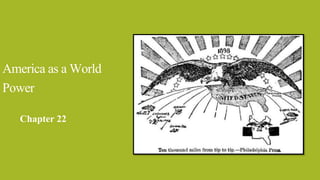
AmericaasaWorld
Power
Chapter 22
Section1: The U.S. Gains Territories Overseas
Big Ideas:
1. The U.S. ended its policy of
isolation
2. Hawaii became a U.S. territory in
1898
3. The United States sought trade
with Japan and China
Key Terms to know:
Imperialism
Isolationism
William H. Seward
Liliuokalani
Spheres of influence
Open Door Policy
Boxer Rebellion
Background
In the mid-1800s, what was the
United States focused on?
The Civil War, Reconstruction,
and problems ‘at home’
IMPERIALISM
Definition: building an empire by
founding colonies or conquering
nations
Why did it happen?
- Need for raw materials
- Want new markets for goods
- Source of power and national
pride
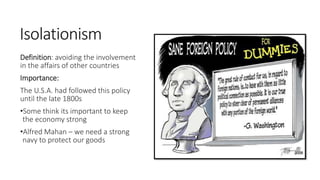
Isolationism
Definition: avoiding the involvement
in the affairs of other countries
Importance:
The U.S.A. had followed this policy
until the late 1800s
•Some think its important to keep
the economy strong
•Alfred Mahan – we need a strong
navy to protect our goods
Seward’s Folly
•1867 – Secretary of State, William
H. Seward, arranges purchasing of
Alaska from Russia
It’s a ‘frozen wasteland’ said
naysayers
“But it’s a steal!”
• He paid 2₵ an acre
• Natural resources abound 
fur, timber, minerals and….
• GOLD
Seward continues…
The nation “must continue to
move on westward”
1867 – annexed the Midway
Islands (halfway between Japan
and the U.S.)
1899 – splits Samoa with
Germany
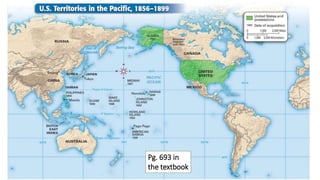
Pg. 693 in
the textbook
Hawaii , a brief & sad history
1800s
• Missionaries try to convert them to Christianity
• They open business and raise crops
1840s
• Most shops and shipyards owned by Americans
1887
• Hawaiian king forced to sign new constitution (“Bayonet
Constitution”)
• More power to planter-controlled legislation
Queen Liliuokalani & Hawaiian Annexation
Becomes queen and proposes a
new constitution
Planters revolt
150 marines come to support the
revolt and end it without battle
Planters form new government,
Hawaiian Island in 1898 annexed by
U.S.A.
Trade with Japan
Economics draw the U.S. to
trade with Japan and China
Commodore Matthew Perry
“persuades” Japanese to open
trade with the U.S. in 1854.
Trade agreement signed in
1858.
Japan’s Rise in Power
Japan was
becoming a world
power because of
land wars (Russia,
Korea, China) and
modernization.
Foreign Powers in China
China’s weak, so other
countries take spheres of
influence (areas where
foreign national control
resources)
U.S.A. claims an Open Door
Policy, that all countries
have equal trading rights in
China
The Boxer Rebellion
“Boxers” – Chinese nationalists
unhappy with foreign influence
June 1900 – laid siege to foreigner’s
village in the capital city of Beijing.
 Killed 200 in the 2 month
siege
 Foreign military forces
(including the Marines) come
in and put down the rebellion
 Pay $333 million dollars in
damages to foreign
governments
Spanish-
AmericanWar
1. 1898, U.S.A. goes to
war with Spain
2. The U.S. gains control
of territories in the
Caribbean and Pacific
Key Terms/Big Ideas Check In
One person will have one minute to
tell their partner (who is silent!)
everything they know about the
term
1. yellow journalism & “Remember
the Maine”
2. Teller Amendment
3. Emilio Aguinaldo – Phillipines
4. Anti-Imperialist League
5. Platt Amendment - Cuba
Open your books to
Section 2 (pgs. 697-
702) and skim the
section. Pay special
attention to the key
terms.
Looking Ahead
day: Review/Notes Day
day: Chapter 22 Test
Homework:

Chapter 22: America as a World Power

  • 1.
  • 2.
    Section1: The U.S.Gains Territories Overseas Big Ideas: 1. The U.S. ended its policy of isolation 2. Hawaii became a U.S. territory in 1898 3. The United States sought trade with Japan and China Key Terms to know: Imperialism Isolationism William H. Seward Liliuokalani Spheres of influence Open Door Policy Boxer Rebellion
  • 3.
    Background In the mid-1800s,what was the United States focused on? The Civil War, Reconstruction, and problems ‘at home’
  • 4.
    IMPERIALISM Definition: building anempire by founding colonies or conquering nations Why did it happen? - Need for raw materials - Want new markets for goods - Source of power and national pride
  • 5.
    Isolationism Definition: avoiding theinvolvement in the affairs of other countries Importance: The U.S.A. had followed this policy until the late 1800s •Some think its important to keep the economy strong •Alfred Mahan – we need a strong navy to protect our goods
  • 6.
    Seward’s Folly •1867 –Secretary of State, William H. Seward, arranges purchasing of Alaska from Russia It’s a ‘frozen wasteland’ said naysayers “But it’s a steal!” • He paid 2₵ an acre • Natural resources abound  fur, timber, minerals and…. • GOLD
  • 7.
    Seward continues… The nation“must continue to move on westward” 1867 – annexed the Midway Islands (halfway between Japan and the U.S.) 1899 – splits Samoa with Germany
  • 8.
  • 9.
    Hawaii , abrief & sad history 1800s • Missionaries try to convert them to Christianity • They open business and raise crops 1840s • Most shops and shipyards owned by Americans 1887 • Hawaiian king forced to sign new constitution (“Bayonet Constitution”) • More power to planter-controlled legislation
  • 10.
    Queen Liliuokalani &Hawaiian Annexation Becomes queen and proposes a new constitution Planters revolt 150 marines come to support the revolt and end it without battle Planters form new government, Hawaiian Island in 1898 annexed by U.S.A.
  • 11.
    Trade with Japan Economicsdraw the U.S. to trade with Japan and China Commodore Matthew Perry “persuades” Japanese to open trade with the U.S. in 1854. Trade agreement signed in 1858.
  • 12.
    Japan’s Rise inPower Japan was becoming a world power because of land wars (Russia, Korea, China) and modernization.
  • 13.
    Foreign Powers inChina China’s weak, so other countries take spheres of influence (areas where foreign national control resources) U.S.A. claims an Open Door Policy, that all countries have equal trading rights in China
  • 14.
    The Boxer Rebellion “Boxers”– Chinese nationalists unhappy with foreign influence June 1900 – laid siege to foreigner’s village in the capital city of Beijing.  Killed 200 in the 2 month siege  Foreign military forces (including the Marines) come in and put down the rebellion  Pay $333 million dollars in damages to foreign governments
  • 15.
    Spanish- AmericanWar 1. 1898, U.S.A.goes to war with Spain 2. The U.S. gains control of territories in the Caribbean and Pacific
  • 16.
    Key Terms/Big IdeasCheck In One person will have one minute to tell their partner (who is silent!) everything they know about the term 1. yellow journalism & “Remember the Maine” 2. Teller Amendment 3. Emilio Aguinaldo – Phillipines 4. Anti-Imperialist League 5. Platt Amendment - Cuba Open your books to Section 2 (pgs. 697- 702) and skim the section. Pay special attention to the key terms.
  • 17.
    Looking Ahead day: Review/NotesDay day: Chapter 22 Test Homework: