U.S. Global
Interventions
US Interventionism as a Humanitarian Effort
Often, American interventions overseas begin as humanitarian efforts
When we entered Somalia in 1992, President Bush claimed that the mission was limited to “... open[ing] the supply
routes, to get food moving, and the prepare the way for a U.N. peacekeeping force…”
In 1993 the US opened its mandate under President Clinton to use all necessary means to ensure peace,
including the placement of US troops in Somalia. Only in 1995 after NATO dropped 1,026 bombs in its
largest military effort thus far, was the war in Somalia ended.
When entering Iraq and Afghanistan, the Bush administration used the guise of advancing women’s rights, citing
various human rights violations as part of the reason it was so important for the US to become involved.
The Pentagon chief at the time estimated that US involvement in Iraq would not last more than 5 months,
costing under 50 billion dollars. He was off by 1 trillion dollars and a decade.
Similarly, when beginning involvement in Libya, President Obama stated that the sole military mission was to protect
the citizens of Benghazi, not to implement a regime change, and that the airstrikes would last “days, not weeks.”
Why does the US intervene?
Since 1980, the US has launched 13 interventions in the Islamic world alone, often reasoning that
military intervention overseas is the only thing stopping the global threat of terrorism from
growing.
However, over the past 2 decades Islamic radicalism has been on the rise.
In a report by Daniel Byman and Jeremy Shapiro on what seems to provoke terrorists in the
Middle East, many of them cite fighting Western interventionism as a reason for their
actions.
In a court deposition from 2007, Cherif Kouachi (one of the suspects in the Charlie Hebedo
attacks in Paris) said that the source of his radicalization was seeing the “injustices” the US
had inflicted upon the Iraqi people over the course of the war.
And yet, the solution Washington constantly gives for terrorist attacks motivated by US
● So why does the US continue to involve itself with global interventions? Largely out of fear of
attacks on American soil.
● In a 2007 interview, President Bush stated that “we fight them there so we don’t have to fight them
here.” This is a sentiment echoed by many US lawmakers to this day. The idea that our overseas
involvement is what stands between the United States and another terrorist attack like September
11th echoes throughout US foreign policy.
○ Even after the Paris attacks a few days ago, Senator John McCain stated that President
Obama’s decision not to send more troops to Iraq would result in a similar attack in the US.
○ Thus, America’s perpetual state of war is seen a preventative measure, in order to ensure
perpetual peace.
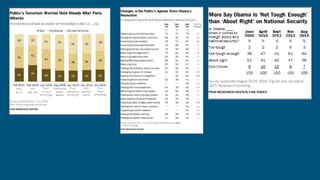
● Washington seems to use the American’s people fear for their own safety to justify its actions. In a
2015 poll by the Pew Research Center shows that Americans are just as afraid of terrorist attacks
in the US as they were a month after 9/11 and defending the nation from further terrorist attacks is
still what Americans believe should be the President’s top concern.
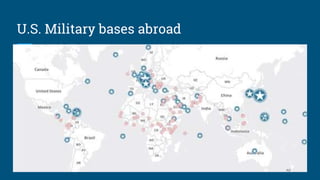
U.S. Military bases abroad
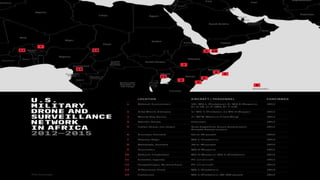
Interventions in Africa
http://m.democracynow.org/stories/15678
- Special Ops involved in 147 countries this year. 75% of all nations.
- involved in 47 African nations (out of 54)
- Cooperative Security Location (CSL) aka “lilly pads”
- Proxy Wars as preferred method of warfare on the African continent
- Diffusion of arms into unintended hands
“They’re involved in Algeria and Angola, Benin and Botswana, Burkina Faso
and Burundi, Cameroon and the Cape Verde Islands. And that’s just the
ABCs of the situation. Skip to the end of the alphabet and the story
remains the same: Senegal and the Seychelles, Togo and Tunisia, Uganda
and Zambia. From north to south, east to west, the Horn of Africa to the
Sahel, the heart of the continent to the islands off its coasts, the U.S.
military is at work. Base construction, security cooperation engagements,
training exercises, advisory deployments, special operations missions, and
a growing logistics network, all undeniable evidence of expansion -- except
at U.S. Africa Command.”
-Nick Turse
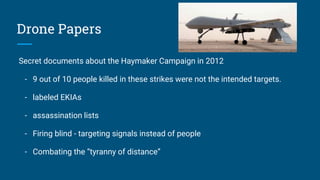
Drone Papers
Secret documents about the Haymaker Campaign in 2012
- 9 out of 10 people killed in these strikes were not the intended targets.
- labeled EKIAs
- assassination lists
- Firing blind - targeting signals instead of people
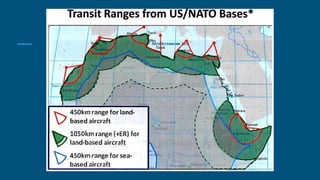
- Combating the “tyranny of distance”
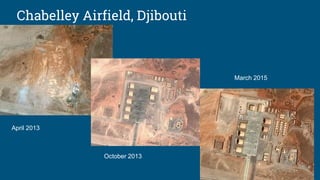
Chabelley Airfield, Djibouti
April 2013
October 2013
March 2015
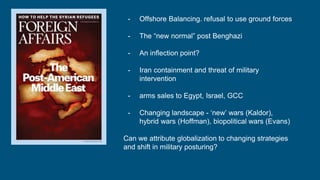
- Offshore Balancing. refusal to use ground forces
- The “new normal” post Benghazi
- An inflection point?
- Iran containment and threat of military
intervention
- arms sales to Egypt, Israel, GCC
- Changing landscape - ‘new’ wars (Kaldor),
hybrid wars (Hoffman), biopolitical wars (Evans)
Can we attribute globalization to changing strategies
and shift in military posturing?
Status of Women in Conflict Zones
90% of war casualties are civilians, a majority of whom are women and children
100 years ago, 90% who lost their lives in war were military personnel
Plight of women and the impact of war on them have been ignored
Women remain underrepresented in decision-making forums related to conflict
In many conflict settings throughout the world, women continue to experience gender-
targeted violence: rape, sexual slavery, murder, and many other human rights
abuses
In general, conflicts exacerbate gender disparities, both in society at large and in families
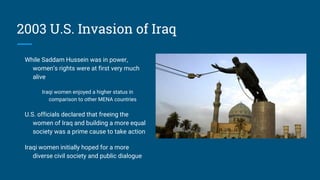
2003 U.S. Invasion of Iraq
While Saddam Hussein was in power,
women’s rights were at first very much
alive
Iraqi women enjoyed a higher status in
comparison to other MENA countries
U.S. officials declared that freeing the
women of Iraq and building a more equal
society was a prime cause to take action
Iraqi women initially hoped for a more
diverse civil society and public dialogue
2003 U.S. Invasion of Iraq (cont.)
U.S. officials made comparisons to status of Afghan women and made very
little differentiation
U.S. government worked with many pro-war Iraqi women’s rights organizations
like “Women for a Free Iraq” to justify the invasion
implicate Saddam Hussein as the main threat to Iraqi women’s rights
Frequently ignored Iraqi anti-war activists
Iran-Iraq war sanctions made daily life difficult for women
“Running just to stay in place”
Iraqi women inside the country and in diaspora began to organize themselves
quickly, forming civil society groups
Female activists were threatened or outright targeted for assassination
increasing insecurity
“Voice without action”
laws written to account for increased participation in government by women, but little progress
made
More effort put into maintaining existing rights
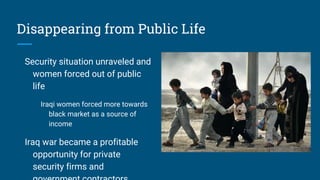
Disappearing from Public Life
Security situation unraveled and
women forced out of public
life
Iraqi women forced more towards
black market as a source of
income
Iraq war became a profitable
opportunity for private
security firms and
Disappearing from Public Life (cont.)
Introduction of neoliberal policies and mass privatization
Iraq imports 80% of food from Jordan, Iran, and Gulf countries
Combined with increasingly volatile security, Iraqi women overwhelmingly without a job in the
sectors that they had been previously well-represented in before 2003 (especially agriculture
and professional sector)
Iraqi women forced more towards black market as a source of income
increases in rates of sexual violence, prostitution, forced sterilization/pregnancy
Violence has prevented women from fully participating in reconstruction

U.s. global interventions

  • 1.
  • 2.
    US Interventionism asa Humanitarian Effort Often, American interventions overseas begin as humanitarian efforts When we entered Somalia in 1992, President Bush claimed that the mission was limited to “... open[ing] the supply routes, to get food moving, and the prepare the way for a U.N. peacekeeping force…” In 1993 the US opened its mandate under President Clinton to use all necessary means to ensure peace, including the placement of US troops in Somalia. Only in 1995 after NATO dropped 1,026 bombs in its largest military effort thus far, was the war in Somalia ended. When entering Iraq and Afghanistan, the Bush administration used the guise of advancing women’s rights, citing various human rights violations as part of the reason it was so important for the US to become involved. The Pentagon chief at the time estimated that US involvement in Iraq would not last more than 5 months, costing under 50 billion dollars. He was off by 1 trillion dollars and a decade. Similarly, when beginning involvement in Libya, President Obama stated that the sole military mission was to protect the citizens of Benghazi, not to implement a regime change, and that the airstrikes would last “days, not weeks.”
  • 3.
    Why does theUS intervene? Since 1980, the US has launched 13 interventions in the Islamic world alone, often reasoning that military intervention overseas is the only thing stopping the global threat of terrorism from growing. However, over the past 2 decades Islamic radicalism has been on the rise. In a report by Daniel Byman and Jeremy Shapiro on what seems to provoke terrorists in the Middle East, many of them cite fighting Western interventionism as a reason for their actions. In a court deposition from 2007, Cherif Kouachi (one of the suspects in the Charlie Hebedo attacks in Paris) said that the source of his radicalization was seeing the “injustices” the US had inflicted upon the Iraqi people over the course of the war. And yet, the solution Washington constantly gives for terrorist attacks motivated by US
  • 4.
    ● So whydoes the US continue to involve itself with global interventions? Largely out of fear of attacks on American soil. ● In a 2007 interview, President Bush stated that “we fight them there so we don’t have to fight them here.” This is a sentiment echoed by many US lawmakers to this day. The idea that our overseas involvement is what stands between the United States and another terrorist attack like September 11th echoes throughout US foreign policy. ○ Even after the Paris attacks a few days ago, Senator John McCain stated that President Obama’s decision not to send more troops to Iraq would result in a similar attack in the US. ○ Thus, America’s perpetual state of war is seen a preventative measure, in order to ensure perpetual peace. ● Washington seems to use the American’s people fear for their own safety to justify its actions. In a 2015 poll by the Pew Research Center shows that Americans are just as afraid of terrorist attacks in the US as they were a month after 9/11 and defending the nation from further terrorist attacks is still what Americans believe should be the President’s top concern.
  • 6.
  • 7.
    Interventions in Africa http://m.democracynow.org/stories/15678 -Special Ops involved in 147 countries this year. 75% of all nations. - involved in 47 African nations (out of 54) - Cooperative Security Location (CSL) aka “lilly pads” - Proxy Wars as preferred method of warfare on the African continent - Diffusion of arms into unintended hands
  • 8.
    “They’re involved inAlgeria and Angola, Benin and Botswana, Burkina Faso and Burundi, Cameroon and the Cape Verde Islands. And that’s just the ABCs of the situation. Skip to the end of the alphabet and the story remains the same: Senegal and the Seychelles, Togo and Tunisia, Uganda and Zambia. From north to south, east to west, the Horn of Africa to the Sahel, the heart of the continent to the islands off its coasts, the U.S. military is at work. Base construction, security cooperation engagements, training exercises, advisory deployments, special operations missions, and a growing logistics network, all undeniable evidence of expansion -- except at U.S. Africa Command.” -Nick Turse
  • 9.
    Drone Papers Secret documentsabout the Haymaker Campaign in 2012 - 9 out of 10 people killed in these strikes were not the intended targets. - labeled EKIAs - assassination lists - Firing blind - targeting signals instead of people - Combating the “tyranny of distance”
  • 11.
    Chabelley Airfield, Djibouti April2013 October 2013 March 2015
  • 13.
    - Offshore Balancing.refusal to use ground forces - The “new normal” post Benghazi - An inflection point? - Iran containment and threat of military intervention - arms sales to Egypt, Israel, GCC - Changing landscape - ‘new’ wars (Kaldor), hybrid wars (Hoffman), biopolitical wars (Evans) Can we attribute globalization to changing strategies and shift in military posturing?
  • 14.
    Status of Womenin Conflict Zones 90% of war casualties are civilians, a majority of whom are women and children 100 years ago, 90% who lost their lives in war were military personnel Plight of women and the impact of war on them have been ignored Women remain underrepresented in decision-making forums related to conflict In many conflict settings throughout the world, women continue to experience gender- targeted violence: rape, sexual slavery, murder, and many other human rights abuses In general, conflicts exacerbate gender disparities, both in society at large and in families
  • 15.
    2003 U.S. Invasionof Iraq While Saddam Hussein was in power, women’s rights were at first very much alive Iraqi women enjoyed a higher status in comparison to other MENA countries U.S. officials declared that freeing the women of Iraq and building a more equal society was a prime cause to take action Iraqi women initially hoped for a more diverse civil society and public dialogue
  • 16.
    2003 U.S. Invasionof Iraq (cont.) U.S. officials made comparisons to status of Afghan women and made very little differentiation U.S. government worked with many pro-war Iraqi women’s rights organizations like “Women for a Free Iraq” to justify the invasion implicate Saddam Hussein as the main threat to Iraqi women’s rights Frequently ignored Iraqi anti-war activists Iran-Iraq war sanctions made daily life difficult for women
  • 17.
    “Running just tostay in place” Iraqi women inside the country and in diaspora began to organize themselves quickly, forming civil society groups Female activists were threatened or outright targeted for assassination increasing insecurity “Voice without action” laws written to account for increased participation in government by women, but little progress made More effort put into maintaining existing rights
  • 18.
    Disappearing from PublicLife Security situation unraveled and women forced out of public life Iraqi women forced more towards black market as a source of income Iraq war became a profitable opportunity for private security firms and
  • 19.
    Disappearing from PublicLife (cont.) Introduction of neoliberal policies and mass privatization Iraq imports 80% of food from Jordan, Iran, and Gulf countries Combined with increasingly volatile security, Iraqi women overwhelmingly without a job in the sectors that they had been previously well-represented in before 2003 (especially agriculture and professional sector) Iraqi women forced more towards black market as a source of income increases in rates of sexual violence, prostitution, forced sterilization/pregnancy Violence has prevented women from fully participating in reconstruction