US Presence in
Afghanistan
(Reasons and Incentives behind its Invasion)
Presented by Hifza Shaheen
MPhil South Asian Studies
Possible questions…
• Was the war really necessary?
• If yes, then what were the reasons?
• What are the influential factors behind the American
decision to continue its presence in Afghanistan even
after displacing the Talibans from power?
When did the war
started??
• Conventional view:
A full-scale invasion had never been on the table before
because it would be expensive, the political will wasn't
there… After Al Qaeda launched an attack, the hammer was
most definitely going to come down on someone. When the
Taliban government refused to hand over Bin Laden and his
men, it's fate was sealed.
• The Bush administration then commenced a bombing
campaign and invasion of Afghanistan, asserting the need
to capture or kill bin Laden and crush his terrorist
organization so that they could not launch another deadly
attack on the American homeland.
• Not only this, with the help of United Nations Security
Council (UNSC) Resolution 1368 of September 12, 2001:
“the Council expresses its readiness to take all
necessary steps to respond to the September 11 attacks”
US did what it really wanted- attacked Afghanistan.
• Widely interpreted then as a UN authorization for
military action in response to the attacks, but crucially it
did not explicitly authorized the Operation Enduring
Freedom (OEF) to oust the Taliban. (Lokanathan, 2016:
129).
• CNN has then reported once:
“The Taliban … refused to hand over bin Laden without
proof or evidence that he was involved in last week’s
attacks on the United States. … The Taliban ambassador to
Pakistan … said that deporting him without proof would
amount to an “insult to Islam.”
• Mullah Abdul Salam Zaeef further stated
"The Americans should show control, conduct an
investigation and show us proof before they attack. The
United Nations and Organisation of Islamic Conference
should also investigate”.
He further stated that
“any aggression against Afghanistan would make a holy
war - jihad - "an obligation for all Muslims” (Defiant
Taliban)
Was the war really
necessary ???
Joseph Morgan once said sharing his experience during
OEF as a HUMINTer…
• The Taliban were not really refusing to turn him over but
rather were demanding certain conditions be satisfied
before they did so. That is not unusual. Governments
routinely have evidentiary standards that must be met
before they grant an extradition request. Bush, however,
was not in a diplomatic mood, and he told the Taliban
“the demands were not open to negotiation or
discussion.” and issued a global warning that: “You are
either with us or with the terrorists”
A General Afghan View…
• In the Afghan capital, Kabul, some civilians warned that
America's uncompromising position was in danger of
uniting the public behind the Taliban, even though they
are loathed for their harsh Islamic laws.
• "To their thinking, the Americans want to throw them out
anyway because of their perceived support of terrorism
and all their other faults, so what difference does it make
to give them bin Laden," said Umer Daudzai, an Afghan
and senior United Nations official in Pakistan.
• We did not do what Americans asked because of our
ethical code.. We believe in Pashtunwali. It has three
elements (Nanawatai, Melmastia and Badal), i.e. the right
of asylum; the grant of hospitality, even to an enemy; and
the answer to an insult with an insult. (Dupree, 1973:228)
Another Afghan view
Why was the Bush administration so stubbornly
opposed to meeting the Taliban’s reasonable
demand …??
• Even after the U.S. bombs began falling in October, the
Taliban tried to negotiate by offering to turn bin Laden
over to a third country if the United States would cease
hostilities and provide evidence of his guilt. But Bush
remained adamant, saying, “There’s no need to discuss
innocence or guilt. We know he’s guilty.”
(London’s Guardian, reporting on this story, printed an
article entitled “Bush Rejects Taliban Offer To Hand Bin
Laden Over.”)
A Pakistani Perspective…
• Astonishingly, when the attacks began, 95 per cent of
Afghans knew nothing either about 9/11 or why their
country was under attack. The US targeted the Taliban
regime to “end the use of Afghanistan as a sanctuary
for terrorism” but appallingly, because of the lack of a
vision or anything resembling a Marshall Plan, it became
a war without end. The country has been at war for 39
years (since 1979) and the question is will the country see
even a minimal kind of peace. (Shahid Hussain Raja-
consultant and a blogger)
Wasn’t the War on Terror
Avoidable??
There were several opportunities before 9/11 for Osama’s extradition by
the Taliban government but the US missed them
• In April 1998, when Talibans were ready to negotiate seriously and
offered two proposals, US naïvely rejected both
• On August 20, 1998, when Saudi Arabia’s intelligence chief Prince
Turki al-Faisal landed in Afghanistan (after negotiation with Mullah
Omar) to bring Osama back, the US started bombing, which derailed
the process. This was the second missed chance to arrest Osama.
• In 2005 the head of the CIA told TIME Magazine that he had an
“excellent” idea of where bin Laden was, but they weren’t going after
him.
• In 2007 Col. David Hunt told Fox News that the US military had an
opportunity to take a shot at bin Laden, and didn’t do it.
………. ……..
• President Obama, who had campaigned as an opponent of
the U.S. invasion of Iraq as a war of choice said of U.S.
military operations in Afghanistan, “This is not a war of
choice. This is a war of necessity.”
• Obama’s words might have made for a good sound bite,
but the evidence shows that, like the war in Iraq, the war
in Afghanistan is, indeed, a war of choice.
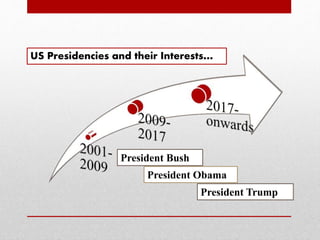
US Presidencies and their Interests…
President Bush
President Obama
President Trump
Then Objectives…
i. To have a friendly regime in Kabul to enable US forces
to search and hunt down Al-Qaeda members
ii. To re-establish deterrence against those who support
them (Talibans)
iii. To establish democracy;
iv. To secure US from future terror attacks
The president said America in Afghanistan aims not at
nation-building but killing terrorists.
“… America and our partners are committed to stripping
terrorists of their territory, cutting off their funding and
exposing the false allure of their evil ideology.”
Reasons to
Attack
Afghanistan…??
i. Collapse of Soviet Union
• Emergence of new and weakened but rich mineral states
• In the South Asia, the absence of the Soviet threat
removed a central measure by which the US
distinguished friends from enemies in the region.
• Of course, U.S. “power” is not just military. It is
economic and political and cultural as well. It is
multidimensional and more imposing as a result. The
overwhelming fact of American power guarantees that
other nations must adjust to and position themselves vis-
à-vis the United States.
ii. Continuation of Great Game
• Control of Central Asia has long been seen as the key to
domination of the world. Russia and Britain jousted for it
during the entire 19th century. President Carter’s advisor,
Zbigniew Brzezinski, wrote in The Grand Chessboard a few
years before 9/11 that Central Asia continued to be the key.
(Brian Good- independent Blogger)
• The United States operates on a capitalistic economy that is
run by the top 1% and the bankers who, whether they make
bad investments or not, love war. War creates money. It allows
for continuous capital. The perpetual war regime that we are
currently living in is based on capital and that's the main
reason regardless of what lives are lost, who is starved, and
how many innocent civilians perish. (Simon Carvajal)
iii. Lithium and other un-tapped Minerals in
Afghanistan:
• Afghanistan has 80 percent of Lithium minerals of Planet
Earth.
• And there are so many kind of rare minerals in
Afghanistan. These rare minerals are important for high
tech unit production. These minerals cost can be 2000
euros / grams for each. (Murat Cem Ceylan- A local
Turkish).
iv. Drug Production:
• At that time about a fifth of the Turkish economy was
dependent on refining opium. There is a connection
between intelligence agencies and black market sales of
drugs for weapons, as well as a connection with the
laundering of the money gained from black market sales.
• In 2001, Afghanistan, after the attack, has started to
produce Drugs for all Europe. That Drug money gives
really big financial power to local terrorist groups such as
PYD, PKK and ISIS.
• All this money was used for USA’s own interests.
• There is no conspiracy theories, no national interests.
There is only instruments of mass production, that's all!
Current Situation…
• The security environment in Afghanistan is still
precarious, evidenced by the uptick in violence in 2016
and the diminishing government control in rural areas.
• Factions of the Government of National Unity remain
divided, and a corrupt patronage system continues to
impede reform.
• Economic growth has shrunk since the drawdown of
international forces, while the government remains
heavily dependent on foreign aid.
• Afghan-Pakistani relations have frayed due to widening
differences on security at a time when regional
competition in and over Afghanistan persists.
… cont.
• However, the combination of a weakening Afghan regime
and an unchecked Taliban resurgence could lead to the
catastrophic collapse of the Afghan government and state,
resulting in either a return to anarchy or the
recrudescence of terrorist groups.
Current Objectives…
The wider objectives are:
• to do everything possible to eliminate the threat posed by
international terrorism;
• to deter states from supporting, harboring or acting
complicity with international terrorist groups;
• reintegration of Afghanistan as a responsible member of
the international community and an end to its self-
imposed isolation.
What’s the
Reason Now…??
• Because the Afghan government asked the US and its
NATO/Coalition partners to continue to assist with the
building of its security forces. Very few foreign personnel are
being used in direct combat roles, their primary responsibilities
are training and enabling the Afghan security forces.
• Defeating an insurgency takes a long time (10 years on average
but some go longer) but the longer the insurgency lasts, the
more likely the government is to prevail. While there had been
time tables previously established for when the US would
withdraw forces, the current agreement is for a status based
approach. This means the US and its allies will withdraw when
the Afghan security forces are able to take over the
responsibility for the country’s security (Brian K. Price- a
blogger)
The Taliban insurgency remains resilient
sixteen years after US led forces toppled its
regime in what led to the United States
Longest War.
• Afghanistan has taken more than 2,400 American lives
and, according to one estimate cited by the Center for
Strategic and International Studies, cost $770 billion in
direct expenses through fiscal 2017.

Us in afghanistan

  • 1.
    US Presence in Afghanistan (Reasonsand Incentives behind its Invasion) Presented by Hifza Shaheen MPhil South Asian Studies
  • 2.
    Possible questions… • Wasthe war really necessary? • If yes, then what were the reasons? • What are the influential factors behind the American decision to continue its presence in Afghanistan even after displacing the Talibans from power?
  • 3.
    When did thewar started?? • Conventional view: A full-scale invasion had never been on the table before because it would be expensive, the political will wasn't there… After Al Qaeda launched an attack, the hammer was most definitely going to come down on someone. When the Taliban government refused to hand over Bin Laden and his men, it's fate was sealed.
  • 4.
    • The Bushadministration then commenced a bombing campaign and invasion of Afghanistan, asserting the need to capture or kill bin Laden and crush his terrorist organization so that they could not launch another deadly attack on the American homeland. • Not only this, with the help of United Nations Security Council (UNSC) Resolution 1368 of September 12, 2001: “the Council expresses its readiness to take all necessary steps to respond to the September 11 attacks” US did what it really wanted- attacked Afghanistan. • Widely interpreted then as a UN authorization for military action in response to the attacks, but crucially it did not explicitly authorized the Operation Enduring Freedom (OEF) to oust the Taliban. (Lokanathan, 2016: 129).
  • 5.
    • CNN hasthen reported once: “The Taliban … refused to hand over bin Laden without proof or evidence that he was involved in last week’s attacks on the United States. … The Taliban ambassador to Pakistan … said that deporting him without proof would amount to an “insult to Islam.”
  • 6.
    • Mullah AbdulSalam Zaeef further stated "The Americans should show control, conduct an investigation and show us proof before they attack. The United Nations and Organisation of Islamic Conference should also investigate”. He further stated that “any aggression against Afghanistan would make a holy war - jihad - "an obligation for all Muslims” (Defiant Taliban)
  • 7.
    Was the warreally necessary ??? Joseph Morgan once said sharing his experience during OEF as a HUMINTer… • The Taliban were not really refusing to turn him over but rather were demanding certain conditions be satisfied before they did so. That is not unusual. Governments routinely have evidentiary standards that must be met before they grant an extradition request. Bush, however, was not in a diplomatic mood, and he told the Taliban “the demands were not open to negotiation or discussion.” and issued a global warning that: “You are either with us or with the terrorists”
  • 8.
    A General AfghanView… • In the Afghan capital, Kabul, some civilians warned that America's uncompromising position was in danger of uniting the public behind the Taliban, even though they are loathed for their harsh Islamic laws. • "To their thinking, the Americans want to throw them out anyway because of their perceived support of terrorism and all their other faults, so what difference does it make to give them bin Laden," said Umer Daudzai, an Afghan and senior United Nations official in Pakistan.
  • 9.
    • We didnot do what Americans asked because of our ethical code.. We believe in Pashtunwali. It has three elements (Nanawatai, Melmastia and Badal), i.e. the right of asylum; the grant of hospitality, even to an enemy; and the answer to an insult with an insult. (Dupree, 1973:228) Another Afghan view
  • 10.
    Why was theBush administration so stubbornly opposed to meeting the Taliban’s reasonable demand …?? • Even after the U.S. bombs began falling in October, the Taliban tried to negotiate by offering to turn bin Laden over to a third country if the United States would cease hostilities and provide evidence of his guilt. But Bush remained adamant, saying, “There’s no need to discuss innocence or guilt. We know he’s guilty.” (London’s Guardian, reporting on this story, printed an article entitled “Bush Rejects Taliban Offer To Hand Bin Laden Over.”)
  • 11.
    A Pakistani Perspective… •Astonishingly, when the attacks began, 95 per cent of Afghans knew nothing either about 9/11 or why their country was under attack. The US targeted the Taliban regime to “end the use of Afghanistan as a sanctuary for terrorism” but appallingly, because of the lack of a vision or anything resembling a Marshall Plan, it became a war without end. The country has been at war for 39 years (since 1979) and the question is will the country see even a minimal kind of peace. (Shahid Hussain Raja- consultant and a blogger)
  • 12.
    Wasn’t the Waron Terror Avoidable?? There were several opportunities before 9/11 for Osama’s extradition by the Taliban government but the US missed them • In April 1998, when Talibans were ready to negotiate seriously and offered two proposals, US naïvely rejected both • On August 20, 1998, when Saudi Arabia’s intelligence chief Prince Turki al-Faisal landed in Afghanistan (after negotiation with Mullah Omar) to bring Osama back, the US started bombing, which derailed the process. This was the second missed chance to arrest Osama. • In 2005 the head of the CIA told TIME Magazine that he had an “excellent” idea of where bin Laden was, but they weren’t going after him. • In 2007 Col. David Hunt told Fox News that the US military had an opportunity to take a shot at bin Laden, and didn’t do it.
  • 13.
    ………. …….. • PresidentObama, who had campaigned as an opponent of the U.S. invasion of Iraq as a war of choice said of U.S. military operations in Afghanistan, “This is not a war of choice. This is a war of necessity.” • Obama’s words might have made for a good sound bite, but the evidence shows that, like the war in Iraq, the war in Afghanistan is, indeed, a war of choice.
  • 14.
    US Presidencies andtheir Interests… President Bush President Obama President Trump
  • 15.
    Then Objectives… i. Tohave a friendly regime in Kabul to enable US forces to search and hunt down Al-Qaeda members ii. To re-establish deterrence against those who support them (Talibans) iii. To establish democracy; iv. To secure US from future terror attacks The president said America in Afghanistan aims not at nation-building but killing terrorists. “… America and our partners are committed to stripping terrorists of their territory, cutting off their funding and exposing the false allure of their evil ideology.”
  • 16.
  • 17.
    i. Collapse ofSoviet Union • Emergence of new and weakened but rich mineral states • In the South Asia, the absence of the Soviet threat removed a central measure by which the US distinguished friends from enemies in the region. • Of course, U.S. “power” is not just military. It is economic and political and cultural as well. It is multidimensional and more imposing as a result. The overwhelming fact of American power guarantees that other nations must adjust to and position themselves vis- à-vis the United States.
  • 18.
    ii. Continuation ofGreat Game • Control of Central Asia has long been seen as the key to domination of the world. Russia and Britain jousted for it during the entire 19th century. President Carter’s advisor, Zbigniew Brzezinski, wrote in The Grand Chessboard a few years before 9/11 that Central Asia continued to be the key. (Brian Good- independent Blogger) • The United States operates on a capitalistic economy that is run by the top 1% and the bankers who, whether they make bad investments or not, love war. War creates money. It allows for continuous capital. The perpetual war regime that we are currently living in is based on capital and that's the main reason regardless of what lives are lost, who is starved, and how many innocent civilians perish. (Simon Carvajal)
  • 19.
    iii. Lithium andother un-tapped Minerals in Afghanistan: • Afghanistan has 80 percent of Lithium minerals of Planet Earth. • And there are so many kind of rare minerals in Afghanistan. These rare minerals are important for high tech unit production. These minerals cost can be 2000 euros / grams for each. (Murat Cem Ceylan- A local Turkish).
  • 20.
    iv. Drug Production: •At that time about a fifth of the Turkish economy was dependent on refining opium. There is a connection between intelligence agencies and black market sales of drugs for weapons, as well as a connection with the laundering of the money gained from black market sales. • In 2001, Afghanistan, after the attack, has started to produce Drugs for all Europe. That Drug money gives really big financial power to local terrorist groups such as PYD, PKK and ISIS. • All this money was used for USA’s own interests. • There is no conspiracy theories, no national interests. There is only instruments of mass production, that's all!
  • 21.
    Current Situation… • Thesecurity environment in Afghanistan is still precarious, evidenced by the uptick in violence in 2016 and the diminishing government control in rural areas. • Factions of the Government of National Unity remain divided, and a corrupt patronage system continues to impede reform. • Economic growth has shrunk since the drawdown of international forces, while the government remains heavily dependent on foreign aid. • Afghan-Pakistani relations have frayed due to widening differences on security at a time when regional competition in and over Afghanistan persists.
  • 22.
    … cont. • However,the combination of a weakening Afghan regime and an unchecked Taliban resurgence could lead to the catastrophic collapse of the Afghan government and state, resulting in either a return to anarchy or the recrudescence of terrorist groups.
  • 23.
    Current Objectives… The widerobjectives are: • to do everything possible to eliminate the threat posed by international terrorism; • to deter states from supporting, harboring or acting complicity with international terrorist groups; • reintegration of Afghanistan as a responsible member of the international community and an end to its self- imposed isolation.
  • 24.
  • 25.
    • Because theAfghan government asked the US and its NATO/Coalition partners to continue to assist with the building of its security forces. Very few foreign personnel are being used in direct combat roles, their primary responsibilities are training and enabling the Afghan security forces. • Defeating an insurgency takes a long time (10 years on average but some go longer) but the longer the insurgency lasts, the more likely the government is to prevail. While there had been time tables previously established for when the US would withdraw forces, the current agreement is for a status based approach. This means the US and its allies will withdraw when the Afghan security forces are able to take over the responsibility for the country’s security (Brian K. Price- a blogger)
  • 26.
    The Taliban insurgencyremains resilient sixteen years after US led forces toppled its regime in what led to the United States Longest War.
  • 27.
    • Afghanistan hastaken more than 2,400 American lives and, according to one estimate cited by the Center for Strategic and International Studies, cost $770 billion in direct expenses through fiscal 2017.

Editor's Notes

  • #6 (The problem with this narrative is that the claim that the Taliban had stubbornly refused to turn over bin Laden is not true).