Development of Urinary &
Genital systems
Human anatomy department, As. Prof.
Yeryomin Anton
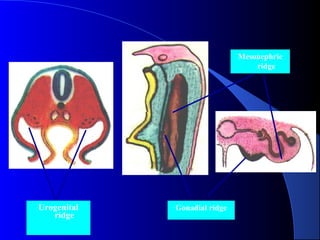
Urogenital
ridge
Gonadial ridge
Mesonephric
ridge
I. Development of Urinary System
1. Development of Kidney and Ureter
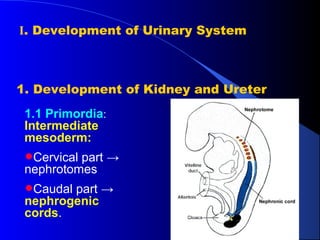
1.1 Primordia:
Intermediate
mesoderm:
•Cervical part →
nephrotomes
•Caudal part →
nephrogenic
cords.
1.2 Pronephros:
Nephrotomes → pronephric tubules and duct →
pronephros → degenerates.
1.3 Mesonephros:
1) Nephrogenic cord → mesonephric ridge →
mesonephros
2) Mesonephric tubules → most disappear;
mesonephric duct → open into cloaca.
1.4 metanephros
1) Primordia: ureteric bud and metanephric
blastema
2) ureteric bud → ureters, renal pelvis, calyces,
collecting tubules
Mesonephric duct
Mesonephric
tubule
Ureteric
bud
Metanephrogenic
blastema
Renal
pelvis
Renal
calyce
Collecting
tubule
3) Metanephric blastema → nephrons →
Bowman's capsule, renal tubules → open
connection to collecting tubules
4) Kidneys ascend → abdomen
2. Formation of Bladder and Urethra
Primordium: urogenital sinus
1) upper part → urinary bladder → continuous
with allantois (obliterated later)
2) Middle part of urogenital sinus → urethra;
3) Lower part → penile urethra in males, vestibule in
females.
3. Congenital Malformations
3.1 Polycystic kidney
•Abnormal development of the collecting system,
or failure of the collecting tubules and nephrons
to join;
•Kidney contains many
cysts, and failure of
renal function may be
caused.
Congenital cystic kidneysCongenital cystic kidneys
Type 1
– Polycystic kidneys found in infants
 Bilateral and results in early death
 Giant or sponge kidneys
 Large renal pelvis and calyces
Type 2
– Cysts are variable in size and shape
– Usually unilateral
– Affected kidney non functional
Congenital cystic kidneysCongenital cystic kidneys
(cont.)(cont.)
 Type 3
– Affected kidneys contain both normal and abnormal
tissue
– Both kidneys involved
– Autosomal dominant gene
 Trisomy of 13-15, 18, 21, 22
 Type 4
– Caused by urethral obstruction
– If severe early death
 Type 5
– Manifests during adult life, death by 50.
– Autosomal dominant
3.2 Pelvic kidney
•Failure of kidney to ascend and still in the pelvis.
3.3 Horseshoe kidney
•Both kidneys fail to ascend, and their lower poles
fuse together.
Horseshoe (fused) kidneyHorseshoe (fused) kidney
Fusion of two kidneys at their lower end
– Tissue that connects kidneys = isthmus
1:400
Trisomy 13-15; 18, 21, Turner’s syndrome,
mosaicism
In rats horseshoe kidney can be produced
experimentally by creating vitamin A
deficiency
3.4 Double ureter
•Early splitting of ureter completely or partially;
•Ureters open into bladder separately, or unite and
open as usual.
3.5 Urachal fistula
•Caused by persisting allantois.
•Urine may drain from the umbilicus.
II. Development of Genital System
1. Development of Gonads
1.1 Primordia: gonadal ridges (coelomic epithelium
+ mesenchyme), primordial germ cells.
1.2 Indifferent stage:
•Gonadal ridges →
primary sex cords.
•Yolk sac → primordial
germ cells migrate into
primary sex cords
1.3 Development of testis
1) Y → SRY → primary sex cords → medulla →
testicular cords → seminiferous tubules →
↗epithelial cells → Sertoli cells
↘primordial germ cells → spermatogonia
2) Mesenchyme (surface) → tunica albuginea;
(between sex cords ) → Leydig cells →
(androgens)
1.4 Development of ovary
1) XX (no SRY) → primary sex cords → medulla →
degenerate
2) Coelomic epithelium → secondary sex cords
(with primordial germ cells )
3) Secondary sex cords → cell clusters →
germ cells → oogonia
epithelial cells → follicular cells
Primordial follicles
4) Oogonia → primary oocyte → no oogonia at
birth.
1.5 Descent of the testis
1) Mesenchyme → gubernaculums
( testis -- genital swelling)
2) Rapid body growth
gubernaculum shortening
→ testis descent →
inguinal canal → scrotum
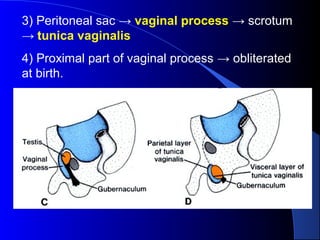
3) Peritoneal sac → vaginal process → scrotum
→ tunica vaginalis
4) Proximal part of vaginal process → obliterated
at birth.
2. Development of Genital Duct
2.1 Primordia: mesonephric duct, paramesonephric
duct.
2.2 Indifferent stage
1) Coelomic epithelium →
paramesonephric ducts:
• cranial end → body cavity;
• caudal ends fuse →
uterine canal.
2) Tip of uterine canal →
urogenital sinus → sinus
tubercle.
2.3 Development of male genital duct
1) Androgens (Leydig cells)→
•mesonephric duct → ductus epididymis, ductus
deferens, ejaculatory duct, seminal gland;
•mesonephric
tubules →
efferent ductules
of testis.
2) Anti-Mullerian duct hormone (Sertoli cells)→
paramesonephric ducts regress.
2.4 Development of female genital duct (no A &
AMH)
1) Paramesonephric duct → uterine tube;
Uterine canal → uterus, upper 1/3 of vagina.
2) Sinus tubercle → vaginal plate → canalized →
lower 2/3 of vagina.
3) Mesonephric ducts → degenerate.
3. Development of external genitalia
3.1 Primordia: urogenital folds, genital tubercle,
urogenital groove, labioscrotal swellings.
3.2 Development
Male (A) Female(no A)
genital tubercle phallus clitoris
urogenital folds lateral wall of urethra labia minora
labioscrotal swellings scrotum labia majora
urogenital groove penile urethra vestibule
4. Congenital Malformations
4.1 Cryptorchidism
•Failure of one or both
testes to descend into
scrotum;
•Seeming to be due to
abnormal androgen
production;
•Testes may remain in
abdomen or in inguinal
canal.
4.2 Congenital inguinal hernia
•Failure of vaginal process to close;
•Intestinal loops may descend into scrotum.
4.3 Abnormalities of the uterus
•Defects of fusion of caudal ends of
paramesonephric ducts;
•May cause double uterus, bicornuate
uterus, uterus septus, etc.
4.4 Vaginal atresia
Caused by failure of vaginal plate to form or
to be canalized.
4.5 Hermaphroditism
1) True hermaphrodite has gonad and external
genitalia of both sexes. rarely observed.
2)Pseudohermaphrodite
•Has either testes (male)
or ovaries (female);
•External genitalia
resembling opposite sex;
•Inadequate (male) or
excessive (female)
androgen production.
4.6 Testicular feminization syndrome
•44+XY chromosome complement;
•Devoid of androgen receptors;
•Testes in inguinal region, no spermatogenesis;
•External genitalia as in females; no uterine tubes,
uterus.
4.7 Hypospadias
•Incomplete fusion of urogenital folds;
•Abnormal opening of urethra along ventral penis.
SUMMARY
1. Primordia and developmental features
of gonads & kidneys.
2. Sex differentiation of the gonads. 2.
3. Differentiation of the urogenital sinus;
4. Sex differentiation of the genital ducts.
5. Congenital malformations of genital
system.

Urogenital devolopment

  • 1.
    Development of Urinary& Genital systems Human anatomy department, As. Prof. Yeryomin Anton
  • 2.
  • 3.
    I. Development ofUrinary System 1. Development of Kidney and Ureter 1.1 Primordia: Intermediate mesoderm: •Cervical part → nephrotomes •Caudal part → nephrogenic cords.
  • 4.
    1.2 Pronephros: Nephrotomes →pronephric tubules and duct → pronephros → degenerates. 1.3 Mesonephros: 1) Nephrogenic cord → mesonephric ridge → mesonephros
  • 5.
    2) Mesonephric tubules→ most disappear; mesonephric duct → open into cloaca.
  • 6.
    1.4 metanephros 1) Primordia:ureteric bud and metanephric blastema
  • 7.
    2) ureteric bud→ ureters, renal pelvis, calyces, collecting tubules Mesonephric duct
  • 8.
  • 9.
    3) Metanephric blastema→ nephrons → Bowman's capsule, renal tubules → open connection to collecting tubules
  • 10.
    4) Kidneys ascend→ abdomen
  • 11.
    2. Formation ofBladder and Urethra Primordium: urogenital sinus 1) upper part → urinary bladder → continuous with allantois (obliterated later)
  • 12.
    2) Middle partof urogenital sinus → urethra; 3) Lower part → penile urethra in males, vestibule in females.
  • 13.
    3. Congenital Malformations 3.1Polycystic kidney •Abnormal development of the collecting system, or failure of the collecting tubules and nephrons to join; •Kidney contains many cysts, and failure of renal function may be caused.
  • 14.
    Congenital cystic kidneysCongenitalcystic kidneys Type 1 – Polycystic kidneys found in infants  Bilateral and results in early death  Giant or sponge kidneys  Large renal pelvis and calyces Type 2 – Cysts are variable in size and shape – Usually unilateral – Affected kidney non functional
  • 15.
    Congenital cystic kidneysCongenitalcystic kidneys (cont.)(cont.)  Type 3 – Affected kidneys contain both normal and abnormal tissue – Both kidneys involved – Autosomal dominant gene  Trisomy of 13-15, 18, 21, 22  Type 4 – Caused by urethral obstruction – If severe early death  Type 5 – Manifests during adult life, death by 50. – Autosomal dominant
  • 16.
    3.2 Pelvic kidney •Failureof kidney to ascend and still in the pelvis. 3.3 Horseshoe kidney •Both kidneys fail to ascend, and their lower poles fuse together.
  • 17.
    Horseshoe (fused) kidneyHorseshoe(fused) kidney Fusion of two kidneys at their lower end – Tissue that connects kidneys = isthmus 1:400 Trisomy 13-15; 18, 21, Turner’s syndrome, mosaicism In rats horseshoe kidney can be produced experimentally by creating vitamin A deficiency
  • 19.
    3.4 Double ureter •Earlysplitting of ureter completely or partially; •Ureters open into bladder separately, or unite and open as usual.
  • 20.
    3.5 Urachal fistula •Causedby persisting allantois. •Urine may drain from the umbilicus.
  • 21.
    II. Development ofGenital System 1. Development of Gonads 1.1 Primordia: gonadal ridges (coelomic epithelium + mesenchyme), primordial germ cells.
  • 22.
    1.2 Indifferent stage: •Gonadalridges → primary sex cords. •Yolk sac → primordial germ cells migrate into primary sex cords
  • 23.
    1.3 Development oftestis 1) Y → SRY → primary sex cords → medulla → testicular cords → seminiferous tubules → ↗epithelial cells → Sertoli cells ↘primordial germ cells → spermatogonia
  • 24.
    2) Mesenchyme (surface)→ tunica albuginea; (between sex cords ) → Leydig cells → (androgens)
  • 25.
    1.4 Development ofovary 1) XX (no SRY) → primary sex cords → medulla → degenerate 2) Coelomic epithelium → secondary sex cords (with primordial germ cells )
  • 26.
    3) Secondary sexcords → cell clusters → germ cells → oogonia epithelial cells → follicular cells Primordial follicles 4) Oogonia → primary oocyte → no oogonia at birth.
  • 27.
    1.5 Descent ofthe testis 1) Mesenchyme → gubernaculums ( testis -- genital swelling)
  • 28.
    2) Rapid bodygrowth gubernaculum shortening → testis descent → inguinal canal → scrotum
  • 29.
    3) Peritoneal sac→ vaginal process → scrotum → tunica vaginalis 4) Proximal part of vaginal process → obliterated at birth.
  • 30.
    2. Development ofGenital Duct 2.1 Primordia: mesonephric duct, paramesonephric duct.
  • 31.
    2.2 Indifferent stage 1)Coelomic epithelium → paramesonephric ducts: • cranial end → body cavity; • caudal ends fuse → uterine canal. 2) Tip of uterine canal → urogenital sinus → sinus tubercle.
  • 32.
    2.3 Development ofmale genital duct 1) Androgens (Leydig cells)→ •mesonephric duct → ductus epididymis, ductus deferens, ejaculatory duct, seminal gland; •mesonephric tubules → efferent ductules of testis.
  • 33.
    2) Anti-Mullerian ducthormone (Sertoli cells)→ paramesonephric ducts regress.
  • 34.
    2.4 Development offemale genital duct (no A & AMH) 1) Paramesonephric duct → uterine tube; Uterine canal → uterus, upper 1/3 of vagina.
  • 35.
    2) Sinus tubercle→ vaginal plate → canalized → lower 2/3 of vagina. 3) Mesonephric ducts → degenerate.
  • 36.
    3. Development ofexternal genitalia 3.1 Primordia: urogenital folds, genital tubercle, urogenital groove, labioscrotal swellings.
  • 37.
    3.2 Development Male (A)Female(no A) genital tubercle phallus clitoris urogenital folds lateral wall of urethra labia minora labioscrotal swellings scrotum labia majora urogenital groove penile urethra vestibule
  • 38.
    4. Congenital Malformations 4.1Cryptorchidism •Failure of one or both testes to descend into scrotum; •Seeming to be due to abnormal androgen production; •Testes may remain in abdomen or in inguinal canal.
  • 39.
    4.2 Congenital inguinalhernia •Failure of vaginal process to close; •Intestinal loops may descend into scrotum.
  • 40.
    4.3 Abnormalities ofthe uterus •Defects of fusion of caudal ends of paramesonephric ducts; •May cause double uterus, bicornuate uterus, uterus septus, etc.
  • 41.
    4.4 Vaginal atresia Causedby failure of vaginal plate to form or to be canalized.
  • 42.
    4.5 Hermaphroditism 1) Truehermaphrodite has gonad and external genitalia of both sexes. rarely observed. 2)Pseudohermaphrodite •Has either testes (male) or ovaries (female); •External genitalia resembling opposite sex; •Inadequate (male) or excessive (female) androgen production.
  • 43.
    4.6 Testicular feminizationsyndrome •44+XY chromosome complement; •Devoid of androgen receptors; •Testes in inguinal region, no spermatogenesis; •External genitalia as in females; no uterine tubes, uterus.
  • 44.
    4.7 Hypospadias •Incomplete fusionof urogenital folds; •Abnormal opening of urethra along ventral penis.
  • 45.
    SUMMARY 1. Primordia anddevelopmental features of gonads & kidneys. 2. Sex differentiation of the gonads. 2. 3. Differentiation of the urogenital sinus; 4. Sex differentiation of the genital ducts. 5. Congenital malformations of genital system.