By
Omar Anwar Sayed
Urology specialist
Asyut university hospital
Supervised by
Dr Ahmed Abdel-
hameed Shahat
Associate Prof. of Urology
Asyut university hospital
1. Physiology of micturition.
2. Precautions.
3. Uroflowmetry parameters.
i. Definitions.
ii. Flow Patterns.
4. EAU guidelines.
5. Take-home messages.
 During bladder filling:
the parasympathetic
innervation of the detrusor
is inhibited and the smooth
and striated parts of the
urethral sphincter are
activated, preventing
involuntary bladder
emptying. This process is
organized by urethral
reflexes known collectively
as the ‘guarding reflex’.
 Some input from the lateral
pons, which is also known as
the ‘L-region’ or the ‘pontine
storage centre’, might facilitate
sphincter reflexes or have a role
in involuntary sphincter
control.
 voluntary control of the bladder
and the urethra has two
important aspects, namely
registration of bladder filling
sensations and manipulation of
the firing of the voiding reflex.
 The PAG has a pivotal role in both. On one
hand, it receives and passes ascending bladder
signals to higher brain centres and into the
realm of conscious sensation. On the other
hand it receives projections from many higher
brain centres and also controls the primary
input to the PMC.
 During
Voiding: Animal
studies have shown
that reflex micturition
is mediated by a
spino-bulbo-spinal
pathway that passes
through the PMC in
the rostral brainstem.
 Excitation of the PMC
activates descending
pathways that cause
urethral relaxation and,
some seconds later,
activation of the sacral
parasympathetic outflow.
This results in contraction
of the bladder and an
increase in intravesical
pressure and the flow of
urine
 Relaxation of the urethral smooth
muscle is mediated by activation
of the parasympathetic pathway to
the urethra, which triggers the
release of NO, and by the removal
of adrenergic and somatic
cholinergic excitatory inputs.
 voluntary voiding in humans
implies interruption of the tonic
suppression (by the prefrontal
cortex) of PAG input to the PMC.
Fowler et al., 2008
1. Physiology of micturition.
2. Precautions.
3. Uroflowmetry parameters.
i. Definitions.
ii. Flow Patterns.
4. EAU guidelines.
5. Take-home messages.
1. Adequate privacy should be provided.
2. Patients should be asked to void when they feel
a ‘‘normal’’ desire to void.
3. Patients should be asked if their voiding was
representative of their usual voiding and their
view should be documented.
4. Automated data analysis must be verified by
inspection of the flow curve, artifacts must be
excluded and verification must be documented.
5. The results from uroflowmetry should be
compared with the data from the patient’s own
recording on a frequency/volume chart.
6. Sonographic estimation of post-void residual
volume completes the noninvasive assessment
of voiding function.
Schäfer et al., 2002
7. Uroflowmetry parameters should preferably be
evaluated with voided volume > 150 mL. as Qmax
is prone to within-subject variation (eau guidelines
2019).
8. For childhood and adolescent:
 The voided volume should not be less than 50 cc or
50% of expected bladder capacity (EBC) for age as
the flow rates and curve may be misleading (Van
Batavia and Combs 2018).
 When Bladder capacity (VV+PVR) are > 115% of
EBC, the uroflow rates and curves may not be
accurate (Franco et al., 2015)
 EBC=(age+1)×30
1. Physiology of micturition.
2. Precautions.
3. Uroflowmetry parameters.
i. Definitions.
ii. Flow Patterns.
4. EAU guidelines of uroflowmetry.
5. Take-home messages.
 is a noninvasive test to study the dynamics of
urine flow.
 Therefore, it is an indispensable, first-line
screening test for most patients with suspected
LUT dysfunction.
 Objective and quantitative information, which
helps one to understand both storage and
voiding symptoms, are provided by this simple
urodynamic measurement.
Schäfer et al., 2002
 Voided volume: the
total volume expelled
via the urethra.
 Maximum flow rate
(Qmax): the maximum
measured value of the
flow rate.
Blavias et al.,2008
 Average flow
rate(Qave): voided
volume divided by
flow time. The
calculation of average
flow rate is only
meaningful if flow is
continuous and
without terminal
dribbling.
Blavias et al.,2008
 Flow time (TQ): the
time over which
measurable flow
actually occurs.
 Time to maximum
flow (TQmax): the
elapsed time from
onset of flow to
maximum flow.
Blavias et al.,2008
 Voiding time: total
duration of
micturition including
interruptions. When
voiding is completed
without interruption,
voiding time is equal
to flow time.
 Qmax is the one of the most important data
obtained with urinary flowmetry but only
second in order of importance to the urinary
flowmetry curve profile.
 Qmax is considered normal for > 15 ml/sec.,
however, BOO could not be excluded.
 Liverpool nomogram can be used for
providing easily interpreted normal reference
ranges of Qmax for both sexes in adults.
 For childhood and adolescent:
 A suggested rule of thumb
is that if the square of the
Qmax [(mL/s)2] is equal to or
bigger than the voided
volume, then the recorded
Qmax is very likely to be
normal.
 Miskolc nomogram can also
be used for diagnosing
lower urinary tract
disturbances (either through
Qmax or Qave) in children
over a wide range of body
size and voided volumes.
 VOID report should be listed as follows: max flow
rate (Qmax)/voided volume(VV)/post-void
residual (PVR).
 Maximum (smoothed) urine flow rate should be
rounded to the nearest whole number (a recording
of 10.25 ml/s would be recorded as 10 ml/s).
 Voided volume and post void residual volume
should be rounded to the nearest 10 ml (a
recording of a voided volume of 342 ml would be
recorded as 340 ml).
Schäfer et al., 2002
 It is either continous or interrupted.
 Normal shape:
1. The normal shape is a bell
shape
2. Qmax is reached in the
first 30% of the curve
(five seconds from the
start).
3. The shape of the curve
can vary, for the same
patient depending on the
volume voided, but the
first and the last leg of the
curve will have similar
shapes.
 Bladder outlet obstruction (BOO)
 Qmax and Qave are smaller (Qave > Qmax/2)
 Qmax is reached relatively fast and is followed by a
long descending slope that ends in terminal
dribbling.
 Two patterns can be recognized
 Compressive BOO BPH
 Constrictive BOO Urethral stricture
 Detrusor
hypocontractility
 Qmax is low and is
reached late in the
second part of the
curve.
 Pressure/flow study
only can establish a
diagnosis.
 Other forms
1. Tower flow curve: an
almost immediate and
rapid rise to peak
uroflow rate shortly after
onset of voiding with
rapid decrease consistent
with an explosive
voiding contraction;
suggestive of detrusor
overactivity (OAB or
IDOD).  Tower-shaped curve in a
10-year-old boy
(Qmax/VV/PVR =
27.9/58.7/3.8).
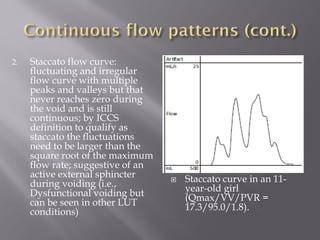
2. Staccato flow curve:
fluctuating and irregular
flow curve with multiple
peaks and valleys but that
never reaches zero during
the void and is still
continuous; by ICCS
definition to qualify as
staccato the fluctuations
need to be larger than the
square root of the maximum
flow rate; suggestive of an
active external sphincter
during voiding (i.e.,
Dysfunctional voiding but
can be seen in other LUT
conditions)
 Staccato curve in an 11-
year-old girl
(Qmax/VV/PVR =
17.3/95.0/1.8).
 Staccato flow pattern (Qmax 38 ml/sec.)
A. Qmax= 2ml/s,
Qave= 2ml/s.
B. Qmax= 10ml/s,
Qave= 2 ml/s.
1. Physiology of micturition.
2. Precautions.
3. Uroflowmetry parameters.
i. Definitions.
ii. Flow Patterns.
4. EAU guidelines.
5. Take-home messages.
 The diagnostic accuracy of uroflowmetry for
detecting BOO varies considerably and is
substantially influenced by threshold values.
 A threshold Qmax of 10 mL/s has a specificity of
70%, a PPV of 70% and a sensitivity of 47% for
BOO.
 The specificity using a threshold Qmax of 15 mL/s
was 38%, the PPV 67% and the sensitivity 82%. If
Qmax is > 15 mL/s, physiological compensatory
processes mean that BOO cannot be excluded.
 Low Qmax can arise as a consequence of BOO,
DUA or an under-filled bladder .
 Therefore, it is limited as a diagnostic test as it
is unable to discriminate between the
underlying mechanisms.
 Specificity can be improved by repeated flow
rate testing. Uroflowmetry can be used for
monitoring treatment outcomes and correlating
symptoms with objective findings.
 In children with neurogenic bladder, uroflowmetry
can rarely be used since most affected patients do
not void spontaneously. In those with cerebral
palsy, non-neurogenic-neurogenic bladder or other
neurological conditions allowing active voiding it
may be a practical tool.
 It provides an objective way of assessing the
efficiency of voiding, while recording of pelvic
floor activity with electromyography (EMG) can be
used to evaluate synergy between detrusor and the
sphincter. The post-void residual urine is
measured by US. The main limitation of
uroflowmetry is a compliant child to follow
instructions
1. Physiology of micturition.
2. Precautions.
3. Uroflowmetry parameters.
i. Definitions.
ii. Flow Patterns.
4. EAU guidelines.
5. Take-home messages.
 Excitation of the PMC relaxation of the
urethra. Seconds later, activation of the sacral
parasympathetic outflow bladder
contraction & ↑ urine flow.
 Precautions should be considered during uroflow
testing.
 VOID report should be listed as follows: max flow
rate (Qmax)/voided volume(VV)/post-void residual
(PVR).
 If Qmax is > 15 mL/s, physiological compensatory
processes mean that BOO cannot be excluded.
 Low Qmax can arise as a consequence of BOO, DUA
or an under-filled bladder .
 Flow patterns are either bell-shaped, plateau, tower-
shaped, staccato or interrupted pattern.
Uroflow Mohamed, Fathy
Gender:
Date of birth:
Investigation age:
Patient number:
Male
11/11/1940
79
Investigation date:
Investigation nr:
Hospital:
Investigator:
Referred by:
11/12/2019
01
ASSIUT UNIVERSTY
Mohamed Osama
00:10 00:20 00:30 00:40 00:50
0
1000 1
Miction command
0
50
ml
Vmic
ml/s
Qura
Time
0 100 200 300 400 500
5
10
15
20
25
100 200 300 400 500
+1
mean 0
-1
-2
-3
Average flow rate
mean 0
-1
-2
-3
Peak flow rate SD
Qura 30
(ml/s)
Bladder volume: 199 ml Average flow rate: 5 ml/s
Volume (ml)
Peak flow rate: 11 ml/s
Siroky nomogram
Uroflow results
VOID
Peak flow rate
Time to peak flow
Voided volume
Flow time
Voiding time
Delay time
Average flow rate
Corrected Qmax
Miction index
11 / 200 / -
10.7
7
199
38
40
10
5.2
14
-
ml/s
s
ml
s
s
s
ml/s
sqrt ml
-
Printedat18/12/2019,11:34:13(v9.1m) 1/1
Uroflowmetry Assiut university presentation

Uroflowmetry Assiut university presentation

  • 1.
    By Omar Anwar Sayed Urologyspecialist Asyut university hospital Supervised by Dr Ahmed Abdel- hameed Shahat Associate Prof. of Urology Asyut university hospital
  • 2.
    1. Physiology ofmicturition. 2. Precautions. 3. Uroflowmetry parameters. i. Definitions. ii. Flow Patterns. 4. EAU guidelines. 5. Take-home messages.
  • 4.
     During bladderfilling: the parasympathetic innervation of the detrusor is inhibited and the smooth and striated parts of the urethral sphincter are activated, preventing involuntary bladder emptying. This process is organized by urethral reflexes known collectively as the ‘guarding reflex’.
  • 5.
     Some inputfrom the lateral pons, which is also known as the ‘L-region’ or the ‘pontine storage centre’, might facilitate sphincter reflexes or have a role in involuntary sphincter control.  voluntary control of the bladder and the urethra has two important aspects, namely registration of bladder filling sensations and manipulation of the firing of the voiding reflex.
  • 6.
     The PAGhas a pivotal role in both. On one hand, it receives and passes ascending bladder signals to higher brain centres and into the realm of conscious sensation. On the other hand it receives projections from many higher brain centres and also controls the primary input to the PMC.
  • 7.
     During Voiding: Animal studieshave shown that reflex micturition is mediated by a spino-bulbo-spinal pathway that passes through the PMC in the rostral brainstem.
  • 8.
     Excitation ofthe PMC activates descending pathways that cause urethral relaxation and, some seconds later, activation of the sacral parasympathetic outflow. This results in contraction of the bladder and an increase in intravesical pressure and the flow of urine
  • 9.
     Relaxation ofthe urethral smooth muscle is mediated by activation of the parasympathetic pathway to the urethra, which triggers the release of NO, and by the removal of adrenergic and somatic cholinergic excitatory inputs.  voluntary voiding in humans implies interruption of the tonic suppression (by the prefrontal cortex) of PAG input to the PMC. Fowler et al., 2008
  • 10.
    1. Physiology ofmicturition. 2. Precautions. 3. Uroflowmetry parameters. i. Definitions. ii. Flow Patterns. 4. EAU guidelines. 5. Take-home messages.
  • 11.
    1. Adequate privacyshould be provided. 2. Patients should be asked to void when they feel a ‘‘normal’’ desire to void. 3. Patients should be asked if their voiding was representative of their usual voiding and their view should be documented.
  • 12.
    4. Automated dataanalysis must be verified by inspection of the flow curve, artifacts must be excluded and verification must be documented. 5. The results from uroflowmetry should be compared with the data from the patient’s own recording on a frequency/volume chart. 6. Sonographic estimation of post-void residual volume completes the noninvasive assessment of voiding function. Schäfer et al., 2002
  • 13.
    7. Uroflowmetry parametersshould preferably be evaluated with voided volume > 150 mL. as Qmax is prone to within-subject variation (eau guidelines 2019). 8. For childhood and adolescent:  The voided volume should not be less than 50 cc or 50% of expected bladder capacity (EBC) for age as the flow rates and curve may be misleading (Van Batavia and Combs 2018).  When Bladder capacity (VV+PVR) are > 115% of EBC, the uroflow rates and curves may not be accurate (Franco et al., 2015)  EBC=(age+1)×30
  • 14.
    1. Physiology ofmicturition. 2. Precautions. 3. Uroflowmetry parameters. i. Definitions. ii. Flow Patterns. 4. EAU guidelines of uroflowmetry. 5. Take-home messages.
  • 15.
     is anoninvasive test to study the dynamics of urine flow.  Therefore, it is an indispensable, first-line screening test for most patients with suspected LUT dysfunction.  Objective and quantitative information, which helps one to understand both storage and voiding symptoms, are provided by this simple urodynamic measurement. Schäfer et al., 2002
  • 16.
     Voided volume:the total volume expelled via the urethra.  Maximum flow rate (Qmax): the maximum measured value of the flow rate. Blavias et al.,2008
  • 17.
     Average flow rate(Qave):voided volume divided by flow time. The calculation of average flow rate is only meaningful if flow is continuous and without terminal dribbling. Blavias et al.,2008
  • 18.
     Flow time(TQ): the time over which measurable flow actually occurs.  Time to maximum flow (TQmax): the elapsed time from onset of flow to maximum flow. Blavias et al.,2008
  • 19.
     Voiding time:total duration of micturition including interruptions. When voiding is completed without interruption, voiding time is equal to flow time.
  • 20.
     Qmax isthe one of the most important data obtained with urinary flowmetry but only second in order of importance to the urinary flowmetry curve profile.  Qmax is considered normal for > 15 ml/sec., however, BOO could not be excluded.  Liverpool nomogram can be used for providing easily interpreted normal reference ranges of Qmax for both sexes in adults.
  • 23.
     For childhoodand adolescent:  A suggested rule of thumb is that if the square of the Qmax [(mL/s)2] is equal to or bigger than the voided volume, then the recorded Qmax is very likely to be normal.  Miskolc nomogram can also be used for diagnosing lower urinary tract disturbances (either through Qmax or Qave) in children over a wide range of body size and voided volumes.
  • 27.
     VOID reportshould be listed as follows: max flow rate (Qmax)/voided volume(VV)/post-void residual (PVR).  Maximum (smoothed) urine flow rate should be rounded to the nearest whole number (a recording of 10.25 ml/s would be recorded as 10 ml/s).  Voided volume and post void residual volume should be rounded to the nearest 10 ml (a recording of a voided volume of 342 ml would be recorded as 340 ml). Schäfer et al., 2002
  • 28.
     It iseither continous or interrupted.
  • 29.
     Normal shape: 1.The normal shape is a bell shape 2. Qmax is reached in the first 30% of the curve (five seconds from the start). 3. The shape of the curve can vary, for the same patient depending on the volume voided, but the first and the last leg of the curve will have similar shapes.
  • 30.
     Bladder outletobstruction (BOO)  Qmax and Qave are smaller (Qave > Qmax/2)  Qmax is reached relatively fast and is followed by a long descending slope that ends in terminal dribbling.  Two patterns can be recognized
  • 31.
  • 32.
     Constrictive BOOUrethral stricture
  • 33.
     Detrusor hypocontractility  Qmaxis low and is reached late in the second part of the curve.  Pressure/flow study only can establish a diagnosis.
  • 34.
     Other forms 1.Tower flow curve: an almost immediate and rapid rise to peak uroflow rate shortly after onset of voiding with rapid decrease consistent with an explosive voiding contraction; suggestive of detrusor overactivity (OAB or IDOD).  Tower-shaped curve in a 10-year-old boy (Qmax/VV/PVR = 27.9/58.7/3.8).
  • 35.
    2. Staccato flowcurve: fluctuating and irregular flow curve with multiple peaks and valleys but that never reaches zero during the void and is still continuous; by ICCS definition to qualify as staccato the fluctuations need to be larger than the square root of the maximum flow rate; suggestive of an active external sphincter during voiding (i.e., Dysfunctional voiding but can be seen in other LUT conditions)  Staccato curve in an 11- year-old girl (Qmax/VV/PVR = 17.3/95.0/1.8).
  • 36.
     Staccato flowpattern (Qmax 38 ml/sec.)
  • 37.
    A. Qmax= 2ml/s, Qave=2ml/s. B. Qmax= 10ml/s, Qave= 2 ml/s.
  • 38.
    1. Physiology ofmicturition. 2. Precautions. 3. Uroflowmetry parameters. i. Definitions. ii. Flow Patterns. 4. EAU guidelines. 5. Take-home messages.
  • 39.
     The diagnosticaccuracy of uroflowmetry for detecting BOO varies considerably and is substantially influenced by threshold values.  A threshold Qmax of 10 mL/s has a specificity of 70%, a PPV of 70% and a sensitivity of 47% for BOO.  The specificity using a threshold Qmax of 15 mL/s was 38%, the PPV 67% and the sensitivity 82%. If Qmax is > 15 mL/s, physiological compensatory processes mean that BOO cannot be excluded.  Low Qmax can arise as a consequence of BOO, DUA or an under-filled bladder .
  • 40.
     Therefore, itis limited as a diagnostic test as it is unable to discriminate between the underlying mechanisms.  Specificity can be improved by repeated flow rate testing. Uroflowmetry can be used for monitoring treatment outcomes and correlating symptoms with objective findings.
  • 44.
     In childrenwith neurogenic bladder, uroflowmetry can rarely be used since most affected patients do not void spontaneously. In those with cerebral palsy, non-neurogenic-neurogenic bladder or other neurological conditions allowing active voiding it may be a practical tool.  It provides an objective way of assessing the efficiency of voiding, while recording of pelvic floor activity with electromyography (EMG) can be used to evaluate synergy between detrusor and the sphincter. The post-void residual urine is measured by US. The main limitation of uroflowmetry is a compliant child to follow instructions
  • 45.
    1. Physiology ofmicturition. 2. Precautions. 3. Uroflowmetry parameters. i. Definitions. ii. Flow Patterns. 4. EAU guidelines. 5. Take-home messages.
  • 46.
     Excitation ofthe PMC relaxation of the urethra. Seconds later, activation of the sacral parasympathetic outflow bladder contraction & ↑ urine flow.  Precautions should be considered during uroflow testing.  VOID report should be listed as follows: max flow rate (Qmax)/voided volume(VV)/post-void residual (PVR).  If Qmax is > 15 mL/s, physiological compensatory processes mean that BOO cannot be excluded.  Low Qmax can arise as a consequence of BOO, DUA or an under-filled bladder .  Flow patterns are either bell-shaped, plateau, tower- shaped, staccato or interrupted pattern.
  • 48.
    Uroflow Mohamed, Fathy Gender: Dateof birth: Investigation age: Patient number: Male 11/11/1940 79 Investigation date: Investigation nr: Hospital: Investigator: Referred by: 11/12/2019 01 ASSIUT UNIVERSTY Mohamed Osama 00:10 00:20 00:30 00:40 00:50 0 1000 1 Miction command 0 50 ml Vmic ml/s Qura Time 0 100 200 300 400 500 5 10 15 20 25 100 200 300 400 500 +1 mean 0 -1 -2 -3 Average flow rate mean 0 -1 -2 -3 Peak flow rate SD Qura 30 (ml/s) Bladder volume: 199 ml Average flow rate: 5 ml/s Volume (ml) Peak flow rate: 11 ml/s Siroky nomogram Uroflow results VOID Peak flow rate Time to peak flow Voided volume Flow time Voiding time Delay time Average flow rate Corrected Qmax Miction index 11 / 200 / - 10.7 7 199 38 40 10 5.2 14 - ml/s s ml s s s ml/s sqrt ml - Printedat18/12/2019,11:34:13(v9.1m) 1/1