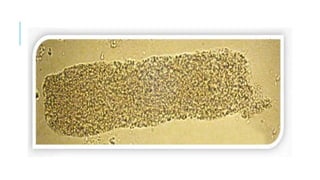
URINE CASTS
DEFINITION:
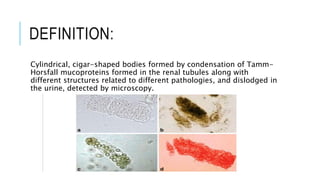
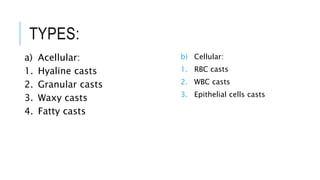
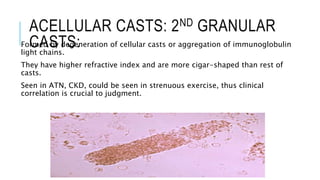
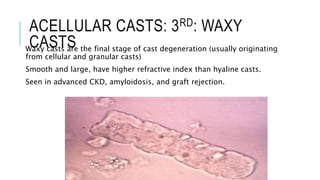
Cylindrical, cigar-shaped bodies formed by condensation of Tamm-
Horsfall mucoproteins formed in the renal tubules along with
different structures related to different pathologies, and dislodged in
the urine, detected by microscopy.
TYPES:
b) Cellular:
1. RBC casts
2. WBC casts
3. Epithelial cells casts
a) Acellular:
1. Hyaline casts
2. Granular casts
3. Waxy casts
4. Fatty casts
ACELLULAR CASTS: 1ST HYALINE
CASTS:The most common type of cast, hyaline casts are solidified Tamm-
Horsfallmucoprotein, their refractive index is very similar to surrounding
fluid.
Seen in fever, dehydration and after strenuous exercise.
ACELLULAR CASTS: 2ND GRANULAR
CASTS:Formed by degeneration of cellular casts or aggregation of immunoglobulin
light chains.
They have higher refractive index and are more cigar-shaped than rest of
casts.
Seen in ATN, CKD, could be seen in strenuous exercise, thus clinical
correlation is crucial to judgment.
ACELLULAR CASTS: 3RD: WAXY
CASTSWaxy casts are the final stage of cast degeneration (usually originating
from cellular and granular casts)
Smooth and large, have higher refractive index than hyaline casts.
Seen in advanced CKD, amyloidosis, and graft rejection.
ACELLULAR CASTS: 4TH FATTY
CASTS
Refractive fatty droplets within hyaline casts
Seen tubular injury when lipid-rich tubular cells rupture.
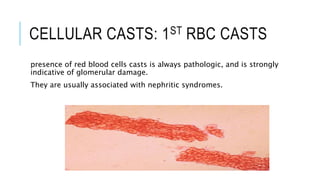
CELLULAR CASTS: 1ST RBC CASTS
presence of red blood cells casts is always pathologic, and is strongly
indicative of glomerular damage.
They are usually associated with nephritic syndromes.
CELLULAR CASTS: WBC CASTS
Indicative of inflammation or infection,
pyelonephritis, acute allergic interstitial nephritis, nephrotic
syndrome, post-streptococcal acute glomerulonephritis
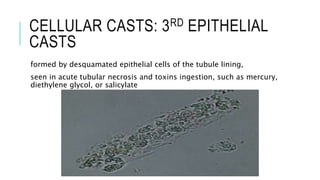
CELLULAR CASTS: 3RD EPITHELIAL
CASTS
formed by desquamated epithelial cells of the tubule lining,
seen in acute tubular necrosis and toxins ingestion, such as mercury,
diethylene glycol, or salicylate
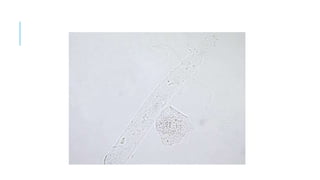
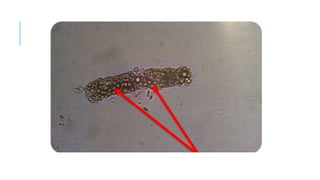
QUIZ: IDENTIFY THE FOLLOWING
TYPES OF CASTS
REFERENCES:
http://eclinpath.com/urinalysis/casts/
Kumar and Clark 9th edition

Urine casts

  • 1.
  • 2.
    DEFINITION: Cylindrical, cigar-shaped bodiesformed by condensation of Tamm- Horsfall mucoproteins formed in the renal tubules along with different structures related to different pathologies, and dislodged in the urine, detected by microscopy.
  • 3.
    TYPES: b) Cellular: 1. RBCcasts 2. WBC casts 3. Epithelial cells casts a) Acellular: 1. Hyaline casts 2. Granular casts 3. Waxy casts 4. Fatty casts
  • 4.
    ACELLULAR CASTS: 1STHYALINE CASTS:The most common type of cast, hyaline casts are solidified Tamm- Horsfallmucoprotein, their refractive index is very similar to surrounding fluid. Seen in fever, dehydration and after strenuous exercise.
  • 5.
    ACELLULAR CASTS: 2NDGRANULAR CASTS:Formed by degeneration of cellular casts or aggregation of immunoglobulin light chains. They have higher refractive index and are more cigar-shaped than rest of casts. Seen in ATN, CKD, could be seen in strenuous exercise, thus clinical correlation is crucial to judgment.
  • 6.
    ACELLULAR CASTS: 3RD:WAXY CASTSWaxy casts are the final stage of cast degeneration (usually originating from cellular and granular casts) Smooth and large, have higher refractive index than hyaline casts. Seen in advanced CKD, amyloidosis, and graft rejection.
  • 7.
    ACELLULAR CASTS: 4THFATTY CASTS Refractive fatty droplets within hyaline casts Seen tubular injury when lipid-rich tubular cells rupture.
  • 8.
    CELLULAR CASTS: 1STRBC CASTS presence of red blood cells casts is always pathologic, and is strongly indicative of glomerular damage. They are usually associated with nephritic syndromes.
  • 9.
    CELLULAR CASTS: WBCCASTS Indicative of inflammation or infection, pyelonephritis, acute allergic interstitial nephritis, nephrotic syndrome, post-streptococcal acute glomerulonephritis
  • 10.
    CELLULAR CASTS: 3RDEPITHELIAL CASTS formed by desquamated epithelial cells of the tubule lining, seen in acute tubular necrosis and toxins ingestion, such as mercury, diethylene glycol, or salicylate
  • 11.
    QUIZ: IDENTIFY THEFOLLOWING TYPES OF CASTS
  • 18.