Urinary Bladder Tumor
Prepared By : Dr.Lutfi Ahmed Al-Bawri
25-1-2018
‫الرحيم‬ ‫الرحمن‬ ‫هللا‬ ‫بسم‬
The Objectives :-
1- Introduction to UB tumor.
2-Sings and Symptoms of UB tumor.
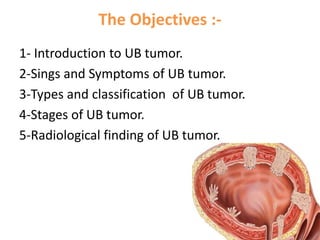
3-Types and classification of UB tumor.
4-Stages of UB tumor.
5-Radiological finding of UB tumor.
1-Introduction to UB tumor.
Incidence, mortality, and survival:-
Bladder cancer is the second most common urological malignancy
and the fourth most common cancer in men. Also it is the 9th
most common cancer worldwide .It represents 3% of all cancer
deaths . About half of patients diagnosed have curable or
controllable disease; hence, 10y survival is 75% for women and
approaching 60% in men.
Risk factors:-
- Men: are 2.5 times more likely to develop the disease than
women, the reasons for which are unclear, but may be associated
with greater urine residuals in the bladder
- Age: increases risk, most commonly diagnosed in the eighth
decade and rare below age 50y.
- Smoking: is the major cause of bladder cancer in the
developed world. Smokers have a 2–5-fold risk of developing
bladder cancer, subsequent recurrences, and higher mortality
compared to non smokers. Estimates suggest that 30–50% of
bladder cancer is caused by smoking. (alph &beta-
naphthyalamine)
- Drugs: phenacitin and cyclophosphamide.
- Race: Black people have a lower incidence than white people,
but inexplicably they appear to carry a poorer prognosis.
- Pelvic radiotherapy: either for prostate cancer (external
beam or brachytherapy) or a gynaecological malignancy, a relative
risk of 1.4–4 exists for the later development of a second primary
malignancy in the bladder.
- Occupational exposure: to carcinogens, in
particular aromatic hydrocarbons like aniline.
Examples of ‘at risk’ occupations are : A latent period of
25–45y exists between exposure and carcinogenesis.
Occupations associated with TCC :-
- Rubber manufacture, e.g. tyres or electric cable.
- Paint and dye manufacture.
- Fine chemical manufacture, e.g. auramine.
- Gas and tar manufacture.
- Iron and aluminium processing.
- Leather workers.
- Painters.
- Drivers exposed to diesel exhaust.
- Chronic inflammation and infection of bladder mucosa:
bladder stones, longterm catheters, and Schistosoma
haematobium (bilharziasis) which are implicated in the
development of SCC of the bladder.
• HPV(human papilloma virus) has possible link to develop
urothelial cancer
Genetic Changes has rule in UB tumor :-
Loss material on chromosome 9 ,P35 tumor suppressor gene
mutation , chromosome 11p, P21,and TP53.
for more details the following table
2-Sings and Symptoms ofUBtumor.
• Symptoms
- The commonest presenting symptom (85% of cases) is painless
visible haematuria . Haematuria may be initial or terminal if
the lesion is at the bladder neck or in the prostatic urethra.
- 34%of patients >50y and 10% <50y with macroscopic
haematuria have bladder cancer. A history of smoking or
occupational exposure is relevant.
- Asymptomatic non-visible haematuria found on routine urine
stick testing accounts for an important minority of presentations.
- Recurrent UTIs and pneumaturia due to malignantcolovesical
fistula, though less common than benign causes (diverticular
and Crohn’s disease).
- More advanced cases may present with lower limb swelling
due to lymphatic/venous obstruction, bone pain, weight loss,
anorexia , confusion, and anuria (renal failure due to bilateral
ureteric obstruction).
- Pain is unusual, even if the patient has obstructed upper tracts
since obstruction and renal deterioration arise gradually.
•Signs
General examination may reveal pallor, indicating
anemia due to blood loss or chronic renal impairment.
Abdominal examination may reveal a suprapubic mass
in the case of locally advanced disease; DRE may reveal
a pelvic mass above or involving the prostate.
Although the likelihood of diagnosing bladder cancer in
patients <50y is low, all patients with these presenting
features should be investigated
Bimanual palpation
The findings described originally by Marshall in 1952
are:
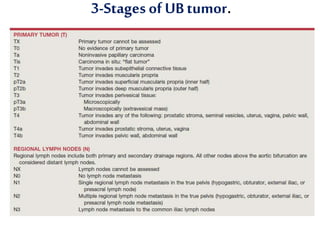
1)T2a-nonpalpable
2)T2b- induration but no three-dimensional mass
3)T3- a three-dimensional mass that is mobile
4)-T4a-invading adjacent structures such as the
prostate, vagina, or rectum
5)-T4b-fixed to pelvic sidewall and not mobile
Normal UB Epithelium
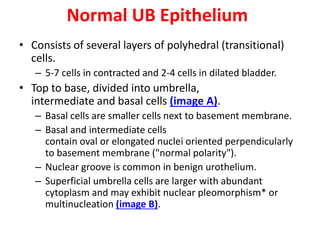
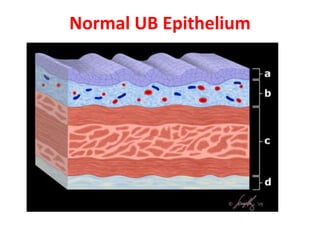
• Consists of several layers of polyhedral (transitional)
cells.
– 5-7 cells in contracted and 2-4 cells in dilated bladder.
• Top to base, divided into umbrella,
intermediate and basal cells (image A).
– Basal cells are smaller cells next to basement membrane.
– Basal and intermediate cells
contain oval or elongated nuclei oriented perpendicularly
to basement membrane ("normal polarity").
– Nuclear groove is common in benign urothelium.
– Superficial umbrella cells are larger with abundant
cytoplasm and may exhibit nuclear pleomorphism* or
multinucleation (image B).
Normal UB Epithelium
Pathogenesis Urothelial carcinoma
Benign tumors of the bladder
There are numerous benign tumors of the bladder, but the more
common ones include:-
Epithelial metaplasia : transformed urothelium with normal
nuclear and cellular architecture surrounded by normal urothelium
usually located on the trigone and composed of squamous which is
usually related to infection, trauma, or surgery
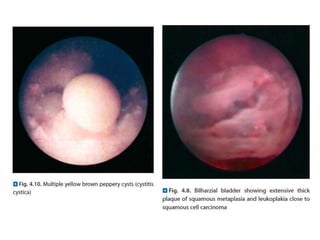
Leukoplakia: similar to squamous metaplasia with the addition of
keratin deposition that appears as a white flaky is often premalignant
Inverted Papilloma benign proliferative lesion that is associated
with chronic inflammation or bladder outlet obstruction and can be
located throughout the bladder but most commonly on the trigone
nephrogenic adenoma
leiomyoma
cystitis cystica
cystitis glandularis
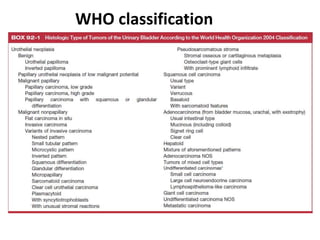
Typesof UB Cancer.
• Primary tumors
A-Urothelial carcinoma ,more than 90%.
B-Non-urothelial cancers :-
1.Squamous cell carcinoma (5% of cases in the U.S.)
2. Adenocarcinoma-1 % of cases in the U.S.
3. Other-small cell carcinoma, rhabdomyosarcoma (most
commonly seen in children), bladder
pheochromocytoma, bladder lymphoma.
• Secondary (metastatic to bladder)-from most to
least common: melanoma, colon, prostate, lung,
breast.
WHO classification
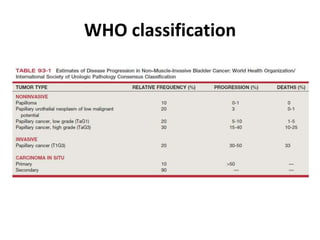
WHO classification
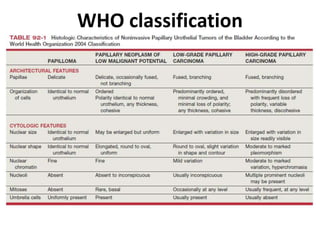
WHO classification
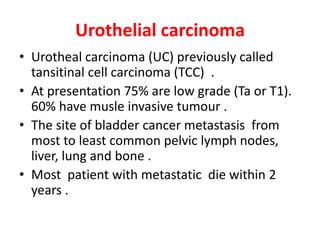
Urothelial carcinoma
• Urotheal carcinoma (UC) previously called
tansitinal cell carcinoma (TCC) .
• At presentation 75% are low grade (Ta or T1).
60% have musle invasive tumour .
• The site of bladder cancer metastasis from
most to least common pelvic lymph nodes,
liver, lung and bone .
• Most patient with metastatic die within 2
years .
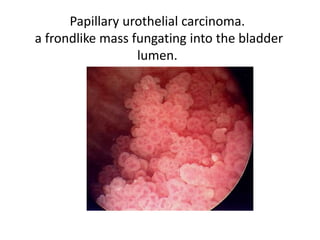
Papillary urothelial carcinoma.
a frondlike mass fungating into the bladder
lumen.
Multicentric urothelial carcinoma. Photograph
of the bladder shows multiple synchronous
tumors (arrows).
Non- Urotheal carcinoma
Squamous cell carcinoma (SCC.)
Associated with chronic inflammation and
cigarrete smoking. The presentation at high
stage than UC.
SCC is more common in Egypt than in U.S
because of Bilharzial infection .
SCC has a worse prognosis than UC except
when arising from Bilharzial infection which is
usually well differentiated and has a low
incidence of metastasis .
Adenocarcinoma
which divided to :
• Primary : the most common tumor in
exstrophic bladder . Adenocarcinoma of the
bladder has worse prognosis than UC .
• Urachal :most cases involved the lower third
of urachus and extended to the bladder wall.
So it occur at the dome and anterior wall of
bladder
• Metastatic
Small cell carcinoma
• Small cell carcinoma of the bladder is an
aggressive neuroendocrine tumor.
• presentation usually with invasive muscularis
propria (stage T2-T4) . Approximately 50% of
patients with metastasis .
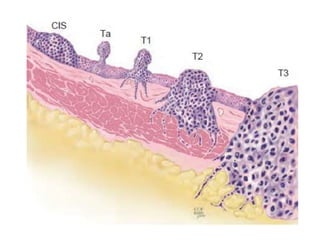
3-Stagesof UBtumor.
U/S urinary-bladder-carcinoma
4-Radiological finding of UB tumor.
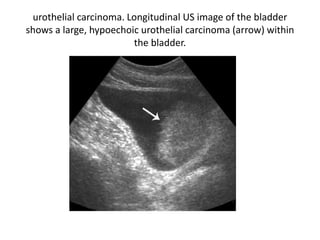
urothelial carcinoma. Longitudinal US image of the bladder
shows a large, hypoechoic urothelial carcinoma (arrow) within
the bladder.
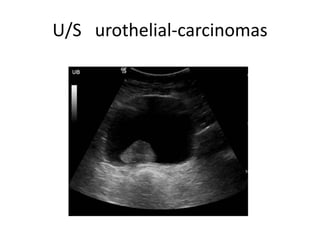
U/S urothelial-carcinomas
U/S urothelial-neoplasm-containing-
transitional-cell-component
CT bladder-carcinoma-in-a-diverticulum
CT bladder-transitional-cell-carcinoma-
at-the-vesicoureteric-junction
CT transitional-cell-carcinoma-of-the-
bladder
MRI Noninvasive papillary urothelial tumor. Coronal T2-weighted MR
image shows an intermediate-signal-intensity mass (arrow) within the
bladder lumen. The hypointense bladder wall is intact.
MRI urothelial-cell-carcinoma
References
• Campbell-Walsh Urology, 11th ed 2016
• Oxford specialist Handbook in Urological Surgery
• Pocket Guide to Urology .
• Radiology Illustrated Uroradiology
• https://radiopaedia.org/articles/transitional-cell-
carcinoma-bladder
Urinary bladder tumor

Urinary bladder tumor

  • 1.
    Urinary Bladder Tumor PreparedBy : Dr.Lutfi Ahmed Al-Bawri 25-1-2018 ‫الرحيم‬ ‫الرحمن‬ ‫هللا‬ ‫بسم‬
  • 2.
    The Objectives :- 1-Introduction to UB tumor. 2-Sings and Symptoms of UB tumor. 3-Types and classification of UB tumor. 4-Stages of UB tumor. 5-Radiological finding of UB tumor.
  • 3.
    1-Introduction to UBtumor. Incidence, mortality, and survival:- Bladder cancer is the second most common urological malignancy and the fourth most common cancer in men. Also it is the 9th most common cancer worldwide .It represents 3% of all cancer deaths . About half of patients diagnosed have curable or controllable disease; hence, 10y survival is 75% for women and approaching 60% in men. Risk factors:- - Men: are 2.5 times more likely to develop the disease than women, the reasons for which are unclear, but may be associated with greater urine residuals in the bladder - Age: increases risk, most commonly diagnosed in the eighth decade and rare below age 50y.
  • 4.
    - Smoking: isthe major cause of bladder cancer in the developed world. Smokers have a 2–5-fold risk of developing bladder cancer, subsequent recurrences, and higher mortality compared to non smokers. Estimates suggest that 30–50% of bladder cancer is caused by smoking. (alph &beta- naphthyalamine) - Drugs: phenacitin and cyclophosphamide. - Race: Black people have a lower incidence than white people, but inexplicably they appear to carry a poorer prognosis. - Pelvic radiotherapy: either for prostate cancer (external beam or brachytherapy) or a gynaecological malignancy, a relative risk of 1.4–4 exists for the later development of a second primary malignancy in the bladder.
  • 5.
    - Occupational exposure:to carcinogens, in particular aromatic hydrocarbons like aniline. Examples of ‘at risk’ occupations are : A latent period of 25–45y exists between exposure and carcinogenesis. Occupations associated with TCC :- - Rubber manufacture, e.g. tyres or electric cable. - Paint and dye manufacture. - Fine chemical manufacture, e.g. auramine. - Gas and tar manufacture. - Iron and aluminium processing. - Leather workers. - Painters. - Drivers exposed to diesel exhaust.
  • 6.
    - Chronic inflammationand infection of bladder mucosa: bladder stones, longterm catheters, and Schistosoma haematobium (bilharziasis) which are implicated in the development of SCC of the bladder. • HPV(human papilloma virus) has possible link to develop urothelial cancer Genetic Changes has rule in UB tumor :- Loss material on chromosome 9 ,P35 tumor suppressor gene mutation , chromosome 11p, P21,and TP53. for more details the following table
  • 8.
    2-Sings and SymptomsofUBtumor. • Symptoms - The commonest presenting symptom (85% of cases) is painless visible haematuria . Haematuria may be initial or terminal if the lesion is at the bladder neck or in the prostatic urethra. - 34%of patients >50y and 10% <50y with macroscopic haematuria have bladder cancer. A history of smoking or occupational exposure is relevant. - Asymptomatic non-visible haematuria found on routine urine stick testing accounts for an important minority of presentations.
  • 9.
    - Recurrent UTIsand pneumaturia due to malignantcolovesical fistula, though less common than benign causes (diverticular and Crohn’s disease). - More advanced cases may present with lower limb swelling due to lymphatic/venous obstruction, bone pain, weight loss, anorexia , confusion, and anuria (renal failure due to bilateral ureteric obstruction). - Pain is unusual, even if the patient has obstructed upper tracts since obstruction and renal deterioration arise gradually.
  • 10.
    •Signs General examination mayreveal pallor, indicating anemia due to blood loss or chronic renal impairment. Abdominal examination may reveal a suprapubic mass in the case of locally advanced disease; DRE may reveal a pelvic mass above or involving the prostate. Although the likelihood of diagnosing bladder cancer in patients <50y is low, all patients with these presenting features should be investigated
  • 11.
    Bimanual palpation The findingsdescribed originally by Marshall in 1952 are: 1)T2a-nonpalpable 2)T2b- induration but no three-dimensional mass 3)T3- a three-dimensional mass that is mobile 4)-T4a-invading adjacent structures such as the prostate, vagina, or rectum 5)-T4b-fixed to pelvic sidewall and not mobile
  • 12.
    Normal UB Epithelium •Consists of several layers of polyhedral (transitional) cells. – 5-7 cells in contracted and 2-4 cells in dilated bladder. • Top to base, divided into umbrella, intermediate and basal cells (image A). – Basal cells are smaller cells next to basement membrane. – Basal and intermediate cells contain oval or elongated nuclei oriented perpendicularly to basement membrane ("normal polarity"). – Nuclear groove is common in benign urothelium. – Superficial umbrella cells are larger with abundant cytoplasm and may exhibit nuclear pleomorphism* or multinucleation (image B).
  • 13.
  • 16.
  • 17.
    Benign tumors ofthe bladder There are numerous benign tumors of the bladder, but the more common ones include:- Epithelial metaplasia : transformed urothelium with normal nuclear and cellular architecture surrounded by normal urothelium usually located on the trigone and composed of squamous which is usually related to infection, trauma, or surgery Leukoplakia: similar to squamous metaplasia with the addition of keratin deposition that appears as a white flaky is often premalignant Inverted Papilloma benign proliferative lesion that is associated with chronic inflammation or bladder outlet obstruction and can be located throughout the bladder but most commonly on the trigone nephrogenic adenoma leiomyoma cystitis cystica cystitis glandularis
  • 20.
    Typesof UB Cancer. •Primary tumors A-Urothelial carcinoma ,more than 90%. B-Non-urothelial cancers :- 1.Squamous cell carcinoma (5% of cases in the U.S.) 2. Adenocarcinoma-1 % of cases in the U.S. 3. Other-small cell carcinoma, rhabdomyosarcoma (most commonly seen in children), bladder pheochromocytoma, bladder lymphoma. • Secondary (metastatic to bladder)-from most to least common: melanoma, colon, prostate, lung, breast.
  • 21.
  • 22.
  • 23.
  • 25.
    Urothelial carcinoma • Urothealcarcinoma (UC) previously called tansitinal cell carcinoma (TCC) . • At presentation 75% are low grade (Ta or T1). 60% have musle invasive tumour . • The site of bladder cancer metastasis from most to least common pelvic lymph nodes, liver, lung and bone . • Most patient with metastatic die within 2 years .
  • 27.
    Papillary urothelial carcinoma. afrondlike mass fungating into the bladder lumen.
  • 28.
    Multicentric urothelial carcinoma.Photograph of the bladder shows multiple synchronous tumors (arrows).
  • 29.
    Non- Urotheal carcinoma Squamouscell carcinoma (SCC.) Associated with chronic inflammation and cigarrete smoking. The presentation at high stage than UC. SCC is more common in Egypt than in U.S because of Bilharzial infection . SCC has a worse prognosis than UC except when arising from Bilharzial infection which is usually well differentiated and has a low incidence of metastasis .
  • 30.
    Adenocarcinoma which divided to: • Primary : the most common tumor in exstrophic bladder . Adenocarcinoma of the bladder has worse prognosis than UC . • Urachal :most cases involved the lower third of urachus and extended to the bladder wall. So it occur at the dome and anterior wall of bladder • Metastatic
  • 32.
    Small cell carcinoma •Small cell carcinoma of the bladder is an aggressive neuroendocrine tumor. • presentation usually with invasive muscularis propria (stage T2-T4) . Approximately 50% of patients with metastasis .
  • 33.
  • 38.
  • 39.
    urothelial carcinoma. LongitudinalUS image of the bladder shows a large, hypoechoic urothelial carcinoma (arrow) within the bladder.
  • 40.
  • 41.
  • 42.
  • 43.
  • 44.
  • 45.
    MRI Noninvasive papillaryurothelial tumor. Coronal T2-weighted MR image shows an intermediate-signal-intensity mass (arrow) within the bladder lumen. The hypointense bladder wall is intact.
  • 46.
  • 47.
    References • Campbell-Walsh Urology,11th ed 2016 • Oxford specialist Handbook in Urological Surgery • Pocket Guide to Urology . • Radiology Illustrated Uroradiology • https://radiopaedia.org/articles/transitional-cell- carcinoma-bladder