Updating Materialized Views
and Caches Using Kafka
-or-
Why You Should Publish
Data Changes to Kafka
Zach Cox
Prairie.Code() Oct 2016
https://github.com/zcox/twitter-microservices-example
About Me
● Building things with Apache Kafka since 2014
○ Currently at Uptake in Chicago: predictive analytics for industrial IoT
○ Previously at Banno in Des Moines: ad targeting for bank web sites
● Co-founded Pongr
○ Startup in Des Moines: photo marketing platform powered by messaging systems
● Software game since 1998
● Links
○ http://theza.ch
○ https://github.com/zcox
○ https://twitter.com/zcox
○ https://www.linkedin.com/in/zachcox
Remember These Things
1. Learn about Apache Kafka http://kafka.apache.org
2. Send events and data changes to Kafka
3. Denormalization is OK
4. Up-to-date materialized views and caches
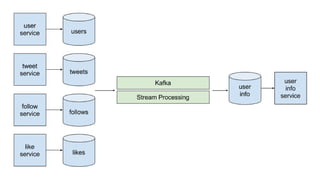
Build a New Service
● Provides read access to data from many sources
○ Query multiple tables or databases
○ Complex joins, aggregations
● Response latency
○ 95% 5 msec
○ Max 10 msec
● Data update latency
○ 95% 1 sec
○ Max 10 sec
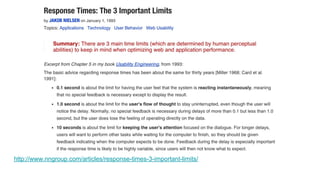
http://www.nngroup.com/articles/response-times-3-important-limits/
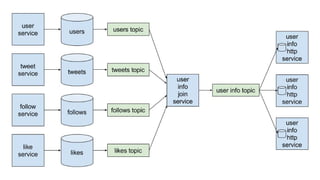
User Information Service
● One operation: get user information
● REST HTTP + JSON
● Input: userId
● GET /users/:userId
● Output:
○ userId
○ username
○ Name
○ Description
○ Location
○ Web page url
○ Joined date
○ Profile image url
○ Background image url
○ # tweets
○ # following
○ # followers
○ # likes
○ # lists
○ # moments
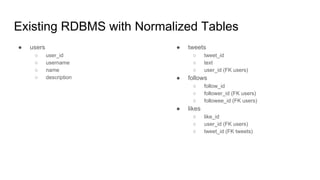
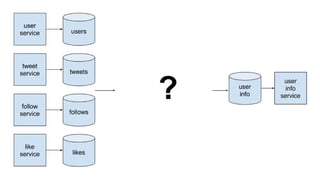
Existing RDBMS with Normalized Tables
● users
○ user_id
○ username
○ name
○ description
● tweets
○ tweet_id
○ text
○ user_id (FK users)
● follows
○ follow_id
○ follower_id (FK users)
○ followee_id (FK users)
● likes
○ like_id
○ user_id (FK users)
○ tweet_id (FK tweets)
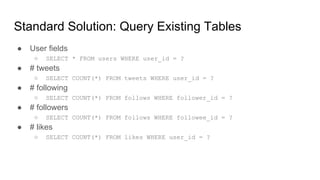
Standard Solution: Query Existing Tables
● User fields
○ SELECT * FROM users WHERE user_id = ?
● # tweets
○ SELECT COUNT(*) FROM tweets WHERE user_id = ?
● # following
○ SELECT COUNT(*) FROM follows WHERE follower_id = ?
● # followers
○ SELECT COUNT(*) FROM follows WHERE followee_id = ?
● # likes
○ SELECT COUNT(*) FROM likes WHERE user_id = ?
Problems with Standard Solution
● Complex: multiple queries across multiple tables
● Potentially large aggregations at query time
○ Puts load on DB
○ Increases service response latency
○ Repeated on every query for same userId
● Shared data storage
○ Some other service writes to these tables (i.e. owns them)
○ When it changes schema, our service could break
Standard Solution: Add a Cache
● e.g. Redis
● Benefits
○ Faster key lookups than RDBMS queries
○ Store expensive computed values in cache and reuse them (i.e. materialized view)
● Usage
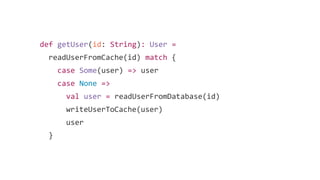
○ Read from cache first, if found then return cached data
○ Otherwise, read from DB, write to cache, return cached data
def getUser(id: String): User =
readUserFromCache(id) match {
case Some(user) => user
case None =>
val user = readUserFromDatabase(id)
writeUserToCache(user)
user
}
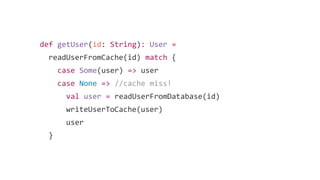
def getUser(id: String): User =
readUserFromCache(id) match {
case Some(user) => user
case None => //cache miss!
val user = readUserFromDatabase(id)
writeUserToCache(user)
user
}
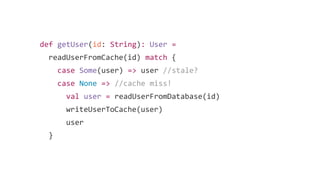
def getUser(id: String): User =
readUserFromCache(id) match {
case Some(user) => user //stale?
case None => //cache miss!
val user = readUserFromDatabase(id)
writeUserToCache(user)
user
}
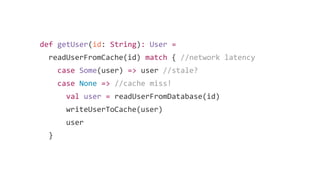
def getUser(id: String): User =
readUserFromCache(id) match { //network latency
case Some(user) => user //stale?
case None => //cache miss!
val user = readUserFromDatabase(id)
writeUserToCache(user)
user
}
Problems with Standard Approach to Caches
● Operational complexity: someone has to manage Redis
● Code complexity: now querying two data stores and writing to one
● Cache misses: still putting some load on DB
● Stale data: cache is not updated when data changes
● Network latency: cache is remote
Can We Solve These Problems?
● Yes: If cache is always updated
● Complexity: only read from cache
● Cache misses: cache always has all data
● Stale data: cache always has updated data
● Network latency: if cache is local to service (bonus)
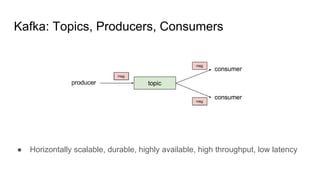
Kafka: Topics, Producers, Consumers
● Horizontally scalable, durable, highly available, high throughput, low latency
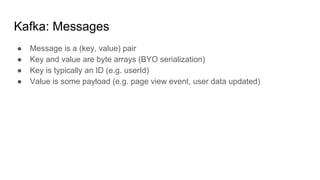
Kafka: Messages
● Message is a (key, value) pair
● Key and value are byte arrays (BYO serialization)
● Key is typically an ID (e.g. userId)
● Value is some payload (e.g. page view event, user data updated)
Kafka: Producer API
val props = … //kafka host:port, other configs
val producer = new KafkaProducer[K, V](props)
producer.send(topic, key, value)
Kafka: Consumer API
val props = … //kafka host:port, other configs
val consumer = new KafkaConsumer[K, V](props)
consumer.subscribe(topics)
while (true) {
val messages = consumer.poll(timeout)
//process list of messages
}
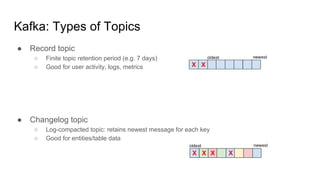
Kafka: Types of Topics
● Record topic
○ Finite topic retention period (e.g. 7 days)
○ Good for user activity, logs, metrics
● Changelog topic
○ Log-compacted topic: retains newest message for each key
○ Good for entities/table data
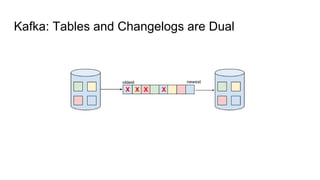
Kafka: Tables and Changelogs are Dual
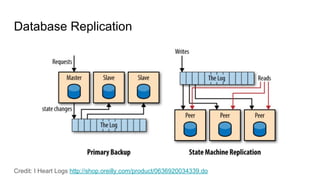
Database Replication
Credit: I Heart Logs http://shop.oreilly.com/product/0636920034339.do
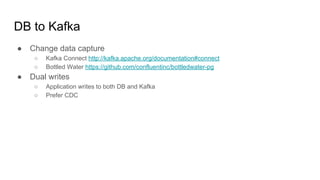
DB to Kafka
● Change data capture
○ Kafka Connect http://kafka.apache.org/documentation#connect
○ Bottled Water https://github.com/confluentinc/bottledwater-pg
● Dual writes
○ Application writes to both DB and Kafka
○ Prefer CDC
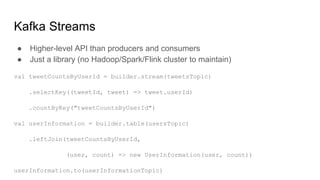
Kafka Streams
● Higher-level API than producers and consumers
● Just a library (no Hadoop/Spark/Flink cluster to maintain)
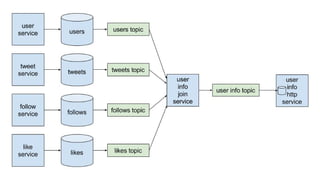
val tweetCountsByUserId = builder.stream(tweetsTopic)
.selectKey((tweetId, tweet) => tweet.userId)
.countByKey("tweetCountsByUserId")
val userInformation = builder.table(usersTopic)
.leftJoin(tweetCountsByUserId,
(user, count) => new UserInformation(user, count))
userInformation.to(userInformationTopic)
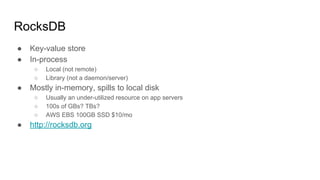
RocksDB
● Key-value store
● In-process
○ Local (not remote)
○ Library (not a daemon/server)
● Mostly in-memory, spills to local disk
○ Usually an under-utilized resource on app servers
○ 100s of GBs? TBs?
○ AWS EBS 100GB SSD $10/mo
● http://rocksdb.org
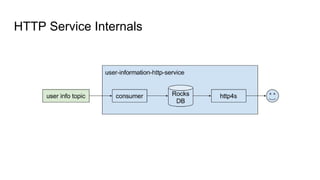
HTTP Service Internals
Live Demo!
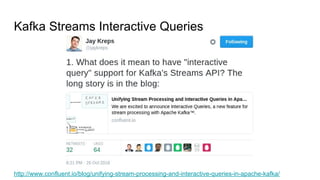
Kafka Streams Interactive Queries
http://www.confluent.io/blog/unifying-stream-processing-and-interactive-queries-in-apache-kafka/
Confluent Schema Registry
● Serialize messages in Kafka topics using Avro
● Avro schemas registered with central server
● Anyone can safely consume data in topics
● http://docs.confluent.io/3.0.1/schema-registry/docs/index.html

Updating materialized views and caches using kafka

  • 1.
    Updating Materialized Views andCaches Using Kafka -or- Why You Should Publish Data Changes to Kafka Zach Cox Prairie.Code() Oct 2016 https://github.com/zcox/twitter-microservices-example
  • 2.
    About Me ● Buildingthings with Apache Kafka since 2014 ○ Currently at Uptake in Chicago: predictive analytics for industrial IoT ○ Previously at Banno in Des Moines: ad targeting for bank web sites ● Co-founded Pongr ○ Startup in Des Moines: photo marketing platform powered by messaging systems ● Software game since 1998 ● Links ○ http://theza.ch ○ https://github.com/zcox ○ https://twitter.com/zcox ○ https://www.linkedin.com/in/zachcox
  • 3.
    Remember These Things 1.Learn about Apache Kafka http://kafka.apache.org 2. Send events and data changes to Kafka 3. Denormalization is OK 4. Up-to-date materialized views and caches
  • 4.
    Build a NewService ● Provides read access to data from many sources ○ Query multiple tables or databases ○ Complex joins, aggregations ● Response latency ○ 95% 5 msec ○ Max 10 msec ● Data update latency ○ 95% 1 sec ○ Max 10 sec
  • 8.
  • 9.
    User Information Service ●One operation: get user information ● REST HTTP + JSON ● Input: userId ● GET /users/:userId ● Output: ○ userId ○ username ○ Name ○ Description ○ Location ○ Web page url ○ Joined date ○ Profile image url ○ Background image url ○ # tweets ○ # following ○ # followers ○ # likes ○ # lists ○ # moments
  • 10.
    Existing RDBMS withNormalized Tables ● users ○ user_id ○ username ○ name ○ description ● tweets ○ tweet_id ○ text ○ user_id (FK users) ● follows ○ follow_id ○ follower_id (FK users) ○ followee_id (FK users) ● likes ○ like_id ○ user_id (FK users) ○ tweet_id (FK tweets)
  • 11.
    Standard Solution: QueryExisting Tables ● User fields ○ SELECT * FROM users WHERE user_id = ? ● # tweets ○ SELECT COUNT(*) FROM tweets WHERE user_id = ? ● # following ○ SELECT COUNT(*) FROM follows WHERE follower_id = ? ● # followers ○ SELECT COUNT(*) FROM follows WHERE followee_id = ? ● # likes ○ SELECT COUNT(*) FROM likes WHERE user_id = ?
  • 12.
    Problems with StandardSolution ● Complex: multiple queries across multiple tables ● Potentially large aggregations at query time ○ Puts load on DB ○ Increases service response latency ○ Repeated on every query for same userId ● Shared data storage ○ Some other service writes to these tables (i.e. owns them) ○ When it changes schema, our service could break
  • 13.
    Standard Solution: Adda Cache ● e.g. Redis ● Benefits ○ Faster key lookups than RDBMS queries ○ Store expensive computed values in cache and reuse them (i.e. materialized view) ● Usage ○ Read from cache first, if found then return cached data ○ Otherwise, read from DB, write to cache, return cached data
  • 14.
    def getUser(id: String):User = readUserFromCache(id) match { case Some(user) => user case None => val user = readUserFromDatabase(id) writeUserToCache(user) user }
  • 15.
    def getUser(id: String):User = readUserFromCache(id) match { case Some(user) => user case None => //cache miss! val user = readUserFromDatabase(id) writeUserToCache(user) user }
  • 16.
    def getUser(id: String):User = readUserFromCache(id) match { case Some(user) => user //stale? case None => //cache miss! val user = readUserFromDatabase(id) writeUserToCache(user) user }
  • 17.
    def getUser(id: String):User = readUserFromCache(id) match { //network latency case Some(user) => user //stale? case None => //cache miss! val user = readUserFromDatabase(id) writeUserToCache(user) user }
  • 18.
    Problems with StandardApproach to Caches ● Operational complexity: someone has to manage Redis ● Code complexity: now querying two data stores and writing to one ● Cache misses: still putting some load on DB ● Stale data: cache is not updated when data changes ● Network latency: cache is remote
  • 19.
    Can We SolveThese Problems? ● Yes: If cache is always updated ● Complexity: only read from cache ● Cache misses: cache always has all data ● Stale data: cache always has updated data ● Network latency: if cache is local to service (bonus)
  • 22.
    Kafka: Topics, Producers,Consumers ● Horizontally scalable, durable, highly available, high throughput, low latency
  • 23.
    Kafka: Messages ● Messageis a (key, value) pair ● Key and value are byte arrays (BYO serialization) ● Key is typically an ID (e.g. userId) ● Value is some payload (e.g. page view event, user data updated)
  • 24.
    Kafka: Producer API valprops = … //kafka host:port, other configs val producer = new KafkaProducer[K, V](props) producer.send(topic, key, value)
  • 25.
    Kafka: Consumer API valprops = … //kafka host:port, other configs val consumer = new KafkaConsumer[K, V](props) consumer.subscribe(topics) while (true) { val messages = consumer.poll(timeout) //process list of messages }
  • 26.
    Kafka: Types ofTopics ● Record topic ○ Finite topic retention period (e.g. 7 days) ○ Good for user activity, logs, metrics ● Changelog topic ○ Log-compacted topic: retains newest message for each key ○ Good for entities/table data
  • 27.
    Kafka: Tables andChangelogs are Dual
  • 28.
    Database Replication Credit: IHeart Logs http://shop.oreilly.com/product/0636920034339.do
  • 29.
    DB to Kafka ●Change data capture ○ Kafka Connect http://kafka.apache.org/documentation#connect ○ Bottled Water https://github.com/confluentinc/bottledwater-pg ● Dual writes ○ Application writes to both DB and Kafka ○ Prefer CDC
  • 30.
    Kafka Streams ● Higher-levelAPI than producers and consumers ● Just a library (no Hadoop/Spark/Flink cluster to maintain) val tweetCountsByUserId = builder.stream(tweetsTopic) .selectKey((tweetId, tweet) => tweet.userId) .countByKey("tweetCountsByUserId") val userInformation = builder.table(usersTopic) .leftJoin(tweetCountsByUserId, (user, count) => new UserInformation(user, count)) userInformation.to(userInformationTopic)
  • 33.
    RocksDB ● Key-value store ●In-process ○ Local (not remote) ○ Library (not a daemon/server) ● Mostly in-memory, spills to local disk ○ Usually an under-utilized resource on app servers ○ 100s of GBs? TBs? ○ AWS EBS 100GB SSD $10/mo ● http://rocksdb.org
  • 34.
  • 35.
  • 40.
    Kafka Streams InteractiveQueries http://www.confluent.io/blog/unifying-stream-processing-and-interactive-queries-in-apache-kafka/
  • 41.
    Confluent Schema Registry ●Serialize messages in Kafka topics using Avro ● Avro schemas registered with central server ● Anyone can safely consume data in topics ● http://docs.confluent.io/3.0.1/schema-registry/docs/index.html