Reading Beyond the
Script: Engaging
Reading Practices for
Paraprofessionals
DR. SUSAN WEGMANN
THE BAPTIST COLLEGE OF FLORIDA
SJWEGMANN@BAPTISTCOLLEGE.EDU
WWW.SLIDESHARE.NET/SWEGMANN
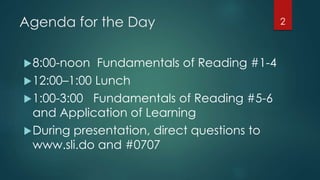
Agenda for the Day
8:00-noon Fundamentals of Reading #1-4
12:00–1:00 Lunch
1:00-3:00 Fundamentals of Reading #5-6
and Application of Learning
During presentation, direct questions to
www.sli.do and #0707
2
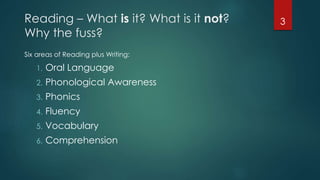
Reading – What is it? What is it not?
Why the fuss?
Six areas of Reading plus Writing:
1. Oral Language
2. Phonological Awareness
3. Phonics
4. Fluency
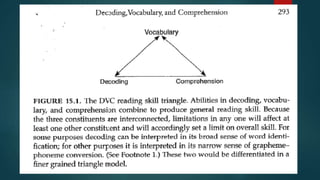
5. Vocabulary
6. Comprehension
3
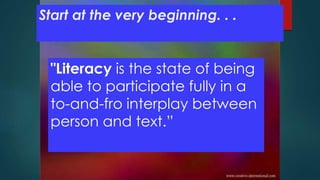
"Literacy is the state of being
able to participate fully in a
to-and-fro interplay between
person and text.”
Start at the very beginning. . .
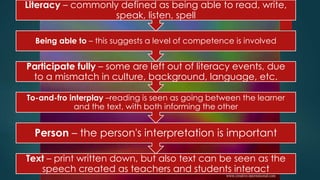
Text – print written down, but also text can be seen as the
speech created as teachers and students interact
Person – the person's interpretation is important
To-and-fro interplay –reading is seen as going between the learner
and the text, with both informing the other
Participate fully – some are left out of literacy events, due
to a mismatch in culture, background, language, etc.
Being able to – this suggests a level of competence is involved
Literacy – commonly defined as being able to read, write,
speak, listen, spell
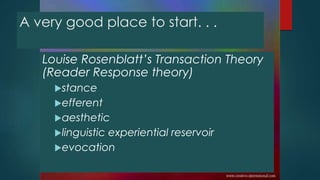
Louise Rosenblatt’s Transaction Theory
(Reader Response theory)
stance
efferent
aesthetic
linguistic experiential reservoir
evocation
A very good place to start. . .
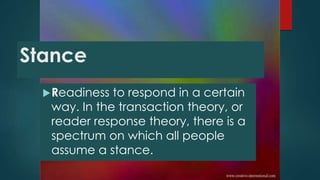
Readiness to respond in a certain
way. In the transaction theory, or
reader response theory, there is a
spectrum on which all people
assume a stance.
Stance
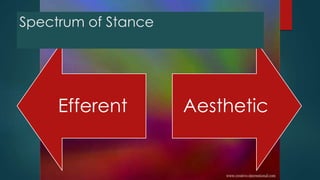
Efferent Aesthetic
Spectrum of Stance
When people read efferently,
they are reading for the purpose
of a later event. (test, questions,
discussion, etc.)
Efferent
Stance
This stance is characterized by an
“in the moment” feel. . . when
time escapes you and you are
fully enjoying the reading event.
Aesthetic
Stance
the accumulation of all our
language and experiences to
date. (More than just background
knowledge.)
Linguistic
Experiential
Reservoir (LER)
When the reader and the text
come together – a sort of synergy;
each evocation is unique.
Evocation
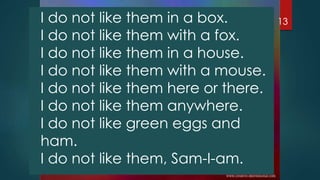
I do not like them in a box.
I do not like them with a fox.
I do not like them in a house.
I do not like them with a mouse.
I do not like them here or there.
I do not like them anywhere.
I do not like green eggs and
ham.
I do not like them, Sam-I-am.
13
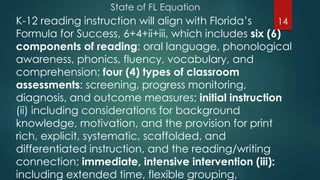
State of FL Equation
K-12 reading instruction will align with Florida’s
Formula for Success, 6+4+ii+iii, which includes six (6)
components of reading: oral language, phonological
awareness, phonics, fluency, vocabulary, and
comprehension; four (4) types of classroom
assessments: screening, progress monitoring,
diagnosis, and outcome measures; initial instruction
(ii) including considerations for background
knowledge, motivation, and the provision for print
rich, explicit, systematic, scaffolded, and
differentiated instruction, and the reading/writing
connection; immediate, intensive intervention (iii):
including extended time, flexible grouping,
14
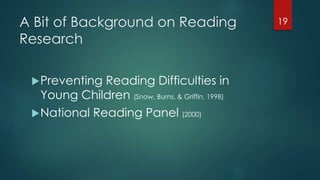
A Bit of Background on Reading
Research
Preventing Reading Difficulties in
Young Children (Snow, Burns, & Griffin. 1998)
National Reading Panel (2000)
19
Six Essential
Components of
Reading
Instruction
20
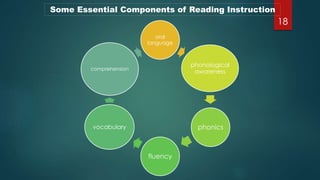
Some Essential Components of Reading Instruction
oral
language
phonological
awareness
phonics
fluency
vocabulary
comprehension
18
Oral
Language
19
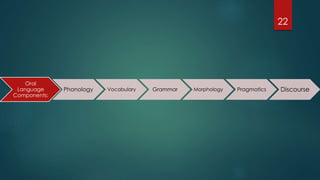
Oral
Language
Components:
Phonology Vocabulary Grammar Morphology Pragmatics Discourse
22
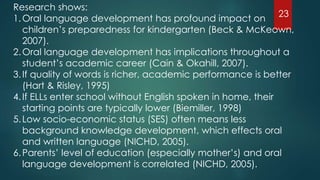
Research shows:
1.Oral language development has profound impact on
children’s preparedness for kindergarten (Beck & McKeown,
2007).
2.Oral language development has implications throughout a
student’s academic career (Cain & Okahill, 2007).
3.If quality of words is richer, academic performance is better
(Hart & Risley, 1995)
4.If ELLs enter school without English spoken in home, their
starting points are typically lower (Biemiller, 1998)
5.Low socio-economic status (SES) often means less
background knowledge development, which effects oral
and written language (NICHD, 2005).
6.Parents’ level of education (especially mother’s) and oral
language development is correlated (NICHD, 2005).
23
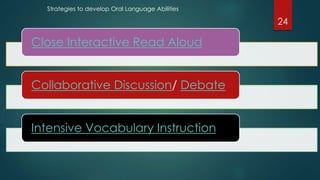
Close Interactive Read Aloud
Collaborative Discussion/ Debate
Intensive Vocabulary Instruction
Strategies to develop Oral Language Abilities
24
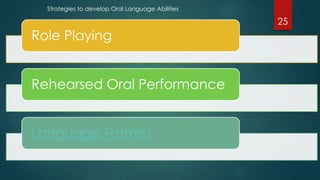
Role Playing
Rehearsed Oral Performance
Language Frames
Strategies to develop Oral Language Abilities
25
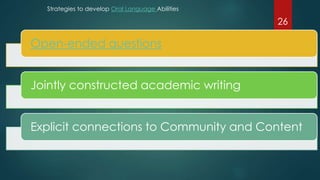
Open-ended questions
Jointly constructed academic writing
Explicit connections to Community and Content
Strategies to develop Oral Language Abilities
26
Phonemic
Awareness
28
Phonemic Awareness (think: auditory)
the ability to hear, identify,
and manipulate individual
sounds in spoken words
the sensitivity to, or explicit
awareness of, sound structure
in words.
can be done in the dark
29
Student with Phonemic Awareness
deficits:
 Unable to hear the difference between sounds such as
short /i/ and /e/.
 Doesn’t enjoy Dr. Seuss, because they just don’t get it
 Can’t do rhyming tasks
 Often mispronounces words by substituting sounds in
words, such as pronouncing “train” as “chrain”
 Can’t blend isolated sounds to make words. I.e. They
may say /c/ /a/ /t/ = “kit”
29
Some research:
 Students could be reliably identified as at risk
for reading failure, if they did poorly on
phonemic awareness tests (Catts, 1991).
 Deficits in phonemic awareness skills
correlated directly to deficits in reading
ability (Ackerman & Dykman, 1993;
Pulakanaho et al., 2008)
 Phonemic awareness skills can be taught
(Byrne & Fielding-Barnsley, 1991).
 Training is successful with older children and
those with a disability (Scott, 1995).
30
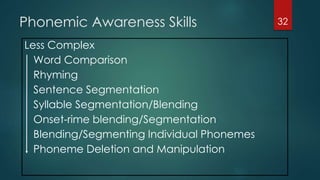
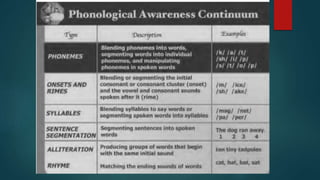
Phonemic Awareness Skills
Less Complex
Word Comparison
Rhyming
Sentence Segmentation
Syllable Segmentation/Blending
Onset-rime blending/Segmentation
Blending/Segmenting Individual Phonemes
Phoneme Deletion and Manipulation
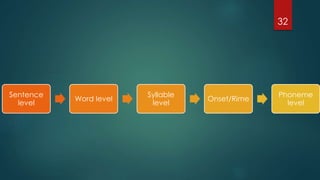
32
Sentence
level
Word level
Syllable
level
Onset/Rime
Phoneme
level
32
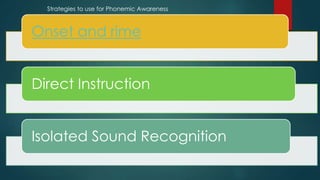
Onset and rime
Direct Instruction
Isolated Sound Recognition
Strategies to use for Phonemic Awareness
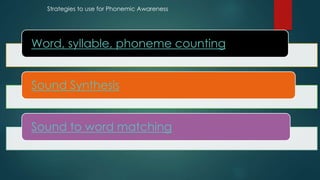
Word, syllable, phoneme counting
Sound Synthesis
Sound to word matching
Strategies to use for Phonemic Awareness
Sound positions
Sound segmentations
Letter-sound associations
Strategies to use for Phonemic Awareness
Word to word matching
Sound deletions
Strategies to use for Phonemic Awareness
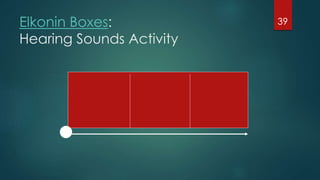
Elkonin Boxes:
Hearing Sounds Activity
39
Phonics
40
“Phonics instruction teaches
children the relationships
between the letters of written
language and the individual
sounds (phonemes) of spoken
language.”
41
The goal [of systematic phonics
instruction] is to enable learners to
acquire sufficient knowledge and use
of the alphabetic code so that they
can make normal progress in learning
to read and comprehend written
language” (National Reading Panel,
2005).
Phonics teaching is a means
to and end. . . Not the end
itself!
43
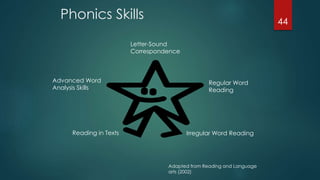
Phonics Skills 44
Letter-Sound
Correspondence
Irregular Word ReadingReading in Texts
Regular Word
Reading
Advanced Word
Analysis Skills
Adapted from Reading and Language
arts (2002)
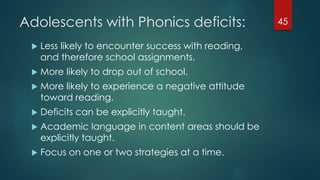
Adolescents with Phonics deficits:
 Less likely to encounter success with reading,
and therefore school assignments.
 More likely to drop out of school.
 More likely to experience a negative attitude
toward reading.
 Deficits can be explicitly taught.
 Academic language in content areas should be
explicitly taught.
 Focus on one or two strategies at a time.
45
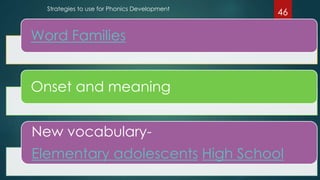
Word Families
Onset and meaning
New vocabulary-
Elementary adolescents High School
Strategies to use for Phonics Development
46
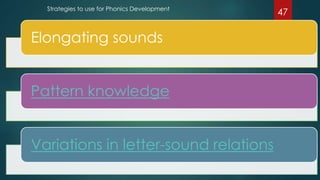
Elongating sounds
Pattern knowledge
Variations in letter-sound relations
Strategies to use for Phonics Development
47
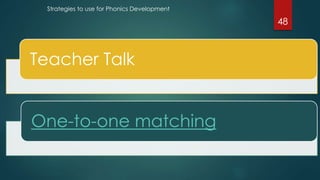
Teacher Talk
One-to-one matching
Strategies to use for Phonics Development
48
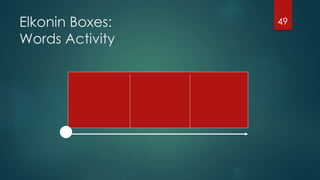
Elkonin Boxes:
Words Activity
49
Fluency
50
The ability to process (surface) and
comprehend (deeper level) text with
speed, accuracy, and expression.
51
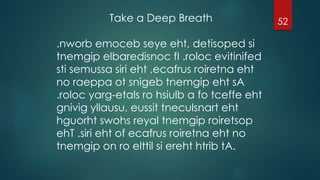
52Take a Deep Breath
.nworb emoceb seye eht, detisoped si
tnemgip elbaredisnoc fI .roloc evitinifed
sti semussa siri eht ,ecafrus roiretna eht
no raeppa ot snigeb tnemgip eht sA
.roloc yarg-etals ro hsiulb a fo tceffe eht
gnivig yllausu, eussit tneculsnart eht
hguorht swohs reyal tnemgip roiretsop
ehT .siri eht of ecafrus roiretna eht no
tnemgip on ro elttil si ereht htrib tA.
Fluency Skills
Automatic recognition of words
Speed
Accuracy
Expression
53
Repeated Reading with a purpose
Guided Oral Reading
Teacher modeling of a Read Aloud –
Interactive read Aloud
55
Strategies to Build Fluency
Shared reading – 4th grade 8th grade
Taped reading
Strategies to Build Fluency
56
Reader’s Theatre- elementary
high school
Vocabulary
56
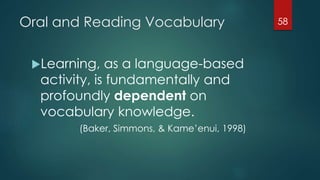
Oral and Reading Vocabulary
Learning, as a language-based
activity, is fundamentally and
profoundly dependent on
vocabulary knowledge.
(Baker, Simmons, & Kame’enui, 1998)
58
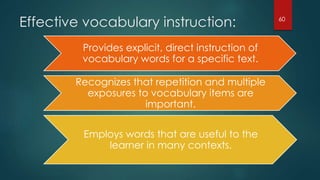
Effective vocabulary instruction:
Provides explicit, direct instruction of
vocabulary words for a specific text.
Recognizes that repetition and multiple
exposures to vocabulary items are
important.
Employs words that are useful to the
learner in many contexts.
60
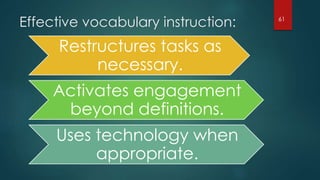
Effective vocabulary instruction:
Restructures tasks as
necessary.
Activates engagement
beyond definitions.
Uses technology when
appropriate.
61
Effective vocabulary instruction:
Wide volume provides
incidental learning.
Uses a variety of
strategies.
62
Strategies to enhance Vocabulary
Word Walls
Read alouds
List-group-label elementary
List-group-label high school
62
Strategies to enhance Vocabulary
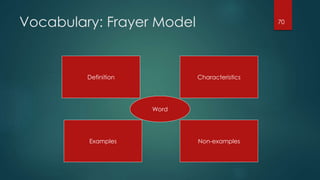
Definition Mapping
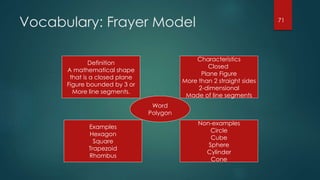
Frayer Model
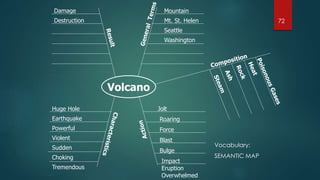
Semantic Map
63
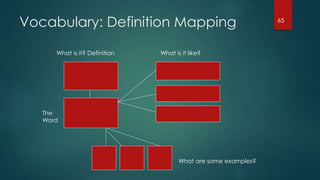
Vocabulary: Definition Mapping
What is it? Definition What is it like?
What are some examples?
The
Word
65
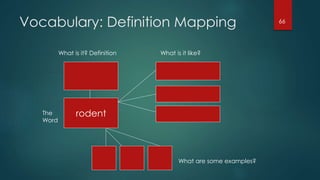
Vocabulary: Definition Mapping
rodent
What is it? Definition What is it like?
What are some examples?
The
Word
66
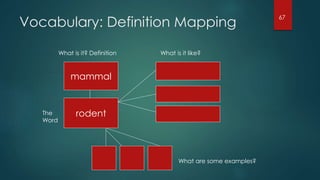
Vocabulary: Definition Mapping
mammal
rodent
What is it? Definition What is it like?
What are some examples?
The
Word
67
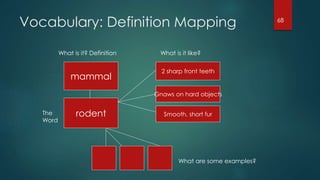
Vocabulary: Definition Mapping
mammal
rodent
2 sharp front teeth
Gnaws on hard objects
Smooth, short fur
What is it? Definition What is it like?
What are some examples?
The
Word
68
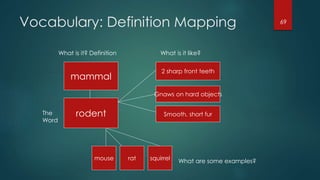
Vocabulary: Definition Mapping
mammal
rodent
2 sharp front teeth
Gnaws on hard objects
Smooth, short fur
mouse rat squirrel
What is it? Definition What is it like?
What are some examples?
The
Word
69
Vocabulary: Frayer Model
Word
Definition
Examples Non-examples
Characteristics
70
Vocabulary: Frayer Model
Word
Polygon
Definition
A mathematical shape
that is a closed plane
Figure bounded by 3 or
More line segments.
Examples
Hexagon
Square
Trapezoid
Rhombus
Non-examples
Circle
Cube
Sphere
Cylinder
Cone
Characteristics
Closed
Plane Figure
More than 2 straight sides
2-dimensional
Made of line segments
71
Volcano
Mountain
Mt. St. Helen
Seattle
Washington
Jolt
Roaring
Force
Blast
Bulge
Impact
Eruption
Overwhelmed
Damage
Destruction
Huge Hole
Earthquake
Powerful
Violent
Sudden
Choking
Tremendous
Vocabulary:
SEMANTIC MAP
72
Comprehension
72
Comprehension
The process of constructing
meaning from written texts, based
on a complex coordination of a
number of interrelated sources of
information.
75
Comprehension Skills
Sentence Structure and Meaning
 Students practice identifying important text elements and
arranging words to make sentences.
Story Structure
 Students practice identifying the sequence of events (beginning,
middle, end) and story grammar (setting, characters, problem,
solution, important events).
Monitoring for Meaning
 Students practice organizing information to gain meaning.
Main Idea/Summarizing
 Students practice stating the main ideas in their own words.
 Students practice summarizing large sections of text.
76
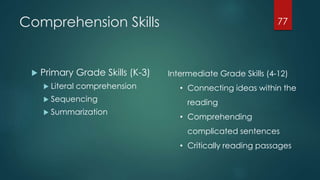
Comprehension Skills
 Primary Grade Skills (K-3)
 Literal comprehension
 Sequencing
 Summarization
77
Intermediate Grade Skills (4-12)
• Connecting ideas within the
reading
• Comprehending
complicated sentences
• Critically reading passages
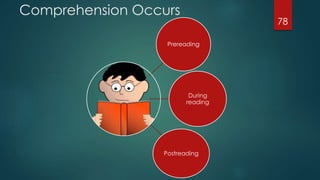
Comprehension Occurs
Prereading
During
reading
Postreading
78
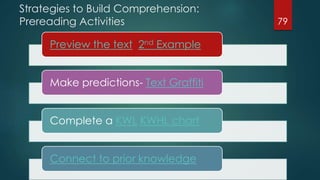
Strategies to Build Comprehension:
Prereading Activities
Preview the text 2nd Example
Make predictions- Text Graffiti
Complete a KWL KWHL chart
Connect to prior knowledge
79
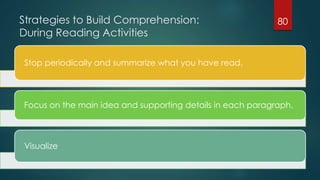
Strategies to Build Comprehension:
During Reading Activities
Stop periodically and summarize what you have read.
Focus on the main idea and supporting details in each paragraph.
Visualize
80
Strategies to Build Comprehension:
After Reading Activities
Delete trivial information; Delete redundant information
Use single category labels to replace a list of smaller items/actions.
Summarize paragraphs
Questioning and Oral Feedback – self monitoring
81
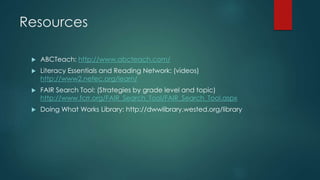
Resources
 ABCTeach: http://www.abcteach.com/
 Literacy Essentials and Reading Network: (videos)
http://www2.nefec.org/learn/
 FAIR Search Tool: (Strategies by grade level and topic)
http://www.fcrr.org/FAIR_Search_Tool/FAIR_Search_Tool.aspx
 Doing What Works Library: http://dwwlibrary.wested.org/library
Reading Beyond the
Script: Engaging
Reading Practices for
Paraprofessionals
DR. SUSAN WEGMANN
THE BAPTIST COLLEGE OF FLORIDA
SJWEGMANN@BAPTISTCOLLEGE.EDU
WWW.SLIDESHARE.NET/SWEGMANN

Updated :Para professional pd reading presentation

  • 1.
    Reading Beyond the Script:Engaging Reading Practices for Paraprofessionals DR. SUSAN WEGMANN THE BAPTIST COLLEGE OF FLORIDA SJWEGMANN@BAPTISTCOLLEGE.EDU WWW.SLIDESHARE.NET/SWEGMANN
  • 4.
    Agenda for theDay 8:00-noon Fundamentals of Reading #1-4 12:00–1:00 Lunch 1:00-3:00 Fundamentals of Reading #5-6 and Application of Learning During presentation, direct questions to www.sli.do and #0707 2
  • 6.
    Reading – Whatis it? What is it not? Why the fuss? Six areas of Reading plus Writing: 1. Oral Language 2. Phonological Awareness 3. Phonics 4. Fluency 5. Vocabulary 6. Comprehension 3
  • 7.
    "Literacy is thestate of being able to participate fully in a to-and-fro interplay between person and text.” Start at the very beginning. . .
  • 8.
    Text – printwritten down, but also text can be seen as the speech created as teachers and students interact Person – the person's interpretation is important To-and-fro interplay –reading is seen as going between the learner and the text, with both informing the other Participate fully – some are left out of literacy events, due to a mismatch in culture, background, language, etc. Being able to – this suggests a level of competence is involved Literacy – commonly defined as being able to read, write, speak, listen, spell
  • 9.
    Louise Rosenblatt’s TransactionTheory (Reader Response theory) stance efferent aesthetic linguistic experiential reservoir evocation A very good place to start. . .
  • 10.
    Readiness to respondin a certain way. In the transaction theory, or reader response theory, there is a spectrum on which all people assume a stance. Stance
  • 11.
  • 12.
    When people readefferently, they are reading for the purpose of a later event. (test, questions, discussion, etc.) Efferent Stance
  • 13.
    This stance ischaracterized by an “in the moment” feel. . . when time escapes you and you are fully enjoying the reading event. Aesthetic Stance
  • 14.
    the accumulation ofall our language and experiences to date. (More than just background knowledge.) Linguistic Experiential Reservoir (LER)
  • 15.
    When the readerand the text come together – a sort of synergy; each evocation is unique. Evocation
  • 16.
    I do notlike them in a box. I do not like them with a fox. I do not like them in a house. I do not like them with a mouse. I do not like them here or there. I do not like them anywhere. I do not like green eggs and ham. I do not like them, Sam-I-am. 13
  • 17.
    State of FLEquation K-12 reading instruction will align with Florida’s Formula for Success, 6+4+ii+iii, which includes six (6) components of reading: oral language, phonological awareness, phonics, fluency, vocabulary, and comprehension; four (4) types of classroom assessments: screening, progress monitoring, diagnosis, and outcome measures; initial instruction (ii) including considerations for background knowledge, motivation, and the provision for print rich, explicit, systematic, scaffolded, and differentiated instruction, and the reading/writing connection; immediate, intensive intervention (iii): including extended time, flexible grouping, 14
  • 19.
    A Bit ofBackground on Reading Research Preventing Reading Difficulties in Young Children (Snow, Burns, & Griffin. 1998) National Reading Panel (2000) 19
  • 20.
  • 21.
    Some Essential Componentsof Reading Instruction oral language phonological awareness phonics fluency vocabulary comprehension 18
  • 22.
  • 23.
  • 24.
    Research shows: 1.Oral languagedevelopment has profound impact on children’s preparedness for kindergarten (Beck & McKeown, 2007). 2.Oral language development has implications throughout a student’s academic career (Cain & Okahill, 2007). 3.If quality of words is richer, academic performance is better (Hart & Risley, 1995) 4.If ELLs enter school without English spoken in home, their starting points are typically lower (Biemiller, 1998) 5.Low socio-economic status (SES) often means less background knowledge development, which effects oral and written language (NICHD, 2005). 6.Parents’ level of education (especially mother’s) and oral language development is correlated (NICHD, 2005). 23
  • 25.
    Close Interactive ReadAloud Collaborative Discussion/ Debate Intensive Vocabulary Instruction Strategies to develop Oral Language Abilities 24
  • 26.
    Role Playing Rehearsed OralPerformance Language Frames Strategies to develop Oral Language Abilities 25
  • 27.
    Open-ended questions Jointly constructedacademic writing Explicit connections to Community and Content Strategies to develop Oral Language Abilities 26
  • 28.
  • 29.
    Phonemic Awareness (think:auditory) the ability to hear, identify, and manipulate individual sounds in spoken words the sensitivity to, or explicit awareness of, sound structure in words. can be done in the dark 29
  • 30.
    Student with PhonemicAwareness deficits:  Unable to hear the difference between sounds such as short /i/ and /e/.  Doesn’t enjoy Dr. Seuss, because they just don’t get it  Can’t do rhyming tasks  Often mispronounces words by substituting sounds in words, such as pronouncing “train” as “chrain”  Can’t blend isolated sounds to make words. I.e. They may say /c/ /a/ /t/ = “kit” 29
  • 31.
    Some research:  Studentscould be reliably identified as at risk for reading failure, if they did poorly on phonemic awareness tests (Catts, 1991).  Deficits in phonemic awareness skills correlated directly to deficits in reading ability (Ackerman & Dykman, 1993; Pulakanaho et al., 2008)  Phonemic awareness skills can be taught (Byrne & Fielding-Barnsley, 1991).  Training is successful with older children and those with a disability (Scott, 1995). 30
  • 32.
    Phonemic Awareness Skills LessComplex Word Comparison Rhyming Sentence Segmentation Syllable Segmentation/Blending Onset-rime blending/Segmentation Blending/Segmenting Individual Phonemes Phoneme Deletion and Manipulation 32
  • 33.
  • 35.
    Onset and rime DirectInstruction Isolated Sound Recognition Strategies to use for Phonemic Awareness
  • 36.
    Word, syllable, phonemecounting Sound Synthesis Sound to word matching Strategies to use for Phonemic Awareness
  • 37.
    Sound positions Sound segmentations Letter-soundassociations Strategies to use for Phonemic Awareness
  • 38.
    Word to wordmatching Sound deletions Strategies to use for Phonemic Awareness
  • 39.
  • 40.
  • 41.
    “Phonics instruction teaches childrenthe relationships between the letters of written language and the individual sounds (phonemes) of spoken language.” 41
  • 42.
    The goal [ofsystematic phonics instruction] is to enable learners to acquire sufficient knowledge and use of the alphabetic code so that they can make normal progress in learning to read and comprehend written language” (National Reading Panel, 2005).
  • 43.
    Phonics teaching isa means to and end. . . Not the end itself! 43
  • 44.
    Phonics Skills 44 Letter-Sound Correspondence IrregularWord ReadingReading in Texts Regular Word Reading Advanced Word Analysis Skills Adapted from Reading and Language arts (2002)
  • 45.
    Adolescents with Phonicsdeficits:  Less likely to encounter success with reading, and therefore school assignments.  More likely to drop out of school.  More likely to experience a negative attitude toward reading.  Deficits can be explicitly taught.  Academic language in content areas should be explicitly taught.  Focus on one or two strategies at a time. 45
  • 46.
    Word Families Onset andmeaning New vocabulary- Elementary adolescents High School Strategies to use for Phonics Development 46
  • 47.
    Elongating sounds Pattern knowledge Variationsin letter-sound relations Strategies to use for Phonics Development 47
  • 48.
    Teacher Talk One-to-one matching Strategiesto use for Phonics Development 48
  • 49.
  • 50.
  • 51.
    The ability toprocess (surface) and comprehend (deeper level) text with speed, accuracy, and expression. 51
  • 52.
    52Take a DeepBreath .nworb emoceb seye eht, detisoped si tnemgip elbaredisnoc fI .roloc evitinifed sti semussa siri eht ,ecafrus roiretna eht no raeppa ot snigeb tnemgip eht sA .roloc yarg-etals ro hsiulb a fo tceffe eht gnivig yllausu, eussit tneculsnart eht hguorht swohs reyal tnemgip roiretsop ehT .siri eht of ecafrus roiretna eht no tnemgip on ro elttil si ereht htrib tA.
  • 53.
    Fluency Skills Automatic recognitionof words Speed Accuracy Expression 53
  • 54.
    Repeated Reading witha purpose Guided Oral Reading Teacher modeling of a Read Aloud – Interactive read Aloud 55 Strategies to Build Fluency
  • 55.
    Shared reading –4th grade 8th grade Taped reading Strategies to Build Fluency 56 Reader’s Theatre- elementary high school
  • 56.
  • 58.
    Oral and ReadingVocabulary Learning, as a language-based activity, is fundamentally and profoundly dependent on vocabulary knowledge. (Baker, Simmons, & Kame’enui, 1998) 58
  • 59.
    Effective vocabulary instruction: Providesexplicit, direct instruction of vocabulary words for a specific text. Recognizes that repetition and multiple exposures to vocabulary items are important. Employs words that are useful to the learner in many contexts. 60
  • 60.
    Effective vocabulary instruction: Restructurestasks as necessary. Activates engagement beyond definitions. Uses technology when appropriate. 61
  • 61.
    Effective vocabulary instruction: Widevolume provides incidental learning. Uses a variety of strategies. 62
  • 62.
    Strategies to enhanceVocabulary Word Walls Read alouds List-group-label elementary List-group-label high school 62
  • 63.
    Strategies to enhanceVocabulary Definition Mapping Frayer Model Semantic Map 63
  • 64.
    Vocabulary: Definition Mapping Whatis it? Definition What is it like? What are some examples? The Word 65
  • 65.
    Vocabulary: Definition Mapping rodent Whatis it? Definition What is it like? What are some examples? The Word 66
  • 66.
    Vocabulary: Definition Mapping mammal rodent Whatis it? Definition What is it like? What are some examples? The Word 67
  • 67.
    Vocabulary: Definition Mapping mammal rodent 2sharp front teeth Gnaws on hard objects Smooth, short fur What is it? Definition What is it like? What are some examples? The Word 68
  • 68.
    Vocabulary: Definition Mapping mammal rodent 2sharp front teeth Gnaws on hard objects Smooth, short fur mouse rat squirrel What is it? Definition What is it like? What are some examples? The Word 69
  • 69.
  • 70.
    Vocabulary: Frayer Model Word Polygon Definition Amathematical shape that is a closed plane Figure bounded by 3 or More line segments. Examples Hexagon Square Trapezoid Rhombus Non-examples Circle Cube Sphere Cylinder Cone Characteristics Closed Plane Figure More than 2 straight sides 2-dimensional Made of line segments 71
  • 71.
  • 72.
  • 75.
    Comprehension The process ofconstructing meaning from written texts, based on a complex coordination of a number of interrelated sources of information. 75
  • 76.
    Comprehension Skills Sentence Structureand Meaning  Students practice identifying important text elements and arranging words to make sentences. Story Structure  Students practice identifying the sequence of events (beginning, middle, end) and story grammar (setting, characters, problem, solution, important events). Monitoring for Meaning  Students practice organizing information to gain meaning. Main Idea/Summarizing  Students practice stating the main ideas in their own words.  Students practice summarizing large sections of text. 76
  • 77.
    Comprehension Skills  PrimaryGrade Skills (K-3)  Literal comprehension  Sequencing  Summarization 77 Intermediate Grade Skills (4-12) • Connecting ideas within the reading • Comprehending complicated sentences • Critically reading passages
  • 78.
  • 79.
    Strategies to BuildComprehension: Prereading Activities Preview the text 2nd Example Make predictions- Text Graffiti Complete a KWL KWHL chart Connect to prior knowledge 79
  • 80.
    Strategies to BuildComprehension: During Reading Activities Stop periodically and summarize what you have read. Focus on the main idea and supporting details in each paragraph. Visualize 80
  • 81.
    Strategies to BuildComprehension: After Reading Activities Delete trivial information; Delete redundant information Use single category labels to replace a list of smaller items/actions. Summarize paragraphs Questioning and Oral Feedback – self monitoring 81
  • 83.
    Resources  ABCTeach: http://www.abcteach.com/ Literacy Essentials and Reading Network: (videos) http://www2.nefec.org/learn/  FAIR Search Tool: (Strategies by grade level and topic) http://www.fcrr.org/FAIR_Search_Tool/FAIR_Search_Tool.aspx  Doing What Works Library: http://dwwlibrary.wested.org/library
  • 84.
    Reading Beyond the Script:Engaging Reading Practices for Paraprofessionals DR. SUSAN WEGMANN THE BAPTIST COLLEGE OF FLORIDA SJWEGMANN@BAPTISTCOLLEGE.EDU WWW.SLIDESHARE.NET/SWEGMANN