


Florida Teacher Certification Examinations

Test Information Guide

General Knowledge Test

FLORIDA DEPARTMENT OF EDUCATION
http://www.fldoe.org

Second Edition
Developed, produced, and printed under the authority of the
Florida Department of Education

Authorization for reproduction of this document is hereby granted to persons acting in an official
capacity within the Florida K-20 education system, as enumerated in Section 1000.04, Florida
Statutes.
Permission is NOT granted for distribution or reproduction outside the State system of public
education or for commercial distribution of the copyrighted materials without written
authorization from the Department of Education. Questions regarding use of these copyrighted
materials are to be addressed to:
FTCE Administrator
Florida Department of Education
325 West Gaines Street, Suite 414
Tallahassee, Florida 32399-0400
Copyright 2008
State of Florida
Department of State
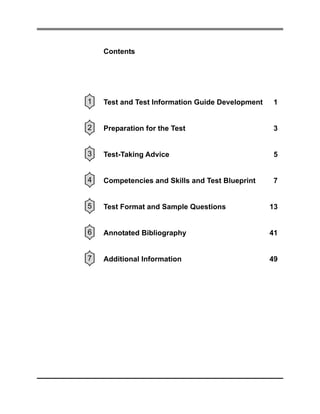
Contents

1

Test and Test Information Guide Development

1

2

Preparation for the Test

3

3

Test-Taking Advice

5

4

Competencies and Skills and Test Blueprint

7

5

Test Format and Sample Questions

13

6

Annotated Bibliography

41

7

Additional Information

49
This page intentionally left blank.
1

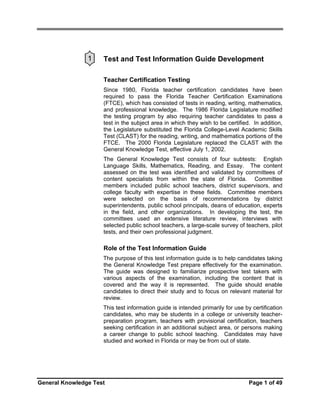
Test and Test Information Guide Development
Teacher Certification Testing
Since 1980, Florida teacher certification candidates have been
required to pass the Florida Teacher Certification Examinations
(FTCE), which has consisted of tests in reading, writing, mathematics,
and professional knowledge. The 1986 Florida Legislature modified
the testing program by also requiring teacher candidates to pass a
test in the subject area in which they wish to be certified. In addition,
the Legislature substituted the Florida College-Level Academic Skills
Test (CLAST) for the reading, writing, and mathematics portions of the
FTCE. The 2000 Florida Legislature replaced the CLAST with the
General Knowledge Test, effective July 1, 2002.
The General Knowledge Test consists of four subtests: English
Language Skills, Mathematics, Reading, and Essay. The content
assessed on the test was identified and validated by committees of
content specialists from within the state of Florida. Committee
members included public school teachers, district supervisors, and
college faculty with expertise in these fields. Committee members
were selected on the basis of recommendations by district
superintendents, public school principals, deans of education, experts
in the field, and other organizations. In developing the test, the
committees used an extensive literature review, interviews with
selected public school teachers, a large-scale survey of teachers, pilot
tests, and their own professional judgment.

Role of the Test Information Guide
The purpose of this test information guide is to help candidates taking
the General Knowledge Test prepare effectively for the examination.
The guide was designed to familiarize prospective test takers with
various aspects of the examination, including the content that is
covered and the way it is represented. The guide should enable
candidates to direct their study and to focus on relevant material for
review.
This test information guide is intended primarily for use by certification
candidates, who may be students in a college or university teacherpreparation program, teachers with provisional certification, teachers
seeking certification in an additional subject area, or persons making
a career change to public school teaching. Candidates may have
studied and worked in Florida or may be from out of state.

General Knowledge Test

Page 1 of 49
College or university faculty may also use the guide to prepare
students for certification, and inservice trainers may find the guide
useful for helping previously certified teachers prepare for
recertification or multiple certification.
This test information guide is not intended as an all-inclusive source of
subject area knowledge, nor is it a substitute for college course work
in the subject area. The sample questions are representative of the
content of the actual test; however, they are not actual test questions
from an actual test form. Instead, the guide is intended to help
candidates prepare for the subject area test by presenting an
overview of the content and format of the examination.

Page 2 of 49

General Knowledge Test
2

Preparation for the Test
The following outline may help you to prepare for the examination.
Adapt these suggestions to suit your own study habits and the time
you have available for review.

Overview
•

Look over the organization of the test information guide.
Section 1 discusses the development of the test and test
information guide.
Section 2 (this section) outlines test preparation steps.
Section 3 offers strategies for taking the test.
Section 4 presents information about the content and structure of
the test.
Section 5 lists question formats and includes sample test
questions.
Section 6 provides an annotated bibliography of general
references you may find useful in your review.
Section 7 identifies a source of further information.

Self-Assessment
•

Decide which content areas you should review.
Section 4 includes the competencies and skills used to develop
this subject area test and the approximate proportion of test
questions from each competency area.

Review
•

Study according to your needs.
Review all of the competencies and concentrate on areas with
which you are least familiar.

Practice
•

Acquaint yourself with the format of the examination.
Section 5 describes types of questions you may find on the
examination.

•

Answer sample test questions.
Section 5 gives you an opportunity to test yourself with sample
test questions and provides an answer key and information
regarding the competency to which each question is linked.

General Knowledge Test

Page 3 of 49
Final preparation
•

Review test-taking advice.
Section 3 includes suggestions for improving your performance on
the examination.

•

Refer to field-specific references.
Section 6 includes an annotated bibliography listing general
references keyed to the competencies and skills used to develop
this subject area test.

Page 4 of 49

General Knowledge Test
3

Test-Taking Advice
•

Go into the examination prepared, alert, and well rested.

•

Complete your travel arrangements prior to the examination date.
Plan to arrive early so that you can locate the parking facilities and
examination room without rushing.

•

Dress comfortably and bring a sweater or jacket in case the room
is too cool.

•

Take the following with you to the test site:
— Admission ticket
— Proper identification as described in "Identification Policy"
— Watch

•

There are many strategies for taking a test and different
techniques for dealing with different types of questions.
Nevertheless, you may find the following general suggestions
useful.
— Read each question and all the response options carefully
before selecting your answer. Pay attention to all of the
details.
— Go through the entire test once and answer all the questions
you are reasonably certain about. Then go back and tackle
the questions that require more thought.
— When you are not certain of the right answer, eliminate as
many options as you can and choose the response that
seems best. It is to your advantage to answer all the
questions on the test, even if you are uncertain about some of
your choices.
— After completing the examination, go back and check every
question. Verify that you have answered all of the questions
and that your responses are correctly entered.

General Knowledge Test

Page 5 of 49
This page intentionally left blank.

Page 6 of 49

General Knowledge Test
4

Competencies and Skills and Test Blueprint
The table on the following pages lists the competencies and skills
used as the basis for the General Knowledge Test.
These
competencies and skills represent the knowledge that teams of
teachers, subject area specialists, and district-level educators have
determined to be important for beginning teachers. This table could
serve as a checklist for assessing your familiarity with each of the
areas covered by the test. The competencies and skills should help
you organize your review.
The test blueprint indicates the
approximate number of test questions that will cover the specific
competency on the exam.
Competencies are broad areas of content knowledge.
Skills identify specific behaviors that demonstrate the competencies.
Approximate number of questions indicates the approximate
number of test questions that represent the competencies on the test.
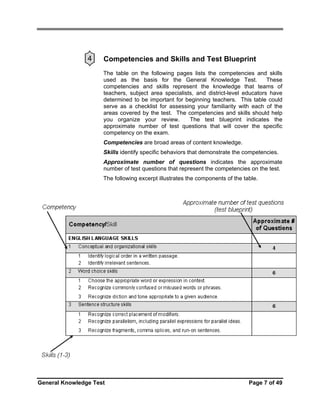
The following excerpt illustrates the components of the table.

General Knowledge Test

Page 7 of 49
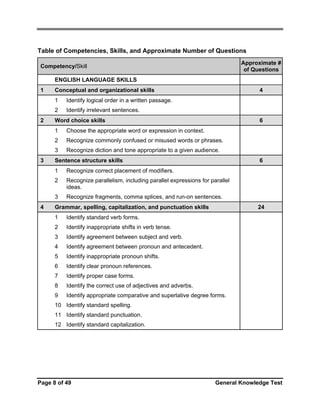
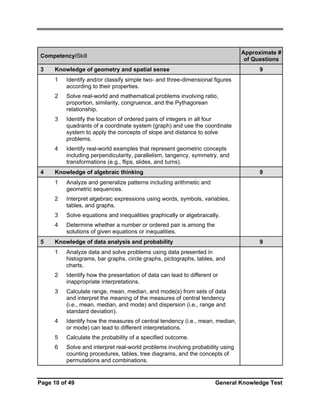
Table of Competencies, Skills, and Approximate Number of Questions
Approximate #
of Questions

Competency/Skill
ENGLISH LANGUAGE SKILLS
1

Conceptual and organizational skills
1

2

Identify logical order in a written passage.

2

4

Identify irrelevant sentences.

Word choice skills

6

1
2

Recognize commonly confused or misused words or phrases.

3
3

Choose the appropriate word or expression in context.
Recognize diction and tone appropriate to a given audience.

Sentence structure skills

6

1
2

Recognize parallelism, including parallel expressions for parallel
ideas.

3
4

Recognize correct placement of modifiers.

Recognize fragments, comma splices, and run-on sentences.

Grammar, spelling, capitalization, and punctuation skills

24

1

Identify standard verb forms.

2

Identify inappropriate shifts in verb tense.

3

Identify agreement between subject and verb.

4

Identify agreement between pronoun and antecedent.

5

Identify inappropriate pronoun shifts.

6

Identify clear pronoun references.

7

Identify proper case forms.

8

Identify the correct use of adjectives and adverbs.

9

Identify appropriate comparative and superlative degree forms.

10 Identify standard spelling.
11 Identify standard punctuation.
12 Identify standard capitalization.

Page 8 of 49

General Knowledge Test
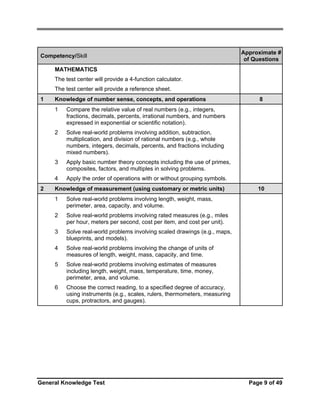
Competency/Skill

Approximate #
of Questions

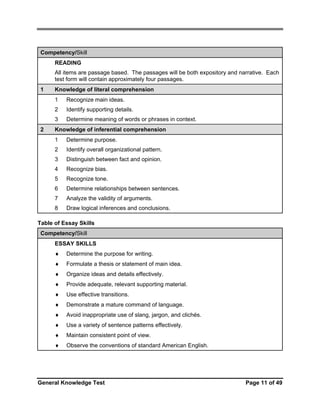
MATHEMATICS
The test center will provide a 4-function calculator.
The test center will provide a reference sheet.
1

Knowledge of number sense, concepts, and operations
1

Solve real-world problems involving addition, subtraction,
multiplication, and division of rational numbers (e.g., whole
numbers, integers, decimals, percents, and fractions including
mixed numbers).

3

Apply basic number theory concepts including the use of primes,
composites, factors, and multiples in solving problems.

4
2

Compare the relative value of real numbers (e.g., integers,
fractions, decimals, percents, irrational numbers, and numbers
expressed in exponential or scientific notation).

2

8

Apply the order of operations with or without grouping symbols.

Knowledge of measurement (using customary or metric units)
1

Solve real-world problems involving length, weight, mass,
perimeter, area, capacity, and volume.

2

Solve real-world problems involving rated measures (e.g., miles
per hour, meters per second, cost per item, and cost per unit).

3

Solve real-world problems involving scaled drawings (e.g., maps,
blueprints, and models).

4

Solve real-world problems involving the change of units of
measures of length, weight, mass, capacity, and time.

5

Solve real-world problems involving estimates of measures
including length, weight, mass, temperature, time, money,
perimeter, area, and volume.

6

10

Choose the correct reading, to a specified degree of accuracy,
using instruments (e.g., scales, rulers, thermometers, measuring
cups, protractors, and gauges).

General Knowledge Test

Page 9 of 49
Approximate #
of Questions

Competency/Skill
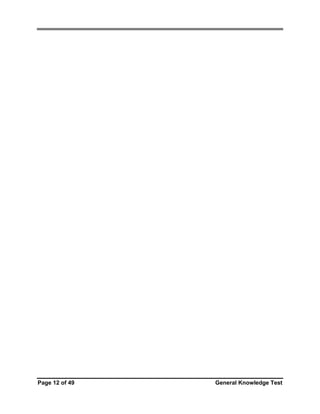
3

Knowledge of geometry and spatial sense

9

1
2

Solve real-world and mathematical problems involving ratio,
proportion, similarity, congruence, and the Pythagorean
relationship.

3

Identify the location of ordered pairs of integers in all four
quadrants of a coordinate system (graph) and use the coordinate
system to apply the concepts of slope and distance to solve
problems.

4

4

Identify and/or classify simple two- and three-dimensional figures
according to their properties.

Identify real-world examples that represent geometric concepts
including perpendicularity, parallelism, tangency, symmetry, and
transformations (e.g., flips, slides, and turns).

Knowledge of algebraic thinking

9

1
2

Interpret algebraic expressions using words, symbols, variables,
tables, and graphs.

3

Solve equations and inequalities graphically or algebraically.

4
5

Analyze and generalize patterns including arithmetic and
geometric sequences.

Determine whether a number or ordered pair is among the
solutions of given equations or inequalities.

Knowledge of data analysis and probability

9

1

Analyze data and solve problems using data presented in
histograms, bar graphs, circle graphs, pictographs, tables, and
charts.

2

Identify how the presentation of data can lead to different or
inappropriate interpretations.

3

Calculate range, mean, median, and mode(s) from sets of data
and interpret the meaning of the measures of central tendency
(i.e., mean, median, and mode) and dispersion (i.e., range and
standard deviation).

4

Identify how the measures of central tendency (i.e., mean, median,
or mode) can lead to different interpretations.

5

Calculate the probability of a specified outcome.

6

Solve and interpret real-world problems involving probability using
counting procedures, tables, tree diagrams, and the concepts of
permutations and combinations.

Page 10 of 49

General Knowledge Test
Competency/Skill
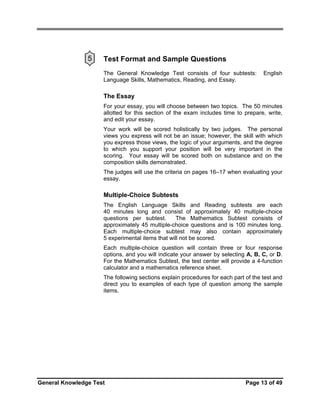
READING
All items are passage based. The passages will be both expository and narrative. Each
test form will contain approximately four passages.
1

Knowledge of literal comprehension
1
2

Identify supporting details.

3
2

Recognize main ideas.
Determine meaning of words or phrases in context.

Knowledge of inferential comprehension
1

Determine purpose.

2

Identify overall organizational pattern.

3

Distinguish between fact and opinion.

4

Recognize bias.

5

Recognize tone.

6

Determine relationships between sentences.

7

Analyze the validity of arguments.

8

Draw logical inferences and conclusions.

Table of Essay Skills
Competency/Skill
ESSAY SKILLS
♦

Determine the purpose for writing.

♦

Formulate a thesis or statement of main idea.

♦

Organize ideas and details effectively.

♦

Provide adequate, relevant supporting material.

♦

Use effective transitions.

♦

Demonstrate a mature command of language.

♦

Avoid inappropriate use of slang, jargon, and clichés.

♦

Use a variety of sentence patterns effectively.

♦

Maintain consistent point of view.

♦

Observe the conventions of standard American English.

General Knowledge Test

Page 11 of 49
This page intentionally left blank

Page 12 of 49

General Knowledge Test
5

Test Format and Sample Questions
The General Knowledge Test consists of four subtests:
Language Skills, Mathematics, Reading, and Essay.

English

The Essay
For your essay, you will choose between two topics. The 50 minutes
allotted for this section of the exam includes time to prepare, write,
and edit your essay.
Your work will be scored holistically by two judges. The personal
views you express will not be an issue; however, the skill with which
you express those views, the logic of your arguments, and the degree
to which you support your position will be very important in the
scoring. Your essay will be scored both on substance and on the
composition skills demonstrated.
The judges will use the criteria on pages 16–17 when evaluating your
essay.

Multiple-Choice Subtests
The English Language Skills and Reading subtests are each
40 minutes long and consist of approximately 40 multiple-choice
questions per subtest.
The Mathematics Subtest consists of
approximately 45 multiple-choice questions and is 100 minutes long.
Each multiple-choice subtest may also contain approximately
5 experimental items that will not be scored.
Each multiple-choice question will contain three or four response
options, and you will indicate your answer by selecting A, B, C, or D.
For the Mathematics Subtest, the test center will provide a 4-function
calculator and a mathematics reference sheet.
The following sections explain procedures for each part of the test and
direct you to examples of each type of question among the sample
items.

General Knowledge Test

Page 13 of 49
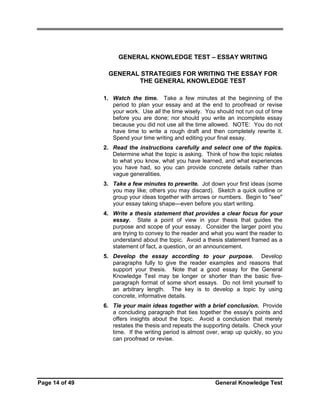
GENERAL KNOWLEDGE TEST – ESSAY WRITING
GENERAL STRATEGIES FOR WRITING THE ESSAY FOR
THE GENERAL KNOWLEDGE TEST
1. Watch the time. Take a few minutes at the beginning of the
period to plan your essay and at the end to proofread or revise
your work. Use all the time wisely. You should not run out of time
before you are done; nor should you write an incomplete essay
because you did not use all the time allowed. NOTE: You do not
have time to write a rough draft and then completely rewrite it.
Spend your time writing and editing your final essay.
2. Read the instructions carefully and select one of the topics.
Determine what the topic is asking. Think of how the topic relates
to what you know, what you have learned, and what experiences
you have had, so you can provide concrete details rather than
vague generalities.
3. Take a few minutes to prewrite. Jot down your first ideas (some
you may like; others you may discard). Sketch a quick outline or
group your ideas together with arrows or numbers. Begin to "see"
your essay taking shape—even before you start writing.
4. Write a thesis statement that provides a clear focus for your
essay. State a point of view in your thesis that guides the
purpose and scope of your essay. Consider the larger point you
are trying to convey to the reader and what you want the reader to
understand about the topic. Avoid a thesis statement framed as a
statement of fact, a question, or an announcement.
5. Develop the essay according to your purpose. Develop
paragraphs fully to give the reader examples and reasons that
support your thesis. Note that a good essay for the General
Knowledge Test may be longer or shorter than the basic fiveparagraph format of some short essays. Do not limit yourself to
an arbitrary length. The key is to develop a topic by using
concrete, informative details.
6. Tie your main ideas together with a brief conclusion. Provide
a concluding paragraph that ties together the essay's points and
offers insights about the topic. Avoid a conclusion that merely
restates the thesis and repeats the supporting details. Check your
time. If the writing period is almost over, wrap up quickly, so you
can proofread or revise.

Page 14 of 49

General Knowledge Test
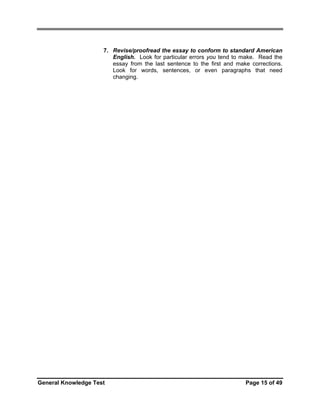
7. Revise/proofread the essay to conform to standard American
English. Look for particular errors you tend to make. Read the
essay from the last sentence to the first and make corrections.
Look for words, sentences, or even paragraphs that need
changing.

General Knowledge Test

Page 15 of 49
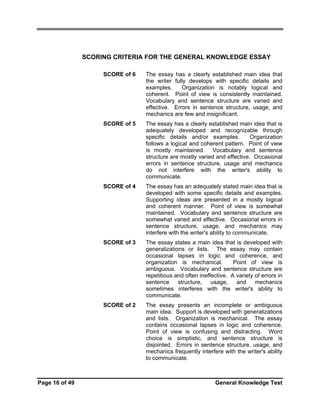
SCORING CRITERIA FOR THE GENERAL KNOWLEDGE ESSAY
SCORE of 6

SCORE of 5

The essay has a clearly established main idea that is
adequately developed and recognizable through
specific details and/or examples.
Organization
follows a logical and coherent pattern. Point of view
is mostly maintained. Vocabulary and sentence
structure are mostly varied and effective. Occasional
errors in sentence structure, usage and mechanics
do not interfere with the writer's ability to
communicate.

SCORE of 4

The essay has an adequately stated main idea that is
developed with some specific details and examples.
Supporting ideas are presented in a mostly logical
and coherent manner. Point of view is somewhat
maintained. Vocabulary and sentence structure are
somewhat varied and effective. Occasional errors in
sentence structure, usage, and mechanics may
interfere with the writer's ability to communicate.

SCORE of 3

The essay states a main idea that is developed with
generalizations or lists. The essay may contain
occasional lapses in logic and coherence, and
organization is mechanical.
Point of view is
ambiguous. Vocabulary and sentence structure are
repetitious and often ineffective. A variety of errors in
sentence
structure,
usage,
and
mechanics
sometimes interferes with the writer's ability to
communicate.

SCORE of 2

Page 16 of 49

The essay has a clearly established main idea that
the writer fully develops with specific details and
examples.
Organization is notably logical and
coherent. Point of view is consistently maintained.
Vocabulary and sentence structure are varied and
effective. Errors in sentence structure, usage, and
mechanics are few and insignificant.

The essay presents an incomplete or ambiguous
main idea. Support is developed with generalizations
and lists. Organization is mechanical. The essay
contains occasional lapses in logic and coherence.
Point of view is confusing and distracting. Word
choice is simplistic, and sentence structure is
disjointed. Errors in sentence structure, usage, and
mechanics frequently interfere with the writer's ability
to communicate.

General Knowledge Test
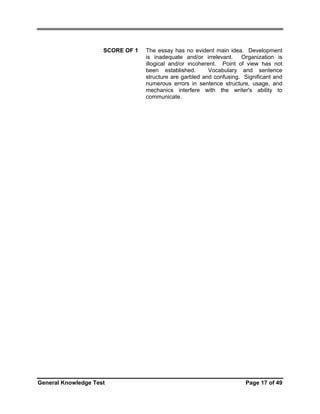
SCORE OF 1

General Knowledge Test

The essay has no evident main idea. Development
is inadequate and/or irrelevant. Organization is
illogical and/or incoherent. Point of view has not
been established.
Vocabulary and sentence
structure are garbled and confusing. Significant and
numerous errors in sentence structure, usage, and
mechanics interfere with the writer's ability to
communicate.

Page 17 of 49
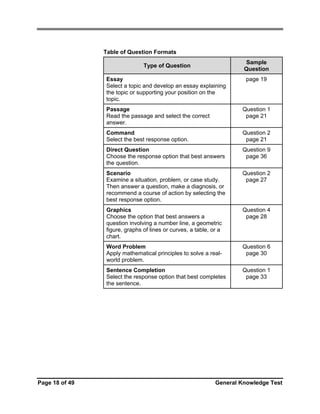
Table of Question Formats
Sample
Question

Type of Question
Essay
Select a topic and develop an essay explaining
the topic or supporting your position on the
topic.

page 19

Passage
Read the passage and select the correct
answer.
Command
Select the best response option.

Question 2
page 21

Direct Question
Choose the response option that best answers
the question.

Question 9
page 36

Scenario
Examine a situation, problem, or case study.
Then answer a question, make a diagnosis, or
recommend a course of action by selecting the
best response option.

Question 2
page 27

Graphics
Choose the option that best answers a
question involving a number line, a geometric
figure, graphs of lines or curves, a table, or a
chart.

Question 4
page 28

Word Problem
Apply mathematical principles to solve a realworld problem.

Question 6
page 30

Sentence Completion
Select the response option that best completes
the sentence.

Page 18 of 49

Question 1
page 21

Question 1
page 33

General Knowledge Test
Sample Questions
The following questions represent both the form and content of
questions on the examination. These questions will acquaint you with
the general format of the examination; however, these sample
questions do not cover all of the competencies and skills that are
tested and will only approximate the degree of examination difficulty.
Answer keys for the multiple-choice questions follow at the end of the
sample questions. The answer keys include information regarding the
competency to which each question is linked.

General Knowledge Test

Page 19 of 49
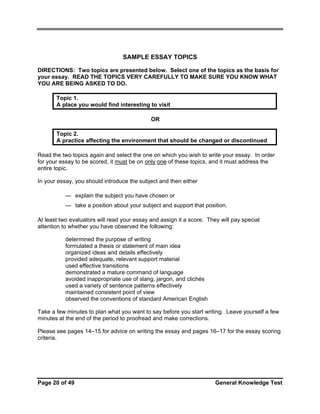
SAMPLE ESSAY TOPICS
DIRECTIONS: Two topics are presented below. Select one of the topics as the basis for
your essay. READ THE TOPICS VERY CAREFULLY TO MAKE SURE YOU KNOW WHAT
YOU ARE BEING ASKED TO DO.
Topic 1.
A place you would find interesting to visit
OR
Topic 2.
A practice affecting the environment that should be changed or discontinued
Read the two topics again and select the one on which you wish to write your essay. In order
for your essay to be scored, it must be on only one of these topics, and it must address the
entire topic.
In your essay, you should introduce the subject and then either
— explain the subject you have chosen or
— take a position about your subject and support that position.
At least two evaluators will read your essay and assign it a score. They will pay special
attention to whether you have observed the following:
•
•
•
•
•
•
•
•
•
•

determined the purpose of writing
formulated a thesis or statement of main idea
organized ideas and details effectively
provided adequate, relevant support material
used effective transitions
demonstrated a mature command of language
avoided inappropriate use of slang, jargon, and clichés
used a variety of sentence patterns effectively
maintained consistent point of view
observed the conventions of standard American English

Take a few minutes to plan what you want to say before you start writing. Leave yourself a few
minutes at the end of the period to proofread and make corrections.
Please see pages 14–15 for advice on writing the essay and pages 16–17 for the essay scoring
criteria.

Page 20 of 49

General Knowledge Test
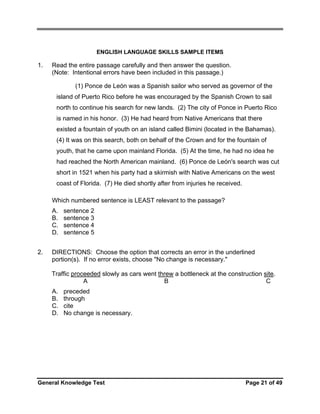
ENGLISH LANGUAGE SKILLS SAMPLE ITEMS

1.

Read the entire passage carefully and then answer the question.
(Note: Intentional errors have been included in this passage.)
(1) Ponce de León was a Spanish sailor who served as governor of the
island of Puerto Rico before he was encouraged by the Spanish Crown to sail
north to continue his search for new lands. (2) The city of Ponce in Puerto Rico
is named in his honor. (3) He had heard from Native Americans that there
existed a fountain of youth on an island called Bimini (located in the Bahamas).
(4) It was on this search, both on behalf of the Crown and for the fountain of
youth, that he came upon mainland Florida. (5) At the time, he had no idea he
had reached the North American mainland. (6) Ponce de León's search was cut
short in 1521 when his party had a skirmish with Native Americans on the west
coast of Florida. (7) He died shortly after from injuries he received.
Which numbered sentence is LEAST relevant to the passage?
A.
B.
C.
D.

2.

sentence 2
sentence 3
sentence 4
sentence 5

DIRECTIONS: Choose the option that corrects an error in the underlined
portion(s). If no error exists, choose "No change is necessary."
Traffic proceeded slowly as cars went threw a bottleneck at the construction site.
A
B
C
A.
B.
C.
D.

preceded
through
cite
No change is necessary.

General Knowledge Test

Page 21 of 49
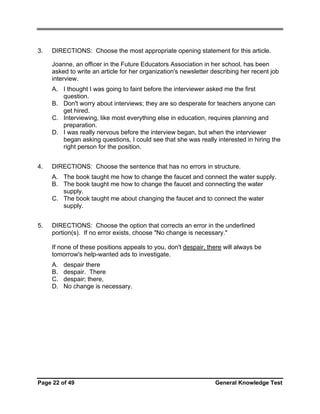
3.

DIRECTIONS: Choose the most appropriate opening statement for this article.
Joanne, an officer in the Future Educators Association in her school, has been
asked to write an article for her organization's newsletter describing her recent job
interview.
A. I thought I was going to faint before the interviewer asked me the first
question.
B. Don't worry about interviews; they are so desperate for teachers anyone can
get hired.
C. Interviewing, like most everything else in education, requires planning and
preparation.
D. I was really nervous before the interview began, but when the interviewer
began asking questions, I could see that she was really interested in hiring the
right person for the position.

4.

DIRECTIONS: Choose the sentence that has no errors in structure.
A. The book taught me how to change the faucet and connect the water supply.
B. The book taught me how to change the faucet and connecting the water
supply.
C. The book taught me about changing the faucet and to connect the water
supply.

5.

DIRECTIONS: Choose the option that corrects an error in the underlined
portion(s). If no error exists, choose "No change is necessary."
If none of these positions appeals to you, don't despair, there will always be
tomorrow's help-wanted ads to investigate.
A.
B.
C.
D.

despair there
despair. There
despair; there,
No change is necessary.

Page 22 of 49

General Knowledge Test
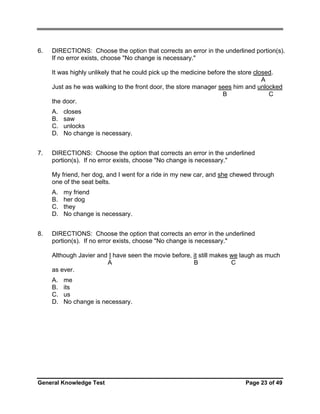
6.

DIRECTIONS: Choose the option that corrects an error in the underlined portion(s).
If no error exists, choose "No change is necessary."
It was highly unlikely that he could pick up the medicine before the store closed.
A
Just as he was walking to the front door, the store manager sees him and unlocked
B
C
the door.
A.
B.
C.
D.

7.

closes
saw
unlocks
No change is necessary.

DIRECTIONS: Choose the option that corrects an error in the underlined
portion(s). If no error exists, choose "No change is necessary."
My friend, her dog, and I went for a ride in my new car, and she chewed through
one of the seat belts.
A.
B.
C.
D.

8.

my friend
her dog
they
No change is necessary.

DIRECTIONS: Choose the option that corrects an error in the underlined
portion(s). If no error exists, choose "No change is necessary."
Although Javier and I have seen the movie before, it still makes we laugh as much
A
B
C
as ever.
A.
B.
C.
D.

me
its
us
No change is necessary.

General Knowledge Test

Page 23 of 49
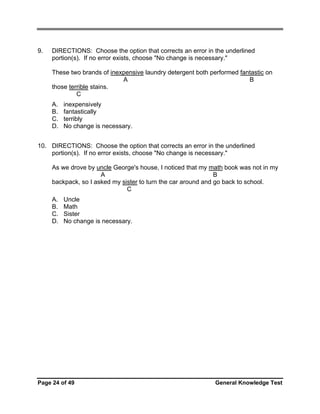
9.

DIRECTIONS: Choose the option that corrects an error in the underlined
portion(s). If no error exists, choose "No change is necessary."
These two brands of inexpensive laundry detergent both performed fantastic on
A
B
those terrible stains.
C
A.
B.
C.
D.

inexpensively
fantastically
terribly
No change is necessary.

10. DIRECTIONS: Choose the option that corrects an error in the underlined
portion(s). If no error exists, choose "No change is necessary."
As we drove by uncle George's house, I noticed that my math book was not in my
A
B
backpack, so I asked my sister to turn the car around and go back to school.
C
A.
B.
C.
D.

Uncle
Math
Sister
No change is necessary.

Page 24 of 49

General Knowledge Test
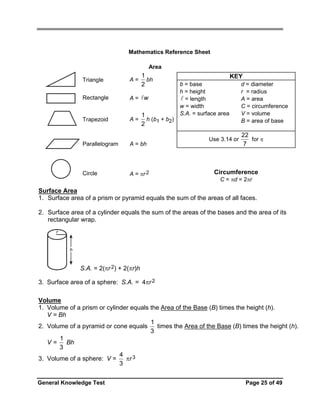
Mathematics Reference Sheet

Area

1
bh
2

Triangle

A=

Rectangle

A= w

Trapezoid

A=

1
h (b1 + b2)
2

Parallelogram

A = bh

Circle

A = πr 2

b = base
h = height
= length
w = width
S.A. = surface area

KEY

Use 3.14 or

d = diameter
r = radius
A = area
C = circumference
V = volume
B = area of base

22
for π
7

Circumference
C = πd = 2πr

Surface Area
1. Surface area of a prism or pyramid equals the sum of the areas of all faces.
2. Surface area of a cylinder equals the sum of the areas of the bases and the area of its
rectangular wrap.
r
h

S.A. = 2(πr 2) + 2(πr)h
3. Surface area of a sphere: S.A. = 4πr 2
Volume
1. Volume of a prism or cylinder equals the Area of the Base (B) times the height (h).
V = Bh
1
times the Area of the Base (B) times the height (h).
2. Volume of a pyramid or cone equals
3
1
V=
Bh
3
4
πr 3
3. Volume of a sphere: V =
3
General Knowledge Test

Page 25 of 49
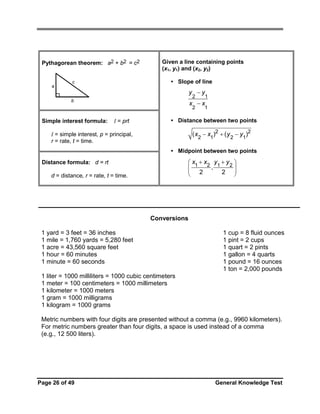
Pythagorean theorem: a2 + b2 = c2

a

Given a line containing points
(x1, y1) and (x2, y2)
• Slope of line

c

y −y
2

Simple interest formula:

1

2

b

1

x −x
I = prt

• Distance between two points

( x2 − x1)2 + ( y 2 − y1)2

I = simple interest, p = principal,
r = rate, t = time.

• Midpoint between two points

⎛ x1 + x2 y1 + y 2 ⎞
⎜
⎟
⎜ 2 , 2 ⎟
⎠
⎝

Distance formula: d = rt
d = distance, r = rate, t = time.

Conversions
1 yard = 3 feet = 36 inches
1 mile = 1,760 yards = 5,280 feet
1 acre = 43,560 square feet
1 hour = 60 minutes
1 minute = 60 seconds

1 cup = 8 fluid ounces
1 pint = 2 cups
1 quart = 2 pints
1 gallon = 4 quarts
1 pound = 16 ounces
1 ton = 2,000 pounds

1 liter = 1000 milliliters = 1000 cubic centimeters
1 meter = 100 centimeters = 1000 millimeters
1 kilometer = 1000 meters
1 gram = 1000 milligrams
1 kilogram = 1000 grams
Metric numbers with four digits are presented without a comma (e.g., 9960 kilometers).
For metric numbers greater than four digits, a space is used instead of a comma
(e.g., 12 500 liters).

Page 26 of 49

General Knowledge Test
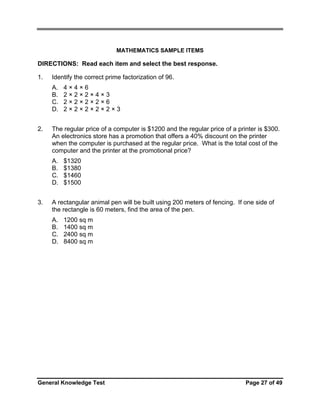
MATHEMATICS SAMPLE ITEMS

DIRECTIONS: Read each item and select the best response.
1.

Identify the correct prime factorization of 96.
A.
B.
C.
D.

2.

The regular price of a computer is $1200 and the regular price of a printer is $300.
An electronics store has a promotion that offers a 40% discount on the printer
when the computer is purchased at the regular price. What is the total cost of the
computer and the printer at the promotional price?
A.
B.
C.
D.

3.

4×4×6
2×2×2×4×3
2×2×2×2×6
2×2×2×2×2×3

$1320
$1380
$1460
$1500

A rectangular animal pen will be built using 200 meters of fencing. If one side of
the rectangle is 60 meters, find the area of the pen.
A.
B.
C.
D.

1200 sq m
1400 sq m
2400 sq m
8400 sq m

General Knowledge Test

Page 27 of 49
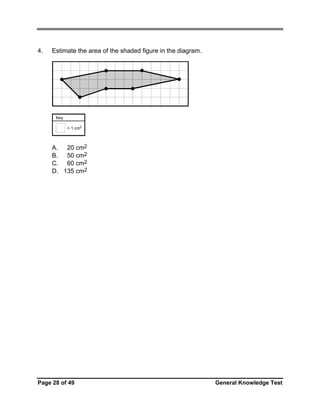
4.

Estimate the area of the shaded figure in the diagram.

Key
= 1 cm2

A. 20 cm2
B. 50 cm2
C. 60 cm2
D. 135 cm2

Page 28 of 49

General Knowledge Test
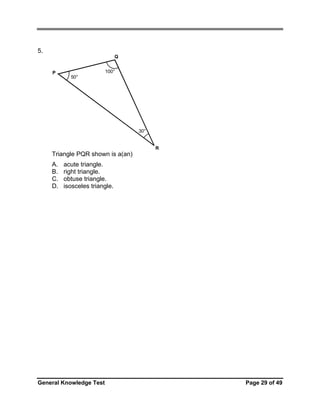
5.
Q
P

100°
50°

30°

R

Triangle PQR shown is a(an)
A.
B.
C.
D.

acute triangle.
right triangle.
obtuse triangle.
isosceles triangle.

General Knowledge Test

Page 29 of 49
6.

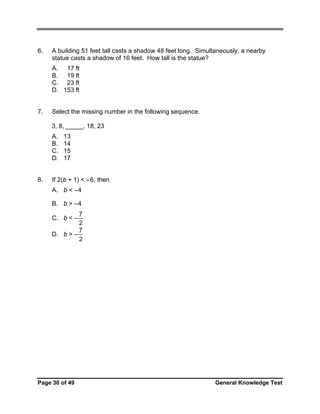
A building 51 feet tall casts a shadow 48 feet long. Simultaneously, a nearby
statue casts a shadow of 16 feet. How tall is the statue?
A. 17 ft
B. 19 ft
C. 23 ft
D. 153 ft

7.

Select the missing number in the following sequence.
3, 8, _____, 18, 23
A.
B.
C.
D.

8.

13
14
15
17

If 2(b + 1) < –6, then
A. b < – 4
B. b > – 4
7
2
7
D. b > –
2
C. b < –

Page 30 of 49

General Knowledge Test
9.

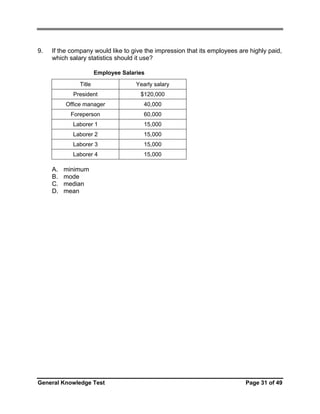
If the company would like to give the impression that its employees are highly paid,
which salary statistics should it use?
Employee Salaries
Title
President

$120,000

Office manager

40,000

Foreperson

60,000

Laborer 1

15,000

Laborer 2

15,000

Laborer 3

15,000

Laborer 4

A.
B.
C.
D.

Yearly salary

15,000

minimum
mode
median
mean

General Knowledge Test

Page 31 of 49
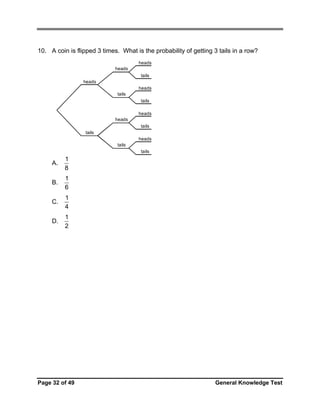
10. A coin is flipped 3 times. What is the probability of getting 3 tails in a row?
heads
heads
tails
heads
heads
tails
tails
heads
heads
tails
tails
heads
tails
tails

A.

1
8

B.

1
6

C.

1
4

D.

1
2

Page 32 of 49

General Knowledge Test
READING SAMPLE ITEMS

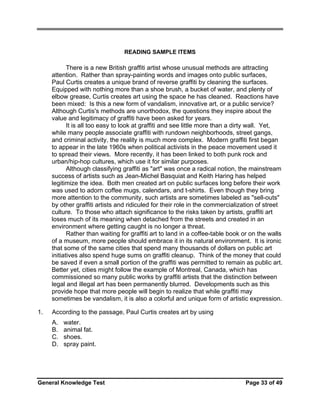
There is a new British graffiti artist whose unusual methods are attracting
attention. Rather than spray-painting words and images onto public surfaces,
Paul Curtis creates a unique brand of reverse graffiti by cleaning the surfaces.
Equipped with nothing more than a shoe brush, a bucket of water, and plenty of
elbow grease, Curtis creates art using the space he has cleaned. Reactions have
been mixed: Is this a new form of vandalism, innovative art, or a public service?
Although Curtis's methods are unorthodox, the questions they inspire about the
value and legitimacy of graffiti have been asked for years.
It is all too easy to look at graffiti and see little more than a dirty wall. Yet,
while many people associate graffiti with rundown neighborhoods, street gangs,
and criminal activity, the reality is much more complex. Modern graffiti first began
to appear in the late 1960s when political activists in the peace movement used it
to spread their views. More recently, it has been linked to both punk rock and
urban/hip-hop cultures, which use it for similar purposes.
Although classifying graffiti as "art" was once a radical notion, the mainstream
success of artists such as Jean-Michel Basquiat and Keith Haring has helped
legitimize the idea. Both men created art on public surfaces long before their work
was used to adorn coffee mugs, calendars, and t-shirts. Even though they bring
more attention to the community, such artists are sometimes labeled as "sell-outs"
by other graffiti artists and ridiculed for their role in the commercialization of street
culture. To those who attach significance to the risks taken by artists, graffiti art
loses much of its meaning when detached from the streets and created in an
environment where getting caught is no longer a threat.
Rather than waiting for graffiti art to land in a coffee-table book or on the walls
of a museum, more people should embrace it in its natural environment. It is ironic
that some of the same cities that spend many thousands of dollars on public art
initiatives also spend huge sums on graffiti cleanup. Think of the money that could
be saved if even a small portion of the graffiti was permitted to remain as public art.
Better yet, cities might follow the example of Montreal, Canada, which has
commissioned so many public works by graffiti artists that the distinction between
legal and illegal art has been permanently blurred. Developments such as this
provide hope that more people will begin to realize that while graffiti may
sometimes be vandalism, it is also a colorful and unique form of artistic expression.
1.

According to the passage, Paul Curtis creates art by using
A.
B.
C.
D.

water.
animal fat.
shoes.
spray paint.

General Knowledge Test

Page 33 of 49
2.

In the fourth paragraph, the word commissioned means
A.
B.
C.
D.

3.

The primary purpose of this passage is to
A.
B.
C.
D.

4.

inspire artists to express themselves through graffiti.
entertain with interesting stories about graffiti art.
identify the origins of graffiti art in North America.
convince readers that graffiti is a legitimate form of art.

This passage uses an overall organizational pattern that
A.
B.
C.
D.

5.

destroyed.
ordered.
honored.
altered.

summarizes the achievements of graffiti artists.
describes information that supports one perspective of graffiti art.
outlines the historical development of graffiti art.
classifies characteristics shared by most works of graffiti art.

What does the following sentence from the third paragraph suggest about graffiti
artists?
"Even though they bring more attention to the community, such artists are
sometimes labeled as 'sell-outs' by other graffiti artists and ridiculed for their role
in the commercialization of street culture."
A.
B.
C.
D.

Some graffiti artists are opposed to the idea of selling graffiti art.
There is a high demand in the marketplace for graffiti artists.
Graffiti artists have little respect for more conventional forms of art.
Graffiti artists no longer are an important element of street culture.

Page 34 of 49

General Knowledge Test
The American Symphony League has only one requirement of the hotels
that host its annual convention: no background music. Ask members of the
organization why, and they will vigorously explain that they want to be sensitized
to music, not desensitized by the lilting rhythms and soothing melodies so often
found in hotel lobbies. Whether it is referred to as elevator music, as mood music,
or by the brand name Muzak, there is little question that this type of music strikes
a discordant note with many listeners. Some say that it reminds them of a trip
to the dentist's office, while others merely cringe at hearing their favorite songs
re-recorded as symphonic mush. Through it all, however, background music
has thrived as one of the most widely heard types of music in the world.
Given its seeming uniformity, it is easy to forget that background music is
typically used for very specific purposes. One of its first uses was, of course, on
elevators. Grinding and clicking from one floor to another, the first elevators made
many passengers uneasy. Operators soon discovered that soft, comforting music
was helpful for reducing motion sickness and coaxing the hesitant to step inside.
Not long after, background music companies began marketing their products to
businesses and places of recreation with the idea that music could enhance the
moods of both workers and consumers. Muzak was the clear leader in this field,
and the company soon perfected program formatting that addressed the needs of
clients during each hour of the day. A typical restaurant program progressed from
cheerful wake-up melodies in the morning, through light classical sounds at lunch,
cocktail music in the afternoon, elegant tones during dinner, and dance music of
increased tempo and volume in the late evening hours. By the early 1940s, this
same program could be heard in over 1,000 restaurants.
An unfortunate backlash against background music began in the following
decade. By that time, the soothing harmonies could be heard in restaurants,
offices, trains, planes, and on phone lines across the world. People began to
complain that playing prerecorded music in public places was a violation of their
privacy. A lawsuit that protested the music and advertisements on public buses in
Washington, D.C., made it all the way to the Supreme Court. Although the Court
ruled in favor of the city, Justice William O. Douglas wrote a strongly worded
dissent that defended the right to be left alone.
Today, many people are thankful that background music weathered this
storm of criticism. They are even more thankful that it has evolved from its early
form. Still heard by as many as 100 million people a day, the music is much more
likely to sound like it is coming from a radio station than from a wilted orchestra.
Meanwhile, the Muzak corporation is working to redefine its image with an edgy
new Web site and playlists that heavily favor pop songs. After seven decades,
people may finally be ready for background music to take a bold step forward.

General Knowledge Test

Page 35 of 49
6.

The author's primary purpose in paragraph 2 of the passage is to
A.
B.
C.
D.

7.

Which of the following is used by the author as an example of the unpleasant
associations that listening to background music evokes in certain people?
A.
B.
C.
D.

8.

traveling by plane
going to work
visiting a dentist's office
riding in an elevator

The organizational plan used by the author in paragraphs 2–4 can best be
described as
A.
B.
C.
D.

9.

describe the different uses of background music.
analyze the marketing strategies of background music companies.
examine how background music is produced.
explain why many people enjoy background music.

order of importance.
spatial order.
comparison and contrast.
chronological order.

Which sentence is a statement of opinion?
A. The American Symphony League has only one requirement of the hotels that
host its annual convention: no background music.
B. By the early 1940s, this same program could be heard in over 1,000
restaurants.
C. An unfortunate backlash against background music began in the following
decade.
D. A lawsuit that protested the music and advertisements on public buses in
Washington, D.C., made it all the way to the Supreme Court.

Page 36 of 49

General Knowledge Test
10. What is the relationship between these two sentences from the passage?
Sentence 1: People began to complain that playing prerecorded music in public
places was a violation of their privacy. (paragraph 3)
Sentence 2: A lawsuit that protested the music and advertisements on public
buses in Washington, D.C., made it all the way to the Supreme Court.
(paragraph 3)
A.
B.
C.
D.

Sentence 2 restates a point made in sentence 1.
Sentence 2 relates a consequence of a development described in sentence 1.
Sentence 2 clarifies a point made in sentence 1.
Sentence 2 describes a solution to a problem stated in sentence 1.

General Knowledge Test

Page 37 of 49
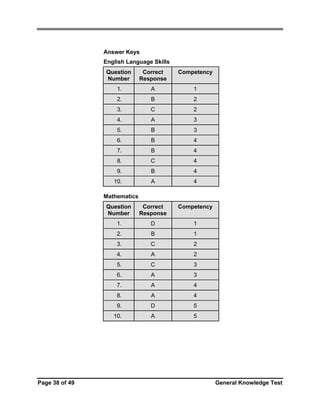
Answer Keys
English Language Skills
Question
Number

Correct
Response

Competency

1.

A

1

2.

B

2

3.

C

2

4.

A

3

5.

B

3

6.

B

4

7.

B

4

8.

C

4

9.

B

4

10.

A

4

Question
Number

Correct
Response

Competency

1.

D

1

2.

B

1

3.

C

2

4.

A

2

5.

C

3

6.

A

3

7.

A

4

8.

A

4

9.

D

5

10.

A

5

Mathematics

Page 38 of 49

General Knowledge Test
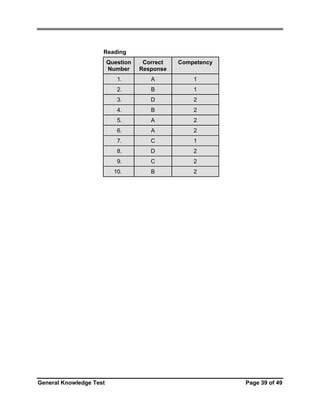
Reading
Question
Number

Competency

1.

A

1

2.

B

1

3.

D

2

4.

B

2

5.

A

2

6.

A

2

7.

C

1

8.

D

2

9.

C

2

10.

General Knowledge Test

Correct
Response

B

2

Page 39 of 49
This page intentionally left blank.

Page 40 of 49

General Knowledge Test
6

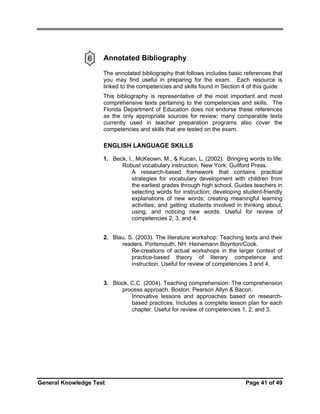
Annotated Bibliography
The annotated bibliography that follows includes basic references that
you may find useful in preparing for the exam. Each resource is
linked to the competencies and skills found in Section 4 of this guide.
This bibliography is representative of the most important and most
comprehensive texts pertaining to the competencies and skills. The
Florida Department of Education does not endorse these references
as the only appropriate sources for review; many comparable texts
currently used in teacher preparation programs also cover the
competencies and skills that are tested on the exam.

ENGLISH LANGUAGE SKILLS
1. Beck, I., McKeown, M., & Kucan, L. (2002). Bringing words to life:
Robust vocabulary instruction. New York: Guilford Press.
A research-based framework that contains practical
strategies for vocabulary development with children from
the earliest grades through high school. Guides teachers in
selecting words for instruction; developing student-friendly
explanations of new words; creating meaningful learning
activities; and getting students involved in thinking about,
using, and noticing new words. Useful for review of
competencies 2, 3, and 4.
2. Blau, S. (2003). The literature workshop: Teaching texts and their
readers. Portsmouth, NH: Heinemann Boynton/Cook.
Re-creations of actual workshops in the larger context of
practice-based theory of literary competence and
instruction. Useful for review of competencies 3 and 4.
3. Block, C.C. (2004). Teaching comprehension: The comprehension
process approach. Boston: Pearson Allyn & Bacon.
Innovative lessons and approaches based on researchbased practices. Includes a complete lesson plan for each
chapter. Useful for review of competencies 1, 2, and 3.

General Knowledge Test

Page 41 of 49
4. Bloom, L.Z. (2004). The essay connection. Boston: Houghton
Mifflin.
A provocative and timely collection of rhetorically arranged
essays by professional and student writers. Stimulates
critical thinking on ethical, social, and political issues.
Useful for review of competencies 1, 2, 3, and 4.
5. Eggers, P. (2007). Steps for writers: Composing essays (Vol. 2).
New York: Pearson Longman.
The basics of composing solid paragraphs and essays in
preparation for freshman composition. Includes finding
one’s own writing process, writing essays based on one’s
own experience and perceptions, and writing essays
involving texts and research. Emphasizes grammar,
proofreading, and peer review. Useful for review of
competencies 1, 2, 3, and 4.
6. Emery, D.W., Kierzek, J.M., & Lindblom, P. (2007). English
fundamentals (14th ed.). New York: Pearson Longman.
Begins with verb connections, basic sentence patterns,
and the internal workings of the sentence and continues to
the more complex structures and relationships of the
language. Includes a survey of college writing with special
emphasis on techniques of invention and their application
to typical college writing assignments. Useful for review of
competencies 1, 2, 3, and 4.
7. Fowler, H.R., & Aaron, J.E. (2004). The Little, Brown handbook
(9th ed.). New York: Pearson Longman.
An authoritative, easy-to-use reference to answer most
questions about grammar, writing, or research. Useful for
review of competencies 1, 3, and 4.
8. Hacker, D. (2006). The Bedford handbook (7th ed.). Boston:
Bedford/St. Martin's.
A widely cited compendium on the writing process,
document design, word choice, punctuation, mechanics,
critical thinking, research writing, and grammar basics.
Useful for review of competencies 1, 2, 3, and 4.

Page 42 of 49

General Knowledge Test
9. Hagemann, J. (2003). Teaching grammar: A reader and
workbook. Boston: Pearson Allyn & Bacon.
Promotes the idea that grammar is best taught in the
context of student writing. Useful for review of
competency 4.
10. Murray, D.M. (2004). The craft of revision (5th ed.). Belmont, CA:
Heinle.
Covers phases of the writing process such as rewriting for
focus, structure, and genre. Includes edited sample
papers. Useful for review of competencies 1, 2, 3, and 4.
11. Raimes, A. (2005) Keys for writers (4th ed.). Boston: Houghton
Mifflin.
A handbook with color-coded tabbed sections, movable
note cards and bookmarks, a grammar section, and an
extensive index. Useful for review of competencies 1, 2, 3,
and 4.
12. Ruszkiewicz, J.J., Friend, C., & Hairston, M. (2007). The Scott
Foresman handbook for writers (8th ed.). Upper Saddle River,
NJ: Pearson Merrill Prentice Hall.
Addresses the multiple dimensions of a writer’s work,
including language, reading, argument, research,
technology, and visual learning. Useful for review of
competencies 1, 2, 3, and 4.
13. Winterowd, W.R., & Murray, P.Y. (1985). English, writing and
skills. San Diego: Coronado Publishers.
A classic language arts textbook for grades 7–12.
Introduces writing and composition skills, rules of
grammar, usage, punctuation, and capitalization. Useful for
review of competencies 1, 3, and 4.
MATHEMATICS
1. Bennett, J. (2004). Holt middle school math, course 3. Austin, TX:
Holt, Rinehart and Winston.
The final component in a program to ease the transition
from arithmetic into algebra. Contains materials to help
teachers plan and pace lessons. Useful for review of
competencies 1 and 4.

General Knowledge Test

Page 43 of 49
2. Billstein, R., Shlomo, L., & Lott, J. (2007). A problem solving
approach to mathematics for elementary school teachers (9th
ed.). Boston: Pearson Addison-Wesley.
A comprehensive, skills-based resource emphasizing
active and collaborative learning. Useful for review of
competencies 1, 2, 3, 4, and 5.
3. Larson, R., Boswell, L., Kanold, T., & Stiff, L. (2004). Algebra I:
Applications, equations, graphs. Evanston, IL: McDougall
Littell.
Helps Algebra I students connect to essential
mathematical concepts with integrated print and
technology support. Useful for review of competencies 1
and 4.
4. Long, C.T., & DeTemple, D. (2005). Mathematical reasoning for
elementary teachers (4th ed.). Boston: Pearson AddisonWesley.
Meaningful content and pedagogy to arm education
students with the tools they will need to become excellent
elementary or middle school teachers. Focuses on
professional development and connecting the material to
the classroom. Useful for review of competencies 1, 2, 3,
4, and 5.
5. Mandery, M., & Schneider, M. (2000). Achieving proficiency in
mathematics. New York: AMSCO School Publications.
Promotes mathematical mastery through critical thinking
and applied strategies, including use of the calculator as a
tool for exploration and implementation. Emphasizes data
reading and interpreting statistical information summarized
in tables, bar graphs, and line graphs. Useful for review of
competencies 1, 2, 3, 4, and 5.
6. Moore, D. (2007). The basic practice of statistics (4th ed.). New
York: W.H. Freeman.
Introduces to students with limited mathematical
backgrounds the same tools, techniques, and interpretive
skills that working statisticians rely on. Useful for review of
competencies 1 and 5.

Page 44 of 49

General Knowledge Test
7. Ortiz, E., & Davenport, T. (2006). CliffsTestPrep FCAT grade 10
reading and math: 10 practice tests. Hoboken, NJ: Wiley.
A detailed description of the exam plus five practice
reading tests and five practice mathematics tests with
answers and examples. Useful for review of competencies
1, 2, 3, 4, and 5.
8. Serra, M. (2008). Discovering geometry: An investigative
approach (4th ed.). Berkeley, CA: Key Curriculum Press.
Enables students to learn theorems and definitions by
performing constructions, measuring figures, relating
patterns and properties, and discussing findings. Uses
real-world applications, puzzles, and extensions to keep
students involved and thinking. Useful for review of
competency 3.
9. Van de Walle, J. (2006). Elementary and middle school
mathematics: Teaching developmentally (6th ed.). Boston:
Pearson Allyn & Bacon.
Four key aspects of teaching mathematics: the nature of
mathematics as a science of pattern and order, an
understanding of how children learn mathematics, a
problem-solving view of teaching mathematics, and
specific methods for integrating assessment with
instruction. Useful for review of competencies 1, 2, 3, 4,
and 5.
10. Wheeler, R., & Wheeler, E. (2005). Modern mathematics:
Fundamentals and concepts (12th ed.). Dubuque, IA:
Kendall/Hunt Publishing Co.
Addresses selected topics without compromising coverage
of critical prerequisites. Useful for review of competencies
1, 2, 3, 4, and 5.
READING
1. Beck, I., & McKeown, M. (2006). Improving comprehension with
questioning the author: A fresh and expanded view of a
powerful approach. New York: Scholastic Professional Books.
An instructional process to support students in gaining
meaning from text. Explicit examples and 25 classroom
cases. Useful for review of competencies 1 and 2.

General Knowledge Test

Page 45 of 49
2. Cooper, J.D., Chard, D., & Kiger, N.D. (2006). The struggling
reader: Interventions that work. New York: Scholastic
Professional Books.
Covers oral language, phonemic awareness, word
recognition, vocabulary, fluency, comprehension, and
writing. Organizes focused interventions around a
classroom-tested framework for assessing students,
diagnosing their needs, teaching them based on findings,
and reassessing them to determine whether more
instruction, practice, or application is needed. Useful for
review of competencies 1 and 2.
3. Elder, J. (2004). Exercise your college reading skills: Developing
more powerful comprehension. New York: McGraw-Hill Higher
Education.
Reinforces essential reading skills. Offers college-level
reading selections from multiple disciplines, writing
prompts, and quizzes at a companion Web site. Useful for
review of competency 2.
4. Harvey, S., & Goudvis, A. (2000). Strategies that work: Teaching
comprehension to enhance understanding. York, ME:
Stenhouse Publishers.
Focuses on teaching comprehension through relevance
and high-interest material. Stresses the importance of
activating background knowledge. Includes a new section
on content area reading for use across the curriculum.
Useful for review of competency 2.
5. Harvey, S., & Goudvis, A. (2005). The comprehension toolkit:
Language and lessons for active literacy. Portsmouth, NH:
Firsthand/Heinemann.
Six strategy cluster books organized around fundamental
comprehension strategies: Monitor Comprehension,
Activate and Connect, Ask Questions, Infer Meaning,
Determine Importance, and Summarize and Synthesize.
Contains 26 lessons structured as a framework on which
educators can build their own lessons. Useful for review of
competencies 1 and 2.

Page 46 of 49

General Knowledge Test
6. Heilman, A.W., Blair, T.R., & William, H.R. (2002). Principles and
practices of teaching reading (10th ed.). Upper Saddle River,
NJ: Pearson Prentice Hall.
Addresses emergent literacy, the reading-writing
connection, alternative assessment strategies, teacher
effectiveness, teaching in a multicultural society, and
literature-based reading. Contains practical instructional
activities and examples, lesson plans, and classroom
activities. Useful for review of competencies 1 and 2.
7. Kamil, M.L., Mosenthal, P.B., Pearson, P.D., & Barr, R. (Eds.).
(2002). Handbook of reading research, Vol. III. Mahwah, NJ:
Lawrence Erlbaum Associates.
Covers topics from vocabulary and comprehension to
reading instruction in the classroom. Addresses two
themes that have emerged since Volumes I and II were
published: (1) broadening the definition of reading, and (2)
broadening the reading research program. Useful for
review of competencies 1 and 2.
8. Lipson, M.Y., & Wixon, K. (2003). Assessment and instruction of
reading and writing difficulty: An interactive approach (3rd ed.).
Boston: Pearson Allyn & Bacon.
Devotes sections to knowledge of reading and writing
research and assessment practices, detailed discussions,
and examples of assessment practices. Useful for review
of competencies 1 and 2.
9. Smith, B.D. (2005). Bridging the gap: College reading (8th ed.).
New York: Pearson Longman.
Links textbook readings to news in the popular press.
Includes material on critical thinking and the Internet. Also
includes material at various reading levels from multiple
academic disciplines. Useful for review of competencies 1
and 2.
10. Spears, D.M. (2006). Developing critical reading skills (7th ed.).
New York: McGraw-Hill Higher Education.
Designed for intermediate and advanced reading courses.
Features a variety of selections and excellent coverage of
critical reading skills. Useful for review of competencies 1
and 2.

General Knowledge Test

Page 47 of 49
11. Stephens, E.C., & Brown, J.E. (2000). A handbook of content
literacy strategies: 75 practical reading and writing ideas.
Norwood, MA: Christopher-Gordon.
Integrates reading and writing as tools for learning in the
content areas. Incorporates nonfiction and fiction literature
throughout. Useful for review of competency 2.
12. Vacca, R.T., & Vacca, J.L. (2005). Content area reading (8th ed.).
Boston: Pearson Allyn & Bacon.
An active learning tool complete with real-world examples
and research-based practices. Addresses reading, writing,
speaking, and listening processes to support learning
across the curriculum. Useful for review of competencies 1
and 2.

Page 48 of 49

General Knowledge Test
7

Additional Information
Please visit the following Web site to review FTCE registration details
and to find additional FTCE information, including test locations and
passing scores.
http://www.fldoe.org/asp/ftce

General Knowledge Test

Page 49 of 49
This page intentionally left blank.
082

General Knowledge Review 2nd edition

  • 1.
    Florida Teacher CertificationExaminations Test Information Guide General Knowledge Test FLORIDA DEPARTMENT OF EDUCATION http://www.fldoe.org Second Edition
  • 2.
    Developed, produced, andprinted under the authority of the Florida Department of Education Authorization for reproduction of this document is hereby granted to persons acting in an official capacity within the Florida K-20 education system, as enumerated in Section 1000.04, Florida Statutes. Permission is NOT granted for distribution or reproduction outside the State system of public education or for commercial distribution of the copyrighted materials without written authorization from the Department of Education. Questions regarding use of these copyrighted materials are to be addressed to: FTCE Administrator Florida Department of Education 325 West Gaines Street, Suite 414 Tallahassee, Florida 32399-0400 Copyright 2008 State of Florida Department of State
  • 3.
    Contents 1 Test and TestInformation Guide Development 1 2 Preparation for the Test 3 3 Test-Taking Advice 5 4 Competencies and Skills and Test Blueprint 7 5 Test Format and Sample Questions 13 6 Annotated Bibliography 41 7 Additional Information 49
  • 4.
  • 5.
    1 Test and TestInformation Guide Development Teacher Certification Testing Since 1980, Florida teacher certification candidates have been required to pass the Florida Teacher Certification Examinations (FTCE), which has consisted of tests in reading, writing, mathematics, and professional knowledge. The 1986 Florida Legislature modified the testing program by also requiring teacher candidates to pass a test in the subject area in which they wish to be certified. In addition, the Legislature substituted the Florida College-Level Academic Skills Test (CLAST) for the reading, writing, and mathematics portions of the FTCE. The 2000 Florida Legislature replaced the CLAST with the General Knowledge Test, effective July 1, 2002. The General Knowledge Test consists of four subtests: English Language Skills, Mathematics, Reading, and Essay. The content assessed on the test was identified and validated by committees of content specialists from within the state of Florida. Committee members included public school teachers, district supervisors, and college faculty with expertise in these fields. Committee members were selected on the basis of recommendations by district superintendents, public school principals, deans of education, experts in the field, and other organizations. In developing the test, the committees used an extensive literature review, interviews with selected public school teachers, a large-scale survey of teachers, pilot tests, and their own professional judgment. Role of the Test Information Guide The purpose of this test information guide is to help candidates taking the General Knowledge Test prepare effectively for the examination. The guide was designed to familiarize prospective test takers with various aspects of the examination, including the content that is covered and the way it is represented. The guide should enable candidates to direct their study and to focus on relevant material for review. This test information guide is intended primarily for use by certification candidates, who may be students in a college or university teacherpreparation program, teachers with provisional certification, teachers seeking certification in an additional subject area, or persons making a career change to public school teaching. Candidates may have studied and worked in Florida or may be from out of state. General Knowledge Test Page 1 of 49
  • 6.
    College or universityfaculty may also use the guide to prepare students for certification, and inservice trainers may find the guide useful for helping previously certified teachers prepare for recertification or multiple certification. This test information guide is not intended as an all-inclusive source of subject area knowledge, nor is it a substitute for college course work in the subject area. The sample questions are representative of the content of the actual test; however, they are not actual test questions from an actual test form. Instead, the guide is intended to help candidates prepare for the subject area test by presenting an overview of the content and format of the examination. Page 2 of 49 General Knowledge Test
  • 7.
    2 Preparation for theTest The following outline may help you to prepare for the examination. Adapt these suggestions to suit your own study habits and the time you have available for review. Overview • Look over the organization of the test information guide. Section 1 discusses the development of the test and test information guide. Section 2 (this section) outlines test preparation steps. Section 3 offers strategies for taking the test. Section 4 presents information about the content and structure of the test. Section 5 lists question formats and includes sample test questions. Section 6 provides an annotated bibliography of general references you may find useful in your review. Section 7 identifies a source of further information. Self-Assessment • Decide which content areas you should review. Section 4 includes the competencies and skills used to develop this subject area test and the approximate proportion of test questions from each competency area. Review • Study according to your needs. Review all of the competencies and concentrate on areas with which you are least familiar. Practice • Acquaint yourself with the format of the examination. Section 5 describes types of questions you may find on the examination. • Answer sample test questions. Section 5 gives you an opportunity to test yourself with sample test questions and provides an answer key and information regarding the competency to which each question is linked. General Knowledge Test Page 3 of 49
  • 8.
    Final preparation • Review test-takingadvice. Section 3 includes suggestions for improving your performance on the examination. • Refer to field-specific references. Section 6 includes an annotated bibliography listing general references keyed to the competencies and skills used to develop this subject area test. Page 4 of 49 General Knowledge Test
  • 9.
    3 Test-Taking Advice • Go intothe examination prepared, alert, and well rested. • Complete your travel arrangements prior to the examination date. Plan to arrive early so that you can locate the parking facilities and examination room without rushing. • Dress comfortably and bring a sweater or jacket in case the room is too cool. • Take the following with you to the test site: — Admission ticket — Proper identification as described in "Identification Policy" — Watch • There are many strategies for taking a test and different techniques for dealing with different types of questions. Nevertheless, you may find the following general suggestions useful. — Read each question and all the response options carefully before selecting your answer. Pay attention to all of the details. — Go through the entire test once and answer all the questions you are reasonably certain about. Then go back and tackle the questions that require more thought. — When you are not certain of the right answer, eliminate as many options as you can and choose the response that seems best. It is to your advantage to answer all the questions on the test, even if you are uncertain about some of your choices. — After completing the examination, go back and check every question. Verify that you have answered all of the questions and that your responses are correctly entered. General Knowledge Test Page 5 of 49
  • 10.
    This page intentionallyleft blank. Page 6 of 49 General Knowledge Test
  • 11.
    4 Competencies and Skillsand Test Blueprint The table on the following pages lists the competencies and skills used as the basis for the General Knowledge Test. These competencies and skills represent the knowledge that teams of teachers, subject area specialists, and district-level educators have determined to be important for beginning teachers. This table could serve as a checklist for assessing your familiarity with each of the areas covered by the test. The competencies and skills should help you organize your review. The test blueprint indicates the approximate number of test questions that will cover the specific competency on the exam. Competencies are broad areas of content knowledge. Skills identify specific behaviors that demonstrate the competencies. Approximate number of questions indicates the approximate number of test questions that represent the competencies on the test. The following excerpt illustrates the components of the table. General Knowledge Test Page 7 of 49
  • 12.
    Table of Competencies,Skills, and Approximate Number of Questions Approximate # of Questions Competency/Skill ENGLISH LANGUAGE SKILLS 1 Conceptual and organizational skills 1 2 Identify logical order in a written passage. 2 4 Identify irrelevant sentences. Word choice skills 6 1 2 Recognize commonly confused or misused words or phrases. 3 3 Choose the appropriate word or expression in context. Recognize diction and tone appropriate to a given audience. Sentence structure skills 6 1 2 Recognize parallelism, including parallel expressions for parallel ideas. 3 4 Recognize correct placement of modifiers. Recognize fragments, comma splices, and run-on sentences. Grammar, spelling, capitalization, and punctuation skills 24 1 Identify standard verb forms. 2 Identify inappropriate shifts in verb tense. 3 Identify agreement between subject and verb. 4 Identify agreement between pronoun and antecedent. 5 Identify inappropriate pronoun shifts. 6 Identify clear pronoun references. 7 Identify proper case forms. 8 Identify the correct use of adjectives and adverbs. 9 Identify appropriate comparative and superlative degree forms. 10 Identify standard spelling. 11 Identify standard punctuation. 12 Identify standard capitalization. Page 8 of 49 General Knowledge Test
  • 13.
    Competency/Skill Approximate # of Questions MATHEMATICS Thetest center will provide a 4-function calculator. The test center will provide a reference sheet. 1 Knowledge of number sense, concepts, and operations 1 Solve real-world problems involving addition, subtraction, multiplication, and division of rational numbers (e.g., whole numbers, integers, decimals, percents, and fractions including mixed numbers). 3 Apply basic number theory concepts including the use of primes, composites, factors, and multiples in solving problems. 4 2 Compare the relative value of real numbers (e.g., integers, fractions, decimals, percents, irrational numbers, and numbers expressed in exponential or scientific notation). 2 8 Apply the order of operations with or without grouping symbols. Knowledge of measurement (using customary or metric units) 1 Solve real-world problems involving length, weight, mass, perimeter, area, capacity, and volume. 2 Solve real-world problems involving rated measures (e.g., miles per hour, meters per second, cost per item, and cost per unit). 3 Solve real-world problems involving scaled drawings (e.g., maps, blueprints, and models). 4 Solve real-world problems involving the change of units of measures of length, weight, mass, capacity, and time. 5 Solve real-world problems involving estimates of measures including length, weight, mass, temperature, time, money, perimeter, area, and volume. 6 10 Choose the correct reading, to a specified degree of accuracy, using instruments (e.g., scales, rulers, thermometers, measuring cups, protractors, and gauges). General Knowledge Test Page 9 of 49
  • 14.
    Approximate # of Questions Competency/Skill 3 Knowledgeof geometry and spatial sense 9 1 2 Solve real-world and mathematical problems involving ratio, proportion, similarity, congruence, and the Pythagorean relationship. 3 Identify the location of ordered pairs of integers in all four quadrants of a coordinate system (graph) and use the coordinate system to apply the concepts of slope and distance to solve problems. 4 4 Identify and/or classify simple two- and three-dimensional figures according to their properties. Identify real-world examples that represent geometric concepts including perpendicularity, parallelism, tangency, symmetry, and transformations (e.g., flips, slides, and turns). Knowledge of algebraic thinking 9 1 2 Interpret algebraic expressions using words, symbols, variables, tables, and graphs. 3 Solve equations and inequalities graphically or algebraically. 4 5 Analyze and generalize patterns including arithmetic and geometric sequences. Determine whether a number or ordered pair is among the solutions of given equations or inequalities. Knowledge of data analysis and probability 9 1 Analyze data and solve problems using data presented in histograms, bar graphs, circle graphs, pictographs, tables, and charts. 2 Identify how the presentation of data can lead to different or inappropriate interpretations. 3 Calculate range, mean, median, and mode(s) from sets of data and interpret the meaning of the measures of central tendency (i.e., mean, median, and mode) and dispersion (i.e., range and standard deviation). 4 Identify how the measures of central tendency (i.e., mean, median, or mode) can lead to different interpretations. 5 Calculate the probability of a specified outcome. 6 Solve and interpret real-world problems involving probability using counting procedures, tables, tree diagrams, and the concepts of permutations and combinations. Page 10 of 49 General Knowledge Test
  • 15.
    Competency/Skill READING All items arepassage based. The passages will be both expository and narrative. Each test form will contain approximately four passages. 1 Knowledge of literal comprehension 1 2 Identify supporting details. 3 2 Recognize main ideas. Determine meaning of words or phrases in context. Knowledge of inferential comprehension 1 Determine purpose. 2 Identify overall organizational pattern. 3 Distinguish between fact and opinion. 4 Recognize bias. 5 Recognize tone. 6 Determine relationships between sentences. 7 Analyze the validity of arguments. 8 Draw logical inferences and conclusions. Table of Essay Skills Competency/Skill ESSAY SKILLS ♦ Determine the purpose for writing. ♦ Formulate a thesis or statement of main idea. ♦ Organize ideas and details effectively. ♦ Provide adequate, relevant supporting material. ♦ Use effective transitions. ♦ Demonstrate a mature command of language. ♦ Avoid inappropriate use of slang, jargon, and clichés. ♦ Use a variety of sentence patterns effectively. ♦ Maintain consistent point of view. ♦ Observe the conventions of standard American English. General Knowledge Test Page 11 of 49
  • 16.
    This page intentionallyleft blank Page 12 of 49 General Knowledge Test
  • 17.
    5 Test Format andSample Questions The General Knowledge Test consists of four subtests: Language Skills, Mathematics, Reading, and Essay. English The Essay For your essay, you will choose between two topics. The 50 minutes allotted for this section of the exam includes time to prepare, write, and edit your essay. Your work will be scored holistically by two judges. The personal views you express will not be an issue; however, the skill with which you express those views, the logic of your arguments, and the degree to which you support your position will be very important in the scoring. Your essay will be scored both on substance and on the composition skills demonstrated. The judges will use the criteria on pages 16–17 when evaluating your essay. Multiple-Choice Subtests The English Language Skills and Reading subtests are each 40 minutes long and consist of approximately 40 multiple-choice questions per subtest. The Mathematics Subtest consists of approximately 45 multiple-choice questions and is 100 minutes long. Each multiple-choice subtest may also contain approximately 5 experimental items that will not be scored. Each multiple-choice question will contain three or four response options, and you will indicate your answer by selecting A, B, C, or D. For the Mathematics Subtest, the test center will provide a 4-function calculator and a mathematics reference sheet. The following sections explain procedures for each part of the test and direct you to examples of each type of question among the sample items. General Knowledge Test Page 13 of 49
  • 18.
    GENERAL KNOWLEDGE TEST– ESSAY WRITING GENERAL STRATEGIES FOR WRITING THE ESSAY FOR THE GENERAL KNOWLEDGE TEST 1. Watch the time. Take a few minutes at the beginning of the period to plan your essay and at the end to proofread or revise your work. Use all the time wisely. You should not run out of time before you are done; nor should you write an incomplete essay because you did not use all the time allowed. NOTE: You do not have time to write a rough draft and then completely rewrite it. Spend your time writing and editing your final essay. 2. Read the instructions carefully and select one of the topics. Determine what the topic is asking. Think of how the topic relates to what you know, what you have learned, and what experiences you have had, so you can provide concrete details rather than vague generalities. 3. Take a few minutes to prewrite. Jot down your first ideas (some you may like; others you may discard). Sketch a quick outline or group your ideas together with arrows or numbers. Begin to "see" your essay taking shape—even before you start writing. 4. Write a thesis statement that provides a clear focus for your essay. State a point of view in your thesis that guides the purpose and scope of your essay. Consider the larger point you are trying to convey to the reader and what you want the reader to understand about the topic. Avoid a thesis statement framed as a statement of fact, a question, or an announcement. 5. Develop the essay according to your purpose. Develop paragraphs fully to give the reader examples and reasons that support your thesis. Note that a good essay for the General Knowledge Test may be longer or shorter than the basic fiveparagraph format of some short essays. Do not limit yourself to an arbitrary length. The key is to develop a topic by using concrete, informative details. 6. Tie your main ideas together with a brief conclusion. Provide a concluding paragraph that ties together the essay's points and offers insights about the topic. Avoid a conclusion that merely restates the thesis and repeats the supporting details. Check your time. If the writing period is almost over, wrap up quickly, so you can proofread or revise. Page 14 of 49 General Knowledge Test
  • 19.
    7. Revise/proofread theessay to conform to standard American English. Look for particular errors you tend to make. Read the essay from the last sentence to the first and make corrections. Look for words, sentences, or even paragraphs that need changing. General Knowledge Test Page 15 of 49
  • 20.
    SCORING CRITERIA FORTHE GENERAL KNOWLEDGE ESSAY SCORE of 6 SCORE of 5 The essay has a clearly established main idea that is adequately developed and recognizable through specific details and/or examples. Organization follows a logical and coherent pattern. Point of view is mostly maintained. Vocabulary and sentence structure are mostly varied and effective. Occasional errors in sentence structure, usage and mechanics do not interfere with the writer's ability to communicate. SCORE of 4 The essay has an adequately stated main idea that is developed with some specific details and examples. Supporting ideas are presented in a mostly logical and coherent manner. Point of view is somewhat maintained. Vocabulary and sentence structure are somewhat varied and effective. Occasional errors in sentence structure, usage, and mechanics may interfere with the writer's ability to communicate. SCORE of 3 The essay states a main idea that is developed with generalizations or lists. The essay may contain occasional lapses in logic and coherence, and organization is mechanical. Point of view is ambiguous. Vocabulary and sentence structure are repetitious and often ineffective. A variety of errors in sentence structure, usage, and mechanics sometimes interferes with the writer's ability to communicate. SCORE of 2 Page 16 of 49 The essay has a clearly established main idea that the writer fully develops with specific details and examples. Organization is notably logical and coherent. Point of view is consistently maintained. Vocabulary and sentence structure are varied and effective. Errors in sentence structure, usage, and mechanics are few and insignificant. The essay presents an incomplete or ambiguous main idea. Support is developed with generalizations and lists. Organization is mechanical. The essay contains occasional lapses in logic and coherence. Point of view is confusing and distracting. Word choice is simplistic, and sentence structure is disjointed. Errors in sentence structure, usage, and mechanics frequently interfere with the writer's ability to communicate. General Knowledge Test
  • 21.
    SCORE OF 1 GeneralKnowledge Test The essay has no evident main idea. Development is inadequate and/or irrelevant. Organization is illogical and/or incoherent. Point of view has not been established. Vocabulary and sentence structure are garbled and confusing. Significant and numerous errors in sentence structure, usage, and mechanics interfere with the writer's ability to communicate. Page 17 of 49
  • 22.
    Table of QuestionFormats Sample Question Type of Question Essay Select a topic and develop an essay explaining the topic or supporting your position on the topic. page 19 Passage Read the passage and select the correct answer. Command Select the best response option. Question 2 page 21 Direct Question Choose the response option that best answers the question. Question 9 page 36 Scenario Examine a situation, problem, or case study. Then answer a question, make a diagnosis, or recommend a course of action by selecting the best response option. Question 2 page 27 Graphics Choose the option that best answers a question involving a number line, a geometric figure, graphs of lines or curves, a table, or a chart. Question 4 page 28 Word Problem Apply mathematical principles to solve a realworld problem. Question 6 page 30 Sentence Completion Select the response option that best completes the sentence. Page 18 of 49 Question 1 page 21 Question 1 page 33 General Knowledge Test
  • 23.
    Sample Questions The followingquestions represent both the form and content of questions on the examination. These questions will acquaint you with the general format of the examination; however, these sample questions do not cover all of the competencies and skills that are tested and will only approximate the degree of examination difficulty. Answer keys for the multiple-choice questions follow at the end of the sample questions. The answer keys include information regarding the competency to which each question is linked. General Knowledge Test Page 19 of 49
  • 24.
    SAMPLE ESSAY TOPICS DIRECTIONS:Two topics are presented below. Select one of the topics as the basis for your essay. READ THE TOPICS VERY CAREFULLY TO MAKE SURE YOU KNOW WHAT YOU ARE BEING ASKED TO DO. Topic 1. A place you would find interesting to visit OR Topic 2. A practice affecting the environment that should be changed or discontinued Read the two topics again and select the one on which you wish to write your essay. In order for your essay to be scored, it must be on only one of these topics, and it must address the entire topic. In your essay, you should introduce the subject and then either — explain the subject you have chosen or — take a position about your subject and support that position. At least two evaluators will read your essay and assign it a score. They will pay special attention to whether you have observed the following: • • • • • • • • • • determined the purpose of writing formulated a thesis or statement of main idea organized ideas and details effectively provided adequate, relevant support material used effective transitions demonstrated a mature command of language avoided inappropriate use of slang, jargon, and clichés used a variety of sentence patterns effectively maintained consistent point of view observed the conventions of standard American English Take a few minutes to plan what you want to say before you start writing. Leave yourself a few minutes at the end of the period to proofread and make corrections. Please see pages 14–15 for advice on writing the essay and pages 16–17 for the essay scoring criteria. Page 20 of 49 General Knowledge Test
  • 25.
    ENGLISH LANGUAGE SKILLSSAMPLE ITEMS 1. Read the entire passage carefully and then answer the question. (Note: Intentional errors have been included in this passage.) (1) Ponce de León was a Spanish sailor who served as governor of the island of Puerto Rico before he was encouraged by the Spanish Crown to sail north to continue his search for new lands. (2) The city of Ponce in Puerto Rico is named in his honor. (3) He had heard from Native Americans that there existed a fountain of youth on an island called Bimini (located in the Bahamas). (4) It was on this search, both on behalf of the Crown and for the fountain of youth, that he came upon mainland Florida. (5) At the time, he had no idea he had reached the North American mainland. (6) Ponce de León's search was cut short in 1521 when his party had a skirmish with Native Americans on the west coast of Florida. (7) He died shortly after from injuries he received. Which numbered sentence is LEAST relevant to the passage? A. B. C. D. 2. sentence 2 sentence 3 sentence 4 sentence 5 DIRECTIONS: Choose the option that corrects an error in the underlined portion(s). If no error exists, choose "No change is necessary." Traffic proceeded slowly as cars went threw a bottleneck at the construction site. A B C A. B. C. D. preceded through cite No change is necessary. General Knowledge Test Page 21 of 49
  • 26.
    3. DIRECTIONS: Choose themost appropriate opening statement for this article. Joanne, an officer in the Future Educators Association in her school, has been asked to write an article for her organization's newsletter describing her recent job interview. A. I thought I was going to faint before the interviewer asked me the first question. B. Don't worry about interviews; they are so desperate for teachers anyone can get hired. C. Interviewing, like most everything else in education, requires planning and preparation. D. I was really nervous before the interview began, but when the interviewer began asking questions, I could see that she was really interested in hiring the right person for the position. 4. DIRECTIONS: Choose the sentence that has no errors in structure. A. The book taught me how to change the faucet and connect the water supply. B. The book taught me how to change the faucet and connecting the water supply. C. The book taught me about changing the faucet and to connect the water supply. 5. DIRECTIONS: Choose the option that corrects an error in the underlined portion(s). If no error exists, choose "No change is necessary." If none of these positions appeals to you, don't despair, there will always be tomorrow's help-wanted ads to investigate. A. B. C. D. despair there despair. There despair; there, No change is necessary. Page 22 of 49 General Knowledge Test
  • 27.
    6. DIRECTIONS: Choose theoption that corrects an error in the underlined portion(s). If no error exists, choose "No change is necessary." It was highly unlikely that he could pick up the medicine before the store closed. A Just as he was walking to the front door, the store manager sees him and unlocked B C the door. A. B. C. D. 7. closes saw unlocks No change is necessary. DIRECTIONS: Choose the option that corrects an error in the underlined portion(s). If no error exists, choose "No change is necessary." My friend, her dog, and I went for a ride in my new car, and she chewed through one of the seat belts. A. B. C. D. 8. my friend her dog they No change is necessary. DIRECTIONS: Choose the option that corrects an error in the underlined portion(s). If no error exists, choose "No change is necessary." Although Javier and I have seen the movie before, it still makes we laugh as much A B C as ever. A. B. C. D. me its us No change is necessary. General Knowledge Test Page 23 of 49
  • 28.
    9. DIRECTIONS: Choose theoption that corrects an error in the underlined portion(s). If no error exists, choose "No change is necessary." These two brands of inexpensive laundry detergent both performed fantastic on A B those terrible stains. C A. B. C. D. inexpensively fantastically terribly No change is necessary. 10. DIRECTIONS: Choose the option that corrects an error in the underlined portion(s). If no error exists, choose "No change is necessary." As we drove by uncle George's house, I noticed that my math book was not in my A B backpack, so I asked my sister to turn the car around and go back to school. C A. B. C. D. Uncle Math Sister No change is necessary. Page 24 of 49 General Knowledge Test
  • 29.
    Mathematics Reference Sheet Area 1 bh 2 Triangle A= Rectangle A=w Trapezoid A= 1 h (b1 + b2) 2 Parallelogram A = bh Circle A = πr 2 b = base h = height = length w = width S.A. = surface area KEY Use 3.14 or d = diameter r = radius A = area C = circumference V = volume B = area of base 22 for π 7 Circumference C = πd = 2πr Surface Area 1. Surface area of a prism or pyramid equals the sum of the areas of all faces. 2. Surface area of a cylinder equals the sum of the areas of the bases and the area of its rectangular wrap. r h S.A. = 2(πr 2) + 2(πr)h 3. Surface area of a sphere: S.A. = 4πr 2 Volume 1. Volume of a prism or cylinder equals the Area of the Base (B) times the height (h). V = Bh 1 times the Area of the Base (B) times the height (h). 2. Volume of a pyramid or cone equals 3 1 V= Bh 3 4 πr 3 3. Volume of a sphere: V = 3 General Knowledge Test Page 25 of 49
  • 30.
    Pythagorean theorem: a2+ b2 = c2 a Given a line containing points (x1, y1) and (x2, y2) • Slope of line c y −y 2 Simple interest formula: 1 2 b 1 x −x I = prt • Distance between two points ( x2 − x1)2 + ( y 2 − y1)2 I = simple interest, p = principal, r = rate, t = time. • Midpoint between two points ⎛ x1 + x2 y1 + y 2 ⎞ ⎜ ⎟ ⎜ 2 , 2 ⎟ ⎠ ⎝ Distance formula: d = rt d = distance, r = rate, t = time. Conversions 1 yard = 3 feet = 36 inches 1 mile = 1,760 yards = 5,280 feet 1 acre = 43,560 square feet 1 hour = 60 minutes 1 minute = 60 seconds 1 cup = 8 fluid ounces 1 pint = 2 cups 1 quart = 2 pints 1 gallon = 4 quarts 1 pound = 16 ounces 1 ton = 2,000 pounds 1 liter = 1000 milliliters = 1000 cubic centimeters 1 meter = 100 centimeters = 1000 millimeters 1 kilometer = 1000 meters 1 gram = 1000 milligrams 1 kilogram = 1000 grams Metric numbers with four digits are presented without a comma (e.g., 9960 kilometers). For metric numbers greater than four digits, a space is used instead of a comma (e.g., 12 500 liters). Page 26 of 49 General Knowledge Test
  • 31.
    MATHEMATICS SAMPLE ITEMS DIRECTIONS:Read each item and select the best response. 1. Identify the correct prime factorization of 96. A. B. C. D. 2. The regular price of a computer is $1200 and the regular price of a printer is $300. An electronics store has a promotion that offers a 40% discount on the printer when the computer is purchased at the regular price. What is the total cost of the computer and the printer at the promotional price? A. B. C. D. 3. 4×4×6 2×2×2×4×3 2×2×2×2×6 2×2×2×2×2×3 $1320 $1380 $1460 $1500 A rectangular animal pen will be built using 200 meters of fencing. If one side of the rectangle is 60 meters, find the area of the pen. A. B. C. D. 1200 sq m 1400 sq m 2400 sq m 8400 sq m General Knowledge Test Page 27 of 49
  • 32.
    4. Estimate the areaof the shaded figure in the diagram. Key = 1 cm2 A. 20 cm2 B. 50 cm2 C. 60 cm2 D. 135 cm2 Page 28 of 49 General Knowledge Test
  • 33.
    5. Q P 100° 50° 30° R Triangle PQR shownis a(an) A. B. C. D. acute triangle. right triangle. obtuse triangle. isosceles triangle. General Knowledge Test Page 29 of 49
  • 34.
    6. A building 51feet tall casts a shadow 48 feet long. Simultaneously, a nearby statue casts a shadow of 16 feet. How tall is the statue? A. 17 ft B. 19 ft C. 23 ft D. 153 ft 7. Select the missing number in the following sequence. 3, 8, _____, 18, 23 A. B. C. D. 8. 13 14 15 17 If 2(b + 1) < –6, then A. b < – 4 B. b > – 4 7 2 7 D. b > – 2 C. b < – Page 30 of 49 General Knowledge Test
  • 35.
    9. If the companywould like to give the impression that its employees are highly paid, which salary statistics should it use? Employee Salaries Title President $120,000 Office manager 40,000 Foreperson 60,000 Laborer 1 15,000 Laborer 2 15,000 Laborer 3 15,000 Laborer 4 A. B. C. D. Yearly salary 15,000 minimum mode median mean General Knowledge Test Page 31 of 49
  • 36.
    10. A coinis flipped 3 times. What is the probability of getting 3 tails in a row? heads heads tails heads heads tails tails heads heads tails tails heads tails tails A. 1 8 B. 1 6 C. 1 4 D. 1 2 Page 32 of 49 General Knowledge Test
  • 37.
    READING SAMPLE ITEMS Thereis a new British graffiti artist whose unusual methods are attracting attention. Rather than spray-painting words and images onto public surfaces, Paul Curtis creates a unique brand of reverse graffiti by cleaning the surfaces. Equipped with nothing more than a shoe brush, a bucket of water, and plenty of elbow grease, Curtis creates art using the space he has cleaned. Reactions have been mixed: Is this a new form of vandalism, innovative art, or a public service? Although Curtis's methods are unorthodox, the questions they inspire about the value and legitimacy of graffiti have been asked for years. It is all too easy to look at graffiti and see little more than a dirty wall. Yet, while many people associate graffiti with rundown neighborhoods, street gangs, and criminal activity, the reality is much more complex. Modern graffiti first began to appear in the late 1960s when political activists in the peace movement used it to spread their views. More recently, it has been linked to both punk rock and urban/hip-hop cultures, which use it for similar purposes. Although classifying graffiti as "art" was once a radical notion, the mainstream success of artists such as Jean-Michel Basquiat and Keith Haring has helped legitimize the idea. Both men created art on public surfaces long before their work was used to adorn coffee mugs, calendars, and t-shirts. Even though they bring more attention to the community, such artists are sometimes labeled as "sell-outs" by other graffiti artists and ridiculed for their role in the commercialization of street culture. To those who attach significance to the risks taken by artists, graffiti art loses much of its meaning when detached from the streets and created in an environment where getting caught is no longer a threat. Rather than waiting for graffiti art to land in a coffee-table book or on the walls of a museum, more people should embrace it in its natural environment. It is ironic that some of the same cities that spend many thousands of dollars on public art initiatives also spend huge sums on graffiti cleanup. Think of the money that could be saved if even a small portion of the graffiti was permitted to remain as public art. Better yet, cities might follow the example of Montreal, Canada, which has commissioned so many public works by graffiti artists that the distinction between legal and illegal art has been permanently blurred. Developments such as this provide hope that more people will begin to realize that while graffiti may sometimes be vandalism, it is also a colorful and unique form of artistic expression. 1. According to the passage, Paul Curtis creates art by using A. B. C. D. water. animal fat. shoes. spray paint. General Knowledge Test Page 33 of 49
  • 38.
    2. In the fourthparagraph, the word commissioned means A. B. C. D. 3. The primary purpose of this passage is to A. B. C. D. 4. inspire artists to express themselves through graffiti. entertain with interesting stories about graffiti art. identify the origins of graffiti art in North America. convince readers that graffiti is a legitimate form of art. This passage uses an overall organizational pattern that A. B. C. D. 5. destroyed. ordered. honored. altered. summarizes the achievements of graffiti artists. describes information that supports one perspective of graffiti art. outlines the historical development of graffiti art. classifies characteristics shared by most works of graffiti art. What does the following sentence from the third paragraph suggest about graffiti artists? "Even though they bring more attention to the community, such artists are sometimes labeled as 'sell-outs' by other graffiti artists and ridiculed for their role in the commercialization of street culture." A. B. C. D. Some graffiti artists are opposed to the idea of selling graffiti art. There is a high demand in the marketplace for graffiti artists. Graffiti artists have little respect for more conventional forms of art. Graffiti artists no longer are an important element of street culture. Page 34 of 49 General Knowledge Test
  • 39.
    The American SymphonyLeague has only one requirement of the hotels that host its annual convention: no background music. Ask members of the organization why, and they will vigorously explain that they want to be sensitized to music, not desensitized by the lilting rhythms and soothing melodies so often found in hotel lobbies. Whether it is referred to as elevator music, as mood music, or by the brand name Muzak, there is little question that this type of music strikes a discordant note with many listeners. Some say that it reminds them of a trip to the dentist's office, while others merely cringe at hearing their favorite songs re-recorded as symphonic mush. Through it all, however, background music has thrived as one of the most widely heard types of music in the world. Given its seeming uniformity, it is easy to forget that background music is typically used for very specific purposes. One of its first uses was, of course, on elevators. Grinding and clicking from one floor to another, the first elevators made many passengers uneasy. Operators soon discovered that soft, comforting music was helpful for reducing motion sickness and coaxing the hesitant to step inside. Not long after, background music companies began marketing their products to businesses and places of recreation with the idea that music could enhance the moods of both workers and consumers. Muzak was the clear leader in this field, and the company soon perfected program formatting that addressed the needs of clients during each hour of the day. A typical restaurant program progressed from cheerful wake-up melodies in the morning, through light classical sounds at lunch, cocktail music in the afternoon, elegant tones during dinner, and dance music of increased tempo and volume in the late evening hours. By the early 1940s, this same program could be heard in over 1,000 restaurants. An unfortunate backlash against background music began in the following decade. By that time, the soothing harmonies could be heard in restaurants, offices, trains, planes, and on phone lines across the world. People began to complain that playing prerecorded music in public places was a violation of their privacy. A lawsuit that protested the music and advertisements on public buses in Washington, D.C., made it all the way to the Supreme Court. Although the Court ruled in favor of the city, Justice William O. Douglas wrote a strongly worded dissent that defended the right to be left alone. Today, many people are thankful that background music weathered this storm of criticism. They are even more thankful that it has evolved from its early form. Still heard by as many as 100 million people a day, the music is much more likely to sound like it is coming from a radio station than from a wilted orchestra. Meanwhile, the Muzak corporation is working to redefine its image with an edgy new Web site and playlists that heavily favor pop songs. After seven decades, people may finally be ready for background music to take a bold step forward. General Knowledge Test Page 35 of 49
  • 40.
    6. The author's primarypurpose in paragraph 2 of the passage is to A. B. C. D. 7. Which of the following is used by the author as an example of the unpleasant associations that listening to background music evokes in certain people? A. B. C. D. 8. traveling by plane going to work visiting a dentist's office riding in an elevator The organizational plan used by the author in paragraphs 2–4 can best be described as A. B. C. D. 9. describe the different uses of background music. analyze the marketing strategies of background music companies. examine how background music is produced. explain why many people enjoy background music. order of importance. spatial order. comparison and contrast. chronological order. Which sentence is a statement of opinion? A. The American Symphony League has only one requirement of the hotels that host its annual convention: no background music. B. By the early 1940s, this same program could be heard in over 1,000 restaurants. C. An unfortunate backlash against background music began in the following decade. D. A lawsuit that protested the music and advertisements on public buses in Washington, D.C., made it all the way to the Supreme Court. Page 36 of 49 General Knowledge Test
  • 41.
    10. What isthe relationship between these two sentences from the passage? Sentence 1: People began to complain that playing prerecorded music in public places was a violation of their privacy. (paragraph 3) Sentence 2: A lawsuit that protested the music and advertisements on public buses in Washington, D.C., made it all the way to the Supreme Court. (paragraph 3) A. B. C. D. Sentence 2 restates a point made in sentence 1. Sentence 2 relates a consequence of a development described in sentence 1. Sentence 2 clarifies a point made in sentence 1. Sentence 2 describes a solution to a problem stated in sentence 1. General Knowledge Test Page 37 of 49
  • 42.
    Answer Keys English LanguageSkills Question Number Correct Response Competency 1. A 1 2. B 2 3. C 2 4. A 3 5. B 3 6. B 4 7. B 4 8. C 4 9. B 4 10. A 4 Question Number Correct Response Competency 1. D 1 2. B 1 3. C 2 4. A 2 5. C 3 6. A 3 7. A 4 8. A 4 9. D 5 10. A 5 Mathematics Page 38 of 49 General Knowledge Test
  • 43.
  • 44.
    This page intentionallyleft blank. Page 40 of 49 General Knowledge Test
  • 45.
    6 Annotated Bibliography The annotatedbibliography that follows includes basic references that you may find useful in preparing for the exam. Each resource is linked to the competencies and skills found in Section 4 of this guide. This bibliography is representative of the most important and most comprehensive texts pertaining to the competencies and skills. The Florida Department of Education does not endorse these references as the only appropriate sources for review; many comparable texts currently used in teacher preparation programs also cover the competencies and skills that are tested on the exam. ENGLISH LANGUAGE SKILLS 1. Beck, I., McKeown, M., & Kucan, L. (2002). Bringing words to life: Robust vocabulary instruction. New York: Guilford Press. A research-based framework that contains practical strategies for vocabulary development with children from the earliest grades through high school. Guides teachers in selecting words for instruction; developing student-friendly explanations of new words; creating meaningful learning activities; and getting students involved in thinking about, using, and noticing new words. Useful for review of competencies 2, 3, and 4. 2. Blau, S. (2003). The literature workshop: Teaching texts and their readers. Portsmouth, NH: Heinemann Boynton/Cook. Re-creations of actual workshops in the larger context of practice-based theory of literary competence and instruction. Useful for review of competencies 3 and 4. 3. Block, C.C. (2004). Teaching comprehension: The comprehension process approach. Boston: Pearson Allyn & Bacon. Innovative lessons and approaches based on researchbased practices. Includes a complete lesson plan for each chapter. Useful for review of competencies 1, 2, and 3. General Knowledge Test Page 41 of 49
  • 46.
    4. Bloom, L.Z.(2004). The essay connection. Boston: Houghton Mifflin. A provocative and timely collection of rhetorically arranged essays by professional and student writers. Stimulates critical thinking on ethical, social, and political issues. Useful for review of competencies 1, 2, 3, and 4. 5. Eggers, P. (2007). Steps for writers: Composing essays (Vol. 2). New York: Pearson Longman. The basics of composing solid paragraphs and essays in preparation for freshman composition. Includes finding one’s own writing process, writing essays based on one’s own experience and perceptions, and writing essays involving texts and research. Emphasizes grammar, proofreading, and peer review. Useful for review of competencies 1, 2, 3, and 4. 6. Emery, D.W., Kierzek, J.M., & Lindblom, P. (2007). English fundamentals (14th ed.). New York: Pearson Longman. Begins with verb connections, basic sentence patterns, and the internal workings of the sentence and continues to the more complex structures and relationships of the language. Includes a survey of college writing with special emphasis on techniques of invention and their application to typical college writing assignments. Useful for review of competencies 1, 2, 3, and 4. 7. Fowler, H.R., & Aaron, J.E. (2004). The Little, Brown handbook (9th ed.). New York: Pearson Longman. An authoritative, easy-to-use reference to answer most questions about grammar, writing, or research. Useful for review of competencies 1, 3, and 4. 8. Hacker, D. (2006). The Bedford handbook (7th ed.). Boston: Bedford/St. Martin's. A widely cited compendium on the writing process, document design, word choice, punctuation, mechanics, critical thinking, research writing, and grammar basics. Useful for review of competencies 1, 2, 3, and 4. Page 42 of 49 General Knowledge Test
  • 47.
    9. Hagemann, J.(2003). Teaching grammar: A reader and workbook. Boston: Pearson Allyn & Bacon. Promotes the idea that grammar is best taught in the context of student writing. Useful for review of competency 4. 10. Murray, D.M. (2004). The craft of revision (5th ed.). Belmont, CA: Heinle. Covers phases of the writing process such as rewriting for focus, structure, and genre. Includes edited sample papers. Useful for review of competencies 1, 2, 3, and 4. 11. Raimes, A. (2005) Keys for writers (4th ed.). Boston: Houghton Mifflin. A handbook with color-coded tabbed sections, movable note cards and bookmarks, a grammar section, and an extensive index. Useful for review of competencies 1, 2, 3, and 4. 12. Ruszkiewicz, J.J., Friend, C., & Hairston, M. (2007). The Scott Foresman handbook for writers (8th ed.). Upper Saddle River, NJ: Pearson Merrill Prentice Hall. Addresses the multiple dimensions of a writer’s work, including language, reading, argument, research, technology, and visual learning. Useful for review of competencies 1, 2, 3, and 4. 13. Winterowd, W.R., & Murray, P.Y. (1985). English, writing and skills. San Diego: Coronado Publishers. A classic language arts textbook for grades 7–12. Introduces writing and composition skills, rules of grammar, usage, punctuation, and capitalization. Useful for review of competencies 1, 3, and 4. MATHEMATICS 1. Bennett, J. (2004). Holt middle school math, course 3. Austin, TX: Holt, Rinehart and Winston. The final component in a program to ease the transition from arithmetic into algebra. Contains materials to help teachers plan and pace lessons. Useful for review of competencies 1 and 4. General Knowledge Test Page 43 of 49
  • 48.
    2. Billstein, R.,Shlomo, L., & Lott, J. (2007). A problem solving approach to mathematics for elementary school teachers (9th ed.). Boston: Pearson Addison-Wesley. A comprehensive, skills-based resource emphasizing active and collaborative learning. Useful for review of competencies 1, 2, 3, 4, and 5. 3. Larson, R., Boswell, L., Kanold, T., & Stiff, L. (2004). Algebra I: Applications, equations, graphs. Evanston, IL: McDougall Littell. Helps Algebra I students connect to essential mathematical concepts with integrated print and technology support. Useful for review of competencies 1 and 4. 4. Long, C.T., & DeTemple, D. (2005). Mathematical reasoning for elementary teachers (4th ed.). Boston: Pearson AddisonWesley. Meaningful content and pedagogy to arm education students with the tools they will need to become excellent elementary or middle school teachers. Focuses on professional development and connecting the material to the classroom. Useful for review of competencies 1, 2, 3, 4, and 5. 5. Mandery, M., & Schneider, M. (2000). Achieving proficiency in mathematics. New York: AMSCO School Publications. Promotes mathematical mastery through critical thinking and applied strategies, including use of the calculator as a tool for exploration and implementation. Emphasizes data reading and interpreting statistical information summarized in tables, bar graphs, and line graphs. Useful for review of competencies 1, 2, 3, 4, and 5. 6. Moore, D. (2007). The basic practice of statistics (4th ed.). New York: W.H. Freeman. Introduces to students with limited mathematical backgrounds the same tools, techniques, and interpretive skills that working statisticians rely on. Useful for review of competencies 1 and 5. Page 44 of 49 General Knowledge Test
  • 49.
    7. Ortiz, E.,& Davenport, T. (2006). CliffsTestPrep FCAT grade 10 reading and math: 10 practice tests. Hoboken, NJ: Wiley. A detailed description of the exam plus five practice reading tests and five practice mathematics tests with answers and examples. Useful for review of competencies 1, 2, 3, 4, and 5. 8. Serra, M. (2008). Discovering geometry: An investigative approach (4th ed.). Berkeley, CA: Key Curriculum Press. Enables students to learn theorems and definitions by performing constructions, measuring figures, relating patterns and properties, and discussing findings. Uses real-world applications, puzzles, and extensions to keep students involved and thinking. Useful for review of competency 3. 9. Van de Walle, J. (2006). Elementary and middle school mathematics: Teaching developmentally (6th ed.). Boston: Pearson Allyn & Bacon. Four key aspects of teaching mathematics: the nature of mathematics as a science of pattern and order, an understanding of how children learn mathematics, a problem-solving view of teaching mathematics, and specific methods for integrating assessment with instruction. Useful for review of competencies 1, 2, 3, 4, and 5. 10. Wheeler, R., & Wheeler, E. (2005). Modern mathematics: Fundamentals and concepts (12th ed.). Dubuque, IA: Kendall/Hunt Publishing Co. Addresses selected topics without compromising coverage of critical prerequisites. Useful for review of competencies 1, 2, 3, 4, and 5. READING 1. Beck, I., & McKeown, M. (2006). Improving comprehension with questioning the author: A fresh and expanded view of a powerful approach. New York: Scholastic Professional Books. An instructional process to support students in gaining meaning from text. Explicit examples and 25 classroom cases. Useful for review of competencies 1 and 2. General Knowledge Test Page 45 of 49
  • 50.
    2. Cooper, J.D.,Chard, D., & Kiger, N.D. (2006). The struggling reader: Interventions that work. New York: Scholastic Professional Books. Covers oral language, phonemic awareness, word recognition, vocabulary, fluency, comprehension, and writing. Organizes focused interventions around a classroom-tested framework for assessing students, diagnosing their needs, teaching them based on findings, and reassessing them to determine whether more instruction, practice, or application is needed. Useful for review of competencies 1 and 2. 3. Elder, J. (2004). Exercise your college reading skills: Developing more powerful comprehension. New York: McGraw-Hill Higher Education. Reinforces essential reading skills. Offers college-level reading selections from multiple disciplines, writing prompts, and quizzes at a companion Web site. Useful for review of competency 2. 4. Harvey, S., & Goudvis, A. (2000). Strategies that work: Teaching comprehension to enhance understanding. York, ME: Stenhouse Publishers. Focuses on teaching comprehension through relevance and high-interest material. Stresses the importance of activating background knowledge. Includes a new section on content area reading for use across the curriculum. Useful for review of competency 2. 5. Harvey, S., & Goudvis, A. (2005). The comprehension toolkit: Language and lessons for active literacy. Portsmouth, NH: Firsthand/Heinemann. Six strategy cluster books organized around fundamental comprehension strategies: Monitor Comprehension, Activate and Connect, Ask Questions, Infer Meaning, Determine Importance, and Summarize and Synthesize. Contains 26 lessons structured as a framework on which educators can build their own lessons. Useful for review of competencies 1 and 2. Page 46 of 49 General Knowledge Test
  • 51.
    6. Heilman, A.W.,Blair, T.R., & William, H.R. (2002). Principles and practices of teaching reading (10th ed.). Upper Saddle River, NJ: Pearson Prentice Hall. Addresses emergent literacy, the reading-writing connection, alternative assessment strategies, teacher effectiveness, teaching in a multicultural society, and literature-based reading. Contains practical instructional activities and examples, lesson plans, and classroom activities. Useful for review of competencies 1 and 2. 7. Kamil, M.L., Mosenthal, P.B., Pearson, P.D., & Barr, R. (Eds.). (2002). Handbook of reading research, Vol. III. Mahwah, NJ: Lawrence Erlbaum Associates. Covers topics from vocabulary and comprehension to reading instruction in the classroom. Addresses two themes that have emerged since Volumes I and II were published: (1) broadening the definition of reading, and (2) broadening the reading research program. Useful for review of competencies 1 and 2. 8. Lipson, M.Y., & Wixon, K. (2003). Assessment and instruction of reading and writing difficulty: An interactive approach (3rd ed.). Boston: Pearson Allyn & Bacon. Devotes sections to knowledge of reading and writing research and assessment practices, detailed discussions, and examples of assessment practices. Useful for review of competencies 1 and 2. 9. Smith, B.D. (2005). Bridging the gap: College reading (8th ed.). New York: Pearson Longman. Links textbook readings to news in the popular press. Includes material on critical thinking and the Internet. Also includes material at various reading levels from multiple academic disciplines. Useful for review of competencies 1 and 2. 10. Spears, D.M. (2006). Developing critical reading skills (7th ed.). New York: McGraw-Hill Higher Education. Designed for intermediate and advanced reading courses. Features a variety of selections and excellent coverage of critical reading skills. Useful for review of competencies 1 and 2. General Knowledge Test Page 47 of 49
  • 52.
    11. Stephens, E.C.,& Brown, J.E. (2000). A handbook of content literacy strategies: 75 practical reading and writing ideas. Norwood, MA: Christopher-Gordon. Integrates reading and writing as tools for learning in the content areas. Incorporates nonfiction and fiction literature throughout. Useful for review of competency 2. 12. Vacca, R.T., & Vacca, J.L. (2005). Content area reading (8th ed.). Boston: Pearson Allyn & Bacon. An active learning tool complete with real-world examples and research-based practices. Addresses reading, writing, speaking, and listening processes to support learning across the curriculum. Useful for review of competencies 1 and 2. Page 48 of 49 General Knowledge Test
  • 53.
    7 Additional Information Please visitthe following Web site to review FTCE registration details and to find additional FTCE information, including test locations and passing scores. http://www.fldoe.org/asp/ftce General Knowledge Test Page 49 of 49
  • 54.
  • 55.