CommonCommon
Man andMan and
JudiciaryJudiciary
Made by: Mahesh 8-F
What is judiciary ?What is judiciary ?
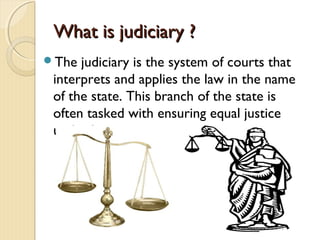
The judiciary is the system of courts that
interprets and applies the law in the name
of the state. This branch of the state is
often tasked with ensuring equal justice
under law.
Relation with Separation of PowersRelation with Separation of Powers
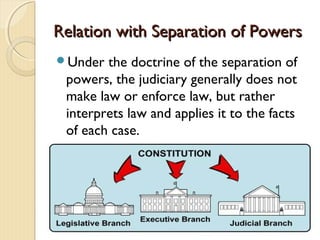
Under the doctrine of the separation of
powers, the judiciary generally does not
make law or enforce law, but rather
interprets law and applies it to the facts
of each case.
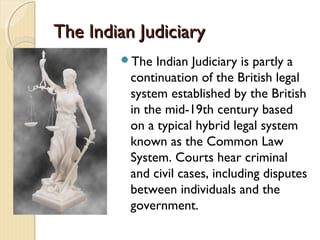
The Indian JudiciaryThe Indian Judiciary
The Indian Judiciary is partly a
continuation of the British legal
system established by the British
in the mid-19th century based
on a typical hybrid legal system
known as the Common Law
System. Courts hear criminal
and civil cases, including disputes
between individuals and the
government.
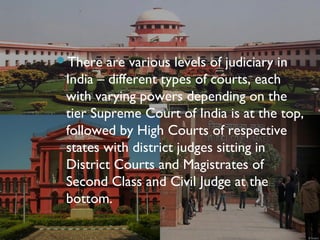
There are various levels of judiciary in
India – different types of courts, each
with varying powers depending on the
tier Supreme Court of India is at the top,
followed by High Courts of respective
states with district judges sitting in
District Courts and Magistrates of
Second Class and Civil Judge at the
bottom.
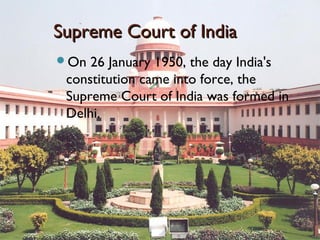
Supreme Court of IndiaSupreme Court of India
On 26 January 1950, the day India's
constitution came into force, the
Supreme Court of India was formed in
Delhi.
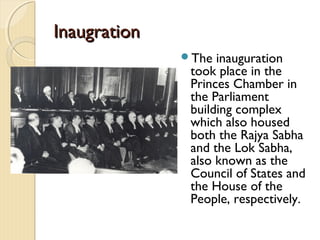
InaugrationInaugration
The inauguration
took place in the
Princes Chamber in
the Parliament
building complex
which also housed
both the Rajya Sabha
and the Lok Sabha,
also known as the
Council of States and
the House of the
People, respectively.
High courtsHigh courts
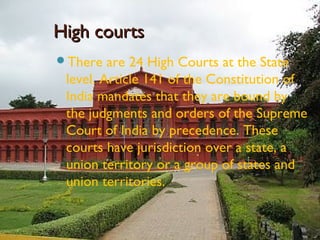
There are 24 High Courts at the State
level. Article 141 of the Constitution of
India mandates that they are bound by
the judgments and orders of the Supreme
Court of India by precedence. These
courts have jurisdiction over a state, a
union territory or a group of states and
union territories.
District courtsDistrict courts
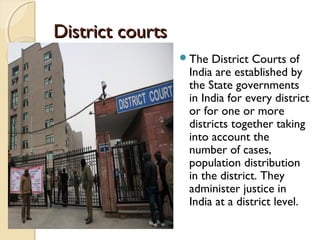
The District Courts of
India are established by
the State governments
in India for every district
or for one or more
districts together taking
into account the
number of cases,
population distribution
in the district. They
administer justice in
India at a district level.
Village courtsVillage courts
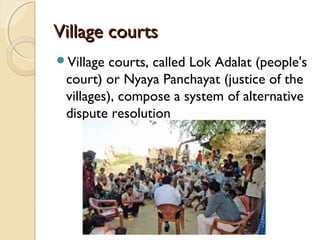
Village courts, called Lok Adalat (people's
court) or Nyaya Panchayat (justice of the
villages), compose a system of alternative
dispute resolution
Judicial corruptionJudicial corruption
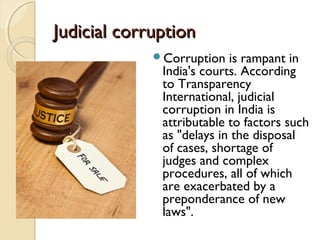
Corruption is rampant in
India's courts. According
to Transparency
International, judicial
corruption in India is
attributable to factors such
as "delays in the disposal
of cases, shortage of
judges and complex
procedures, all of which
are exacerbated by a
preponderance of new
laws".
E-Courts Mission Mode ProjectE-Courts Mission Mode Project
The E-courts project was established in
the year 2005.[23] According to the
project, all the courts including taluk
courts will get computerised. As per the
project in 2008, all the District courts
were initialised under the project. In
2010, all the District court were
computerised.
The entry of back log case has started.
The IT department had one system
officer and two system assistants in each
court. They initiated the services in the
Supreme Court in June 2011.
Common man and judiciary

Common man and judiciary

  • 1.
  • 3.
    What is judiciary?What is judiciary ? The judiciary is the system of courts that interprets and applies the law in the name of the state. This branch of the state is often tasked with ensuring equal justice under law.
  • 4.
    Relation with Separationof PowersRelation with Separation of Powers Under the doctrine of the separation of powers, the judiciary generally does not make law or enforce law, but rather interprets law and applies it to the facts of each case.
  • 5.
    The Indian JudiciaryTheIndian Judiciary The Indian Judiciary is partly a continuation of the British legal system established by the British in the mid-19th century based on a typical hybrid legal system known as the Common Law System. Courts hear criminal and civil cases, including disputes between individuals and the government.
  • 6.
    There are variouslevels of judiciary in India – different types of courts, each with varying powers depending on the tier Supreme Court of India is at the top, followed by High Courts of respective states with district judges sitting in District Courts and Magistrates of Second Class and Civil Judge at the bottom.
  • 7.
    Supreme Court ofIndiaSupreme Court of India On 26 January 1950, the day India's constitution came into force, the Supreme Court of India was formed in Delhi.
  • 8.
    InaugrationInaugration The inauguration took placein the Princes Chamber in the Parliament building complex which also housed both the Rajya Sabha and the Lok Sabha, also known as the Council of States and the House of the People, respectively.
  • 9.
    High courtsHigh courts Thereare 24 High Courts at the State level. Article 141 of the Constitution of India mandates that they are bound by the judgments and orders of the Supreme Court of India by precedence. These courts have jurisdiction over a state, a union territory or a group of states and union territories.
  • 10.
    District courtsDistrict courts TheDistrict Courts of India are established by the State governments in India for every district or for one or more districts together taking into account the number of cases, population distribution in the district. They administer justice in India at a district level.
  • 11.
    Village courtsVillage courts Villagecourts, called Lok Adalat (people's court) or Nyaya Panchayat (justice of the villages), compose a system of alternative dispute resolution
  • 12.
    Judicial corruptionJudicial corruption Corruptionis rampant in India's courts. According to Transparency International, judicial corruption in India is attributable to factors such as "delays in the disposal of cases, shortage of judges and complex procedures, all of which are exacerbated by a preponderance of new laws".
  • 13.
    E-Courts Mission ModeProjectE-Courts Mission Mode Project The E-courts project was established in the year 2005.[23] According to the project, all the courts including taluk courts will get computerised. As per the project in 2008, all the District courts were initialised under the project. In 2010, all the District court were computerised.
  • 14.
    The entry ofback log case has started. The IT department had one system officer and two system assistants in each court. They initiated the services in the Supreme Court in June 2011.