Update on software as a medical device (SaMD)
The TGA and IMDRF perspectives
David Hau
Medical Officer
Devices Clinical Section, Medical Devices Branch
Medical Devices and Product Quality Division, TGA
Digital Health Show 2017
30 March 2017
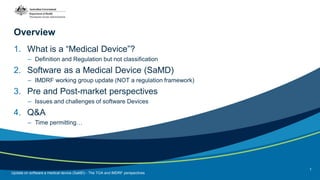
Overview
1. What is a “Medical Device”?
– Definition and Regulation but not classification
2. Software as a Medical Device (SaMD)
– IMDRF working group update (NOT a regulation framework)
3. Pre and Post-market perspectives
– Issues and challenges of software Devices
4. Q&A
– Time permitting…
Update on software a medical device (SaMD) - The TGA and IMDRF perspectives
1
Is it a “device”? Definition
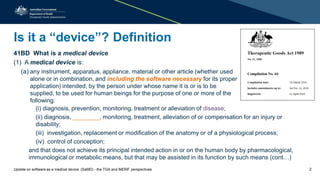
41BD What is a medical device
(1) A medical device is:
(a) any instrument, apparatus, appliance, material or other article (whether used
alone or in combination, and including the software necessary for its proper
application) intended, by the person under whose name it is or is to be
supplied, to be used for human beings for the purpose of one or more of the
following:
(i) diagnosis, prevention, monitoring, treatment or alleviation of disease;
(ii) diagnosis, ________, monitoring, treatment, alleviation of or compensation for an injury or
disability;
(iii) investigation, replacement or modification of the anatomy or of a physiological process;
(iv) control of conception;
and that does not achieve its principal intended action in or on the human body by pharmacological,
immunological or metabolic means, but that may be assisted in its function by such means (cont…)
Update on software as a medical device (SaMD) - the TGA and IMDRF perspectives 2
Is it a “device”? Definition
41BD What is a medical device (cont.)
…and that does not achieve its principal intended action in or on the human body by pharmacological,
immunological or metabolic means, but that may be assisted in its function by such means; or
(aa) any instrument, apparatus, appliance, material or other article specified under
subsection (2A); or
(ab) any instrument, apparatus, appliance, material or other article that is included in a class of
instruments, apparatus, appliances, materials or other articles specified under subsection (2B); or
(b) an accessory to an instrument, apparatus, appliance, material or other article covered by
paragraph (a), (aa) or (ab).
Note: Declarations under subsection (3) exclude articles from the scope of this definition. Declarations
under section 7 can also have this effect: see subsection 7(4).
Update on software as a medical device (SaMD) - the TGA and IMDRF perspectives 3
Is it a “device”? What’s the Intended Purpose?
41BD 2 Intended Purpose
• “Intended Purpose” is to be derived from labelling, instructions, advertising material and technical
documentation, provided by the Legal Manufacturer
– (the person under whose name the main equipment).
41BD 2 Intended Purpose
• “Intended Purpose” is to be derived from labelling, instructions, advertising material and technical
documentation, provided by the Legal Manufacturer
– (the person under whose name the main equipment).
• NOTE:
– The Secretary may declare particular things, devices, classes, types,
or articles to be Medical Devices
… or NOT!
– Such a declaration under this section does not stop articles from being
therapeutic goods.
– Such a declaration takes effect on the day on which the declaration is
published – unless specified.
• NOTE:
– The Secretary may declare particular things, devices, classes, types,
or articles to be Medical Devices
… or NOT!
– Such a declaration under this section does not stop articles from being
therapeutic goods.
– Such a declaration takes effect on the day on which the declaration is
published – unless specified.
Update on software as a medical device (SaMD) - the TGA and IMDRF perspectives 4
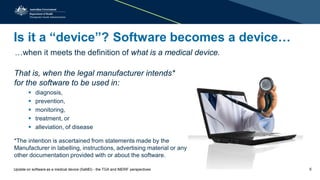
Is it a “device”? Software becomes a device…
…when it meets the definition of what is a medical device.
That is, when the legal manufacturer intends*
for the software to be used in:
 diagnosis,
 prevention,
 monitoring,
 treatment, or
 alleviation, of disease
*The intention is ascertained from statements made by the
Manufacturer in labelling, instructions, advertising material or any
other documentation provided with or about the software.
5Update on software as a medical device (SaMD) - the TGA and IMDRF perspectives
Is all “medical software” regulated by TGA?
• NO (please see previous discussion)
• EXCLUSIONS may include:
– Software that is limited to managing and presenting information (HIS, dosage calculator)
– Software that are simply sources of information (like a textbook) or advice to health professionals or
consumers
 (except if it relates to the advertising of therapeutic goods, labelling, and instructions for use)
6
• INCLUDED likely includes
– Software that has a role in diagnosing or managing illness
– Software that analyses clinical data, such as the results of blood
tests or ECGs
• The TGA already regulates medical device software used for
therapeutic purposes under the medical devices regulatory framework.
Mobile apps would be considered within this framework.
Update on software as a medical device (SaMD) - the TGA and IMDRF perspectives
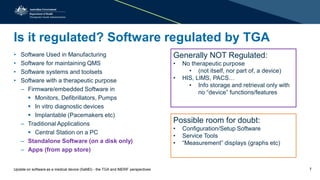
Is it regulated? Software regulated by TGA
• Software Used in Manufacturing
• Software for maintaining QMS
• Software systems and toolsets
• Software with a therapeutic purpose
– Firmware/embedded Software in
 Monitors, Defibrillators, Pumps
 In vitro diagnostic devices
 Implantable (Pacemakers etc)
– Traditional Applications
 Central Station on a PC
– Standalone Software (on a disk only)
– Apps (from app store)
Generally NOT Regulated:
• No therapeutic purpose
• (not itself, nor part of, a device)
• HIS, LIMS, PACS…
• Info storage and retrieval only with
no “device” functions/features
Possible room for doubt:
• Configuration/Setup Software
• Service Tools
• “Measurement” displays (graphs etc)
7Update on software as a medical device (SaMD) - the TGA and IMDRF perspectives
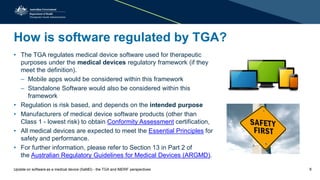
How is software regulated by TGA?
• The TGA regulates medical device software used for therapeutic
purposes under the medical devices regulatory framework (if they
meet the definition).
– Mobile apps would be considered within this framework
– Standalone Software would also be considered within this
framework
• Regulation is risk based, and depends on the intended purpose
• Manufacturers of medical device software products (other than
Class 1 - lowest risk) to obtain Conformity Assessment certification,
• All medical devices are expected to meet the Essential Principles for
safety and performance.
• For further information, please refer to Section 13 in Part 2 of
the Australian Regulatory Guidelines for Medical Devices (ARGMD).
8Update on software as a medical device (SaMD) - the TGA and IMDRF perspectives
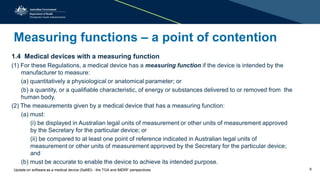
Measuring functions – a point of contention
1.4 Medical devices with a measuring function
(1) For these Regulations, a medical device has a measuring function if the device is intended by the
manufacturer to measure:
(a) quantitatively a physiological or anatomical parameter; or
(b) a quantity, or a qualifiable characteristic, of energy or substances delivered to or removed from the
human body.
(2) The measurements given by a medical device that has a measuring function:
(a) must:
(i) be displayed in Australian legal units of measurement or other units of measurement approved
by the Secretary for the particular device; or
(ii) be compared to at least one point of reference indicated in Australian legal units of
measurement or other units of measurement approved by the Secretary for the particular device;
and
(b) must be accurate to enable the device to achieve its intended purpose.
Update on software as a medical device (SaMD) - the TGA and IMDRF perspectives 9
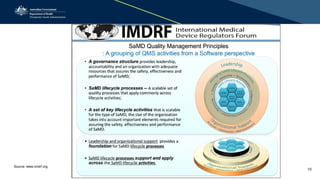
Source: www.imdrf.org
10
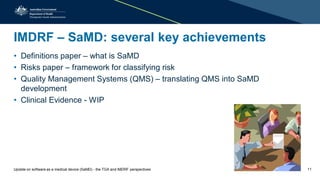
IMDRF – SaMD: several key achievements
• Definitions paper – what is SaMD
• Risks paper – framework for classifying risk
• Quality Management Systems (QMS) – translating QMS into SaMD
development
• Clinical Evidence - WIP
Update on software as a medical device (SaMD) - the TGA and IMDRF perspectives 11
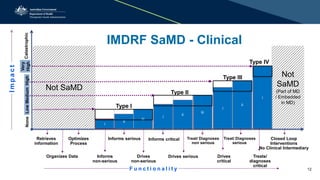
IMDRF SaMD - Clinical
Not SaMD
Retrieves
information
Organizes Data
Informs serious
Informs
non-serious
Closed Loop
Interventions
No Clinical Intermediary
Optimizes
Process
CatastrophicHighMediumLowNone
Impact
Not
SaMD
(Part of MD
/ Embedded
in MD)
i
i
i
i
F u n c t i o n a l i t y
Informs critical
Drives
non-serious
Drives serious
Treat/ Diagnoses
non serious
Drives
critical
Treat/ Diagnoses
serious
Treats/
diagnoses
critical
ii
iii
ii
iii
ii
Very
High
Type I
Type II
Type III
Type IV
12
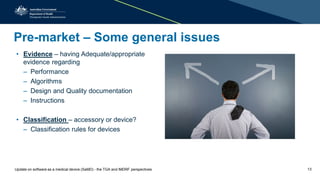
Pre-market – Some general issues
• Evidence – having Adequate/appropriate
evidence regarding
– Performance
– Algorithms
– Design and Quality documentation
– Instructions
• Classification – accessory or device?
– Classification rules for devices
Update on software as a medical device (SaMD) - the TGA and IMDRF perspectives 13
Post-market – some general issues
• Feature Creep - crossing the definitional line,
one feature at a time
• E.g. a blood sugar level (BSL) tracking app:
– Record BSL (rev 1.0)
– Graph BSL (rev 1.3)
– Trend BSL (rev 2.3)
– Alert BSL (rev 2.7)
• Blind to the Regs – not being aware of
building a regulated Medical Device
– Home tinkerers
– An “obvious” extension of an existing
product – remote view
• Feature obfuscation – deliberate “de-
emphasising” of features to down-classify
a device – practiced in USA
• Media and Public Interest – matching the
promise to reality
– Health market to reach $26 billion by
2017 (was just $700 million in 2011!)
Update on software as a medical device (SaMD) - the TGA and IMDRF perspectives 14
Post-market incidents and complaints
• Learning to recognise reportable incidents
is a big challenge – users may think…
– Software issues are managed by a
“reboot” – so no report is needed…
wrong.
– Software issues are misidentified as
“user issues” – no report needed…
wrong.
• Software issues most evident immediately
after an update/upgrade
• Upward trends (relating to quality) are
reportable
• Capturing and tracking incidents and
complaints – a big challenge
• Linking incidents to risk management –
closing the feedback loop
• TGA’s Recognise, Retain, and Report
campaign
Update on software as a medical device (SaMD) - the TGA and IMDRF perspectives 15
Post-market regulatory actions
Challenges
• Safety related updates under URPTG –
not widely known in Software industry
• Software expected to follow IEC 62304 –
recognised as state-of-the-art – linked to
Essential Principles
• Proliferation of “manufacturers” – with
limited or no medical domain knowledge
• Software recalls - fixed by the time its
reported
Benefits
• Software recalls - fixed “overnight” -
everywhere, globally...
• Feedback in stores for possible complaint
records
• Some ecosystems (e.g. Apple) can “force”
updates or disabling of features and apps
Update on software as a medical device (SaMD) - the TGA and IMDRF perspectives 16
Summary
• What is a “Medical Device”?
– Something that meets the definition in the Act
• Software as a Medical Device (SaMD)
– If it looks like a duck…
– IMDRF paper open for comment
• Post-market Perspectives
– Tracking and reporting incidents
– Updates aligned to correct regulatory pathway
• Q&A (Time permitting…)
Update on software as a medical device (SaMD) - The TGA and IMDRF perspectives
17
Advice on software/apps regulation
The TGA web statement – worth a read:
• www.tga.gov.au/regulation-medical-software-and-mobile-medical-apps
Some highlights follow…
Other useful sources:
• FDA: Mobile Apps Guidance
www.fda.gov/downloads/MedicalDevices/DeviceRegulationandGuidance/GuidanceDocuments/UCM263366.pdf
• IMDRF: SaMD – more on that shortly
www.imdrf.org/consultations/cons-samd-aqms-150326.asp
Update on software as a medical device (SaMD) - the TGA and IMDRF perspectives 18
Update on software as a medical device (SaMD)

Update on software as a medical device (SaMD)

  • 1.
    Update on softwareas a medical device (SaMD) The TGA and IMDRF perspectives David Hau Medical Officer Devices Clinical Section, Medical Devices Branch Medical Devices and Product Quality Division, TGA Digital Health Show 2017 30 March 2017
  • 2.
    Overview 1. What isa “Medical Device”? – Definition and Regulation but not classification 2. Software as a Medical Device (SaMD) – IMDRF working group update (NOT a regulation framework) 3. Pre and Post-market perspectives – Issues and challenges of software Devices 4. Q&A – Time permitting… Update on software a medical device (SaMD) - The TGA and IMDRF perspectives 1
  • 3.
    Is it a“device”? Definition 41BD What is a medical device (1) A medical device is: (a) any instrument, apparatus, appliance, material or other article (whether used alone or in combination, and including the software necessary for its proper application) intended, by the person under whose name it is or is to be supplied, to be used for human beings for the purpose of one or more of the following: (i) diagnosis, prevention, monitoring, treatment or alleviation of disease; (ii) diagnosis, ________, monitoring, treatment, alleviation of or compensation for an injury or disability; (iii) investigation, replacement or modification of the anatomy or of a physiological process; (iv) control of conception; and that does not achieve its principal intended action in or on the human body by pharmacological, immunological or metabolic means, but that may be assisted in its function by such means (cont…) Update on software as a medical device (SaMD) - the TGA and IMDRF perspectives 2
  • 4.
    Is it a“device”? Definition 41BD What is a medical device (cont.) …and that does not achieve its principal intended action in or on the human body by pharmacological, immunological or metabolic means, but that may be assisted in its function by such means; or (aa) any instrument, apparatus, appliance, material or other article specified under subsection (2A); or (ab) any instrument, apparatus, appliance, material or other article that is included in a class of instruments, apparatus, appliances, materials or other articles specified under subsection (2B); or (b) an accessory to an instrument, apparatus, appliance, material or other article covered by paragraph (a), (aa) or (ab). Note: Declarations under subsection (3) exclude articles from the scope of this definition. Declarations under section 7 can also have this effect: see subsection 7(4). Update on software as a medical device (SaMD) - the TGA and IMDRF perspectives 3
  • 5.
    Is it a“device”? What’s the Intended Purpose? 41BD 2 Intended Purpose • “Intended Purpose” is to be derived from labelling, instructions, advertising material and technical documentation, provided by the Legal Manufacturer – (the person under whose name the main equipment). 41BD 2 Intended Purpose • “Intended Purpose” is to be derived from labelling, instructions, advertising material and technical documentation, provided by the Legal Manufacturer – (the person under whose name the main equipment). • NOTE: – The Secretary may declare particular things, devices, classes, types, or articles to be Medical Devices … or NOT! – Such a declaration under this section does not stop articles from being therapeutic goods. – Such a declaration takes effect on the day on which the declaration is published – unless specified. • NOTE: – The Secretary may declare particular things, devices, classes, types, or articles to be Medical Devices … or NOT! – Such a declaration under this section does not stop articles from being therapeutic goods. – Such a declaration takes effect on the day on which the declaration is published – unless specified. Update on software as a medical device (SaMD) - the TGA and IMDRF perspectives 4
  • 6.
    Is it a“device”? Software becomes a device… …when it meets the definition of what is a medical device. That is, when the legal manufacturer intends* for the software to be used in:  diagnosis,  prevention,  monitoring,  treatment, or  alleviation, of disease *The intention is ascertained from statements made by the Manufacturer in labelling, instructions, advertising material or any other documentation provided with or about the software. 5Update on software as a medical device (SaMD) - the TGA and IMDRF perspectives
  • 7.
    Is all “medicalsoftware” regulated by TGA? • NO (please see previous discussion) • EXCLUSIONS may include: – Software that is limited to managing and presenting information (HIS, dosage calculator) – Software that are simply sources of information (like a textbook) or advice to health professionals or consumers  (except if it relates to the advertising of therapeutic goods, labelling, and instructions for use) 6 • INCLUDED likely includes – Software that has a role in diagnosing or managing illness – Software that analyses clinical data, such as the results of blood tests or ECGs • The TGA already regulates medical device software used for therapeutic purposes under the medical devices regulatory framework. Mobile apps would be considered within this framework. Update on software as a medical device (SaMD) - the TGA and IMDRF perspectives
  • 8.
    Is it regulated?Software regulated by TGA • Software Used in Manufacturing • Software for maintaining QMS • Software systems and toolsets • Software with a therapeutic purpose – Firmware/embedded Software in  Monitors, Defibrillators, Pumps  In vitro diagnostic devices  Implantable (Pacemakers etc) – Traditional Applications  Central Station on a PC – Standalone Software (on a disk only) – Apps (from app store) Generally NOT Regulated: • No therapeutic purpose • (not itself, nor part of, a device) • HIS, LIMS, PACS… • Info storage and retrieval only with no “device” functions/features Possible room for doubt: • Configuration/Setup Software • Service Tools • “Measurement” displays (graphs etc) 7Update on software as a medical device (SaMD) - the TGA and IMDRF perspectives
  • 9.
    How is softwareregulated by TGA? • The TGA regulates medical device software used for therapeutic purposes under the medical devices regulatory framework (if they meet the definition). – Mobile apps would be considered within this framework – Standalone Software would also be considered within this framework • Regulation is risk based, and depends on the intended purpose • Manufacturers of medical device software products (other than Class 1 - lowest risk) to obtain Conformity Assessment certification, • All medical devices are expected to meet the Essential Principles for safety and performance. • For further information, please refer to Section 13 in Part 2 of the Australian Regulatory Guidelines for Medical Devices (ARGMD). 8Update on software as a medical device (SaMD) - the TGA and IMDRF perspectives
  • 10.
    Measuring functions –a point of contention 1.4 Medical devices with a measuring function (1) For these Regulations, a medical device has a measuring function if the device is intended by the manufacturer to measure: (a) quantitatively a physiological or anatomical parameter; or (b) a quantity, or a qualifiable characteristic, of energy or substances delivered to or removed from the human body. (2) The measurements given by a medical device that has a measuring function: (a) must: (i) be displayed in Australian legal units of measurement or other units of measurement approved by the Secretary for the particular device; or (ii) be compared to at least one point of reference indicated in Australian legal units of measurement or other units of measurement approved by the Secretary for the particular device; and (b) must be accurate to enable the device to achieve its intended purpose. Update on software as a medical device (SaMD) - the TGA and IMDRF perspectives 9
  • 11.
  • 12.
    IMDRF – SaMD:several key achievements • Definitions paper – what is SaMD • Risks paper – framework for classifying risk • Quality Management Systems (QMS) – translating QMS into SaMD development • Clinical Evidence - WIP Update on software as a medical device (SaMD) - the TGA and IMDRF perspectives 11
  • 13.
    IMDRF SaMD -Clinical Not SaMD Retrieves information Organizes Data Informs serious Informs non-serious Closed Loop Interventions No Clinical Intermediary Optimizes Process CatastrophicHighMediumLowNone Impact Not SaMD (Part of MD / Embedded in MD) i i i i F u n c t i o n a l i t y Informs critical Drives non-serious Drives serious Treat/ Diagnoses non serious Drives critical Treat/ Diagnoses serious Treats/ diagnoses critical ii iii ii iii ii Very High Type I Type II Type III Type IV 12
  • 14.
    Pre-market – Somegeneral issues • Evidence – having Adequate/appropriate evidence regarding – Performance – Algorithms – Design and Quality documentation – Instructions • Classification – accessory or device? – Classification rules for devices Update on software as a medical device (SaMD) - the TGA and IMDRF perspectives 13
  • 15.
    Post-market – somegeneral issues • Feature Creep - crossing the definitional line, one feature at a time • E.g. a blood sugar level (BSL) tracking app: – Record BSL (rev 1.0) – Graph BSL (rev 1.3) – Trend BSL (rev 2.3) – Alert BSL (rev 2.7) • Blind to the Regs – not being aware of building a regulated Medical Device – Home tinkerers – An “obvious” extension of an existing product – remote view • Feature obfuscation – deliberate “de- emphasising” of features to down-classify a device – practiced in USA • Media and Public Interest – matching the promise to reality – Health market to reach $26 billion by 2017 (was just $700 million in 2011!) Update on software as a medical device (SaMD) - the TGA and IMDRF perspectives 14
  • 16.
    Post-market incidents andcomplaints • Learning to recognise reportable incidents is a big challenge – users may think… – Software issues are managed by a “reboot” – so no report is needed… wrong. – Software issues are misidentified as “user issues” – no report needed… wrong. • Software issues most evident immediately after an update/upgrade • Upward trends (relating to quality) are reportable • Capturing and tracking incidents and complaints – a big challenge • Linking incidents to risk management – closing the feedback loop • TGA’s Recognise, Retain, and Report campaign Update on software as a medical device (SaMD) - the TGA and IMDRF perspectives 15
  • 17.
    Post-market regulatory actions Challenges •Safety related updates under URPTG – not widely known in Software industry • Software expected to follow IEC 62304 – recognised as state-of-the-art – linked to Essential Principles • Proliferation of “manufacturers” – with limited or no medical domain knowledge • Software recalls - fixed by the time its reported Benefits • Software recalls - fixed “overnight” - everywhere, globally... • Feedback in stores for possible complaint records • Some ecosystems (e.g. Apple) can “force” updates or disabling of features and apps Update on software as a medical device (SaMD) - the TGA and IMDRF perspectives 16
  • 18.
    Summary • What isa “Medical Device”? – Something that meets the definition in the Act • Software as a Medical Device (SaMD) – If it looks like a duck… – IMDRF paper open for comment • Post-market Perspectives – Tracking and reporting incidents – Updates aligned to correct regulatory pathway • Q&A (Time permitting…) Update on software as a medical device (SaMD) - The TGA and IMDRF perspectives 17
  • 19.
    Advice on software/appsregulation The TGA web statement – worth a read: • www.tga.gov.au/regulation-medical-software-and-mobile-medical-apps Some highlights follow… Other useful sources: • FDA: Mobile Apps Guidance www.fda.gov/downloads/MedicalDevices/DeviceRegulationandGuidance/GuidanceDocuments/UCM263366.pdf • IMDRF: SaMD – more on that shortly www.imdrf.org/consultations/cons-samd-aqms-150326.asp Update on software as a medical device (SaMD) - the TGA and IMDRF perspectives 18