PMDA in Japan
Ø PMDA is the main regulatory body of PMDA located in- Tokyo
Ø PMDA (Pharmaceuticals and Medical Devices Agency) is Japanese regulatory agency, working
together with Ministry of health and labour welfare (MHLW).
Ø It was established in April 01, 2004
Ø to serve in areas of review of drugs and medical devices, post-marketing safety measures, relief
services for adverse health effects.
Ø Our obligation is to protect the public health by assuring safety, efficacy and quality of
pharmaceuticals and medical devices.
Ø The role of the PMDA is to provide consultations concerning the clinical trials of new drugs and
medical devices, and to conduct approval reviews and surveys of the reliability of application data
— Capital -- Tokyo
— Language -- Japanese
— Ethnic groups -- 98.5% Japanese
0.5% Korea
0.4 % Brazilian
— Currency -- yen
— Market status -- second largest pharmaceutical marketing the world.
— PMDA-JAPAN is carried out by Chief Executive Tatsuya Kondo.
— PMDA focuses on 3 key services, which is a Safety triangle system.
a
Organization of PMDA:-
Ø It consists 27 0ffices
Ø It consists of the ministry proper, affiliated institutions, councils, local branches, and
external organizations.
Ø The ministry proper includes the Minister's Secretariat, 11 bureaus, and the Director-
General for Policy Planning and Evaluation.
Ø Councils include the Social Insurance Council, Pharmaceutical Affairs and Food Sanitation
Council (PAFSC), and other organizations.
Ø Affiliated institutions include the National Institute of Health Sciences and the National
Institute of Infectious Diseases.
Ø Local branches are regional bureaus of health and welfare and prefectural labor bureaus.
The external organizations are the Social Insurance Agency and the Central Labor Relations
Commission
Organization chart
PMDA three major functions:-
Pharmaceutical laws and regulations:-
Ø Pharmaceutical administration in Japan is based on various laws and regulations, consisting
mainly of:
1. The Drugs and Medical Devices Law,
2. Law Concerning the Establishment for Pharmaceuticals and Medical Devices
Organization,
3. Law Concerning Securing Stable Supply of Blood Products,
4. Poisonous and Deleterious Substances Control Law
5. Narcotics and Psychotropic Control Law
6. Cannabis Control Law,
7. Opium Law, and
8. Stimulants Control Law.
Required document:-
Ø Application form (written).
Ø Application letter (XML).
Ø Protocols.
Ø Case report form.
Ø IB ( investigator brochure).
Ø Written reason with appropriate request for clinical trials.
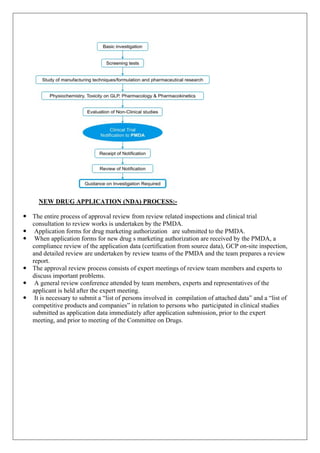
INVESTIGATIONAL NEW DRUG (IND) APPLICATION PROSESS:-
Ø IND application to be prepared in the common technical document format (CTD) format.
Ø Pre-IND meeting.
Ø Subsequent to the application submission, PMDA evaluates the application with respect to the
preclinical data and protocols for clinical studies etc.
Ø It may probably take 30 days for initial IND and 14 days for second IND.
Ø After PMDA completes the review, the IND fill will be transferred to the IRB board for the
review.
Ø IRB takes 1-4 weeks of time for the complete review.
Ø Once IRB approved the review than the clinical trials on human beings will be started.
NEW DRUG APPLICATION (NDA) PROCESS:-
— The entire process of approval review from review related inspections and clinical trial
consultation to review works is undertaken by the PMDA.
— Application forms for drug marketing authorization are submitted to the PMDA.
— When application forms for new drug s marketing authorization are received by the PMDA, a
compliance review of the application data (certification from source data), GCP on-site inspection,
and detailed review are undertaken by review teams of the PMDA and the team prepares a review
report.
— The approval review process consists of expert meetings of review team members and experts to
discuss important problems.
— A general review conference attended by team members, experts and representatives of the
applicant is held after the expert meeting.
— It is necessary to submit a “list of persons involved in compilation of attached data” and a “list of
competitive products and companies” in relation to persons who participated in clinical studies
submitted as application data immediately after application submission, prior to the expert
meeting, and prior to meeting of the Committee on Drugs.
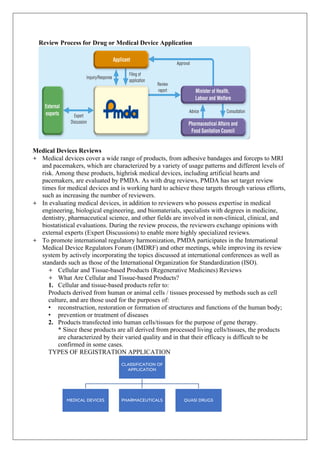
PMDA review process
The evaluation process followed by the PMDA is as follows:
1. Interview (presentation, inquiries, and replies)
2. Team review
3. Inquiries and replies
4. Application for GMP inspection (about 6 months before the meeting of the Committee on
Drugs)
5. Review report (1)
6. Expert meeting
7. Review report (2)
8. Report to MHLW for consultation to PAFSC
COMPLETE OVERVIEW OF APPROVAL PROCESS IN JAPAN
JAPANESE PHARMACEUTICAL LAW
1. Pharmaceutical affair law
2. Pharmacist Law
3. Law Concerning the Establishment for Pharmaceuticals and Medical Devices Organization
4. Law Concerning Securing Stable Supply of Blood Products
5. Poisonous and Deleterious Substances Control Law,
6. Narcotics and Psychotropics Control Law,
7. Cannabis Control Law,
8. Opium Law
9. Stimulants Control Law Copyright
Pharmaceutical affairs law has 11 chapters and 91 articles
+ Chapter 1—general provisions
+ Chapter 2: Prefectural pharmaceutical affairs councils
+ Chapter 7: Handling of drugs
+ Chapter 9-2: Handling of designated drug substances
+ Chapter 9-3: Designation of orphan drug
CLASSIFICATION OF DRUG PRODUCTS
1. ETHICAL DRUGS
2. PRESCRIPTION DRUGS
3. OTC DRUGS
Class I drug products
Class II drug products
Class III drug products
4. ORPHAN DRUGS
APPROVAL APPLICATION FOR MARKETING A DRUG
• When marketing a drug, it is necessary to obtain approval for each product by receiving
examinations on both its efficacy and safety.
• Only a MAH license holder can submit an approval application for a product.
• To obtain product approval, the manufacturer in Japan needs to be licensed. For a foreign
manufacturer, a Foreign Manufacturer Accredited Certificate (FMA) is required.
• The application is sent to the PMDA and further examination is mainly conducted by this
agency
APPLICATION FEE FOR A NEW DRUG
DESCRIPTION TOTAL FEE( YEN)
1. Drug containing new ingredient, drug for a new route of administration, drug
with a new combination, biotechnology based existing drug (excluding an orphan
drug)
31,068,900
2. Drug containing new ingredient, drug for a new route of administration, drug
with a new combination, biotechnology based existing drug (orphan drug)
23,847,800
3. Drug with a new indication, drug with a new dosage form, drug for new dosage
and drug with similar formulation (excluding an orphan drug)
14,230,600
4. Drug with a new indication, drug with a new dosage form, drug for new dosage
and drug with similar formulation (orphan drug)
10,957,300
Required document :
REQUIRED DOCUMENT CONTENTS MODULES
Documents on origin or course of
discovery and usage
Status of development and comparison of package
insert with similar drug.
Module 1
Documents on manufacturing method
and test methods
Structure determination and physical – chemical
property
Module 3
Documents on stability Long term stability test, accelerated test Module 3
Documents on pharmacologic actions Test supporting efficacy /safety pharmacology Module 4
Documents on clinical test results Phase 1, phase 2, phase 3 Module Module 5
REVIEW PROCESS
+ Drugs Reviews
+ In the review of drug applications, PMDA reviewers, who have degrees in pharmaceutical
science, medicine, veterinary medicine, physical science, biostatistics, or other specialties,
form a team to evaluate the quality, pharmacology, pharmacokinetics, toxicology, clinical
implications, and biostatistics regarding the particular drug product under review. During the
review process, the reviewers exchange opinions with external experts (Expert Discussions) to
ensure that more effective reviews are conducted by making use of their advanced expertise.
In addition, PMDA participates in the International Conference on Harmonization of
Technical Requirements for Registration of Pharmaceuticals for Human Use (ICH) and has
actively incorporated the guidelines agreed upon at ICH into its drug reviews.
+ PMDA strives to speed up the review process by setting target review times, while clarifying
the standards for review by publishing the basic considerations for reviewers on its website.
PMDA’s drug reviews encompass not only new drugs but also generic drugs, OTC drugs /
“behind-the-counter (BTC)” drugs (requiring pharmacists’ advice) that can be purchased at
pharmacies without a doctor’s prescription, and quasi-drugs. PMDA also conducts re-
examinations and re-evaluations of approved drug products.
In FY 2013, a total of 7118 drugs were approved, of which 4008 were prescription drugs
(including 504 new drugs), 916 were OTC drugs / BTC drugs, 166 were in vitro diagnostics,
and 2028 were quasi-drugs.
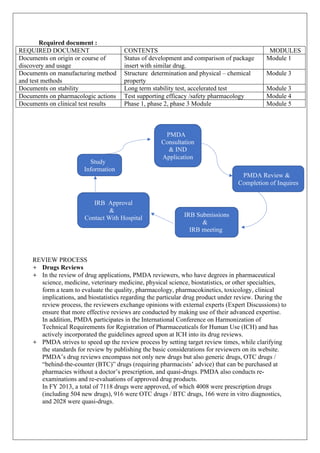
PMDA
Consultation
& IND
Application
PMDA Review &
Completion of Inquires
IRB Approval
&
Contact With Hospital IRB Submissions
&
IRB meeting
Reveiws
Study
Information
Review Process for Drug or Medical Device Application
Medical Devices Reviews
+ Medical devices cover a wide range of products, from adhesive bandages and forceps to MRI
and pacemakers, which are characterized by a variety of usage patterns and different levels of
risk. Among these products, highrisk medical devices, including artificial hearts and
pacemakers, are evaluated by PMDA. As with drug reviews, PMDA has set target review
times for medical devices and is working hard to achieve these targets through various efforts,
such as increasing the number of reviewers.
+ In evaluating medical devices, in addition to reviewers who possess expertise in medical
engineering, biological engineering, and biomaterials, specialists with degrees in medicine,
dentistry, pharmaceutical science, and other fields are involved in non-clinical, clinical, and
biostatistical evaluations. During the review process, the reviewers exchange opinions with
external experts (Expert Discussions) to enable more highly specialized reviews.
+ To promote international regulatory harmonization, PMDA participates in the International
Medical Device Regulators Forum (IMDRF) and other meetings, while improving its review
system by actively incorporating the topics discussed at international conferences as well as
standards such as those of the International Organization for Standardization (ISO).
+ Cellular and Tissue-based Products (Regenerative Medicines) Reviews
+ What Are Cellular and Tissue-based Products?
1. Cellular and tissue-based products refer to:
Products derived from human or animal cells / tissues processed by methods such as cell
culture, and are those used for the purposes of:
• reconstruction, restoration or formation of structures and functions of the human body;
• prevention or treatment of diseases
2. Products transfected into human cells/tissues for the purpose of gene therapy.
* Since these products are all derived from processed living cells/tissues, the products
are characterized by their varied quality and in that their efficacy is difficult to be
confirmed in some cases.
TYPES OF REGISTRATION APPLICATION
CLASSIFICATION OF
APPLICATION
MEDICAL DEVICES PHARMACEUTICALS QUASI DRUGS
CLASSIFICATION OF MEDICAL DEVICE
REGISTRATION OF MEDICAL DEVICES
+ Registration of medical devices and pharmaceuticals in Japan is complicated, and high costs
and long timeframes. In some cases, Japanese regulators require clinical trials in Japan to be
conducted.
+ Product registration in Japan needs to be pursued carefully and only after determining that
there is a strong market demand for your product
REGULATORY PATHWAY FOR MEDICAL DEVICE
TODOKEDE, NINSHO AND SHONIN FOR MEDICAL DEVICE IN JAPAN
+ To market medical devices in Japan, the MAH must register the device through the following
procedures.
+ Pre-market Submission (Todokede) - CLASS I Medical DEVICES
+ To register and market General Medical Devices (Class I devices), the MAH must file a Pre-
Market Submission to PMDA. There is no review/assessment by the PMDA for Class I
devices.
+ Pre-market Certification (Ninsho) - CLASS II MEDICAL DEVICES Only Class II
devices which are specified as Controlled Devices are subject to Pre-market Certification.
Class II devices other than Specified Controlled Devices are subject to Pre-market Approval
+ Pre-market Approval (Shonin) - CLASS II, III & IV MEDICAL DEVICES
+ To register and market a “Highly Controlled Medical Device” the MAH needs to file a Pre-
market Approval Application with the PMDA and obtain their approval. Class II devices
that are not Specified Controlled Devices are also subject to Pre-Market Approval
ACCREDITATION OF FOREIGN MANUFACTURERS
+ A foreign manufacturer (a person/ a company) intending to manufacture drugs, quasi-drugs,
or medical devices in foreign countries and export them to Japan, is required to be
accredited by the Minister of Health, Labour, and Welfare as an “Accredited Foreign
Manufacturer”.
+ In addition, a foreign manufacturer intending to manufacture only drug substances to be
exported to Japan also need to obtain accreditation as an “Accredited Foreign
Manufacturer”
PHARMACEUTICALS
+ An “Applicant” is required to submit “Application for Accreditation” (Form No. 18 in the
PAL Enforcement Regulations) that is addressed to the Minister, and “Application for
Accreditation Examination” [Form No.16- (2)]
+ Documents to Be Attached to Accreditation Application:-
+ A medical certificate from a physician which indicates whether or not an “Applicant” has
mental disorders or is addicted to narcotics, cannabis, opium or stimulant drugs.
+ A curriculum vitae of the person who is responsible to the manufacturing establishment
QUASI DRUGS
+ A medical certificate for an “Applicant” from a physician” and “a curriculum vitae of the
person who is responsible for the foreign manufacturing establishment.
+ In this case, the “Applicant” can omit filling out the space of “Address” in the section of
“Person who is responsible for manufacturing establishment
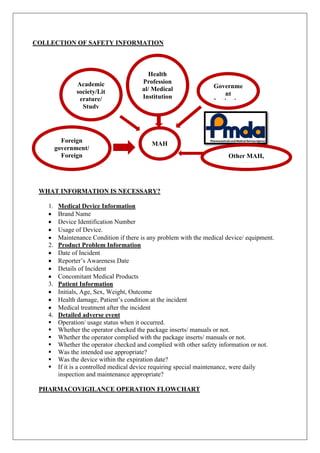
APPLICATION FOR CHANGE VS RENEWAL
CHANGE
+ must submit a form, “Application for Change/Addition” (Form No. 21 specified in the
PAL Enforcement Regulations)
+ accredited to new categories while cancelling their previously accredited categories.
RENEWAL
+ Unless an “Accredited Foreign Manufacturer” renews their accreditation, using a
form of “Application for Renewal of Accreditation” , within its 5 year effective
period, their accreditation becomes null and avoid. Form No – 20 is the application
for renewal
DMF IN JAPAN
Drug master file in japan:-
Ø A DMF is a system to register confidential data on quality manufacturing methods, etc. of a drug
substance used for a drug. Domestic and foreign drug manufacturers register their DMFs to the
PMDA on a voluntary basis
Ø The manufacturer of the drug substance can be reviewed by the competent Japanese authority
without sharing information containing details on its manufacturing methods, production
management and quality control with the manufacturers of the drug product.
Ø DMF is not a patent and cannot be approved/disapproved but can be registered for regulatory
review.
Ø Not required registration of MF
Ø DMF is reviewed at the time of the approval review for the pharmaceutical products listing
Ø DMF. At the time of DMF registration, PMDA checks whether it is written in the correct format,
e.g., minimum required items are included (application) and data is attached (CTD M3).
Drug approval system in japan:-
Ø The entire process of approval review from review related inspections and clinical trial
consultation to review works is undertaken by the PMDA.
Ø Application forms for approval to market drugs are usually submitted to the PMDA.
Ø When application forms for new drugs are received by the PMDA, a compliance review of the
application data (certification from source data), GCP on-site inspection, and detailed review are
undertaken by review teams of the PMDA and the team prepares a review report.
Ø Applicability of DMF in Japan: In Japan DMF can be submitted only for:
§ Drug Substances or intermediates (For medical use)
§ Cellular and tissue-based materials used for manufacturing
§ New and pre-mix excipients with different composition ratios from the existing ones
Qualification of MF Holder
• The MF holder can only be the actual manufacturer of the API
• DMF application cannot be accepted if the company performs only repackaging, packaging,
labeling, storage or testing of the AP
DMF Content in Japan
The name of the API, excipient or other drug substance
The manufacturing site
General Requirements for DMF Registration in Japan
CTD MODULE 3
Application form,
Notification and
other related
documents
Combined in a
Master File
PMDA
5
Application Process for Pharmaceutical Drug Product
Without Master File
API Manufacturer sends all
information including CTD – 3
Disclosed (open) and restricted
(closed) part to the Marketing
Authorization (MA) Applicant
The MA Applicant sends the
dossier to the PMDA for
approval
With Master File
API Manufacturer sends Dossier to In-
Country Caretaker
The In-Country caretaker registers the
MF and the Dossier holds a
Registration number
The API is registered to the PMDA and
posted on the website for reference to
other companies, keeping confidential
all the CTD-3 information
7
Registration Process of DMF in Japan
• Foreign Manufacturers had to hire an In-
Country caretaker to register an API in Japan
• The In-Country Caretaker submits the
Master file dossier and gets a MF number
• The Master file of the API is submitted to the
PMDA with the MF number
The ingredients, including quantity, chemical structure, and general properties
Manufacturing method, process controls, process validation, process development and material controls
Quality control testing, analytical procedures, validation of analytical procedures, justification of
specifications and excipients of human/animal origin information (if applicable)
Safety data
Non-clinical study data (primarily for new excipients)
Test methods, including impurities and description of methods for determining structure
Specifications, analytical procedures, validation of these procedures, batch analyses, justification of
specifications and reference standards/materials
Storage method, stability testing data, post-approval stability protocol and expiration date
AFM or domestic manufacturing license category, number and/or date
ICC name and add ress
PMDA Timeline (Business Days)
PMDA Issuance of DMF certificate/form 43 60 business days after approval
PMDA Publishing non-confidential DFM
update on PMDA homepage
15 days after issuance of Form 43
Changes to the registred DMF
1. Minor changes
the MF registrants submit the minor change notification along with application of chnge to the
PMDA and MHLW
2. Partial changes
The MA holder submit the partial change application to MHLW and PMDA
3. Cancellation of DMF
The notification (original 1), statement and an original MF certificate is submitted to the
PMDA.
• To protect the “know-how” of API manufacturing methods from the marketing
authorization applicant (MAA) / holder (MAH) of pharmaceutical products.(* MF is not a
patent.) Registration in the MF is optional, not required by law. An MF registration
certificate is not a marketing certificate.
• In a regulatory review, items registered in the MF are quoted as information necessary for
the review. Some of these items will be approval items.
PMDA Review Process of Drug Application
Referencing DMF
Pharmaceutical
manufacturer (applicant)
Safety, Quality and
efficacy data
Drug substance
manufacturers
Quality and Manufacturing
methods data
PMDA review
Application
data
DMF registration
Number
Register quality and
manufacturing method
data
Reviewed as
complete data
Non-disclosure
information (excludes
public health safety )
9
• Foreign manufacturers applying for MF registration must appoint an in-country caretaker
for drug substances (APIs), etc.
Ø Not required by law
Ø No fee for MF registration
The Application Form, Notification, And Other Related Documents
Ø CTD module 3 must in English
Ø Application Form, Notification, And Other Related Documents for pharmaceuticals which
are submitted to PMDA, written in Japanese
Ø an in-country caretaker for drug substances (APIs) etc., who lives in Japan and will
undertake clerical work for the relevant registration.
Application for Registration of Drug Substances, etc.
Application (Original 1, Duplicate 1; Duplicate must not be a Xerox
copy of Original)
Data of Application for MF Registration(including CTD Module3*)
*The CTD M3 submits only electronic data.
More in ppt DMF IN Japan
POST MARKETING SURVEILANCE IN JAPAN
• Post marketing surveillance (PMS), also known as post market surveillance, is the
practice of monitoring the safety of a pharmaceutical drug or medical device after it has
been released on the market and is an important part of the science
of pharmacovigilance.
• In JAPAN, Post market surveillance is overseen by both the Pharmaceuticals and
Medical Devices Agency (PMDA) and the Ministry of Health, Labor and
Welfare (MHLW).
GOOD VIGILANCE PRACTICE
(GVP)
GOOD POST-MARKETING
STUDY (GPSP)
Collection & Analysis of
Safety Information
Planning & Execution of
Safety Measures FSCA-
Report to authority, etc.
In-house Inspection
Training/ Education of
Relevant Staff
Preparation of SOPs on the
above
Post-Marketing clinical
study
Specified-Use survey
Use-Result survey
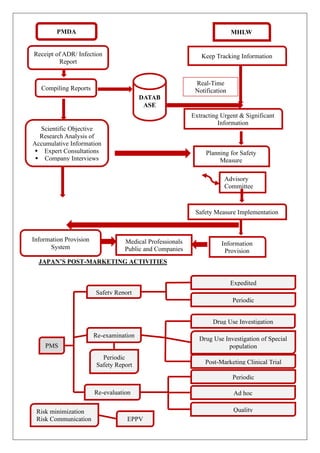
COLLECTION OF SAFETY INFORMATION
WHAT INFORMATION IS NECESSARY?
1. Medical Device Information
• Brand Name
• Device Identification Number
• Usage of Device.
• Maintenance Condition if there is any problem with the medical device/ equipment.
2. Product Problem Information
• Date of Incident
• Reporter’s Awareness Date
• Details of Incident
• Concomitant Medical Products
3. Patient Information
• Initials, Age, Sex, Weight, Outcome
• Health damage, Patient’s condition at the incident
• Medical treatment after the incident
4. Detailed adverse event
§ Operation/ usage status when it occurred.
§ Whether the operator checked the package inserts/ manuals or not.
§ Whether the operator complied with the package inserts/ manuals or not.
§ Whether the operator checked and complied with other safety information or not.
§ Was the intended use appropriate?
§ Was the device within the expiration date?
§ If it is a controlled medical device requiring special maintenance, were daily
inspection and maintenance appropriate?
PHARMACOVIGILANCE OPERATION FLOWCHART
Health
Profession
al/ Medical
Institution
Foreign
government/
Foreign
company
MAH
Governme
nt
Institution
Academic
society/Lit
erature/
Study
Other MAH,
company
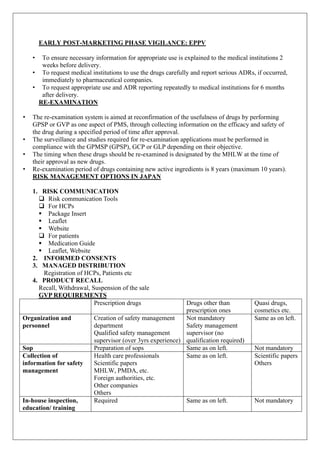
JAPAN’S POST-MARKETING ACTIVITIES
PMDA
Receipt of ADR/ Infection
Report
Compiling Reports
Scientific Objective
Research Analysis of
Accumulative Information
§ Expert Consultations
§ Company Interviews
Information Provision
System
MHLW
Keep Tracking Information
Extracting Urgent & Significant
Information
Planning for Safety
Measure
Safety Measure Implementation
Information
Provision
Real-Time
Notification
Medical Professionals
Public and Companies
DATAB
ASE
Advisory
Committee
PMS
Periodic
Re-evaluation
Periodic
Safety Report
Incl. PSUR
EPPV
Expedited
Re-examination
Risk minimization
Risk Communication
Safety Report
Quality
Ad hoc
Periodic
Post-Marketing Clinical Trial
Drug Use Investigation of Special
population
Drug Use Investigation
EARLY POST-MARKETING PHASE VIGILANCE: EPPV
• To ensure necessary information for appropriate use is explained to the medical institutions 2
weeks before delivery.
• To request medical institutions to use the drugs carefully and report serious ADRs, if occurred,
immediately to pharmaceutical companies.
• To request appropriate use and ADR reporting repeatedly to medical institutions for 6 months
after delivery.
RE-EXAMINATION
• The re-examination system is aimed at reconfirmation of the usefulness of drugs by performing
GPSP or GVP as one aspect of PMS, through collecting information on the efficacy and safety of
the drug during a specified period of time after approval.
• The surveillance and studies required for re-examination applications must be performed in
compliance with the GPMSP (GPSP), GCP or GLP depending on their objective.
• The timing when these drugs should be re-examined is designated by the MHLW at the time of
their approval as new drugs.
• Re-examination period of drugs containing new active ingredients is 8 years (maximum 10 years).
RISK MANAGEMENT OPTIONS IN JAPAN
1. RISK COMMUNICATION
q Risk communication Tools
q For HCPs
§ Package Insert
§ Leaflet
§ Website
q For patients
§ Medication Guide
§ Leaflet, Website
2. INFORMED CONSENTS
3. MANAGED DISTRIBUTION
Registration of HCPs, Patients etc
4. PRODUCT RECALL
Recall, Withdrawal, Suspension of the sale
GVP REQUIREMENTS
Prescription drugs Drugs other than
prescription ones
Quasi drugs,
cosmetics etc.
Organization and
personnel
Creation of safety management
department
Qualified safety management
supervisor (over 3yrs experience)
Not mandatory
Safety management
supervisor (no
qualification required)
Same as on left.
Sop Preparation of sops Same as on left. Not mandatory
Collection of
information for safety
management
Health care professionals
Scientific papers
MHLW, PMDA, etc.
Foreign authorities, etc.
Other companies
Others
Same as on left. Scientific papers
Others
In-house inspection,
education/ training
Required Same as on left. Not mandatory
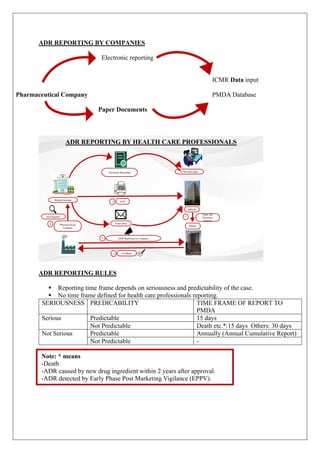
ADR REPORTING BY COMPANIES
Electronic reporting
ICMR Data input
Pharmaceutical Company PMDA Database
Paper Documents
ADR REPORTING RULES
§ Reporting time frame depends on seriousness and predictability of the case.
§ No time frame defined for health care professionals reporting.
SERIOUSNESS PREDICABILITY TIME FRAME OF REPORT TO
PMDA
Serious Predictable 15 days
Not Predictable Death etc.*:15 days Others: 30 days
Not Serious Predictable Annually (Annual Cumulative Report)
Not Predictable -
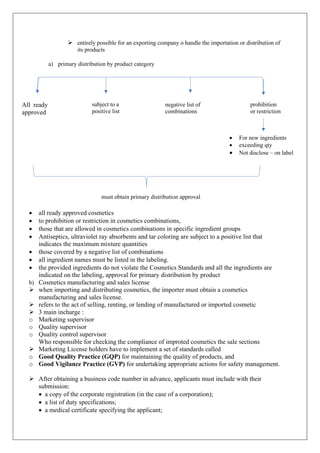
ADR REPORTING BY HEALTH CARE PROFESSIONALS
ICSR Data Input
ADR Reporting by Company
PMDA
Feedback
MHLW
Electronic Reporting
Investigation
FAX
Postal Mail
Pharmaceutical
Company
Medical Institute
Paper and
Electronic
Reports
1
2
3
4
5
Note: * means
-Death
-ADR caused by new drug ingredient within 2 years after approval.
-ADR detected by Early Phase Post Marketing Vigilance (EPPV).
Cosmetics regulation in JAPAN
cosmetics are regulated by the Ministry of Health, Labour and Welfare (MHLW) under the
Pharmaceutical Affairs Law (PAL)
beauty products are divided into quasi-drugs and cosmetics. And both regulated differ
Cosmetic from a legal point of view
defines cosmetics as “articles with mild action on the human body, which are intended to be applied
to the human body through rubbing, sprinkling or other method, aiming to clean, beautify and
increase the attractiveness, alter the appearance or to keep the skin or hair in good condition.
cosmetics are furthermore classified into 6 different categories
Quasi-drugs from a legal point of view
beauty products are classified into two categories
cosmetics and quasi drug
difference between cosmetics and quasi-drugs remains ambiguous. In practice, this distinction is made
based on differences in the effects assigned to each product
the nature and the quantity of ingredients used, application method, dosage, and appearance of the
product.
The PAL defines “Quasi-drug” (医薬部外品) as an item for the purpose of:
1. Preventing nausea and other discomfort.
2. Preventing heat rash, soreness, etc.
3. Encouraging hair growth or removing hair, or
4. Exterminating and preventing mice, flies, mosquitoes, fleas, etc.
Among the quasi-drugs are deodorants, depilatories, hair growth treatments, hair dyes, perm and
straightening products, as well as medicated cosmetics, such as whitening products, anti-aging
products and oily skin or acne treatment products.
the item shall have mild effects on the human body
IMPORTING COSMETICS TO JAPAN
1. Importation flow
Ø To sell cosmetic products in Japan, importers must ensure they comply with the PAL
(Protection of Cosmetics) law.
Ø This involves assessing samples by testing and inspection facilities designated by the
MHLW, owned or contracted by the importer.
Ø The importer must take full responsibility for imported cosmetics through regulation
analysis and safety testing, even if they are already legal in their home country.
Ø After testing and testing, importers must fill 3 forms:
o Manufacture and Sales of Cosmetics Notification,
o Cosmetics Import Notification for Manufacture and Sales
o manufacturer’s or importer’s brand name
Ø These forms contain a record of the testing and inspection results, verifying the
product does not contain prohibited combinations.
Ø Labeling and advertising for cosmetics are regulated by law, with improper labeling
resulting in prohibition.
Ø Importers must inspect every item to ensure packaging, add a Japanese label, and
possibly repack the product.
Ø the container, packaging, or package inserts of cosmetics be specifically labelled to
ensure the appropriate use, handling and quality, and liability.
Ø Once fully legal, products can be dispatched to the responsible distribution company.
2. Notifications and licenses
Ø entirely possible for an exporting company o handle the importation or distribution of
its products
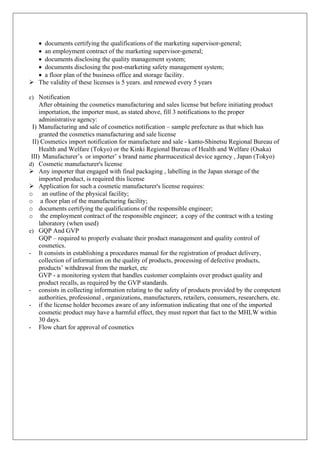
a) primary distribution by product category
• all ready approved cosmetics
• to prohibition or restriction in cosmetics combinations,
• those that are allowed in cosmetics combinations in specific ingredient groups
• Antiseptics, ultraviolet ray absorbents and tar coloring are subject to a positive list that
indicates the maximum mixture quantities
• those covered by a negative list of combinations
• all ingredient names must be listed in the labeling.
• the provided ingredients do not violate the Cosmetics Standards and all the ingredients are
indicated on the labeling, approval for primary distribution by product
b) Cosmetics manufacturing and sales license
Ø when importing and distributing cosmetics, the importer must obtain a cosmetics
manufacturing and sales license.
Ø refers to the act of selling, renting, or lending of manufactured or imported cosmetic
Ø 3 main incharge :
o Marketing supervisor
o Quality supervisor
o Quality control supervisor
Who responsible for checking the compliance of improted cosmetics the sale sections
Ø Marketing License holders have to implement a set of standards called
o Good Quality Practice (GQP) for maintaining the quality of products, and
o Good Vigilance Practice (GVP) for undertaking appropriate actions for safety management.
Ø After obtaining a business code number in advance, applicants must include with their
submission:
• a copy of the corporate registration (in the case of a corporation);
• a list of duty specifications;
• a medical certificate specifying the applicant;
All ready
approved
prohibition
or restriction
subject to a
positive list
negative list of
combinations
• For new ingredients
• exceeding qty
• Not disclose – on label
must obtain primary distribution approval
• documents certifying the qualifications of the marketing supervisor-general;
• an employment contract of the marketing supervisor-general;
• documents disclosing the quality management system;
• documents disclosing the post-marketing safety management system;
• a floor plan of the business office and storage facility.
Ø The validity of these licenses is 5 years. and renewed every 5 years
c) Notification
After obtaining the cosmetics manufacturing and sales license but before initiating product
importation, the importer must, as stated above, fill 3 notifications to the proper
administrative agency:
I) Manufacturing and sale of cosmetics notification – sample prefecture as that which has
granted the cosmetics manufacturing and sale license
II) Cosmetics import notification for manufacture and sale - kanto-Shinetsu Regional Bureau of
Health and Welfare (Tokyo) or the Kinki Regional Bureau of Health and Welfare (Osaka)
III) Manufacturer’s or importer’ s brand name pharmaceutical device agency , Japan (Tokyo)
d) Cosmetic manufacturer's license
Ø Any importer that engaged with final packaging , labelling in the Japan storage of the
imported product, is required this license
Ø Application for such a cosmetic manufacturer's license requires:
o an outline of the physical facility;
o a floor plan of the manufacturing facility;
o documents certifying the qualifications of the responsible engineer;
o the employment contract of the responsible engineer; a copy of the contract with a testing
laboratory (when used)
e) GQP And GVP
GQP – required to properly evaluate their product management and quality control of
cosmetics.
- It consists in establishing a procedures manual for the registration of product delivery,
collection of information on the quality of products, processing of defective products,
products’ withdrawal from the market, etc
GVP - a monitoring system that handles customer complaints over product quality and
product recalls, as required by the GVP standards.
- consists in collecting information relating to the safety of products provided by the competent
authorities, professional , organizations, manufacturers, retailers, consumers, researchers, etc.
- if the license holder becomes aware of any information indicating that one of the imported
cosmetic product may have a harmful effect, they must report that fact to the MHLW within
30 days.
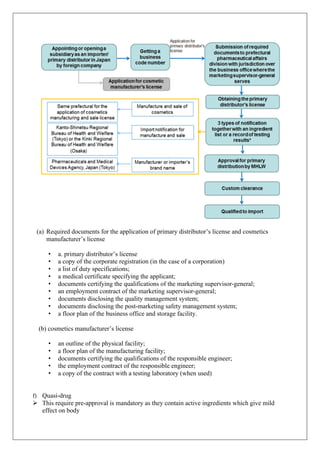
- Flow chart for approval of cosmetics
(a) Required documents for the application of primary distributor’s license and cosmetics
manufacturer’s license
• a. primary distributor’s license
• a copy of the corporate registration (in the case of a corporation)
• a list of duty specifications;
• a medical certificate specifying the applicant;
• documents certifying the qualifications of the marketing supervisor-general;
• an employment contract of the marketing supervisor-general;
• documents disclosing the quality management system;
• documents disclosing the post-marketing safety management system;
• a floor plan of the business office and storage facility.
(b) cosmetics manufacturer’s license
• an outline of the physical facility;
• a floor plan of the manufacturing facility;
• documents certifying the qualifications of the responsible engineer;
• the employment contract of the responsible engineer;
• a copy of the contract with a testing laboratory (when used)
f) Quasi-drug
Ø This require pre-approval is mandatory as they contain active ingredients which give mild
effect on body
Ø They need approval of MHLW
Ø Having an active ingredient approved by the MHLW allows the product to display its
effectiveness for a result that has yet to be recognized. This allows companies to indicate
that the product is "Medicated."
Ø This process takes approximately six month for the MHLW to carry out the appropriate
examination.
g) Requirements on sunscreens
In Japan, sunscreens are classified as quasi-drugs, therefore, they require approval of their
formulations, ingredients, use levels and functionalities, in addition to stability testing and a
certificate showing no animal-derived materials were used. Product evaluations should be based
on ISO 24442 in vivo testing and labeling. Also, an SPF of 50+, corresponding to PA++++, is
the maximum level allowed on the label.
h) Labelling requirement
the Consumer Affairs Agency (CAA) may require documentation, for labeling that makes
claims of superior quality etc.
all information must be expressed in Japanese
For cosmetics:
• Product name by type
• Brand name
• Name and address of primary distributor
• Content (weight or capacity)
• Country of origin
• Manufacturing number or code
• List of ingredients as required by the MHLW
• Expiration date, for a cosmetic designated by the MHLW
• Precautions on usage or storage
• Information contact
For soaps:
o Name and address of primary distributor
o Brand name
o The word "Soap"
o List of ingredients as required by the MHLW
o Manufacturing number or code
o Expiration date, for a designated cosmetic soap
o For those products manufactured by a frame mixing method, a term to that effect
o Standard weight per unit
o Country of origin