The Future of Organizational Learning
Brett Elmgren, March 12, 2014
Read my blog at brettelmgren.com
Add me on LinkedIn
Follow me on Twitter @BrettElmgren
2
Go to: “Insert > Header & Footer” to insert
your title on all slides
3
“I believe…
through positivity, collaboration and passion we can
change our work and change our lives.”
What do I do?
• Evolve our learning and development culture
• Design, develop, and deliver learning
• Curate and recommend informal and social
learning opportunities
• Develop people
• Challenge the status quo
5
Our values
What does Cameco do?
The Evolution of Learning
What is one thing you learned in the
past 24 hours?
How did you learn it?
A. Reading online
B. Reading in print
C. Through Conversation
D. Watching a video
E. On the job practice
F. Listening to audio
G. In a classroom
H. Other
Readingonline
Readingin
print
Through
Conversation
W
atchingavideo
W
atchingTV
Listeningto
audio
In
a
classroom
Other
0% 0% 0% 0%0%0%0%0%
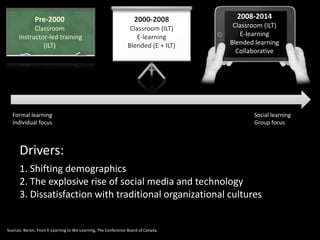
How are you Learning?
Pre-2000
Classroom
Instructor-led training
(ILT)
2000-2008
Classroom (ILT)
E-learning
Blended (E + ILT)
2008-2014
Classroom (ILT)
E-learning
Blended learning
Collaborative
Formal learning
Individual focus
Social learning
Group focus
Sources: Bersin, From E-Learning to We-Learning, The Conference Board of Canada.
1. Shifting demographics
2. The explosive rise of social media and technology
3. Dissatisfaction with traditional organizational cultures
Drivers:
1. Shifting Demographics
• Traditionalists (born 1925 – 1945)
• Baby Boom Generation (born 1946 – 1964)
• Generation X (born 1965 – 1976)
• Millennial Generation (born 1977 – 1997)
Generational breakdown
Generations
Traditionalists
Baby Boomers
Generation X
Millennials36%
45%
17%
The rise of the millennials
• 50% of the workforce by 2020
Traditionalists
Baby boomers
Generation X
Millennials
Generation 2020
51%
20%
22%
6%
Sources: Bureau of Labor Statistics Employment Projections.
Constantly connected…
On a date…At the movies…During a marathon…On the big day…
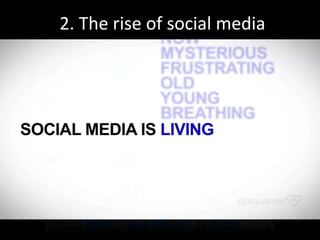
2. The rise of social media
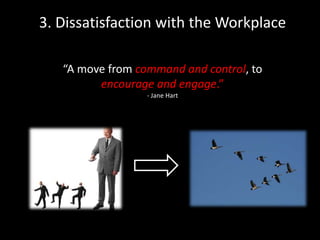
3. Dissatisfaction with the Workplace
“A move from command and control, to
encourage and engage.”
- Jane Hart
Learning 1.0 to Learning 2.0
A shift from viewing learning as a product created for
learners to a collaborative and connected process involving
learners.
Sources: Learning and Development: 2011, The Conference Board of Canada.
Imagine it is 1996, and you are presented
with two business plans…
- Current leader
- Large and
profitable
- Team of highly
paid professionals
- A strategic
marketing plan to
sell to the masses
- Start-up
- No money or
resources
- All contributions
are made
voluntarily
- Revenue is
generated
through donation
- Source: Daniel Pink. Drive, 2009
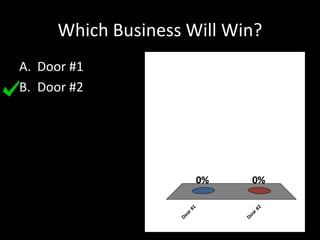
Which Business Will Win?
A. Door #1
B. Door #2
Door#1
Door#2
0%0%
Door #1 Door #2
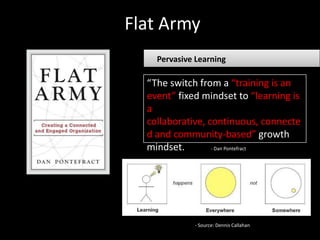
Flat Army
Pervasive Learning
“The switch from a “training is an
event” fixed mindset to “learning is
a
collaborative, continuous, connecte
d and community-based” growth
mindset. - Dan Pontefract
- Source: Dennis Callahan
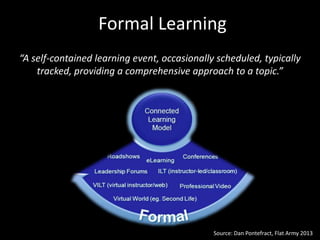
3-33: Pervasive Learning Model
Source: Dan Pontefract, Flat Army 2013
Formal Learning
“A self-contained learning event, occasionally scheduled, typically
tracked, providing a comprehensive approach to a topic.”
Source: Dan Pontefract, Flat Army 2013
Formal Learning
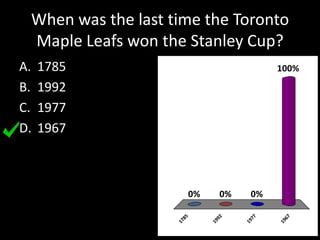
When was the last time the Toronto
Maple Leafs won the Stanley Cup?
A. 1785
B. 1992
C. 1977
D. 1967
1785
1992
1977
1967
0%
100%
0%0%
Fastest Responders
Seconds Participant Seconds Participant
2.514 331998
3.733 3B536D
Formal Learning
Formal Learning
Informal Learning
“Learning that occurs primarily
spontaneously and outside of
formal, designed activities.”
Source: Dan Pontefract, Flat Army 2013
“Learning on demand!”
“Learning at the speed of need!”
Informal Learning
Informal Learning
Informal Learning
Social Learning
Source: Dan Pontefract, Flat Army 2013
“Social learning can either be
formal or informal, and involves
learning through interactions
with others.”
Social learning is NOT social
media. Social media provides
a tool through which social
learning can thrive.
Why Enterprise Social?
• Breakdown Silo’s
• Drive innovation
• Foster learning (informal & social)
• Support a culture of collaboration
Enterprise Social Networking
Yammer Animation
Video Sharing
What Will Learning Look like in 2020?
1. The rise of gamification
2. The “flipped” classroom
3. The ARC
How Games Drive Behavioural Change
Gamification
“A business strategy which applies game design techniques to non-
game experiences to drive user behavior.”
Source: Gamification.org
Source: @DanPontefract
“Flipping the classroom”
“Assign the lessons as homework, and take what
used to be homework and have students practice
in the classroom.”
- Sal Khan
How to “Flip” your Training
• Have your experts record their processes
• Host the videos online
• Direct learners to the video’s
• Allow learners to learn on their own time
• Assess for mastery without grades
• Complete practical application
• Assess practical application for mastery
• Enlist a social community of support
“Itunes saved the music industry.”
- Wall Street Journal
The Future for L&D: ARC
ACCESS
RECOMMEND
CURATE
What will learning look like in 2020?
1. The rise of gamification
2. The “flipped” classroom
3. The ARC
Want a Career in Learning and
Development?
Which one looks like my career path?
What I did in the past 7 days
• Delivered new-hire onboarding
• Facilitated a TED’s on Tuesday Lunch and Learn
• Shared leadership content through social media
• Edited an e-learning program
• Drafted a podcast schedule
• Facilitated a focus group
• Conducted a needs analysis for leadership development
How to be Great
• Be passionate about learning
• Learn to collaborate
• Get awesome at listening
• Become technically competent
• Read, read, read, read, read, and then read more
• Master your distractions
• Challenge the status quo
• Fail … and fail often
• Be humble…It’s not about you.
“The Real World”
“The only way to know the future, is
to create it.”
Read my blog at brettelmgren.com
Add me on LinkedIn
Follow me on Twitter @BrettElmgren

Uof s presentation

  • 1.
    The Future ofOrganizational Learning Brett Elmgren, March 12, 2014 Read my blog at brettelmgren.com Add me on LinkedIn Follow me on Twitter @BrettElmgren
  • 2.
    2 Go to: “Insert> Header & Footer” to insert your title on all slides
  • 3.
    3 “I believe… through positivity,collaboration and passion we can change our work and change our lives.”
  • 4.
    What do Ido? • Evolve our learning and development culture • Design, develop, and deliver learning • Curate and recommend informal and social learning opportunities • Develop people • Challenge the status quo
  • 5.
  • 6.
  • 7.
    What is onething you learned in the past 24 hours?
  • 8.
    How did youlearn it? A. Reading online B. Reading in print C. Through Conversation D. Watching a video E. On the job practice F. Listening to audio G. In a classroom H. Other Readingonline Readingin print Through Conversation W atchingavideo W atchingTV Listeningto audio In a classroom Other 0% 0% 0% 0%0%0%0%0%
  • 9.
    How are youLearning?
  • 10.
    Pre-2000 Classroom Instructor-led training (ILT) 2000-2008 Classroom (ILT) E-learning Blended(E + ILT) 2008-2014 Classroom (ILT) E-learning Blended learning Collaborative Formal learning Individual focus Social learning Group focus Sources: Bersin, From E-Learning to We-Learning, The Conference Board of Canada. 1. Shifting demographics 2. The explosive rise of social media and technology 3. Dissatisfaction with traditional organizational cultures Drivers:
  • 11.
    1. Shifting Demographics •Traditionalists (born 1925 – 1945) • Baby Boom Generation (born 1946 – 1964) • Generation X (born 1965 – 1976) • Millennial Generation (born 1977 – 1997) Generational breakdown Generations Traditionalists Baby Boomers Generation X Millennials36% 45% 17% The rise of the millennials • 50% of the workforce by 2020 Traditionalists Baby boomers Generation X Millennials Generation 2020 51% 20% 22% 6% Sources: Bureau of Labor Statistics Employment Projections.
  • 12.
    Constantly connected… On adate…At the movies…During a marathon…On the big day…
  • 13.
    2. The riseof social media
  • 14.
    3. Dissatisfaction withthe Workplace “A move from command and control, to encourage and engage.” - Jane Hart
  • 15.
    Learning 1.0 toLearning 2.0 A shift from viewing learning as a product created for learners to a collaborative and connected process involving learners. Sources: Learning and Development: 2011, The Conference Board of Canada.
  • 16.
    Imagine it is1996, and you are presented with two business plans… - Current leader - Large and profitable - Team of highly paid professionals - A strategic marketing plan to sell to the masses - Start-up - No money or resources - All contributions are made voluntarily - Revenue is generated through donation - Source: Daniel Pink. Drive, 2009
  • 17.
    Which Business WillWin? A. Door #1 B. Door #2 Door#1 Door#2 0%0%
  • 18.
  • 19.
    Flat Army Pervasive Learning “Theswitch from a “training is an event” fixed mindset to “learning is a collaborative, continuous, connecte d and community-based” growth mindset. - Dan Pontefract - Source: Dennis Callahan
  • 20.
    3-33: Pervasive LearningModel Source: Dan Pontefract, Flat Army 2013
  • 21.
    Formal Learning “A self-containedlearning event, occasionally scheduled, typically tracked, providing a comprehensive approach to a topic.” Source: Dan Pontefract, Flat Army 2013
  • 22.
  • 23.
    When was thelast time the Toronto Maple Leafs won the Stanley Cup? A. 1785 B. 1992 C. 1977 D. 1967 1785 1992 1977 1967 0% 100% 0%0%
  • 24.
    Fastest Responders Seconds ParticipantSeconds Participant 2.514 331998 3.733 3B536D
  • 25.
  • 26.
  • 27.
    Informal Learning “Learning thatoccurs primarily spontaneously and outside of formal, designed activities.” Source: Dan Pontefract, Flat Army 2013 “Learning on demand!” “Learning at the speed of need!”
  • 28.
  • 29.
  • 30.
  • 31.
    Social Learning Source: DanPontefract, Flat Army 2013 “Social learning can either be formal or informal, and involves learning through interactions with others.”
  • 32.
    Social learning isNOT social media. Social media provides a tool through which social learning can thrive.
  • 33.
    Why Enterprise Social? •Breakdown Silo’s • Drive innovation • Foster learning (informal & social) • Support a culture of collaboration
  • 34.
  • 35.
  • 36.
  • 37.
    What Will LearningLook like in 2020? 1. The rise of gamification 2. The “flipped” classroom 3. The ARC
  • 38.
    How Games DriveBehavioural Change
  • 39.
    Gamification “A business strategywhich applies game design techniques to non- game experiences to drive user behavior.” Source: Gamification.org Source: @DanPontefract
  • 40.
    “Flipping the classroom” “Assignthe lessons as homework, and take what used to be homework and have students practice in the classroom.” - Sal Khan
  • 41.
    How to “Flip”your Training • Have your experts record their processes • Host the videos online • Direct learners to the video’s • Allow learners to learn on their own time • Assess for mastery without grades • Complete practical application • Assess practical application for mastery • Enlist a social community of support
  • 42.
    “Itunes saved themusic industry.” - Wall Street Journal
  • 43.
    The Future forL&D: ARC ACCESS RECOMMEND CURATE
  • 44.
    What will learninglook like in 2020? 1. The rise of gamification 2. The “flipped” classroom 3. The ARC
  • 45.
    Want a Careerin Learning and Development?
  • 46.
    Which one lookslike my career path?
  • 47.
    What I didin the past 7 days • Delivered new-hire onboarding • Facilitated a TED’s on Tuesday Lunch and Learn • Shared leadership content through social media • Edited an e-learning program • Drafted a podcast schedule • Facilitated a focus group • Conducted a needs analysis for leadership development
  • 48.
    How to beGreat • Be passionate about learning • Learn to collaborate • Get awesome at listening • Become technically competent • Read, read, read, read, read, and then read more • Master your distractions • Challenge the status quo • Fail … and fail often • Be humble…It’s not about you.
  • 49.
  • 50.
    “The only wayto know the future, is to create it.” Read my blog at brettelmgren.com Add me on LinkedIn Follow me on Twitter @BrettElmgren