International INTERNATIONAL Journal of Computer JOURNAL Engineering OF and COMPUTER Technology (IJCET), ENGINEERING ISSN 0976-6367(Print), 
& 
ISSN 0976 - 6375(Online), Volume 5, Issue 11, November (2014), pp. 57-64 © IAEME 
TECHNOLOGY (IJCET) 
ISSN 0976 – 6367(Print) 
ISSN 0976 – 6375(Online) 
Volume 5, Issue 11, November (2014), pp. 57-64 
© IAEME: www.iaeme.com/IJCET.asp 
Journal Impact Factor (2014): 8.5328 (Calculated by GISI) 
www.jifactor.com 
IJCET 
© I A E M E 
UNSUPERVISED APPROACH TO DEDUCE SCHEMA  
EXTRACT DATA FROM TEMPLATE WEB PAGES 
Mr. Shinde Santaji Krishna1, Dr. Shashank Dattatraya Joshi2 
1Research Scholar, Department of Computer Engineering, Shri Jagdish Prasad Jhabarmal Tibrewala 
University, Vidyanagari, Jhunjhunu, Rajasthan, India 
2Professor, Department of Computer Engineering, Bharati Vidyapeeth Deemed University College 
of Engineering, Pune, Maharashtra, India 
57 
ABSTRACT 
Web data extraction has been an important part for many Web data analysis applications. The 
aim of a web data extraction system is to extract relevant data from the web pages. Embedding of 
fixed template into web page is done by using fixed template. Thus extracting structured data from 
the template generated web pages are challenging the task that is useful for Web Information 
Integration. In this paper, an unsupervised approach is presented that automatically detects schema of 
web pages  performs page-level extraction task. Here, first visually similar web pages are found 
out by comparing their visual clues. Then for visually similar web pages, extraction of data is done 
by using tree merging algorithm that is used in an approach FiVaTech. Also, the schema is detected 
from the same web pages by removing noisy blocks like advertisement, navigation bars that are 
irrelevant in a data extraction task. Then time based analysis is performed. 
Keywords: Data Extraction, Structured Data, Tree Merging, Web, Wrappe. 
1. INTRODUCTION 
The World Wide Web is rapidly growing source of information. Structured data on the web 
are data records generated dynamically from the databases and displayed in web pages using some 
fixed template. Extracted structured data is used from the template generated pages for information 
integration and reused in very big range of applications, such as price comparison, product 
comparison, etc. So, there is a need to automatically extract the structured data from web pages. 
Web data extractors are the tools that facilitate extracting relevant data from web pages. 
Based on automation degree, Web data extraction task can be classified as manually constructed, 
supervised, semi supervised and unsupervised systems. Manually constructed systems require
International Journal of Computer Engineering and Technology (IJCET), ISSN 0976-6367(Print), 
ISSN 0976 - 6375(Online), Volume 5, Issue 11, November (2014), pp. 57-64 © IAEME 
programmers to deduct the extraction rules but are costly. Supervised systems require fewer user 
skills to label the sample pages to induce the extraction rules. To indicate extracted data, semi 
supervised system do not require users to label any sample pages but require post-processing from 
the users to choose a pattern. Unsupervised systems generate the wrappers automatically without any 
user interventions. Based on the extraction, the web data extraction task can be classified as field-level, 
record-level, page-level and site-level. 
This paper presents an unsupervised, page-level data extraction system that automatically 
extracts data from the web pages. This method is depends on first finding visually and structurally 
similar web pages to extract the schema and data from the web pages. So, first for given two input 
web pages we check whether the pages are visually similar or not by making use of VIPS [11] 
algorithm  fixed/variant template detection algorithm. Then for the visually similar web pages, a 
schema is detected by using the tree merging algorithm [1] which consists four steps :identification 
of peer nodes, alignment of matrix, tandem pattern mining, merging of optional nodes .Then data is 
extracted. Then for the same pages by removing noise blocks, schema is detected by using same tree 
merging algorithm. Time-based analysis is done based on time required to detect schema by 
removing noise  without removing noise. 
58 
2. RELATED WORK 
Reporting of number of approaches is done for extracting information from web pages. Web 
data extractors deduce extraction rules automatically using supervised techniques or unsupervised 
techniques. Supervised techniques require the user to provide samples of the extracted data. 
Unsupervised techniques are that can extract structured data from different web pages without 
human intervention. WIEN, Soft-Melay represents supervised approaches. There are unsupervised 
approaches that use DOM tree structure or visual information for extracting the information. 
Approaches that use DOM tree information are RoadRunner[10], IEPAD[2], MDR[5], DEPTA[7]. 
Approaches that use visual information are ViPER[14], ViDE[16]. 
There are two approaches RoadRunner [10] and ExAlg[2] that are closely related which 
models the template used to generate input documents. RoadRunner is an approach that uses the rule 
that is initialized to any input document  then it is used to parse another document. ExAlg [2] finds 
maximal classes of tokens that occur in every input document that corresponds to template and by 
using token differentiation and nesting criteria it deduces an extraction rule. 
3. PROPOSED WORK 
Automatically extracting a structured data from the template generated web pages are very 
tedious task which is used to speed up the data integration. Here a method is proposed to 
automatically detect a schema  extract data from given web pages. This presents an unsupervised, 
page-level data extraction approach. 
Problem Definition: 
Find the schema for the web pages created by some template  extract data. 
Schema: 
The schema of a website determines structure of a website that identifies the type of data that can 
be of basic, tuple, set or optional type. For example, for the web page that contains the list of the 
products by displaying product name, price and discount. Here the product name and price are of 
basic type whereas discount is of an optional type.
International Journal of Computer Engineering and Technology (IJCET), ISSN 0976-6367(Print), 
ISSN 0976 - 6375(Online), Volume 5, Issue 11, November (2014), pp. 57-64 © IAEME 
59 
System Overview: 
Here, visual clues  DOM tree structure of the web pages are considered to detect the 
schema of a web page. To detect visually similar web pages, Use of vision-based page segmentation 
algorithm [11] is done to detect usually similar pages, and visual block tree of each web page is built. 
Then the visual block trees are compared to check whether the web pages are visually similar or not. 
For visually similar web pages, their structural similarity can be checked by constructing a 
fixed/variant pattern tree for each Deep Web site. Application of system is done with either a single 
or multiple data records in web pages. It detects the schema by making use of identification of peer 
nodes, alignment of matrix, pattern mining, and merging of optional node [1]. In the peer node 
recognition step, the same tag in the same level is compared and labeled them with the same symbol 
if they are matching subtrees. In the matrix alignment step, nodes in the peer matrix are aligned to 
get a list of aligned nodes. In the pattern mining step, it detects repetitive patterns of different lengths 
in the aligned list starting from length 1. In the optional node detection step, optional nodes are found 
out and grouped them if a node disappears in some columns of the matrix. After finding pattern tree, 
data extraction is done by matching pattern tree  HTML tree at each level. Also for the same web 
pages, noisy blocks like advertisement, navigation bars are removed  the schema is detected by 
using tree merging algorithm [1]. Here, analysis is done based on time required to detect the schema 
 extract data from the web pages without removing noise and by removing noise. 
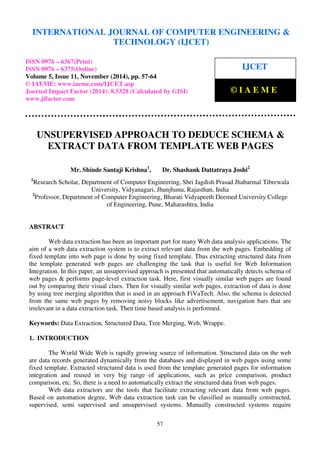
The Architecture 
The system architecture is shown in figure 1. Given the input as two web pages, visual 
similarity of them is checked by applying VIPS [11] and by Match_block algorithm. 
For visually similar pages, tree merging algorithm [1] is used to combine DOM trees into a 
single tree  from leaf nodes of combined tree repetitive nodes are identified. The resultant pattern 
tree is used to detect the schema of web pages. Also for the same pages, by using 
noise_block_removal algorithm, creation of DOM trees without noise is done  schema is detected. 
Fig. 1: System Architecture
International Journal of Computer Engineering and Technology (IJCET), ISSN 0976-6367(Print), 
ISSN 0976 - 6375(Online), Volume 5, Issue 11, November (2014), pp. 57-64 © IAEME 
Algorithm: 
Input: Web pages 
Output: Schema  extracted data 
1 With two input web pages apply VIPS to build visual block trees. 
2 Compare visual block trees to check web pages are visually similar or not. 
3 If pages are visually similar then 
4 If Remove_noise is selected then 
5 Apply Remove_Noise algorithm  create DOM trees 
6 On DOM, trees apply tree merging algorithm [1] which results in the pattern tree. 
7 Identify schema. 
8 Compare pattern tree  HTML tree of a web page to extract data. 
9 Else 
10 On DOM trees without noise, apply tree merging algorithm [1] to create pattern tree. 
11 Identify schema 
12 Compare pattern tree  HTML tree of a web page to extract data 
13 Else 
14 Display pages are not visually similar. 
15 End. 
60 
Steps: 
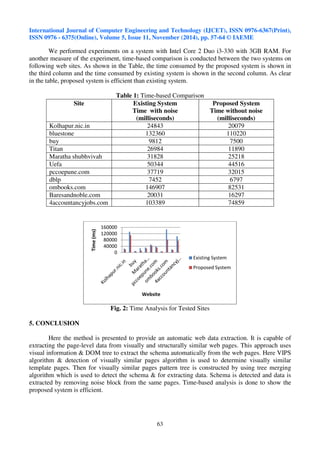
Building visual block trees using VIPS algorithm 
We obtain a vision-base content structure of the page by using VIPS (Vision-based Page 
Segmentation) which combines the DOM structure and visual cues. Using VIPS, a web page is 
segmented into different blocks to build visual block trees. Extraction of visual blocks, detection of 
separator, and construction of content structure are three main steps in VIPS. Division of web page is 
first done into different big blocks, and each big block is segmented until threshold is reached. The 
threshold is called Permitted Degree of Coherence (PDoC). For each visual block, its DoC is set that 
detects consistency of contents for each visual block. 
Fig. 2: (a) presentation structure, (b)visual block tree of the page
International Journal of Computer Engineering and Technology (IJCET), ISSN 0976-6367(Print), 
ISSN 0976 - 6375(Online), Volume 5, Issue 11, November (2014), pp. 57-64 © IAEME 
Algorithm Remove_noise (TreeNode) 
Input: TreeNode 
Output: DOM tree by removing noise blocks 
1. Find the area of each child in a TreeNode. 
2. if (the area of each child in a TreeNode  40%) return NULL; 
3. biggest = the child with the biggest percentage area; 
4. for each child in a TreeNode 
5. If (child != biggest) then 
6. Remove images from corresponding to tag child 
7. Endif 
8. Remove_noise(biggest) 
61 
Detection of visually similar web pages: 
To check whether pages are visually similar or not, blocks in visual block trees are compared 
based on visual features like background color. If the percentage of matched blocks is greater than or 
equal to the threshold (60%), then pages are visually similar otherwise they are not visually similar. 
Algorithm: Match_block (VB1,VB2) 
Input: Visual Block trees VB1  VB2 of web pages 
Output: Visually similar or not 
1. Initialize threshold=60%; 
2. Compare the blocks in VB1  VB2 based on the visual features 
3. If the percentage of matching blocks = threshold 
4. Visually similar pages 
5. else 
6. Not similar pages 
7. EndIf 
Noise Block Removal Algorithm 
It has become difficult to identify relevant pieces of information since web pages also contain 
irrelevant content like advertisement, navigation panels. Hence, there is need to remove noise blocks 
from web pages that help us to get accurate data. 
For each tag in DOM tree, there is an associated bounding rectangle. Browser provides 
position, height, and width of bounding the rectangle of that tag. Calculation of percentage area of 
each node is done as: 
PercentageArea(n)=area(n)/area(body)% 
Following algorithm is used to remove noise block.[18] 
Tree Merging Algorithm [1] 
For visually similar web pages, the schema is identified by merging DOM trees of the web 
pages that forms the pattern tree. It consists of the four steps: identification of peer nodes, matrix 
representation, pattern mining, merging of optional nodes. 
Identification of peer nodes: 
Here two tags having the same name are compared to check whether they are peer subtrees. 
Assignment of same symbol is done for peer nodes. Use of two-trees matching algorithm is done to
International Journal of Computer Engineering and Technology (IJCET), ISSN 0976-6367(Print), 
ISSN 0976 - 6375(Online), Volume 5, Issue 11, November (2014), pp. 57-64 © IAEME 
check similarity. Two subtrees are considered as peer subtrees if the matching score between the two 
trees is greater than the threshold (0.5). 
62 
Matrix Representation : 
After the recognition of peer nodes, the next step is to get an associated matrix. The 
algorithm tries to form an associated matrix such that every row contain the same symbol, or it is 
basic typed data. 
If the row is not aligned in a matrix, then node is shifted depending on the span value of a 
node. Span value of a node is the highest number of the diverse nodes between any two successive 
occurrences of the node in each column plus one. Use of following rules is done in order to 
determine a column to be shifted from the current row r and for identifying required shift distance. 
Rules for Matrix Association: 
• Rule 1: A column is selected, from left to right, such that a node n with the same symbol 
exists at upper row r1  r-r1  span(n).Then that column is shifted with shift distance equal 
to 1. 
• Rule 2: If rule 1 fails, then a column c is selected with nearest row rdown from r such that same 
node is present in a subsequent row or column other than c. In such case, column is shifted 
with distance rdown-r. 
• Rule 3: If both rules R1 and R2 fail, and then check if r contains all data (text/image) nodes. 
In this, no shifting is done. 
• Rule 4: If all of R1, R2 and R3 fail, we select the symbol that occurs the maximum number of 
times on this row. Keeping all columns with that symbol in r unchanged; shift all other 
columns down by one. 
Repetitive Pattern Mining: 
This step will detect extra occurrences of discovered pattern  combines them by erasing all 
occurrences except first one. 
Optional Node Merging: 
This step identifies optional nodes, the nodes that are missing in some columns of the matrix 
and group nodes according to their occurrence vector. 
Schema Detection [1] 
In this step, structure of a website that is a schema is identified. It identifies basic type, set 
type, optional type  tuple type. It also finds order of set type and optional data. 
Data Extraction 
After pattern tree is construction, both the HTML trees and the Pattern trees are scanned from 
top to down simultaneously, matching both at each level and then descending down recursively. 
4. EXPERIMENTAL RESULTS 
Our system generates the two types of output files, given two web pages of the website as 
input to the system. The first type presents schema of website in XML-like structure  second type of 
file (an XML file) presents extracted data. 
We performed an experiment on web documents downloaded from the RoadRunner and web 
sites as given in table.
International Journal of Computer Engineering and Technology (IJCET), ISSN 0976-6367(Print), 
ISSN 0976 - 6375(Online), Volume 5, Issue 11, November (2014), pp. 57-64 © IAEME 
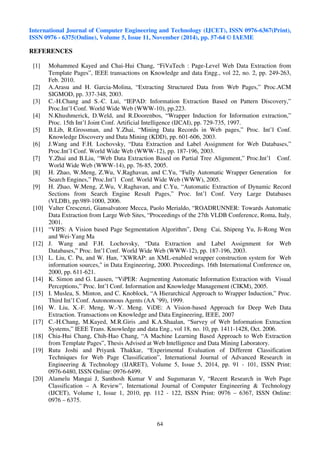
We performed experiments on a system with Intel Core 2 Duo i3-330 with 3GB RAM. For 
another measure of the experiment, time-based comparison is conducted between the two systems on 
following web sites. As shown in the Table, the time consumed by the proposed system is shown in 
the third column and the time consumed by existing system is shown in the second column. As clear 
in the table, proposed system is efficient than existing system. 
Table 1: Time-based Comparison 
Site Existing System 
Time with noise 
(milliseconds) 
	
 
63 
Proposed System 
Time without noise 
(milliseconds) 
Kolhapur.nic.in 24843 20079 
bluestone 132360 110220 
buy 9812 7500 
Titan 26984 11890 
Maratha shubhvivah 31828 25218 
Uefa 50344 44516 
pccoepune.com 37719 32015 
dblp 7452 6797 
ombooks.com 146907 82531 
Baresandnoble.com 20031 16297 
4accountancyjobs.com 103389 74859
Fig. 2: Time Analysis for Tested Sites 
5. CONCLUSION 
 
Here the method is presented to provide an automatic web data extraction. It is capable of 
extracting the page-level data from visually and structurally similar web pages. This approach uses 
visual information  DOM tree to extract the schema automatically from the web pages. Here VIPS 
algorithm  detection of visually similar pages algorithm is used to determine visually similar 
template pages. Then for visually similar pages pattern tree is constructed by using tree merging 
algorithm which is used to detect the schema  for extracting data. Schema is detected and data is 
extracted by removing noise block from the same pages. Time-based analysis is done to show the 
proposed system is efficient.

Unsupervised approach to deduce schema and extract data from template web pages

  • 1.
    International INTERNATIONAL Journalof Computer JOURNAL Engineering OF and COMPUTER Technology (IJCET), ENGINEERING ISSN 0976-6367(Print), & ISSN 0976 - 6375(Online), Volume 5, Issue 11, November (2014), pp. 57-64 © IAEME TECHNOLOGY (IJCET) ISSN 0976 – 6367(Print) ISSN 0976 – 6375(Online) Volume 5, Issue 11, November (2014), pp. 57-64 © IAEME: www.iaeme.com/IJCET.asp Journal Impact Factor (2014): 8.5328 (Calculated by GISI) www.jifactor.com IJCET © I A E M E UNSUPERVISED APPROACH TO DEDUCE SCHEMA EXTRACT DATA FROM TEMPLATE WEB PAGES Mr. Shinde Santaji Krishna1, Dr. Shashank Dattatraya Joshi2 1Research Scholar, Department of Computer Engineering, Shri Jagdish Prasad Jhabarmal Tibrewala University, Vidyanagari, Jhunjhunu, Rajasthan, India 2Professor, Department of Computer Engineering, Bharati Vidyapeeth Deemed University College of Engineering, Pune, Maharashtra, India 57 ABSTRACT Web data extraction has been an important part for many Web data analysis applications. The aim of a web data extraction system is to extract relevant data from the web pages. Embedding of fixed template into web page is done by using fixed template. Thus extracting structured data from the template generated web pages are challenging the task that is useful for Web Information Integration. In this paper, an unsupervised approach is presented that automatically detects schema of web pages performs page-level extraction task. Here, first visually similar web pages are found out by comparing their visual clues. Then for visually similar web pages, extraction of data is done by using tree merging algorithm that is used in an approach FiVaTech. Also, the schema is detected from the same web pages by removing noisy blocks like advertisement, navigation bars that are irrelevant in a data extraction task. Then time based analysis is performed. Keywords: Data Extraction, Structured Data, Tree Merging, Web, Wrappe. 1. INTRODUCTION The World Wide Web is rapidly growing source of information. Structured data on the web are data records generated dynamically from the databases and displayed in web pages using some fixed template. Extracted structured data is used from the template generated pages for information integration and reused in very big range of applications, such as price comparison, product comparison, etc. So, there is a need to automatically extract the structured data from web pages. Web data extractors are the tools that facilitate extracting relevant data from web pages. Based on automation degree, Web data extraction task can be classified as manually constructed, supervised, semi supervised and unsupervised systems. Manually constructed systems require
  • 2.
    International Journal ofComputer Engineering and Technology (IJCET), ISSN 0976-6367(Print), ISSN 0976 - 6375(Online), Volume 5, Issue 11, November (2014), pp. 57-64 © IAEME programmers to deduct the extraction rules but are costly. Supervised systems require fewer user skills to label the sample pages to induce the extraction rules. To indicate extracted data, semi supervised system do not require users to label any sample pages but require post-processing from the users to choose a pattern. Unsupervised systems generate the wrappers automatically without any user interventions. Based on the extraction, the web data extraction task can be classified as field-level, record-level, page-level and site-level. This paper presents an unsupervised, page-level data extraction system that automatically extracts data from the web pages. This method is depends on first finding visually and structurally similar web pages to extract the schema and data from the web pages. So, first for given two input web pages we check whether the pages are visually similar or not by making use of VIPS [11] algorithm fixed/variant template detection algorithm. Then for the visually similar web pages, a schema is detected by using the tree merging algorithm [1] which consists four steps :identification of peer nodes, alignment of matrix, tandem pattern mining, merging of optional nodes .Then data is extracted. Then for the same pages by removing noise blocks, schema is detected by using same tree merging algorithm. Time-based analysis is done based on time required to detect schema by removing noise without removing noise. 58 2. RELATED WORK Reporting of number of approaches is done for extracting information from web pages. Web data extractors deduce extraction rules automatically using supervised techniques or unsupervised techniques. Supervised techniques require the user to provide samples of the extracted data. Unsupervised techniques are that can extract structured data from different web pages without human intervention. WIEN, Soft-Melay represents supervised approaches. There are unsupervised approaches that use DOM tree structure or visual information for extracting the information. Approaches that use DOM tree information are RoadRunner[10], IEPAD[2], MDR[5], DEPTA[7]. Approaches that use visual information are ViPER[14], ViDE[16]. There are two approaches RoadRunner [10] and ExAlg[2] that are closely related which models the template used to generate input documents. RoadRunner is an approach that uses the rule that is initialized to any input document then it is used to parse another document. ExAlg [2] finds maximal classes of tokens that occur in every input document that corresponds to template and by using token differentiation and nesting criteria it deduces an extraction rule. 3. PROPOSED WORK Automatically extracting a structured data from the template generated web pages are very tedious task which is used to speed up the data integration. Here a method is proposed to automatically detect a schema extract data from given web pages. This presents an unsupervised, page-level data extraction approach. Problem Definition: Find the schema for the web pages created by some template extract data. Schema: The schema of a website determines structure of a website that identifies the type of data that can be of basic, tuple, set or optional type. For example, for the web page that contains the list of the products by displaying product name, price and discount. Here the product name and price are of basic type whereas discount is of an optional type.
  • 3.
    International Journal ofComputer Engineering and Technology (IJCET), ISSN 0976-6367(Print), ISSN 0976 - 6375(Online), Volume 5, Issue 11, November (2014), pp. 57-64 © IAEME 59 System Overview: Here, visual clues DOM tree structure of the web pages are considered to detect the schema of a web page. To detect visually similar web pages, Use of vision-based page segmentation algorithm [11] is done to detect usually similar pages, and visual block tree of each web page is built. Then the visual block trees are compared to check whether the web pages are visually similar or not. For visually similar web pages, their structural similarity can be checked by constructing a fixed/variant pattern tree for each Deep Web site. Application of system is done with either a single or multiple data records in web pages. It detects the schema by making use of identification of peer nodes, alignment of matrix, pattern mining, and merging of optional node [1]. In the peer node recognition step, the same tag in the same level is compared and labeled them with the same symbol if they are matching subtrees. In the matrix alignment step, nodes in the peer matrix are aligned to get a list of aligned nodes. In the pattern mining step, it detects repetitive patterns of different lengths in the aligned list starting from length 1. In the optional node detection step, optional nodes are found out and grouped them if a node disappears in some columns of the matrix. After finding pattern tree, data extraction is done by matching pattern tree HTML tree at each level. Also for the same web pages, noisy blocks like advertisement, navigation bars are removed the schema is detected by using tree merging algorithm [1]. Here, analysis is done based on time required to detect the schema extract data from the web pages without removing noise and by removing noise. The Architecture The system architecture is shown in figure 1. Given the input as two web pages, visual similarity of them is checked by applying VIPS [11] and by Match_block algorithm. For visually similar pages, tree merging algorithm [1] is used to combine DOM trees into a single tree from leaf nodes of combined tree repetitive nodes are identified. The resultant pattern tree is used to detect the schema of web pages. Also for the same pages, by using noise_block_removal algorithm, creation of DOM trees without noise is done schema is detected. Fig. 1: System Architecture
  • 4.
    International Journal ofComputer Engineering and Technology (IJCET), ISSN 0976-6367(Print), ISSN 0976 - 6375(Online), Volume 5, Issue 11, November (2014), pp. 57-64 © IAEME Algorithm: Input: Web pages Output: Schema extracted data 1 With two input web pages apply VIPS to build visual block trees. 2 Compare visual block trees to check web pages are visually similar or not. 3 If pages are visually similar then 4 If Remove_noise is selected then 5 Apply Remove_Noise algorithm create DOM trees 6 On DOM, trees apply tree merging algorithm [1] which results in the pattern tree. 7 Identify schema. 8 Compare pattern tree HTML tree of a web page to extract data. 9 Else 10 On DOM trees without noise, apply tree merging algorithm [1] to create pattern tree. 11 Identify schema 12 Compare pattern tree HTML tree of a web page to extract data 13 Else 14 Display pages are not visually similar. 15 End. 60 Steps: Building visual block trees using VIPS algorithm We obtain a vision-base content structure of the page by using VIPS (Vision-based Page Segmentation) which combines the DOM structure and visual cues. Using VIPS, a web page is segmented into different blocks to build visual block trees. Extraction of visual blocks, detection of separator, and construction of content structure are three main steps in VIPS. Division of web page is first done into different big blocks, and each big block is segmented until threshold is reached. The threshold is called Permitted Degree of Coherence (PDoC). For each visual block, its DoC is set that detects consistency of contents for each visual block. Fig. 2: (a) presentation structure, (b)visual block tree of the page
  • 5.
    International Journal ofComputer Engineering and Technology (IJCET), ISSN 0976-6367(Print), ISSN 0976 - 6375(Online), Volume 5, Issue 11, November (2014), pp. 57-64 © IAEME Algorithm Remove_noise (TreeNode) Input: TreeNode Output: DOM tree by removing noise blocks 1. Find the area of each child in a TreeNode. 2. if (the area of each child in a TreeNode 40%) return NULL; 3. biggest = the child with the biggest percentage area; 4. for each child in a TreeNode 5. If (child != biggest) then 6. Remove images from corresponding to tag child 7. Endif 8. Remove_noise(biggest) 61 Detection of visually similar web pages: To check whether pages are visually similar or not, blocks in visual block trees are compared based on visual features like background color. If the percentage of matched blocks is greater than or equal to the threshold (60%), then pages are visually similar otherwise they are not visually similar. Algorithm: Match_block (VB1,VB2) Input: Visual Block trees VB1 VB2 of web pages Output: Visually similar or not 1. Initialize threshold=60%; 2. Compare the blocks in VB1 VB2 based on the visual features 3. If the percentage of matching blocks = threshold 4. Visually similar pages 5. else 6. Not similar pages 7. EndIf Noise Block Removal Algorithm It has become difficult to identify relevant pieces of information since web pages also contain irrelevant content like advertisement, navigation panels. Hence, there is need to remove noise blocks from web pages that help us to get accurate data. For each tag in DOM tree, there is an associated bounding rectangle. Browser provides position, height, and width of bounding the rectangle of that tag. Calculation of percentage area of each node is done as: PercentageArea(n)=area(n)/area(body)% Following algorithm is used to remove noise block.[18] Tree Merging Algorithm [1] For visually similar web pages, the schema is identified by merging DOM trees of the web pages that forms the pattern tree. It consists of the four steps: identification of peer nodes, matrix representation, pattern mining, merging of optional nodes. Identification of peer nodes: Here two tags having the same name are compared to check whether they are peer subtrees. Assignment of same symbol is done for peer nodes. Use of two-trees matching algorithm is done to
  • 6.
    International Journal ofComputer Engineering and Technology (IJCET), ISSN 0976-6367(Print), ISSN 0976 - 6375(Online), Volume 5, Issue 11, November (2014), pp. 57-64 © IAEME check similarity. Two subtrees are considered as peer subtrees if the matching score between the two trees is greater than the threshold (0.5). 62 Matrix Representation : After the recognition of peer nodes, the next step is to get an associated matrix. The algorithm tries to form an associated matrix such that every row contain the same symbol, or it is basic typed data. If the row is not aligned in a matrix, then node is shifted depending on the span value of a node. Span value of a node is the highest number of the diverse nodes between any two successive occurrences of the node in each column plus one. Use of following rules is done in order to determine a column to be shifted from the current row r and for identifying required shift distance. Rules for Matrix Association: • Rule 1: A column is selected, from left to right, such that a node n with the same symbol exists at upper row r1 r-r1 span(n).Then that column is shifted with shift distance equal to 1. • Rule 2: If rule 1 fails, then a column c is selected with nearest row rdown from r such that same node is present in a subsequent row or column other than c. In such case, column is shifted with distance rdown-r. • Rule 3: If both rules R1 and R2 fail, and then check if r contains all data (text/image) nodes. In this, no shifting is done. • Rule 4: If all of R1, R2 and R3 fail, we select the symbol that occurs the maximum number of times on this row. Keeping all columns with that symbol in r unchanged; shift all other columns down by one. Repetitive Pattern Mining: This step will detect extra occurrences of discovered pattern combines them by erasing all occurrences except first one. Optional Node Merging: This step identifies optional nodes, the nodes that are missing in some columns of the matrix and group nodes according to their occurrence vector. Schema Detection [1] In this step, structure of a website that is a schema is identified. It identifies basic type, set type, optional type tuple type. It also finds order of set type and optional data. Data Extraction After pattern tree is construction, both the HTML trees and the Pattern trees are scanned from top to down simultaneously, matching both at each level and then descending down recursively. 4. EXPERIMENTAL RESULTS Our system generates the two types of output files, given two web pages of the website as input to the system. The first type presents schema of website in XML-like structure second type of file (an XML file) presents extracted data. We performed an experiment on web documents downloaded from the RoadRunner and web sites as given in table.
  • 7.
    International Journal ofComputer Engineering and Technology (IJCET), ISSN 0976-6367(Print), ISSN 0976 - 6375(Online), Volume 5, Issue 11, November (2014), pp. 57-64 © IAEME We performed experiments on a system with Intel Core 2 Duo i3-330 with 3GB RAM. For another measure of the experiment, time-based comparison is conducted between the two systems on following web sites. As shown in the Table, the time consumed by the proposed system is shown in the third column and the time consumed by existing system is shown in the second column. As clear in the table, proposed system is efficient than existing system. Table 1: Time-based Comparison Site Existing System Time with noise (milliseconds) 63 Proposed System Time without noise (milliseconds) Kolhapur.nic.in 24843 20079 bluestone 132360 110220 buy 9812 7500 Titan 26984 11890 Maratha shubhvivah 31828 25218 Uefa 50344 44516 pccoepune.com 37719 32015 dblp 7452 6797 ombooks.com 146907 82531 Baresandnoble.com 20031 16297 4accountancyjobs.com 103389 74859
  • 8.
    Fig. 2: TimeAnalysis for Tested Sites 5. CONCLUSION Here the method is presented to provide an automatic web data extraction. It is capable of extracting the page-level data from visually and structurally similar web pages. This approach uses visual information DOM tree to extract the schema automatically from the web pages. Here VIPS algorithm detection of visually similar pages algorithm is used to determine visually similar template pages. Then for visually similar pages pattern tree is constructed by using tree merging algorithm which is used to detect the schema for extracting data. Schema is detected and data is extracted by removing noise block from the same pages. Time-based analysis is done to show the proposed system is efficient.