IEEE TRANSACTIONS ON KNOWLEDGE AND DATA ENGINEERING,                               VOL. 22,     NO. 2,    FEBRUARY 2010                                     249


     FiVaTech: Page-Level Web Data Extraction
               from Template Pages
                                        Mohammed Kayed and Chia-Hui Chang, Member, IEEE

       Abstract—Web data extraction has been an important part for many Web data analysis applications. In this paper, we formulate the
       data extraction problem as the decoding process of page generation based on structured data and tree templates. We propose an
       unsupervised, page-level data extraction approach to deduce the schema and templates for each individual Deep Website, which
       contains either singleton or multiple data records in one Webpage. FiVaTech applies tree matching, tree alignment, and mining
       techniques to achieve the challenging task. In experiments, FiVaTech has much higher precision than EXALG and is comparable with
       other record-level extraction systems like ViPER and MSE. The experiments show an encouraging result for the test pages used in
       many state-of-the-art Web data extraction works.

       Index Terms—Semistructured data, Web data extraction, multiple trees merging, wrapper induction.

                                                                                           Ç

1    INTRODUCTION

D    EEP Web, as is known to everyone, contains magnitudes
     more and valuable information than the surface Web.
However, making use of such consolidated information
                                                                                               targets as in nontemplate page information extraction
                                                                                               (e.g., Softmealy [5], Stalker [9], WIEN [6], etc.) and the key
                                                                                               to automatic extraction depends on whether we can deduce
requires substantial efforts since the pages are generated for                                 the template automatically.
visualization not for data exchange. Thus, extracting                                              Generally speaking, templates, as a common model for
information from Webpages for searchable Websites has                                          all pages, occur quite fixed as opposed to data values which
been a key step for Web information integration. Generating                                    vary across pages. Finding such a common template
an extraction program for a given search form is equivalent                                    requires multiple pages or a single page containing multiple
to wrapping a data source such that all extractor or wrapper                                   records as input. When multiple pages are given, the
programs return data of the same format for information                                        extraction target aims at page-wide information (e.g.,
integration.                                                                                   RoadRunner [4] and EXALG [1]). When single pages are
   An important characteristic of pages belonging to the                                       given, the extraction target is usually constrained to record-
same Website is that such pages share the same template                                        wide information (e.g., IEPAD [2], DeLa [11], and DEPTA
since they are encoded in a consistent manner across all the                                   [14]), which involves the addition issue of record-boundary
pages. In other words, these pages are generated with a                                        detection. Page-level extraction tasks, although do not
predefined template by plugging data values. In practice,                                      involve the addition problem of boundary detection, are
template pages can also occur in surface Web (with static                                      much more complicated than record-level extraction tasks
hyperlinks). For example, commercial Websites often have a                                     since more data are concerned.
template for displaying company logos, browsing menus,                                             A common technique that is used to find template is
and copyright announcements, such that all pages of the                                        alignment: either string alignment (e.g., IEPAD, RoadRun-
same Website look consistent and designed. In addition,                                        ner) or tree alignment (e.g., DEPTA). As for the problem of
templates can also be used to render a list of records to                                      distinguishing template and data, most approaches assume
show objects of the same kind. Thus, information extraction                                    that HTML tags are part of the template, while EXALG
from template pages can be applied in many situations.                                         considers a general model where word tokens can also be
   What’s so special with template pages is that the                                           part of the template and tag tokens can also be data.
extraction targets for template Webpages are almost equal                                      However, EXALG’s approach, without explicit use of
to the data values embedded during page generation. Thus,                                      alignment, produces many accidental equivalent classes,
there is no need to annotate the Webpages for extraction                                       making the reconstruction of the schema not complete.
                                                                                                   In this paper, we focus on page-level extraction tasks and
                                                                                               propose a new approach, called FiVaTech, to automatically
. M. Kayed is with the Department of Mathematics, Faculty of Science, Beni-                    detect the schema of a Website. The proposed technique
  Suef University, Beni-Suef, Egypt. E-mail: mskayed@yahoo.com.
. C.-H. Chang is with the Department of Computer Science and Information                       presents a new structure, called fixed/variant pattern tree, a
  Engineering, National Central University, No. 300, Jungda Rd, Jhongli                        tree that carries all of the required information needed to
  City, Taoyuan, Taiwan 320, ROC. E-mail: chia@csie.ncu.edu.tw.                                identify the template and detect the data schema. We
Manuscript received 10 Jan. 2008; revised 23 Nov. 2008; accepted 10 Mar.                       combine several techniques: alignment, pattern mining, as
2009; published online 31 Mar. 2009.                                                           well as the idea of tree templates to solve the much difficult
Recommended for acceptance by B. Moon.
For information on obtaining reprints of this article, please send e-mail to:
                                                                                               problem of page-level template construction. In experi-
tkde@computer.org, and reference IEEECS Log Number TKDE-2008-01-0015.                          ments, FiVaTech has much higher precision than EXALG,
Digital Object Identifier no. 10.1109/TKDE.2009.82.                                            one of the few page-level extraction system, and is
                                                       1041-4347/10/$26.00 ß 2010 IEEE         Published by the IEEE Computer Society
            Authorized licensed use limited to: National Central University. Downloaded on January 6, 2010 at 21:54 from IEEE Xplore. Restrictions apply.
250                                                      IEEE TRANSACTIONS ON KNOWLEDGE AND DATA ENGINEERING,                                  VOL. 22, NO. 2,   FEBRUARY 2010


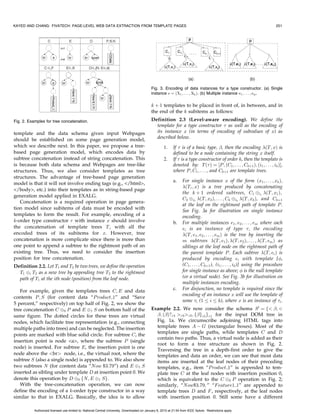
Fig. 1. (a) A Webpage and its two different schemas (b) S and (c) S0 .

comparable with other record-level extraction systems like                                                   c.     A set, denoted by fkg , if the cardinality is greater
ViPER and MSE.                                                                                                      than 1 for some instantiation.
   The rest of the paper is organized as follows: Section 2                                                  d.     A disjunction, denoted by ð1 j2 j . . . jk Þ , if all
defines the data extraction problem. Section 3 provides the                                                         i ði ¼ 1; . . . ; kÞ are options and the cardinality
system framework as well as the detailed algorithm of                                                               sum of the k options ð1 À k Þ equals 1 for every
FiVaTech, for constructing the fixed/variant pattern tree                                                           instantiation of .
with an example. Section 4 describes the details of template                                  Example 2.1. Fig. 1a shows a fictional Webpage that
and Website schema deduction. Section 5 describes our                                           presents a list of products. For each product, a product
experiments. Section 6 compares FiVaTech with related                                           name, a price, a discount percent (optional), and a list of
Web data extraction techniques. Finally, Section 7 concludes                                    features are presented (shaded nodes in the figure.). The
the paper.                                                                                      data instance here is {“Product 1,” “Now $3.79,” “save
                                                                                                5 percent,” “Feature 1 1”;  “Product 2,” “now $7.88,”
                                                                                                , {“Feature 2 1,” “Feature 2 2”} }, where  denotes the
2     PROBLEM FORMULATION
                                                                                                empty string, which is missed in the second product.
In this section, we formulate the model for page creation,                                      This data instance embedded in the page of Fig. 1a can be
which describes how data are embedded using a template.                                         expressed by two different schemas S and S 0 as shown in
As we know, a Webpage is created by embedding a data                                            Figs. 1b and 1c, respectively. Fig. 1b shows a set w1 of
instance x (taken from a database) into a predefined                                            order 4 (denoting the list of products in Fig. 1a): the first
template. Usually a CGI program executes the encoding                                           two components are basic types (the name and the price
function that combines a data instance with the template                                        of the product), the third component is an option w2 (the
to form the Webpage, where all data instances of the                                            discount percent), and the last component is a set w3 (a
database conform to a common schema, which can be                                               list of features for the product).
defined as follows (a similar definition can also be found                                            In addition to this succinct representation, the same
at EXALG [1]):                                                                                  data can also be organized by their parent nodes in its
                                                                                                Document Object Model (DOM) tree. That is, we can
Definition 2.1 (Structured data). A data schema can be of the                                   reorganize the above data instance as {“Product 1,”
  following types:                                                                              “now $3:79,” “Save 5 percent”, {“Feature 1 1”} ,
      1.   A basic type
represents a string of tokens, where a                                “Product_2,” “Now $7.88,” , {“Feature 2_1,”
           token is some basic units of text.                                                   “Feature 2_2”} }, which can be expressed by the schema
      2.   If 1 ; 2 ; . . . ; k are types, then their ordered list                           S 0 . The second basic data and the optional data (4 ) form a
           1 ; 2 ; . . . ; k  also forms a type . We say that the                         2-tuple 3 (since the price and the optional discount
           type  is constructed from the types 1 ; 2 ; . . . ; k using                      percent of each product are embedded under the same
           a type constructor of order k. An instance of the k-                                 parent node in the Webpage), which further conjugates
           order  is of the form x1 ; x2 ; . . . ; xk , where                                with the first basic data (the product name) to form
           x1 ; x2 ; . . . ; xk are instances of types 1 ; 2 ; . . . ; k ,                   another 2-tuple (2 ). Thus, the root of the new schema S 0
           respectively. The type  is called                                                   is a 2-set (1 ), which consists of two components 2 and 5
                                                                                                (1-set) as shown in Fig. 1c.
           a.     A tuple, denoted by k  , if the cardinality (the
                  number of instances) is 1 for every instantiation.                            As mentioned before, template pages are generated by
           b.     An option, denoted by ðkÞ? , if the cardinality is                         embedding a data instance in a predefined template via a
                  either 0 or 1 for every instantiation.                                      CGI program. Thus, the reverse engineering of finding the

           Authorized licensed use limited to: National Central University. Downloaded on January 6, 2010 at 21:54 from IEEE Xplore. Restrictions apply.
KAYED AND CHANG: FIVATECH: PAGE-LEVEL WEB DATA EXTRACTION FROM TEMPLATE PAGES                                                                                                251


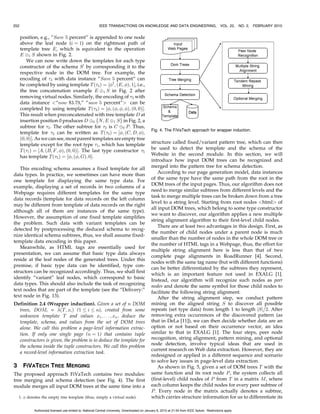
                                                                                              Fig. 3. Encoding of data instances for a type constructor. (a) Single
                                                                                              instance e ¼ ðX1 ; . . . ; Xk Þ. (b) Multiple instance e1 ; . . . ; em .

                                                                                              k þ 1 templates to be placed in front of, in between, and in
                                                                                              the end of the k subitems as follows:
Fig. 2. Examples for tree concatenation.                                                      Definition 2.3 (Level-aware encoding). We define the
                                                                                                template for a type constructor  as well as the encoding of
template and the data schema given input Webpages                                               its instance x (in terms of encoding of subvalues of x) as
should be established on some page generation model,                                            described below.
which we describe next. In this paper, we propose a tree-                                              1.    If  is of a basic type,
, then the encoding ðT ; xÞ is
based page generation model, which encodes data by                                                           defined to be a node containing the string x itself.
subtree concatenation instead of string concatenation. This                                            2.    If  is a type constructor of order k, then the template is
is because both data schema and Webpages are tree-like                                                       denoted by: T ðÞ ¼ ½P ; ðC1 ; . . . ; Ckþ1 Þ; ði1 ; . . . ; ik ÞŠ,
structures. Thus, we also consider templates as tree                                                         where P ; C1 ; . . . , and Ckþ1 are template trees.
structures. The advantage of tree-based page generation
                                                                                                             a.     For single instance x of the form ðx1 ; . . . ; xk Þ;
model is that it will not involve ending tags (e.g., /html,
                                                                                                                    ðT ; xÞ is a tree produced by concatenating
/body, etc.) into their templates as in string-based page
                                                                                                                    the k þ 1 ordered subtrees, C1 Èi1 ðT ; x1 Þ;
generation model applied in EXALG.
                                                                                                                    C2 Èi2 ðT ; x2 Þ; . . . ; Ck Èik ðT ; xk Þ, and Ckþ1
   Concatenation is a required operation in page genera-
                                                                                                                    at the leaf on the rightmost path of template P .
tion model since subitems of data must be encoded with
                                                                                                                    See Fig. 3a for illustration on single instance
templates to form the result. For example, encoding of a                                                            encoding.
k-order type constructor  with instance x should involve                                                    b.     For multiple instances e1 ; e2 ; . . . ; em where each
the concatenation of template trees T , with all the                                                                ei is an instance of type , the encoding
encoded trees of its subitems for x. However, tree                                                                  ðT ; e1 ; e2 ; . . . ; em Þ is the tree by inserting the
concatenation is more complicate since there is more than                                                           m subtrees ðT ; e1 Þ; ðT ; e2 Þ; . . . ; ðT ; em Þ as
one point to append a subtree to the rightmost path of an                                                           siblings at the leaf node on the rightmost path of
existing tree. Thus, we need to consider the insertion                                                              the parent template P . Each subtree ðT ; ei Þ is
position for tree concatenation.                                                                                    produced by encoding ei with template [,
Definition 2.2. Let T1 and T2 be two trees, we define the operation                                                 (C1 ; . . . ; Ckþ1 ), (i1 ; . . . ; ik )] using the procedure
  T1 Èi T2 as a new tree by appending tree T2 to the rightmost                                                      for single instance as above;  is the null template
  path of T1 at the ith node (position) from the leaf node.                                                         (or a virtual node). See Fig. 3b for illustration on
                                                                                                                    multiple instances encoding.
   For example, given the templates trees C; E and data                                                      c.     For disjunction, no template is required since the
                                                                                                                    encoding of an instance x will use the template of
contents P ; S (for content data “P roduct 1” and “Save
                                                                                                                    some i (1 i k), where x is an instance of i .
5 percent,” respectively) on top half of Fig. 2, we show the
tree concatenation C È0 P and E È1 S on bottom half of the                                    Example 2.2. We now consider the schema S 0 ¼ f
; 
same figure. The dotted circles for these trees are virtual
; ð
Þ?4 3 2 ; f
g5 g1 for the input DOM tree in
nodes, which facilitate tree representation (e.g., connecting                                   Fig. 1a. We circumscribe adjoining HTML tags into
multiple paths into trees) and can be neglected. The insertion                                  template trees A À G (rectangular boxes). Most of the
                                                                                                templates are single paths, while templates C and D
points are marked with blue solid circle. For subtree C, the
                                                                                                contain two paths. Thus, a virtual node is added as their
insertion point is node a, where the subtree P (single
                                                                                                root to form a tree structure as shown in Fig. 2.
node) is inserted. For subtree E, the insertion point is one
                                                                                                Traversing the tree in a depth-first order to give the
node above the br node, i.e., the virtual root, where the                                     templates and data an order, we can see that most data
subtree S (also a single node) is appended to. We also show                                     items are inserted at the leaf nodes of their preceding
two subtrees N (for content data “Now $3:79”) and E È1 S                                        templates, e.g., item “P roduct 1” is appended to tem-
inserted as sibling under template D at insertion point 0. We                                   plate tree C at the leaf nodes with insertion position 0,
denote this operation by D È0 fN; E È1 Sg.                                                      which is equivalent to the C È0 P operation in Fig. 2;
   With the tree-concatenation operation, we can now                                            similarly, “Now$3:79; ” “F eature1 1” are appended to
define the encoding of a k-order type constructor in a way                                      template trees D and F , respectively, at the leaf nodes
similar to that in EXALG. Basically, the idea is to allow                                       with insertion position 0. Still some have a different

           Authorized licensed use limited to: National Central University. Downloaded on January 6, 2010 at 21:54 from IEEE Xplore. Restrictions apply.
252                                                        IEEE TRANSACTIONS ON KNOWLEDGE AND DATA ENGINEERING,                                  VOL. 22, NO. 2,   FEBRUARY 2010


      position, e.g., “Save 5 percent” is appended to one node
      above the leaf node (i ¼ 1) on the rightmost path of
      template tree E, which is equivalent to the operation
      E È1 S shown in Fig. 2.
          We can now write down the templates for each type
      constructor of the schema S 0 by corresponding it to the
      respective node in the DOM tree. For example, the
      encoding of 4 with data instance “Save 5 percent” can
      be completed by using template T ð4 Þ ¼ ½1; ðE; Þ; 1Š, i.e.,
      the tree concatenation example E È1 S in Fig. 2 after
      removing virtual nodes. Similarly, the encoding of 3 with
      data instance “now $3:79,” “save 5 percent” can be
      completed by using template T ð3 Þ ¼ ½; ð; ; Þ; ð0; 0ÞŠ.
      This result when preconcatenated with tree template D at
      insertion position 0 produces D È0 fN; E È1 Sg in Fig. 2, a
      subtree for 2 . The other subtree for 2 is C È0 P . Thus,
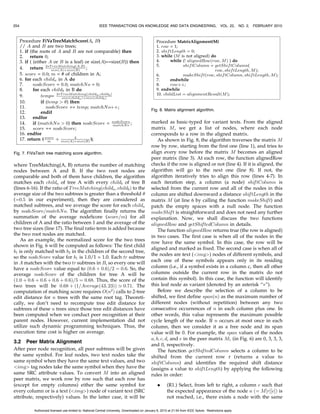
                                                                                                Fig. 4. The FiVaTech approach for wrapper induction.
      template for 2 can be written as T ð2 Þ ¼ ½; ðC; D; Þ;
      ð0; 0ÞŠ. As we can see, most parent templates are empty tree
      template except for the root type 1 , which has template                                 structure called fixed/variant pattern tree, which can then
      T ð1 Þ ¼ ½A; ðB; F ; Þ; ð0; 0ÞŠ. The last type constructor 5                           be used to detect the template and the schema of the
      has template T ð5 Þ ¼ ½; ð; GÞ; 0Š.                                                    Website in the second module. In this section, we will
                                                                                                introduce how input DOM trees can be recognized and
   This encoding schema assumes a fixed template for all                                        merged into the pattern tree for schema detection.
data types. In practice, we sometimes can have more than                                            According to our page generation model, data instances
                                                                                                of the same type have the same path from the root in the
one template for displaying the same type data. For
                                                                                                DOM trees of the input pages. Thus, our algorithm does not
example, displaying a set of records in two columns of a
                                                                                                need to merge similar subtrees from different levels and the
Webpage requires different templates for the same type
                                                                                                task to merge multiple trees can be broken down from a tree
data records (template for data records on the left column
                                                                                                level to a string level. Starting from root nodes html of
may be different from template of data records on the right
                                                                                                all input DOM trees, which belong to some type constructor
although all of them are instances of the same type).
                                                                                                we want to discover, our algorithm applies a new multiple
However, the assumption of one fixed template simplifies
                                                                                                string alignment algorithm to their first-level child nodes.
the problem. Such data with variant templates can be
                                                                                                    There are at least two advantages in this design. First, as
detected by postprocessing the deduced schema to recog-
                                                                                                the number of child nodes under a parent node is much
nize identical schema subtrees, thus, we shall assume fixed-
                                                                                                smaller than the number of nodes in the whole DOM tree or
template data encoding in this paper.
                                                                                                the number of HTML tags in a Webpage, thus, the effort for
   Meanwhile, as HTML tags are essentially used for
                                                                                                multiple string alignment here is less than that of two
presentation, we can assume that basic type data always
                                                                                                complete page alignments in RoadRunner [4]. Second,
reside at the leaf nodes of the generated trees. Under this
                                                                                                nodes with the same tag name (but with different functions)
premise, if basic type data can be identified, type con-
                                                                                                can be better differentiated by the subtrees they represent,
structors can be recognized accordingly. Thus, we shall first
                                                                                                which is an important feature not used in EXALG [1].
identify “variant” leaf nodes, which correspond to basic
                                                                                                Instead, our algorithm will recognize such nodes as peer
data types. This should also include the task of recognizing
                                                                                                nodes and denote the same symbol for those child nodes to
text nodes that are part of the template (see the “Delivery:”                                   facilitate the following string alignment.
text node in Fig. 13).                                                                              After the string alignment step, we conduct pattern
Definition 2.4 (Wrapper induction). Given a set of n DOM                                        mining on the aligned string S to discover all possible
  trees, DOMi = ðT ; xi Þ (1 i n), created from some                                           repeats (set type data) from length 1 to length jSj=2. After
  unknown template T and values x1 ; . . . ; xn , deduce the                                    removing extra occurrences of the discovered pattern (as
  template, schema, and values from the set of DOM trees                                        that in DeLa [11]), we can then decide whether data are an
  alone. We call this problem a page-level information extrac-                                  option or not based on their occurrence vector, an idea
  tion. If only one single page (n ¼ 1) that contains tuple                                     similar to that in EXALG [1]. The four steps, peer node
  constructors is given, the problem is to deduce the template for                              recognition, string alignment, pattern mining, and optional
                                                                                                node detection, involve typical ideas that are used in
  the schema inside the tuple constructors. We call this problem
                                                                                                current research on Web data extraction. However, they are
  a record-level information extraction task.
                                                                                                redesigned or applied in a different sequence and scenario
                                                                                                to solve key issues in page-level data extraction.
3      FIVATECH TREE MERGING                                                                        As shown in Fig. 5, given a set of DOM trees T with the
The proposed approach FiVaTech contains two modules:                                            same function and its root node P , the system collects all
tree merging and schema detection (see Fig. 4). The first                                       (first-level) child nodes of P from T in a matrix M, where
module merges all input DOM trees at the same time into a                                       each column keeps the child nodes for every peer subtree of
                                                                                                P . Every node in the matrix actually denotes a subtree,
    1.  denotes the empty tree template (thus, simply a virtual node).                         which carries structure information for us to differentiate its

             Authorized licensed use limited to: National Central University. Downloaded on January 6, 2010 at 21:54 from IEEE Xplore. Restrictions apply.
KAYED AND CHANG: FIVATECH: PAGE-LEVEL WEB DATA EXTRACTION FROM TEMPLATE PAGES                                                                               253


                                                                                              Fig. 6. Example of set-type data.

                                                                                              3.1 Peer Node Recognition
                                                                                              One of the key issues for misalignment among multiple
                                                                                              pages (or multiple records in a single page) is that the same
                                                                                              HTML tags can have different meanings (we do not
                                                                                              consider different HTML tags with same meaning since
                                                                                              we assume that templates are fixed for the same data as
                                                                                              discussed above). As each tag/node is actually denoted by a
                                                                                              tree, we can use 2-tree matching algorithm for computing
                                                                                              whether two nodes with the same tag are similar. There are
                                                                                              several 2-tree matching algorithms proposed before. We
                                                                                              adopt Yang’s algorithm [13] in which level crossing is not
                                                                                              allowed (i.e., two tag nodes in two trees are matched only if
                                                                                              they appear at the same level) while node replacement is
FIg. 5. Multiple tree merging algorithm.                                                      allowed only on the roots of the two trees (i.e., two trees
                                                                                              may be matching even their root nodes are labeled by
role. Then, we conduct the four steps: peer node recogni-                                     different HTML tags). To fit our problem, we modified the
tion, matrix alignment, pattern mining, and optional node                                     algorithm such that node replacement is allowed at leaves
detection in turn.                                                                            instead of roots. Thus, two leaf nodes can be matched even
                                                                                              if they have different text values. The running time of the
   .   In the peer node recognition step (line 9), two nodes                                  algorithm is still Oðs1 s2 Þ, where s1 and s2 are the numbers of
       with the same tag name are compared to check if                                        nodes of the trees.
       they are peer subtrees. All peer subtrees will be                                          A more serious problem is score normalization. Tradi-
       denoted by the same symbol.                                                            tional 2-tree matching algorithm returns the number of
   . In the matrix alignment step (line 10), the system tries                                 maximum matching, which requires normalization for
       to align nodes (symbols) in the peer matrix to get a list                              comparison. A typical way to compute a normalized score
       of aligned nodes childList. In addition to alignment,                                  is the ratio between the numbers of pairs in the mapping
       the other important task is to recognize variant leaf                                  over the maximum size of the two trees as is used in DEPTA
       nodes that correspond to basic-typed data.                                             [14]. However, the formula might return a low value for
   . In the pattern mining step (line 11), the system takes                                   trees containing set-type data. For example, given the two
       the aligned childList as input to detect every                                         matched trees A and B as shown in Fig. 6, where tr1 À tr6
       repetitive pattern in this list starting with length 1.                                are six similar data records, we assume that the mapping
       For each detected repetitive pattern, all occurrences                                  pairs between any two different subtrees tri and trj are 6.
       of this pattern except for the first one are deleted for                               Thus, the tree matching algorithm will detect a mapping
       further mining of longer repeats. The result of this                                   that includes 15 pairs: 6 Â 2 pairs from tr1 and tr2 (matched
       mining step is a modified list of nodes without any                                    with tr5 and tr6 , respectively), 2 pairs from b1 , and finally, a
       repetitive patterns.                                                                   mapping from the root of A to the root of B. Assume also
   . In the last step (line 12), the system recognizes                                        that the size of every tri is approximately 10. According to
       optional nodes if a node disappears in some columns                                    such a measure, the matching score between the two trees A
       of the matrix and group nodes according to their                                       and B will be 15=43ð’0:35Þ, which is low.
       occurrence vector.                                                                         For Web data extraction problem, where set-type data
   After the above four steps, the system inserts nodes in                                    occur, it is unfair to use the maximum size of the two trees to
the modified childList as children of P . For nonleaf child                                   compute the matching score. Practically, we noticed that this
node c, if c is not a fixed template tree (as defined in the next                             multiple-valued data have great influence on first-level
section), the algorithm recursively calls the tree merging                                    subtrees of the two trees A and B. Thus, we propose
algorithm with the peer subtrees of c (by calling procedure                                   FiVaTreeMatchingScore (Fig. 7) to handle this problem
                                                                                              without increasing the complexity as follows: If the two root
peerNodeðc; MÞ, which returns nodes in M having the same
                                                                                              nodes A and B are not comparable (i.e., have different labels
symbol of c) to build the pattern tree (line 14). The next four                               and both are not text nodes), the algorithm gives a score 0
sections will discuss in details recognition of peer subtrees,                                for the two trees (line 2). If either of the two root nodes has
multiple string alignment, frequent pattern mining, and                                       no children (line 3) or they are of the same size, the
merging of optional nodes, which are applied for each node                                    algorithm computes the score as the ratio of TreeMatch-
in constructing the fixed/variant pattern tree (lines 9-12).                                  ing(A, B) over the average of the two tree sizes (line 4),

           Authorized licensed use limited to: National Central University. Downloaded on January 6, 2010 at 21:54 from IEEE Xplore. Restrictions apply.
254                                                     IEEE TRANSACTIONS ON KNOWLEDGE AND DATA ENGINEERING,                                  VOL. 22, NO. 2,   FEBRUARY 2010


                                                                                             Fig. 8. Matrix alignment algorithm.

                                                                                             marked as basic-typed for variant texts. From the aligned
                                                                                             matrix M, we get a list of nodes, where each node
                                                                                             corresponds to a row in the aligned matrix.
                                                                                                 As shown in Fig. 8, the algorithm traverses the matrix M
                                                                                             row by row, starting from the first one (line 1), and tries to
Fig. 7. FiVaTech tree matching score algorithm.                                              align every row before the matrix M becomes an aligned
                                                                                             peer matrix (line 3). At each row, the function alignedRow
where TreeMatching(A, B) returns the number of matching                                      checks if the row is aligned or not (line 4). If it is aligned, the
nodes between A and B. If the two root nodes are                                             algorithm will go to the next one (line 8). If not, the
comparable and both of them have children, the algorithm                                     algorithm iteratively tries to align this row (lines 4-7). In
matches each childa of tree A with every childb of tree B                                    each iteration step, a column (a node) shiftColumn is
(lines 6-16). If the ratio of T reeMatchingðchilda ; childb Þ to the                         selected from the current row and all of the nodes in this
average size of the two subtrees is greater than a threshold                                column are shifted downward a distance shiftLength in the
(¼0:5 in our experiment), then they are considered as                                        matrix M (at line 6 by calling the function makeShift) and
matched subtrees, and we average the score for each childa                                   patch the empty spaces with a null node. The function
by nodeScore=matchNo. The algorithm finally returns the                                      makeShift is straightforward and does not need any further
summation of the average nodeScore (score=m) for all                                         explanation. Now, we shall discuss the two functions
children of A and the ratio between 1 and the average of the                                 alignedRow and getShiftedColumn in details.
two tree sizes (line 17). The final ratio term is added because                                  The function alignedRow returns true (the row is aligned)
the two root nodes are matched.                                                              in two cases. The first case is when all of the nodes in the
    As an example, the normalized score for the two trees
                                                                                             row have the same symbol. In this case, the row will be
shown in Fig. 6 will be computed as follows: The first child
                                                                                             aligned and marked as fixed. The second case is when all of
b1 is only matched with b2 in the children of the second tree,
                                                                                             the nodes are text (img) nodes of different symbols, and
so the nodeScore value for b1 is 1.0/1 = 1.0. Each tr subtree
in A matches with the two tr subtrees in B, so every one will                                each one of these symbols appears only in its residing
have a nodeScore value equal to ð0:6 þ 0:6Þ=2 ¼ 0:6. So, the                                 column (i.e., if a symbol exists in a column c, then all other
average nodeScore of the children for tree A will be                                         columns outside the current row in the matrix do not
ð1:0 þ 0:6 þ 0:6 þ 0:6 þ 0:6Þ=5 ¼ 0:68. Thus, the score of the                               contain this symbol). In this case, the function will identify
two trees will be 0:68 þ ð1=Averageð43; 23ÞÞ ’ 0:71. The                                     this leaf node as variant (denoted by an asterisk “Ô).
computation of matching score requires Oðn2 Þ calls to 2-tree                                    Before we describe the selection of a column to be
edit distance for n trees with the same root tag. Theoreti-                                  shifted, we first define spanðnÞ as the maximum number of
cally, we don’t need to recompute tree edit distance for                                     different nodes (without repetition) between any two
subtrees of these n trees since those tree edit distances have                               consecutive occurrences of n in each column plus one. In
been computed when we conduct peer recognition at their                                      other words, this value represents the maximum possible
parent nodes. However, current implementation did not                                        cycle length of the node. If n occurs at most once in each
utilize such dynamic programming techniques. Thus, the                                       column, then we consider it as a free node and its span
execution time cost is higher on average.                                                    value will be 0. For example, the span values of the nodes
                                                                                             a; b; c; d, and e in the peer matrix M1 (in Fig. 6) are 0, 3, 3, 3,
3.2 Peer Matrix Alignment
                                                                                             and 0, respectively.
After peer node recognition, all peer subtrees will be given                                     The function getShiftedColumn selects a column to be
the same symbol. For leaf nodes, two text nodes take the                                     shifted from the current row r (returns a value to
same symbol when they have the same text values, and two                                     shiftColumn) and identifies the required shift distance
img tag nodes take the same symbol when they have the                                      (assigns a value to shiftLength) by applying the following
same SRC attribute values. To convert M into an aligned                                      rules in order:
peer matrix, we work row by row such that each row has
(except for empty columns) either the same symbol for                                            .      (R1.) Select, from left to right, a column c such that
every column or is a text (img) node of variant text (SRC                                             the expected appearance of the node n ð¼ M½rнcŠÞ is
attribute, respectively) values. In the latter case, it will be                                         not reached, i.e., there exists a node with the same

          Authorized licensed use limited to: National Central University. Downloaded on January 6, 2010 at 21:54 from IEEE Xplore. Restrictions apply.
KAYED AND CHANG: FIVATECH: PAGE-LEVEL WEB DATA EXTRACTION FROM TEMPLATE PAGES                                                                             255


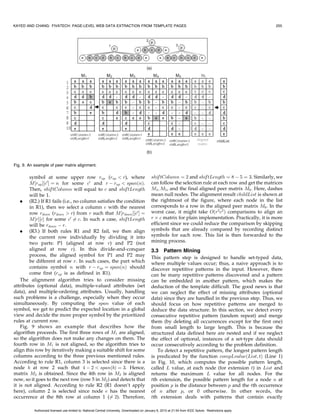
Fig. 9. An example of peer matrix alignment.

        symbol at some upper row rup (rup  r), where                                        shiftColumn ¼ 2 and shiftLength ¼ 8 À 5 ¼ 3. Similarly, we
        M½rup нc0 Š ¼ n for some c0 and r À rup  spanðnÞ.                                  can follow the selection rule at each row and get the matrices
        Then, shiftColumn will equal to c and shiftLength                                    M4 ; M5 , and the final aligned peer matrix M6 . Here, dashes
        will be 1.                                                                           mean null nodes. The alignment result childList is shown at
    . (R2.) If R1 fails (i.e., no column satisfies the condition                             the rightmost of the figure, where each node in the list
        in R1), then we select a column c with the nearest                                   corresponds to a row in the aligned peer matrix M6 . In the
        row rdown (rdown  r) from r such that M½rdown нc0 Š ¼                              worst case, it might take Oðr2 c2 Þ comparisons to align an
        M½rнcŠ for some c0 6¼ c. In such a case, shiftLength                                r  c matrix for plain implementation. Practically, it is more
        will be rdown À r.                                                                   efficient since we could reduce the comparison by skipping
    . (R3.) If both rules R1 and R2 fail, we then align                                      symbols that are already compared by recording distinct
        the current row individually by dividing it into                                     symbols for each row. This list is then forwarded to the
        two parts: P1 (aligned at row r) and P2 (not                                         mining process.
        aligned at row r). In this divide-and-conquer                                        3.3 Pattern Mining
        process, the aligned symbol for P1 and P2 may                                        This pattern step is designed to handle set-typed data,
        be different at row r. In such cases, the part which                                 where multiple values occur; thus, a naive approach is to
        contains symbol n with r À rup ¼ spanðnÞ should                                      discover repetitive patterns in the input. However, there
        come first (rup is as defined in R1).                                                can be many repetitive patterns discovered and a pattern
    The alignment algorithm tries to consider missing                                        can be embedded in another pattern, which makes the
attributes (optional data), multiple-valued attributes (set                                  deduction of the template difficult. The good news is that
data), and multiple-ordering attributes. Usually, handling                                   we can neglect the effect of missing attributes (optional
such problems is a challenge, especially when they occur                                     data) since they are handled in the previous step. Thus, we
simultaneously. By computing the span value of each                                          should focus on how repetitive patterns are merged to
symbol, we get to predict the expected location in a global                                  deduce the data structure. In this section, we detect every
view and decide the more proper symbol by the prioritized                                    consecutive repetitive pattern (tandem repeat) and merge
rules at current row.                                                                        them (by deleting all occurrences except for the first one)
    Fig. 9 shows an example that describes how the                                           from small length to large length. This is because the
algorithm proceeds. The first three rows of M1 are aligned,                                  structured data defined here are nested and if we neglect
so the algorithm does not make any changes on them. The                                      the effect of optional, instances of a set-type data should
fourth row in M1 is not aligned, so the algorithm tries to                                   occur consecutively according to the problem definition.
align this row by iteratively making a suitable shift for some                                  To detect a repetitive pattern, the longest pattern length
columns according to the three previous mentioned rules.                                     is predicated by the function compLvalueðList; tÞ (Line 1)
According to rule R1, column 3 is selected since there is a                                  in Fig. 10, which computes the possible pattern length,
node b at row 2 such that 4 À 2  spanðbÞ ¼ 3. Hence,                                        called L value, at each node (for extension t) in List and
matrix M2 is obtained. Since the 4th row in M2 is aligned                                    returns the maximum L value for all nodes. For the
now, so it goes to the next row (row 5 in M2 ) and detects that                              tth extension, the possible pattern length for a node n at
it is not aligned. According to rule R2 (R1 doesn’t apply                                    position p is the distance between p and the tth occurrence
here), column 2 is selected since node e has the nearest                                     of n after p, or 0 otherwise. In other words, the
occurrence at the 8th row at column 1 (6¼ 2). Therefore,                                     tth extension deals with patterns that contain exactly

          Authorized licensed use limited to: National Central University. Downloaded on January 6, 2010 at 21:54 from IEEE Xplore. Restrictions apply.
256                                                      IEEE TRANSACTIONS ON KNOWLEDGE AND DATA ENGINEERING,                                  VOL. 22, NO. 2,   FEBRUARY 2010


                                                                                              (line 21). The termination condition is when there is no
                                                                                              more nodes with more than one occurrence or the list
                                                                                              cannot be extended by the function patternCanExtend,
                                                                                              which is verified by checking if the length of List is greater
                                                                                              than twice the length of the shortest repetitive pattern, i.e.,
                                                                                              jListj  2ðlbÞðextend þ 1Þ, where lb is the minimum L value
                                                                                              in the current list. The complexity of the algorithm is
                                                                                              quadratic (Oðn2 Þ; n ¼ jListj).
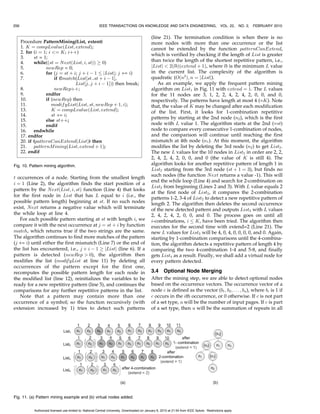
                                                                                                  As an example, we apply the frequent pattern mining
                                                                                              algorithm on List1 in Fig. 11 with extend ¼ 1. The L values
                                                                                              for the 11 nodes are 3, 1, 2, 2, 4, 2, 4, 2, 0, 0, and 0,
                                                                                              respectively. The patterns have length at most 4 (=K). Note
                                                                                              that, the value of K may be changed after each modification
                                                                                              of the list. First, it looks for 1-combination repetitive
                                                                                              patterns by starting at the 2nd node (n2 ), which is the first
                                                                                              node with L value 1. The algorithm starts at the 2nd (=st)
                                                                                              node to compare every consecutive 1-combination of nodes,
                                                                                              and the comparison will continue until reaching the first
                                                                                              mismatch at 4th node (n1 ). At this moment, the algorithm
                                                                                              modifies the list by deleting the 3rd node (n2 ) to get List2 .
                                                                                              The new L values for the 10 nodes in List2 in order are 2, 2,
                                                                                              2, 4, 2, 4, 2, 0, 0, and 0 (the value of K is still 4). The
Fig. 10. Pattern mining algorithm.                                                            algorithm looks for another repetitive pattern of length 1 in
                                                                                              List2 starting from the 3rd node (st þ 1 ¼ 3), but finds no
                                                                                              such nodes (the function Next returns a value -1). This will
t occurrences of a node. Starting from the smallest length
                                                                                              end the while loop (Line 4) and search for 2-combination on
i ¼ 1 (Line 2), the algorithm finds the start position of a
                                                                                              List2 from beginning (Lines 2 and 3). With L value equals 2
pattern by the NextðList; i; stÞ function (Line 4) that looks
                                                                                              at the first node of List2 , it compares the 2-combination
for the first node in List that has L equal to i (i.e., the
                                                                                              patterns 1-2, 3-4 of List2 to detect a new repetitive pattern of
possible pattern length) beginning at st. If no such nodes                                    length 2. The algorithm then deletes the second occurrence
exist, Next returns a negative value which will terminate                                     of the new detected pattern and outputs List3 with L values
the while loop at line 4.                                                                     2, 4, 2, 4, 2, 0, 0, and 0. The process goes on until all
   For each possible pattern starting at st with length i, we                                 i-combinations, i K, have been tried. The algorithm then
compare it with the next occurrence at j ¼ st þ i by function                                 executes for the second time with extend=2 (Line 21). The
match, which returns true if the two strings are the same.                                    new L values for List3 will be 4, 0, 4, 0, 0, 0, 0, and 0. Again,
The algorithm continues to find more matches of the pattern                                   starting by 1-combination comparisons until the 4-combina-
(j += i) until either the first mismatch (Line 7) or the end of                               tion, the algorithm detects a repetitive pattern of length 4 by
the list has encountered, i.e., j þ i À 1 ! jListj (line 6). If a                             comparing the two 4-combination 1-4 and 5-8, and finally
pattern is detected (newRep  0), the algorithm then                                          gets List4 as a result. Finally, we shall add a virtual node for
modifies the list (modifyList at line 11) by deleting all                                     every pattern detected.
occurrences of the pattern except for the first one,
recomputes the possible pattern length for each node in                                       3.4 Optional Node Merging
the modified list (line 12), reinitializes the variables to be                                After the mining step, we are able to detect optional nodes
ready for a new repetitive pattern (line 5), and continues the                                based on the occurrence vectors. The occurrence vector of a
comparisons for any further repetitive patterns in the list.                                  node c is defined as the vector (b1 ; b2 ; . . . ; bu ), where bi is 1 if
   Note that a pattern may contain more than one                                              c occurs in the ith occurrence, or 0 otherwise. If c is not part
occurrence of a symbol; so the function recursively (with                                     of a set type, u will be the number of input pages. If c is part
extension increased by 1) tries to detect such patterns                                       of a set type, then u will be the summation of repeats in all


Fig. 11. (a) Pattern mining example and (b) virtual nodes added.


           Authorized licensed use limited to: National Central University. Downloaded on January 6, 2010 at 21:54 from IEEE Xplore. Restrictions apply.
KAYED AND CHANG: FIVATECH: PAGE-LEVEL WEB DATA EXTRACTION FROM TEMPLATE PAGES                                                                               257


pages. For example, the childList “abcdbcdbcde” in Fig. 9 will
become “abcde” after the mining step, where the three
nodes b; c, and d will be considered as set-typed data with 6
repeats (3 from the first tree, 1 from the second, and 2 from
the third tree of Fig. 9a). For the two nodes a and e, the
occurrence vector is (1,1,1). The occurrence vectors of the
three nodes b; c, and d are (1,1,1,1,1,1), (1,1,1,1,1,1), and
(1,0,1,1,0,1), respectively. We shall detect node d as optional
for it disappears in some occurrences of the pattern.
   With the occurrence vector defined above, we then
group optional nodes based on the following rules and add
to the pattern tree one virtual node for the group.

   .   Rule 1. If a set of adjacent optional nodes
       ci ; ciþ1 ; . . . ; ck (i  k) have the same occurrence
       vectors, we shall group them as optional.
   . Rule 2. If a set of adjacent optional nodes
       ci ; ciþ1 ; . . . ; ck (i  k) have complement occurrence
       vectors, we shall group them as disjunction.
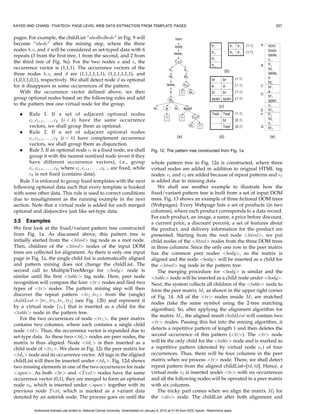
   . Rule 3. If an optional node ci is a fixed node, we shall                                  Fig. 12. The pattern tree constructed from Fig. 1a.
       group it with the nearest nonfixed node (even if they
       have different occurrence vectors), i.e., group                                         whole pattern tree in Fig. 12a is constructed, where three
       ci ; ciþ1 ; . . . ; ck , where ci ; ciþ1 ; . . . ; ckÀ1 are fixed, while                virtual nodes are added in addition to original HTML tag
       ck is not fixed (contains data).                                                        nodes: v1 and v3 are added because of repeat patterns and v2
   Rule 3 is enforced to group fixed templates with the next                                   is added due to missing data.
following optional data such that every template is hooked                                        We shall use another example to illustrate how the
with some other data. This rule is used to correct conditions                                  fixed/variant pattern tree is built from a set of input DOM
due to misalignment as the running example in the next                                         trees. Fig. 13 shows an example of three fictional DOM trees
section. Note that a virtual node is added for each merged                                     (Webpages). Every Webpage lists a set of products (in two
optional and disjunctive just like set-type data.                                              columns), where each product corresponds to a data record.
                                                                                               For each product, an image, a name, a price before discount,
3.5 Examples                                                                                   a current price, a discount percent, a set of features about
We first look at the fixed/variant pattern tree constructed                                    the product, and delivery information for the product are
from Fig. 1a. As discussed above, this pattern tree is                                         presented. Starting from the root node html, we put
initially started from the html tag node as a root node.                                     child nodes of the html nodes from the three DOM trees
Then, children of the html nodes of the input DOM                                            in three columns. Since the only one row in the peer matrix
trees are collected for alignment. As there is only one input                                  has the common peer nodes body, so the matrix is
page in Fig. 1a, the single child list is automatically aligned                                aligned and the node body will be inserted as a child for
and pattern mining does not change the childList. The                                          the html tag node in the pattern tree.
second call to MultipleTreeMerge for body node is                                               The merging procedure for body is similar and the
similar until the first table tag node. Here, peer node                                      table node will be inserted as a child node under body.
recognition will compare the four tr nodes and find two                                      Next, the system collects all children of the table node to
types of tr nodes. The pattern mining step will then                                         form the peer matrix M1 as shown in the upper right corner
discover the repeat pattern tr1 ; tr2  from the (single)                                     of Fig. 14. All of the tr nodes inside M1 are matched
childList ¼ ½tr1 ; tr2 ; tr1 ; tr2 Š (see Fig. 12b) and represent it
                                                                                               nodes (take the same symbol using the 2-tree matching
by a virtual node fv1 g that is inserted as a child for the
                                                                                               algorithm). So, after applying the alignment algorithm for
table node in the pattern tree.
                                                                                               the matrix M1 , the aligned result childList will contain two
   For the two occurrences of node tr1 , the peer matrix
                                                                                               tr nodes. Passing this list into the mining algorithm, it
contains two columns, where each contains a single child
node td. Thus, the occurrence vector is expanded due to                                      detects a repetitive pattern of length 1 and then deletes the
set-type data. As these two td1  nodes are peer nodes, the                                   second occurrence of this pattern (tr). The tr node
matrix is thus aligned. Node td1  is then inserted as a                                      will be the only child for the table node and is marked as
child node of tr1 . We show in Fig. 12c the peer matrix for                                  a repetitive pattern (denoted by virtual node v1 ) of four
td2  node and its occurrence vector. All tags in the aligned                                 occurrences. Thus, there will be four columns in the peer
childList will then be inserted under td2 . Fig. 12d shows                                   matrix when we process tr node. There, we shall detect
two missing elements in one of the two occurrences for node                                    repeat pattern from the aligned childList=[td; td]. Hence, a
span. As both br and T ext nodes have the same                                           virtual node v2 is inserted under tr with six occurrences
occurrence vector (0,1), they are merged to form an optional                                   and all the following nodes will be operated in a peer matrix
node v3 , which is inserted under span together with its                                     with six columns.
previous node T ext, which is marked as a variant data                                            The tricky part comes when we align the matrix M2 for
denoted by an asterisk node. The process goes on until the                                     the div node. The childList after both alignment and

            Authorized licensed use limited to: National Central University. Downloaded on January 6, 2010 at 21:54 from IEEE Xplore. Restrictions apply.

Fi vatechcameraready

  • 1.
    IEEE TRANSACTIONS ONKNOWLEDGE AND DATA ENGINEERING, VOL. 22, NO. 2, FEBRUARY 2010 249 FiVaTech: Page-Level Web Data Extraction from Template Pages Mohammed Kayed and Chia-Hui Chang, Member, IEEE Abstract—Web data extraction has been an important part for many Web data analysis applications. In this paper, we formulate the data extraction problem as the decoding process of page generation based on structured data and tree templates. We propose an unsupervised, page-level data extraction approach to deduce the schema and templates for each individual Deep Website, which contains either singleton or multiple data records in one Webpage. FiVaTech applies tree matching, tree alignment, and mining techniques to achieve the challenging task. In experiments, FiVaTech has much higher precision than EXALG and is comparable with other record-level extraction systems like ViPER and MSE. The experiments show an encouraging result for the test pages used in many state-of-the-art Web data extraction works. Index Terms—Semistructured data, Web data extraction, multiple trees merging, wrapper induction. Ç 1 INTRODUCTION D EEP Web, as is known to everyone, contains magnitudes more and valuable information than the surface Web. However, making use of such consolidated information targets as in nontemplate page information extraction (e.g., Softmealy [5], Stalker [9], WIEN [6], etc.) and the key to automatic extraction depends on whether we can deduce requires substantial efforts since the pages are generated for the template automatically. visualization not for data exchange. Thus, extracting Generally speaking, templates, as a common model for information from Webpages for searchable Websites has all pages, occur quite fixed as opposed to data values which been a key step for Web information integration. Generating vary across pages. Finding such a common template an extraction program for a given search form is equivalent requires multiple pages or a single page containing multiple to wrapping a data source such that all extractor or wrapper records as input. When multiple pages are given, the programs return data of the same format for information extraction target aims at page-wide information (e.g., integration. RoadRunner [4] and EXALG [1]). When single pages are An important characteristic of pages belonging to the given, the extraction target is usually constrained to record- same Website is that such pages share the same template wide information (e.g., IEPAD [2], DeLa [11], and DEPTA since they are encoded in a consistent manner across all the [14]), which involves the addition issue of record-boundary pages. In other words, these pages are generated with a detection. Page-level extraction tasks, although do not predefined template by plugging data values. In practice, involve the addition problem of boundary detection, are template pages can also occur in surface Web (with static much more complicated than record-level extraction tasks hyperlinks). For example, commercial Websites often have a since more data are concerned. template for displaying company logos, browsing menus, A common technique that is used to find template is and copyright announcements, such that all pages of the alignment: either string alignment (e.g., IEPAD, RoadRun- same Website look consistent and designed. In addition, ner) or tree alignment (e.g., DEPTA). As for the problem of templates can also be used to render a list of records to distinguishing template and data, most approaches assume show objects of the same kind. Thus, information extraction that HTML tags are part of the template, while EXALG from template pages can be applied in many situations. considers a general model where word tokens can also be What’s so special with template pages is that the part of the template and tag tokens can also be data. extraction targets for template Webpages are almost equal However, EXALG’s approach, without explicit use of to the data values embedded during page generation. Thus, alignment, produces many accidental equivalent classes, there is no need to annotate the Webpages for extraction making the reconstruction of the schema not complete. In this paper, we focus on page-level extraction tasks and propose a new approach, called FiVaTech, to automatically . M. Kayed is with the Department of Mathematics, Faculty of Science, Beni- detect the schema of a Website. The proposed technique Suef University, Beni-Suef, Egypt. E-mail: mskayed@yahoo.com. . C.-H. Chang is with the Department of Computer Science and Information presents a new structure, called fixed/variant pattern tree, a Engineering, National Central University, No. 300, Jungda Rd, Jhongli tree that carries all of the required information needed to City, Taoyuan, Taiwan 320, ROC. E-mail: chia@csie.ncu.edu.tw. identify the template and detect the data schema. We Manuscript received 10 Jan. 2008; revised 23 Nov. 2008; accepted 10 Mar. combine several techniques: alignment, pattern mining, as 2009; published online 31 Mar. 2009. well as the idea of tree templates to solve the much difficult Recommended for acceptance by B. Moon. For information on obtaining reprints of this article, please send e-mail to: problem of page-level template construction. In experi- tkde@computer.org, and reference IEEECS Log Number TKDE-2008-01-0015. ments, FiVaTech has much higher precision than EXALG, Digital Object Identifier no. 10.1109/TKDE.2009.82. one of the few page-level extraction system, and is 1041-4347/10/$26.00 ß 2010 IEEE Published by the IEEE Computer Society Authorized licensed use limited to: National Central University. Downloaded on January 6, 2010 at 21:54 from IEEE Xplore. Restrictions apply.
  • 2.
    250 IEEE TRANSACTIONS ON KNOWLEDGE AND DATA ENGINEERING, VOL. 22, NO. 2, FEBRUARY 2010 Fig. 1. (a) A Webpage and its two different schemas (b) S and (c) S0 . comparable with other record-level extraction systems like c. A set, denoted by fkg , if the cardinality is greater ViPER and MSE. than 1 for some instantiation. The rest of the paper is organized as follows: Section 2 d. A disjunction, denoted by ð1 j2 j . . . jk Þ , if all defines the data extraction problem. Section 3 provides the i ði ¼ 1; . . . ; kÞ are options and the cardinality system framework as well as the detailed algorithm of sum of the k options ð1 À k Þ equals 1 for every FiVaTech, for constructing the fixed/variant pattern tree instantiation of . with an example. Section 4 describes the details of template Example 2.1. Fig. 1a shows a fictional Webpage that and Website schema deduction. Section 5 describes our presents a list of products. For each product, a product experiments. Section 6 compares FiVaTech with related name, a price, a discount percent (optional), and a list of Web data extraction techniques. Finally, Section 7 concludes features are presented (shaded nodes in the figure.). The the paper. data instance here is {“Product 1,” “Now $3.79,” “save 5 percent,” “Feature 1 1”; “Product 2,” “now $7.88,” , {“Feature 2 1,” “Feature 2 2”} }, where denotes the 2 PROBLEM FORMULATION empty string, which is missed in the second product. In this section, we formulate the model for page creation, This data instance embedded in the page of Fig. 1a can be which describes how data are embedded using a template. expressed by two different schemas S and S 0 as shown in As we know, a Webpage is created by embedding a data Figs. 1b and 1c, respectively. Fig. 1b shows a set w1 of instance x (taken from a database) into a predefined order 4 (denoting the list of products in Fig. 1a): the first template. Usually a CGI program executes the encoding two components are basic types (the name and the price function that combines a data instance with the template of the product), the third component is an option w2 (the to form the Webpage, where all data instances of the discount percent), and the last component is a set w3 (a database conform to a common schema, which can be list of features for the product). defined as follows (a similar definition can also be found In addition to this succinct representation, the same at EXALG [1]): data can also be organized by their parent nodes in its Document Object Model (DOM) tree. That is, we can Definition 2.1 (Structured data). A data schema can be of the reorganize the above data instance as {“Product 1,” following types: “now $3:79,” “Save 5 percent”, {“Feature 1 1”} , 1. A basic type
  • 3.
    represents a stringof tokens, where a “Product_2,” “Now $7.88,” , {“Feature 2_1,” token is some basic units of text. “Feature 2_2”} }, which can be expressed by the schema 2. If 1 ; 2 ; . . . ; k are types, then their ordered list S 0 . The second basic data and the optional data (4 ) form a 1 ; 2 ; . . . ; k also forms a type . We say that the 2-tuple 3 (since the price and the optional discount type is constructed from the types 1 ; 2 ; . . . ; k using percent of each product are embedded under the same a type constructor of order k. An instance of the k- parent node in the Webpage), which further conjugates order is of the form x1 ; x2 ; . . . ; xk , where with the first basic data (the product name) to form x1 ; x2 ; . . . ; xk are instances of types 1 ; 2 ; . . . ; k , another 2-tuple (2 ). Thus, the root of the new schema S 0 respectively. The type is called is a 2-set (1 ), which consists of two components 2 and 5 (1-set) as shown in Fig. 1c. a. A tuple, denoted by k , if the cardinality (the number of instances) is 1 for every instantiation. As mentioned before, template pages are generated by b. An option, denoted by ðkÞ? , if the cardinality is embedding a data instance in a predefined template via a either 0 or 1 for every instantiation. CGI program. Thus, the reverse engineering of finding the Authorized licensed use limited to: National Central University. Downloaded on January 6, 2010 at 21:54 from IEEE Xplore. Restrictions apply.
  • 4.
    KAYED AND CHANG:FIVATECH: PAGE-LEVEL WEB DATA EXTRACTION FROM TEMPLATE PAGES 251 Fig. 3. Encoding of data instances for a type constructor. (a) Single instance e ¼ ðX1 ; . . . ; Xk Þ. (b) Multiple instance e1 ; . . . ; em . k þ 1 templates to be placed in front of, in between, and in the end of the k subitems as follows: Fig. 2. Examples for tree concatenation. Definition 2.3 (Level-aware encoding). We define the template for a type constructor as well as the encoding of template and the data schema given input Webpages its instance x (in terms of encoding of subvalues of x) as should be established on some page generation model, described below. which we describe next. In this paper, we propose a tree- 1. If is of a basic type,
  • 5.
    , then theencoding ðT ; xÞ is based page generation model, which encodes data by defined to be a node containing the string x itself. subtree concatenation instead of string concatenation. This 2. If is a type constructor of order k, then the template is is because both data schema and Webpages are tree-like denoted by: T ðÞ ¼ ½P ; ðC1 ; . . . ; Ckþ1 Þ; ði1 ; . . . ; ik ÞŠ, structures. Thus, we also consider templates as tree where P ; C1 ; . . . , and Ckþ1 are template trees. structures. The advantage of tree-based page generation a. For single instance x of the form ðx1 ; . . . ; xk Þ; model is that it will not involve ending tags (e.g., /html, ðT ; xÞ is a tree produced by concatenating /body, etc.) into their templates as in string-based page the k þ 1 ordered subtrees, C1 Èi1 ðT ; x1 Þ; generation model applied in EXALG. C2 Èi2 ðT ; x2 Þ; . . . ; Ck Èik ðT ; xk Þ, and Ckþ1 Concatenation is a required operation in page genera- at the leaf on the rightmost path of template P . tion model since subitems of data must be encoded with See Fig. 3a for illustration on single instance templates to form the result. For example, encoding of a encoding. k-order type constructor with instance x should involve b. For multiple instances e1 ; e2 ; . . . ; em where each the concatenation of template trees T , with all the ei is an instance of type , the encoding encoded trees of its subitems for x. However, tree ðT ; e1 ; e2 ; . . . ; em Þ is the tree by inserting the concatenation is more complicate since there is more than m subtrees ðT ; e1 Þ; ðT ; e2 Þ; . . . ; ðT ; em Þ as one point to append a subtree to the rightmost path of an siblings at the leaf node on the rightmost path of existing tree. Thus, we need to consider the insertion the parent template P . Each subtree ðT ; ei Þ is position for tree concatenation. produced by encoding ei with template [, Definition 2.2. Let T1 and T2 be two trees, we define the operation (C1 ; . . . ; Ckþ1 ), (i1 ; . . . ; ik )] using the procedure T1 Èi T2 as a new tree by appending tree T2 to the rightmost for single instance as above; is the null template path of T1 at the ith node (position) from the leaf node. (or a virtual node). See Fig. 3b for illustration on multiple instances encoding. For example, given the templates trees C; E and data c. For disjunction, no template is required since the encoding of an instance x will use the template of contents P ; S (for content data “P roduct 1” and “Save some i (1 i k), where x is an instance of i . 5 percent,” respectively) on top half of Fig. 2, we show the tree concatenation C È0 P and E È1 S on bottom half of the Example 2.2. We now consider the schema S 0 ¼ f
  • 6.
    ; same figure.The dotted circles for these trees are virtual
  • 7.
  • 8.
  • 9.
    g5 g1 forthe input DOM tree in nodes, which facilitate tree representation (e.g., connecting Fig. 1a. We circumscribe adjoining HTML tags into multiple paths into trees) and can be neglected. The insertion template trees A À G (rectangular boxes). Most of the templates are single paths, while templates C and D points are marked with blue solid circle. For subtree C, the contain two paths. Thus, a virtual node is added as their insertion point is node a, where the subtree P (single root to form a tree structure as shown in Fig. 2. node) is inserted. For subtree E, the insertion point is one Traversing the tree in a depth-first order to give the node above the br node, i.e., the virtual root, where the templates and data an order, we can see that most data subtree S (also a single node) is appended to. We also show items are inserted at the leaf nodes of their preceding two subtrees N (for content data “Now $3:79”) and E È1 S templates, e.g., item “P roduct 1” is appended to tem- inserted as sibling under template D at insertion point 0. We plate tree C at the leaf nodes with insertion position 0, denote this operation by D È0 fN; E È1 Sg. which is equivalent to the C È0 P operation in Fig. 2; With the tree-concatenation operation, we can now similarly, “Now$3:79; ” “F eature1 1” are appended to define the encoding of a k-order type constructor in a way template trees D and F , respectively, at the leaf nodes similar to that in EXALG. Basically, the idea is to allow with insertion position 0. Still some have a different Authorized licensed use limited to: National Central University. Downloaded on January 6, 2010 at 21:54 from IEEE Xplore. Restrictions apply.
  • 10.
    252 IEEE TRANSACTIONS ON KNOWLEDGE AND DATA ENGINEERING, VOL. 22, NO. 2, FEBRUARY 2010 position, e.g., “Save 5 percent” is appended to one node above the leaf node (i ¼ 1) on the rightmost path of template tree E, which is equivalent to the operation E È1 S shown in Fig. 2. We can now write down the templates for each type constructor of the schema S 0 by corresponding it to the respective node in the DOM tree. For example, the encoding of 4 with data instance “Save 5 percent” can be completed by using template T ð4 Þ ¼ ½1; ðE; Þ; 1Š, i.e., the tree concatenation example E È1 S in Fig. 2 after removing virtual nodes. Similarly, the encoding of 3 with data instance “now $3:79,” “save 5 percent” can be completed by using template T ð3 Þ ¼ ½; ð; ; Þ; ð0; 0ÞŠ. This result when preconcatenated with tree template D at insertion position 0 produces D È0 fN; E È1 Sg in Fig. 2, a subtree for 2 . The other subtree for 2 is C È0 P . Thus, Fig. 4. The FiVaTech approach for wrapper induction. template for 2 can be written as T ð2 Þ ¼ ½; ðC; D; Þ; ð0; 0ÞŠ. As we can see, most parent templates are empty tree template except for the root type 1 , which has template structure called fixed/variant pattern tree, which can then T ð1 Þ ¼ ½A; ðB; F ; Þ; ð0; 0ÞŠ. The last type constructor 5 be used to detect the template and the schema of the has template T ð5 Þ ¼ ½; ð; GÞ; 0Š. Website in the second module. In this section, we will introduce how input DOM trees can be recognized and This encoding schema assumes a fixed template for all merged into the pattern tree for schema detection. data types. In practice, we sometimes can have more than According to our page generation model, data instances of the same type have the same path from the root in the one template for displaying the same type data. For DOM trees of the input pages. Thus, our algorithm does not example, displaying a set of records in two columns of a need to merge similar subtrees from different levels and the Webpage requires different templates for the same type task to merge multiple trees can be broken down from a tree data records (template for data records on the left column level to a string level. Starting from root nodes html of may be different from template of data records on the right all input DOM trees, which belong to some type constructor although all of them are instances of the same type). we want to discover, our algorithm applies a new multiple However, the assumption of one fixed template simplifies string alignment algorithm to their first-level child nodes. the problem. Such data with variant templates can be There are at least two advantages in this design. First, as detected by postprocessing the deduced schema to recog- the number of child nodes under a parent node is much nize identical schema subtrees, thus, we shall assume fixed- smaller than the number of nodes in the whole DOM tree or template data encoding in this paper. the number of HTML tags in a Webpage, thus, the effort for Meanwhile, as HTML tags are essentially used for multiple string alignment here is less than that of two presentation, we can assume that basic type data always complete page alignments in RoadRunner [4]. Second, reside at the leaf nodes of the generated trees. Under this nodes with the same tag name (but with different functions) premise, if basic type data can be identified, type con- can be better differentiated by the subtrees they represent, structors can be recognized accordingly. Thus, we shall first which is an important feature not used in EXALG [1]. identify “variant” leaf nodes, which correspond to basic Instead, our algorithm will recognize such nodes as peer data types. This should also include the task of recognizing nodes and denote the same symbol for those child nodes to text nodes that are part of the template (see the “Delivery:” facilitate the following string alignment. text node in Fig. 13). After the string alignment step, we conduct pattern Definition 2.4 (Wrapper induction). Given a set of n DOM mining on the aligned string S to discover all possible trees, DOMi = ðT ; xi Þ (1 i n), created from some repeats (set type data) from length 1 to length jSj=2. After unknown template T and values x1 ; . . . ; xn , deduce the removing extra occurrences of the discovered pattern (as template, schema, and values from the set of DOM trees that in DeLa [11]), we can then decide whether data are an alone. We call this problem a page-level information extrac- option or not based on their occurrence vector, an idea tion. If only one single page (n ¼ 1) that contains tuple similar to that in EXALG [1]. The four steps, peer node constructors is given, the problem is to deduce the template for recognition, string alignment, pattern mining, and optional node detection, involve typical ideas that are used in the schema inside the tuple constructors. We call this problem current research on Web data extraction. However, they are a record-level information extraction task. redesigned or applied in a different sequence and scenario to solve key issues in page-level data extraction. 3 FIVATECH TREE MERGING As shown in Fig. 5, given a set of DOM trees T with the The proposed approach FiVaTech contains two modules: same function and its root node P , the system collects all tree merging and schema detection (see Fig. 4). The first (first-level) child nodes of P from T in a matrix M, where module merges all input DOM trees at the same time into a each column keeps the child nodes for every peer subtree of P . Every node in the matrix actually denotes a subtree, 1. denotes the empty tree template (thus, simply a virtual node). which carries structure information for us to differentiate its Authorized licensed use limited to: National Central University. Downloaded on January 6, 2010 at 21:54 from IEEE Xplore. Restrictions apply.
  • 11.
    KAYED AND CHANG:FIVATECH: PAGE-LEVEL WEB DATA EXTRACTION FROM TEMPLATE PAGES 253 Fig. 6. Example of set-type data. 3.1 Peer Node Recognition One of the key issues for misalignment among multiple pages (or multiple records in a single page) is that the same HTML tags can have different meanings (we do not consider different HTML tags with same meaning since we assume that templates are fixed for the same data as discussed above). As each tag/node is actually denoted by a tree, we can use 2-tree matching algorithm for computing whether two nodes with the same tag are similar. There are several 2-tree matching algorithms proposed before. We adopt Yang’s algorithm [13] in which level crossing is not allowed (i.e., two tag nodes in two trees are matched only if they appear at the same level) while node replacement is FIg. 5. Multiple tree merging algorithm. allowed only on the roots of the two trees (i.e., two trees may be matching even their root nodes are labeled by role. Then, we conduct the four steps: peer node recogni- different HTML tags). To fit our problem, we modified the tion, matrix alignment, pattern mining, and optional node algorithm such that node replacement is allowed at leaves detection in turn. instead of roots. Thus, two leaf nodes can be matched even if they have different text values. The running time of the . In the peer node recognition step (line 9), two nodes algorithm is still Oðs1 s2 Þ, where s1 and s2 are the numbers of with the same tag name are compared to check if nodes of the trees. they are peer subtrees. All peer subtrees will be A more serious problem is score normalization. Tradi- denoted by the same symbol. tional 2-tree matching algorithm returns the number of . In the matrix alignment step (line 10), the system tries maximum matching, which requires normalization for to align nodes (symbols) in the peer matrix to get a list comparison. A typical way to compute a normalized score of aligned nodes childList. In addition to alignment, is the ratio between the numbers of pairs in the mapping the other important task is to recognize variant leaf over the maximum size of the two trees as is used in DEPTA nodes that correspond to basic-typed data. [14]. However, the formula might return a low value for . In the pattern mining step (line 11), the system takes trees containing set-type data. For example, given the two the aligned childList as input to detect every matched trees A and B as shown in Fig. 6, where tr1 À tr6 repetitive pattern in this list starting with length 1. are six similar data records, we assume that the mapping For each detected repetitive pattern, all occurrences pairs between any two different subtrees tri and trj are 6. of this pattern except for the first one are deleted for Thus, the tree matching algorithm will detect a mapping further mining of longer repeats. The result of this that includes 15 pairs: 6 Â 2 pairs from tr1 and tr2 (matched mining step is a modified list of nodes without any with tr5 and tr6 , respectively), 2 pairs from b1 , and finally, a repetitive patterns. mapping from the root of A to the root of B. Assume also . In the last step (line 12), the system recognizes that the size of every tri is approximately 10. According to optional nodes if a node disappears in some columns such a measure, the matching score between the two trees A of the matrix and group nodes according to their and B will be 15=43ð’0:35Þ, which is low. occurrence vector. For Web data extraction problem, where set-type data After the above four steps, the system inserts nodes in occur, it is unfair to use the maximum size of the two trees to the modified childList as children of P . For nonleaf child compute the matching score. Practically, we noticed that this node c, if c is not a fixed template tree (as defined in the next multiple-valued data have great influence on first-level section), the algorithm recursively calls the tree merging subtrees of the two trees A and B. Thus, we propose algorithm with the peer subtrees of c (by calling procedure FiVaTreeMatchingScore (Fig. 7) to handle this problem without increasing the complexity as follows: If the two root peerNodeðc; MÞ, which returns nodes in M having the same nodes A and B are not comparable (i.e., have different labels symbol of c) to build the pattern tree (line 14). The next four and both are not text nodes), the algorithm gives a score 0 sections will discuss in details recognition of peer subtrees, for the two trees (line 2). If either of the two root nodes has multiple string alignment, frequent pattern mining, and no children (line 3) or they are of the same size, the merging of optional nodes, which are applied for each node algorithm computes the score as the ratio of TreeMatch- in constructing the fixed/variant pattern tree (lines 9-12). ing(A, B) over the average of the two tree sizes (line 4), Authorized licensed use limited to: National Central University. Downloaded on January 6, 2010 at 21:54 from IEEE Xplore. Restrictions apply.
  • 12.
    254 IEEE TRANSACTIONS ON KNOWLEDGE AND DATA ENGINEERING, VOL. 22, NO. 2, FEBRUARY 2010 Fig. 8. Matrix alignment algorithm. marked as basic-typed for variant texts. From the aligned matrix M, we get a list of nodes, where each node corresponds to a row in the aligned matrix. As shown in Fig. 8, the algorithm traverses the matrix M row by row, starting from the first one (line 1), and tries to Fig. 7. FiVaTech tree matching score algorithm. align every row before the matrix M becomes an aligned peer matrix (line 3). At each row, the function alignedRow where TreeMatching(A, B) returns the number of matching checks if the row is aligned or not (line 4). If it is aligned, the nodes between A and B. If the two root nodes are algorithm will go to the next one (line 8). If not, the comparable and both of them have children, the algorithm algorithm iteratively tries to align this row (lines 4-7). In matches each childa of tree A with every childb of tree B each iteration step, a column (a node) shiftColumn is (lines 6-16). If the ratio of T reeMatchingðchilda ; childb Þ to the selected from the current row and all of the nodes in this average size of the two subtrees is greater than a threshold column are shifted downward a distance shiftLength in the (¼0:5 in our experiment), then they are considered as matrix M (at line 6 by calling the function makeShift) and matched subtrees, and we average the score for each childa patch the empty spaces with a null node. The function by nodeScore=matchNo. The algorithm finally returns the makeShift is straightforward and does not need any further summation of the average nodeScore (score=m) for all explanation. Now, we shall discuss the two functions children of A and the ratio between 1 and the average of the alignedRow and getShiftedColumn in details. two tree sizes (line 17). The final ratio term is added because The function alignedRow returns true (the row is aligned) the two root nodes are matched. in two cases. The first case is when all of the nodes in the As an example, the normalized score for the two trees row have the same symbol. In this case, the row will be shown in Fig. 6 will be computed as follows: The first child aligned and marked as fixed. The second case is when all of b1 is only matched with b2 in the children of the second tree, the nodes are text (img) nodes of different symbols, and so the nodeScore value for b1 is 1.0/1 = 1.0. Each tr subtree in A matches with the two tr subtrees in B, so every one will each one of these symbols appears only in its residing have a nodeScore value equal to ð0:6 þ 0:6Þ=2 ¼ 0:6. So, the column (i.e., if a symbol exists in a column c, then all other average nodeScore of the children for tree A will be columns outside the current row in the matrix do not ð1:0 þ 0:6 þ 0:6 þ 0:6 þ 0:6Þ=5 ¼ 0:68. Thus, the score of the contain this symbol). In this case, the function will identify two trees will be 0:68 þ ð1=Averageð43; 23ÞÞ ’ 0:71. The this leaf node as variant (denoted by an asterisk “Ô). computation of matching score requires Oðn2 Þ calls to 2-tree Before we describe the selection of a column to be edit distance for n trees with the same root tag. Theoreti- shifted, we first define spanðnÞ as the maximum number of cally, we don’t need to recompute tree edit distance for different nodes (without repetition) between any two subtrees of these n trees since those tree edit distances have consecutive occurrences of n in each column plus one. In been computed when we conduct peer recognition at their other words, this value represents the maximum possible parent nodes. However, current implementation did not cycle length of the node. If n occurs at most once in each utilize such dynamic programming techniques. Thus, the column, then we consider it as a free node and its span execution time cost is higher on average. value will be 0. For example, the span values of the nodes a; b; c; d, and e in the peer matrix M1 (in Fig. 6) are 0, 3, 3, 3, 3.2 Peer Matrix Alignment and 0, respectively. After peer node recognition, all peer subtrees will be given The function getShiftedColumn selects a column to be the same symbol. For leaf nodes, two text nodes take the shifted from the current row r (returns a value to same symbol when they have the same text values, and two shiftColumn) and identifies the required shift distance img tag nodes take the same symbol when they have the (assigns a value to shiftLength) by applying the following same SRC attribute values. To convert M into an aligned rules in order: peer matrix, we work row by row such that each row has (except for empty columns) either the same symbol for . (R1.) Select, from left to right, a column c such that every column or is a text (img) node of variant text (SRC the expected appearance of the node n ð¼ M½rнcŠÞ is attribute, respectively) values. In the latter case, it will be not reached, i.e., there exists a node with the same Authorized licensed use limited to: National Central University. Downloaded on January 6, 2010 at 21:54 from IEEE Xplore. Restrictions apply.
  • 13.
    KAYED AND CHANG:FIVATECH: PAGE-LEVEL WEB DATA EXTRACTION FROM TEMPLATE PAGES 255 Fig. 9. An example of peer matrix alignment. symbol at some upper row rup (rup r), where shiftColumn ¼ 2 and shiftLength ¼ 8 À 5 ¼ 3. Similarly, we M½rup нc0 Š ¼ n for some c0 and r À rup spanðnÞ. can follow the selection rule at each row and get the matrices Then, shiftColumn will equal to c and shiftLength M4 ; M5 , and the final aligned peer matrix M6 . Here, dashes will be 1. mean null nodes. The alignment result childList is shown at . (R2.) If R1 fails (i.e., no column satisfies the condition the rightmost of the figure, where each node in the list in R1), then we select a column c with the nearest corresponds to a row in the aligned peer matrix M6 . In the row rdown (rdown r) from r such that M½rdown нc0 Š ¼ worst case, it might take Oðr2 c2 Þ comparisons to align an M½rнcŠ for some c0 6¼ c. In such a case, shiftLength r  c matrix for plain implementation. Practically, it is more will be rdown À r. efficient since we could reduce the comparison by skipping . (R3.) If both rules R1 and R2 fail, we then align symbols that are already compared by recording distinct the current row individually by dividing it into symbols for each row. This list is then forwarded to the two parts: P1 (aligned at row r) and P2 (not mining process. aligned at row r). In this divide-and-conquer 3.3 Pattern Mining process, the aligned symbol for P1 and P2 may This pattern step is designed to handle set-typed data, be different at row r. In such cases, the part which where multiple values occur; thus, a naive approach is to contains symbol n with r À rup ¼ spanðnÞ should discover repetitive patterns in the input. However, there come first (rup is as defined in R1). can be many repetitive patterns discovered and a pattern The alignment algorithm tries to consider missing can be embedded in another pattern, which makes the attributes (optional data), multiple-valued attributes (set deduction of the template difficult. The good news is that data), and multiple-ordering attributes. Usually, handling we can neglect the effect of missing attributes (optional such problems is a challenge, especially when they occur data) since they are handled in the previous step. Thus, we simultaneously. By computing the span value of each should focus on how repetitive patterns are merged to symbol, we get to predict the expected location in a global deduce the data structure. In this section, we detect every view and decide the more proper symbol by the prioritized consecutive repetitive pattern (tandem repeat) and merge rules at current row. them (by deleting all occurrences except for the first one) Fig. 9 shows an example that describes how the from small length to large length. This is because the algorithm proceeds. The first three rows of M1 are aligned, structured data defined here are nested and if we neglect so the algorithm does not make any changes on them. The the effect of optional, instances of a set-type data should fourth row in M1 is not aligned, so the algorithm tries to occur consecutively according to the problem definition. align this row by iteratively making a suitable shift for some To detect a repetitive pattern, the longest pattern length columns according to the three previous mentioned rules. is predicated by the function compLvalueðList; tÞ (Line 1) According to rule R1, column 3 is selected since there is a in Fig. 10, which computes the possible pattern length, node b at row 2 such that 4 À 2 spanðbÞ ¼ 3. Hence, called L value, at each node (for extension t) in List and matrix M2 is obtained. Since the 4th row in M2 is aligned returns the maximum L value for all nodes. For the now, so it goes to the next row (row 5 in M2 ) and detects that tth extension, the possible pattern length for a node n at it is not aligned. According to rule R2 (R1 doesn’t apply position p is the distance between p and the tth occurrence here), column 2 is selected since node e has the nearest of n after p, or 0 otherwise. In other words, the occurrence at the 8th row at column 1 (6¼ 2). Therefore, tth extension deals with patterns that contain exactly Authorized licensed use limited to: National Central University. Downloaded on January 6, 2010 at 21:54 from IEEE Xplore. Restrictions apply.
  • 14.
    256 IEEE TRANSACTIONS ON KNOWLEDGE AND DATA ENGINEERING, VOL. 22, NO. 2, FEBRUARY 2010 (line 21). The termination condition is when there is no more nodes with more than one occurrence or the list cannot be extended by the function patternCanExtend, which is verified by checking if the length of List is greater than twice the length of the shortest repetitive pattern, i.e., jListj 2ðlbÞðextend þ 1Þ, where lb is the minimum L value in the current list. The complexity of the algorithm is quadratic (Oðn2 Þ; n ¼ jListj). As an example, we apply the frequent pattern mining algorithm on List1 in Fig. 11 with extend ¼ 1. The L values for the 11 nodes are 3, 1, 2, 2, 4, 2, 4, 2, 0, 0, and 0, respectively. The patterns have length at most 4 (=K). Note that, the value of K may be changed after each modification of the list. First, it looks for 1-combination repetitive patterns by starting at the 2nd node (n2 ), which is the first node with L value 1. The algorithm starts at the 2nd (=st) node to compare every consecutive 1-combination of nodes, and the comparison will continue until reaching the first mismatch at 4th node (n1 ). At this moment, the algorithm modifies the list by deleting the 3rd node (n2 ) to get List2 . The new L values for the 10 nodes in List2 in order are 2, 2, 2, 4, 2, 4, 2, 0, 0, and 0 (the value of K is still 4). The Fig. 10. Pattern mining algorithm. algorithm looks for another repetitive pattern of length 1 in List2 starting from the 3rd node (st þ 1 ¼ 3), but finds no such nodes (the function Next returns a value -1). This will t occurrences of a node. Starting from the smallest length end the while loop (Line 4) and search for 2-combination on i ¼ 1 (Line 2), the algorithm finds the start position of a List2 from beginning (Lines 2 and 3). With L value equals 2 pattern by the NextðList; i; stÞ function (Line 4) that looks at the first node of List2 , it compares the 2-combination for the first node in List that has L equal to i (i.e., the patterns 1-2, 3-4 of List2 to detect a new repetitive pattern of possible pattern length) beginning at st. If no such nodes length 2. The algorithm then deletes the second occurrence exist, Next returns a negative value which will terminate of the new detected pattern and outputs List3 with L values the while loop at line 4. 2, 4, 2, 4, 2, 0, 0, and 0. The process goes on until all For each possible pattern starting at st with length i, we i-combinations, i K, have been tried. The algorithm then compare it with the next occurrence at j ¼ st þ i by function executes for the second time with extend=2 (Line 21). The match, which returns true if the two strings are the same. new L values for List3 will be 4, 0, 4, 0, 0, 0, 0, and 0. Again, The algorithm continues to find more matches of the pattern starting by 1-combination comparisons until the 4-combina- (j += i) until either the first mismatch (Line 7) or the end of tion, the algorithm detects a repetitive pattern of length 4 by the list has encountered, i.e., j þ i À 1 ! jListj (line 6). If a comparing the two 4-combination 1-4 and 5-8, and finally pattern is detected (newRep 0), the algorithm then gets List4 as a result. Finally, we shall add a virtual node for modifies the list (modifyList at line 11) by deleting all every pattern detected. occurrences of the pattern except for the first one, recomputes the possible pattern length for each node in 3.4 Optional Node Merging the modified list (line 12), reinitializes the variables to be After the mining step, we are able to detect optional nodes ready for a new repetitive pattern (line 5), and continues the based on the occurrence vectors. The occurrence vector of a comparisons for any further repetitive patterns in the list. node c is defined as the vector (b1 ; b2 ; . . . ; bu ), where bi is 1 if Note that a pattern may contain more than one c occurs in the ith occurrence, or 0 otherwise. If c is not part occurrence of a symbol; so the function recursively (with of a set type, u will be the number of input pages. If c is part extension increased by 1) tries to detect such patterns of a set type, then u will be the summation of repeats in all Fig. 11. (a) Pattern mining example and (b) virtual nodes added. Authorized licensed use limited to: National Central University. Downloaded on January 6, 2010 at 21:54 from IEEE Xplore. Restrictions apply.
  • 15.
    KAYED AND CHANG:FIVATECH: PAGE-LEVEL WEB DATA EXTRACTION FROM TEMPLATE PAGES 257 pages. For example, the childList “abcdbcdbcde” in Fig. 9 will become “abcde” after the mining step, where the three nodes b; c, and d will be considered as set-typed data with 6 repeats (3 from the first tree, 1 from the second, and 2 from the third tree of Fig. 9a). For the two nodes a and e, the occurrence vector is (1,1,1). The occurrence vectors of the three nodes b; c, and d are (1,1,1,1,1,1), (1,1,1,1,1,1), and (1,0,1,1,0,1), respectively. We shall detect node d as optional for it disappears in some occurrences of the pattern. With the occurrence vector defined above, we then group optional nodes based on the following rules and add to the pattern tree one virtual node for the group. . Rule 1. If a set of adjacent optional nodes ci ; ciþ1 ; . . . ; ck (i k) have the same occurrence vectors, we shall group them as optional. . Rule 2. If a set of adjacent optional nodes ci ; ciþ1 ; . . . ; ck (i k) have complement occurrence vectors, we shall group them as disjunction. . Rule 3. If an optional node ci is a fixed node, we shall Fig. 12. The pattern tree constructed from Fig. 1a. group it with the nearest nonfixed node (even if they have different occurrence vectors), i.e., group whole pattern tree in Fig. 12a is constructed, where three ci ; ciþ1 ; . . . ; ck , where ci ; ciþ1 ; . . . ; ckÀ1 are fixed, while virtual nodes are added in addition to original HTML tag ck is not fixed (contains data). nodes: v1 and v3 are added because of repeat patterns and v2 Rule 3 is enforced to group fixed templates with the next is added due to missing data. following optional data such that every template is hooked We shall use another example to illustrate how the with some other data. This rule is used to correct conditions fixed/variant pattern tree is built from a set of input DOM due to misalignment as the running example in the next trees. Fig. 13 shows an example of three fictional DOM trees section. Note that a virtual node is added for each merged (Webpages). Every Webpage lists a set of products (in two optional and disjunctive just like set-type data. columns), where each product corresponds to a data record. For each product, an image, a name, a price before discount, 3.5 Examples a current price, a discount percent, a set of features about We first look at the fixed/variant pattern tree constructed the product, and delivery information for the product are from Fig. 1a. As discussed above, this pattern tree is presented. Starting from the root node html, we put initially started from the html tag node as a root node. child nodes of the html nodes from the three DOM trees Then, children of the html nodes of the input DOM in three columns. Since the only one row in the peer matrix trees are collected for alignment. As there is only one input has the common peer nodes body, so the matrix is page in Fig. 1a, the single child list is automatically aligned aligned and the node body will be inserted as a child for and pattern mining does not change the childList. The the html tag node in the pattern tree. second call to MultipleTreeMerge for body node is The merging procedure for body is similar and the similar until the first table tag node. Here, peer node table node will be inserted as a child node under body. recognition will compare the four tr nodes and find two Next, the system collects all children of the table node to types of tr nodes. The pattern mining step will then form the peer matrix M1 as shown in the upper right corner discover the repeat pattern tr1 ; tr2 from the (single) of Fig. 14. All of the tr nodes inside M1 are matched childList ¼ ½tr1 ; tr2 ; tr1 ; tr2 Š (see Fig. 12b) and represent it nodes (take the same symbol using the 2-tree matching by a virtual node fv1 g that is inserted as a child for the algorithm). So, after applying the alignment algorithm for table node in the pattern tree. the matrix M1 , the aligned result childList will contain two For the two occurrences of node tr1 , the peer matrix tr nodes. Passing this list into the mining algorithm, it contains two columns, where each contains a single child node td. Thus, the occurrence vector is expanded due to detects a repetitive pattern of length 1 and then deletes the set-type data. As these two td1 nodes are peer nodes, the second occurrence of this pattern (tr). The tr node matrix is thus aligned. Node td1 is then inserted as a will be the only child for the table node and is marked as child node of tr1 . We show in Fig. 12c the peer matrix for a repetitive pattern (denoted by virtual node v1 ) of four td2 node and its occurrence vector. All tags in the aligned occurrences. Thus, there will be four columns in the peer childList will then be inserted under td2 . Fig. 12d shows matrix when we process tr node. There, we shall detect two missing elements in one of the two occurrences for node repeat pattern from the aligned childList=[td; td]. Hence, a span. As both br and T ext nodes have the same virtual node v2 is inserted under tr with six occurrences occurrence vector (0,1), they are merged to form an optional and all the following nodes will be operated in a peer matrix node v3 , which is inserted under span together with its with six columns. previous node T ext, which is marked as a variant data The tricky part comes when we align the matrix M2 for denoted by an asterisk node. The process goes on until the the div node. The childList after both alignment and Authorized licensed use limited to: National Central University. Downloaded on January 6, 2010 at 21:54 from IEEE Xplore. Restrictions apply.