Universities and social networking: making sense out of nonsense   David I Harrison Eduserv Foundation Symposium 8 th  May 2008
Making sense … ? Cardiff’s Modern IT Working Environment (MWE) in partnership with IBM Modelling the MWE and what this means for the delivery of Information Services in a Social Computing (and Web 2.0) world Closing thoughts – enablement, partnership, cultural change and governance
Some Background to the MWE … The vision – “all about people” (but initially it’s been about technology: organisation-centric, BPM, SOA and … building collaboration toolset). The journey – exposed to IBM’s use of social networking in the enterprise; challenged to consider “disruptive technology” as part of the service delivery mix. The realisation – user-centric, cultural change, governance  and … EA.
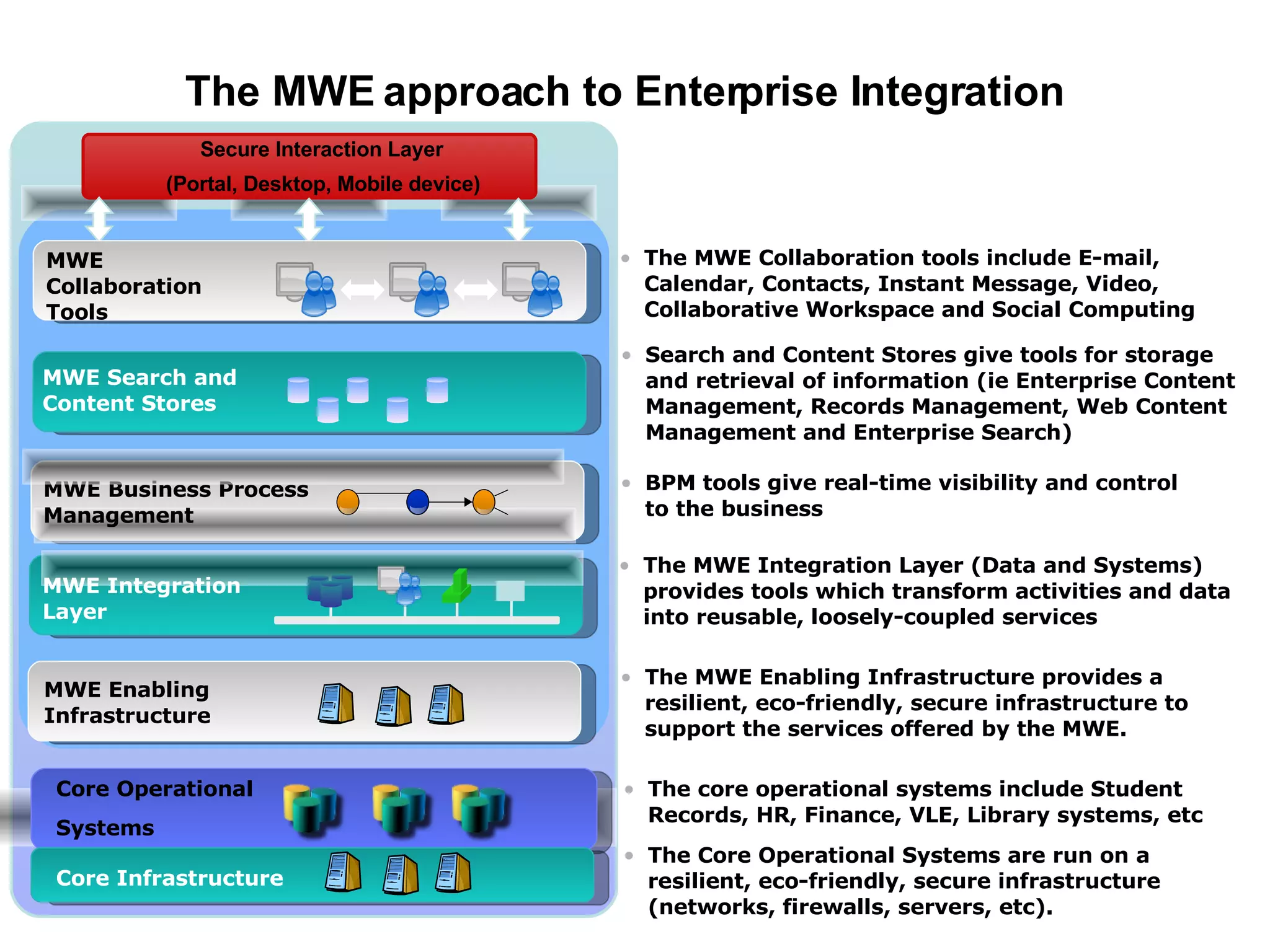
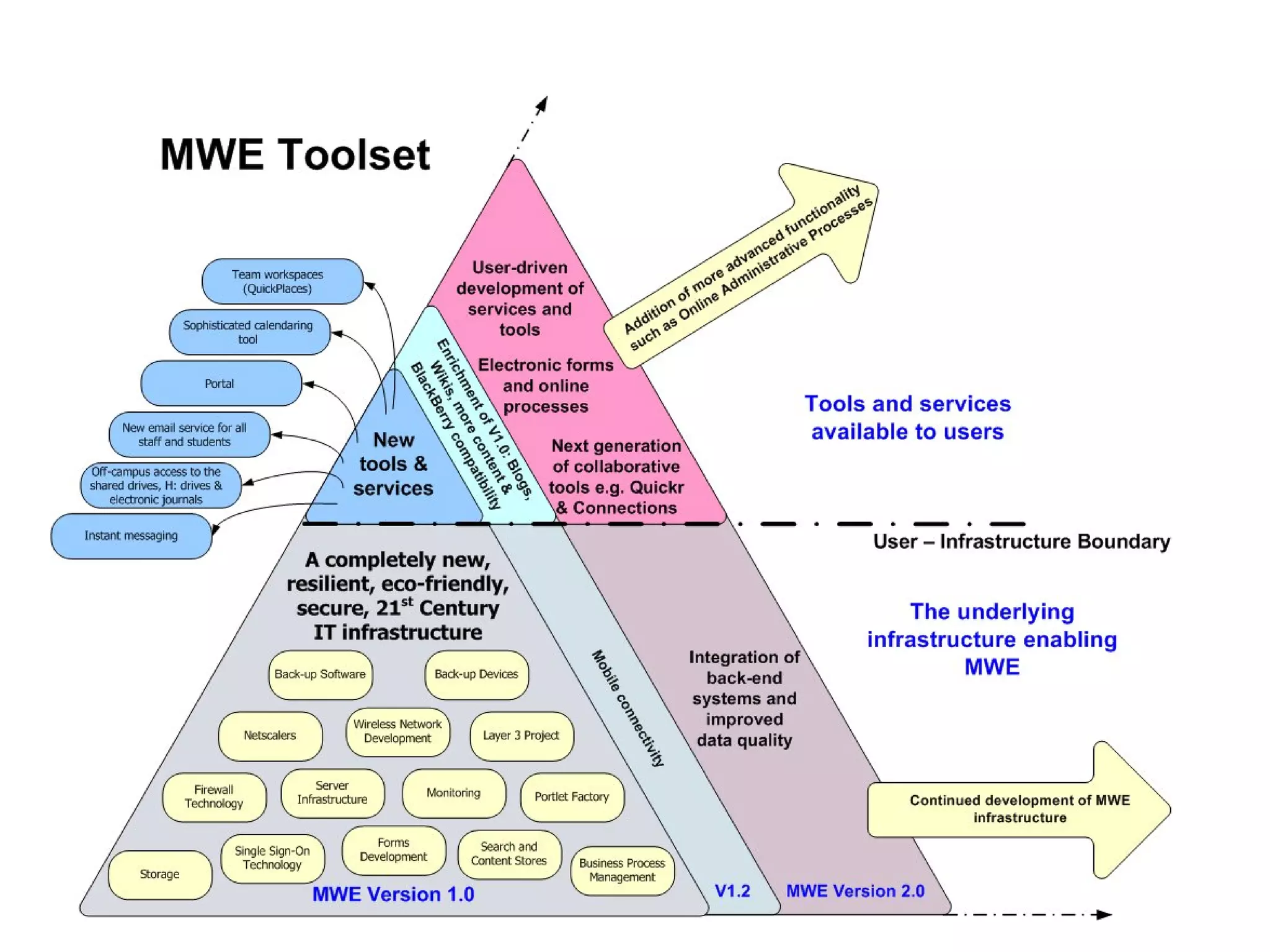
The MWE approach to Enterprise Integration Secure Interaction Layer  (Portal, Desktop, Mobile device)  MWE Business Process Management BPM tools give real-time visibility and control to the business MWE Collaboration Tools  The MWE Collaboration tools include E-mail, Calendar, Contacts, Instant Message, Video, Collaborative Workspace and Social Computing The MWE Integration Layer (Data and Systems) provides tools which transform activities and data into reusable, loosely-coupled services MWE Integration Layer Search and Content Stores give tools for storage and retrieval of information (ie Enterprise Content Management, Records Management, Web Content Management and Enterprise Search) MWE Search and Content Stores MWE Enabling Infrastructure The MWE Enabling Infrastructure provides a resilient, eco-friendly, secure infrastructure to support the services offered by the MWE. Core Operational  Systems Core Infrastructure The core operational systems include Student Records, HR, Finance, VLE, Library systems, etc The Core Operational Systems are run on a resilient, eco-friendly, secure infrastructure (networks, firewalls, servers, etc).
 
But that’s just the start … now to “make sense out of nonsense”! A philosophical rationale for Information Services moving forward Raises questions about the main thrust of activities Poses new questions that are difficult to answer A model to help understanding and communication of the bigger picture and the place of emergent technologies within the enterprise Credit: Dr Joe Nicholls, Principal Consultant in the Futures Group Thanks: Paul Hobson & Stephen Griffiths
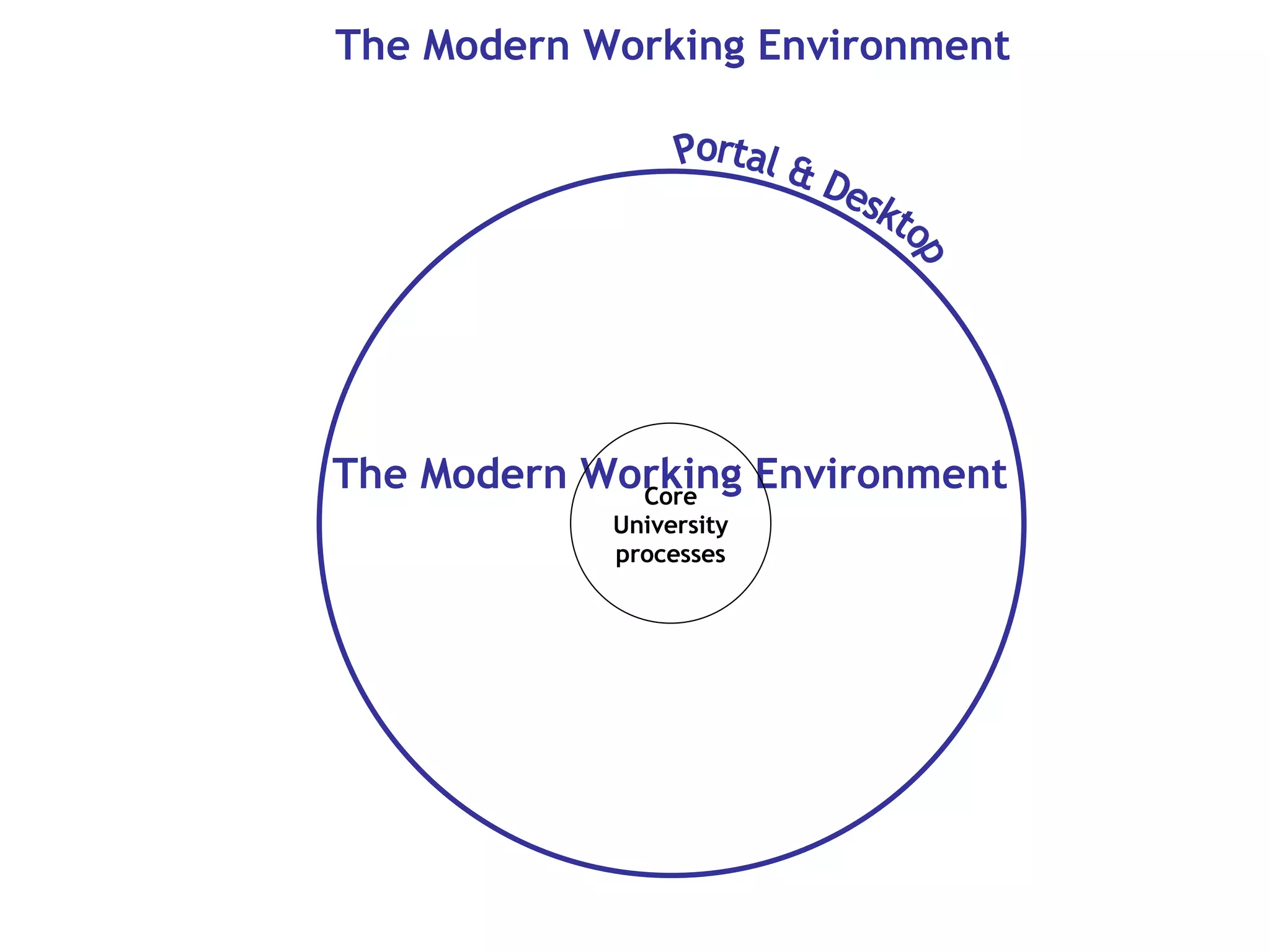
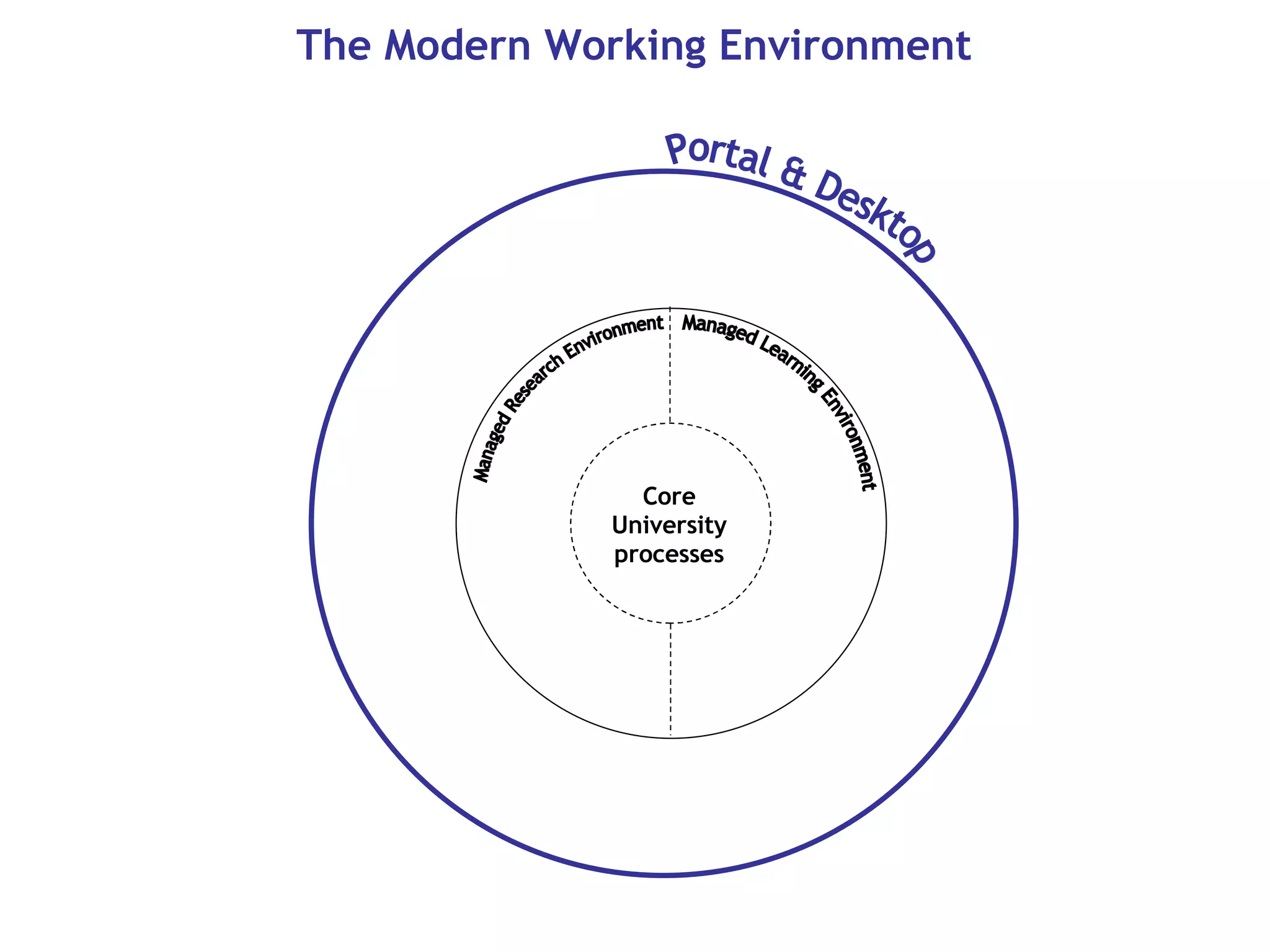
The Modern Working Environment The Modern Working Environment Core University processes Portal & Desktop
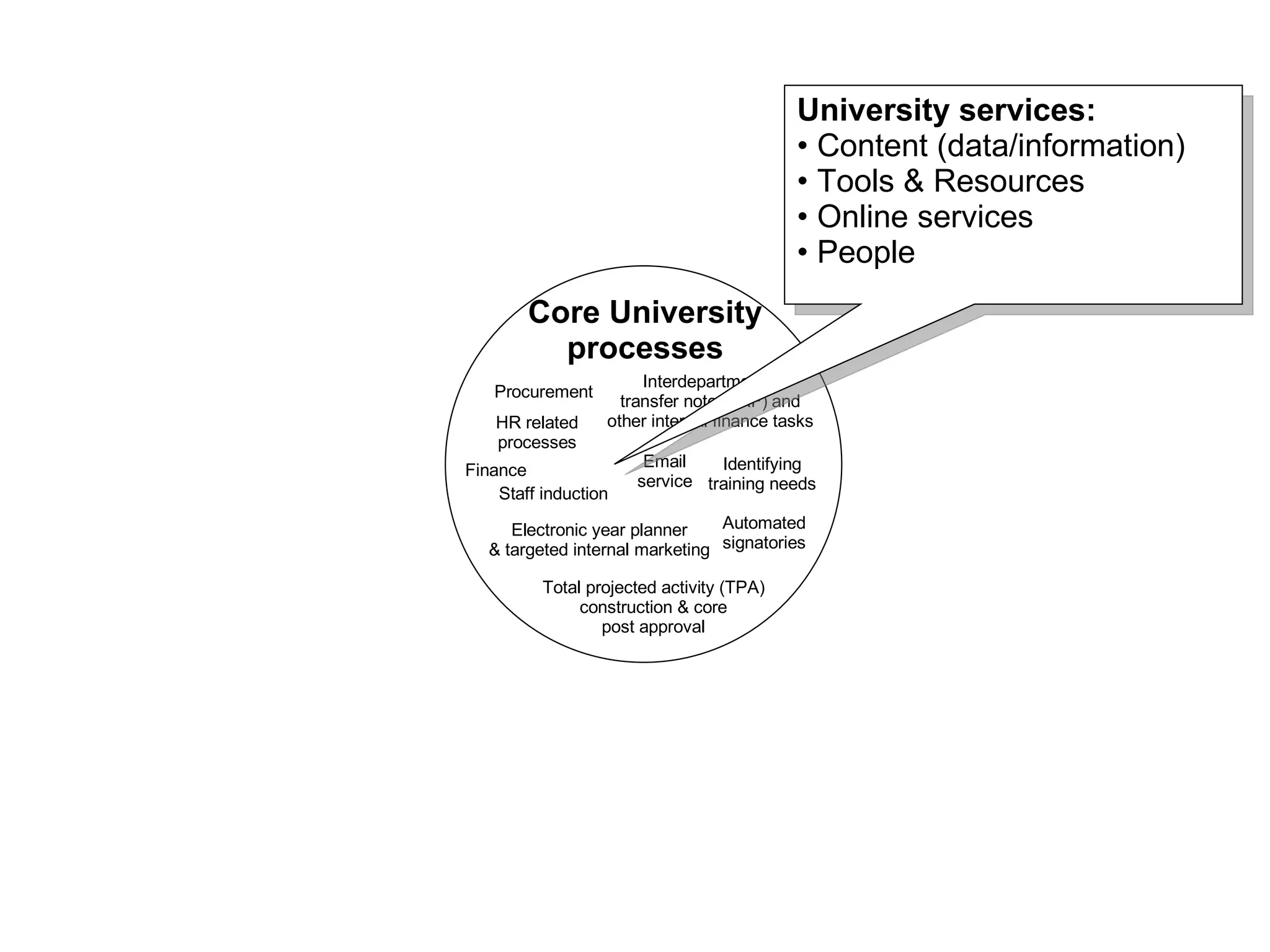
University services: Content (data/information) Tools & Resources  Online services People Core University processes Automated signatories Identifying training needs Total projected activity (TPA) construction & core post approval Electronic year planner & targeted internal marketing Interdepartmental transfer note (TRF) and other internal finance tasks Procurement HR related processes Staff induction Finance Email service
Managed Research Environment Managed Learning Environment The Modern Working Environment Core University processes Portal & Desktop
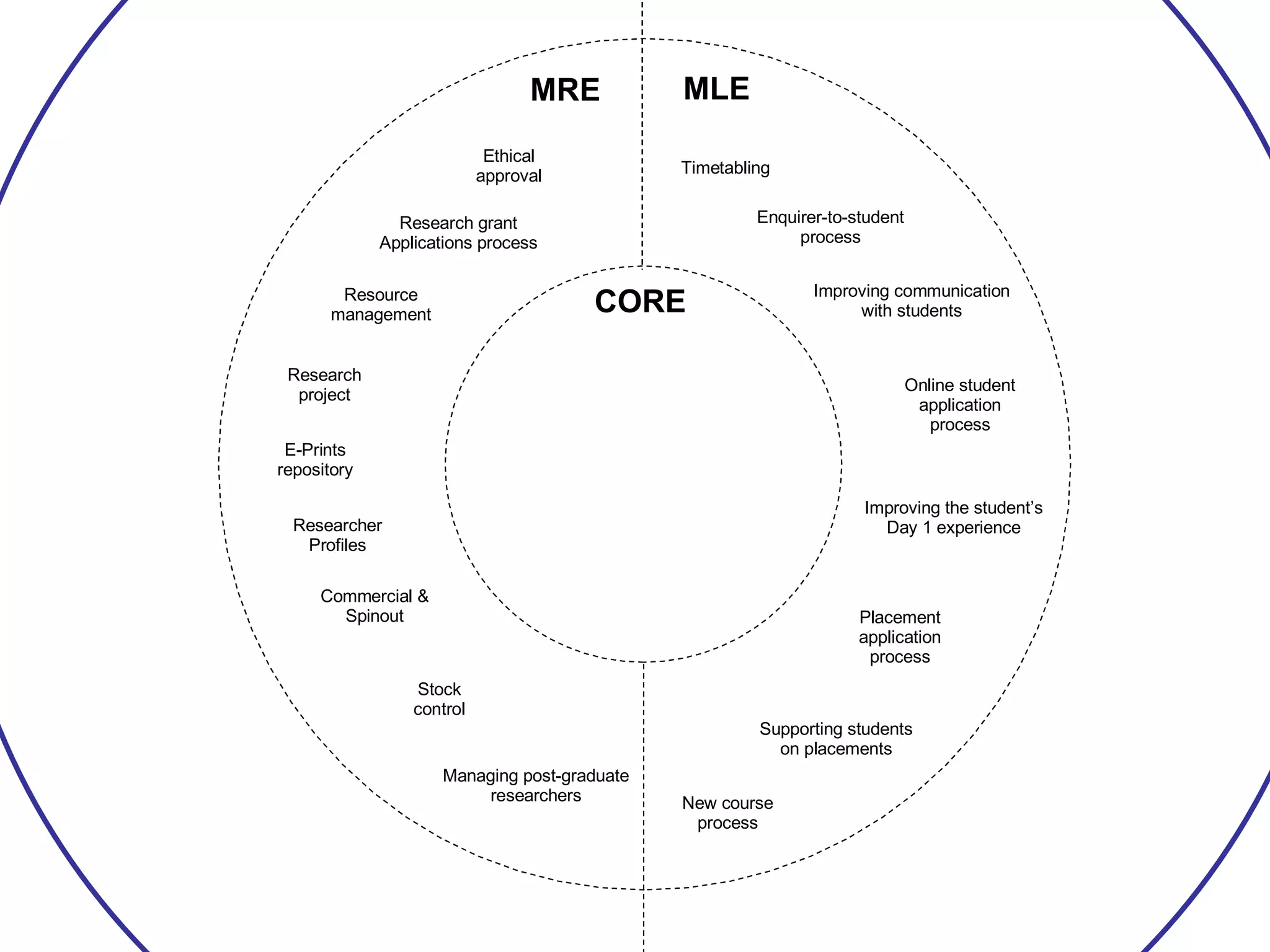
MRE MLE CORE Timetabling Enquirer-to-student process Online student application process Placement application process New course process Improving communication with students Improving the student’s Day 1 experience Supporting students on placements Research grant Applications process Research project Managing post-graduate researchers E-Prints repository Researcher Profiles Commercial & Spinout Ethical approval Resource management Stock control
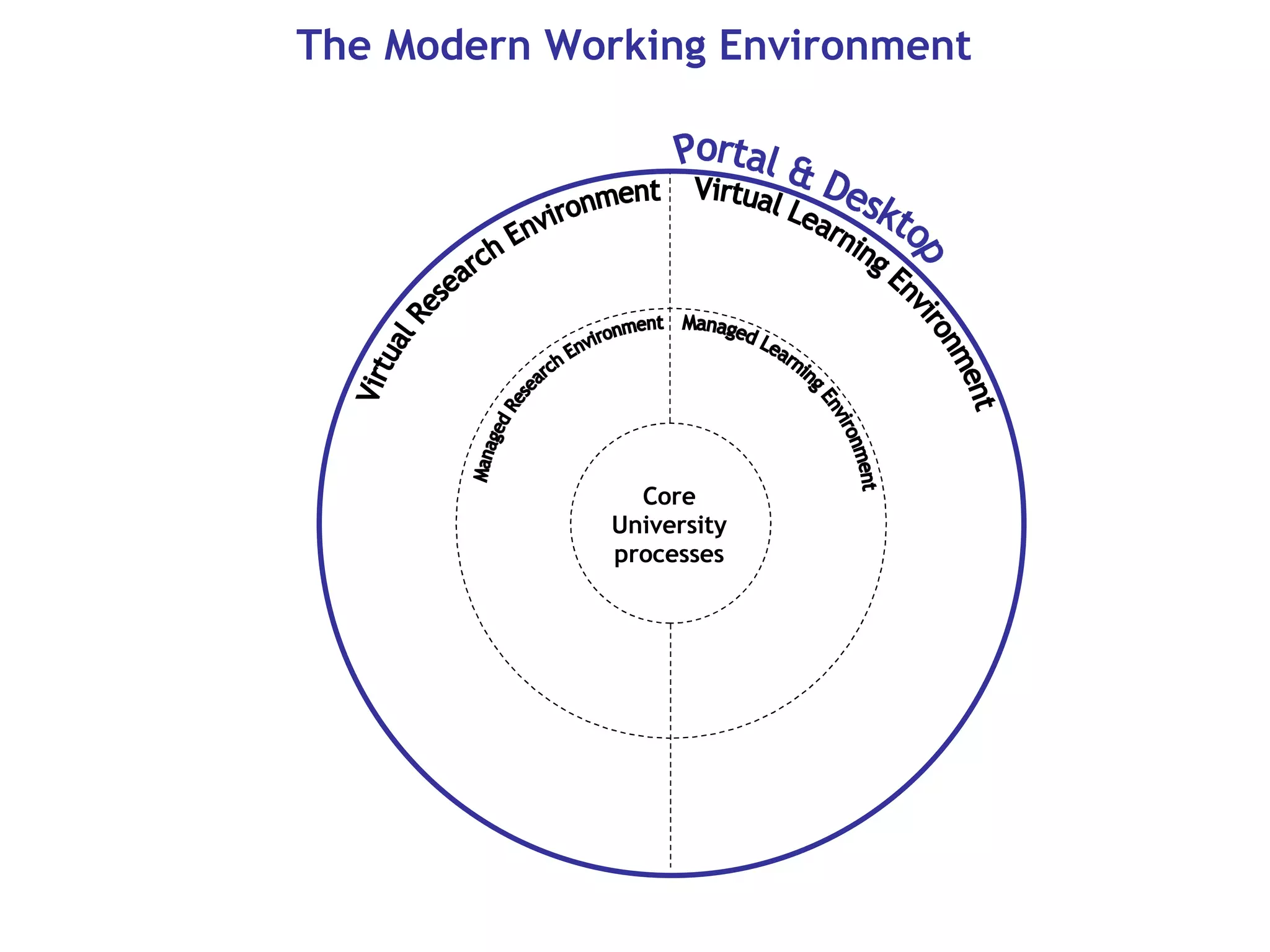
Virtual Research Environment Virtual Learning Environment Portal & Desktop The Modern Working Environment Managed Research Environment Core University processes Managed Learning Environment
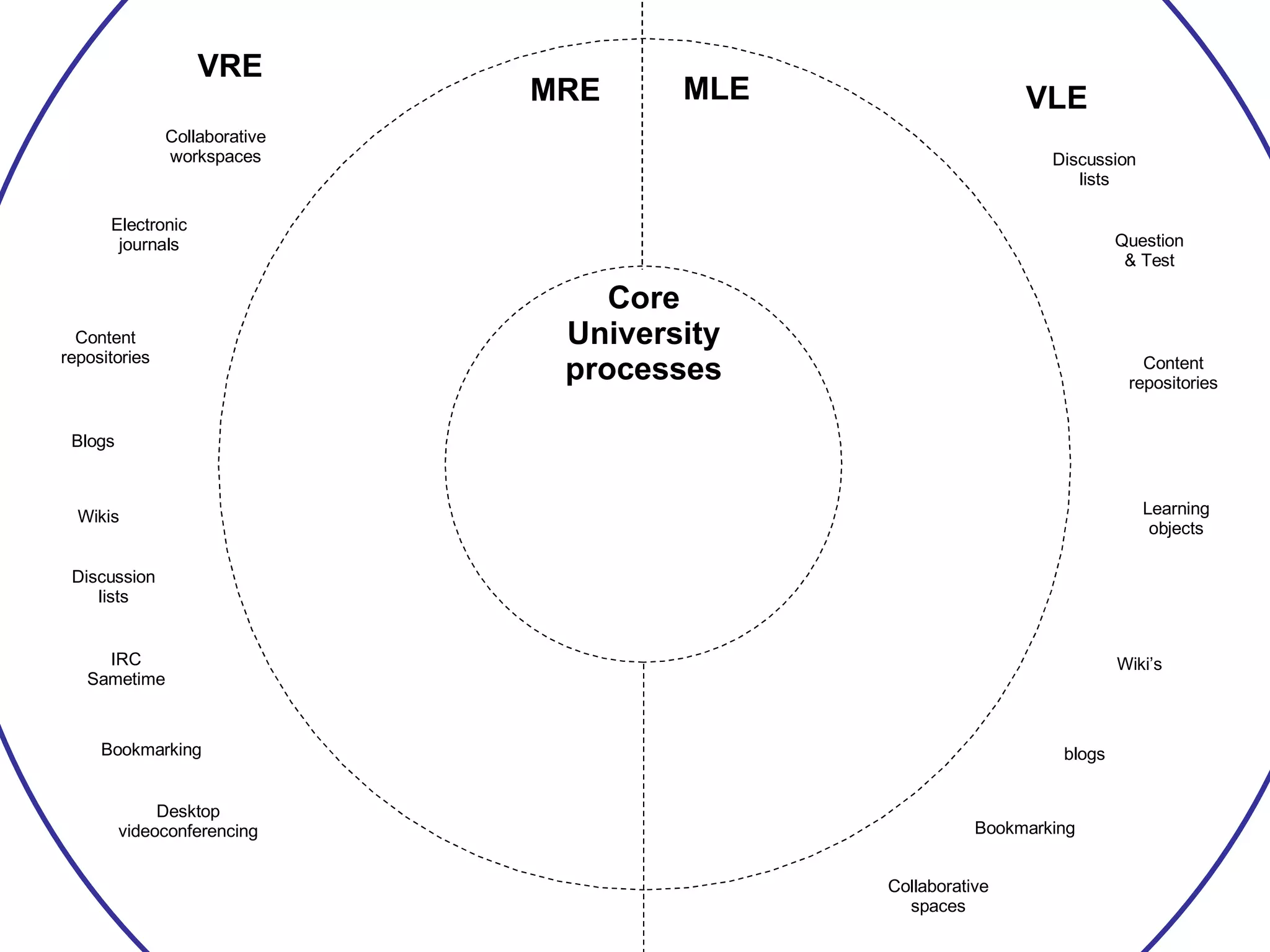
VRE MRE MLE VLE Core University processes Discussion lists Question & Test Content repositories Learning objects Wiki’s blogs Bookmarking Collaborative spaces Collaborative workspaces Electronic journals Blogs Wikis IRC Sametime Desktop videoconferencing Bookmarking Content repositories Discussion lists
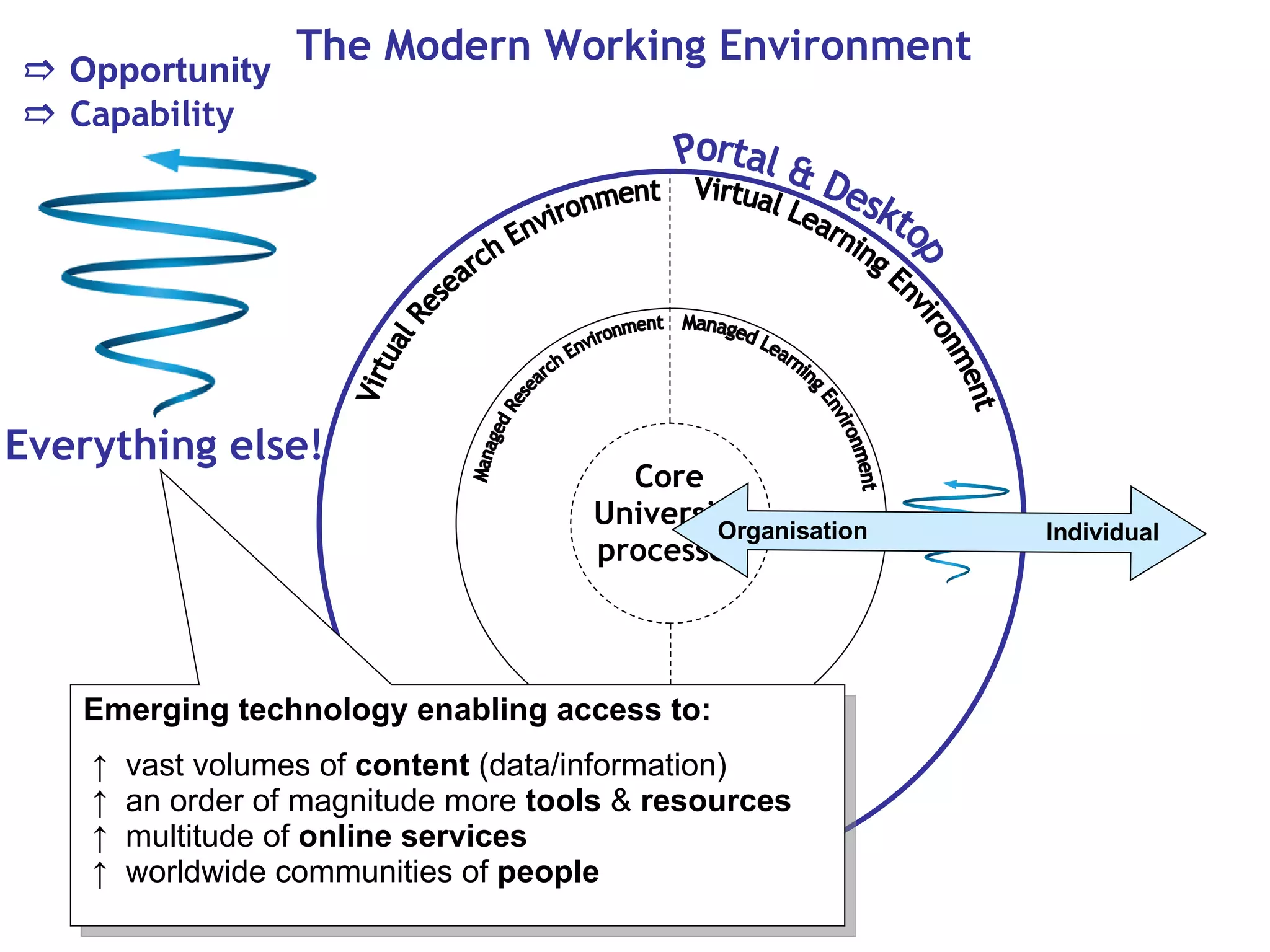
Managed Research Environment Virtual Research Environment Core University processes Virtual Learning Environment Managed Learning Environment Everything else! The Modern Working Environment Portal & Desktop    Opportunity    Capability Emerging technology enabling access to: ↑  vast volumes of  content  (data/information) ↑  an order of magnitude more  tools  &  resources   ↑  multitude of  online services ↑  worldwide communities of  people Individual Organisation
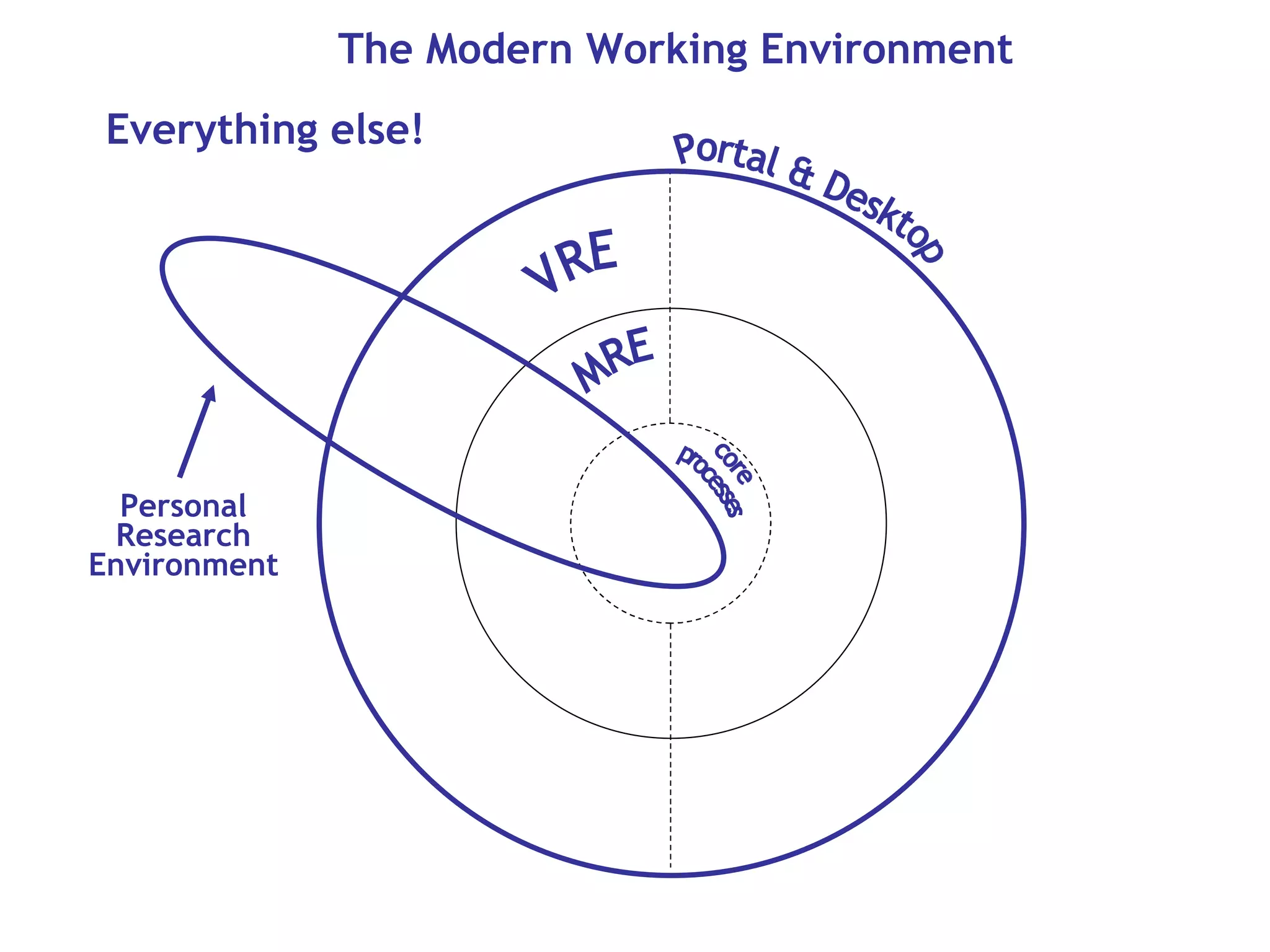
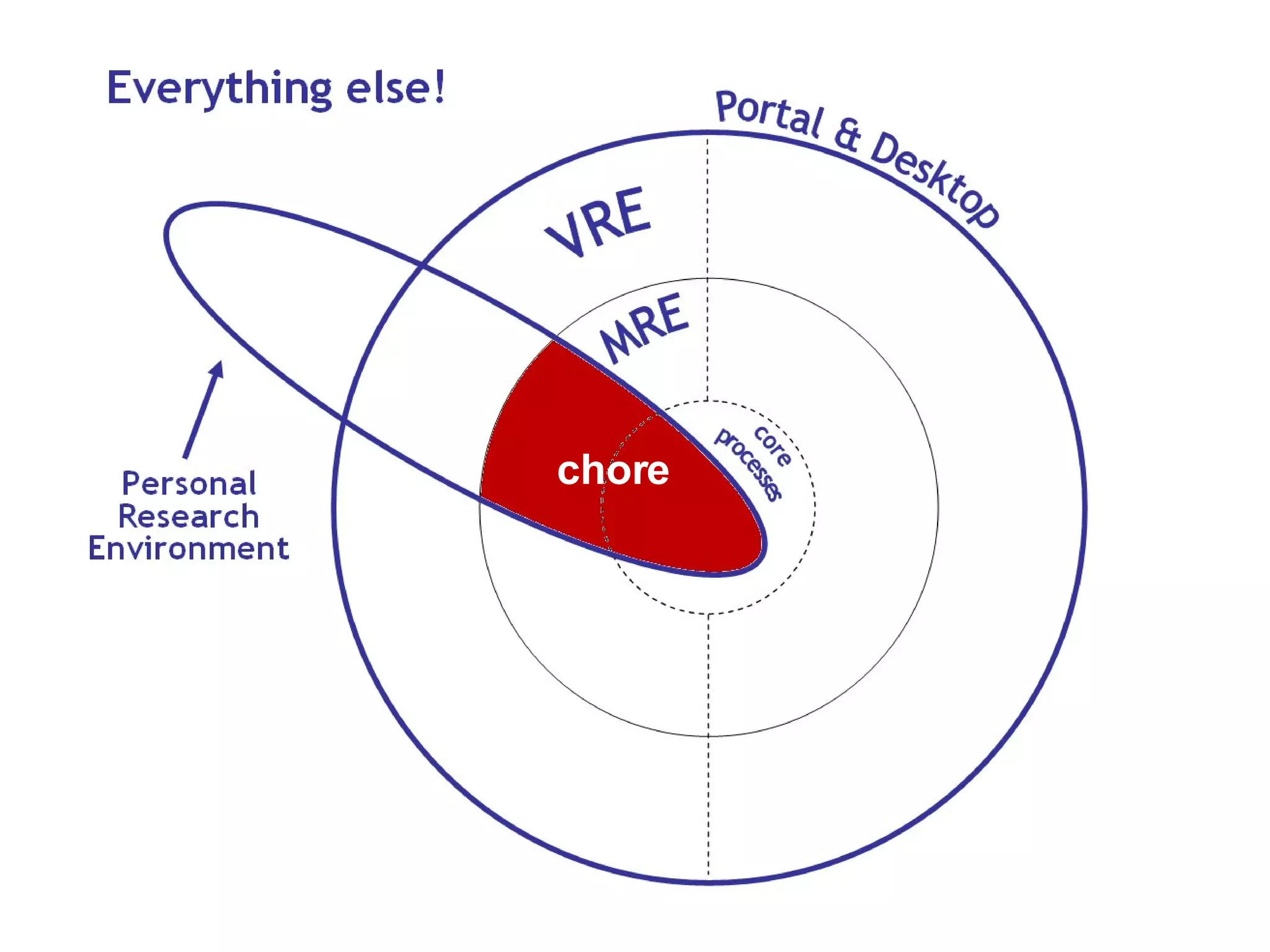
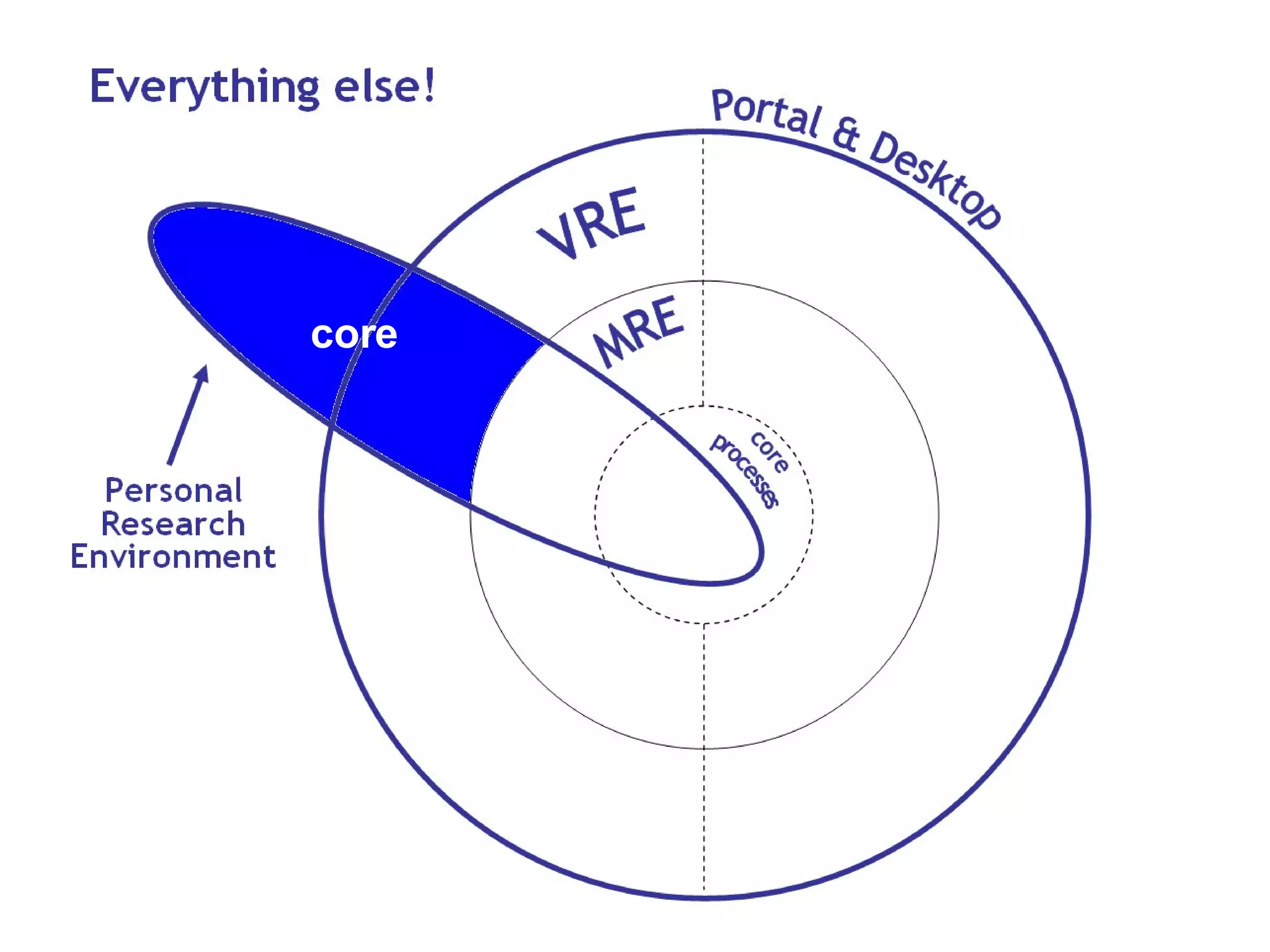
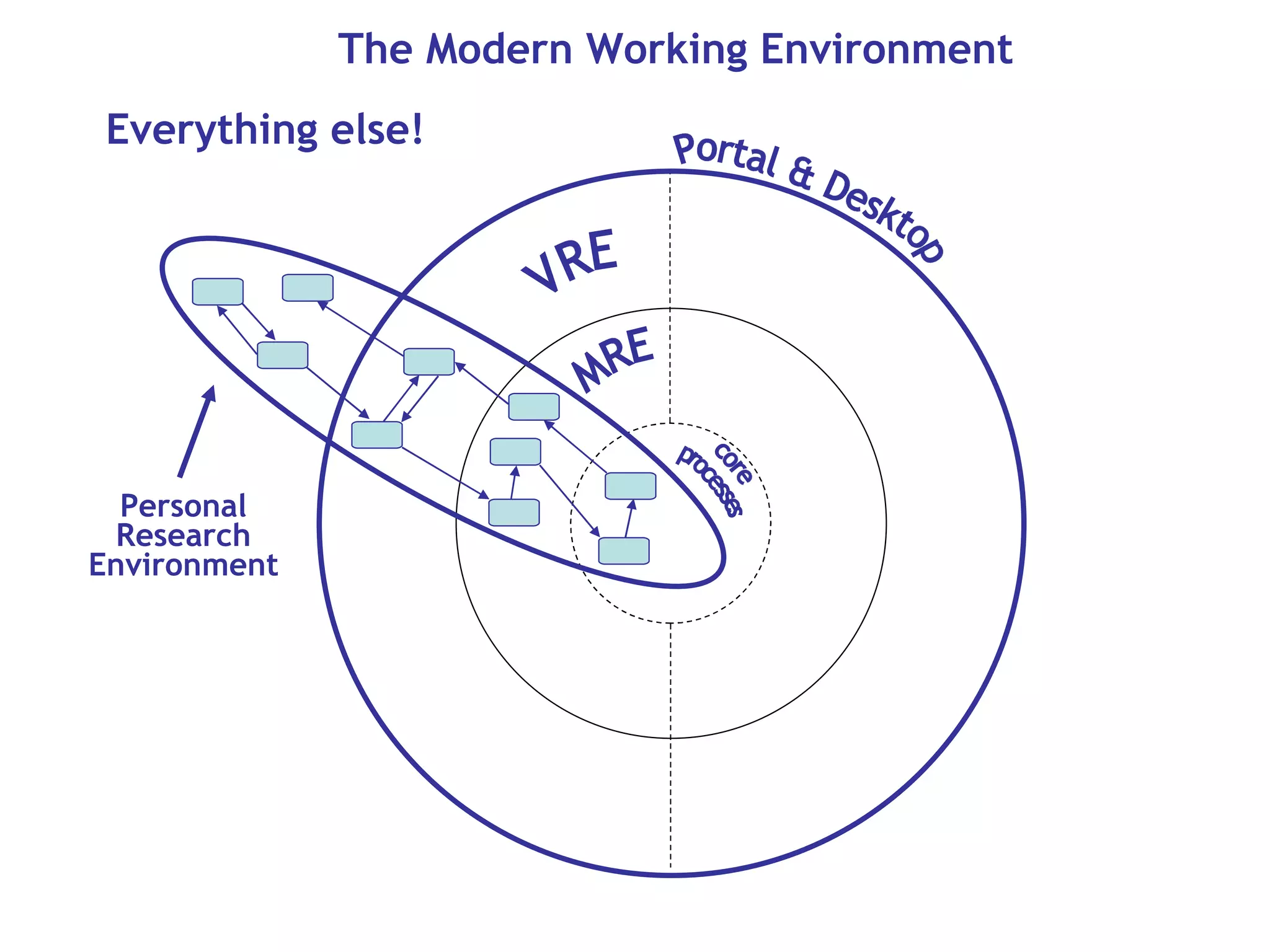
The Modern Working Environment Everything else! core processes MRE VRE Portal & Desktop Personal Research Environment
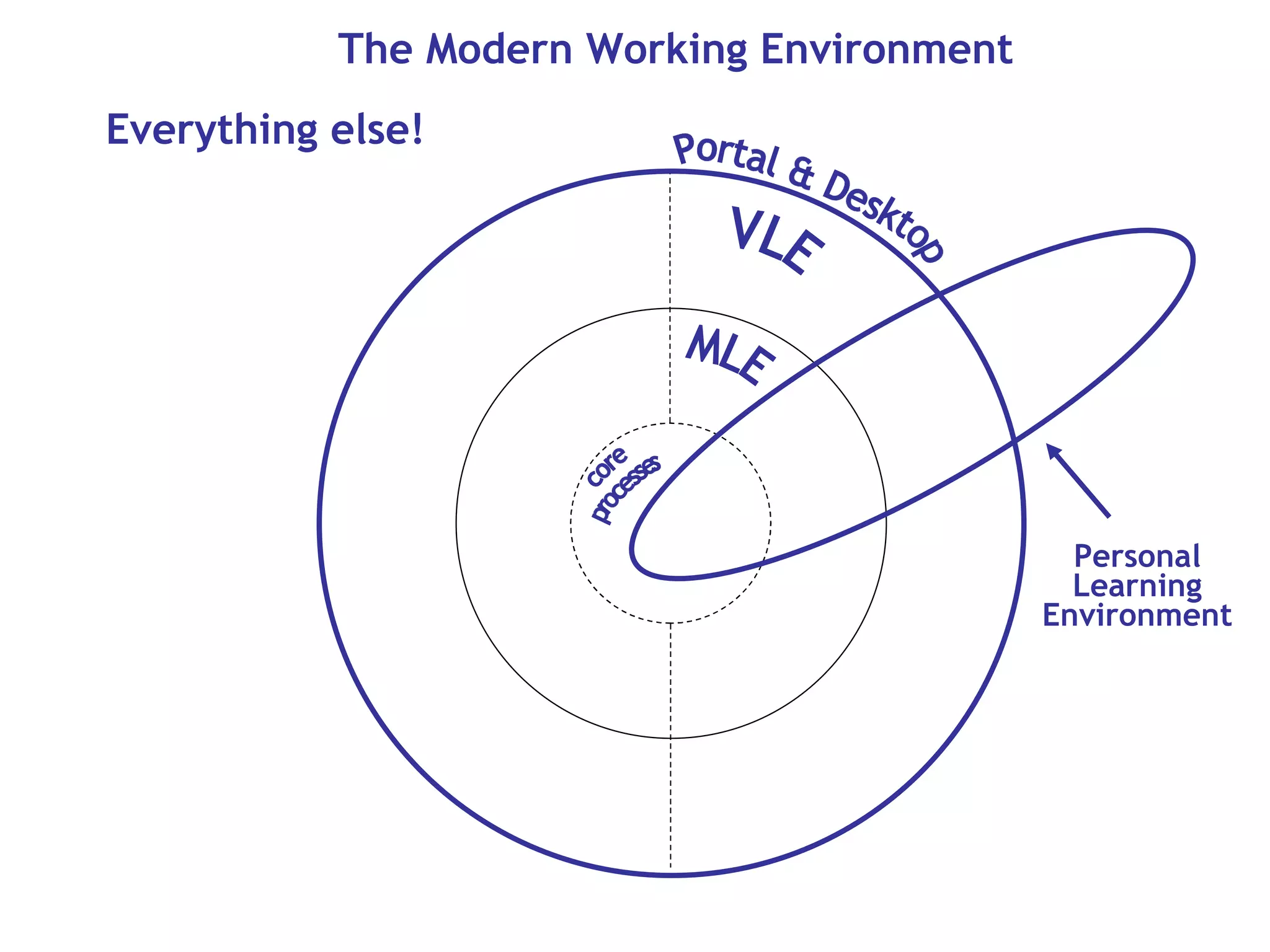
The Modern Working Environment Everything else! core processes MLE VLE Portal & Desktop Personal Learning Environment
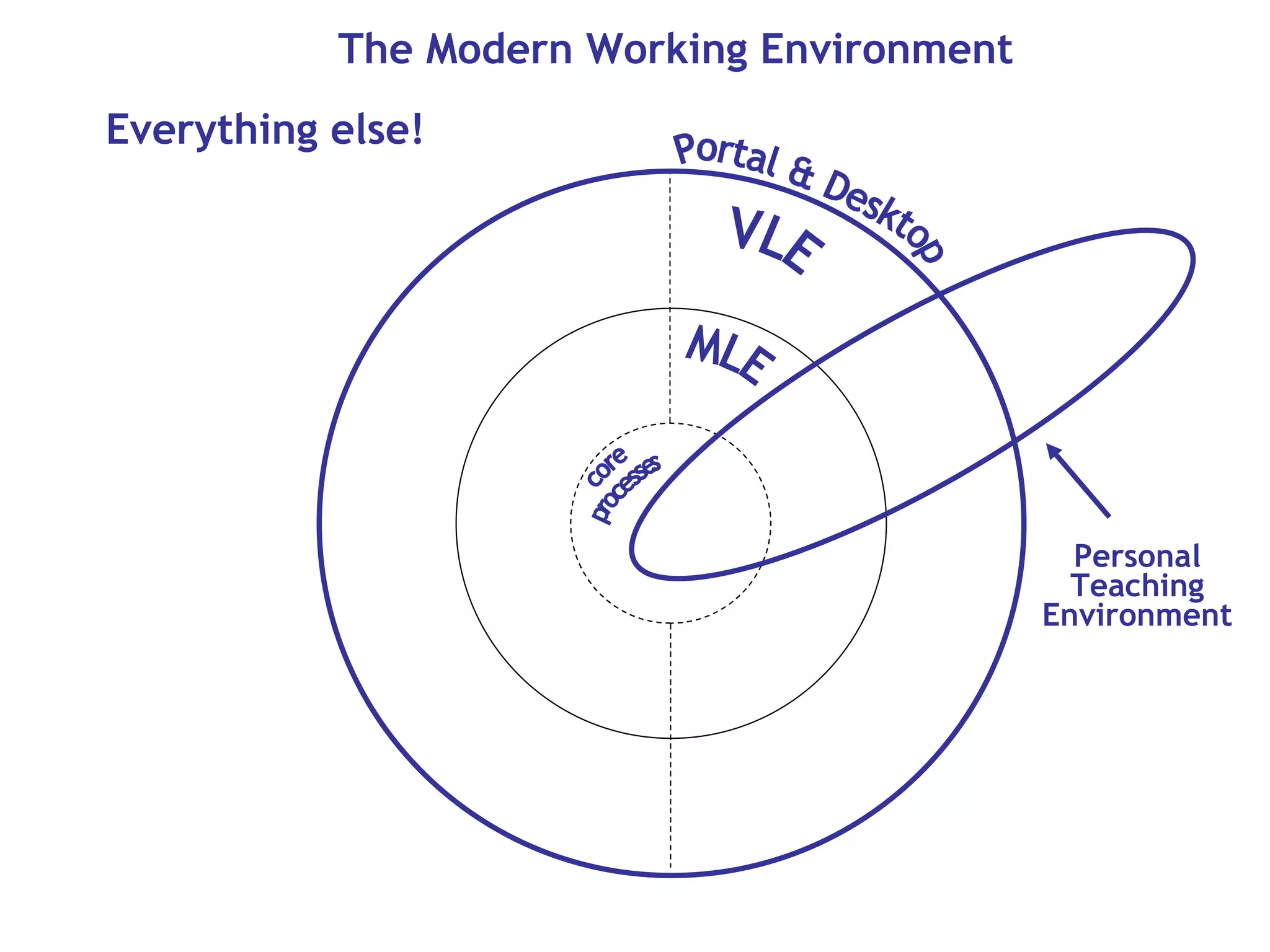
The Modern Working Environment Everything else! core processes MLE VLE Portal & Desktop Personal Teaching Environment
chore
core
The Modern Working Environment Everything else! core processes MRE VRE Portal & Desktop Personal Research Environment
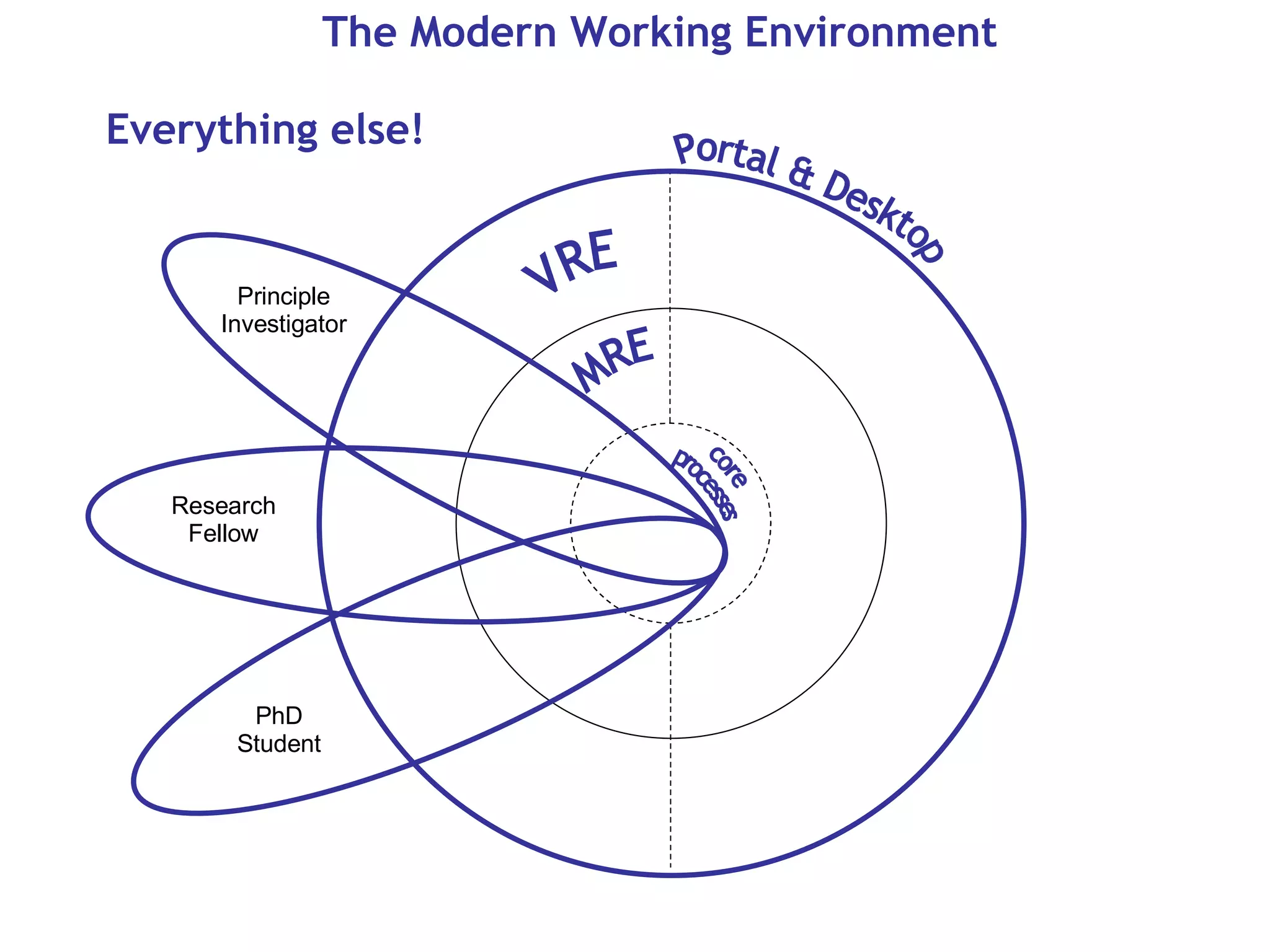
The Modern Working Environment Everything else! core processes MRE VRE Portal & Desktop Principle Investigator Research Fellow PhD Student
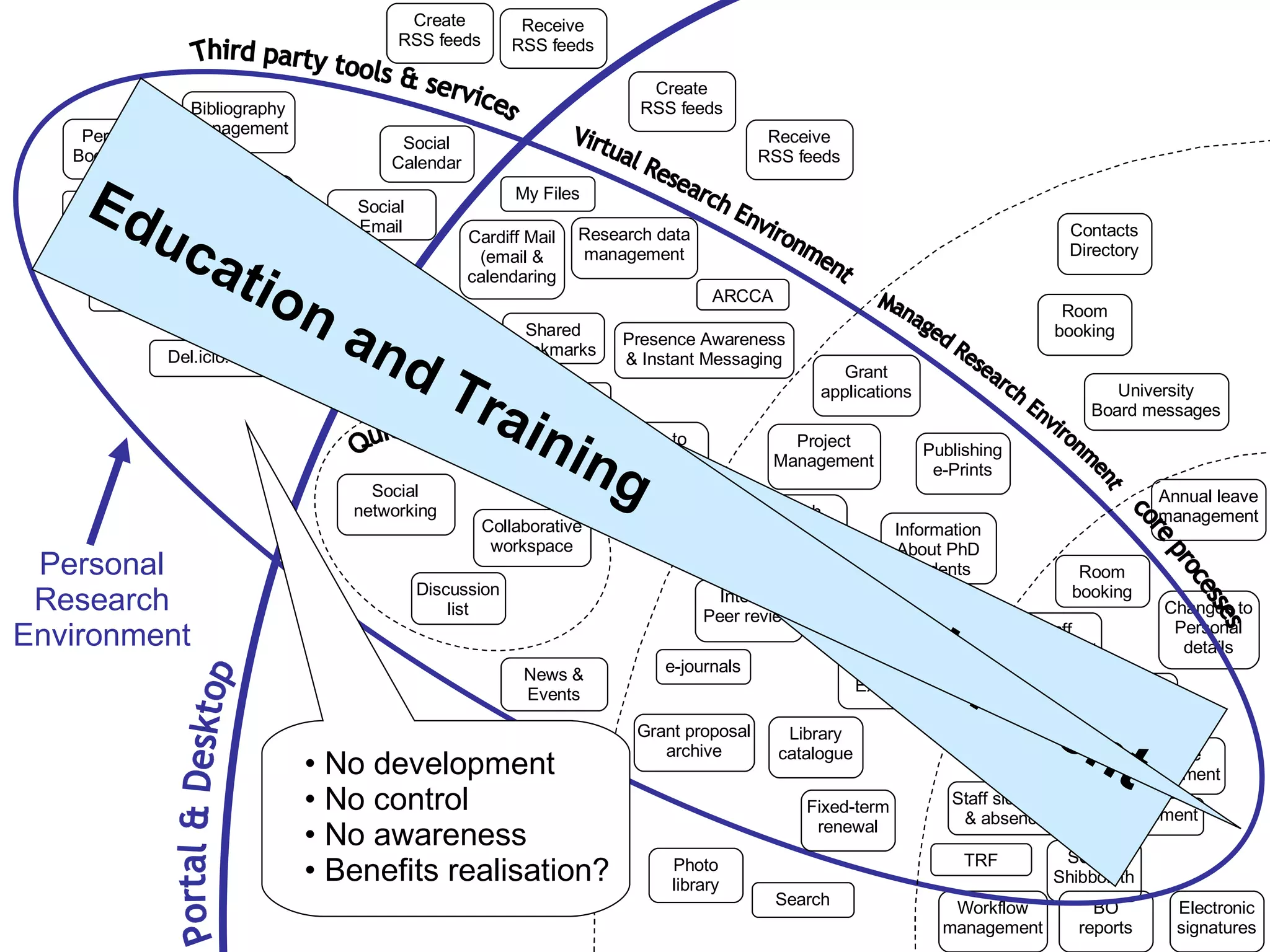
Third party tools & services core processes Virtual Research Environment Managed Research Environment Personal Research Environment Portal & Desktop Room booking Staff recruitment Procurement Finance management Payroll Policies & Procedures Staff development Staff sickness & absence Changes to Personal details TRF Annual leave management Electronic signatures SSO & Shibboleth Workflow management BO reports Grant applications Publishing e-Prints Research Assessment Exercise Directory of Expertise Information About PhD students Project Management Research skills resources Internal Peer review Library catalogue e-journals Grant proposal archive Fixed-term renewal Photo library Room booking Contacts Directory University Board messages Search Quickplace Collaborative authoring Research data management Social networking Collaborative workspace Shared Bookmarks Create RSS feeds Access to IP restricted resources ARCCA Alerts News & Events Cardiff Mail (email & calendaring Presence Awareness & Instant Messaging Discussion list My Files Receive RSS feeds Bibliography management Social Email Social Calendar Office applications Personal Bookmarks Receive RSS feeds Social networking Blog Facebook Google Create RSS feeds Del.icio.us Development Education and Training No development No control No awareness Benefits realisation?
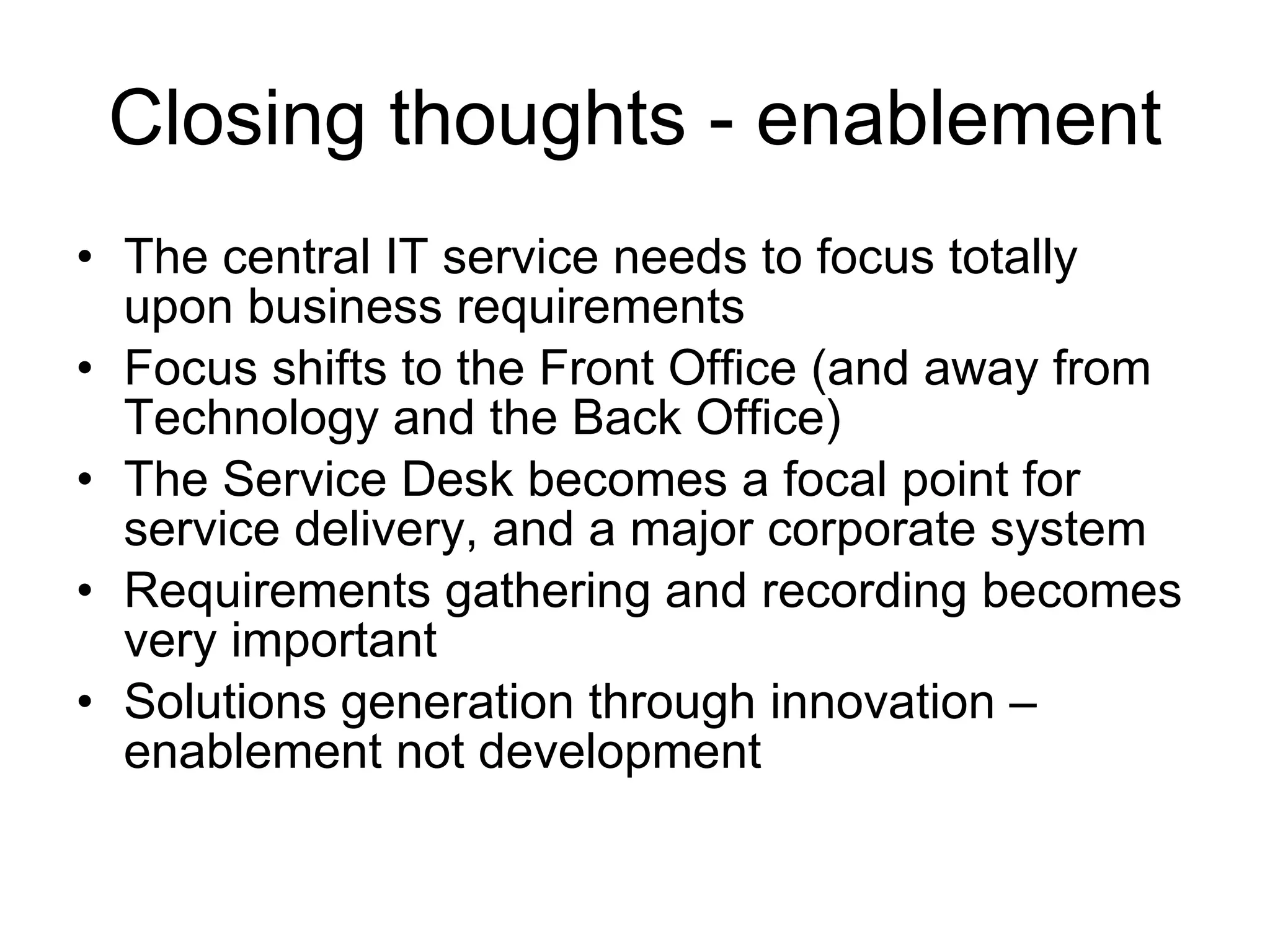
Closing thoughts - enablement The central IT service needs to focus totally upon business requirements  Focus shifts to the Front Office (and away from Technology and the Back Office) The Service Desk becomes a focal point for service delivery, and a major corporate system  Requirements gathering and recording becomes very important Solutions generation through innovation – enablement not development
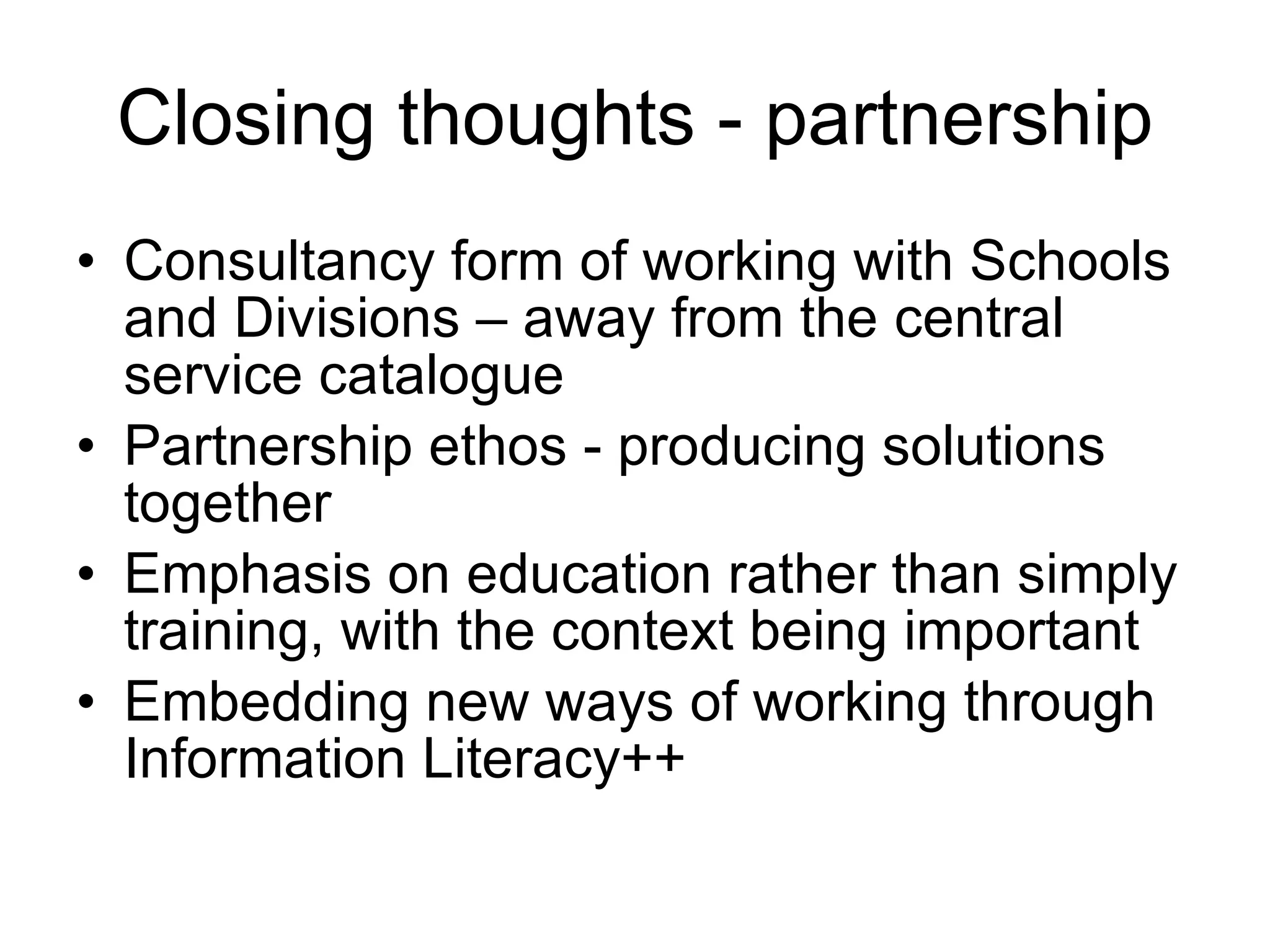
Closing thoughts - partnership Consultancy form of working with Schools and Divisions – away from the central service catalogue Partnership ethos - producing solutions together Emphasis on education rather than simply training, with the context being important Embedding new ways of working through Information Literacy++
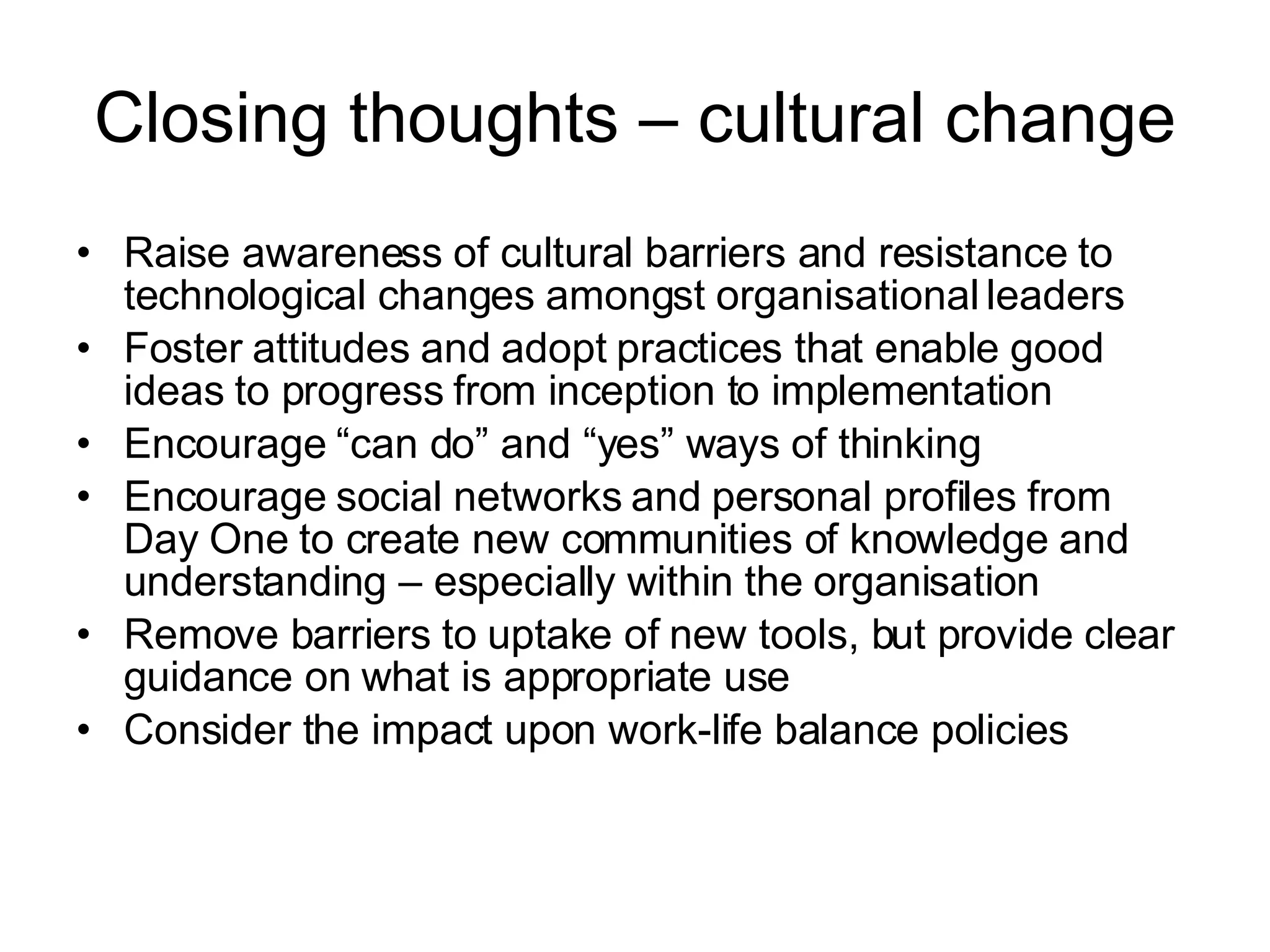
Closing thoughts – cultural change Raise awareness of cultural barriers and resistance to technological changes amongst organisational leaders Foster attitudes and adopt practices that enable good ideas to progress from inception to implementation Encourage “can do” and “yes” ways of thinking Encourage social networks and personal profiles from Day One to create new communities of knowledge and understanding – especially within the organisation Remove barriers to uptake of new tools, but provide clear guidance on what is appropriate use Consider the impact upon work-life balance policies
Closing thoughts - governance How much control is actually necessary? Do you produce policies … or guidelines? Take care with the publishing of personal/team views. Encourage multiple blogging domains, with personal ones being off-site. What is the “value” of the “unofficial” or “black economy” of information, networking and communication? How should the institution respond? Should it shape, direct or control the new pathways to produce what it might consider … “results”? The innovatory organisation will make a deliberate decision NOT to control, and should seriously consider nurturing such activity … but finally One calculation of efficiency probably demands that an organization fights to maintain the “official channels”; but is that really efficient when one is dealing with innovation and education in the crowd of academia on a global level?
Some IBM links IBM Blogging Guidelines  http://www.ibm.com/developerworks/blogs/page/jasnell?entry=blogging_ibm IBM Hursley’s unoffical technology teamblog  http://eightbar.co.uk/ Ed Brill’s Lotus Blog  http://www.edbrill.com/ebrill/edbrill.nsf Alan Lepofsky’s Lotus Notes Blog  http://www.alanlepofsky.net/alepofsky/alanblog.nsf Stuart McIntyre’s Lotus Connections Blog  http://lotusconnectionsblog.com/ IBM developerWorks Lotus Team Blog http://www-10.lotus.com/ldd/dwteamblog.nsf

Universities and social networking: making sense out of nonsense

  • 1.
    Universities and socialnetworking: making sense out of nonsense David I Harrison Eduserv Foundation Symposium 8 th May 2008
  • 2.
    Making sense …? Cardiff’s Modern IT Working Environment (MWE) in partnership with IBM Modelling the MWE and what this means for the delivery of Information Services in a Social Computing (and Web 2.0) world Closing thoughts – enablement, partnership, cultural change and governance
  • 3.
    Some Background tothe MWE … The vision – “all about people” (but initially it’s been about technology: organisation-centric, BPM, SOA and … building collaboration toolset). The journey – exposed to IBM’s use of social networking in the enterprise; challenged to consider “disruptive technology” as part of the service delivery mix. The realisation – user-centric, cultural change, governance and … EA.
  • 4.
    The MWE approachto Enterprise Integration Secure Interaction Layer (Portal, Desktop, Mobile device) MWE Business Process Management BPM tools give real-time visibility and control to the business MWE Collaboration Tools The MWE Collaboration tools include E-mail, Calendar, Contacts, Instant Message, Video, Collaborative Workspace and Social Computing The MWE Integration Layer (Data and Systems) provides tools which transform activities and data into reusable, loosely-coupled services MWE Integration Layer Search and Content Stores give tools for storage and retrieval of information (ie Enterprise Content Management, Records Management, Web Content Management and Enterprise Search) MWE Search and Content Stores MWE Enabling Infrastructure The MWE Enabling Infrastructure provides a resilient, eco-friendly, secure infrastructure to support the services offered by the MWE. Core Operational Systems Core Infrastructure The core operational systems include Student Records, HR, Finance, VLE, Library systems, etc The Core Operational Systems are run on a resilient, eco-friendly, secure infrastructure (networks, firewalls, servers, etc).
  • 5.
  • 6.
    But that’s justthe start … now to “make sense out of nonsense”! A philosophical rationale for Information Services moving forward Raises questions about the main thrust of activities Poses new questions that are difficult to answer A model to help understanding and communication of the bigger picture and the place of emergent technologies within the enterprise Credit: Dr Joe Nicholls, Principal Consultant in the Futures Group Thanks: Paul Hobson & Stephen Griffiths
  • 7.
    The Modern WorkingEnvironment The Modern Working Environment Core University processes Portal & Desktop
  • 8.
    University services: Content(data/information) Tools & Resources Online services People Core University processes Automated signatories Identifying training needs Total projected activity (TPA) construction & core post approval Electronic year planner & targeted internal marketing Interdepartmental transfer note (TRF) and other internal finance tasks Procurement HR related processes Staff induction Finance Email service
  • 9.
    Managed Research EnvironmentManaged Learning Environment The Modern Working Environment Core University processes Portal & Desktop
  • 10.
    MRE MLE CORETimetabling Enquirer-to-student process Online student application process Placement application process New course process Improving communication with students Improving the student’s Day 1 experience Supporting students on placements Research grant Applications process Research project Managing post-graduate researchers E-Prints repository Researcher Profiles Commercial & Spinout Ethical approval Resource management Stock control
  • 11.
    Virtual Research EnvironmentVirtual Learning Environment Portal & Desktop The Modern Working Environment Managed Research Environment Core University processes Managed Learning Environment
  • 12.
    VRE MRE MLEVLE Core University processes Discussion lists Question & Test Content repositories Learning objects Wiki’s blogs Bookmarking Collaborative spaces Collaborative workspaces Electronic journals Blogs Wikis IRC Sametime Desktop videoconferencing Bookmarking Content repositories Discussion lists
  • 13.
    Managed Research EnvironmentVirtual Research Environment Core University processes Virtual Learning Environment Managed Learning Environment Everything else! The Modern Working Environment Portal & Desktop  Opportunity  Capability Emerging technology enabling access to: ↑ vast volumes of content (data/information) ↑ an order of magnitude more tools & resources ↑ multitude of online services ↑ worldwide communities of people Individual Organisation
  • 14.
    The Modern WorkingEnvironment Everything else! core processes MRE VRE Portal & Desktop Personal Research Environment
  • 15.
    The Modern WorkingEnvironment Everything else! core processes MLE VLE Portal & Desktop Personal Learning Environment
  • 16.
    The Modern WorkingEnvironment Everything else! core processes MLE VLE Portal & Desktop Personal Teaching Environment
  • 17.
  • 18.
  • 19.
    The Modern WorkingEnvironment Everything else! core processes MRE VRE Portal & Desktop Personal Research Environment
  • 20.
    The Modern WorkingEnvironment Everything else! core processes MRE VRE Portal & Desktop Principle Investigator Research Fellow PhD Student
  • 21.
    Third party tools& services core processes Virtual Research Environment Managed Research Environment Personal Research Environment Portal & Desktop Room booking Staff recruitment Procurement Finance management Payroll Policies & Procedures Staff development Staff sickness & absence Changes to Personal details TRF Annual leave management Electronic signatures SSO & Shibboleth Workflow management BO reports Grant applications Publishing e-Prints Research Assessment Exercise Directory of Expertise Information About PhD students Project Management Research skills resources Internal Peer review Library catalogue e-journals Grant proposal archive Fixed-term renewal Photo library Room booking Contacts Directory University Board messages Search Quickplace Collaborative authoring Research data management Social networking Collaborative workspace Shared Bookmarks Create RSS feeds Access to IP restricted resources ARCCA Alerts News & Events Cardiff Mail (email & calendaring Presence Awareness & Instant Messaging Discussion list My Files Receive RSS feeds Bibliography management Social Email Social Calendar Office applications Personal Bookmarks Receive RSS feeds Social networking Blog Facebook Google Create RSS feeds Del.icio.us Development Education and Training No development No control No awareness Benefits realisation?
  • 22.
    Closing thoughts -enablement The central IT service needs to focus totally upon business requirements Focus shifts to the Front Office (and away from Technology and the Back Office) The Service Desk becomes a focal point for service delivery, and a major corporate system Requirements gathering and recording becomes very important Solutions generation through innovation – enablement not development
  • 23.
    Closing thoughts -partnership Consultancy form of working with Schools and Divisions – away from the central service catalogue Partnership ethos - producing solutions together Emphasis on education rather than simply training, with the context being important Embedding new ways of working through Information Literacy++
  • 24.
    Closing thoughts –cultural change Raise awareness of cultural barriers and resistance to technological changes amongst organisational leaders Foster attitudes and adopt practices that enable good ideas to progress from inception to implementation Encourage “can do” and “yes” ways of thinking Encourage social networks and personal profiles from Day One to create new communities of knowledge and understanding – especially within the organisation Remove barriers to uptake of new tools, but provide clear guidance on what is appropriate use Consider the impact upon work-life balance policies
  • 25.
    Closing thoughts -governance How much control is actually necessary? Do you produce policies … or guidelines? Take care with the publishing of personal/team views. Encourage multiple blogging domains, with personal ones being off-site. What is the “value” of the “unofficial” or “black economy” of information, networking and communication? How should the institution respond? Should it shape, direct or control the new pathways to produce what it might consider … “results”? The innovatory organisation will make a deliberate decision NOT to control, and should seriously consider nurturing such activity … but finally One calculation of efficiency probably demands that an organization fights to maintain the “official channels”; but is that really efficient when one is dealing with innovation and education in the crowd of academia on a global level?
  • 26.
    Some IBM linksIBM Blogging Guidelines http://www.ibm.com/developerworks/blogs/page/jasnell?entry=blogging_ibm IBM Hursley’s unoffical technology teamblog http://eightbar.co.uk/ Ed Brill’s Lotus Blog http://www.edbrill.com/ebrill/edbrill.nsf Alan Lepofsky’s Lotus Notes Blog http://www.alanlepofsky.net/alepofsky/alanblog.nsf Stuart McIntyre’s Lotus Connections Blog http://lotusconnectionsblog.com/ IBM developerWorks Lotus Team Blog http://www-10.lotus.com/ldd/dwteamblog.nsf