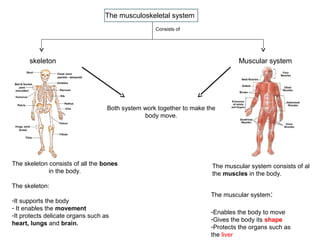
The musculoskeletal system
Consists of

skeleton

Muscular system

Both system work together to make the
body move.

The skeleton consists of all the bones
in the body.

The muscular system consists of al
the muscles in the body.

The skeleton:
-It supports the body
- It enables the movement
-It protects delicate organs such as
heart, lungs and brain.

The muscular system:
-Enables the body to move
-Gives the body its shape
-Protects the organs such as
the liver
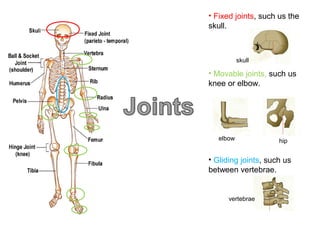
• Fixed joints, such us the
skull.

skull

• Movable joints, such us
knee or elbow.

elbow

hip

• Gliding joints, such us
between vertebrae.

vertebrae
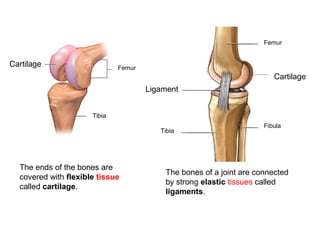
Femur

Cartilage

Femur

Cartilage
Ligament
Tibia
Tibia

The ends of the bones are
covered with flexible tissue
called cartilage.

Fibula

The bones of a joint are connected
by strong elastic tissues called
ligaments.
Write the words of each sentence in the correct order to make sense:
1.body/ supports/ the/ the/ skeleton

2. meet/ places/ bones/ two/ joints/ where/ are/ the

3. ends/ the/ of/ cartilage/ covers/ bones/ the

4. flexible/ cartilage/ tissue/ is

5. elastic/ strong/ ligaments/ are/ tissue
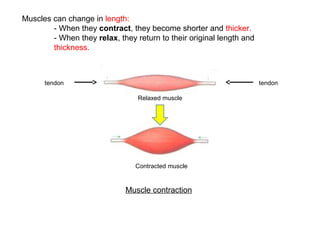
Muscles can change in length:
- When they contract, they become shorter and thicker.
- When they relax, they return to their original length and
thickness.

tendon

tendon
Relaxed muscle

Contracted muscle

Muscle contraction
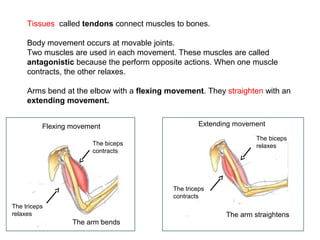
Tissues called tendons connect muscles to bones.
Body movement occurs at movable joints.
Two muscles are used in each movement. These muscles are called
antagonistic because the perform opposite actions. When one muscle
contracts, the other relaxes.
Arms bend at the elbow with a flexing movement. They straighten with an
extending movement.
Flexing movement

Extending movement
The biceps
relaxes

The biceps
contracts

The triceps
contracts
The triceps
relaxes

The arm bends

The arm straightens
Decide if the following sentences are true or false. If they are false, correct them.
•When muscles contract, they become longer

T/F

•When muscles relax, they return to their original length and thickness T / F

•Tendons connect the bones of a joint

T/F

•Antagonistic muscles perform the same actions T / F

•Arms bend at the elbow with a flexing movement T / F
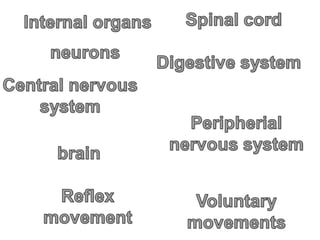
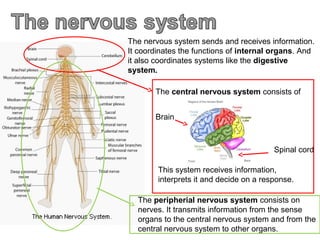
The nervous system sends and receives information.
It coordinates the functions of internal organs. And
it also coordinates systems like the digestive
system.
The central nervous system consists of
Brain

Spinal cord
This system receives information,
interprets it and decide on a response.
The peripherial nervous system consists on
nerves. It transmits information from the sense
organs to the central nervous system and from the
central nervous system to other organs.
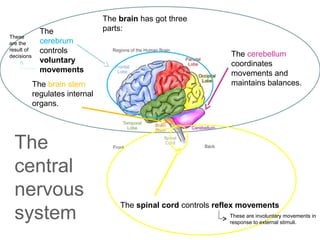
These
are the
result of
decisions

The
cerebrum
controls
voluntary
movements
The brain stem
regulates internal
organs.

The
central
nervous
system

The brain has got three
parts:
The cerebellum
coordinates
movements and
maintains balances.

The spinal cord controls reflex movements
These are involuntary movements in
response to external stimuli.
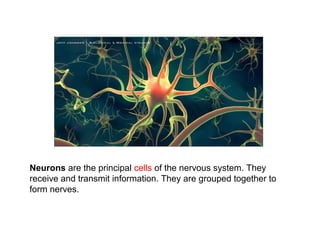
Neurons are the principal cells of the nervous system. They
receive and transmit information. They are grouped together to
form nerves.
Read the following definitions and write the corresponding words:
1.This part of the brain controls voluntary movements.
2.This part of the brain coordinates movements and maintains the balance.
3.This part of the brain regulates internal organs.
4.These are the principal celss of the nervousn system.
5.These are involuntary movements in response to external stimuli.

CEREBELLUM

REFLEX MOVEMENTS
NEURONS

BRAIN STEM
CEREBRUM
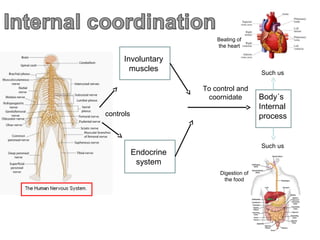
Beating of
the heart

Involuntary
muscles

Such us

To control and
coornidate
controls

Body´s
Internal
process

Such us

Endocrine
system
Digestion of
the food
Involuntary muscles
They work automatically. We cannot control them with our decisions.
The body needs involuntary muscles in order to function correctly.
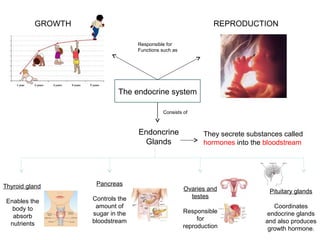
GROWTH

REPRODUCTION
Responsible for
Functions such as

The endocrine system
Consists of

Endoncrine
Glands

Thyroid gland

Pancreas

Enables the
body to
absorb
nutrients

Controls the
amount of
sugar in the
bloodstream

They secrete substances called
hormones into the bloodstream

Ovaries and
testes

Pituitary glands

Responsible
for
reproduction

Coordinates
endocrine glands
and also produces
growth hormone.
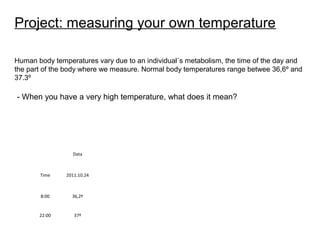
Project: measuring your own temperature
Human body temperatures vary due to an individual´s metabolism, the time of the day and
the part of the body where we measure. Normal body temperatures range betwee 36,6º and
37.3º

- When you have a very high temperature, what does it mean?


Data


Time

2011.10.24


8:00

36,2º


22:00

37º


Unit2 the body

  • 3.
    The musculoskeletal system Consistsof skeleton Muscular system Both system work together to make the body move. The skeleton consists of all the bones in the body. The muscular system consists of al the muscles in the body. The skeleton: -It supports the body - It enables the movement -It protects delicate organs such as heart, lungs and brain. The muscular system: -Enables the body to move -Gives the body its shape -Protects the organs such as the liver
  • 4.
    • Fixed joints,such us the skull. skull • Movable joints, such us knee or elbow. elbow hip • Gliding joints, such us between vertebrae. vertebrae
  • 5.
    Femur Cartilage Femur Cartilage Ligament Tibia Tibia The ends ofthe bones are covered with flexible tissue called cartilage. Fibula The bones of a joint are connected by strong elastic tissues called ligaments.
  • 6.
    Write the wordsof each sentence in the correct order to make sense: 1.body/ supports/ the/ the/ skeleton 2. meet/ places/ bones/ two/ joints/ where/ are/ the 3. ends/ the/ of/ cartilage/ covers/ bones/ the 4. flexible/ cartilage/ tissue/ is 5. elastic/ strong/ ligaments/ are/ tissue
  • 8.
    Muscles can changein length: - When they contract, they become shorter and thicker. - When they relax, they return to their original length and thickness. tendon tendon Relaxed muscle Contracted muscle Muscle contraction
  • 9.
    Tissues called tendonsconnect muscles to bones. Body movement occurs at movable joints. Two muscles are used in each movement. These muscles are called antagonistic because the perform opposite actions. When one muscle contracts, the other relaxes. Arms bend at the elbow with a flexing movement. They straighten with an extending movement. Flexing movement Extending movement The biceps relaxes The biceps contracts The triceps contracts The triceps relaxes The arm bends The arm straightens
  • 10.
    Decide if thefollowing sentences are true or false. If they are false, correct them. •When muscles contract, they become longer T/F •When muscles relax, they return to their original length and thickness T / F •Tendons connect the bones of a joint T/F •Antagonistic muscles perform the same actions T / F •Arms bend at the elbow with a flexing movement T / F
  • 12.
    The nervous systemsends and receives information. It coordinates the functions of internal organs. And it also coordinates systems like the digestive system. The central nervous system consists of Brain Spinal cord This system receives information, interprets it and decide on a response. The peripherial nervous system consists on nerves. It transmits information from the sense organs to the central nervous system and from the central nervous system to other organs.
  • 13.
    These are the result of decisions The cerebrum controls voluntary movements Thebrain stem regulates internal organs. The central nervous system The brain has got three parts: The cerebellum coordinates movements and maintains balances. The spinal cord controls reflex movements These are involuntary movements in response to external stimuli.
  • 14.
    Neurons are theprincipal cells of the nervous system. They receive and transmit information. They are grouped together to form nerves.
  • 15.
    Read the followingdefinitions and write the corresponding words: 1.This part of the brain controls voluntary movements. 2.This part of the brain coordinates movements and maintains the balance. 3.This part of the brain regulates internal organs. 4.These are the principal celss of the nervousn system. 5.These are involuntary movements in response to external stimuli. CEREBELLUM REFLEX MOVEMENTS NEURONS BRAIN STEM CEREBRUM
  • 17.
    Beating of the heart Involuntary muscles Suchus To control and coornidate controls Body´s Internal process Such us Endocrine system Digestion of the food
  • 18.
    Involuntary muscles They workautomatically. We cannot control them with our decisions. The body needs involuntary muscles in order to function correctly.
  • 19.
    GROWTH REPRODUCTION Responsible for Functions suchas The endocrine system Consists of Endoncrine Glands Thyroid gland Pancreas Enables the body to absorb nutrients Controls the amount of sugar in the bloodstream They secrete substances called hormones into the bloodstream Ovaries and testes Pituitary glands Responsible for reproduction Coordinates endocrine glands and also produces growth hormone.
  • 20.
    Project: measuring yourown temperature Human body temperatures vary due to an individual´s metabolism, the time of the day and the part of the body where we measure. Normal body temperatures range betwee 36,6º and 37.3º - When you have a very high temperature, what does it mean?   Data             Time 2011.10.24             8:00 36,2º             22:00 37º