Analysis of RecursiveAlgorithms
• What is a recurrence relation?
• Forming Recurrence Relations
• Solving Recurrence Relations
• Analysis Of Recursive Factorial method
• Analysis Of Recursive Selection Sort
• Analysis Of Recursive Binary Search
• Analysis Of Recursive Towers of Hanoi Algorithm
2.
What is arecurrence relation?
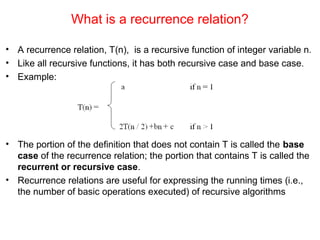
• A recurrence relation, T(n), is a recursive function of integer variable n.
• Like all recursive functions, it has both recursive case and base case.
• Example:
• The portion of the definition that does not contain T is called the base
case of the recurrence relation; the portion that contains T is called the
recurrent or recursive case.
• Recurrence relations are useful for expressing the running times (i.e.,
the number of basic operations executed) of recursive algorithms
3.
Forming Recurrence Relations
•For a given recursive method, the base case and the recursive case of
its recurrence relation correspond directly to the base case and the
recursive case of the method.
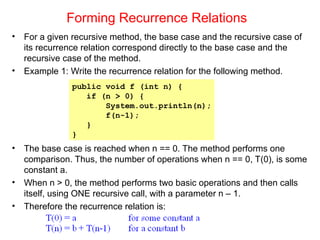
• Example 1: Write the recurrence relation for the following method.
• The base case is reached when n == 0. The method performs one
comparison. Thus, the number of operations when n == 0, T(0), is some
constant a.
• When n > 0, the method performs two basic operations and then calls
itself, using ONE recursive call, with a parameter n – 1.
• Therefore the recurrence relation is:
public void f (int n) {
if (n > 0) {
System.out.println(n);
f(n-1);
}
}
4.
Forming Recurrence Relations
•Example 2: Write the recurrence relation for the following method.
• The base case is reached when n == 1. The method performs one
comparison and one return statement. Therefore, T(1), is constant c.
• When n > 1, the method performs TWO recursive calls, each with the
parameter n / 2, and some constant # of basic operations.
• Hence, the recurrence relation is:
public int g(int n) {
if (n == 1)
return 2;
else
return 3 * g(n / 2) + g( n / 2) + 5;
}
5.
Solving Recurrence Relations
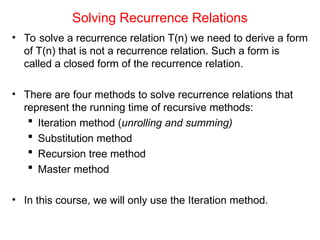
•To solve a recurrence relation T(n) we need to derive a form
of T(n) that is not a recurrence relation. Such a form is
called a closed form of the recurrence relation.
• There are four methods to solve recurrence relations that
represent the running time of recursive methods:
Iteration method (unrolling and summing)
Substitution method
Recursion tree method
Master method
• In this course, we will only use the Iteration method.
6.
Solving Recurrence Relations- Iteration method
• Steps:
Expand the recurrence
Express the expansion as a summation by plugging the recurrence
back into itself until you see a pattern.
Evaluate the summation
• In evaluating the summation one or more of the following summation
formulae may be used:
• Arithmetic series:
Geometric Series:
•Special Cases of Geometric Series:
Analysis Of RecursiveFactorial method
Example1: Form and solve the recurrence relation for the running time
of factorial method and hence determine its big-O complexity:
T(0) = c
T(n) = b + T(n - 1)
= b + b + T(n - 2)
= b +b +b + T(n - 3)
…
= kb + T(n - k)
When k = n, we have:
T(n) = nb + T(n - n)
= bn + T(0)
= bn + c.
Therefore method factorial is O(n).
long factorial (int n) {
if (n == 0)
return 1;
else
return n * factorial (n – 1);
}
9.
Analysis Of RecursiveSelection Sort
public static void selectionSort(int[] x) {
selectionSort(x, x.length - 1);}
private static void selectionSort(int[] x, int n) {
int minPos;
if (n > 0) {
minPos = findMinPos(x, n);
swap(x, minPos, n);
selectionSort(x, n - 1);
}
}
private static int findMinPos (int[] x, int n) {
int k = n;
for(int i = 0; i < n; i++)
if(x[i] < x[k]) k = i;
return k;
}
private static void swap(int[] x, int minPos, int n) {
int temp=x[n]; x[n]=x[minPos]; x[minPos]=temp;
}
10.
Analysis Of RecursiveSelection Sort
• findMinPos is O(n), and swap is O(1), therefore the recurrence relation for
the running time of the selectionSort method is:
T(0) = a
T(n) = T(n – 1) + n + c n > 0
= [T(n-2) +(n-1) + c] + n + c = T(n-2) + (n-1) + n + 2c
= [T(n-3) + (n-2) + c] +(n-1) + n + 2c= T(n-3) + (n-2) + (n-1) + n + 3c
= T(n-4) + (n-3) + (n-2) + (n-1) + n + 4c
= ……
= T(n-k) + (n-k + 1) + (n-k + 2) + …….+ n + kc
When k = n, we have :
Therefore, Recursive Selection Sort is O(n2
)
11.
Analysis Of RecursiveBinary Search
• The recurrence relation for the running time of the method is:
T(1) = a if n = 1 (one element array)
T(n) = T(n / 2) + b if n > 1
public int binarySearch (int target, int[] array,
int low, int high) {
if (low > high)
return -1;
else {
int middle = (low + high)/2;
if (array[middle] == target)
return middle;
else if(array[middle] < target)
return binarySearch(target, array, middle + 1, high);
else
return binarySearch(target, array, low, middle - 1);
}
}
12.
Analysis Of RecursiveBinary Search
Expanding:
T(n) = T(n / 2) + b
= [T(n / 4) + b] + b = T (n / 22
) + 2b
= [T(n / 8) + b] + 2b = T(n / 23
) + 3b
= ……..
= T( n / 2k
) + kb
When n / 2k
= 1 n = 2k
k = log2 n, we have:
T(n) = T(1) + b log2 n
= a + b log2 n
Therefore, Recursive Binary Search is O(log n)
13.
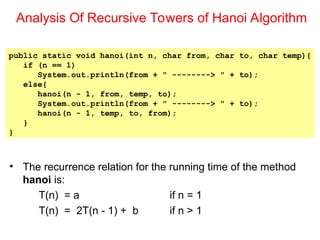
Analysis Of RecursiveTowers of Hanoi Algorithm
• The recurrence relation for the running time of the method
hanoi is:
T(n) = a if n = 1
T(n) = 2T(n - 1) + b if n > 1
public static void hanoi(int n, char from, char to, char temp){
if (n == 1)
System.out.println(from + " --------> " + to);
else{
hanoi(n - 1, from, temp, to);
System.out.println(from + " --------> " + to);
hanoi(n - 1, temp, to, from);
}
}
14.
Analysis Of RecursiveTowers of Hanoi Algorithm
Expanding:
T(n) = 2T(n – 1) + b
= 2[2T(n – 2) + b] + b = 22
T(n – 2) + 2b + b
= 22
[2T(n – 3) + b] + 2b + b = 23
T(n – 3) + 22
b + 2b + b
= 23
[2T(n – 4) + b] + 22
b + 2b + b = 24
T(n – 4) + 23
b + 22
b + 21
b +
20
b
= ……
= 2k
T(n – k) + b[2k- 1
+ 2k– 2
+ . . . 21
+ 20
]
When k = n – 1, we have:
Therefore, The method hanoi is O(2n
)



![Analysis Of Recursive Selection Sort
public static void selectionSort(int[] x) {
selectionSort(x, x.length - 1);}
private static void selectionSort(int[] x, int n) {
int minPos;
if (n > 0) {
minPos = findMinPos(x, n);
swap(x, minPos, n);
selectionSort(x, n - 1);
}
}
private static int findMinPos (int[] x, int n) {
int k = n;
for(int i = 0; i < n; i++)
if(x[i] < x[k]) k = i;
return k;
}
private static void swap(int[] x, int minPos, int n) {
int temp=x[n]; x[n]=x[minPos]; x[minPos]=temp;
}](https://image.slidesharecdn.com/unit12analysisofrecursivealgorithms1-251125063507-f4086e7a/85/Unit12_AnalysisOfRecursiveAlgorithms-1-ppt-9-320.jpg)
![Analysis Of Recursive Selection Sort
• findMinPos is O(n), and swap is O(1), therefore the recurrence relation for
the running time of the selectionSort method is:
T(0) = a
T(n) = T(n – 1) + n + c n > 0
= [T(n-2) +(n-1) + c] + n + c = T(n-2) + (n-1) + n + 2c
= [T(n-3) + (n-2) + c] +(n-1) + n + 2c= T(n-3) + (n-2) + (n-1) + n + 3c
= T(n-4) + (n-3) + (n-2) + (n-1) + n + 4c
= ……
= T(n-k) + (n-k + 1) + (n-k + 2) + …….+ n + kc
When k = n, we have :
Therefore, Recursive Selection Sort is O(n2
)](https://image.slidesharecdn.com/unit12analysisofrecursivealgorithms1-251125063507-f4086e7a/85/Unit12_AnalysisOfRecursiveAlgorithms-1-ppt-10-320.jpg)
![Analysis Of Recursive Binary Search
• The recurrence relation for the running time of the method is:
T(1) = a if n = 1 (one element array)
T(n) = T(n / 2) + b if n > 1
public int binarySearch (int target, int[] array,
int low, int high) {
if (low > high)
return -1;
else {
int middle = (low + high)/2;
if (array[middle] == target)
return middle;
else if(array[middle] < target)
return binarySearch(target, array, middle + 1, high);
else
return binarySearch(target, array, low, middle - 1);
}
}](https://image.slidesharecdn.com/unit12analysisofrecursivealgorithms1-251125063507-f4086e7a/85/Unit12_AnalysisOfRecursiveAlgorithms-1-ppt-11-320.jpg)
![Analysis Of Recursive Binary Search
Expanding:
T(n) = T(n / 2) + b
= [T(n / 4) + b] + b = T (n / 22
) + 2b
= [T(n / 8) + b] + 2b = T(n / 23
) + 3b
= ……..
= T( n / 2k
) + kb
When n / 2k
= 1 n = 2k
k = log2 n, we have:
T(n) = T(1) + b log2 n
= a + b log2 n
Therefore, Recursive Binary Search is O(log n)](https://image.slidesharecdn.com/unit12analysisofrecursivealgorithms1-251125063507-f4086e7a/85/Unit12_AnalysisOfRecursiveAlgorithms-1-ppt-12-320.jpg)
![Analysis Of Recursive Towers of Hanoi Algorithm
Expanding:
T(n) = 2T(n – 1) + b
= 2[2T(n – 2) + b] + b = 22
T(n – 2) + 2b + b
= 22
[2T(n – 3) + b] + 2b + b = 23
T(n – 3) + 22
b + 2b + b
= 23
[2T(n – 4) + b] + 22
b + 2b + b = 24
T(n – 4) + 23
b + 22
b + 21
b +
20
b
= ……
= 2k
T(n – k) + b[2k- 1
+ 2k– 2
+ . . . 21
+ 20
]
When k = n – 1, we have:
Therefore, The method hanoi is O(2n
)](https://image.slidesharecdn.com/unit12analysisofrecursivealgorithms1-251125063507-f4086e7a/85/Unit12_AnalysisOfRecursiveAlgorithms-1-ppt-14-320.jpg)


![PCC_CS_404_OUCHITYAPRODHAN_17000124029[1].pptx](https://cdn.slidesharecdn.com/ss_thumbnails/pcccs404ouchityaprodhan170001240291-250416041539-b214e64e-thumbnail.jpg?width=640&height=640&fit=bounds)


