Design and Analysis of Algorithms
Dr Huma
huma.ayub@uettaxila
Lecture No. 3
SE-5104
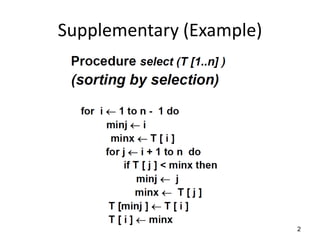
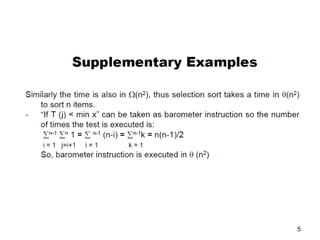
Supplementary (Example)
2
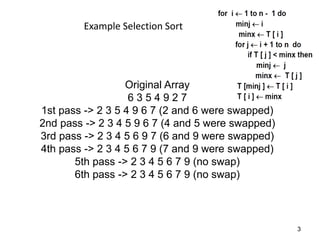
Example Selection Sort
3
Original Array
6 3 5 4 9 2 7
1st pass -> 2 3 5 4 9 6 7 (2 and 6 were swapped)
2nd pass -> 2 3 4 5 9 6 7 (4 and 5 were swapped)
3rd pass -> 2 3 4 5 6 9 7 (6 and 9 were swapped)
4th pass -> 2 3 4 5 6 7 9 (7 and 9 were swapped)
5th pass -> 2 3 4 5 6 7 9 (no swap)
6th pass -> 2 3 4 5 6 7 9 (no swap)
4
5
6
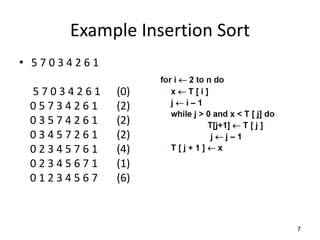
Example Insertion Sort
• 5 7 0 3 4 2 6 1
5 7 0 3 4 2 6 1 (0)
0 5 7 3 4 2 6 1 (2)
0 3 5 7 4 2 6 1 (2)
0 3 4 5 7 2 6 1 (2)
0 2 3 4 5 7 6 1 (4)
0 2 3 4 5 6 7 1 (1)
0 1 2 3 4 5 6 7 (6)
7
8
9
10
11
Important Summations
12
Important Summations that should be
Committed to Memory.
13
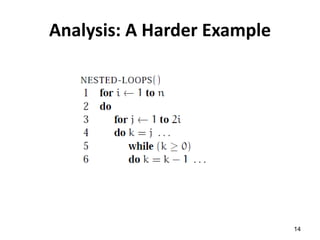
Analysis: A Harder Example
14
Solution
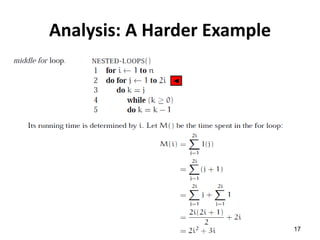
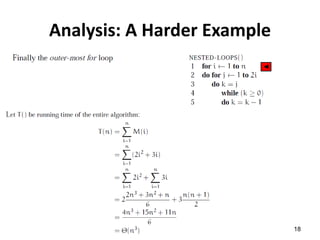
• How do we analyze the running time of an
algorithm that has complex nested loop?
• The answer write out the loops as
summations and then solve the summations.
• To convert loops into summations, we
work from inside-out.
15
Analysis: A Harder Example
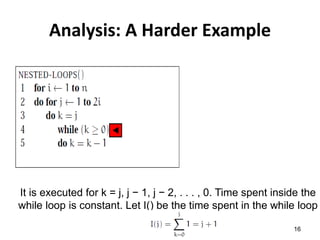
It is executed for k = j, j − 1, j − 2, . . . , 0. Time spent inside the
while loop is constant. Let I() be the time spent in the while loop
16
Analysis: A Harder Example
17
Analysis: A Harder Example
18
Analysis of Recursive Algorithms
• What is a recurrence relation?
• Forming Recurrence Relations
• Solving Recurrence Relations
• Analysis Of Recursive Factorial method
• Analysis Of Recursive Selection Sort
• Analysis Of Recursive Binary Search
• Analysis Of Recursive Towers of Hanoi Algorithm
Recursion
Recursion can solve many programming problems that are
difficult to conceptualize and solve linearly
In the field of artificial intelligence, recursion often is used
to write programs that exhibit intelligent behavior:
playing games of chess
proving mathematical theorems
recognizing patterns, and so on
Recursive algorithms can
compute factorials
compute a greatest common divisor
process data structures (strings, arrays, linked lists, etc.)
search efficiently using a binary search
find a path through a maze, and more
What is a recurrence relation?
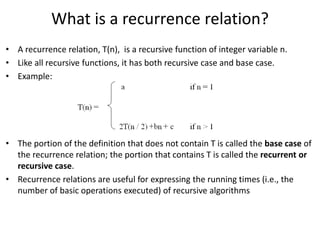
• A recurrence relation, T(n), is a recursive function of integer variable n.
• Like all recursive functions, it has both recursive case and base case.
• Example:
• The portion of the definition that does not contain T is called the base case of
the recurrence relation; the portion that contains T is called the recurrent or
recursive case.
• Recurrence relations are useful for expressing the running times (i.e., the
number of basic operations executed) of recursive algorithms
Forming Recurrence Relations
• For a given recursive method, the base case and the recursive case of
its recurrence relation correspond directly to the base case and the
recursive case of the method.
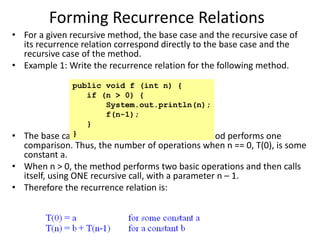
• Example 1: Write the recurrence relation for the following method.
• The base case is reached when n == 0. The method performs one
comparison. Thus, the number of operations when n == 0, T(0), is some
constant a.
• When n > 0, the method performs two basic operations and then calls
itself, using ONE recursive call, with a parameter n – 1.
• Therefore the recurrence relation is:
public void f (int n) {
if (n > 0) {
System.out.println(n);
f(n-1);
}
}
Forming Recurrence Relations
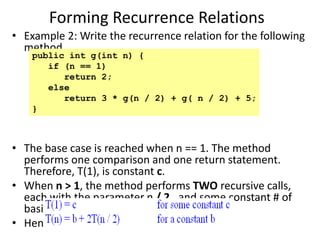
• Example 2: Write the recurrence relation for the following
method.
• The base case is reached when n == 1. The method
performs one comparison and one return statement.
Therefore, T(1), is constant c.
• When n > 1, the method performs TWO recursive calls,
each with the parameter n / 2, and some constant # of
basic operations.
• Hence, the recurrence relation is:
public int g(int n) {
if (n == 1)
return 2;
else
return 3 * g(n / 2) + g( n / 2) + 5;
}
Solving Recurrence Relations
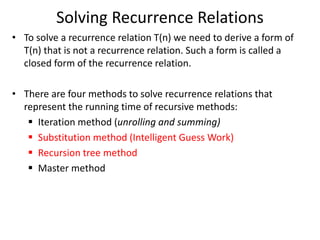
• To solve a recurrence relation T(n) we need to derive a form of
T(n) that is not a recurrence relation. Such a form is called a
closed form of the recurrence relation.
• There are four methods to solve recurrence relations that
represent the running time of recursive methods:
 Iteration method (unrolling and summing)
 Substitution method (Intelligent Guess Work)
 Recursion tree method
 Master method
Solving Recurrence Relations - Iteration
method
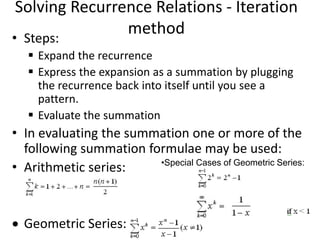
• Steps:
 Expand the recurrence
 Express the expansion as a summation by plugging
the recurrence back into itself until you see a
pattern.
 Evaluate the summation
• In evaluating the summation one or more of the
following summation formulae may be used:
• Arithmetic series:
 Geometric Series:
•Special Cases of Geometric Series:
Solving Recurrence Relations - Iteration
method
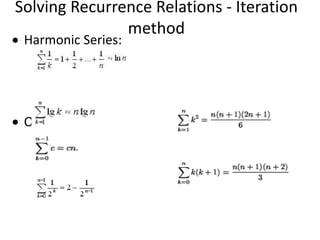
 Harmonic Series:
 Others:
Eg. 1 - Linear Search
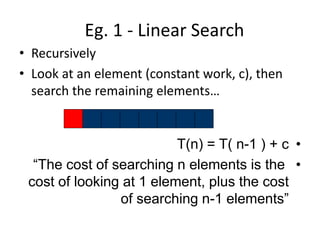
• Recursively
• Look at an element (constant work, c), then
search the remaining elements…
•
T(n) = T( n-1 ) + c
•
“The cost of searching n elements is the
cost of looking at 1 element, plus the cost
of searching n-1 elements”
Iteration method (unrolling and summing)
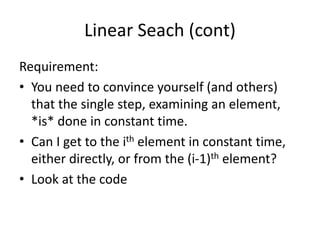
Linear Seach (cont)
Requirement:
• You need to convince yourself (and others)
that the single step, examining an element,
*is* done in constant time.
• Can I get to the ith element in constant time,
either directly, or from the (i-1)th element?
• Look at the code
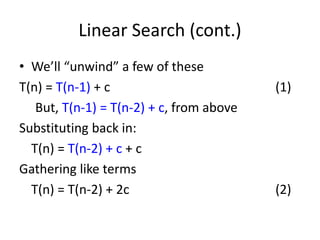
Linear Search (cont.)
• We’ll “unwind” a few of these
T(n) = T(n-1) + c (1)
But, T(n-1) = T(n-2) + c, from above
Substituting back in:
T(n) = T(n-2) + c + c
Gathering like terms
T(n) = T(n-2) + 2c (2)
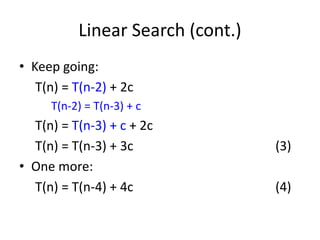
Linear Search (cont.)
• Keep going:
T(n) = T(n-2) + 2c
T(n-2) = T(n-3) + c
T(n) = T(n-3) + c + 2c
T(n) = T(n-3) + 3c (3)
• One more:
T(n) = T(n-4) + 4c (4)
Kurt Schmidt
Drexel University
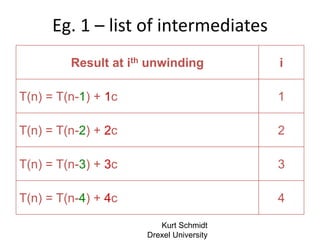
Eg. 1 – list of intermediates
Result at ith unwinding i
T(n) = T(n-1) + 1c 1
T(n) = T(n-2) + 2c 2
T(n) = T(n-3) + 3c 3
T(n) = T(n-4) + 4c 4
Linear Search (cont.)
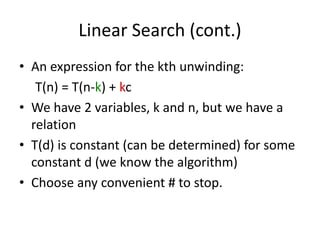
• An expression for the kth unwinding:
T(n) = T(n-k) + kc
• We have 2 variables, k and n, but we have a
relation
• T(d) is constant (can be determined) for some
constant d (we know the algorithm)
• Choose any convenient # to stop.
Linear Search (cont.)
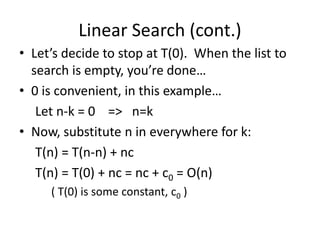
• Let’s decide to stop at T(0). When the list to
search is empty, you’re done…
• 0 is convenient, in this example…
Let n-k = 0 => n=k
• Now, substitute n in everywhere for k:
T(n) = T(n-n) + nc
T(n) = T(0) + nc = nc + c0 = O(n)
( T(0) is some constant, c0 )
Analysis Of Recursive Factorial method
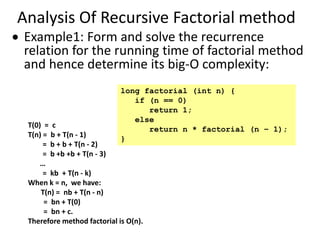
 Example1: Form and solve the recurrence
relation for the running time of factorial method
and hence determine its big-O complexity:
T(0) = c
T(n) = b + T(n - 1)
= b + b + T(n - 2)
= b +b +b + T(n - 3)
…
= kb + T(n - k)
When k = n, we have:
T(n) = nb + T(n - n)
= bn + T(0)
= bn + c.
Therefore method factorial is O(n).
long factorial (int n) {
if (n == 0)
return 1;
else
return n * factorial (n – 1);
}
Analysis Of Recursive Binary Search
• The recurrence relation for the running time of the method is:
T(1) = a if n = 1 (one element array)
T(n) = T(n / 2) + b if n > 1
public int binarySearch (int target, int[] array,
int low, int high) {
if (low > high)
return -1;
else {
int middle = (low + high)/2;
if (array[middle] == target)
return middle;
else if(array[middle] < target)
return binarySearch(target, array, middle + 1, high);
else
return binarySearch(target, array, low, middle - 1);
}
}
Analysis Of Recursive Binary Search
Expanding:
T(n) = T(n / 2) + b
= [T(n / 4) + b] + b = T (n / 22) + 2b
= [T(n / 8) + b] + 2b = T(n / 23) + 3b
= ……..
= T( n / 2k) + kb
When n / 2k = 1  n = 2k  k = log2 n, we have:
T(n) = T(1) + b log2 n
= a + b log2 n
Therefore, Recursive Binary Search is O(log n)
Tower of Hanoi
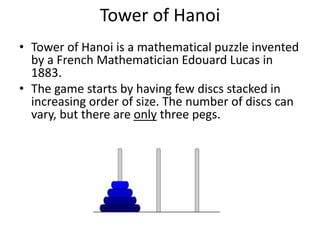
• Tower of Hanoi is a mathematical puzzle invented
by a French Mathematician Edouard Lucas in
1883.
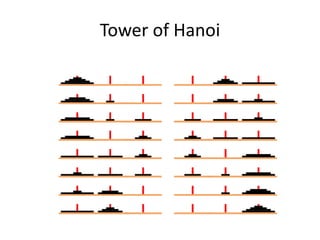
• The game starts by having few discs stacked in
increasing order of size. The number of discs can
vary, but there are only three pegs.
Tower of Hanoi
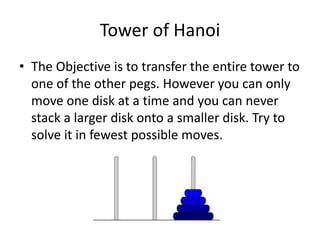
• The Objective is to transfer the entire tower to
one of the other pegs. However you can only
move one disk at a time and you can never
stack a larger disk onto a smaller disk. Try to
solve it in fewest possible moves.
Tower of Hanoi
Tower of Hanoi
Solution
To get a better understanding for the general algorithm
used to solve
the Tower of Hanoi, try to solve the puzzle with a small
amount of
Disks, 3 or 4, and once you master that , you can solve the
same
puzzle with more discs with the following algorithm.
Tower of Hanoi
Recursive Solution for the Tower of Hanoi with algorithm
public static void hanoi(int n, char BEG, char AUX, char END)
{
if (n == 1)
System.out.println(BEG + " --------> " + END);
else
{
hanoi(n - 1, BEG, END, AUX);
System.out.println(BEG + " --------> " + END);
hanoi(n - 1, AUX, BEG,END);
}
}
Tower of Hanoi
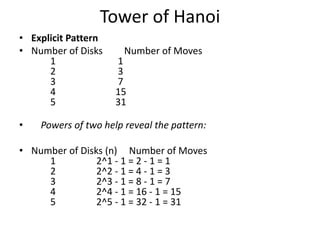
• Explicit Pattern
• Number of Disks Number of Moves
1 1
2 3
3 7
4 15
5 31
• Powers of two help reveal the pattern:
• Number of Disks (n) Number of Moves
1 2^1 - 1 = 2 - 1 = 1
2 2^2 - 1 = 4 - 1 = 3
3 2^3 - 1 = 8 - 1 = 7
4 2^4 - 1 = 16 - 1 = 15
5 2^5 - 1 = 32 - 1 = 31
Analysis Of Recursive Towers of Hanoi
Algorithm
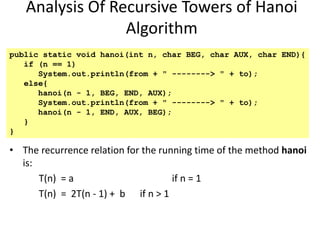
• The recurrence relation for the running time of the method hanoi
is:
T(n) = a if n = 1
T(n) = 2T(n - 1) + b if n > 1
public static void hanoi(int n, char BEG, char AUX, char END){
if (n == 1)
System.out.println(from + " --------> " + to);
else{
hanoi(n - 1, BEG, END, AUX);
System.out.println(from + " --------> " + to);
hanoi(n - 1, END, AUX, BEG);
}
}
Analysis Of Recursive Towers of Hanoi
Algorithm
Expanding:
T(n) = 2T(n – 1) + b
= 2[2T(n – 2) + b] + b = 22 T(n – 2) + 2b + b
= 22 [2T(n – 3) + b] + 2b + b = 23 T(n – 3) + 22b + 2b + b
= 23 [2T(n – 4) + b] + 22b + 2b + b = 24 T(n – 4) + 23 b + 22b + 21b + 20b
= ……
= 2k T(n – k) + b[2k- 1 + 2k– 2 + . . . 21 + 20]
When k = n – 1, we have:
Therefore, The method hanoi is O(2n)
• More Examples to discuss in class…..

lec 03wweweweweweweeweweweewewewewee.pdf

  • 1.
    Design and Analysisof Algorithms Dr Huma huma.ayub@uettaxila Lecture No. 3 SE-5104
  • 2.
  • 3.
    Example Selection Sort 3 OriginalArray 6 3 5 4 9 2 7 1st pass -> 2 3 5 4 9 6 7 (2 and 6 were swapped) 2nd pass -> 2 3 4 5 9 6 7 (4 and 5 were swapped) 3rd pass -> 2 3 4 5 6 9 7 (6 and 9 were swapped) 4th pass -> 2 3 4 5 6 7 9 (7 and 9 were swapped) 5th pass -> 2 3 4 5 6 7 9 (no swap) 6th pass -> 2 3 4 5 6 7 9 (no swap)
  • 4.
  • 5.
  • 6.
  • 7.
    Example Insertion Sort •5 7 0 3 4 2 6 1 5 7 0 3 4 2 6 1 (0) 0 5 7 3 4 2 6 1 (2) 0 3 5 7 4 2 6 1 (2) 0 3 4 5 7 2 6 1 (2) 0 2 3 4 5 7 6 1 (4) 0 2 3 4 5 6 7 1 (1) 0 1 2 3 4 5 6 7 (6) 7
  • 8.
  • 9.
  • 10.
  • 11.
  • 12.
  • 13.
    Important Summations thatshould be Committed to Memory. 13
  • 14.
  • 15.
    Solution • How dowe analyze the running time of an algorithm that has complex nested loop? • The answer write out the loops as summations and then solve the summations. • To convert loops into summations, we work from inside-out. 15
  • 16.
    Analysis: A HarderExample It is executed for k = j, j − 1, j − 2, . . . , 0. Time spent inside the while loop is constant. Let I() be the time spent in the while loop 16
  • 17.
  • 18.
  • 19.
    Analysis of RecursiveAlgorithms • What is a recurrence relation? • Forming Recurrence Relations • Solving Recurrence Relations • Analysis Of Recursive Factorial method • Analysis Of Recursive Selection Sort • Analysis Of Recursive Binary Search • Analysis Of Recursive Towers of Hanoi Algorithm
  • 20.
    Recursion Recursion can solvemany programming problems that are difficult to conceptualize and solve linearly In the field of artificial intelligence, recursion often is used to write programs that exhibit intelligent behavior: playing games of chess proving mathematical theorems recognizing patterns, and so on Recursive algorithms can compute factorials compute a greatest common divisor process data structures (strings, arrays, linked lists, etc.) search efficiently using a binary search find a path through a maze, and more
  • 21.
    What is arecurrence relation? • A recurrence relation, T(n), is a recursive function of integer variable n. • Like all recursive functions, it has both recursive case and base case. • Example: • The portion of the definition that does not contain T is called the base case of the recurrence relation; the portion that contains T is called the recurrent or recursive case. • Recurrence relations are useful for expressing the running times (i.e., the number of basic operations executed) of recursive algorithms
  • 22.
    Forming Recurrence Relations •For a given recursive method, the base case and the recursive case of its recurrence relation correspond directly to the base case and the recursive case of the method. • Example 1: Write the recurrence relation for the following method. • The base case is reached when n == 0. The method performs one comparison. Thus, the number of operations when n == 0, T(0), is some constant a. • When n > 0, the method performs two basic operations and then calls itself, using ONE recursive call, with a parameter n – 1. • Therefore the recurrence relation is: public void f (int n) { if (n > 0) { System.out.println(n); f(n-1); } }
  • 23.
    Forming Recurrence Relations •Example 2: Write the recurrence relation for the following method. • The base case is reached when n == 1. The method performs one comparison and one return statement. Therefore, T(1), is constant c. • When n > 1, the method performs TWO recursive calls, each with the parameter n / 2, and some constant # of basic operations. • Hence, the recurrence relation is: public int g(int n) { if (n == 1) return 2; else return 3 * g(n / 2) + g( n / 2) + 5; }
  • 24.
    Solving Recurrence Relations •To solve a recurrence relation T(n) we need to derive a form of T(n) that is not a recurrence relation. Such a form is called a closed form of the recurrence relation. • There are four methods to solve recurrence relations that represent the running time of recursive methods:  Iteration method (unrolling and summing)  Substitution method (Intelligent Guess Work)  Recursion tree method  Master method
  • 25.
    Solving Recurrence Relations- Iteration method • Steps:  Expand the recurrence  Express the expansion as a summation by plugging the recurrence back into itself until you see a pattern.  Evaluate the summation • In evaluating the summation one or more of the following summation formulae may be used: • Arithmetic series:  Geometric Series: •Special Cases of Geometric Series:
  • 26.
    Solving Recurrence Relations- Iteration method  Harmonic Series:  Others:
  • 27.
    Eg. 1 -Linear Search • Recursively • Look at an element (constant work, c), then search the remaining elements… • T(n) = T( n-1 ) + c • “The cost of searching n elements is the cost of looking at 1 element, plus the cost of searching n-1 elements”
  • 28.
  • 29.
    Linear Seach (cont) Requirement: •You need to convince yourself (and others) that the single step, examining an element, *is* done in constant time. • Can I get to the ith element in constant time, either directly, or from the (i-1)th element? • Look at the code
  • 30.
    Linear Search (cont.) •We’ll “unwind” a few of these T(n) = T(n-1) + c (1) But, T(n-1) = T(n-2) + c, from above Substituting back in: T(n) = T(n-2) + c + c Gathering like terms T(n) = T(n-2) + 2c (2)
  • 31.
    Linear Search (cont.) •Keep going: T(n) = T(n-2) + 2c T(n-2) = T(n-3) + c T(n) = T(n-3) + c + 2c T(n) = T(n-3) + 3c (3) • One more: T(n) = T(n-4) + 4c (4)
  • 32.
    Kurt Schmidt Drexel University Eg.1 – list of intermediates Result at ith unwinding i T(n) = T(n-1) + 1c 1 T(n) = T(n-2) + 2c 2 T(n) = T(n-3) + 3c 3 T(n) = T(n-4) + 4c 4
  • 33.
    Linear Search (cont.) •An expression for the kth unwinding: T(n) = T(n-k) + kc • We have 2 variables, k and n, but we have a relation • T(d) is constant (can be determined) for some constant d (we know the algorithm) • Choose any convenient # to stop.
  • 34.
    Linear Search (cont.) •Let’s decide to stop at T(0). When the list to search is empty, you’re done… • 0 is convenient, in this example… Let n-k = 0 => n=k • Now, substitute n in everywhere for k: T(n) = T(n-n) + nc T(n) = T(0) + nc = nc + c0 = O(n) ( T(0) is some constant, c0 )
  • 35.
    Analysis Of RecursiveFactorial method  Example1: Form and solve the recurrence relation for the running time of factorial method and hence determine its big-O complexity: T(0) = c T(n) = b + T(n - 1) = b + b + T(n - 2) = b +b +b + T(n - 3) … = kb + T(n - k) When k = n, we have: T(n) = nb + T(n - n) = bn + T(0) = bn + c. Therefore method factorial is O(n). long factorial (int n) { if (n == 0) return 1; else return n * factorial (n – 1); }
  • 36.
    Analysis Of RecursiveBinary Search • The recurrence relation for the running time of the method is: T(1) = a if n = 1 (one element array) T(n) = T(n / 2) + b if n > 1 public int binarySearch (int target, int[] array, int low, int high) { if (low > high) return -1; else { int middle = (low + high)/2; if (array[middle] == target) return middle; else if(array[middle] < target) return binarySearch(target, array, middle + 1, high); else return binarySearch(target, array, low, middle - 1); } }
  • 37.
    Analysis Of RecursiveBinary Search Expanding: T(n) = T(n / 2) + b = [T(n / 4) + b] + b = T (n / 22) + 2b = [T(n / 8) + b] + 2b = T(n / 23) + 3b = …….. = T( n / 2k) + kb When n / 2k = 1  n = 2k  k = log2 n, we have: T(n) = T(1) + b log2 n = a + b log2 n Therefore, Recursive Binary Search is O(log n)
  • 38.
    Tower of Hanoi •Tower of Hanoi is a mathematical puzzle invented by a French Mathematician Edouard Lucas in 1883. • The game starts by having few discs stacked in increasing order of size. The number of discs can vary, but there are only three pegs.
  • 39.
    Tower of Hanoi •The Objective is to transfer the entire tower to one of the other pegs. However you can only move one disk at a time and you can never stack a larger disk onto a smaller disk. Try to solve it in fewest possible moves.
  • 40.
  • 41.
    Tower of Hanoi Solution Toget a better understanding for the general algorithm used to solve the Tower of Hanoi, try to solve the puzzle with a small amount of Disks, 3 or 4, and once you master that , you can solve the same puzzle with more discs with the following algorithm.
  • 42.
    Tower of Hanoi RecursiveSolution for the Tower of Hanoi with algorithm public static void hanoi(int n, char BEG, char AUX, char END) { if (n == 1) System.out.println(BEG + " --------> " + END); else { hanoi(n - 1, BEG, END, AUX); System.out.println(BEG + " --------> " + END); hanoi(n - 1, AUX, BEG,END); } }
  • 44.
    Tower of Hanoi •Explicit Pattern • Number of Disks Number of Moves 1 1 2 3 3 7 4 15 5 31 • Powers of two help reveal the pattern: • Number of Disks (n) Number of Moves 1 2^1 - 1 = 2 - 1 = 1 2 2^2 - 1 = 4 - 1 = 3 3 2^3 - 1 = 8 - 1 = 7 4 2^4 - 1 = 16 - 1 = 15 5 2^5 - 1 = 32 - 1 = 31
  • 45.
    Analysis Of RecursiveTowers of Hanoi Algorithm • The recurrence relation for the running time of the method hanoi is: T(n) = a if n = 1 T(n) = 2T(n - 1) + b if n > 1 public static void hanoi(int n, char BEG, char AUX, char END){ if (n == 1) System.out.println(from + " --------> " + to); else{ hanoi(n - 1, BEG, END, AUX); System.out.println(from + " --------> " + to); hanoi(n - 1, END, AUX, BEG); } }
  • 46.
    Analysis Of RecursiveTowers of Hanoi Algorithm Expanding: T(n) = 2T(n – 1) + b = 2[2T(n – 2) + b] + b = 22 T(n – 2) + 2b + b = 22 [2T(n – 3) + b] + 2b + b = 23 T(n – 3) + 22b + 2b + b = 23 [2T(n – 4) + b] + 22b + 2b + b = 24 T(n – 4) + 23 b + 22b + 21b + 20b = …… = 2k T(n – k) + b[2k- 1 + 2k– 2 + . . . 21 + 20] When k = n – 1, we have: Therefore, The method hanoi is O(2n)
  • 47.
    • More Examplesto discuss in class…..