Economics & Principles of
Management
Economics & Principles of
Management
Management
By
Objectives
Management
By
Objectives
What is MBO?
• Management by objectives (MBO) is a
systematic and organized approach that
allows management to focus on achievable
goals and to attain the best possible results
from available resources. It aims to increase
organizational performance by aligning goals
and subordinate objectives throughout the
organization. Ideally, employees get strong
input to identify their objectives, time lines for
completion, etc. MBO includes ongoing
tracking and feedback in the process to reach
objectives.
What is MBO?
• Management by Objectives (MBO) was first
outlined by Peter Drucker in 1954 in his book
'The Practice of Management'. In the 90s,
Peter Drucker himself decreased the
significance of this organization management
method, when he said: "It's just another tool.
It is not the great cure for management
inefficiency... Management by Objectives
works if you know the objectives, 90% of the
time you don't."
Benefits of MBO
• Improvement of managing
• Clarification of Organisation
• Encouragement of Personal commitment
• Development of Effective control
Benefits of MBO
• MBO programs continually emphasize what
should be done in an organization to achieve
organizational goals.
• MBO process secures employee commitment
to attaining organizational goals.
Weakness of MBO
• The development of objectives can be time
consuming, leaving both managers and
employees less time in which to do their
actual work.
• The elaborate written goals, careful
communication of goals, and detailed
performance evaluation required in an MBO
program increase the volume of paperwork in
an organization.
Weakness of MBO
• Failure to teach the philosophy of MBO
• Failure to give guidelines to goal setters
• Difficulty of setting goals
• Emphasis on short run goals
• Danger of Inflexibility
Economics & Principles of
Management
Economics & Principles of
Management
MANAGEMENT
BY
EXCEPTIONS
MANAGEMENT
BY
EXCEPTIONS
Controlling as a Management
Function
• Controlling
– A process of monitoring performance and taking
action to ensure desired results.
– It sees to it that the right things happen, in the
right ways, and at the right time.
Controlling as a Management
Function
• Controlling
– Done well, it ensures that the overall directions of
individuals and groups are consistent with short
and long range plans.
– It helps ensure that objectives and
accomplishments are consistent with one another
throughout an organization.
Controlling as a Management
Function
• Controlling
– It helps maintain compliance with essential
organizational rules and policies.
Controlling as a Management
Function
• Cybernetic Control System
– One that is self-contained in its performance
monitoring and correction capabilities.
(thermostat)
– The control process practiced in organizations is
not cybernetic, but it does follow similar
principles.
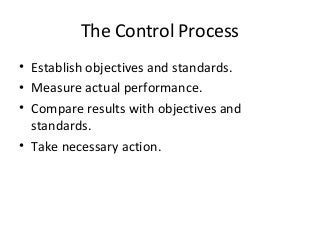
The Control Process
• Establish objectives and standards.
• Measure actual performance.
• Compare results with objectives and
standards.
• Take necessary action.
Measuring Actual Performance
• Measurements must be accurate enough to
spot deviations or variances between what
really occurs and what is most desired.
• Without measurement, effective control is not
possible.
Comparing Results with Objectives
and Standards
• The comparison of actual performance with desired
performance establishes the need for action.
• Ways of making such comparisons include:
– Historical / Relative / Engineering
– Benchmarking
Taking Corrective Action
• Taking any action necessary to correct or
improve things.
• Management-by-Exception focuses
managerial attention on substantial
differences between actual and desired
performance.
Economics & Principles of
Management
Economics & Principles of
Management
SWOT ANALYSISSWOT ANALYSIS
Strength
• Strength is the power and excellence with the
resources, skills and
• advantages in relation to the competitors. A strength
is a distinct technical superiority with best technical
know-how, financial resources and
• skill of the people in the organization, goodwill and
image in the market for the product and
• services, company’s access to best distribution
network, the discipline, morale,
• attitude and mannerisms of the employees at all
levels with a sense of belonging.
Weakness
• Weakness is the incapability, limitation and
deficiency in resources such as technical,
financial, manpower, skills, brand image and
distribution pattern. It
• refers to constraints or obstacles, which check
movement in a certain direction
• and may also inhibit an organization in gaining
a distinct competitive advantage.
Opportunities
• Environmental opportunity is an alternative area for
company’s action in
• which the particular company would enjoy a competitive
advantage.
• An opportunity is a major favorable advantage to a company.
Proper analysis of the environment and
• identification of new market,
• new and improved customer group
• with better product substitutes or supplier’s relationship
could represent
• opportunities for the company.
Threat
• Environmental threat is the challenge posed by the
unavoidable trend or
• development that would lead, in the absence of purposeful
action to the erosion
• of the company’s position. Slow market growth, entry of
resourceful multinational companies,
• increase bargaining power of the buyers or sellers because of
a large number of options, quick rate of obsolescence due to
major technological
• change and adverse situation because of change of
government policy rules and
• regulation is disadvantageous to any company and may pose
a serious threat to business operation.
Economics & Principles of
Management
Economics & Principles of
Management
STRATEGIC
MANAGEMENT
STRATEGIC
MANAGEMENT
Why Strategic Management?
Strategic management provides the route map for the firm. It
lends a framework, which can ensure that decisions
concerning the future are taken in asystematic and
purposeful way. Strategic management also serves as a hedge
against uncertainty, a hedge against totally unexpected
developments on the business horizon. It lends a frame of
reference for investment decisions. It aids the concentration
of resources on vital areas of best potential. It offers a
methodology by which the firm could anticipate and project
the future and be internally equipped to face it. It helps to
develop processes, systems, mechanisms and managerial
attitude that are essential for this purpose
Defining Strategy
Chandler defined strategy as: "The determination of the basic
long term
goals and objectives of an enterprise and the adoption of the
courses of action and the allocation of resources necessary
for carrying out this goals".
Andrews defined strategy as: "The pattern of objectives,
purposes, goals
and the major policies and plans for achieving these goals
stated in such a way so as to define what business the
company is in or is to be and the kind of the company it is or it
is to be".
Hierarchy of strategy
Corporate strategy
Business strategy
Functional strategy
Levels Of Strategy
Corporate level
Business level
Functional level
Corporate strategy
Corporate strategy is one, which decides what
business the organization should be in, and how
the overall group of activities should be
structured and managed. Porter has described
it as the overall plan for a diversified business.
The strategies are then evolved for each
strategic business unit and strategic
business area.
Strategic business unit
As the number and diversity of products
increases the structure is likely to
be centered upon division called Strategic
Business Unit (SBU). SBU are
responsible individually for developing,
manufacturing and marketing their own
product or group of products
Functional Strategy
Strategy that is related to each functional area
of business such as production, marketing and
personnel is called functional strategy. It is
Designed and managed in a coordinated way so
that they interrelate with each other and at
the same time collectively allow the competitive
strategy to be implementedproperly.
Economics & Principles of
Management
Economics & Principles of
Management
ENTREPRENUER
RESOURCE
PLANNING
ENTREPRENUER
RESOURCE
PLANNING
Definition
A cross-functional enterprise system
driven by an integrated suite of
software modules that supports the
basic internal business processes of a
company (or Transactional Backbone)
Detailed Definition
A business strategy and set of industry-domain-
specific applications that build customer and
shareholder communities value network system
by enabling and optimizing enterprise and inter-
enterprise collaborative operational and
financial processes”
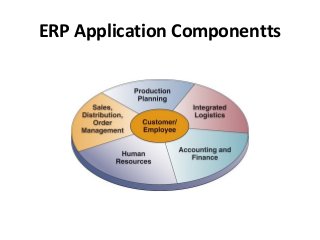
ERP Application Componentts
ERP Benefits
Quality and Efficiency
Decreased Costs
Decision Support
Enterprise Agility
Security (Firewall & VPN)
Causes of ERP Faillures
Business mangers and IT professionals
underestimate the complexity of the
planning, development, and training needed
Failure to involve affected employees in the
planning and development phases
Trying to do too much too fast in the
conversion process
Failure to do enough data conversion and
Testing
Implement an ERP System
To support business goals
Integrated, on-line, secure, self-service processes for
business
Eliminate costly mainframe/fragmented technologies
Improved Integration of Systems and Processes
Lower Costs
Empower Employees
Enable Partners, Customers and Suppliers
Implement an ERP System
Obtain the right mix of people, processes and
technology
Requirement for
implementation ERP Systems
People
Project Structure
Should be aligned to processes
Process
Implementation Process (outlined in detail)
Adapt your processes to those of the ERP.
Technology
Hardware
Software
Integrated Systems
Economics & Principles of
Management
Economics & Principles of
Management
SUPPLY CHAIN
MANAGEMENT
SUPPLY CHAIN
MANAGEMENT
Supplier
Supplier
Supplier
Storage
}
Mfg. Dist. Retailer CustomerStorage
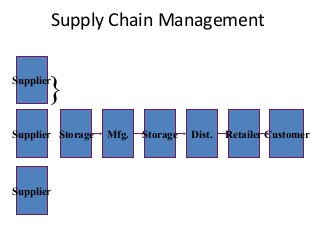
Supply Chain Management
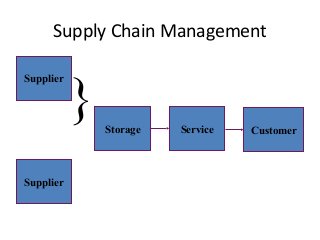
Supplier
Supplier
Storage
} Service Customer
Introduction
A supply chain is a sequence of organizations –
their facilities, functions and activities - that are
involved in producing and delivering a product or
service
Introduction
Supply chain management deals with linking the
organizations within the supply chain in order to
meet demand across the chain as efficiently as
possible
Introduction
Supply chain management deals with linking the
organizations within the supply chain in order
to meet demand across the chain as efficiently
as possible.
In a supply chain, virtually all of the members
serve as both customers as well as suppliers.
Importance of supply chain management
To gain efficiencies from procurement, distribution
and logistics
To make outsourcing more efficient
To reduce transportation costs of inventories
To meet competitive pressures from shorter
development times, more new products, and
demand for more customization
Importance of supply chain management
To meet the challenge of globalization and
longer supply chains
To meet the new challenges from e-
commerce
To manage the complexities of supply chains
To manage the inventories needed across the
supply chain
Supply chain management difficult
Different organizations in the supply chain may have different,
conflicting objectives
Manufacturers: long run production, high quality, high productivity,
low production cost
Distributors: low inventory, reduced transportation costs, quick
replenishment capability
Customers: shorter order lead time, high in-stock inventory, large
variety of products, low prices
Supply chains are dynamic - they evolve and change over time
Supply chains and vertical integration
For any organization vertical integration involves either
taking on more of the supplier activities (backward) and/or
taking on more of the distribution activities (forward)
An example of backward vertical integration would be a
peanut butter manufacturer that decides to start growing
peanuts rather than buying peanuts from a supplier
An example of forward vertical integration would be a
peanut butter manufacturer that decides to start
marketing their peanut better directly to grocery stores
In supply chains, some of the supplying and some of the
distribution might be performed by the manufacturer
Supply chains and vertical
integration
The significance of vertical integration in the supply chain is
that the activities that are performed by the manufacturer
are typically more easily managed than those which are
performed by other organizations
Therefore, the degree of vertical integration can have an
impact on the structure and relationships between
members of a supply chain
Economics & Principles of
Management
Economics & Principles of
Management
ACTIVITY
BASED
MANAGEMENT
ACTIVITY
BASED
MANAGEMENT
Activity-Based Management
The use of activity analysis to help
management make decisions
Activity-Based Management
• Approach to management that aims to
maximize the value adding activities while
minimizing or eliminating non-value adding
activities. The overall objective of ABM is to
improve efficiencies and effectiveness of an
organization in securing its markets. It draws
on activity based-costing (ABC) as its major
source of information and focuses on (1)
reducing costs, (2) creating performance
measures, (3) improving cash flow and quality
and, (4) producing enhanced value products.
Keys to Successfully Implementing
ABM
1. Organizational Culture1. Organizational Culture
2. Top-Management Commitment2. Top-Management Commitment
3. Change Champion3. Change Champion
4. Change Process4. Change Process
5. Continuing Education5. Continuing Education

Unit v

  • 1.
    Economics & Principlesof Management Economics & Principles of Management Management By Objectives Management By Objectives
  • 2.
    What is MBO? •Management by objectives (MBO) is a systematic and organized approach that allows management to focus on achievable goals and to attain the best possible results from available resources. It aims to increase organizational performance by aligning goals and subordinate objectives throughout the organization. Ideally, employees get strong input to identify their objectives, time lines for completion, etc. MBO includes ongoing tracking and feedback in the process to reach objectives.
  • 3.
    What is MBO? •Management by Objectives (MBO) was first outlined by Peter Drucker in 1954 in his book 'The Practice of Management'. In the 90s, Peter Drucker himself decreased the significance of this organization management method, when he said: "It's just another tool. It is not the great cure for management inefficiency... Management by Objectives works if you know the objectives, 90% of the time you don't."
  • 4.
    Benefits of MBO •Improvement of managing • Clarification of Organisation • Encouragement of Personal commitment • Development of Effective control
  • 5.
    Benefits of MBO •MBO programs continually emphasize what should be done in an organization to achieve organizational goals. • MBO process secures employee commitment to attaining organizational goals.
  • 6.
    Weakness of MBO •The development of objectives can be time consuming, leaving both managers and employees less time in which to do their actual work. • The elaborate written goals, careful communication of goals, and detailed performance evaluation required in an MBO program increase the volume of paperwork in an organization.
  • 7.
    Weakness of MBO •Failure to teach the philosophy of MBO • Failure to give guidelines to goal setters • Difficulty of setting goals • Emphasis on short run goals • Danger of Inflexibility
  • 8.
    Economics & Principlesof Management Economics & Principles of Management MANAGEMENT BY EXCEPTIONS MANAGEMENT BY EXCEPTIONS
  • 9.
    Controlling as aManagement Function • Controlling – A process of monitoring performance and taking action to ensure desired results. – It sees to it that the right things happen, in the right ways, and at the right time.
  • 10.
    Controlling as aManagement Function • Controlling – Done well, it ensures that the overall directions of individuals and groups are consistent with short and long range plans. – It helps ensure that objectives and accomplishments are consistent with one another throughout an organization.
  • 11.
    Controlling as aManagement Function • Controlling – It helps maintain compliance with essential organizational rules and policies.
  • 12.
    Controlling as aManagement Function • Cybernetic Control System – One that is self-contained in its performance monitoring and correction capabilities. (thermostat) – The control process practiced in organizations is not cybernetic, but it does follow similar principles.
  • 13.
    The Control Process •Establish objectives and standards. • Measure actual performance. • Compare results with objectives and standards. • Take necessary action.
  • 14.
    Measuring Actual Performance •Measurements must be accurate enough to spot deviations or variances between what really occurs and what is most desired. • Without measurement, effective control is not possible.
  • 15.
    Comparing Results withObjectives and Standards • The comparison of actual performance with desired performance establishes the need for action. • Ways of making such comparisons include: – Historical / Relative / Engineering – Benchmarking
  • 16.
    Taking Corrective Action •Taking any action necessary to correct or improve things. • Management-by-Exception focuses managerial attention on substantial differences between actual and desired performance.
  • 17.
    Economics & Principlesof Management Economics & Principles of Management SWOT ANALYSISSWOT ANALYSIS
  • 18.
    Strength • Strength isthe power and excellence with the resources, skills and • advantages in relation to the competitors. A strength is a distinct technical superiority with best technical know-how, financial resources and • skill of the people in the organization, goodwill and image in the market for the product and • services, company’s access to best distribution network, the discipline, morale, • attitude and mannerisms of the employees at all levels with a sense of belonging.
  • 19.
    Weakness • Weakness isthe incapability, limitation and deficiency in resources such as technical, financial, manpower, skills, brand image and distribution pattern. It • refers to constraints or obstacles, which check movement in a certain direction • and may also inhibit an organization in gaining a distinct competitive advantage.
  • 20.
    Opportunities • Environmental opportunityis an alternative area for company’s action in • which the particular company would enjoy a competitive advantage. • An opportunity is a major favorable advantage to a company. Proper analysis of the environment and • identification of new market, • new and improved customer group • with better product substitutes or supplier’s relationship could represent • opportunities for the company.
  • 21.
    Threat • Environmental threatis the challenge posed by the unavoidable trend or • development that would lead, in the absence of purposeful action to the erosion • of the company’s position. Slow market growth, entry of resourceful multinational companies, • increase bargaining power of the buyers or sellers because of a large number of options, quick rate of obsolescence due to major technological • change and adverse situation because of change of government policy rules and • regulation is disadvantageous to any company and may pose a serious threat to business operation.
  • 22.
    Economics & Principlesof Management Economics & Principles of Management STRATEGIC MANAGEMENT STRATEGIC MANAGEMENT
  • 23.
    Why Strategic Management? Strategicmanagement provides the route map for the firm. It lends a framework, which can ensure that decisions concerning the future are taken in asystematic and purposeful way. Strategic management also serves as a hedge against uncertainty, a hedge against totally unexpected developments on the business horizon. It lends a frame of reference for investment decisions. It aids the concentration of resources on vital areas of best potential. It offers a methodology by which the firm could anticipate and project the future and be internally equipped to face it. It helps to develop processes, systems, mechanisms and managerial attitude that are essential for this purpose
  • 24.
    Defining Strategy Chandler definedstrategy as: "The determination of the basic long term goals and objectives of an enterprise and the adoption of the courses of action and the allocation of resources necessary for carrying out this goals". Andrews defined strategy as: "The pattern of objectives, purposes, goals and the major policies and plans for achieving these goals stated in such a way so as to define what business the company is in or is to be and the kind of the company it is or it is to be".
  • 25.
    Hierarchy of strategy Corporatestrategy Business strategy Functional strategy
  • 26.
    Levels Of Strategy Corporatelevel Business level Functional level
  • 27.
    Corporate strategy Corporate strategyis one, which decides what business the organization should be in, and how the overall group of activities should be structured and managed. Porter has described it as the overall plan for a diversified business. The strategies are then evolved for each strategic business unit and strategic business area.
  • 28.
    Strategic business unit Asthe number and diversity of products increases the structure is likely to be centered upon division called Strategic Business Unit (SBU). SBU are responsible individually for developing, manufacturing and marketing their own product or group of products
  • 29.
    Functional Strategy Strategy thatis related to each functional area of business such as production, marketing and personnel is called functional strategy. It is Designed and managed in a coordinated way so that they interrelate with each other and at the same time collectively allow the competitive strategy to be implementedproperly.
  • 30.
    Economics & Principlesof Management Economics & Principles of Management ENTREPRENUER RESOURCE PLANNING ENTREPRENUER RESOURCE PLANNING
  • 31.
    Definition A cross-functional enterprisesystem driven by an integrated suite of software modules that supports the basic internal business processes of a company (or Transactional Backbone)
  • 32.
    Detailed Definition A businessstrategy and set of industry-domain- specific applications that build customer and shareholder communities value network system by enabling and optimizing enterprise and inter- enterprise collaborative operational and financial processes”
  • 33.
  • 34.
    ERP Benefits Quality andEfficiency Decreased Costs Decision Support Enterprise Agility Security (Firewall & VPN)
  • 35.
    Causes of ERPFaillures Business mangers and IT professionals underestimate the complexity of the planning, development, and training needed Failure to involve affected employees in the planning and development phases Trying to do too much too fast in the conversion process Failure to do enough data conversion and Testing
  • 36.
    Implement an ERPSystem To support business goals Integrated, on-line, secure, self-service processes for business Eliminate costly mainframe/fragmented technologies Improved Integration of Systems and Processes Lower Costs Empower Employees Enable Partners, Customers and Suppliers
  • 37.
    Implement an ERPSystem Obtain the right mix of people, processes and technology
  • 38.
    Requirement for implementation ERPSystems People Project Structure Should be aligned to processes Process Implementation Process (outlined in detail) Adapt your processes to those of the ERP. Technology Hardware Software Integrated Systems
  • 39.
    Economics & Principlesof Management Economics & Principles of Management SUPPLY CHAIN MANAGEMENT SUPPLY CHAIN MANAGEMENT
  • 40.
    Supplier Supplier Supplier Storage } Mfg. Dist. RetailerCustomerStorage Supply Chain Management
  • 41.
  • 42.
    Introduction A supply chainis a sequence of organizations – their facilities, functions and activities - that are involved in producing and delivering a product or service
  • 43.
    Introduction Supply chain managementdeals with linking the organizations within the supply chain in order to meet demand across the chain as efficiently as possible
  • 44.
    Introduction Supply chain managementdeals with linking the organizations within the supply chain in order to meet demand across the chain as efficiently as possible. In a supply chain, virtually all of the members serve as both customers as well as suppliers.
  • 45.
    Importance of supplychain management To gain efficiencies from procurement, distribution and logistics To make outsourcing more efficient To reduce transportation costs of inventories To meet competitive pressures from shorter development times, more new products, and demand for more customization
  • 46.
    Importance of supplychain management To meet the challenge of globalization and longer supply chains To meet the new challenges from e- commerce To manage the complexities of supply chains To manage the inventories needed across the supply chain
  • 47.
    Supply chain managementdifficult Different organizations in the supply chain may have different, conflicting objectives Manufacturers: long run production, high quality, high productivity, low production cost Distributors: low inventory, reduced transportation costs, quick replenishment capability Customers: shorter order lead time, high in-stock inventory, large variety of products, low prices Supply chains are dynamic - they evolve and change over time
  • 48.
    Supply chains andvertical integration For any organization vertical integration involves either taking on more of the supplier activities (backward) and/or taking on more of the distribution activities (forward) An example of backward vertical integration would be a peanut butter manufacturer that decides to start growing peanuts rather than buying peanuts from a supplier An example of forward vertical integration would be a peanut butter manufacturer that decides to start marketing their peanut better directly to grocery stores In supply chains, some of the supplying and some of the distribution might be performed by the manufacturer
  • 49.
    Supply chains andvertical integration The significance of vertical integration in the supply chain is that the activities that are performed by the manufacturer are typically more easily managed than those which are performed by other organizations Therefore, the degree of vertical integration can have an impact on the structure and relationships between members of a supply chain
  • 50.
    Economics & Principlesof Management Economics & Principles of Management ACTIVITY BASED MANAGEMENT ACTIVITY BASED MANAGEMENT
  • 51.
    Activity-Based Management The useof activity analysis to help management make decisions
  • 52.
    Activity-Based Management • Approachto management that aims to maximize the value adding activities while minimizing or eliminating non-value adding activities. The overall objective of ABM is to improve efficiencies and effectiveness of an organization in securing its markets. It draws on activity based-costing (ABC) as its major source of information and focuses on (1) reducing costs, (2) creating performance measures, (3) improving cash flow and quality and, (4) producing enhanced value products.
  • 53.
    Keys to SuccessfullyImplementing ABM 1. Organizational Culture1. Organizational Culture 2. Top-Management Commitment2. Top-Management Commitment 3. Change Champion3. Change Champion 4. Change Process4. Change Process 5. Continuing Education5. Continuing Education