Chapter 1 conceptual framework for strategic management (2)
This document provides definitions and explanations of key concepts in strategic management, including:
1. Strategy, policy, tactics, strategic management, programs, procedures, and stakeholders are defined. The differences between strategy and policy are explained.
2. The strategic management process and its implications for the organization are introduced. Strategic intent and how organizational vision, mission, goals, and objectives are formulated is discussed.
3. Key frameworks for analyzing the external environment like ETOP are defined along with strategic business units (SBUs) and their role in strategic planning.
In this document
Powered by AI
Introduction to strategic management concepts, including definitions, strategy types, and key components.
Definition of strategy, types of strategy including corporate, business, and functional strategy.
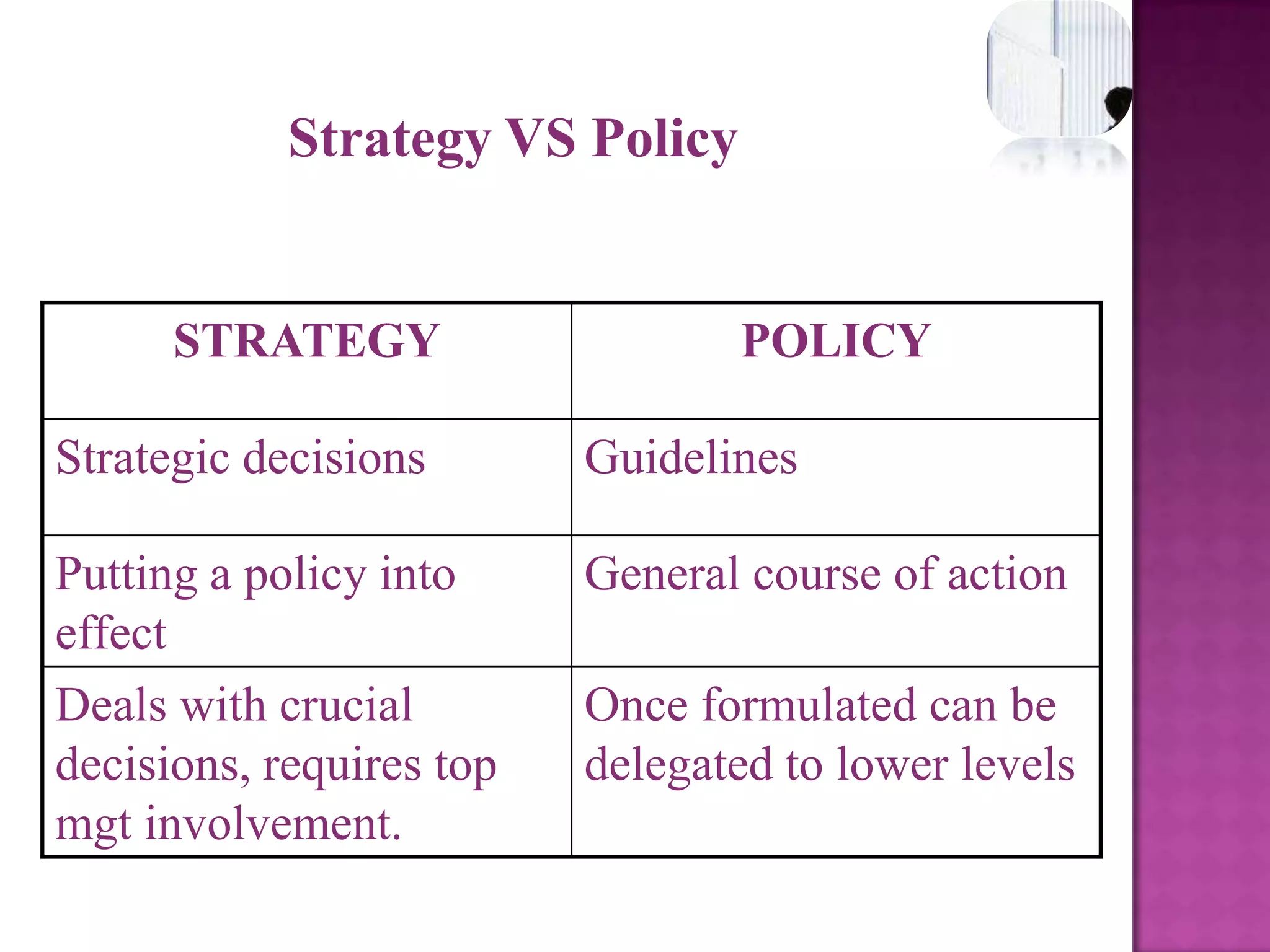
Explanation of policy vs. strategy, types of policies: corporate, business, and functional, and their roles.
Definition of tactics, their role in strategic management, and types of tactics as per Wheelen and Hunger.
Definition and significance of strategic management, its relation to top-level management, and the decision-making process.
Benefits such as increased profitability and efficiency, alongside drawbacks like time consumption and possible dissatisfaction.
Definitions of programs and procedures, their purposes in achieving objectives, including organizational context.Definition of business, stakeholders, and the concept of Strategic Business Units (SBUs) with characteristics and advantages.
Introduction to ETOP and SAP, their purposes in understanding the strategic position and environmental factors.
Stages of strategic management process, including formulation, implementation, and evaluation of strategies.
Concepts of vision and mission statements, their role in guiding organization strategies, and examples from Toyota and IBM.Clarifies the distinction between goals (long-term aims) and objectives (concrete targets) along with their importance.
Chapter 1 conceptual framework for strategic management (2)
1.
CHAPTER-1 Conceptual framework for strategic managementReported by : Rajmohan Gupta Abhishek Neogi Kinchit Rai Milan lakhani Jenish Malaviya Meghal ChauhanTo : Virag Shah (Lecturer ESM)
2.
CONTENTSConcept, Meaning, Definition - Strategy - Policy - Tactics - Strategic Management - Program - Procedure - Business - Stakeholders - SBU - ETOP - OCP - SAPStrategic management process & its implication
3.
Strategic intent - Organizational Vision,mission,goals&objectives - Their formulation and role in strategic management
STRATEGY : Strategyis the determination of the long-term goals and objectives of an enterprise and the adoption of the courses of action and the allocation of resources necessary for carrying out these goals.Strategy isn’t themission—it’s theplan that allowsthe company toaccomplish themissionStrategy is management’s game plan for strengthening the organization’s position, pleasing customers, and achieving performance targets.
6.
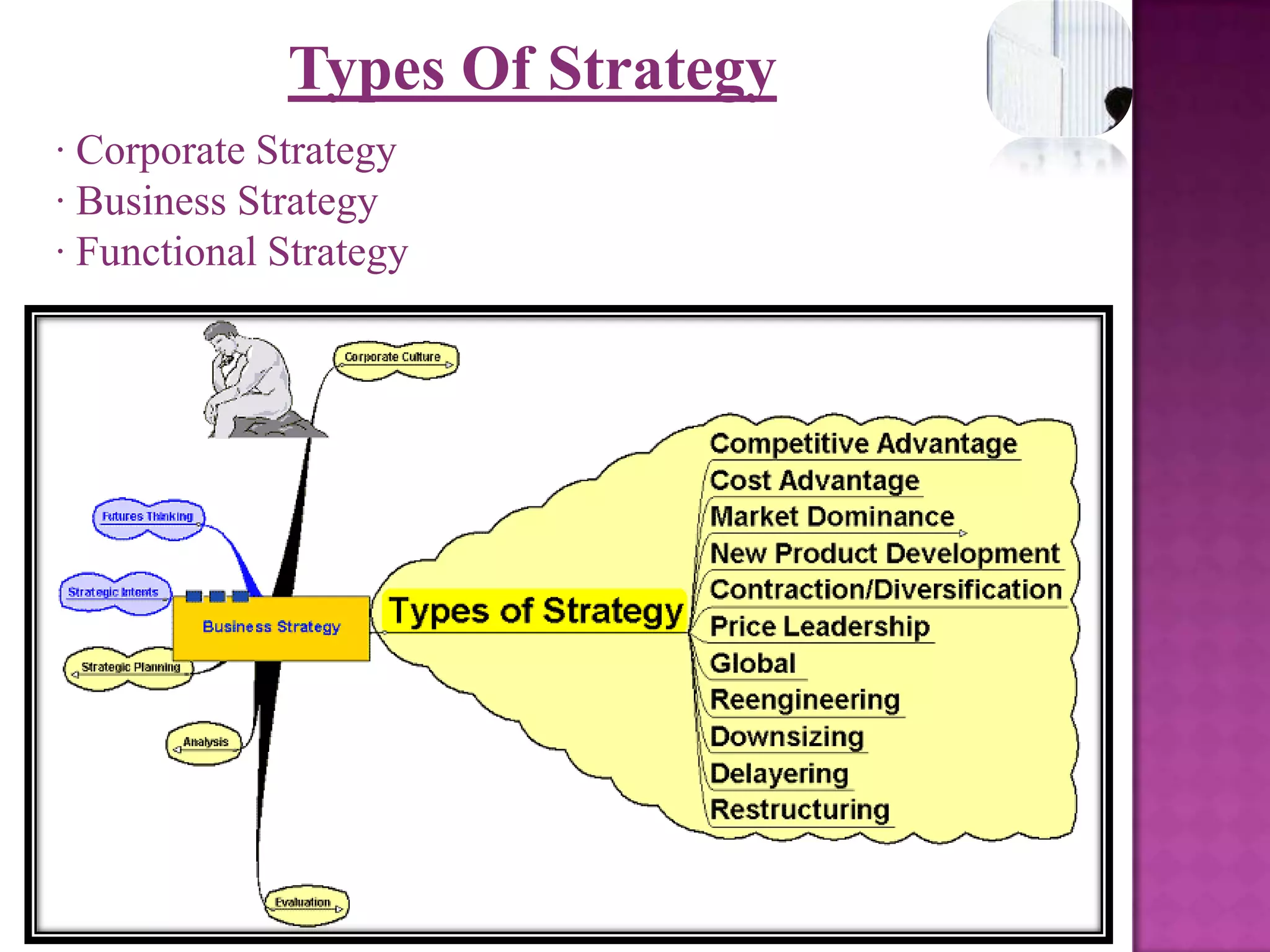
Types Of Strategy·Corporate Strategy· Business Strategy· Functional Strategy
7.
POLICY : Aguiding principle, typically established by senior management, which is adopted by an organization or project to influence and determine decisions.Policies are the means by which annual objectives will be achieved. Policies include guidelines, rules, and procedures established to support efforts to achievestated objectives.Policy means having rules and procedures in place so people know what to do in certain situations. Business can have policy in place so that action and progress can be made.Diff: A strategy is a plan to do things a certain way to achieve a desired outcome. A policy is a rule designed to ensure consistency in governance and to avoid undesirable outcomes. .
8.
Types of policyCorporatepolicyCorporate policy describes a companies overall direction in terms of its general attitude towards growth and the management of its various businesses and product lines. It typical fit within the three main categories of stability, growth and retrenchment.Business policyBusiness policy usually occurs at the business unit or product level and it emphasizes improvement of the competitive position of a corporation products or services in the specific industry or market segment served by that business unit. Business strategies may fit within the two overall categories of competitive or cooperative strategies.Functional policyFunctional policy is the approach taken by a functional area to achieve corporate and business unit objectives and strategies by maximizing resources productivity. It is concerned with developing and nurturing a distinctive competence to provide a company or business unit with a competitive advantage.
Tactics : Tacticmeans the approach towards workflow or the method of performing things. In terms of strategic management we have a solid definition given by Wheelen and Hunger “A tactic is a specific operating plan detailing how a strategy is to be implemented in terms of when and where it is to be put into action”. Tactics are narrower in scope and shorter in their time ascompared to strategies.There are two types of tactics as given by Wheelen and Hunger .· Timing tactic· Market Location tactic
11.
STRATEGIC MANAGEMENT :Strategic management is defined as the art and science of formulating, implementing, and evaluating cross-functional decisions that enable the organization to achieve its objectives." Generally, strategic management is not only related to a single specialization but covers cross-functional or overall organization.
12.
Strategic managementis a comprehensive area that covers almost all the functional areas of the organization. It is an umbrella concept of management that comprises all such functional areas as marketing, finance & account, human resource, and production & operation into a top level management discipline. Therefore, strategic management has an importance in the organizational success and failure than any specific functional areas.(Cont …….Strategic management deals with organizational level and top level issues whereas functional or operational level management deals with the specific areas of the business.
13.
. Top-level managerssuch as Chairman, Managing Director, and corporate level planners involve more in strategic management process.
14.
Strategic management relatesto setting vision, mission, objectives, and strategies that can be the guideline to design functional strategies in other functional areas
15.
Therefore, it istop-level management that paves the way for other functional or operational management in an organizationDefinition:Glueck – Strategic Management can be defined as a set of decisions, actions resulting in formulations & implementation of strategies designed to achieve the objectives of enterprise.
Political PressureProgram : Plan of action aimed at accomplishing a clear objective, with details on what work is to be done, by whom, when, and what means or resources will be used.Wheelen and Hunger defines a program in the following words “A program is a statement of activities or steps needed to accomplish a single use plan. It may involve restructuring of organization, changing the company’s internal culture or beginning a new researcheffort.”Procedure :It is a specified series of actions or operations which have to be executed in the same manner in order to always obtain the same result under the same circumstances (for example, emergency procedures). Less precisely speaking, this word can indicate a sequence of tasks,steps,decision, calculations and processes, that when undertaken in the sequence laid down produces the described result, product or outcome.Business: It may be understood as the organize efforts of enterprise to supply consumer it’s with goods & services for a profit.Business includes all activities concerned with production, trade, banking, insurance, finance agency, advertising, packaging & other related activities. Stakeholders :Person, group, or organization that has direct or indirect stake in an organization because it can affect or be affected by the organization's actions, objectives, and policies. Key stakeholders in a business organization include creditors, customers, directors, employees, government (and its agencies), owners (shareholders), suppliers, unions, and the community from which the business draws its resources.
39.
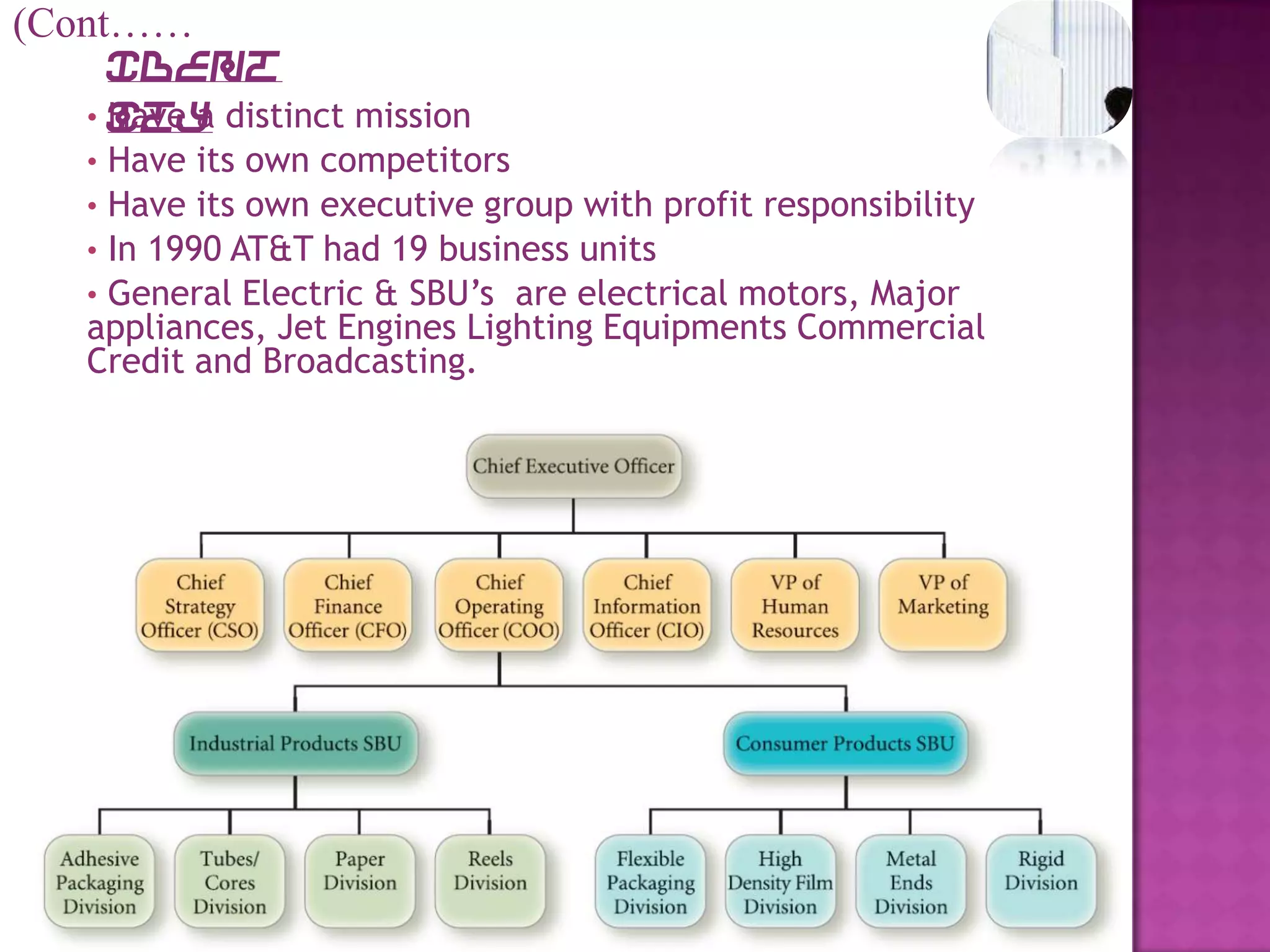
STRATEGIC BUSINESS UNIT(SBU)Strategic Business Unit or SBU is understood as a business unit within the overall corporate identity which is distinguishable from other business because it serves a defined external market where management can conduct strategic planning in relation to products and markets. The unique small business unit benefits that a firm aggressively promotes in a consistent manner. When companies become really large, they are best thought of as being composed of a number of businesses (or SBUs).The idea was developed by Mckinsey & Co. (Consulting Firm) & General Electric in 1971.General Electronics classified its businesses into 49 strategic business units (SBU’s).
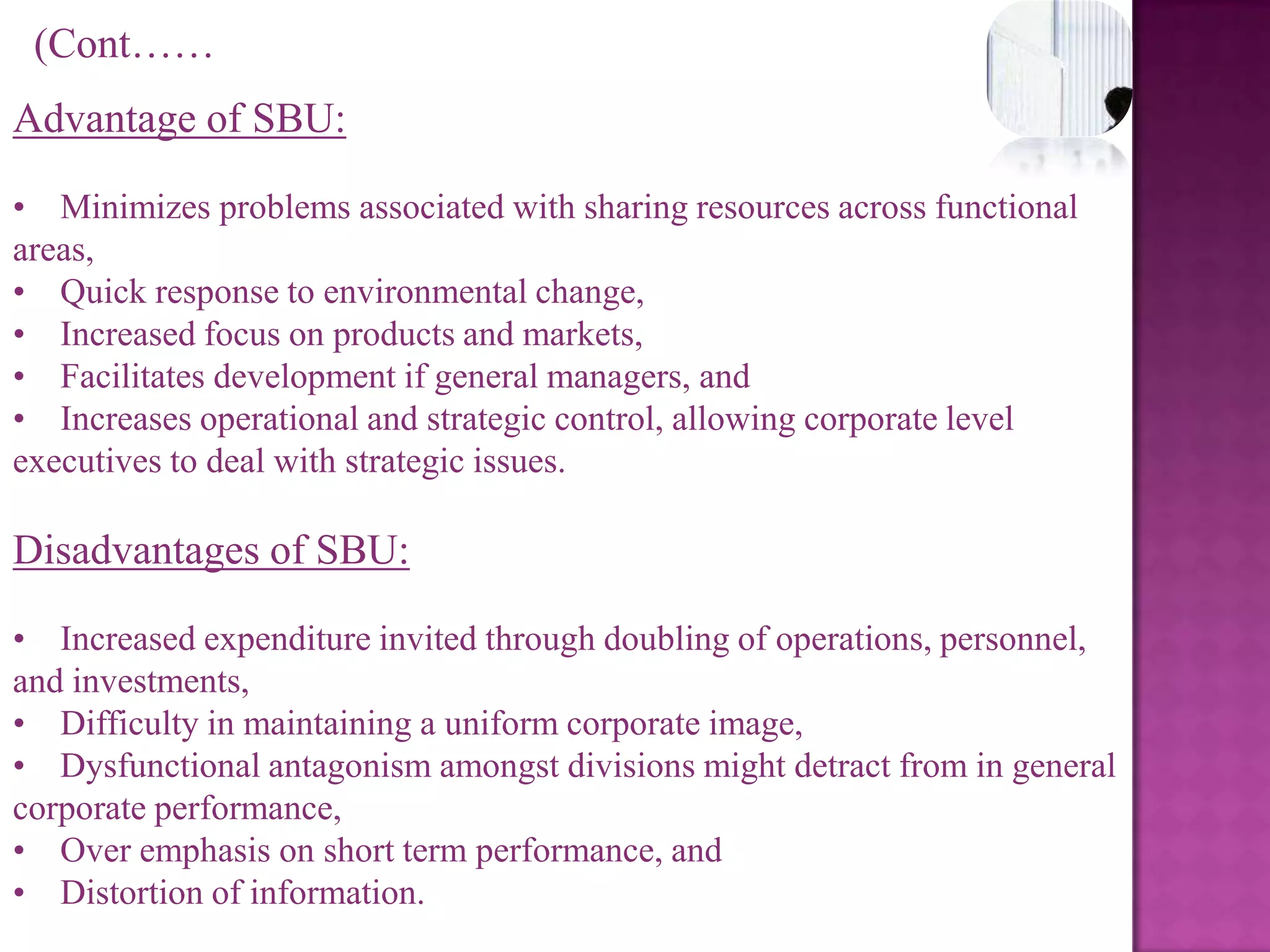
It has amanager who is responsible for strategic planning and profit performance and who controls most of the factors affecting profit.
44.
The purpose ofidentifying the company’s strategic business units is to develop separate strategic and assign appropriate funding.
45.
And helps thedevelopment of business level strategies since these may need to vary from one SBU to another.(Cont……Advantage of SBU: • Minimizes problems associated with sharing resources across functional areas,• Quick response to environmental change,• Increased focus on products and markets,• Facilitates development if general managers, and• Increases operational and strategic control, allowing corporate level executives to deal with strategic issues.Disadvantages of SBU: • Increased expenditure invited through doubling of operations, personnel, and investments,• Difficulty in maintaining a uniform corporate image,• Dysfunctional antagonism amongst divisions might detract from in general corporate performance,• Over emphasis on short term performance, and• Distortion of information.
General Electric& SBU’s are electrical motors, Major appliances, Jet Engines Lighting Equipments Commercial Credit and Broadcasting.ENVIRONMENT THREAT AND OPPORTUNITY PROFILE(ETOP)It is a process of dividing the environment into different sectors and then analyzing the impact of each sector on the organizationAdvantage of ETOP It provides a clear of which sector and sub sectors have favorable impact on the organization. It helps interpret the result of environment analysis.
Appropriate strategiescan be formulated to take advantage of opportunities and counter the threat.
53.
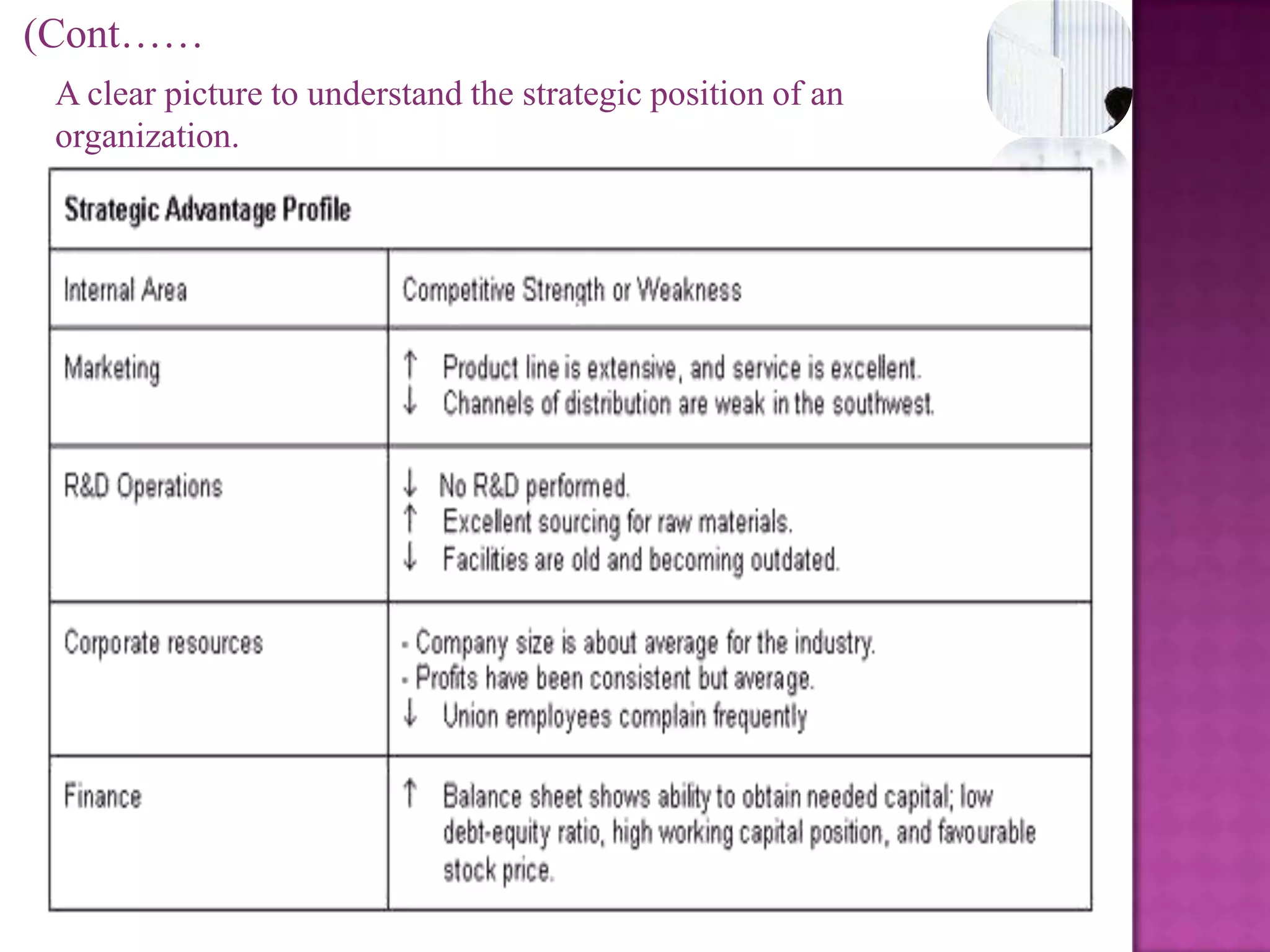
SWOT analysis(Strategic weakness, opportunities and threats.)STRATEGIC ADVANTAGE PROFILE(SAP)Every firm has strategic advantages and disadvantages. For example, large firms have financial strength but they tend to move slowly, compared to smaller firms, and often cannot react to changes quickly. No firm is equally strong in all its functions. In other words, every firm has strengths as well as weaknesses.Strategists must be aware of the strategic advantages or strengths of the firm to be able to choose the best opportunity for the firm. On the other hand they must regularly analyse their strategic disadvantages or weaknesses in order to face environmental threats effectivelyExamples:The Strategist should look to see if the firm is stronger in these factors than its competitors. When a firm is strong in the market, it has a strategic advantage in launching new products or services and increasing market share of present products and services.
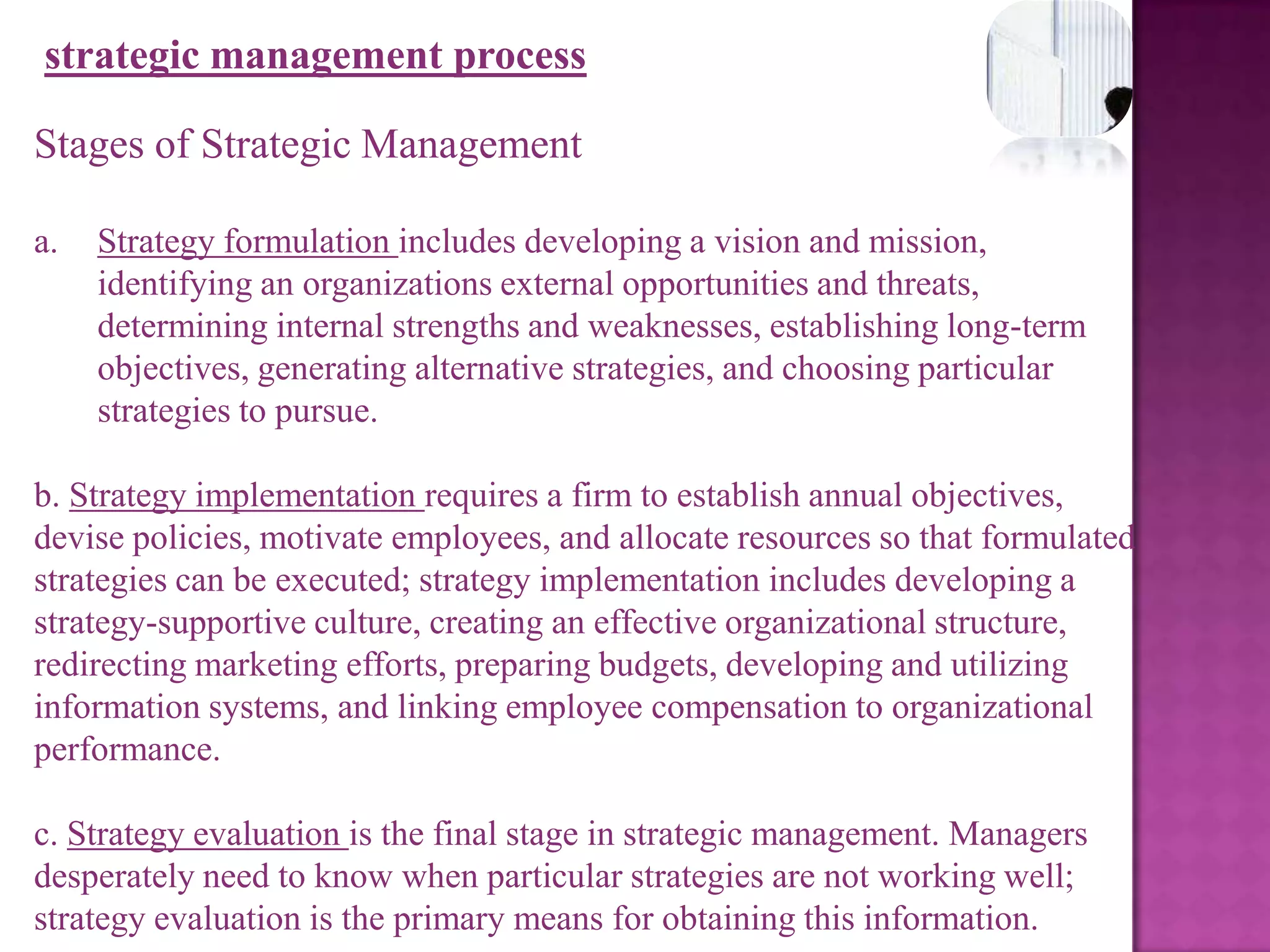
strategic management processStagesof Strategic ManagementStrategy formulation includes developing a vision and mission, identifying an organizations external opportunities and threats, determining internal strengths and weaknesses, establishing long-term objectives, generating alternative strategies, and choosing particular strategies to pursue.b. Strategy implementation requires a firm to establish annual objectives, devise policies, motivate employees, and allocate resources so that formulated strategies can be executed; strategy implementation includes developing a strategy-supportive culture, creating an effective organizational structure, redirecting marketing efforts, preparing budgets, developing and utilizing information systems, and linking employee compensation to organizationalperformance.c. Strategy evaluation is the final stage in strategic management. Managers desperately need to know when particular strategies are not working well; strategy evaluation is the primary means for obtaining this information.
56.
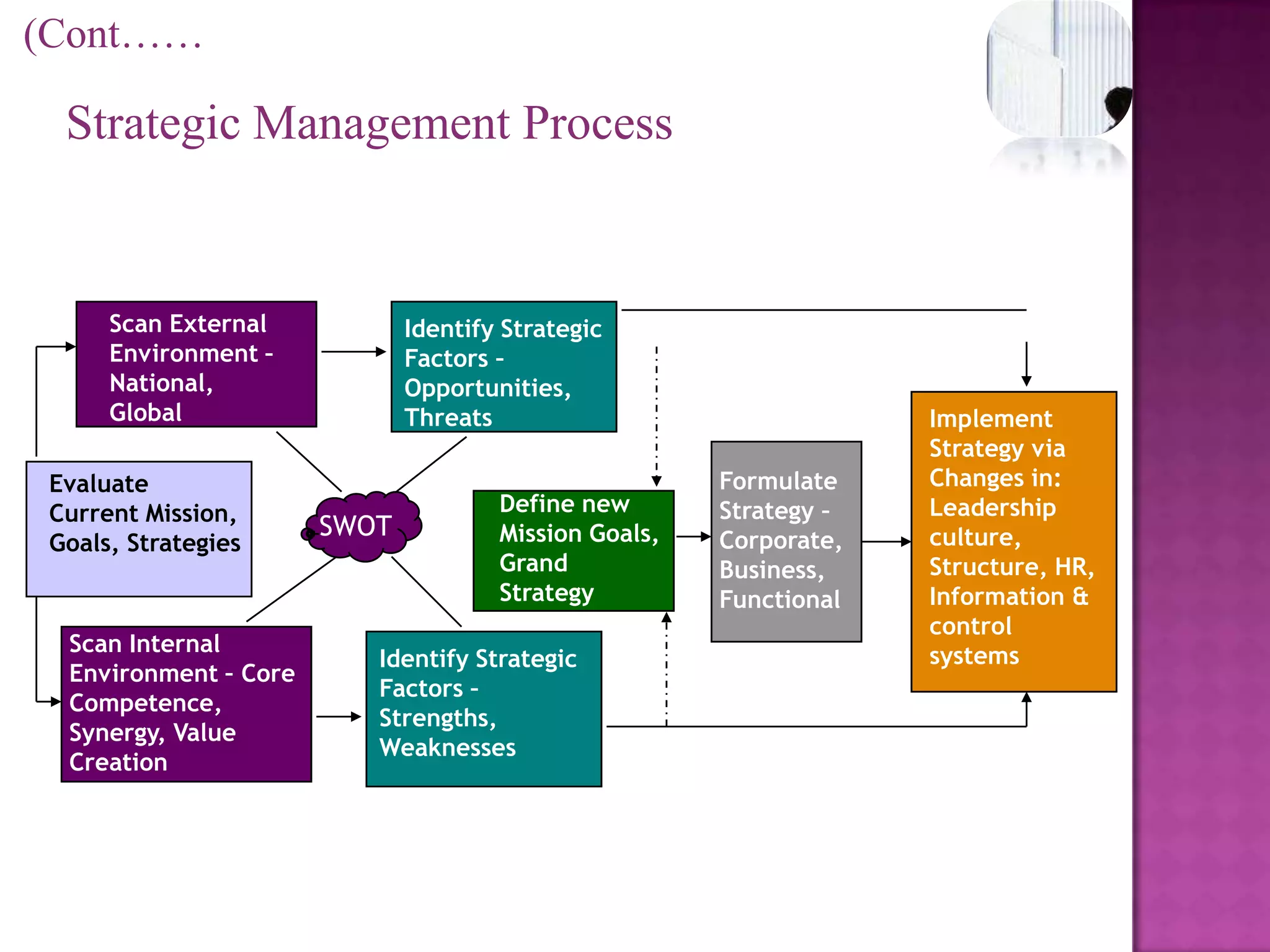
(Cont……Strategic Management ProcessScanExternal Environment – National, GlobalIdentify Strategic Factors – Opportunities, ThreatsImplement Strategy via Changes in: Leadership culture, Structure, HR, Information & control systemsFormulate Strategy – Corporate, Business, FunctionalEvaluate Current Mission, Goals, StrategiesDefine new Mission Goals, Grand StrategySWOTScan Internal Environment – Core Competence, Synergy, Value CreationIdentify Strategic Factors – Strengths, Weaknesses23
57.
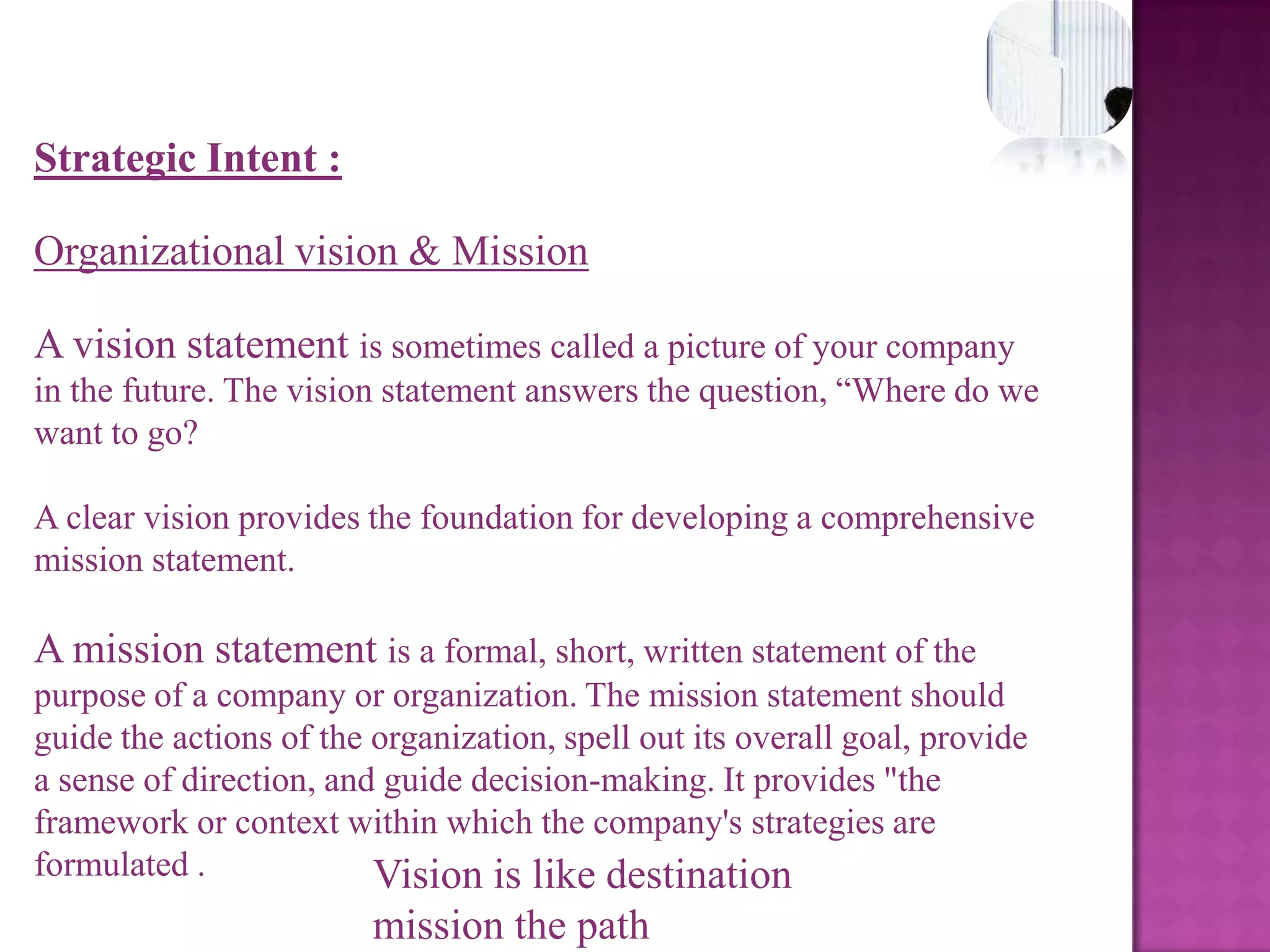
Strategic Intent :Organizational vision & Mission A vision statement is sometimes called a picture of your company in the future. The vision statement answers the question, “Where do we want to go?A clear vision provides the foundation for developing a comprehensive mission statement.A mission statement is a formal, short, written statement of the purpose of a company or organization. The mission statement should guide the actions of the organization, spell out its overall goal, provide a sense of direction, and guide decision-making. It provides "the framework or context within which the company's strategies are formulated .Vision is like destination mission the path
58.
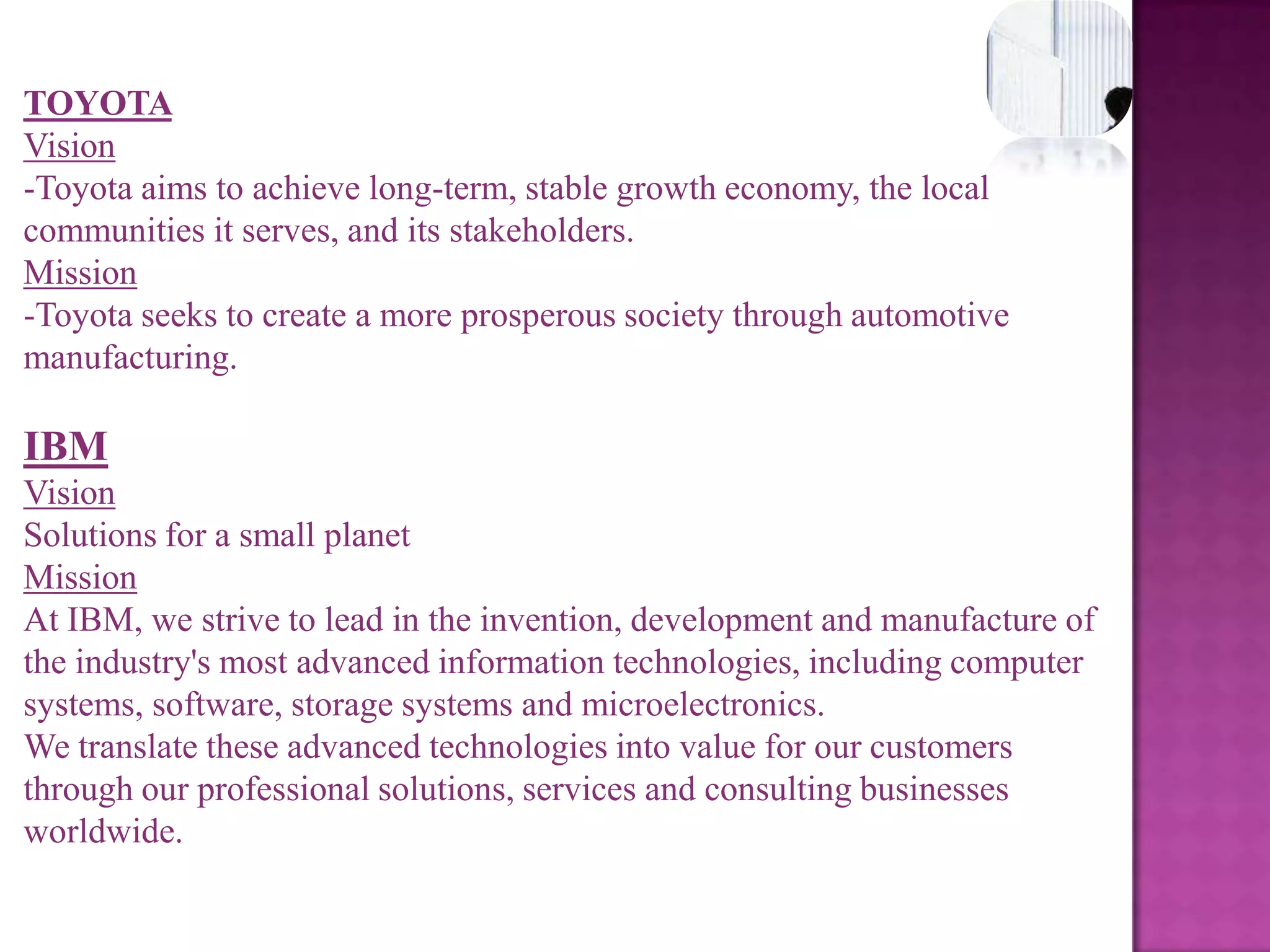
TOYOTA Vision-Toyota aimsto achieve long-term, stable growth economy, the local communities it serves, and its stakeholders. Mission-Toyota seeks to create a more prosperous society through automotive manufacturing.IBM VisionSolutions for a small planet MissionAt IBM, we strive to lead in the invention, development and manufacture of the industry's most advanced information technologies, including computer systems, software, storage systems and microelectronics. We translate these advanced technologies into value for our customers through our professional solutions, services and consulting businesses worldwide.
59.
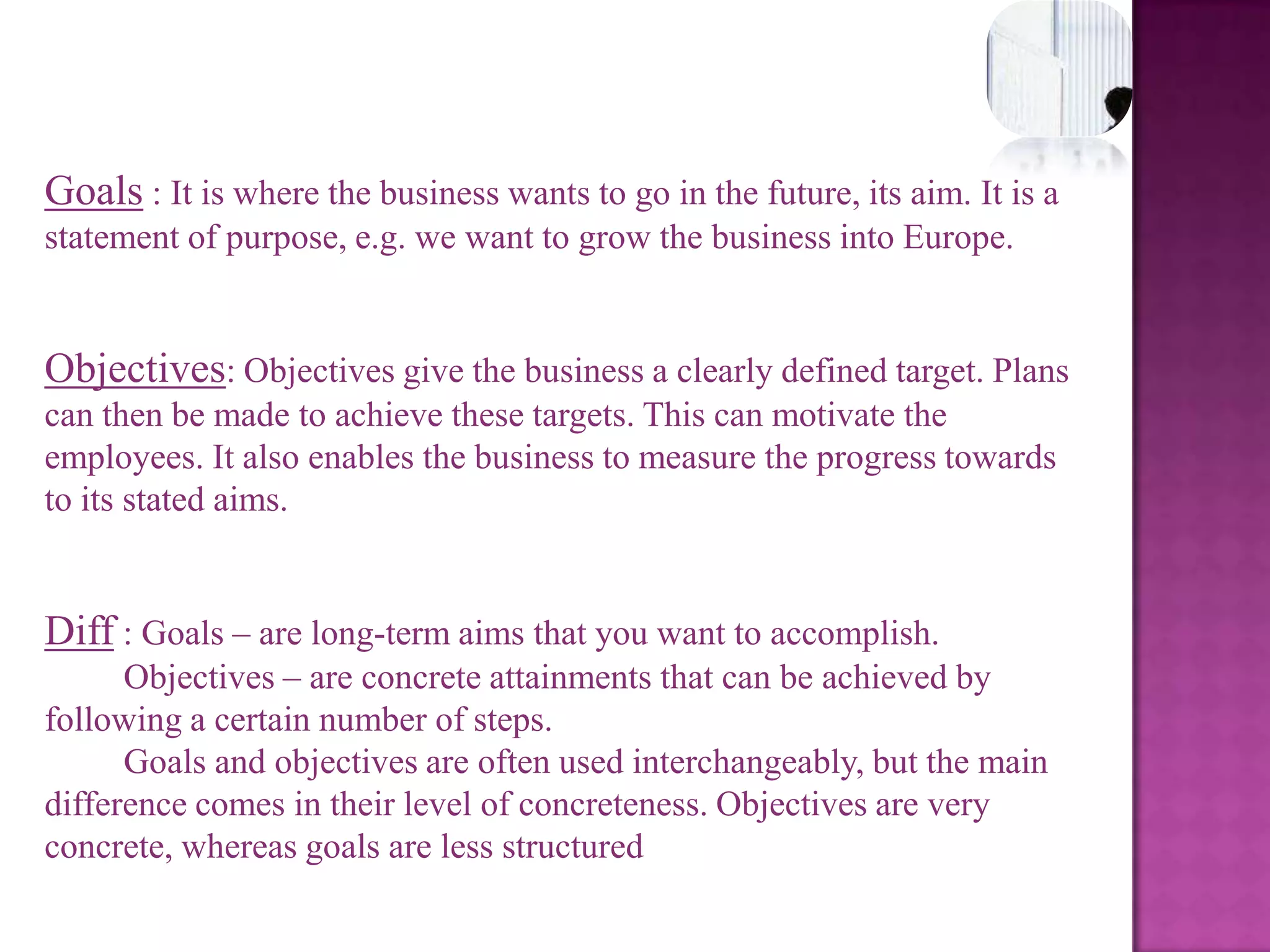
Goals : Itis where the business wants to go in the future, its aim. It is a statement of purpose, e.g. we want to grow the business into Europe.Objectives: Objectives give the business a clearly defined target. Plans can then be made to achieve these targets. This can motivate the employees. It also enables the business to measure the progress towards to its stated aims.Diff : Goals – are long-term aims that you want to accomplish. Objectives – are concrete attainments that can be achieved by following a certain number of steps. Goals and objectives are often used interchangeably, but the main difference comes in their level of concreteness. Objectives are very concrete, whereas goals are less structured