Job and Role
management
process
By sujith bhaskar R
Management Information System has been
used differently by various authors. It is
defined here as a formal system of gathering,
integrating, comparing, analyzing, and
dispersing information internal and external to
the enterprise in a timely, effective, and
efficient manner.
Causes of Negative Deviations from
Standards
• Uncertainty
• Lack of knowledge, experience, or judgement
Questionable Assumptions Underlying Direct
Control
• Assumption that performance can be measured.
• Assumption that personal responsibility exists
• Assumption that the time expenditure is
warranted
• Assumption that mistakes can be discovered in
time
• Assumption that the person responsible will
take corrective steps.
Assumptions of the Principle of
Preventive Control
• Assumption that qualified managers
make a minimum of errors
• Assumptions that management
fundamentals can be used to measure
performance
• Assumption that the application of
management fundamentals can be
evaluated.
Developing Excellent Managers
• Instilling a Willingness to Learn
• Accelerating Management Development
• Planning for Innovation
• Measuring and Rewarding Management
• Tailoring Information
• Expanding Research and Development in Tools and
Techniques
• Developing More Managerial Inventions
• Creating Strong Intellectual Leadership
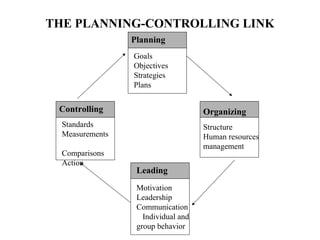
THE PLANNING-CONTROLLING LINK
Planning
Controlling
Leading
Organizing
Goals
Objectives
Strategies
Plans
Standards
Measurements
Comparisons
Action
Motivation
Leadership
Communication
Individual and
group behavior
Structure
Human resources
management
QUALITIES OF AN EFFECTIVE CONTROL SYSTEM
1. Accuracy
2. Timeliness
3. Economy
4. Flexibility
5. Understandability
6. Reasonable criteria
7. Strategic placement
8. Emphasis on the exception
9. Multiple criteria
10. Corrective action
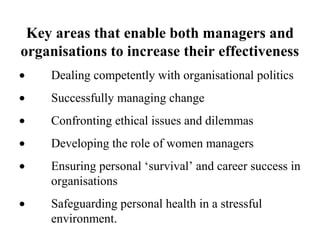
Key areas that enable both managers and
organisations to increase their effectiveness
• Dealing competently with organisational politics
• Successfully managing change
• Confronting ethical issues and dilemmas
• Developing the role of women managers
• Ensuring personal ‘survival’ and career success in
organisations
• Safeguarding personal health in a stressful
environment.
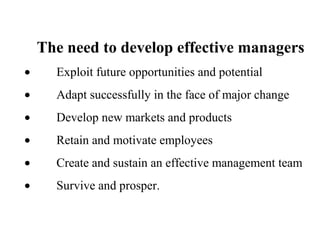
The need to develop effective managers
• Exploit future opportunities and potential
• Adapt successfully in the face of major change
• Develop new markets and products
• Retain and motivate employees
• Create and sustain an effective management team
• Survive and prosper.
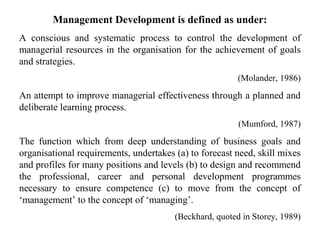
Management Development is defined as under:
A conscious and systematic process to control the development of
managerial resources in the organisation for the achievement of goals
and strategies.
(Molander, 1986)
An attempt to improve managerial effectiveness through a planned and
deliberate learning process.
(Mumford, 1987)
The function which from deep understanding of business goals and
organisational requirements, undertakes (a) to forecast need, skill mixes
and profiles for many positions and levels (b) to design and recommend
the professional, career and personal development programmes
necessary to ensure competence (c) to move from the concept of
‘management’ to the concept of ‘managing’.
(Beckhard, quoted in Storey, 1989)
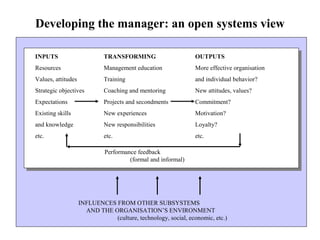
Developing the manager: an open systems view
INPUTS TRANSFORMING OUTPUTS
Resources Management education More effective organisation
Values, attitudes Training and individual behavior?
Strategic objectives Coaching and mentoring New attitudes, values?
Expectations Projects and secondments Commitment?
Existing skills New experiences Motivation?
and knowledge New responsibilities Loyalty?
etc. etc. etc.
Performance feedback
(formal and informal)
INFLUENCES FROM OTHER SUBSYSTEMS
AND THE ORGANISATION’S ENVIRONMENT
(culture, technology, social, economic, etc.)
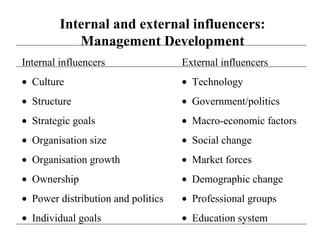
Internal and external influencers:
Management Development
Internal influencers External influencers
• Culture • Technology
• Structure • Government/politics
• Strategic goals • Macro-economic factors
• Organisation size • Social change
• Organisation growth • Market forces
• Ownership • Demographic change
• Power distribution and politics • Professional groups
• Individual goals • Education system
STRATEGY
The broad program for defining and achieving
an organization’s objectives; the organization’s
response to its environment over time.
STRATEGY AS THE GRAND PLAN
The concept of strategy is ancient. The word itself
comes from the Greek strategeia, which means the art or
science of being a general. Effective Greek generals
needed to lead an army, win and hold territory, protect a
city from invasion, wipe out the enemy, and so forth.
Each kind of objective required a different deployment
of resources. Likewise, an army’s strategy could be
defined as the actual pattern of actions that it took in
response to the enemy.
STRATEGY AS THE GRAND PLAN
The Greeks also knew that strategy was more than
fighting battles. Effective generals had to determine
the right lines of supply, decide when to fight and when
not to fight, and manage the army’s relationships with
citizens, politicians, and diplomats. Effective generals
not only had to plan but to act as well. Dating back to
the Greeks, then, the concept of strategy had both
planning components and decision-making or action
components. Taken together, these two concepts from
the basis for the “grand” strategy plan.
LEVELS OF STRATEGY
Corporate-level strategy
Strategy formulated by top management to oversee the interests
and operations of multiline corporations.
Business-unit strategy
Strategy formulated to meet the goals of a particular business.
Functional-level strategy
Strategy formulated by a specific functional area in an effort to
carry out business-unit strategy.
MANAGEMENT BY OBJECTIVES (MBO)
A formal set of procedures that establishes and
reviews progress toward common goals for
managers and subordinates.
Elements of the MBO System
1. Commitment to the program
2. Top-level goals setting
3. Individual goals
4. Participation
5. Autonomy in implementation of plans
6. Performance review
Organizational structure
The way in which an organization’s activities are divided,
organized, and coordinated.
Division of work
The breakdown of a complex task into complex task into
components so that individuals are responsible for a limited set of
activities instead of the task as a whole.
Departmentalization
The grouping into departments of work activities that are similar
and logically connected.
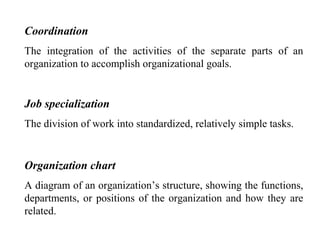
Coordination
The integration of the activities of the separate parts of an
organization to accomplish organizational goals.
Job specialization
The division of work into standardized, relatively simple tasks.
Organization chart
A diagram of an organization’s structure, showing the functions,
departments, or positions of the organization and how they are
related.
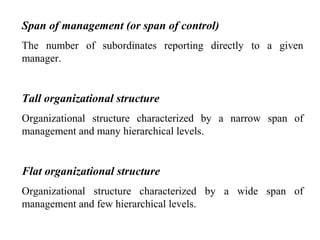
Span of management (or span of control)
The number of subordinates reporting directly to a given
manager.
Tall organizational structure
Organizational structure characterized by a narrow span of
management and many hierarchical levels.
Flat organizational structure
Organizational structure characterized by a wide span of
management and few hierarchical levels.
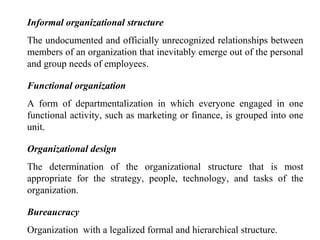
Informal organizational structure
The undocumented and officially unrecognized relationships between
members of an organization that inevitably emerge out of the personal
and group needs of employees.
Functional organization
A form of departmentalization in which everyone engaged in one
functional activity, such as marketing or finance, is grouped into one
unit.
Organizational design
The determination of the organizational structure that is most
appropriate for the strategy, people, technology, and tasks of the
organization.
Bureaucracy
Organization with a legalized formal and hierarchical structure.

Management process 4

  • 1.
  • 2.
    Management Information Systemhas been used differently by various authors. It is defined here as a formal system of gathering, integrating, comparing, analyzing, and dispersing information internal and external to the enterprise in a timely, effective, and efficient manner.
  • 3.
    Causes of NegativeDeviations from Standards • Uncertainty • Lack of knowledge, experience, or judgement
  • 4.
    Questionable Assumptions UnderlyingDirect Control • Assumption that performance can be measured. • Assumption that personal responsibility exists • Assumption that the time expenditure is warranted • Assumption that mistakes can be discovered in time • Assumption that the person responsible will take corrective steps.
  • 5.
    Assumptions of thePrinciple of Preventive Control • Assumption that qualified managers make a minimum of errors • Assumptions that management fundamentals can be used to measure performance • Assumption that the application of management fundamentals can be evaluated.
  • 6.
    Developing Excellent Managers •Instilling a Willingness to Learn • Accelerating Management Development • Planning for Innovation • Measuring and Rewarding Management • Tailoring Information • Expanding Research and Development in Tools and Techniques • Developing More Managerial Inventions • Creating Strong Intellectual Leadership
  • 7.
  • 8.
    QUALITIES OF ANEFFECTIVE CONTROL SYSTEM 1. Accuracy 2. Timeliness 3. Economy 4. Flexibility 5. Understandability 6. Reasonable criteria 7. Strategic placement 8. Emphasis on the exception 9. Multiple criteria 10. Corrective action
  • 9.
    Key areas thatenable both managers and organisations to increase their effectiveness • Dealing competently with organisational politics • Successfully managing change • Confronting ethical issues and dilemmas • Developing the role of women managers • Ensuring personal ‘survival’ and career success in organisations • Safeguarding personal health in a stressful environment.
  • 10.
    The need todevelop effective managers • Exploit future opportunities and potential • Adapt successfully in the face of major change • Develop new markets and products • Retain and motivate employees • Create and sustain an effective management team • Survive and prosper.
  • 11.
    Management Development isdefined as under: A conscious and systematic process to control the development of managerial resources in the organisation for the achievement of goals and strategies. (Molander, 1986) An attempt to improve managerial effectiveness through a planned and deliberate learning process. (Mumford, 1987) The function which from deep understanding of business goals and organisational requirements, undertakes (a) to forecast need, skill mixes and profiles for many positions and levels (b) to design and recommend the professional, career and personal development programmes necessary to ensure competence (c) to move from the concept of ‘management’ to the concept of ‘managing’. (Beckhard, quoted in Storey, 1989)
  • 12.
    Developing the manager:an open systems view INPUTS TRANSFORMING OUTPUTS Resources Management education More effective organisation Values, attitudes Training and individual behavior? Strategic objectives Coaching and mentoring New attitudes, values? Expectations Projects and secondments Commitment? Existing skills New experiences Motivation? and knowledge New responsibilities Loyalty? etc. etc. etc. Performance feedback (formal and informal) INFLUENCES FROM OTHER SUBSYSTEMS AND THE ORGANISATION’S ENVIRONMENT (culture, technology, social, economic, etc.)
  • 13.
    Internal and externalinfluencers: Management Development Internal influencers External influencers • Culture • Technology • Structure • Government/politics • Strategic goals • Macro-economic factors • Organisation size • Social change • Organisation growth • Market forces • Ownership • Demographic change • Power distribution and politics • Professional groups • Individual goals • Education system
  • 14.
    STRATEGY The broad programfor defining and achieving an organization’s objectives; the organization’s response to its environment over time.
  • 15.
    STRATEGY AS THEGRAND PLAN The concept of strategy is ancient. The word itself comes from the Greek strategeia, which means the art or science of being a general. Effective Greek generals needed to lead an army, win and hold territory, protect a city from invasion, wipe out the enemy, and so forth. Each kind of objective required a different deployment of resources. Likewise, an army’s strategy could be defined as the actual pattern of actions that it took in response to the enemy.
  • 16.
    STRATEGY AS THEGRAND PLAN The Greeks also knew that strategy was more than fighting battles. Effective generals had to determine the right lines of supply, decide when to fight and when not to fight, and manage the army’s relationships with citizens, politicians, and diplomats. Effective generals not only had to plan but to act as well. Dating back to the Greeks, then, the concept of strategy had both planning components and decision-making or action components. Taken together, these two concepts from the basis for the “grand” strategy plan.
  • 17.
    LEVELS OF STRATEGY Corporate-levelstrategy Strategy formulated by top management to oversee the interests and operations of multiline corporations. Business-unit strategy Strategy formulated to meet the goals of a particular business. Functional-level strategy Strategy formulated by a specific functional area in an effort to carry out business-unit strategy.
  • 18.
    MANAGEMENT BY OBJECTIVES(MBO) A formal set of procedures that establishes and reviews progress toward common goals for managers and subordinates.
  • 19.
    Elements of theMBO System 1. Commitment to the program 2. Top-level goals setting 3. Individual goals 4. Participation 5. Autonomy in implementation of plans 6. Performance review
  • 20.
    Organizational structure The wayin which an organization’s activities are divided, organized, and coordinated. Division of work The breakdown of a complex task into complex task into components so that individuals are responsible for a limited set of activities instead of the task as a whole. Departmentalization The grouping into departments of work activities that are similar and logically connected.
  • 21.
    Coordination The integration ofthe activities of the separate parts of an organization to accomplish organizational goals. Job specialization The division of work into standardized, relatively simple tasks. Organization chart A diagram of an organization’s structure, showing the functions, departments, or positions of the organization and how they are related.
  • 22.
    Span of management(or span of control) The number of subordinates reporting directly to a given manager. Tall organizational structure Organizational structure characterized by a narrow span of management and many hierarchical levels. Flat organizational structure Organizational structure characterized by a wide span of management and few hierarchical levels.
  • 23.
    Informal organizational structure Theundocumented and officially unrecognized relationships between members of an organization that inevitably emerge out of the personal and group needs of employees. Functional organization A form of departmentalization in which everyone engaged in one functional activity, such as marketing or finance, is grouped into one unit. Organizational design The determination of the organizational structure that is most appropriate for the strategy, people, technology, and tasks of the organization. Bureaucracy Organization with a legalized formal and hierarchical structure.